In this article
The rod loads heavy, and the fight is frantic, unlike the rhythmic pulse of the species you were targeting. This fish digs deep, head-shaking with a violence that feels unfamiliar. When it finally slides into the net, the celebration stalls. It has stripes, but the shape is wrong. It has bars, but the tail is too round.
In that moment of hesitation, the line between a trophy photo and a wildlife violation blurs. I have seen even seasoned guides freeze in this situation, debating whether a fish is a keeper or a protected breeder. Identification is not just academic; it is the primary responsibility of the angler.
This angler-first guide shifts your perspective from guessing based on “patterns” to knowing based on ichthyology and evidence. We will move beyond vague color descriptions and look at the hard anatomical markers—pores, patches, and fin rays—that provide legal proof of your catch.
What Defines a “Frankenstein Fish” and Why Does It Matter?

Hybrid species are distinct biological entities, not random mutations. Understanding freshwater biology and fish culture explains why they fight the way they do and why the laws governing them are so specific.
Why are hybrid fish stocked in freshwater systems?
Fisheries managers introduce hybrids primarily to utilize Heterosis, or Hybrid Vigor. This biological phenomenon results in offspring that exhibit superior traits to both parent fish. They often grow faster in their first two years and tolerate environmental extremes, such as warmer water or lower oxygen levels, better than pure-strain natives.
You can review the principles of Heterosis in this FAO guide on commercial hybridization, which explains the science behind this rapid growth and aggression. The goal is often specific ecological utility. For example, Wipers are frequently stocked to control overabundant forage fish like Gizzard Shad that have grown too large for native predators to manage. However, this utility comes with a catch.
Most hybrids fall on a “Sterility Spectrum.” “Dead-End” hybrids like Tiger Muskellunge (and the trout equivalent, the Tiger Trout) are functionally sterile, meaning they cannot naturally replenish their populations. This dictates strict “Put-and-Take” or “Trophy” management regulations, as harvest cannot be offset by natural reproduction.
Pro-Tip: Because hybrids like Wipers have higher metabolic rates, they fight to exhaustion faster than their parents. Avoid over-playing these fish; use heavier tackle to land them quickly and ensure their survival upon release.
Anglers must understand that funding science and fisheries management is what makes these unique opportunities possible. When you buy a license or pay excise taxes on gear—from bait casting reels to soft-plastic baits—you are paying for the fish hatcheries that engineer these high-performance fish. Once you understand the engineering, identifying the “model” becomes easier.
The Esox Matrix: Tiger Musky vs. Northern Pike vs. Muskellunge
Identification in the Pike family often relies on color, but color can deceive. Water clarity, diet, and stress can wash out tiger stripes and bars. To be certain, you must look at the pores, distinguishing the prize from smaller cousins like Chain Pickerel or Grass Pickerel.
What is the “Fail-Safe” method for Esox identification?
Visual patterns are unreliable; the only forensic evidence accepted by fisheries biologists and conservation officers is the meristic count of submandibular pores on the underside of the jaw.
Northern Pike (Esox lucius) consistently possess 5 or fewer pores per side (total count of 10 or less). Conversely, pure-strain Muskellunge (Esox masquinongy) possess 6 to 9 pores per side (total count of 12 or more). To perform the check, carefully flip the fish or view it from below in a clear net. Count the sensory openings along the lower jawline. The Iowa DNR guide to Esox identification provides the definitive regulatory data on these counts.
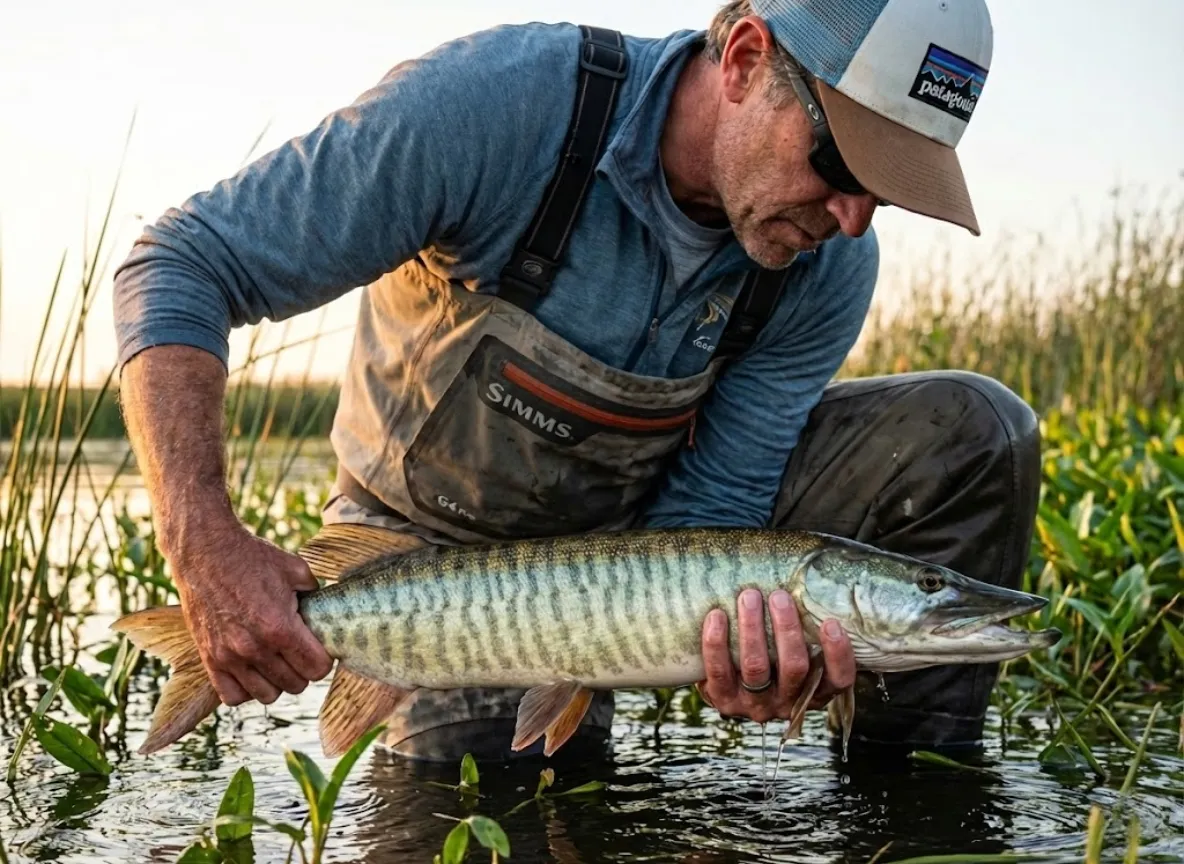
The Tiger Musky (Esox masquinongy x lucius) is defined by an intermediate count, typically 5 to 8 jaw pores, but is most famously identified by asymmetry. If you catch a fish presenting 5 pores on the left jaw and 6 on the right, it is statistically highly probable to be a tiger musky hybrid. Relying on this count is far more accurate than identifying submandibular pores on Northern Pike based solely on head shape.
Can body shape and cheek scales confirm the species?
Yes, examining cheek scalation and tail geometry acts as a secondary verification to the pore count.
Northern Pike have fully scaled cheeks, while true Muskies have naked lower cheeks. Tigers fall in the middle, often displaying cheeks that are about two-thirds scaled. Also, the Caudal Fin (Tail) shape is a distinct marker; Tiger Muskellunge inherit the rounded tail fins of the Pike, contrasting sharply with the pointed tail fins of a pure musky.
For advanced identification, apply the Casselman (1986) Morphometric Ratio. Tiger Muskies possess a disproportionately large head, roughly 30% of their body length. True-strain muskies usually have head lengths closer to 25% of their total length. This “Big Head Rule” is vital for identifying “Clear” variants that lack characteristic markings, as noted in the USGS Species Profile for Tiger Muskellunge.
Knowing these morphological traits is the first step in distinguishing true Muskies from hybrids, allowing you to target each effectively with specific muskie plugs or bucktails.
The Morone Matrix: Wiper vs. Striped Bass vs. White Bass
Wipers (Hybrid Striped Bass) are pound-for-pound some of the hardest fighting fish in North American freshwater sportfishing. Confusing them with White Bass or even invasive White Perch is common, but confusing them with pure Striped Bass can lead to legal trouble regarding creel limits.
How does the “Tooth Patch Test” determine the species?
The definitive field test for Morone species involves examining the basihyal (tongue) for rough tooth patches.
White Bass possess a single, heart-shaped patch in the center of the tongue. Striped Bass and Hybrid Striped Bass both possess two patches, which immediately rules out the White Bass—often the primary confusion for smaller specimens. The Texas Parks & Wildlife Morone identification guide offers an excellent visual matrix for this test.
To distinguish the Wiper from the pure Striper, examine the gap between the patches. Pure Striped Bass patches are parallel and distinctly separated like rails. Wiper patches are often joined, touching, or converging.
Pro-Tip: Use a plastic fish gripper or depress the lower lip with your thumb to check the tongue. These fish have razor-sharp gill plates and dorsal spines. Review anatomically correct grips for species to do this safely.
What is the “Field Ratio Test” for body shape?
Hybrid Stripers are biologically predisposed to be “deep-bodied,” creating a distinctive football body shape compared to the torpedo-like Striped Bass.
Apply the 1/3 Rule: If the body depth (belly to back) is greater than 33% of the fish’s standard length, it is highly likely a Wiper. The Iowa DNR Hybrid Striped Bass profile validates this body height to length ratio.
Additionally, check the integrity of the horizontal stripe patterns. Pure Striped Bass feature solid, continuous lines to the tail. Wipers exhibit broken horizontal stripes, often appearing like a “glitchy” pattern below the lateral line. Because navigating state size and bag limits is crucial, knowing this ratio helps you release illegal fish quickly.
The “Other” Hybrids: Saugeye and Splake
While Muskellunge and Striped Bass get the glory, the Saugeye and Splake are staples of many northern and mid-western fisheries. Their identification comes down to fins and markings.
How do dorsal fin markings identify a Saugeye?
The Saugeye (Walleye x Sauger) is best identified by looking closely at the spiny dorsal fin.
Pure Walleye biology dictates a distinct black blotch at the base of the dorsal fin with no spots on the membrane. Sauger have rows of spots but lack the blotch. Saugeye are the mix: they typically exhibit distinct rows of spots (the Sauger trait) plus a less-defined, messy black blotch at the base (the Walleye trait).
You should also check the caudal fin (tail) for the “White Tip.” Walleye have a distinct white tip on the lower lobe. Sauger have none. Saugeye usually have a smaller, messier white tip. Authorities like the Ohio DNR use these markings as the standard for identification in temperate freshwater systems.
How does tail shape differentiate Splake from Brook or Lake Trout?
Splake (produced by fertilizing female Lake Trout eggs with Brook Trout milt) are best identified by the fork of the tail.
Lake Trout have a deeply forked tail, while Brook Trout have a square tail. Splake possess a “moderate” fork that falls exactly in between these two extremes. You can also look for “Vermiculation” (worm-like markings) on the back; Splake have broken, less distinct markings compared to the clean patterns of a Brook Trout.
While distinguishing trout species and variants within the genus Salvelinus can be difficult visually, usually the tail fork is the most reliable field mark. For absolute scientific certainty, biologists count Pyloric Caeca (internal organs), as detailed in Maine IFW Splake species information, but for the fishermen, the tail is sufficient.
Conclusion
True outdoor competence is not just about catching fish; it is about understanding the aquatic resource you are interacting with.
- Evidence over Aesthetics: Pore counts and tooth patches are legal proof; colors are only clues.
- The Power of Asymmetry: An uneven pore count (5 left, 6 right) is your strongest indicator of a Tiger Musky.
- The 1/3 Rule: Wipers are defined by a body depth greater than 33% of their length.
- Stewardship: Correct identification protects native genetics and ensures you remain compliant with fisheries management laws.
Bookmark this guide. When the adrenaline is fading and you are staring at a mysterious fish that doesn’t quite fit the mold, these forensic checks will give you the answer.
FAQ – Frequently Asked Questions
How many pores does a Tiger Musky have compared to a Pike?
Tiger Muskellunge typically have 5 to 8 submandibular pores per side, often with an asymmetrical count (e.g., 5 on one side, 6 on the other). Northern Pike consistently have 5 or fewer pores per side.
Are all hybrid fish sterile?
No, not all hybrids are sterile. While Tiger Muskies and Triploid Wipers are functionally sterile, hybrids like Saugeye and Splake can be fertile and may backcross with parent species, posing risks to native genetics.
Can you keep a Wiper if you catch one?
This depends entirely on local regulatory inquiry and laws, which often distinguish between Hybrid Striped Bass and pure Striped Bass. Because identification is critical for catch validation, always verify the broken stripes and tooth patches before retaining the fish.
Do hybrid fish fight harder than their parents?
Generally, yes. Due to the phenomenon of Hybrid Vigor (Heterosis), hybrids often exhibit faster growth rates and higher metabolic activity, leading to more aggressive strikes on safety-pin spinnerbaits or topwater baits, and greater endurance during the fight.
Risk Disclaimer: Fishing, boating, and all related outdoor activities involve inherent risks that can lead to injury. The information provided on Master Fishing Mag is for educational and informational purposes only. While we strive for accuracy, the information, techniques, and advice on gear and safety are not a substitute for your own best judgment, local knowledge, and adherence to official regulations. Fishing regulations, including seasons, size limits, and species restrictions, change frequently and vary by location. Always consult the latest official regulations from your local fish and wildlife agency before heading out. Proper handling of hooks, knives, and other sharp equipment is essential for safety. Furthermore, be aware of local fish consumption advisories. By using this website, you agree that you are solely responsible for your own safety and for complying with all applicable laws. Any reliance you place on our content is strictly at your own risk. Master Fishing Mag and its authors will not be held liable for any injury, damage, or loss sustained in connection with the use of the information herein.
Affiliate Disclosure: We are a participant in the Amazon Services LLC Associates Program, an affiliate advertising program designed to provide a means for us to earn advertising fees by advertising and linking to Amazon.com. As an Amazon Associate, we earn from qualifying purchases. We also participate in other affiliate programs and may receive a commission on products purchased through our links, at no extra cost to you. Additional terms are found in the terms of service.