Home Seasonal Guides Best Ice Fishing Shelters for Wind & Cold

Best Ice Fishing Shelters for Wind & Cold

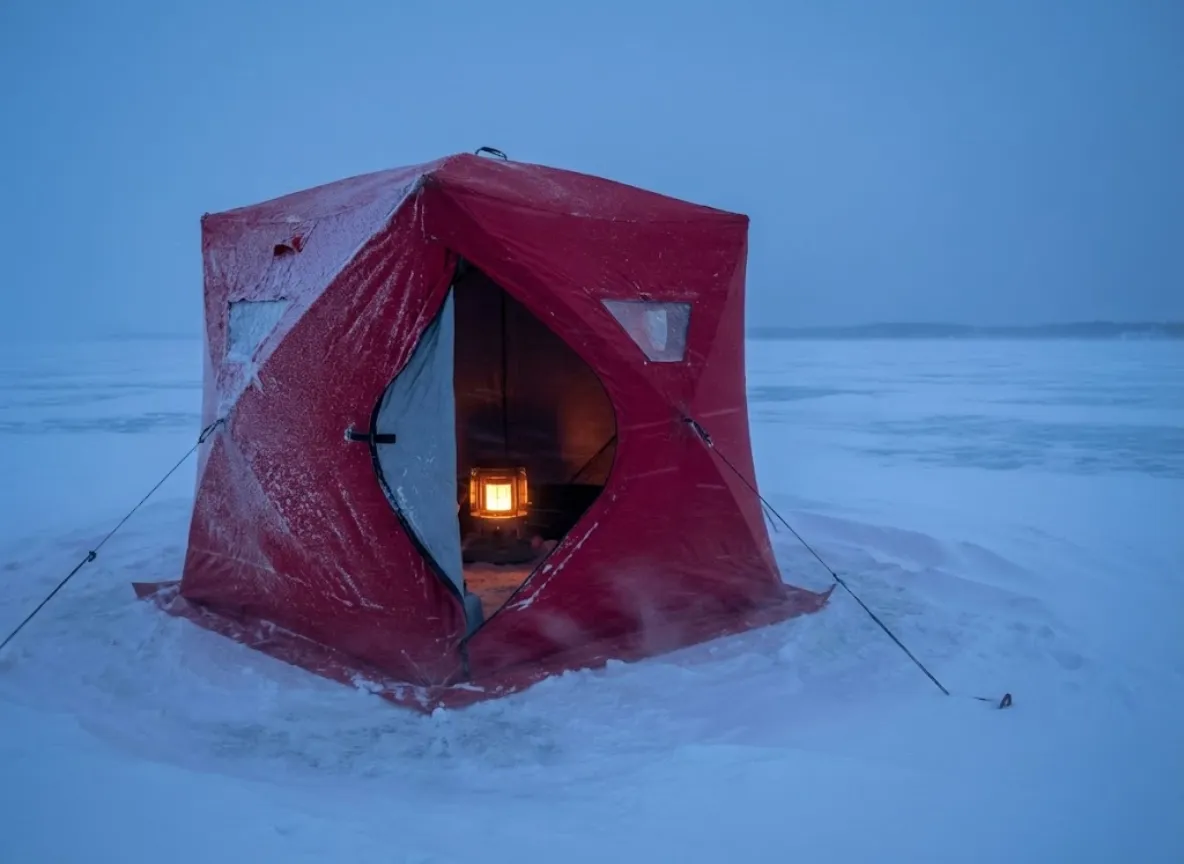
A red insulated ice fishing shelter withstands heavy winds and blowing snow on a frozen lake at twilight.

A 30mph wind on a frozen lake behaves differently than it does on land. Without trees or hills to create friction, the “frozen boundary layer” allows air to accelerate into a laminar flow that hits shelter walls with the force of a solid object. In these conditions, a shelter—whether you call it a portable, a trap, or an ice shanty—is not just a convenience; it is the only barrier between an angler and hypothermia.

The difference between a comfortable day chasing lake trout and a catastrophic structural implosion lies in the engineering specifications—specifically pole diameter and fabric bonding—not the brand logo. I’ve spent decades on hard water, watching cheap hub shelters turn into kites while properly engineered frames stood their ground against gale force winds. This technical angler’s fortification guide moves past the marketing fluff to focus on the physics of survival: the rigidity of 11mm+ poles and the thermal dynamics required to keep you fishing when the mercury drops.

How to Choose the Right Ice Fishing Shelter

An angler kneeling on the ice inspecting the pole thickness and hub mechanism of an ice fishing tent.

Before you look at a price tag, you need to understand the objective physics that keep a portable structure standing on a frictionless surface.

Why Does Pole Diameter Dictate Wind Survival?

Most shelter failures happen due to the “Implosion Threshold,” where standard poles simply cannot resist the pressure load. Standard 9.5mm fiberglass poles, common in budget pop-up ice fishing units like the Thunder Bay Ice Cube 3, will flex to a breaking point—often inverting into the tent—at wind speeds around 20-25mph. To survive gusting winds, you need the stiffness provided by “Heavy Duty” 11mm poles, which push that failure point closer to 40mph.

It comes down to the modulus of elasticity. You want stiffness, not flexibility, to maintain your interior volume during a gust. Structural engineering principles on pole design criteria show that minor increases in diameter yield exponential gains in rigidity. We look for metal ball-and-socket hub assemblies rather than plastic, as they maintain structural integrity in extreme cold.

A technical infographic comparing ice fishing shelter poles. On the left, a 9.5mm "Budget Standard" fiberglass pole is shown bowing severely under a 25mph wind load, with a cracked plastic hub. On the right, an 11mm "Heavy Duty" pole remains rigid under a 40mph load, connected to a metal ball-and-socket hub. A central cross-section graphic highlights the 30%+ increase in thickness and stiffness.

However, even the strongest poles fail if set up incorrectly. The Wind Wall setup technique is essential: always anchor the windward wall first before expanding the hub. This simple step prevents the wind from catching a loose sail and snapping a hub before you even drill your first hole.

Pro-Tip: Bring a cordless drill adapter for your ice anchors. Hand-screwing anchors in -20°F wind is a recipe for frostbitten fingers and cut corners on safety.

How Does Fabric Insulation Prevent “Indoor Rain”?

Insulation prevents condensation by keeping the inner wall temperature above the dew point, stopping moisture from freezing on contact. Without this barrier, single-layer fabrics cool rapidly to outside temperatures. When you run a propane heater inside, the moisture from combustion hits those freezing walls and turns into “indoor rain” that soaks your fishing gear.

To stop this, you need thermal breaks. Bonded insulation (typically 600D to 900D with high GSM) keeps the inner wall temperature stable, eliminating condensation. We compare proprietary tech like Eskimo’s IQ insulated fabric, Otter’s ThermalTec shell, and Clam’s StormShield fabric against generic nylon. This efficiency allows you to reduce propane usage, extending your fuel life significantly.

A split-screen 3D cross-section illustration showing the difference between single-layer tent fabric and triple-layer bonded insulation. The left side shows a thin blue layer with internal condensation labeled "Indoor Rain." The right side shows thick, textured layers blocking the cold, labeled "Thermal Barrier," resulting in a dry, warm interior.

While the shelter holds the heat, your personal comfort relies on the science of layering to manage body moisture. If you get sweaty setting up, no amount of thermal fabric will keep you warm. Understanding wind chill and heat loss is critical; a quality thermal shell creates a microclimate that removes the windchill factor entirely, letting you fish in a hoodie while a blizzard rages outside.

Our Selection Process: How We Built This Guide

Two anglers physically pushing against an ice fishing shelter in a snowstorm to test its wind stability.

We don’t trust manufacturer specs blindly. Our recommendations are built on an “Anti-Sell” methodology. We analyze gear based on failure points, not marketing highlights. We pitted market leaders like Eskimo, Otter Outdoors, and Clam against budget contenders like Ice Runner and Thunder Bay.

  • Wind Stability Scores: We prioritized pole geometry. If it uses 9.5mm poles, it gets a lower score for open-ice use.
  • Thermal Efficiency: We looked for fabric thickness and insulation weight that actually traps heat, distinguishing between “wind breakers” and true insulators.
  • The Filter: We specifically looked for recurring failure modes—frozen YKK zippers, cracked hubs, and condensation issues—to ensure our recommendations reflect the reality of the ice.
  • Transparency: We may earn a commission if you purchase through our links, but this never influences our stress-test ratings. If a shelter leaks, we say it leaks.

The Best Ice Fishing Shelters of 2026: Our Top Recommendations for Every Need

A frost-covered thermal flip-over ice shelter on black ice at sunrise with steam rising from the vent.

We have categorized these picks based on your logistical “Persona.” A solo angler dragging a sled by hand has different structural needs than a group with an ATV or snowmobile.

Our Top Picks for The Solo Tactical Angler

These anglers prioritize speed and self-reliance. Stability is safety when you are alone on the ice. We compared these against the Clam Nanook XL and Jason Mitchell XT Thermal, but favored models that balanced weight with rigidity.

Otter XT Hideout

$ $ $ $
Otter XT Hideout

The Otter XT Hideout is the fortress for the solo angler who refuses to be moved. By utilizing a rotomolded sled and your own body weight, it creates a 260lb anchored mass that is practically impervious to sliding in high winds. The ThermalTec 600D fabric offers elite heat retention and total darkness for sight fishing. However, this stability comes at a cost: at 60 lbs, lifting this unit into a truck bed alone is a back-breaking task, and the slanted front wall can feel claustrophobic if you are over 6’2″.

Overall
Wind Stability
Thermal Efficiency
Portability
Setup Speed
Fishable Area
Weight

60 lbs

Fishable Area

12.6 sq. ft.

Pole System

Square Aluminum Frame

Insulation

ThermalTec 600D

You Should Buy This If…

  • You fish in open, high-wind areas without tree cover.
  • You require a “zero-setup” time to maximize fishing.
  • Sight fishing (dark house) is your primary tactic.

You Should Reconsider If…

  • You have to lift the sled into a truck bed alone (60 lbs is heavy).
  • You are over 6’2″ (slanted front wall can feel cramped).

Eskimo Wide 1 Thermal

$ $ $ $
Eskimo Wide 1 Thermal

Eskimo addresses the primary complaint of solo flips—claustrophobia—with an expanding spreader bar system that widens the floor plan to 17.5 sq. ft. This allows you to place a heater and sonar beside your hole rather than tripping over them. The IQ Insulated fabric does an excellent job of retaining heat. The trade-off for this extra space is mechanical complexity; the sliding poles required for the expansion can freeze up in slushy conditions, making teardown frustrating at the end of a long day.

Overall
Wind Stability
Thermal Efficiency
Portability
Setup Speed
Fishable Area
Weight

65 lbs

Fishable Area

17.5 sq. ft.

Pole System

Steel/Aluminum Expandable

Insulation

IQ Insulated Fabric

You Should Buy This If…

  • You need floor space for a heater and Humminbird/Garmin unit.
  • You find standard flips claustrophobic.
  • You tow with a machine (ATV/Snowmobile).

You Should Reconsider If…

  • You prioritize absolute simplicity (expansion bars add setup steps).
  • You fish in slush often (sliding poles can freeze).

Our Top Picks for The Core Angler (Small Group)

For 2-3 people, the hub style is king. Here we focus on the battle between Eskimo’s usability and Otter’s thermal dominance, evaluating features like trip-proof doors versus maximum heat retention.

Eskimo Outbreak 450XDP

$ $ $ $
Eskimo Outbreak 450XDP

The Outbreak 450XDP is our ‘Gold Standard’ for 2026 because it solves actual on-ice problems. The full-panel ‘No-Trip’ door prevents the inevitable stumble when rushing out to a flag, and the XDP hub geometry allows this massive shelter to collapse down to 58 inches, fitting in short-bed trucks. The 11mm poles are robust. The downside? The door zipper sits right in the slush zone at the bottom; if you aren’t diligent about clearing ice, that zipper will freeze solid, locking you in or out.

Overall
Wind Stability
Thermal Efficiency
Portability
Usability (Door)
Fishable Area
Weight

54 lbs

Fishable Area

75 sq. ft.

Pole System

11mm Heavy Duty Fiberglass

Insulation

StormShield 3-layer Bonded

You Should Buy This If…

  • You have a short truck bed or SUV (needs compact pack-down).
  • You fish with older anglers or kids (No-Trip door prevents falls).
  • You need space for 3 anglers comfortably.

You Should Reconsider If…

  • You are unwilling to maintain zippers (door zipper sits in slush).
  • You need a blackout interior (Grey interior is brighter).

Otter Vortex Pro Cabin

$ $ $ $
Otter Vortex Pro Cabin

Otter brings the heat with the Vortex Pro Cabin. Its pentagonal geometry sheds wind far better than square hubs, and the ThermalTec 600D fabric is arguably the warmest on the market, creating a pitch-black interior ideal for sight fishing. The 11mm Cobalt poles are nearly indestructible. However, despite the premium build, the removable TPU windows have a known flaw: in wet, heavy snow, they can leak moisture, leading to drips inside your sanctuary.

Overall
Wind Stability
Thermal Efficiency
Portability
Usability (Door)
Fishable Area
Weight

36 lbs

Fishable Area

48 sq. ft.

Pole System

11mm Cobalt Poles + Wind Support

Insulation

ThermalTec 600D

You Should Buy This If…

  • You are a sight fisherman demanding total darkness.
  • Maximum warmth is your priority over floor space.
  • You want a lighter carry (36 lbs vs Eskimo’s 54 lbs).

You Should Reconsider If…

  • You need maximum square footage (significantly smaller than the 450XD).
  • You dislike tight “triangle” doors.

Frabill Fortress 260

$ $ $ $
Frabill Fortress 260

The Frabill Fortress 260 is for the angler who feels cramped in standard hubs. The proprietary “Kick-Out” hub technology extends the walls at shoulder height, providing massive elbow room for hook sets without increasing the footprint on the ice. It’s incredibly space-efficient. The catch is the hybrid insulation; the skirt uses lighter 300D fabric, which saves weight but creates a noticeable thermal difference near the floor—prepare for “cold ankles” on sub-zero days.

Overall
Wind Stability
Thermal Efficiency
Portability
Space Efficiency
Durability
Weight

33 lbs

Fishable Area

69 sq. ft.

Pole System

Standard Fiberglass

Insulation

Hybrid (600D Top / 300D Skirt)

You Should Buy This If…

  • You need maximum elbow room for hook sets.
  • You want high square footage at a low carry weight.
  • You are looking for a mid-range price point.

You Should Reconsider If…

  • You fish in extreme sub-zero temps (hybrid insulation leads to “cold ankles”).
  • You are concerned about moving parts (kick-outs add complexity).

Our Top Picks for The Ice Camper (Expedition Leader)

These are portable cabins. Focus on volume, sleeping capacity, and wind resistance for large surface areas. If you are setting up a basecamp, these challenge standard ice houses for comfort but offer mobility.

Otter Vortex Pro Monster Lodge

$ $ $ $
Otter Vortex Pro Monster Lodge

The Otter Monster Lodge is less a tent and more a portable estate. With 132 sq. ft. of space and walk-around ceiling height, it easily accommodates cots and a kitchen for overnight trips. The 11mm Cobalt poles and wind-deflecting shape provide essential rigidity for such a large structure. Be warned: at 73 lbs and with huge surface area, setting this up alone in any wind is dangerous. It is a two-person job, and quality control on stitching has been hit-or-miss on recent batches.

Overall
Wind Stability
Thermal Efficiency
Space
Portability
Setup Difficulty
Weight

73 lbs

Fishable Area

132 sq. ft.

Pole System

11mm Cobalt Poles

Insulation

ThermalTec 600D

You Should Buy This If…

  • You plan to sleep on the ice with cots and flooring.
  • You need to accommodate 5-7 anglers.
  • You have a large sled or vehicle for transport.

You Should Reconsider If…

  • You fish alone (unsafe to setup in wind solo).
  • You have limited drying space at home (massive wet footprint).

Eskimo Outbreak 650XD

$ $ $ $
Eskimo Outbreak 650XD

The 650XD balances massive size with wind resilience better than its larger cousin, the 850XD. Its hexagonal shape deflects gusts that would flatten a square tent of this size. It offers 94 sq. ft. of space and the essential ‘No-Trip’ door for group safety. The StormShield fabric is excellent, but for a shelter this size intended for high winds, Eskimo skimps on the anchors. You will need to buy aftermarket straps and anchors to secure all points, as the included kit is insufficient for a ‘basecamp’ setup.

Overall
Wind Stability
Thermal Efficiency
Space
Portability
Usability
Weight

52 lbs

Fishable Area

94 sq. ft.

Pole System

11mm Heavy Duty

Insulation

StormShield

You Should Buy This If…

  • You prioritize wind stability in a large group shelter.
  • You want the “No-Trip” door safety for a group.
  • You need 94 sq ft of fishable space.

You Should Reconsider If…

  • You need the absolute maximum square footage (850XD is bigger but less stable).
  • You are limited by transport length (check bed size).

Clam X-600 Thermal Hub

$ $ $ $
Clam X-600 Thermal Hub

Clam’s X-600 is built for the coldest places on earth. It boasts industry-leading 90g insulation per square meter and ‘Flex-Tested’ 11mm poles designed to bend significantly before breaking. It is the warmest out-of-the-box shelter available. However, that thick skin makes it heavy and incredibly bulky. The carry bag is notoriously tight; trying to stuff this frozen, stiff 90g fabric back into its sack at the end of the day is a struggle that has ruined more than one fishing trip.

Overall
Wind Stability
Thermal Efficiency
Space
Portability
Bag Usability
Weight

60+ lbs

Fishable Area

94 sq. ft.

Pole System

11mm Flex-Tested

Insulation

90g Thermal Skin

You Should Buy This If…

  • You fish in the absolute coldest climates (Northern Canada/Alaska).
  • You want the thickest insulation available (90g).
  • You have a team to help lift/pack.

You Should Reconsider If…

  • You struggle with packing shelters away (tightest bag in the industry).
  • You need a lightweight setup (heavy due to insulation).

Conclusion

The data is clear: if you fish where the winds howl across the Great Lakes, 11mm poles are non-negotiable. Don’t save money on non-insulated shelters if you plan to use propane heat; the condensation will soak you from the inside out.

Otter Outdoors wins on structural rigidity and darkness, making it the choice for the hardcore specialist. Eskimo wins on general usability with their door designs and pack-down geometry.

Don’t wait for the first blizzard to test your ice fishing gear. Inspect your current poles for micro-fractures today, or upgrade to an 11mm system to ensure your next trip isn’t cut short by the wind.

FAQ – Frequently Asked Questions

What is the best way to anchor a hub shelter in high wind?

Use the Wind Wall method: Anchor the single windward wall grommet before popping the roof or sides. This prevents the shelter from turning into a kite during setup. Use a drill adapter for heavy duty anchors to ensure they are driven fully into the ice, and always use guy lines with cinch straps for vertical stability.

How do I stop condensation in my ice shelter?

Ventilation is mandatory. Even with IQ insulated fabric, you must crack the top vents to allow the moisture from your breath and propane heater to escape. If you seal it up tight, that moisture will freeze on your coat hangers and electronics.

Can one person set up a large hub shelter alone?

In calm conditions, yes. However, in winds over 15mph, setting up a 6-person hub alone is dangerous and risks breaking poles. Always anchor down the windward corner first or ask for assistance to prevent the structure from twisting.

Is an insulated shelter worth the extra weight?

Absolutely. Thermal shelters reduce propane consumption by up to 50%, prevent indoor rain (condensation), and dampen wind noise. This makes them essential for comfort and safety in sub-zero temps, despite the added bulk compared to lighter uninsulated shelters.

Risk Disclaimer: Fishing, boating, and all related outdoor activities involve inherent risks that can lead to injury. The information provided on Master Fishing Mag is for educational and informational purposes only. While we strive for accuracy, the information, techniques, and advice on gear and safety are not a substitute for your own best judgment, local knowledge, and adherence to official regulations. Fishing regulations, including seasons, size limits, and species restrictions, change frequently and vary by location. Always consult the latest official regulations from your local fish and wildlife agency before heading out. Proper handling of hooks, knives, and other sharp equipment is essential for safety. Furthermore, be aware of local fish consumption advisories. By using this website, you agree that you are solely responsible for your own safety and for complying with all applicable laws. Any reliance you place on our content is strictly at your own risk. Master Fishing Mag and its authors will not be held liable for any injury, damage, or loss sustained in connection with the use of the information herein.

Affiliate Disclosure: We are a participant in the Amazon Services LLC Associates Program, an affiliate advertising program designed to provide a means for us to earn advertising fees by advertising and linking to Amazon.com. As an Amazon Associate, we earn from qualifying purchases. We also participate in other affiliate programs and may receive a commission on products purchased through our links, at no extra cost to you. Additional terms are found in the terms of service.