

In this article
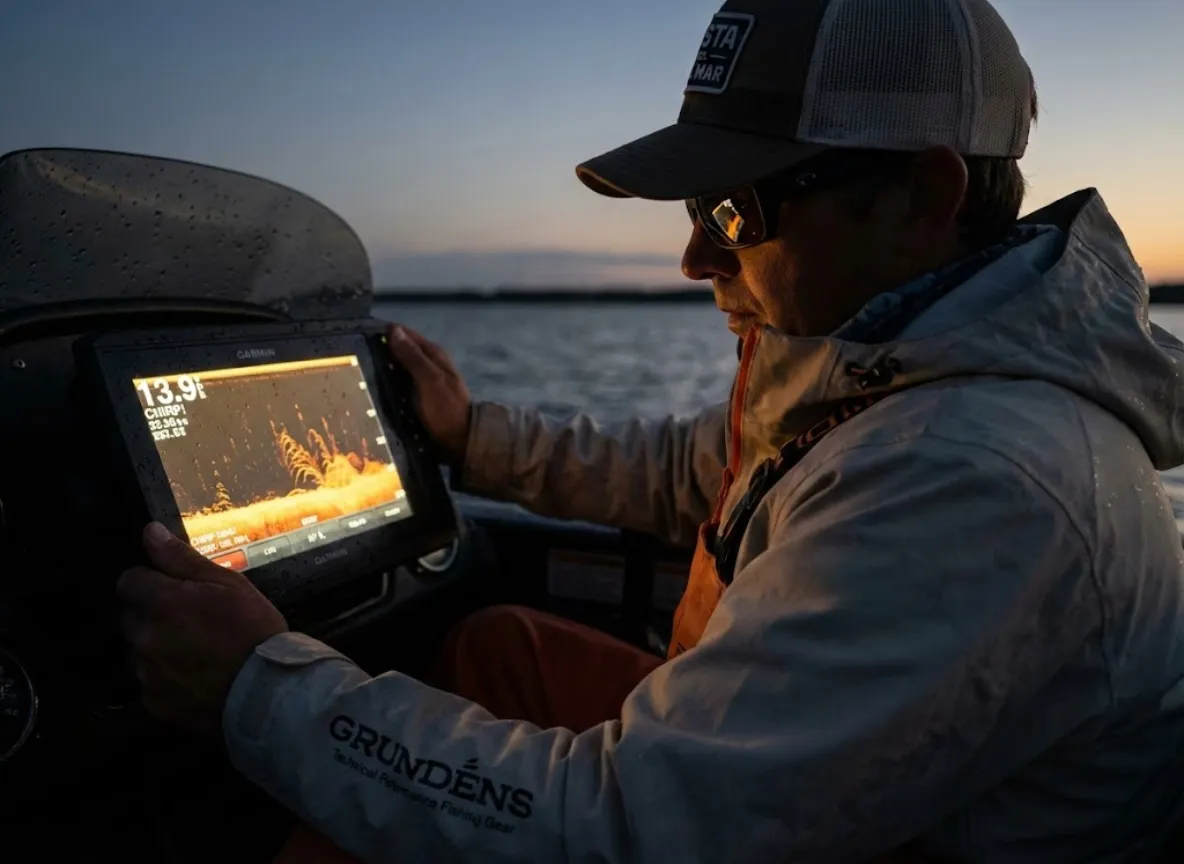
The screen glows green and amber against the pre-dawn darkness, plotting a jagged bottom 80 feet down. Suddenly, a thick red arch appears, hovering tight to a structure. This isn’t a television broadcast; it is a graphical interpretation of physics via hydroacoustics.
The difference between identifying that arch as a trophy Walleye or dismissing it as a submerged tree branch isn’t luck—it is the deliberate application of frequency modulation. You cannot catch what you cannot confirm.
Many anglers view their marine electronics as magic boxes, hoping the factory settings will reveal the secrets below. But true competence comes from moving past “guessing with a gadget” to “hunting with a sensor.” To do that, we must understand the mechanics of pulse compression, the tactical use of the swept frequency range, and the biological acoustics of the fish we target. We are going to strip away the water column to reveal what is actually there.
What fundamentally separates CHIRP from traditional sonar?

For decades, recreational fishing technology was limited by traditional 2D sonar. You picked 50 kilohertz (kHz) for deep water or 200 kHz for shallow water, and you lived with the limitations of a fixed frequency. Today, we have moved into the era of broadband sonar processing.
Why does “Pulse Compression” change how we see underwater?
Standard monotonic sonars face a brutal trade-off. To get high resolution, the unit must send out a short pulse duration. However, short pulses lack the power output required to travel deep and return a signal. If you lengthen the pulse to gain depth, you lose detail. This results in “smearing,” where two fish swimming close together merge into a single, amorphous blob on your screen.
Historically, this physical limitation of single frequency systems meant anglers had to choose between seeing deep or seeing clearly. You rarely got both.
CHIRP (Compressed High-Intensity Radiated Pulse) breaks this rule by transmitting a long-duration chirp signal that sweeps across a range of frequencies—for example, from 130 to 210 kHz. This allows the transducer to put 10 to 50 times more acoustic energy into the water than a standard ping.
The magic happens when the return signal hits the fish finder models. A Digital Signal Processor (DSP) uses “matched filtering” to compress this long sweep into a sharp, high-resolution image. This separates targets by mere inches, even at depth, drastically improving the signal-to-noise ratio.
This technology, which shares DNA with Navy radar origins, ensures that individual echoes are distinct. This is validated by research into broadband acoustic methods for resonance classification, which confirms that sweeping frequencies provides superior data on target composition compared to standard sonars.
This clarity is essential when you are learning the nuances of interpreting traditional 2D sonar for accurate fish identification. Once you understand the signal, the next challenge is selecting the right lens for the job.
How do different frequency bands interact with the water column?
Not all chirp signals are created equal. The frequency band you choose acts like a specialized lens, optimized for specific depths and environments. Whether you use Garmin, Humminbird, or Lowrance, the physics of the frequency-by-species matrix remain constant.
CHIRP Sonar Frequency Comparison
Comparison of High, Medium, and Low CHIRP parameters for marine electronics
Target Separation
Extreme (< 1 inch). Ideal for separating baitfish from predators.
Bandwidth & Depth
80 – 100 kHz bandwidth. Max practical depth of ~600 ft due to high absorption loss.
Primary Utility
Structure detail and tracking small targets in shallow water.
Target Separation
Good (~2-3 inches). Solid balance between detail and depth performance.
Bandwidth & Depth
50 – 70 kHz bandwidth. Max practical depth of ~1,500 ft with moderate loss.
Primary Utility
General search, trolling, and locating the thermocline.
Target Separation
Moderate (> 6 inches). Designed for depth over fine target distinction.
Bandwidth & Depth
20 – 35 kHz bandwidth. Max practical depth of ~10,000 ft with low absorption loss.
Primary Utility
Deep dropping, bottom tracking, and penetrating deep ocean layers.
When should you deploy High CHIRP (150–250 kHz)?
High CHIRP operates with short wavelengths, offering the highest possible target separation. In many systems, this separation is less than one inch. This band is your primary tool for structure fishing. It is capable of distinguishing a predator holding tight inside a brush pile or a grouper lurking in a coral head.
It also changes how you see the food chain. High frequencies render bait balls as distinct “grainy” clusters rather than solid blobs, allowing you to estimate the size of the individual baitfish.
The trade-off is rapid acoustic attenuation. Higher frequencies are absorbed quickly by water, limiting practical depth to roughly 600 feet in saltwater, though often less in turbid freshwater. Standard High CHIRP transducers typically have a narrow cone angle. This reduces your search area but drastically increases target resolution.
Pro-Tip: If you troll for pelagic species, look for “High Wide” (HW) transducers. These are the exception to the rule, offering the resolution of high frequency with a wide 25-degree beam.
Why is Medium CHIRP (80–160 kHz) the “Scanner” frequency?
Medium CHIRP occupies the sweet spot of hydroacoustics. It balances reasonable depth penetration with moderate separation. Its wider beam width covers a larger volume of water compared to standard High CHIRP, making it the ideal frequency for wide-area scouting, trolling, or drifting to locate scattered fish.
This frequency is the standard for inland and nearshore coastal fishing, effective down to approximately 1,500 feet. Because the wider cone keeps targets in the beam longer, Medium CHIRP produces the classic, elongated “fish arches” that most anglers recognize.
If you are choosing the right kayak fish finder, perhaps a portable Deeper Sonar or compact unit, you will often find that 80-160kHz is the default setting. Operators often use Medium CHIRP to find the “neighborhood”—the general area where fish are holding—and then switch to higher frequencies to identify the “house,” or the specific piece of cover.
How does Low CHIRP (40–60 kHz) penetrate the abyss?
When the target lies in the abyss, high and medium frequencies fail to return a signal. Low CHIRP utilizes long wavelengths that suffer minimal absorption loss. These lower frequencies can travel to deep water depths exceeding 10,000 feet.
This is the “heavy artillery” of professional fishing technology. It is used primarily for deep dropping, swordfishing, and tracking bottom at high boat speeds. The beam is generally wide and powerful, ensuring a return even when the vessel is rolling in heavy seas. High-end systems, like those utilizing an Airmar thru-hull transducer paired with a module like the GSD 26, rely on this band.
Crucially, Low CHIRP penetrates the “Deep Scattering Layer” (DSL). The DSL is a dense fog of plankton, squid, and biomass that reflects high frequencies, creating surface clutter or noise on the screen. Low frequency filters out the noise of these small organisms to reveal the large, hard returns of swordfish or tilefish hiding beneath or within the layer.
While you sacrifice resolution—two fish swimming feet apart at 1,500 feet will likely appear as a single target—you gain detection. Understanding the physics of acoustic scattering from fish swimbladders helps explain why these long waves are necessary to get a return from depth.
How does fish physiology dictate frequency selection?
We have discussed the beam; now we must discuss the target. Fish are not uniform reflectors. Their detection depends heavily on the interaction between sound waves and their specific anatomy, creating a unique acoustic signature.
Why does the swim bladder matter for sonar returns?
A fish’s flesh has a density very similar to water. This means acoustic energy passes right through the body with weak reflection. The gas-filled swim bladder, however, creates a massive impedance mismatch. This organ is responsible for 90% to 95% of the energy returned to your transducer.
Fish without swim bladders, such as mackerel or skipjack tuna, have significantly lower Target Strength (TS) and are much harder to mark. Research on the shape, volume, and resonance frequency of the swimbladder of yellowfin tuna confirms that the air bladder size and state is the primary variable in detection.
This creates a biological complication. Physoclistous fish (like Bass and Walleye) have closed bladders. According to Boyle’s Law, as they go deeper, water pressure compresses the gas in their bladder. A Walleye at 40 feet has a smaller acoustic footprint than the same Walleye at 10 feet.
Physostomous fish (like Trout) can vent gas. This is critical to understand, as it relates to barotrauma in fish caused by rapid ascent. Knowing whether your target species has a compressible bladder helps you realize why deep-water marks often look smaller and fainter than you expect.
How do you interpret environmental clues using CHIRP?
Sonar imaging is not just for finding fish; it is an environmental sensor. You can use it to strip away the water column and reveal the habitat features that attract the biology.
How can CHIRP distinguish hard bottom from soft mud?
Bottom hardness dictates the return. Hard bottoms, such as rock, coral, or packed gravel, reflect more energy than soft bottoms like mud or silt. On your display, a hard bottom results in a thicker, brighter “bottom line” usually showing a high-intensity color like red or yellow. Soft bottoms absorb energy, appearing as a thin, dull line with little color saturation.
To confirm what you are seeing, look for the “Second Echo.” This is a ghost bottom that appears at twice the depth (e.g., if the bottom is 50 feet, the second echo appears at 100 feet). This happens when the signal is strong enough to bounce off the bottom, hit the surface, and bounce off the bottom a second time. Soft mud rarely produces a second echo.
Low CHIRP frequencies can even penetrate the top layer of sediment to reveal hard rock buried beneath soft silt—a technique known as sub-bottom profiling. High CHIRP, meanwhile, provides the definition to distinguish the roughness of the substrate. Identifying the transition where hard bottom meets soft is often the key to scoring the perfect fishing spot.
Why is the thermocline visible and strategically important?
The thermocline is the transition layer between warm surface water and cold deep water. It is characterized by a rapid change in water density. This density shift reflects sound. On your sonar, it appears as a horizontal band of “static” or haze across the screen at a consistent depth.
Medium CHIRP is often the most effective band for highlighting this layer due to its sensitivity to volume scattering. Recognizing this haze is vital. In summer lakes, the water below the thermocline may be oxygen-depleted. If you see the thermocline at 25 feet, fishing at 40 feet is a waste of time—the water there is dead.
In the ocean, the thermocline acts as a physical wall. Predators like tuna will pin baitfish against this density barrier. For a deeper understanding of these temperature layers, review our guide on thermoclines explained: fishing depth & sonar guide.
Summary: The Tactical Triad
The transition from novice to expert angler involves treating your sonar system as a precision instrument rather than a television. CHIRP technology has decoupled the link between pulse length and resolution, allowing us to see deeper with greater clarity than ever before.
Remember the tactical triad: High CHIRP is your scalpel for separating fish from structure. Medium CHIRP is your searchlight for covering water. Low CHIRP is your hammer for deep penetration.
By matching these frequencies to the specific physiology of your target—specifically their swim bladder—you stop hoping for a bite and start hunting the biomass.
Explore our comprehensive library of fishing strategies to learn how to present the perfect lure once you’ve located your target.
FAQ – Frequently Asked Questions
What is the best CHIRP frequency for shallow water fishing?
High CHIRP (150–250 kHz) is superior for shallow water (under 60 ft). Its short wavelengths provide the resolution needed to separate fish from bottom cover like grass, brush, or rocks.
Can I use a CHIRP transducer with a non-CHIRP fish finder?
Generally, no. While some plugs may fit physically, a non-CHIRP (legacy) head unit cannot process the frequency modulated sweep of a chirp transducer. The brain of the unit needs the specific head unit processing power and software to decode the pulse.
Why do I see a double bottom reading on my sonar?
A second echo appears when the bottom is hard enough to reflect the signal all the way to the surface, where it bounces off the water-air interface and returns to the bottom again. This is a reliable indicator of hard substrate (rock or gravel) versus soft mud.
What is the difference between High CHIRP and High Wide (HW) CHIRP?
Standard High CHIRP typically has a narrow beam, which is excellent for detail directly under the boat. High Wide (HW) uses a constant 25° beam to cover a massive area, making it ideal for trolling and locating pelagic fish in the upper water column.
Risk Disclaimer: Fishing, boating, and all related outdoor activities involve inherent risks that can lead to injury. The information provided on Master Fishing Mag is for educational and informational purposes only. While we strive for accuracy, the information, techniques, and advice on gear and safety are not a substitute for your own best judgment, local knowledge, and adherence to official regulations. Fishing regulations, including seasons, size limits, and species restrictions, change frequently and vary by location. Always consult the latest official regulations from your local fish and wildlife agency before heading out. Proper handling of hooks, knives, and other sharp equipment is essential for safety. Furthermore, be aware of local fish consumption advisories. By using this website, you agree that you are solely responsible for your own safety and for complying with all applicable laws. Any reliance you place on our content is strictly at your own risk. Master Fishing Mag and its authors will not be held liable for any injury, damage, or loss sustained in connection with the use of the information herein.
Affiliate Disclosure: We are a participant in the Amazon Services LLC Associates Program, an affiliate advertising program designed to provide a means for us to earn advertising fees by advertising and linking to Amazon.com. As an Amazon Associate, we earn from qualifying purchases. We also participate in other affiliate programs and may receive a commission on products purchased through our links, at no extra cost to you. Additional terms are found in the terms of service.

