
In this article
The skepticism is earned. A $15 shirt and a $90 shirt both carry a UPF 50+ tag, nothing on either tag proves the claim, and one of the top results people find when they search this is a Reddit thread asking whether the whole category is nonsense. Here’s the part the tags don’t tell you: that number isn’t a marketing invention. It comes from a spectrophotometer in an accredited lab running ASTM D6603 and AATCC 183, and the physics behind it is simple enough to check yourself with a bright window. What follows is what actually blocks UV radiation, why a wet cotton shirt quits while a wet synthetic keeps working, when a rating dies without the shirt looking any different, and whether the price gap buys you anything.
What UPF Actually Measures (And Why It Isn’t SPF)
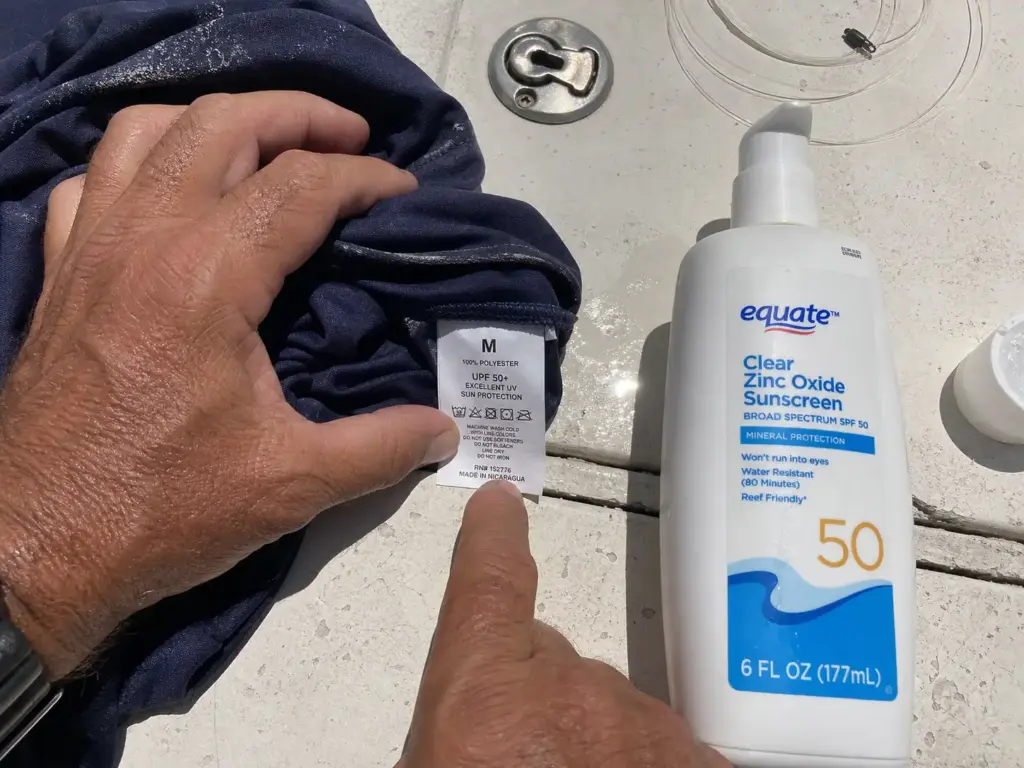
Everyone assumes UPF and SPF are the same number wearing different hats. They aren’t measuring the same thing, and once you see the difference, you stop layering shirt and sunscreen the way most anglers do.
The 1-in-50 Rule, and Why SPF Isn’t the Same Number
UPF stands for Ultraviolet Protection Factor, and it’s a fraction dressed up as a whole number. UPF 50 means the fabric lets through one-fiftieth of the UV radiation hitting it. Two percent gets to your skin, ninety-eight percent stops in the cloth. According to The Skin Cancer Foundation’s guidance on sun-protective clothing, that 98% figure is what earns a garment the top tier.
SPF measures something else entirely. It rates sunscreen by time-to-sunburn, and sunburn is a UVB response, so SPF is essentially a UVB number. It says almost nothing about UVA, the longer wavelength that does its damage quietly over decades. UPF measures transmission through cloth across both UVA and UVB. Different quantity, different method, different lab. So UPF 50 and SPF 50 are not two versions of the same protection, and the shirt doesn’t sweat off at hour three.
Where the Numbers Stop Mattering
The Skin Cancer Foundation calls UPF 30–49 very good protection and UPF 50+ excellent. Past 50+, the returns collapse. Moving from 98% blocked to 99% blocked is one more percentage point of an already tiny remainder, and no manufacturer will tell you that in a product description.
The bigger caveat is buried in the whole system. The UPF rating describes the fabric as tested: flat, dry, unstretched, brand new. Every variable in the rest of this article is a departure from that condition, and your shirt is never in that condition after 9 a.m. Seen against how sun protection fits into the rest of your fishing kit, the tag is one input, not the answer.
The Two Ways a Shirt Earns Its Rating
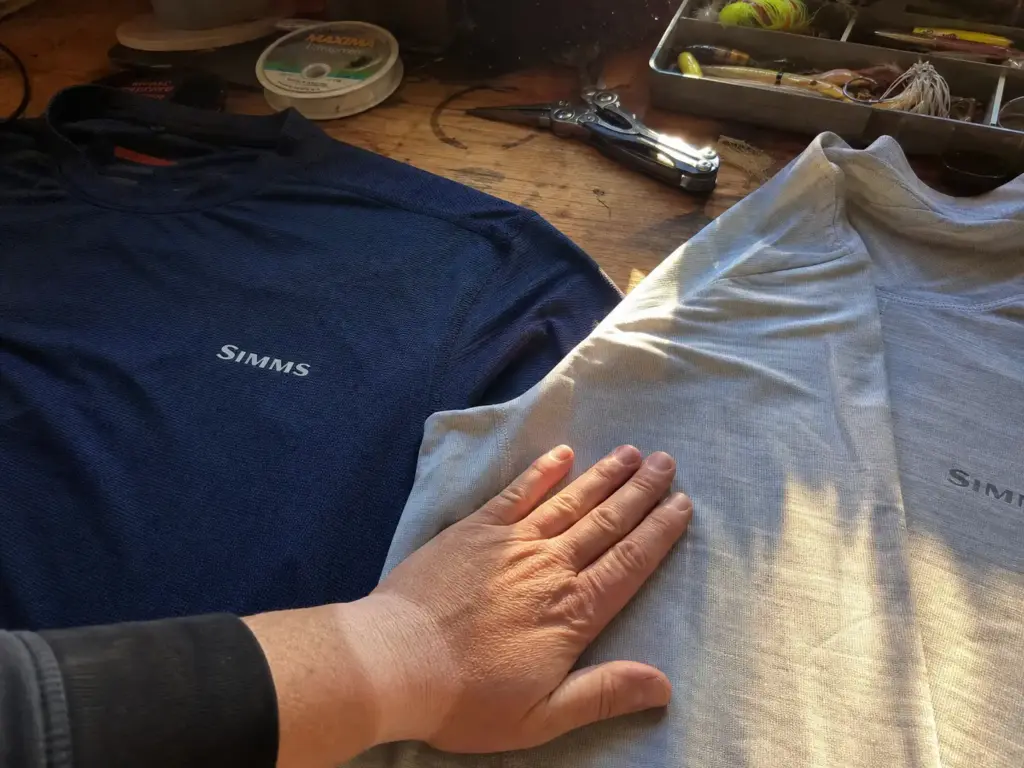
Two shirts hang on the same rack, both stamped UPF 50+. One got there by how it was woven. The other got there from a chemical bath. You can’t tell them apart on the hanger. A season of washing tells them apart for you.
Woven-In Versus Sprayed-On
Inherent UPF comes from the construction: weave density, fiber type, and color. Dense polyester with sub-visible gaps blocks UV because there’s physically nowhere for the photons to get through. Nothing was added, and nothing can wash out. It’s also the more expensive path, because a fabric dense enough to block UV tends to be a fabric dense enough to cook you, and engineering breathability back into a tight weave is where the real work sits.
Topical UPF is a finish applied to the cloth: titanium dioxide and zinc oxide particles that scatter UV, or organic absorbers built around a benzene ring that soak up UV energy and release it as heat. Real protection, tested to the same standards, and it works exactly as advertised on day one. It just has a lifespan. The finish sits on the fiber rather than being the fiber, and everything that scrubs a fabric also scrubs the finish. Brands lean on it because it’s far cheaper to spray a light, loose cloth than to weave a dense one that still moves air. That same trade-off shows up in rain gear, where the choice between a surface treatment and a built-in membrane decides how long a jacket keeps working.
Neither type is dishonest. Both are lab-tested against the same standard, and both deliver the number they claim when new. The difference is durability, not integrity. The tag rarely says which one you have, but product pages sometimes do, and the language is a giveaway: inherent, built-in, or woven-in on one side, treated or finished on the other. A brand that won’t say usually has a reason, and the reason is rarely that the fabric is too good to describe.
Search the product page for the word “inherent” before you buy. If the brand built the rating into the weave, they say so in the copy, because it’s the expensive part and they want credit for it. Silence on that point almost always means a finish.
Weave Density Is the Whole Ballgame
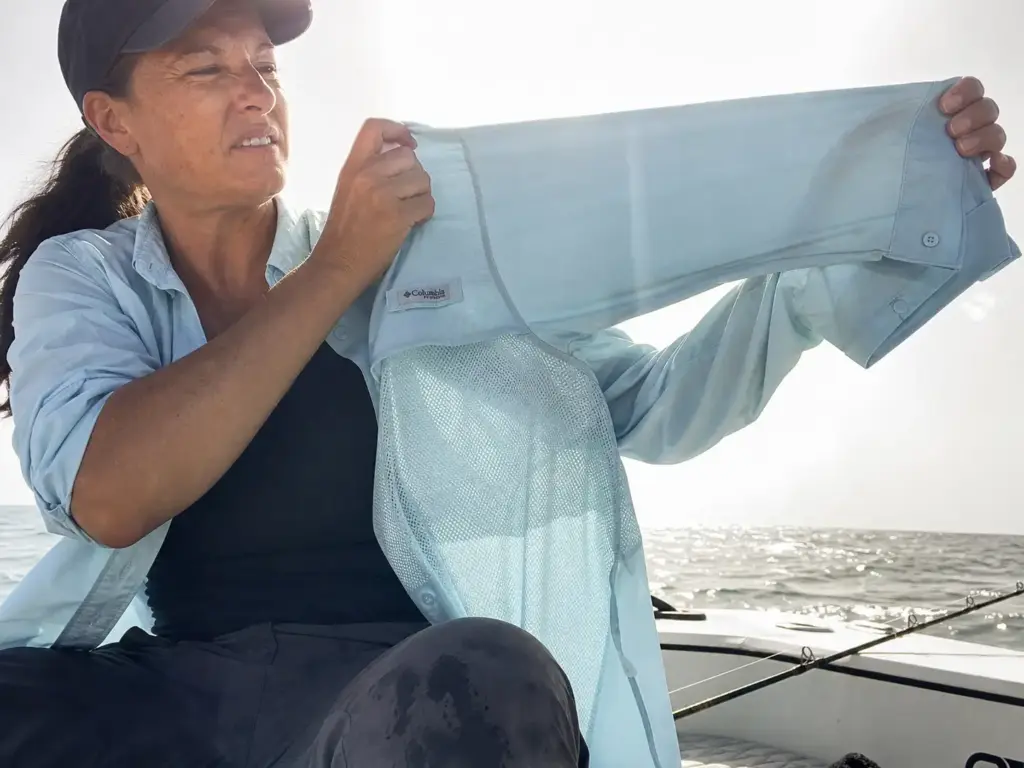
Here’s the part nobody explains properly. UV doesn’t get absorbed through a shirt so much as it finds the holes. Every fabric is a screen door. The only question is how big the gaps are.
Why UV Finds the Gaps, and How to See It Yourself
UPF rises as fabric porosity falls. That’s the whole mechanism in one sentence. When the interstices between yarns drop under roughly 0.1mm, UV has no straight path through the cloth and stops, with zero chemistry involved. Widen those gaps and UV walks through them unchanged, no matter what the tag says.
This is measured, not estimated. The AATCC 183 test method used by accredited labs to measure UV transmission puts a fabric swatch in a spectrophotometer and reads how much UV transmission makes it to the other side, wavelength by wavelength. The number on your tag is a reading off an instrument, not a committee’s opinion.
Because the mechanism is geometric, you can approximate it with your eyes. Hold the fabric up to a bright window. If daylight comes through the weave in distinct pinpoints, UV is coming through too. If it reads as a dim even glow with no visible holes, the weave is doing its job. It won’t give you a number, but it costs nothing, and it’s the single most-repeated field check in gear threads for a reason.
Do the light test on the shoulders and the elbows, not the belly. The chest panel of a five-year-old shirt looks fine because nothing ever rubs it. The shoulders are where a strap has been grinding the yarn open all season, and that’s where the sun gets you.
Color, Dye and Why Stretch Costs You
The numbers here reframe the entire topic. A standard white cotton T-shirt tests around UPF 7. A dark long-sleeve denim shirt can hit roughly UPF 1,700. Both live in the same “regular clothes” category and they’re two orders of magnitude apart, which should tell you the label matters less than the cloth.
Color and dye contribute independently of weave. Darker dyes absorb UV energy before it reaches skin, which is why the same weave in black outperforms it in white. Then there’s the variable almost nobody accounts for: stretch. Pulling fabric taut across your shoulders physically opens the weave and widens every gap in it. A shirt that fits snug protects worse than the identical shirt cut loose, and it’s hotter too.
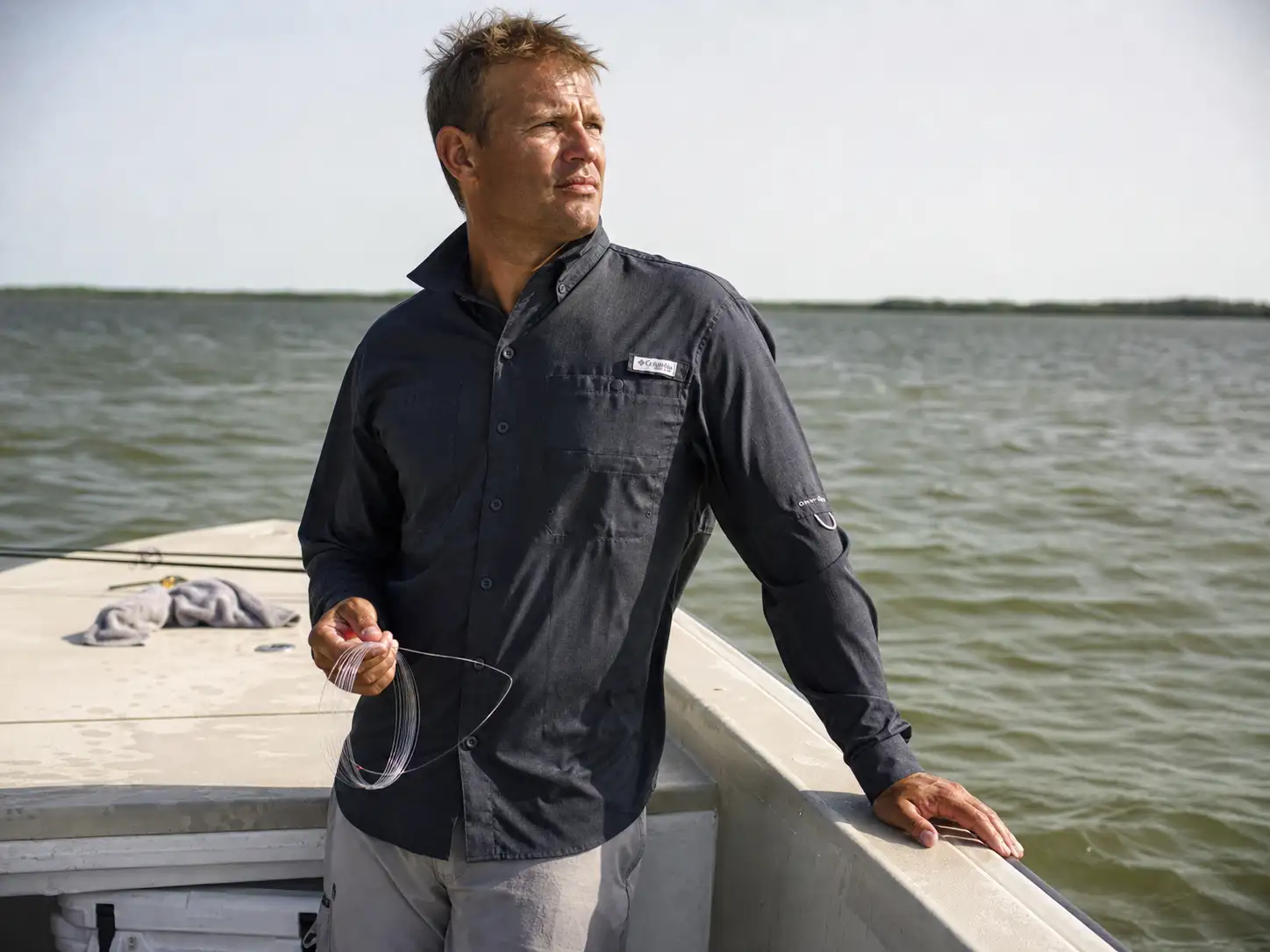
The Columbia PFG Tamiami II (men’s · women’s) is a useful thing to hold while you think about this, because its rating comes from the weave itself rather than a finish, and the vented mesh back panel is the visible compromise: dense where you need coverage, open where you need air. If you want picks rather than mechanism, our roundup covers which sun shirts actually hold their rating past a season.
The consequence worth sitting with: a dark synthetic shirt already hanging in your closet, with no UPF marketing anywhere on it, may well outperform a poorly made shirt that has the rating printed on the chest.
What Happens When the Shirt Gets Wet
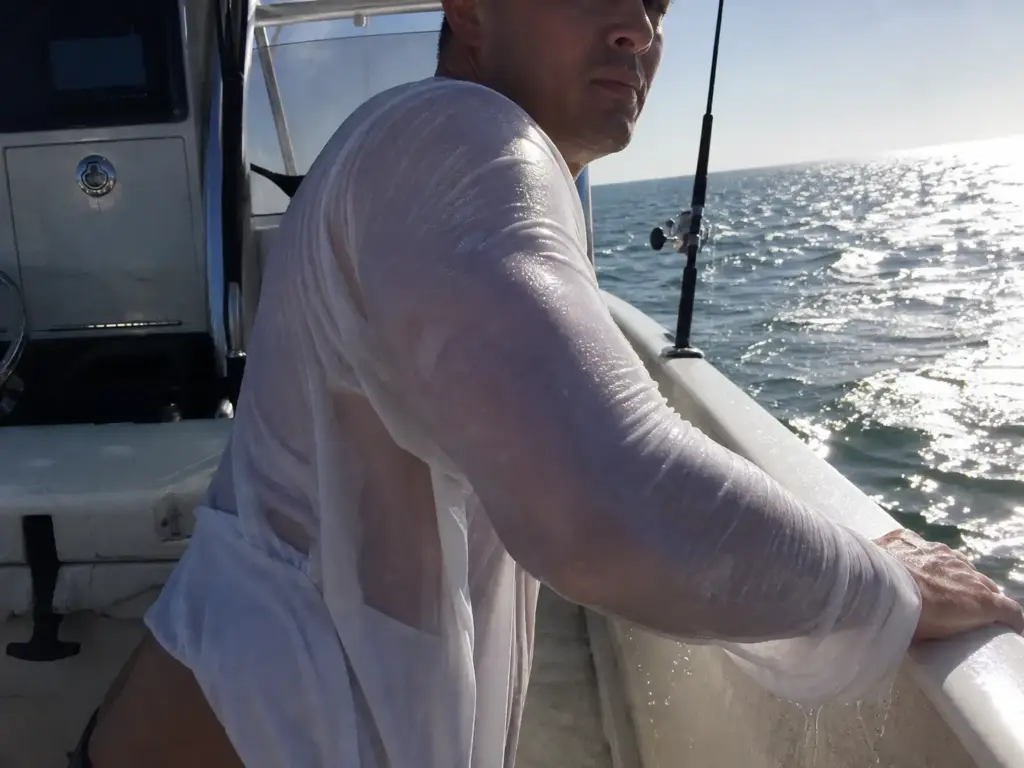
This is the one that catches anglers. You’re splashed by ten in the morning and sweat-soaked by noon, and whether that matters depends entirely on what your shirt is made of. Almost nobody makes that distinction before they’re already burned.
Search this question and you get contradictions. Some sources state flatly that fabric protection roughly halves when wet. Others insist a quality synthetic is fine soaked. Both camps are right, and they’re describing different fibers.
Two Forces Fighting Inside Wet Cloth
Two physical effects run simultaneously in wet cloth, and they push in opposite directions.
The first: water fills the inter-fiber voids. Air is a wide-open path for UV, and water in those same voids is a worse one, so filling the gaps can slightly reduce transmission. That’s the effect people cite when they say wet fabric is fine.
The second: fiber swelling. Water absorbed into the fiber itself makes each yarn thicker, which pushes neighboring yarns apart and widens every interstice in the weave. That increases transmission, and it’s the effect behind the widely cited guidance that fabric protection drops when wet. Which one wins isn’t decided by how wet the shirt is. It’s decided by what the shirt is made of.
Why Cotton Quits and Polyester Doesn’t
Hygroscopic natural fibers, cotton and linen above all, pull water into the fiber structure. They swell. Swelling wins, the weave opens, and the UPF falls off a cliff. Worth noting that raw unbleached cotton starts out slightly better than the bleached kind, because the lignins still in the fiber absorb some UV on their own. Bleaching strips them, and the white tee in your drawer lost that head start at the factory. ARPANSA data puts a dry cotton shirt at UPF 5 and the same shirt saturated at UPF 1–2. That is not reduced protection, it’s a shirt that has stopped functioning as sun protection while you’re still wearing it.
Hydrophobic synthetics behave the opposite way. Polyester and nylon don’t absorb water into the fiber, they carry it on the surface and between yarns. The fiber diameter doesn’t change, the weave geometry holds, and the rating survives essentially intact. This is the same hydrophobic-versus-absorbent split that drives base layer choice, so it’s worth reading how that fiber behavior plays out across a full layering system.
So the honest answer to “does a wet shirt still protect you” is: name the fiber. Cotton, no. Polyester, yes.
The Sweat Problem Nobody Plans For
Here’s why this is a fishing problem in a way it isn’t a hiking problem. A hiker’s shirt might stay genuinely dry for six hours. Yours won’t. Spray over the bow, wet hands from every fish, a landed redfish pressed against your chest, and the constant baseline of sweat in July heat. Your shirt spends most of the day somewhere between damp and soaked.
The story that keeps surfacing in gear threads is always the same shape: someone wears a white cotton tee on a hot flats day, feels covered because they have sleeves on, and comes home with a burn through the shirt across the shoulders. By noon that cotton was at UPF 1–2. The sleeves were a psychological layer, not a physical one.
One term worth cleaning up while we’re here. Wetting out is borrowed from rainwear, where it describes a DWR finish failing and the face fabric saturating. It has nothing to do with UV performance, and anglers who apply it to sun shirts end up conflating two unrelated failures. A sun shirt getting wet is normal. A rain shell wetting out is a problem.
Salt, Sweat and Sunscreen on a Full Day
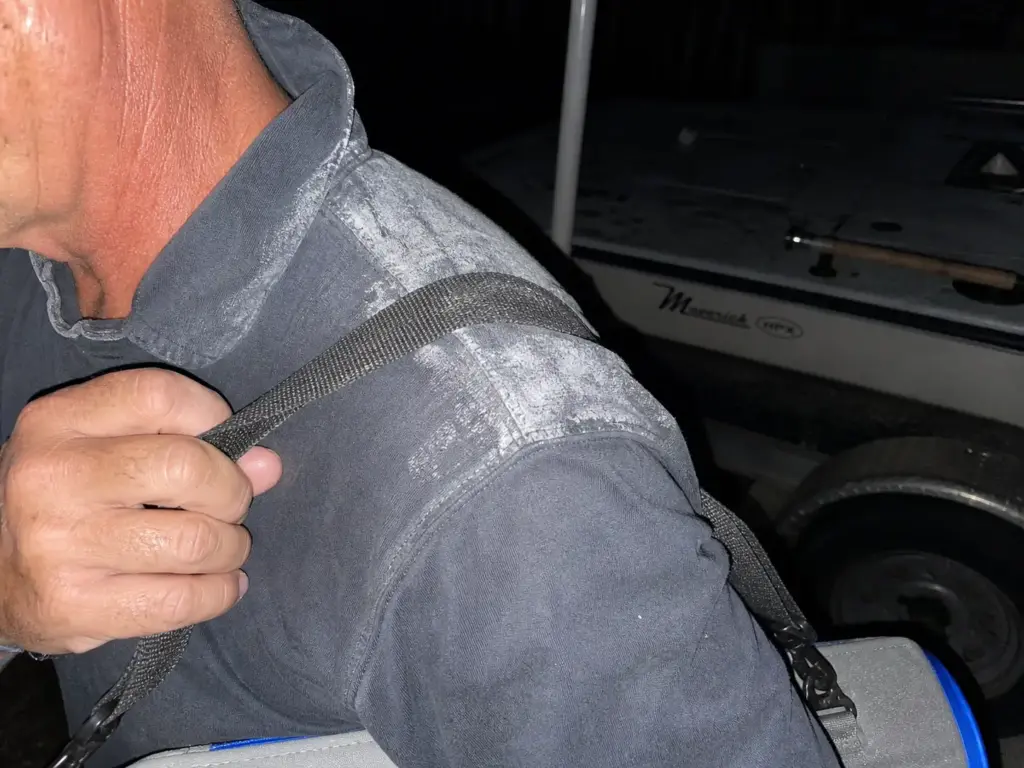
Lab conditions are a flat dry swatch at room temperature. Your shirt spends nine hours soaked in salt, rubbed raw by a PFD strap, smeared with whatever sunscreen ran off your neck, and baked. None of that is in the test, and none of the general explainers cover it because none of them are written for people who fish.
What Saltwater Does to the Weave
Salt doesn’t attack the UV protection directly. What it does is crystallize inside the weave as the shirt dries, leaving abrasive grit lodged between the yarns. Every subsequent movement of the fabric grinds those crystals against the fiber. Over a season of saltwater trips, that’s a slow mechanical sanding of the exact structure the rating depends on.
The practical version: rinse the shirt promptly instead of letting it dry stiff in a hatch or a truck bed. Fresh water, five minutes, no soap. A shirt that dries stiff and chalky has salt in it, and that stiffness is the grit working on the weave.
The Strap-and-Cuff Problem
Wear isn’t uniform, and this is the point that changes how you evaluate a shirt you already own. Mechanically stressed zones degrade far faster than average fabric: shoulders under a pack or PFD strap, rolled cuffs, the patch that rubs a boat seat or a gunwale all day. Those localized areas can fall from UPF 50 when new to UPF 10 or less while the rest of the shirt still tests fine.
So a shirt can look perfectly serviceable and still burn your shoulders, because the burn happens exactly where the fabric was worked hardest. That’s why so many anglers report burning “through” a sun shirt and conclude the whole category is nonsense. The category isn’t nonsense. Their shoulders are.
If you run a sling pack or a PFD with a fixed strap, rotate which shoulder carries it every couple of trips. The wear pattern on a two-year-old shirt is usually one bright pale stripe on one side and untouched fabric everywhere else, all from a strap that never moved.
Sunscreen, Sweat and Storage
Sunscreen and sweat sit on the fabric surface all day, and both leave residue that doesn’t rinse out on its own. That’s an argument for washing sun shirts more often than they look like they need it, and against stuffing one damp into a hatch overnight.
Now the honest caveat, since this section leans on published durability data. Most of the wash-cycle and wear-zone numbers in circulation come from brands that sell UPF shirts and have an obvious incentive to make durability sound better than it is. I’d treat the mechanisms as sound and the cycle counts as ballpark. Fabric performance claims tend to meet reality the same way in rain gear, where the marketing number and the third-season number are rarely the same number.
How Long a UPF Shirt Actually Lasts
Nobody retires a shirt because the UV rating expired. They retire it when it looks worn out, and those two events run on completely different schedules.
30 Washes or 100 — It Depends on the Type
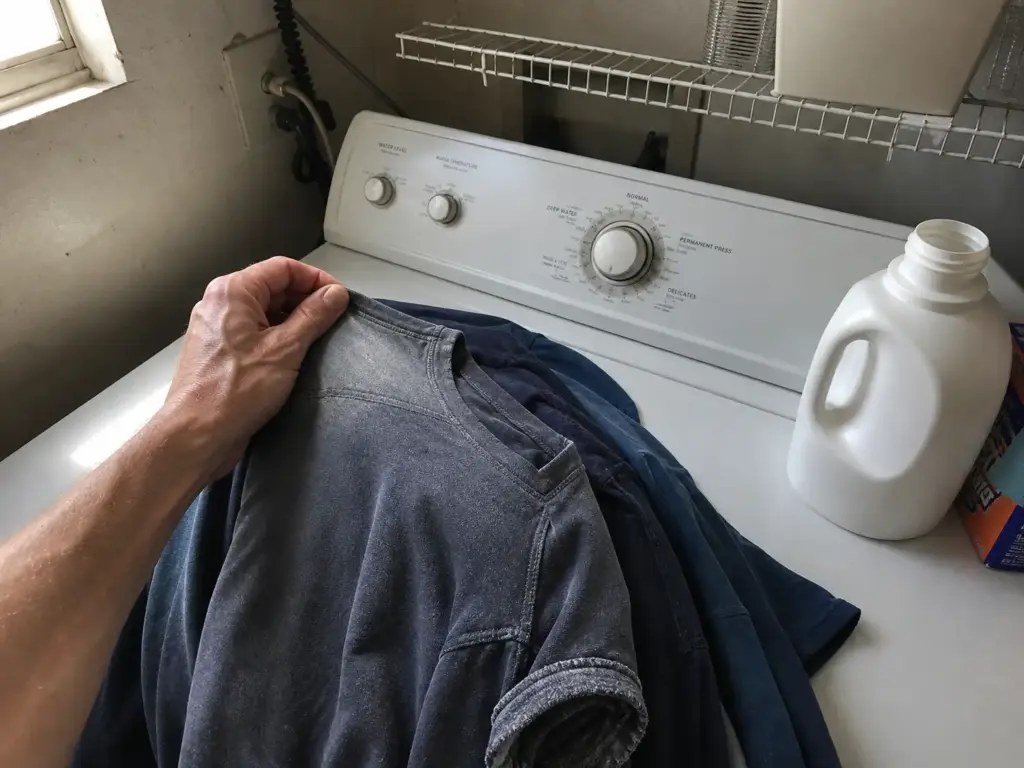
This is where the inherent-versus-topical question from earlier stops being academic. Topical UPF treatments begin measurably degrading around 30–50 wash cycles. Construction-based, weave-density UPF holds past 100 washes in well-made shirts.
Run the arithmetic on your own season. Fish 40 days a year and wash the shirt after most of them, and a topical finish is a two-season garment while a well-woven synthetic is a five-season one. Same tag, same claim on day one, wildly different value. That’s the practical payoff of asking which type you’re buying. Same caveat as before: those cycle numbers come largely from the companies selling these shirts. Directionally sound, precisely uncertain.
The Laundry Habits That Wreck a Rating
Three things degrade a UV-blocking finish faster than wearing the shirt does:
- Bleach attacks the finish chemistry directly and strips it in a handful of cycles
- Fabric softener deposits a coating that interferes with the finish and, on synthetics, clogs the fabric’s moisture handling at the same time
- High heat, in the wash and especially in the dryer, breaks the finish down and cooks elastane in stretch blends
The fix is boring: cold wash, no softener, no bleach, hang dry. Sun shirts dry in twenty minutes on a rail anyway, roughly how long the dryer takes to preheat.
The common mistake is widespread. People wash sun shirts with softener because the fabric starts to feel scratchy after a few dozen cycles. That scratchiness is often the finish itself aging, and softener is precisely the thing that strips what’s left of it. You’re trading protection for hand-feel and you can’t get it back.
How to Test a Shirt You Already Own
The window test from earlier works even better as a comparison than as an absolute. Hold the shirt against a bright window and look at the shoulders and elbows against the chest panel. If the high-wear zones now show more daylight through the weave than the untouched areas do, the rating has moved, regardless of what the tag still claims.
Look for the visual tells alongside it: a pale stripe where a strap rides, fuzzed fibers at the cuffs, fabric gone thin and soft where it used to be crisp. The same logic applies to the rest of the kit, and sun gloves face the same degradation on an even shorter clock, because your hands never stop working while a shirt panel mostly just hangs there.
What a Cheap Shirt Gets Right and Wrong
Time for the anti-sell. A budget shirt and a premium fishing-brand shirt both say UPF 50+. One of those claims is much easier to verify than the other, but the price gap between them is mostly not about UV at all. It’s the same way a higher modulus number on a rod blank stops meaning much past a point: the spec is real, and it stops being the thing you’re actually paying for well before the price stops climbing.
Where the Price Difference Actually Goes
The physics is indifferent to price. A dense, dark synthetic weave blocks UV identically whether the shirt cost fifteen dollars or ninety, because the mechanism is the geometry from earlier and geometry doesn’t read price tags.
What money genuinely buys is everything around the UV number: cut and venting that keep you functional in nine hours of heat, seam construction that survives a season instead of pilling, collars and cuffs designed to cover the spots you forget, and traceable testing documentation. Real differences, and some matter a lot. None of them is more UV blocking.
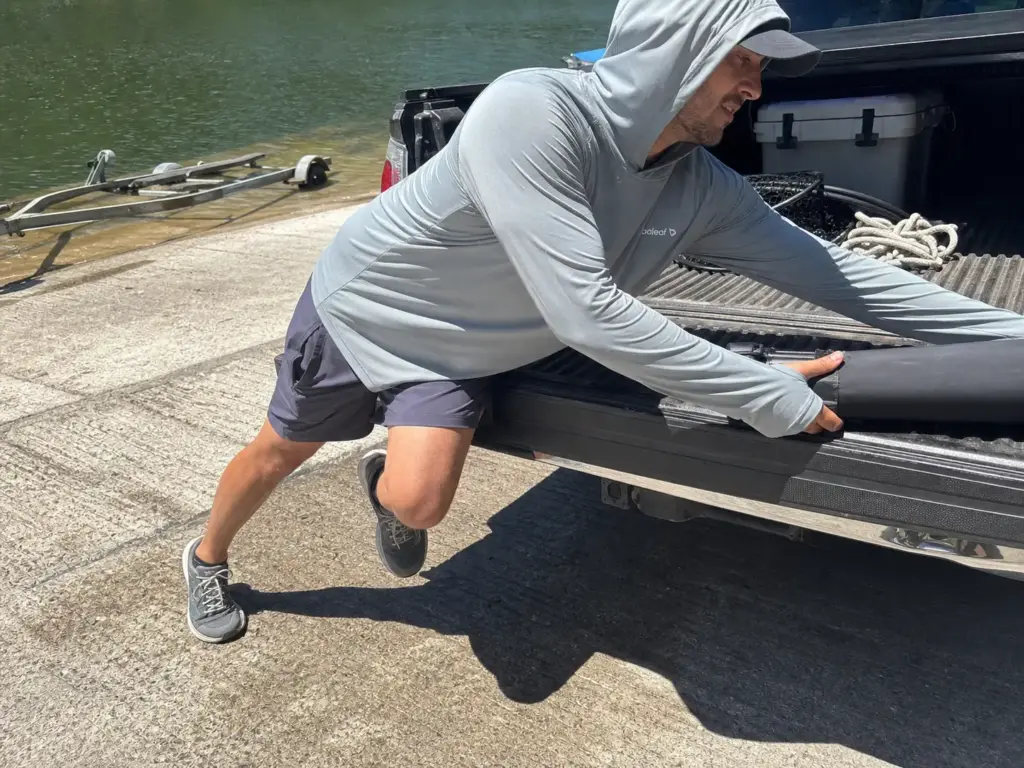
The Baleaf Sun Protection Hoodie (men’s · women’s) is a clean illustration of the point: a budget-tier synthetic hoodie carrying a UPF 50+ rating, hood and thumbholes included, on a fabric doing the same job as a shirt costing several times more. And the Hanes Cool DRI Long Sleeve UPF 50+ two-pack pushes it further, since two shirts at that price means you can rotate them, wash them on a sane schedule, and retire one without hesitating. Neither is a premium fishing garment. Neither pretends to be.
Untested Doesn’t Mean Unprotective
The most reframing data point in this whole topic comes from testing plain garments with no UPF marketing on them at all. A heavyweight cotton long-sleeve tee and a synthetic compression crew, both sold with zero sun-protection claims, measured UPF 115 and UPF 392 respectively.
Set those next to the UPF 7 white tee. The difference isn’t a treatment or a brand. It’s density, color, and fiber, exactly what the physics predicted three sections ago. The number can be earned without ever being advertised, and it can be advertised on fabric that barely earns it.
The One Thing Cheap Listings Can’t Prove
Here’s the actual budget risk, and it isn’t the fabric. UPF testing requires accredited third-party labs working under ASTM D6603 for labeling and AATCC 183 for the transmission measurement, with AS/NZS 4399 serving the same role in Australia and New Zealand. There is no legitimate self-certification path.
So a no-name marketplace listing claiming UPF 50+ with no testing documentation behind it is making a claim, not reporting a result. It might be completely accurate, since dense synthetic fabric usually does hit those numbers. You just have no way to know, and neither does the seller if they never paid for the test.
Look for a checkable credential instead of brand trust. The Skin Cancer Foundation’s Seal of Recommendation program, which now requires a minimum UPF of 50, is one, and a brand that names the standard and the lab in its own copy is another. Cheap is fine. Unverifiable is the part to think about.
Building a Sun Setup That Holds All Day
Knowing the physics is useless if your shirt covers your torso while the sun spends nine hours working on your neck, your hands, and the backs of your ears. The shirt is one piece of the system, and it’s the piece people over-index on because it’s the one with a number printed on it.
Coverage Beats the Number on the Tag
A UPF 30 long-sleeve covering your forearms out-protects a UPF 50+ short-sleeve that leaves them bare, every single time. Ninety-eight percent of nothing is nothing. Area first, number second. Fit follows the same logic: a shirt cut with a little room protects better than the same shirt stretched taut, and it moves air better too. Between sizes for all-day sun, size up.
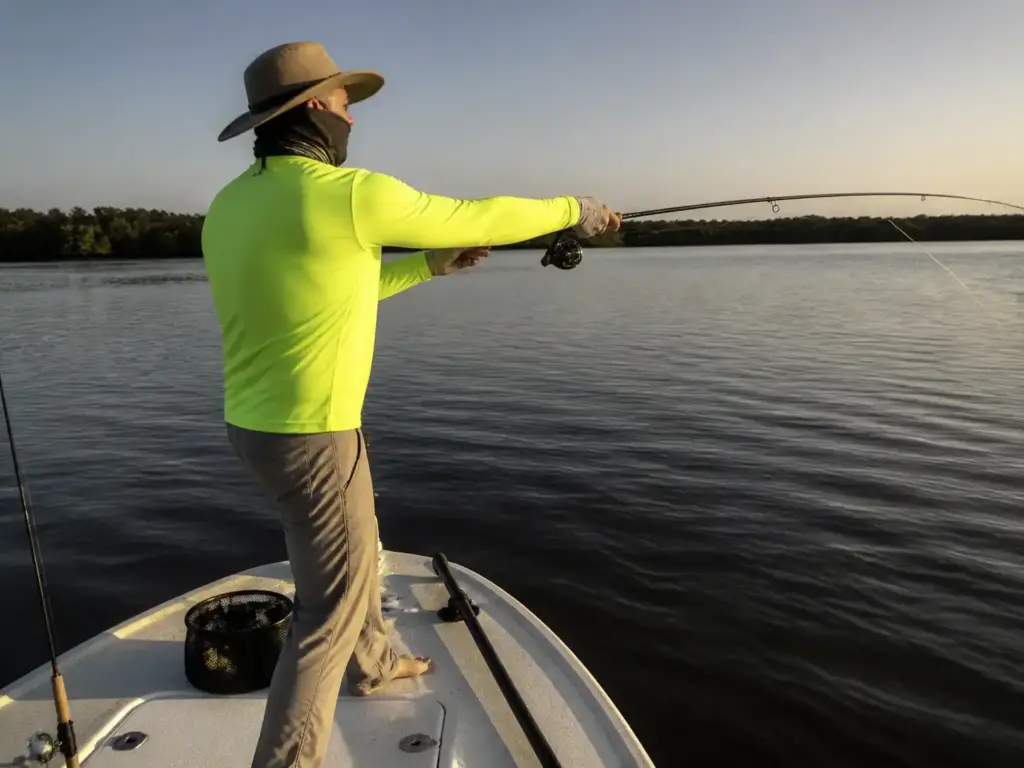
Then run the inventory of what a long-sleeve shirt genuinely misses: the back of your neck between the collar and the hat brim, the tops and backs of your ears, the backs of your hands wrapped around a rod grip for eight hours, and the underside of your chin and jaw.
That last one catches people because it’s counterintuitive. Reflected UV off water is a real load, not a footnote. Open water bounces UV back up at you from below, which is why a day on the water outruns the same hours on a trail, and why anglers burn in places that never see direct sun. A neck gaiter closes the gap between collar and hat brim, and a wide brim handles the reflected UV coming up off the water better than a ball cap, which shades your face and abandons your ears entirely. Don’t stop at skin, either: your eyes take the same UV load your skin does, from the same two directions, for the same nine hours.
Hooded sun shirts solved the neck-and-ear problem years before anyone marketed them as a category. The word “sun hoodie” came out of gear threads, not a brand deck, which tells you it was anglers who noticed the collar-to-brim gap first.
Where Sunscreen Still Earns Its Place
The shirt and the sunscreen are not redundant, and treating them as interchangeable is where most sun setups fall apart. The shirt handles its covered area all day with no reapplication and no missed spots. Sunscreen handles the exposed gaps and needs redoing every couple of hours, more if you’re wet.
So the split is clean: fabric on everything you can cover, sunscreen on everything you can’t. If you’d rather not commit to long sleeves in August heat, sun sleeves cover the forearms on their own and pull off at the ramp. That leaves face, ears, the backs of your hands, and the underside of your jaw where the water throws UV back up at you. Apply it before you launch, not when you notice the burn, and reapply on a schedule rather than on a feeling.
Conclusion
The rating is physical, not promotional. Weave density and fiber type do the blocking, and you can check the important half yourself against a bright window in four seconds.
Wet changes everything, but only for the wrong fiber. Cotton swells, opens, and collapses to UPF 1–2 when soaked. Hydrophobic synthetics hold their geometry and their rating. On the water, where your shirt is damp from ten in the morning onward, that single distinction is the decision.
Price buys fit, venting, seam durability, and traceable testing. It does not buy more UV blocking. A dense, dark synthetic with an honest rating is a legitimate option, and the number on the tag matters less than whether anyone accredited ever measured it.
Before you pack this weekend, hold the shirt you’re planning to wear up to a window. Look at the shoulders. What you see through that weave tells you more than the tag ever did.
Frequently Asked Questions
01Does UPF clothing really work, or is it marketing?
It works, and it is measurable: UPF 50 fabric blocks 98% of UV in accredited lab testing under ASTM D6603 and AATCC 183. What is marketing is the assumption that every UPF 50+ tag has that testing behind it.
02What is the difference between UPF and SPF?
UPF measures how much UVA and UVB a fabric blocks. SPF measures sunscreen using time-to-sunburn and covers UVB only. They are different measurements, so UPF 50 and SPF 50 are not equivalent numbers.
03Does a UPF shirt still protect you when it is wet?
A synthetic one does. Polyester and nylon do not absorb water into the fiber, so the weave geometry and the rating hold. Cotton is the opposite: fibers swell, the weave opens, and a dry UPF 5 cotton shirt can fall to UPF 1 or 2 when saturated.
04What UPF rating do I need for a full day of fishing?
UPF 50+ is the tier worth paying for on all-day water exposure, and the Skin Cancer Foundation Seal of Recommendation now sets 50 as its minimum. Above 50+ the gains are marginal, moving from 98% to 99% blocked.
05Does regular clothing protect you without a UPF label?
Sometimes better than a labeled shirt. A white cotton tee tests around UPF 7, but dense dark fabric can measure far higher untested. Testing has found plain untreated garments at UPF 115 and UPF 392. Density, color and fiber decide it, not the label.
Risk Disclaimer: Fishing, boating, and all related outdoor activities involve inherent risks that
can lead to injury. The information provided on Master Fishing Mag is for educational and informational purposes
only. While we strive for accuracy, the information, techniques, and advice on gear and safety are not a substitute
for your own best judgment, local knowledge, and adherence to official regulations. Fishing regulations, including
seasons, size limits, and species restrictions, change frequently and vary by location. Always consult the latest
official regulations from your local fish and wildlife agency before heading out. Proper handling of hooks, knives,
and other sharp equipment is essential for safety. Furthermore, be aware of local fish consumption advisories. By
using this website, you agree that you are solely responsible for your own safety and for complying with all
applicable laws. Any reliance you place on our content is strictly at your own risk. Master Fishing Mag and its
authors will not be held liable for any injury, damage, or loss sustained in connection with the use of the
information herein.
Affiliate Disclosure: We are a participant in the Amazon Services LLC Associates Program, an
affiliate advertising program designed to provide a means for us to earn advertising fees by advertising and linking
to Amazon.com. As an Amazon Associate, we earn from qualifying purchases. We also participate in other affiliate
programs and may receive a commission on products purchased through our links, at no extra cost to you. Additional
terms are found in the terms of service.