
In this article
You crest the last stretch of trail down to the river still warm from the walk, maybe even a little damp under the collar, and it feels like you dressed exactly right. Then you step into the current, plant your feet, and about five minutes later the first real chill arrives. The shirt that was perfect while you were moving is now working against you. That is not bad luck or a cheap shirt, it is a measurable physical process, and understanding it is what separates an actual fishing base layer system from owning a thermal shirt.
Ask anyone who fishes cold water regularly and they will tell you the same thing: the piece touching your skin decides how the whole day goes. Here is what a base plus mid plus shell system really is, which material wins during which phase of the trip, how to pick a weight, and when a thirty-dollar thermal is genuinely all you need.
What a Fishing Base Layer System Actually Means
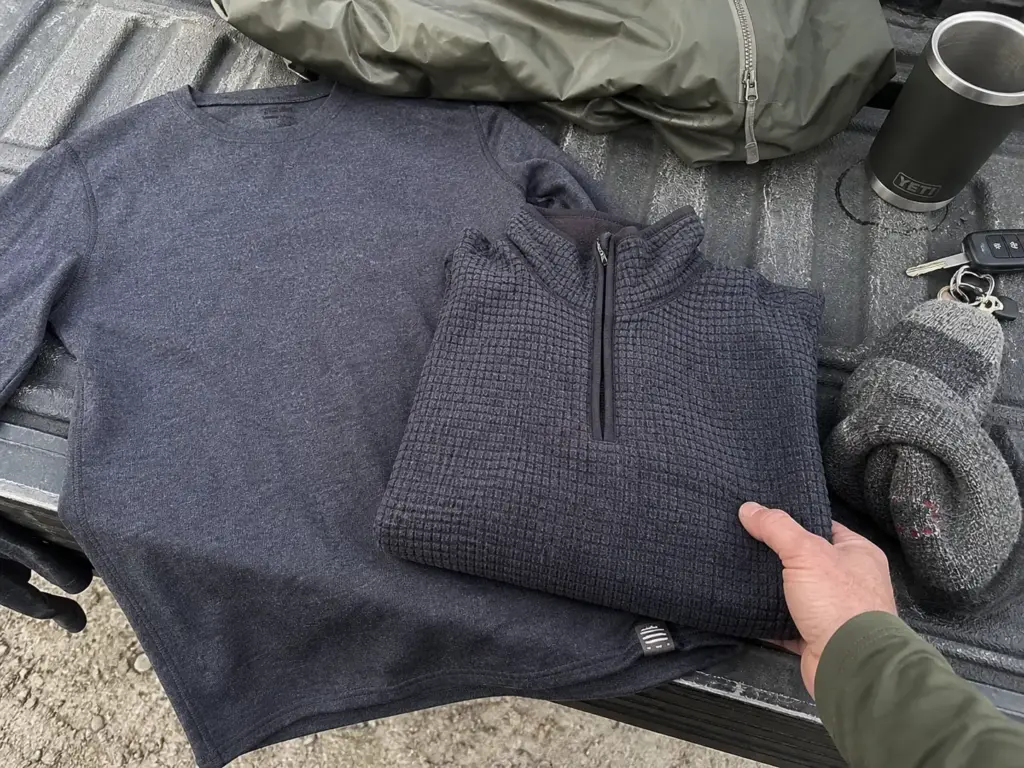
Most anglers arrive at this one garment at a time. A thermal shirt one winter, a fleece the next, a rain jacket the season something finally soaked through, and what you end up with is three pieces that do not talk to each other. A system is the opposite of that: three garments chosen with the other two in mind, which is the same logic that runs through the wider fishing apparel and sun protection system. Winter anglers sometimes call it the sandwich strategy, and the name is more useful than it sounds because it keeps you thinking about the stack rather than the shirt.
The three layers have jobs that are genuinely incompatible with each other. The base layer moves moisture off your skin. The mid layer traps warm air. The outer layer, whether that is a shell or a wading jacket, stops wind and water.
Ask a single garment to do two of those and it does both badly, which is why a heavy fleece-lined thermal worn alone under a rain jacket feels great for an hour and clammy for the next five.
Only one of those three ever touches your skin, and that is why the base layer decides whether the system works at all. Everything above it is managing air and weather. The next-to-skin layer is managing you, specifically the water your body is producing whether you notice it or not.
Systems are built in temperature bands, roughly ten degrees at a stretch, not as one undifferentiated pile of winter clothes meant to cover everything from 45°F down to 10°F. Anglers who fish cold-water fishing conditions all season usually end up with two base weights and one mid layer they combine differently, rather than four separate outfits. It costs less and it fails less.
That combining is the part people skip, and it has a name worth knowing: dynamic layering, or active layer management. The system is not a set of clothes you put on in the parking lot and wear until dark. It is a small kit you keep adjusting, and layer shedding on the walk in is as much a part of it as any garment you bought.
You know your system works when you stop thinking about it halfway through the day. If you are opening and closing zippers every twenty minutes, the problem is one layer deeper than where you are fiddling. People adjust the shell because it has the zipper. The fix is almost always the base.
Why Cotton Fails Next to Your Skin
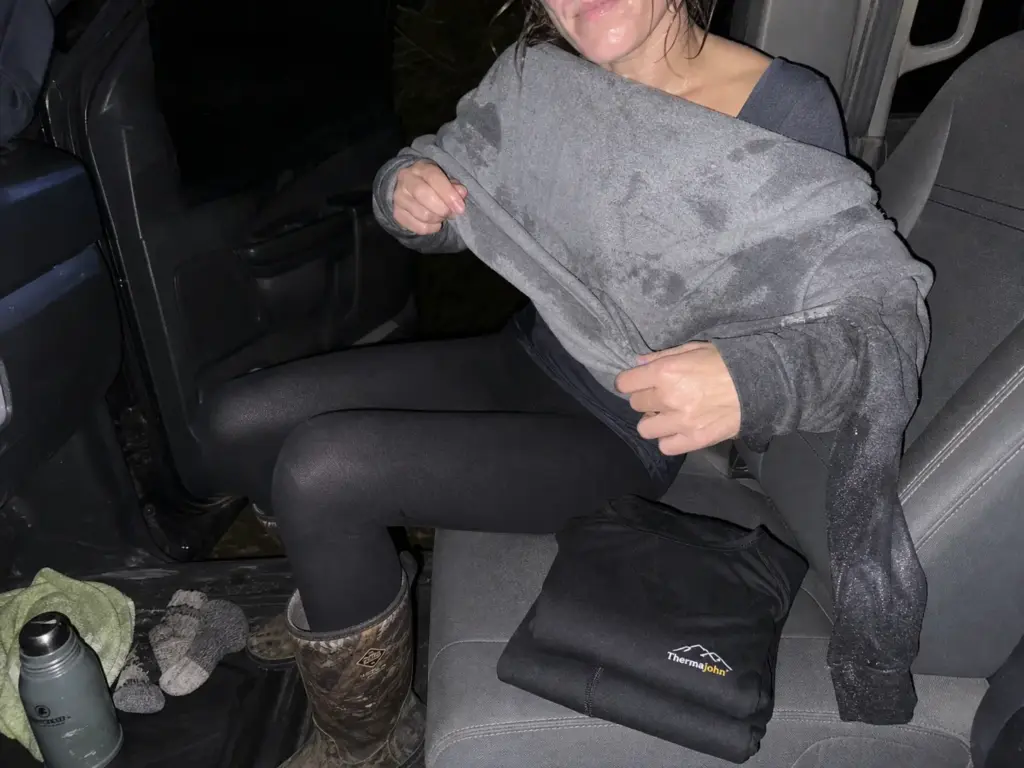
Everyone has heard the cotton kills rule. Almost nobody has heard the reason, which is exactly why the cotton hoodie still ends up in the boat on a mild morning, because “not that cold out” feels like it should override a rule you were never given a mechanism for. The mechanism is what actually changes behavior.
Cotton is a hydrophilic fiber, meaning it pulls water into itself rather than shedding it, and once it does, the fiber structure collapses. Dry cotton insulates because of the still air trapped between and inside its fibers. Wet cotton has no trapped air left. The pockets that were doing the insulating are full of water, and water sitting against skin is a completely different thermal situation than air sitting against skin.
The number that makes this concrete: wet skin loses heat roughly 25 times faster than dry skin against still air. That is the physics behind why wet cotton pulls heat off your skin 25 times faster than still air, and it is the difference between a rule you can ignore and a multiplier you cannot argue with. Once you hold that number in your head, “avoid cotton” stops being folklore.
It gets worse on the drying side. Cotton can absorb up to 27 times its own weight in water, and it releases that water far more slowly than wool or synthetics do. Practically, that means a cotton layer that gets wet at nine in the morning is still wet at three in the afternoon.
There is no recovery window. Wool that gets damp is drying while you fish; cotton that gets damp is simply wet for the rest of the trip.
Stack those two effects and you get the reason a soaked base layer under a genuinely warm jacket still leaves you shivering: wet clothing multiplies your baseline heat loss rate by roughly five. The jacket is not the failure point. Adding another layer on top of a saturated base is treating the symptom at the wrong end of the stack, because the problem is underneath, not above. That is also where cold stops being a comfort question and starts being a hypothermia risk question.
There is one more thing worth knowing, and it is the part that catches people out. Wet cotton does not feel cold at first. It feels heavy. By the time it registers as cold you have already been losing heat for twenty minutes, and twenty minutes is a long head start to give away in November.
This is not a gear-brand marketing position either: the American Hiking Society’s own clothing guidance, which flags cotton as a hazard in cold or hot conditions alike, reaches the same conclusion with nothing to sell you.
Merino vs Synthetic — What Each One Actually Wins At
The question is almost always framed wrong. It is not which material is better. It is which one is better while you are moving versus which one is better once you have stopped, and those turn out to be two different answers with two different reasons behind them.
Merino: keeps working after it’s already wet
Merino wool manages moisture in a way that sounds like a contradiction until you look at the fiber. The core is hydrophilic while the outside behaves as a hydrophobic fiber, so merino absorbs water into the inside of each strand instead of holding it as a film on the surface. The face against your skin stays comparatively dry, and the trapped air between fibers survives, which is why merino keeps insulating when it is already damp.
That single property is why anglers who spend hours motionless drift toward wool: bank fishermen, ice shanty sitters, anyone whose day is mostly standing rather than walking. It is also why merino handles multi-day trips better than the spec sheet suggests. Wool has real odor bacteria resistance built into the fiber, so the same top goes three days without becoming a problem in a shared cabin.
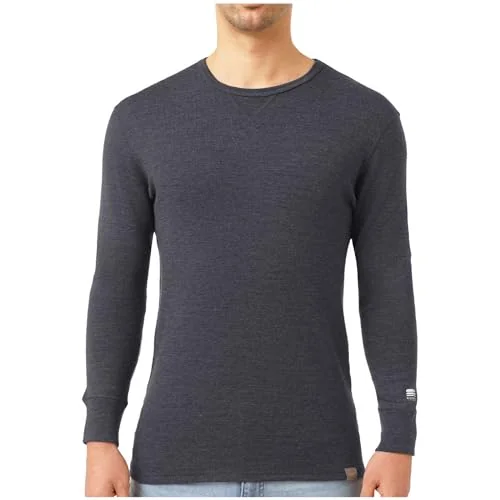
Four hundred grams per square meter is a lot of wool, and that is the point. It is the right call for an ice house or a long static session on the bank, and the wrong call for a day where you walk a mile in before you fish. If your cold-water days lean lighter, the same line in a thinner weight covers the moving half of the year: the MERIWOOL merino base layer in a lighter build (men’s form-fit top · women’s midweight long sleeve) gives you the odor resistance and the damp-state insulation without the sauna effect on the walk in.
Synthetic: wicks and dries faster
A polyester base layer of the Capilene type beats merino on two measurements that matter enormously during the active half of a fishing day: it moves moisture off the skin faster, and it dries faster once wet. If your morning involves rowing, paddling, or high-activity hike-in fishing, that speed is worth more than merino’s damp-state insulation, because the goal during exertion is not to insulate. It is to get the sweat out before you stop.
Synthetics are also tougher against abrasion, which matters more than people expect once a wading belt and a sling pack strap start working on the same two spots for six hours. And they cost less per garment, which means a synthetic base layer is the easier one to own in two weights. Where the fabric technology genuinely earns its price is in fine-gauge wicking fabric construction, not in the marketing name printed on the tag.
The honest verdict
For the moving half of the day, synthetic. For the standing-still half, merino. That is the whole answer, and it is also exactly the tension the next section is about, because most fishing days contain both halves, in sequence, with no chance to change clothes in between.
If you are only buying one, the tiebreaker is not which material wins in the abstract. It is which phase dominates your fishing. Someone who wades and moves constantly should buy synthetic and stop reading comparison charts. Someone who walks twenty minutes and then sits for six hours should buy merino.
The same tradeoff runs through merino and synthetic fishing socks, so whatever you conclude for your torso probably applies to your feet too.
One last thing worth setting expectations on: merino does not feel warmer than synthetic when you first put it on. In the store, on your skin, they feel roughly equivalent. The difference shows up in hour three, after you have sweated once and cooled down once. That is the test, and it is not one you can run in a fitting room.
The Sweat-to-Stand Paradox Nobody Warns You About
This is the failure mode nobody puts in a buying guide, and it is the one that ruins the most fishing days. You arrive warm. You stop. Within five minutes the shirt that was keeping you comfortable has turned into a cold wet rag against your back, and no amount of zipping up fixes it.
Every angler who fishes cold water has lived this. Almost nobody has been told why it happens or what to do differently.
What actually happens when you stop moving
While you are working, whether that is hiking in, rowing, or breaking through brush, evaporation is your cooling system and it is doing its job well. Your body is generating a lot of heat, and moisture vapor transport into the base layer is how it sheds the excess. Thermal regulation is functioning exactly as designed.
Then you stop. Heat generation falls off a cliff within minutes, but every bit of moisture that was in your clothing is still there. The cooling mechanism that was helping you does not switch off politely; it keeps pulling heat out of you at the same rate, only now there is no furnace running underneath to replace it.
Skiers describe the identical thing on a chairlift: an open-weave layer that is brilliant during the climb becomes a liability the moment movement stops and evaporative cooling is no longer a resource. Swap chairlift for standing in a February riffle and it is the same physics with wet feet.
That drop is the thermal crash, and it is also where the stakes change from uncomfortable to consequential, because sustained heat loss in cold water conditions moves toward hypothermia, and that has an actual number attached to it: the National Weather Service’s threshold for hypothermia, a core temperature below 95°F. You are not going to get there from one damp shirt on a mild day. You can absolutely get there from a soaked base layer, a long static session, and an unexpected dunking, and the base layer is the part of that chain you control while getting dressed.
Vent on the way in, not after you arrive
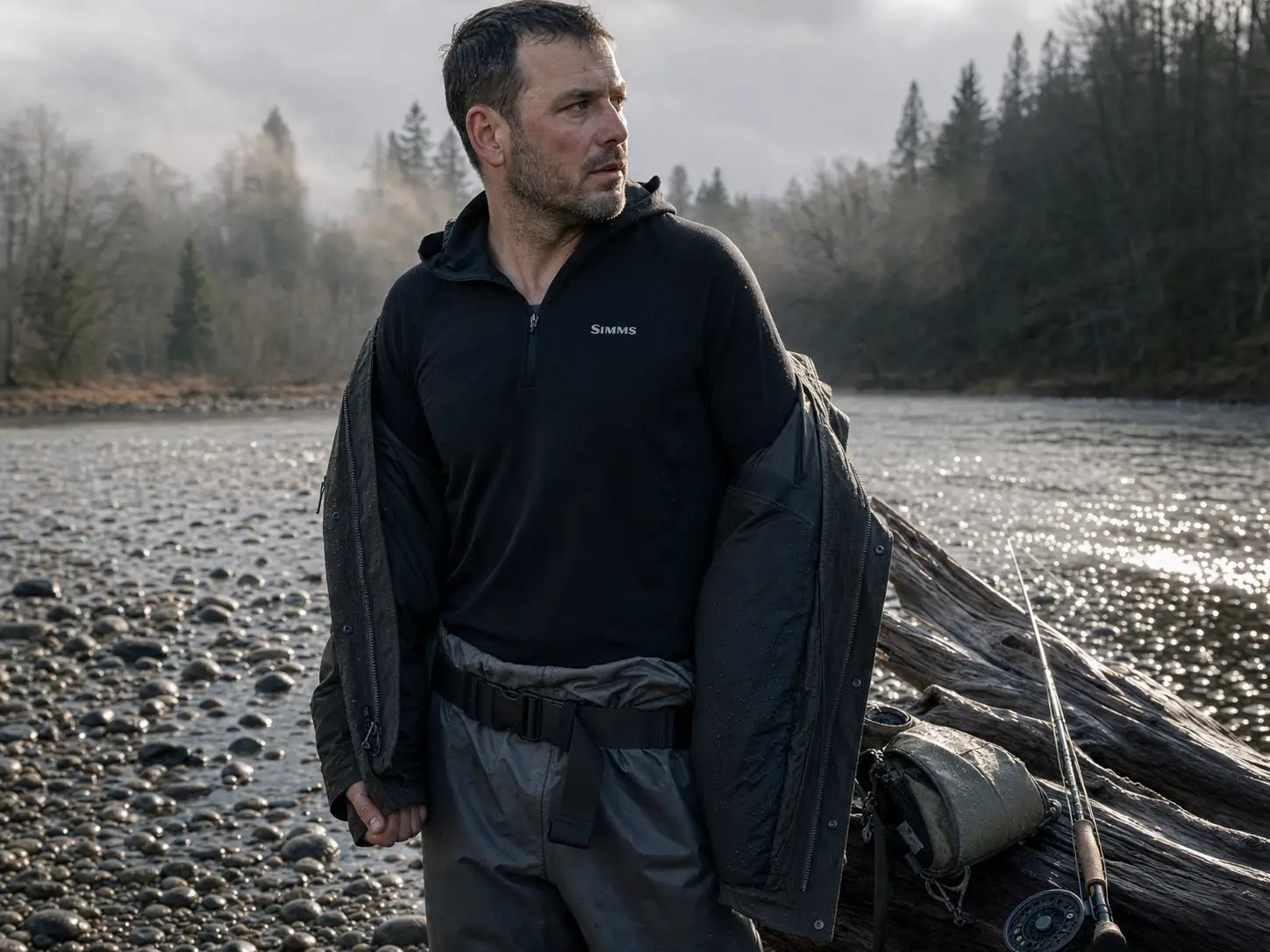
Open everything before you feel warm, not after. Zippers, collar, cuffs: use them aggressively during the walk in, even if you feel slightly cold starting out. Arriving dry beats arriving comfortable by a wide margin, because you can add a layer at the water. You cannot un-sweat a shirt.
The most common version of this mistake is arriving fully zipped, pleasantly warm, and a little damp, then transitioning straight to standing in current. Trapped moisture cools fast in that situation, and the window where you could have done something about it closed twenty minutes back on the trail. Anglers who have figured this out start the walk in slightly underdressed on purpose.
The second version of the mistake is trusting the fabric and skipping the management. A high-performing base layer is not a set-and-forget purchase. A mesh or grid structure gives you a wider ventilation range to work with, but it will not operate the zipper for you. Fabric buys you margin, and active layer management is what spends it well.
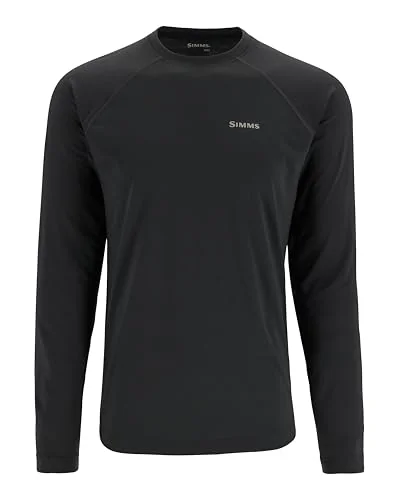
A lightweight top like the Simms Lightweight Baselayer Top is the piece that makes venting work, because a lightweight layer has less water storage capacity to begin with. There is simply less fabric holding less moisture when you stop. Pair it with a mid layer you can add at the water and you have converted the paradox into a two-step routine instead of a problem.
Build for the phase that dominates your day
An ice angler who walks twenty minutes and then sits for six hours has a fundamentally different problem than someone who wades and moves all day. Same water temperature, same air temperature, completely different clothing answer. The first person needs the walk to not soak them and the sit to keep them warm. The second person needs continuous moisture transport and never really goes static at all.
The same split shows up at the ramp in early season. Boat ramp cold at first light, standing around rigging rods with the wind coming off the water, asks for more insulation than the running-and-gunning that follows it, and most people dress for one and suffer through the other.
The classic version of getting this wrong: the ice fisherman who bundles into a heavyweight for the pre-dawn walk out, arrives genuinely sweaty, and then sits for six hours in a damp shirt that cools a degree at a time. He dressed for the coldest number on the thermometer and ignored the fact that he was about to exercise. The heavyweight was the right garment at the wrong point in the sequence.
If your day involves standing still in cold current for hours, weight the whole system toward the static phase and solve the walk in with ventilation rather than with a thinner base. Static cold is much harder to fix once it sets in than transient warmth is.
One field cue worth internalizing: the warning arrives at your neck before it arrives at your torso. When you feel cold on the back of your neck within a few minutes of stopping, the base layer is already saturated. That is your signal to add the mid layer immediately, not in ten minutes when you have finished the run you are working.
Fishnet and Grid Fleece — The Structure Fix
The answer serious winter anglers have converged on is not a better fabric. It is a different structure. It looks faintly ridiculous on the hanger, like someone cut up a landing net and made a shirt out of it, and it works precisely because of what looks wrong about it.
How an open weave beats a solid one
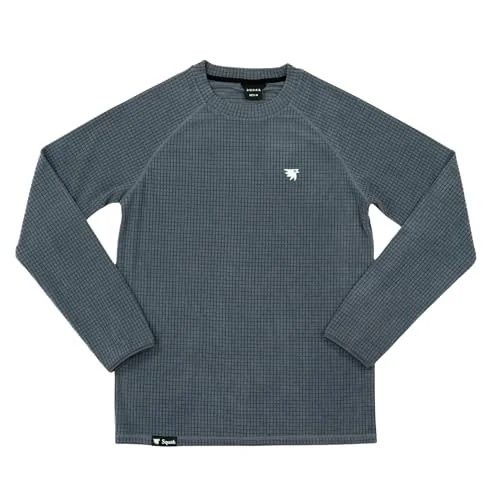
An open-weave or fishnet base layer does two things at once that a solid knit cannot. The strands themselves are minimal and sit against your skin at only a few points, so sweat gets pulled away almost instantly and there is very little fabric to hold it. Meanwhile the holes trap pockets of warm air under whatever mid layer sits on top. Users who fish and hike in these describe the effect as the layer being physically unable to stay damp against the skin, which is a bold claim until you look at how little material is actually in contact.
There is a piece of community vocabulary attached to this that explains a lot: the bellows effect. As you move, the open structure pumps air in and out through the mesh, driving ventilation that a solid knit simply cannot produce. That is why mesh performs so strongly during exertion and, per the previous section, why it needs the most attention when you stop.
The other bit of shorthand you will run into is the Lifa combo: mesh underneath with a close-fitting Lifa polypropylene layer over it. The mesh handles the air gap and the instant pull-away, the polypro layer handles the transport onward. It is a two-piece base layer, and it is more common among cold-weather anglers than any gear guide would suggest.
Polartec Alpha Direct, the synthetic equivalent
Polartec Alpha Direct is the engineered version of the same idea: a 100% polyester lofted grid built for active thermal management. It holds heat when you are still, vents extremely fast when you ramp up, carries a very strong warmth-to-weight ratio, and dries quickly. The design brief amounted to “stop making people take a layer off every twenty minutes,” and it mostly delivers.
The practical value is self-regulation. A conventional fleece has one setting, so you manage temperature by adding and removing it. A grid structure has a working range, which means fewer stops and fewer moments standing in the wind with a jacket half off and your hands full of rod. If you want to understand what happens to that vapor once it leaves the grid, it is worth reading how the shell layer’s membrane handles the vapor your base layer just moved, because the two layers only work as a pair.
The two ways people ruin it
Pair mesh with a smooth-faced mid layer, never another textured fleece. A textured surface pressed against an open weave physically fills the air pockets that make the structure work, and you end up with two expensive layers performing like one cheap one.
The second way to waste the money is compression. A wading belt cinched hard, or a sling pack strap loaded and pulled tight, crushes the loft out of Alpha Direct or mesh exactly where it is bearing. The structure is the insulation, so flattening the structure removes the insulation. You cannot fish without a wading belt, but you can wear the pack strap over the shell instead of under it, and you can stop cranking the belt two notches past comfortable.
Worth knowing before you try one on: if you pull a mesh layer on at home and think it is doing nothing, that means it is correct. Mesh does not insulate by itself. It insulates in combination with the layer on top of it, and judging it barefoot in your living room will send you back to the store for the wrong thing.
Picking the Right Weight Class for Your Water
Weight class is where most of the money gets wasted, and the mistake is always the same shape: people buy for the coldest number in the forecast instead of for what they will actually be doing once they are fishing.
What the gsm numbers actually mean
Base layers are rated in grams per square meter, and the bands are usefully consistent across brands:
- Lightweight, roughly 140–170 gsm: above 60°F, or any temperature when you are working hard.
- Midweight base layer, roughly 200–300 gsm: the 30–60°F range at moderate activity. This is the band most anglers live in.
- Heavyweight base layer, 300 gsm and up: below 30°F, low activity or fully static.
Those numbers describe insulation, not toughness or quality. A 400gsm bargain merino top is warmer than a 200gsm premium one, full stop. What the premium price buys shows up elsewhere, which is the subject of the next section.
Match the weight to the activity, not the forecast
A heavyweight top worn for a mile of river access has you soaked before your line hits the water, and then you spend the rest of the day paying for it. The forecast said 25°F, so the heavyweight felt correct in the driveway. It was correct for standing in the river and wrong for getting there, and there is no way to reverse that decision once you have sweated into it.
Ice fishing is the clearest case because the activity level is genuinely low. The effective range there is about 200–330 gsm, with 200 gsm consistently described as the most versatile middle weight. If you are buying exactly one weight for hard-water season, buy the 200: it is warm enough sitting in the house and it is not a sauna on the walk out. Those same activity-and-temperature thresholds are what drive the same water-temperature thresholds that decide neoprene versus breathable waders, which is a decision worth making on the same logic rather than separately.
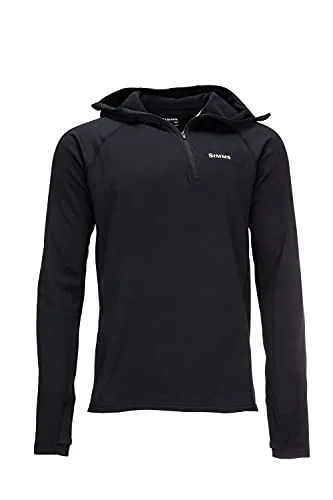
The grid backing is what makes a heavyweight like the Simms Heavyweight Baselayer Hoody more forgiving than its gsm number suggests. A solid-knit heavyweight is a one-setting garment; a grid-backed one has some venting range built in, which softens the penalty if your day turns out to have more walking in it than you planned.
Fit matters as much as weight
A base layer should sit close to the skin without compressing it. Loose fabric creates pockets of humid air that never clear, which is the failure everyone attributes to the material when it was actually the size. Too tight is its own problem: a fully compressive fit presses hard against whatever is over it and can flatten the mid layer’s structure, undoing the thing you paid for. Snug is the target, compressive is not, at least on the cold-weather side of the wardrobe.
The layering system interaction most people get backwards is sizing up. If you need extra room to stack layers, take it in the mid layer, not the base. A half size up in the fleece gives the system space to work. A half size up in the base layer just adds the humid air pockets back.
When a Thirty-Dollar Thermal Is Genuinely Fine
Retailer pages only push premium. Roundups list budget options next to expensive ones and never say a word about when the cheap one actually falls down. So here is the call nobody else makes: a lot of the time, the inexpensive thermal is genuinely enough, and it is worth knowing exactly where that stops being true.
Where cheap thermals genuinely hold up
Short outings, moderate temperatures, steady activity, single day. In those conditions the performance gap between a budget fleece-lined thermal and a technical base layer barely shows up, because you never run the moisture cycle hard enough to expose the difference. You get warm, you stay roughly the same temperature, you go home.
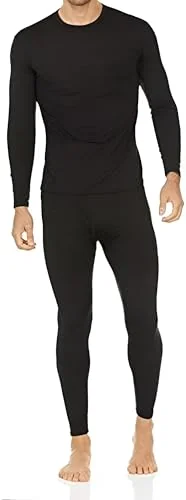
As a base layer under waders for a morning of wading, a thirty-dollar fleece-lined set does the job. That is not a grudging concession. It is the honest answer for a large share of the fishing that most people actually do, including a good deal of casual winter fishing where the day never runs long enough to expose the difference.
Where they start costing you
Multi-day trips are the first place the gap opens, and it opens on odor rather than warmth. Polyester holds smell in a way wool does not, so by day three a budget synthetic set is unpleasant in a way that has nothing to do with performance and everything to do with sharing a cabin.
The bigger functional gap is repeated sweat-and-dry cycling. Fleece-lined polyester dries noticeably slower than a fine-gauge technical synthetic, and the problem never shows up on the first cycle of the day. It shows up on the second, when you have already sweated once, cooled once, and the lining is still holding water from three hours ago. That is also the exact scenario the sweat-to-stand paradox describes, which is why budget gear and static cold are a bad combination specifically.
Then there is durability, and the failure point is seams under a wading belt. Flatlock seams and reinforced stress points are unglamorous features that budget sets tend to skip, and the belt line is where the abrasion concentrates every single day you fish.
Where the money actually goes
What you pay extra for in a premium base layer is not warmth. Gram for gram, insulation is insulation, and a cheap 400gsm top is warmer than an expensive 200gsm one. The premium buys three things: faster drying, odor control, and flatlock seams that do not chafe in hour six.
That last one sounds trivial and is not. Nobody notices a seam until hour six. After hour six, it is the only thing you notice, and the fish stop being the thing you are thinking about. The same reasoning applies further down the system, since the same cold-weather layering logic applies to your hands, where a cheap liner is fine right up until the day it is the thing ruining your afternoon.
Base Layers in Warm Water and Saltwater
Nearly everyone hears base layer and thinks winter. But the saltwater angler wearing a UPF compression shirt all summer is already wearing one. It is just doing a different job with the same mechanism, which is why a sun protection shirt belongs in the same conversation as a 400gsm merino top.
Same principle, opposite direction
Moisture management works in both directions, and the physics does not change with the season. In cold weather you want sweat moved off your skin so it cannot chill you. In hot weather you want the exact same thing, so that evaporation cools you in a controlled way instead of leaving you soaked and sticky in a shirt that has stopped breathing.
Cotton is the worst choice in both directions for the same underlying reason: it saturates, stops moving anything, and then just sits there. The American Hiking Society flags it as a hazard in heat as well as in cold, and on a flats boat in August a saturated cotton shirt stops evaporating and starts acting like a wet blanket.
What UPF adds to the job
A UPF 50+ compression shirt is functionally a base layer with sun protection built in: skin-contact fit, cool-dry construction, active moisture transport, plus a fabric dense enough to block UV. Understanding how UPF fabric actually blocks UV on the water is worth the ten minutes, because the rating comes from weave density and fiber type rather than from a coating that washes out.
On a saltwater boat, sun exposure is the dominant load of the day, not temperature. You are on the water for eight hours with reflection coming off the surface at you from below as well as from above. That is why saltwater fishing apparel is built around UPF and airflow rather than insulation. It changes which property you optimize for, but it does not change the fact that you are choosing a base layer.
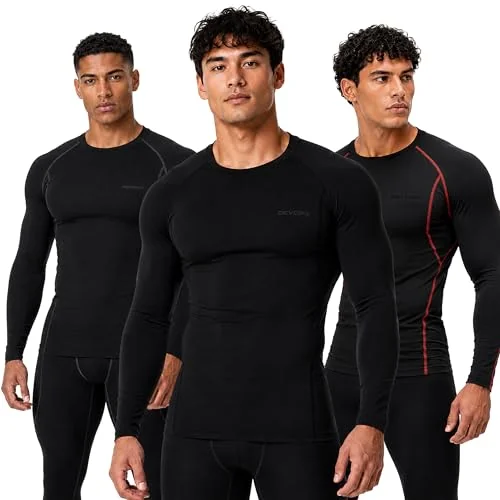
Worth knowing before you buy: UPF ratings survive washing at very different rates depending on how the protection was built into the fabric, which is why it is worth looking at UPF fishing shirts that survive repeated washing rather than assuming the number on the tag is permanent.
The October surprise
The version of this that clicks for most people happens in fall. You wear a lightweight UPF compression shirt all summer as sun protection, think of it purely as hot-weather gear, and then in October you throw it on under a fleece because it is what is clean. And it works genuinely well, because a thin, quick-drying polyester layer with a snug fit is a lightweight base layer whatever the tag calls it.
The garment did not change. The job changed. Once you see that, you stop shopping by season and start shopping by function, which is a cheaper and more useful way to build the whole system.
Conclusion
Pick your material by the phase that dominates your day. Synthetic if you are moving, merino if you are standing still, and if your day is genuinely both, build the system around whichever half is longer.
Vent during the effort, not after it. Arriving dry beats arriving warm every time, and it is the only part of this that costs nothing.
Choose weight by what you will be doing, not by the coldest number in the forecast. A heavyweight top worn for a hike in is a worse choice than a midweight top worn correctly.
On your next cold-water trip, open your zippers on the walk in before you feel warm, and pay attention to how you arrive at the water. It is the cheapest change in the entire system, and it will tell you more about what your base layer needs to do than any spec sheet.
Frequently Asked Questions
01How well do fish net base layers work?
Very well during exertion and less well once you stop, because the open weave moves sweat almost instantly and traps warm air under the mid layer. Pairing it with a smooth-faced mid layer is what makes or breaks the system.
02What is the 3 layer rule for winter?
A base layer that moves moisture, a mid layer that traps warm air, and a shell that blocks wind and water. Each has a separate job, and the base layer decides whether the other two accomplish anything.
03Are base layers better than thermals?
They are the same category under two names. Thermal usually describes a thick fleece-lined garment, while base layer describes the function. What matters is the material and the weight, not the label on the package.
04What is the 80/20 rule in fishing?
The idea that 80 percent of the fish hold in 20 percent of the water. Applied to clothing the parallel holds up: most of your thermal comfort comes from the garment touching your skin, not the jacket everyone can see.
05Can you wear a base layer under waders?
Yes, and it is where fit matters most. Go snug but not compressive, and avoid bulky seams where the wading belt sits, because by hour six that seam is the only thing you will notice.
Risk Disclaimer: Fishing, boating, and all related outdoor activities involve inherent risks that
can lead to injury. The information provided on Master Fishing Mag is for educational and informational purposes
only. While we strive for accuracy, the information, techniques, and advice on gear and safety are not a substitute
for your own best judgment, local knowledge, and adherence to official regulations. Fishing regulations, including
seasons, size limits, and species restrictions, change frequently and vary by location. Always consult the latest
official regulations from your local fish and wildlife agency before heading out. Proper handling of hooks, knives,
and other sharp equipment is essential for safety. Furthermore, be aware of local fish consumption advisories. By
using this website, you agree that you are solely responsible for your own safety and for complying with all
applicable laws. Any reliance you place on our content is strictly at your own risk. Master Fishing Mag and its
authors will not be held liable for any injury, damage, or loss sustained in connection with the use of the
information herein.
Affiliate Disclosure: We are a participant in the Amazon Services LLC Associates Program, an
affiliate advertising program designed to provide a means for us to earn advertising fees by advertising and linking
to Amazon.com. As an Amazon Associate, we earn from qualifying purchases. We also participate in other affiliate
programs and may receive a commission on products purchased through our links, at no extra cost to you. Additional
terms are found in the terms of service.