
In this article
Last October I spent three days fishing the same 200-yard stretch of river. Day one, the smallmouth were stacked on a gravel flat behind a mid-river boulder, hammering tubes on every cast. Day two — same spot, same water, same lure — nothing. Not a bump. They’d moved 300 yards downstream overnight into a deeper pool I’d walked past without a second look. That’s fall smallmouth fishing on rivers. The fish are on a schedule you didn’t get a copy of, and figuring it out is the whole game.
Fall is the best window to catch numbers and size on river smallmouth. But the fish aren’t where they were in summer, they aren’t doing what they were doing in summer, and the presentations that worked in August will get you skunked by mid-October. Here’s what actually drives the fall pattern and how to stay on fish as they shift.
Quick Answer: Fall smallmouth bass in rivers follow a predictable downstream migration triggered by dropping water temperatures. Here’s what you need to know:
- Fish start moving when water hits 61°F — not before
- The migration covers up to 18 miles toward deeper wintering holes
- Three distinct phases (early, mid, late) require different lure speeds and locations
- Slow your retrieve by 50% compared to summer — this is the single biggest adjustment
- Overcast days with falling barometric pressure produce the best bite windows
- Handle cold-water fish carefully — delayed mortality spikes below 50°F
The Three Phases of Fall Smallmouth — Early, Mid, and Late
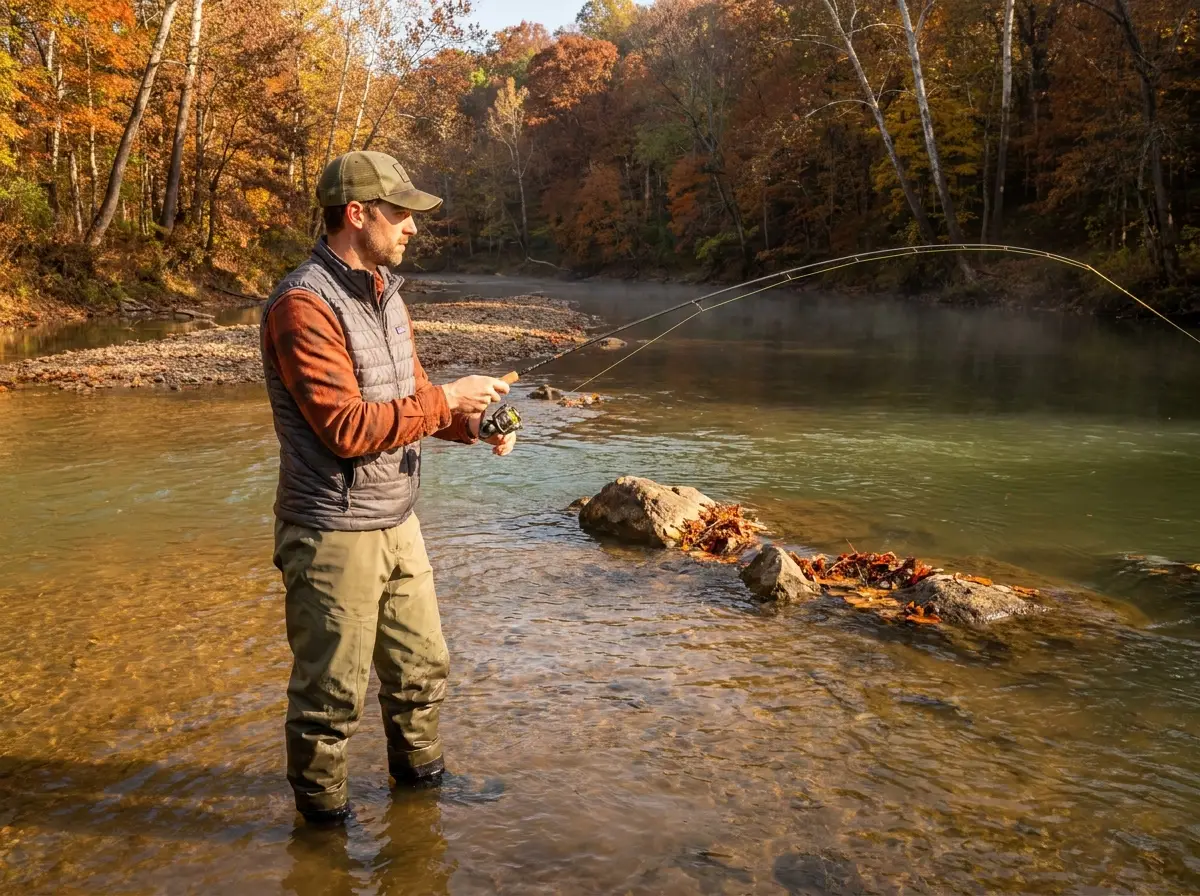
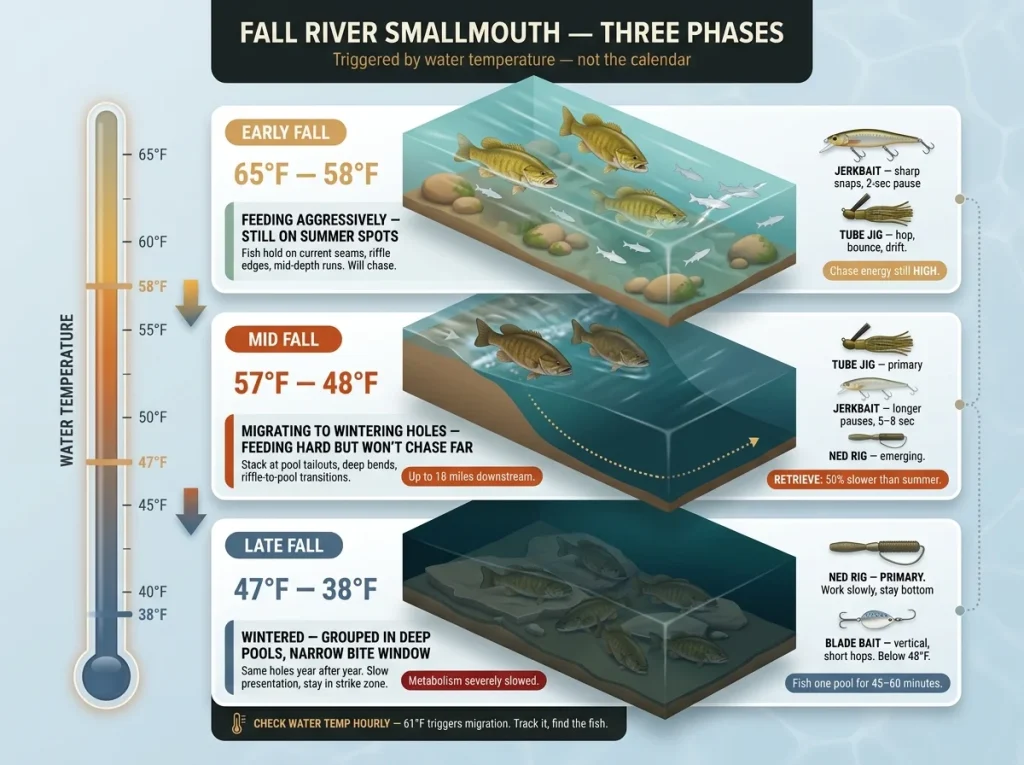
Most fishing content treats fall as one season. It’s not. River smallmouth go through three distinct behavioral phases between September and December, and each one demands a different approach. The trigger for all of it is water temperature — not the calendar, not the leaves changing, not your gut feeling.
Early Fall (Water Temps 65°F–58°F)
This is the feed-up. Smallmouth are still on their summer spots — current seams, riffle edges, and mid-depth runs — but they’re eating with an urgency that wasn’t there in August. The fish sense what’s coming. Shad and crawfish are both active, and smallmouth are keying on whichever forage is more available in your particular stretch.
Your retrieve can still be moderately aggressive here. Jerkbaits with sharp snaps and two-second pauses work because the fish are willing to chase. Tubes bounced along current breaks produce consistently. This is the phase where most anglers do well without changing much from their summer approach — and then get confused when it stops working.
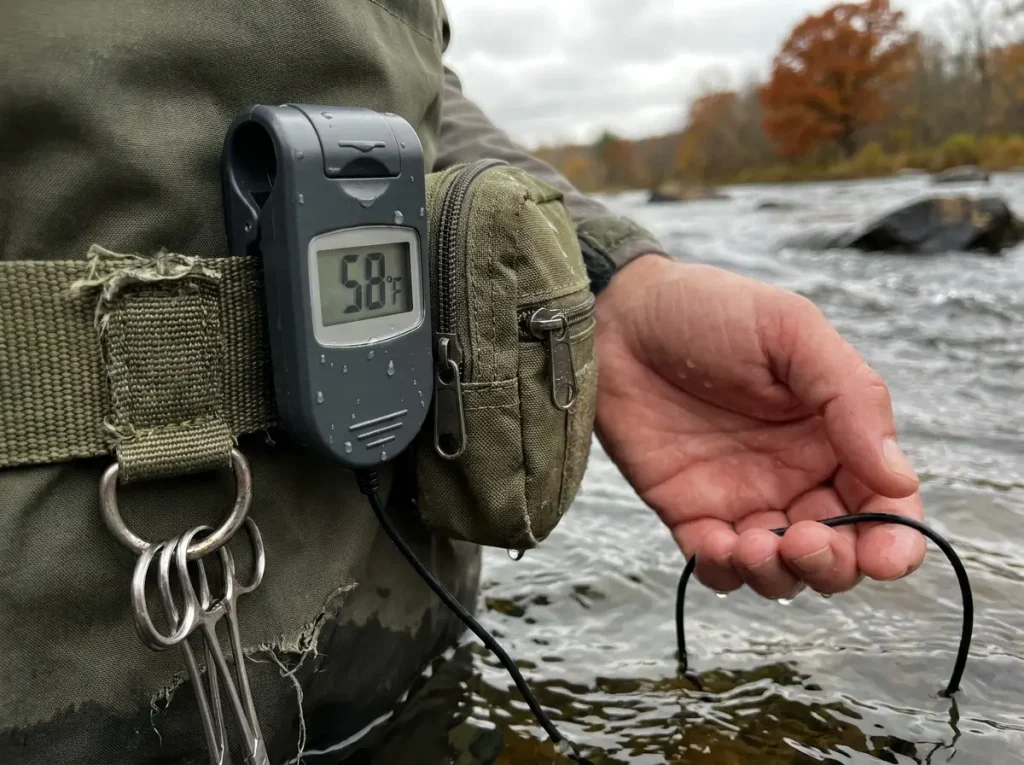
Pro tip: Clip a digital water thermometer to your wading belt and check it every hour. When you see the reading drop from the mid-60s into the upper 50s over a few trips, the early phase is ending. That’s your signal to slow everything down and start looking downstream.
Mid Fall (Water Temps 57°F–48°F)
This is when the migration kicks in. Smallmouth begin moving downstream toward their wintering holes — deeper pools with slower current, rocky substrate, and often some wood cover. A USGS study at Bonneville Dam tracked smallmouth traveling an average of 18 miles during the fall transition. They don’t move all at once. It happens in stages, usually triggered by overnight temperature drops.
The fish are concentrated along the migration corridor, stacking up at predictable spots: pool tailouts, deep bends, and the transitions between riffles and runs. They’re still feeding hard — this is actually the highest-calorie intake period of the year for river smallmouth — but they won’t chase far. Your presentations need to come to them.
If you understand how water level changes affect fish positioning, apply that same logic here. The fish are reading current speed and depth the same way — they want the most food for the least energy expenditure.
Late Fall (Water Temps 47°F–38°F)
The migration is over. Smallmouth are on their wintering holes and they’re not leaving until spring. Metabolism has slowed significantly. You’ll find clusters of fish — sometimes a dozen or more — holding within a surprisingly small area of the pool. They’ll eat, but the window is narrow and the presentation has to be precise.
This is Ned rig and blade bait territory. Anything that can be worked slowly along the bottom without leaving the strike zone. If you’re used to covering water, this phase forces you to slow down and fish a single pool for an hour. That patience is the price of admission.
Reading the River — Where Fall Smallmouth Actually Hold
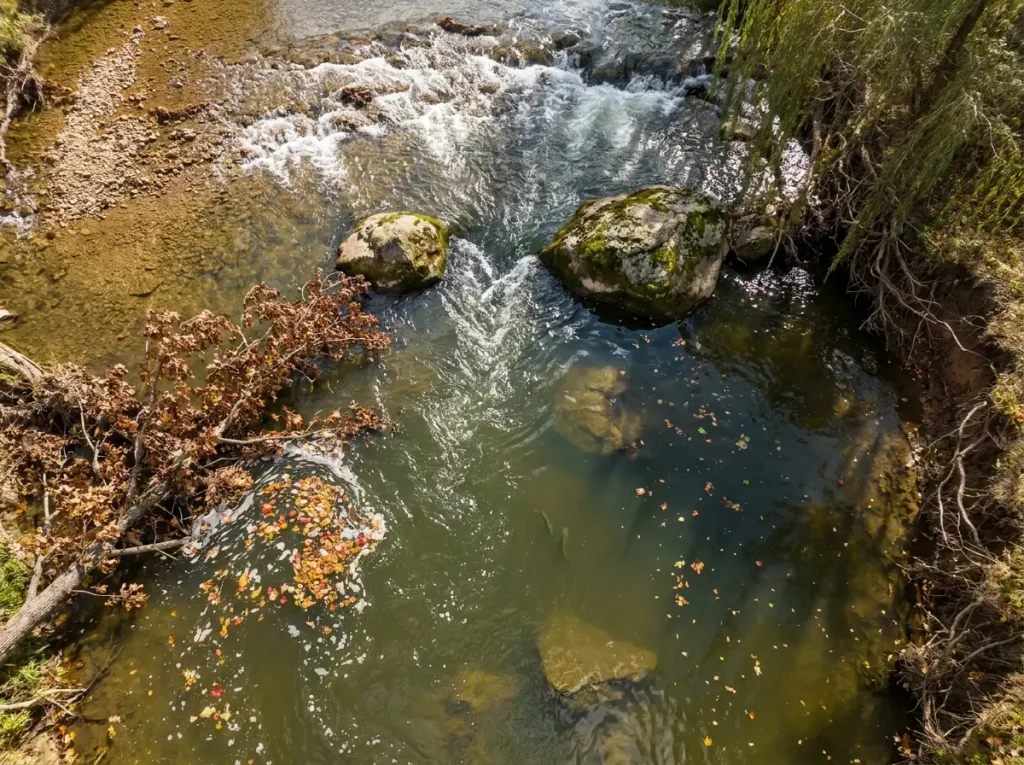
Knowing that smallmouth migrate downstream doesn’t help unless you can identify where they stop along the way. The fish aren’t picking random spots. They’re choosing locations based on four factors: depth, current speed, substrate, and overhead cover.
The Transition Zone
The single most productive fall structure is the transition between a riffle and a deep pool. Stand at the tail of any riffle and look downstream — you’ll see the water change color from pale green to dark olive as the bottom drops away. That color break is where smallmouth stage. They sit right on the edge, faces into the current, intercepting forage that washes down from the faster water above.
Cast upstream of the transition and let your lure sweep through the zone naturally. The take usually happens right at the depth change — you’ll feel the bottom disappear and then the rod loads.
Current Seams and Eddies
Where fast water meets slow water, a visible line forms on the surface. Foam, leaves, and debris collect along this seam. Smallmouth hold just inside the slow side, using the seam as a conveyor belt that delivers food without requiring effort. Back eddies behind large boulders or downed trees create the same effect on a smaller scale.
Reading water like this separates the angler who catches fish in every pool from the one who hammers only the obvious spots. If you want to go deeper on identifying productive structure, our guide on reading USGS stream gauges helps you find rivers at the right flow before you even leave the house.
The Wintering Hole Checklist
Not every deep pool is a wintering hole. The spots smallmouth choose share specific characteristics: relative depth (deepest section within a reasonable stretch), rocky or cobble substrate (not mud or sand), some woody debris for cover, minimal heavy current, and — this one surprises people — access to direct sunlight for at least part of the day. Virginia’s Department of Wildlife Resources confirms that wintering smallmouth select pools where thermal gain from sunlight creates micro-temperature advantages.
Once you find a real wintering hole, mark it. Fish return to the same one year after year.
The Fall Migration — How Far They Go and Why
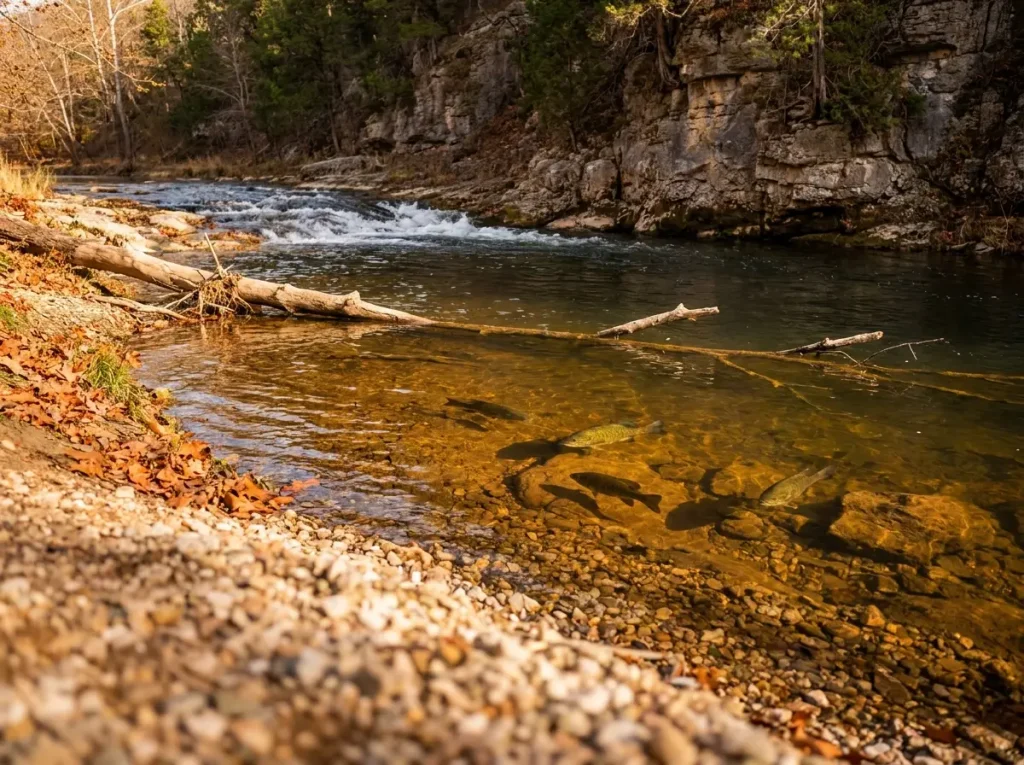
River smallmouth aren’t homebodies. The 18-mile average migration documented in USGS research means some fish travel much farther — and a few barely move at all. The distance depends on the river’s geography. Fish in rivers with abundant deep pools don’t need to go far. Fish in long, shallow stretches may cover serious distance to reach adequate wintering water.
The trigger is consistent: 61°F water temperature. Below that threshold, smallmouth shift from territorial summer behavior to migratory fall behavior. They stop defending a specific rock or run and start moving with purpose. You can feel the change on the water. A spot that held reliable fish for months goes quiet practically overnight.
The migration follows the path of least resistance — the main channel. Fish don’t cut through riffles to reach a pool on the other side. They slide downstream through the deepest available corridor, stacking up temporarily at every piece of structure that offers a feeding opportunity and a current break.
Pro tip: Fish the same river through September and October, hitting a different section each trip. Mark where you catch fish on a map with the date and water temperature. By year two, you’ll have a migration calendar specific to your water that tells you exactly which pools hold fish at which temperatures. No guide will give you that data.
For a full breakdown of smallmouth biology and how their sensory systems drive these movements, check our smallmouth bass species guide.
Lures That Earn Bites When the Water Cools
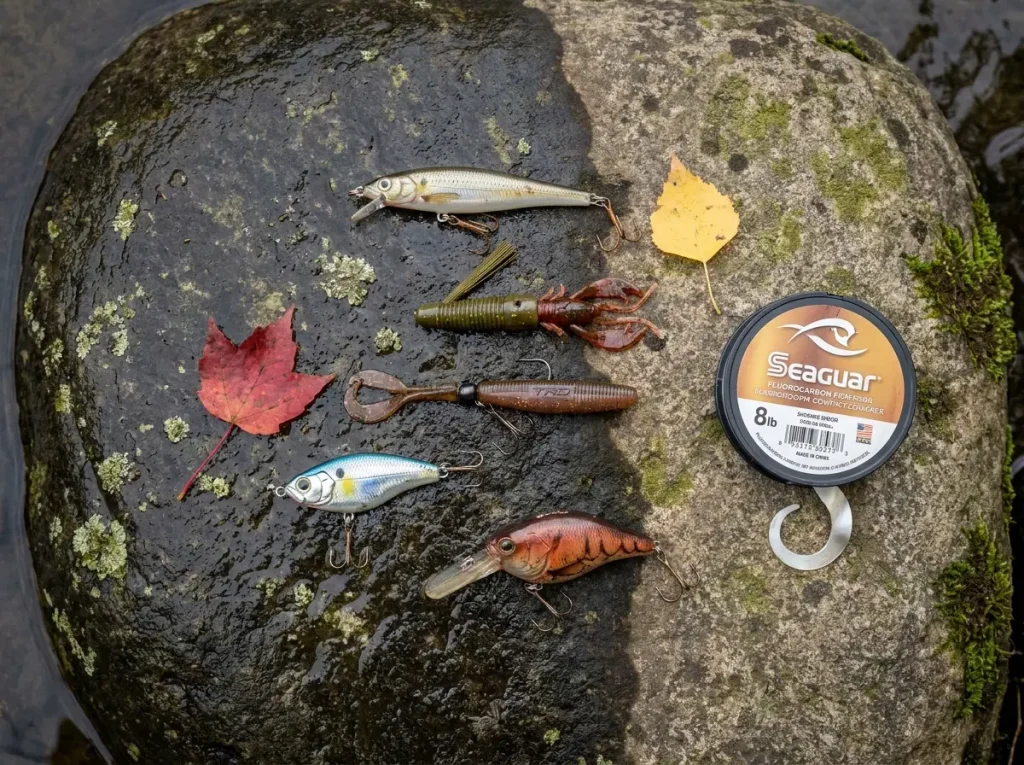
Summer smallmouth eat fast and sloppy. Fall smallmouth are selective. The metabolism is slowing, and every calorie spent chasing a lure has to be worth the return. Your tackle box needs to reflect that math.
The Core Four
Tubes — A 3.5-inch tube on a 3/8-ounce mushroom-head jig is the most reliable fall river smallmouth presentation across every temperature phase. Green pumpkin in clear water, smoke in stained water. Hop it along the bottom or dead-drift it through transitions. The tube imitates both a crawfish and a sculpin depending on how you work it — and smallmouth eat both all fall.
Jerkbaits — A Rapala X-Rap in natural shad colors works the early and mid phases when fish still have chase energy. The key is pausing longer than feels comfortable. We’ll get into cadence in the next section, but the short version: if you think you’re pausing long enough, double it.
Ned rig — A natural brown Z-Man TRD on a 1/6-ounce Ned head is the late fall specialist. It stands up off the bottom, moves with subtle current action, and stays in the strike zone when nothing else can. Our finesse fishing guide covers the line and rod setup that makes this presentation work.
Blade baits — When water drops below 48°F and everything else stops producing, a blade bait ripped vertically off the bottom triggers reaction strikes from fish that won’t chase a horizontal retrieve. Short hops, tight to the bottom. The blade bait winter guide breaks down the mechanics if you haven’t thrown one before.
What to Leave Home
Spinnerbaits, big swimbaits, and anything with a fast-retrieve design. These are summer tools. Fall smallmouth won’t run down a lure that’s moving faster than the forage around them. Match your lure color to the current water temperature — natural patterns outperform bright colors once water drops below 60°F.
Retrieve Speed — The One Adjustment That Changes Everything
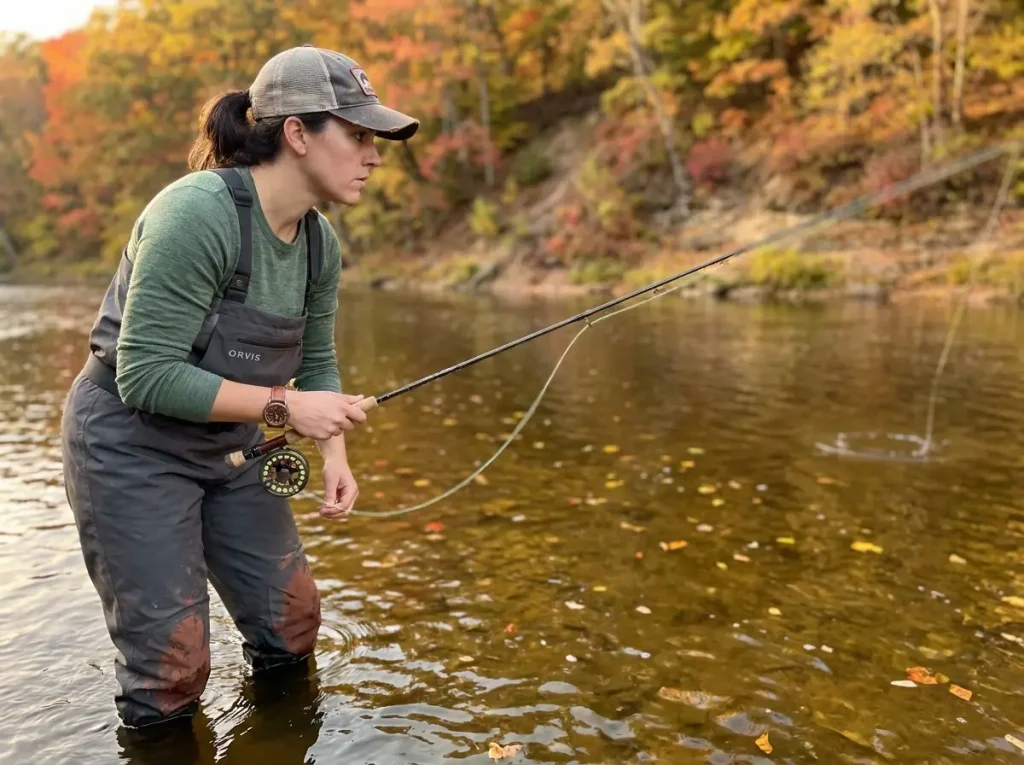
I’ve watched anglers with the right lure on the right spot at the right time catch nothing because they were working it too fast. Retrieve speed is the invisible variable that separates a limit day from a blank in fall river fishing.
The 50% Rule
Whatever your summer retrieve speed was — cut it in half. That’s your starting point for early fall. By mid-fall, cut it in half again. By late fall, you’re barely moving the lure at all. This isn’t a suggestion. It’s the physics of cold-water fish metabolism. Smallmouth below 55°F physically cannot accelerate fast enough to catch a lure moving at summer speed. You’re not being patient for style points — you’re matching the fish’s capability.
Jerkbait Cadence in Cold Water
The jerkbait cadence guide covers the full science, but here’s the fall-specific application: two sharp snaps, then pause. In early fall, pause three seconds. In mid-fall, pause five to eight seconds. In late fall, pause ten seconds or more. The fish aren’t ignoring your lure — they’re approaching it slowly and waiting for it to stop before committing.
Keep the rod tip low, almost touching the water. Slack line between snaps lets the jerkbait glide and suspend rather than ripping forward. The strike usually comes during the pause — you’ll see the line jump sideways before you feel the weight.
Bottom Contact Is Non-Negotiable
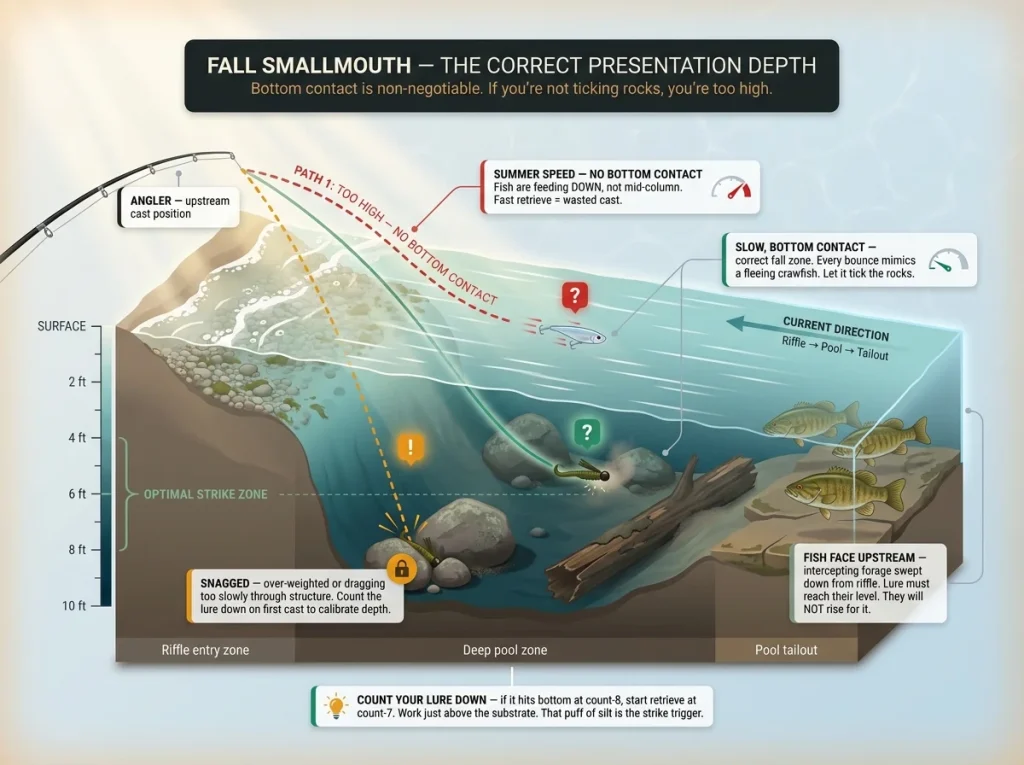
Tubes, Ned rigs, and blade baits all share one requirement: they need to be on or within six inches of the bottom. If you’re not occasionally ticking rocks, you’re too high. Fall smallmouth feed down, not up. They’re not looking at the surface or mid-column. Every cast that doesn’t reach bottom is a wasted cast.
Pro tip: Count your lure down on the first cast to a new spot. If your tube hits bottom at a count of eight, start your retrieve at seven on the next cast. You want to be working just above the substrate, close enough that the jig head bumps rocks and kicks up silt. That disturbance mimics a fleeing crawfish — and nothing triggers a smallmouth faster.
Early Morning, Overcast, or Falling Temps — When to Be on the Water
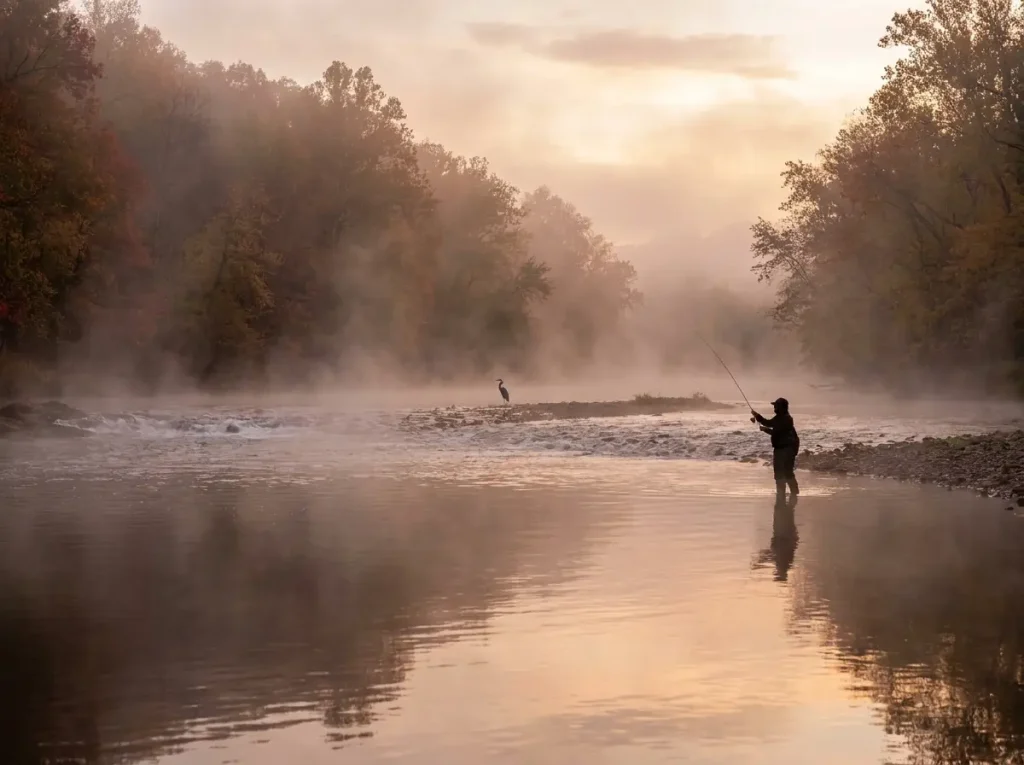
Fall smallmouth feed in predictable windows. Miss the window and you’ll think the river is empty. Hit it and you’ll wonder why you ever fished any other season.
The Morning Bite
The best window is the first two hours after sunrise. Water temperature is at its daily low, but light levels are increasing — and that combination triggers feeding activity in a way that midday sun doesn’t. Smallmouth that spent the night tucked behind boulders move to the front of current seams and start actively intercepting forage.
This window compresses as fall progresses. In early fall, the morning bite can run three or four hours. By late fall, you might get forty-five minutes before the fish go quiet.
Overcast Days Win
Cloud cover eliminates harsh shadows and gives smallmouth confidence to hold in shallower, more exposed water. On sunny fall days, the fish push tighter to structure and become more position-dependent. On overcast days, they roam. Roaming fish are feeding fish.
The fall baitfish migration guide explains why shad movement also increases under cloud cover — and where shad go, smallmouth follow.
Falling Barometer, Rising Activity
A dropping barometric pressure — the 12 to 24 hours before a front moves through — is the single best feeding trigger in fall river fishing. The fish sense the pressure change and feed aggressively before conditions deteriorate. The day after the front passes, with high pressure and blue skies, is usually the worst fishing day of the week.
Plan your trips around the weather, not around your schedule. One overcast pre-frontal morning in October is worth three sunny weekend afternoons.
Catch and Release in Cold Water — Handle Them Right
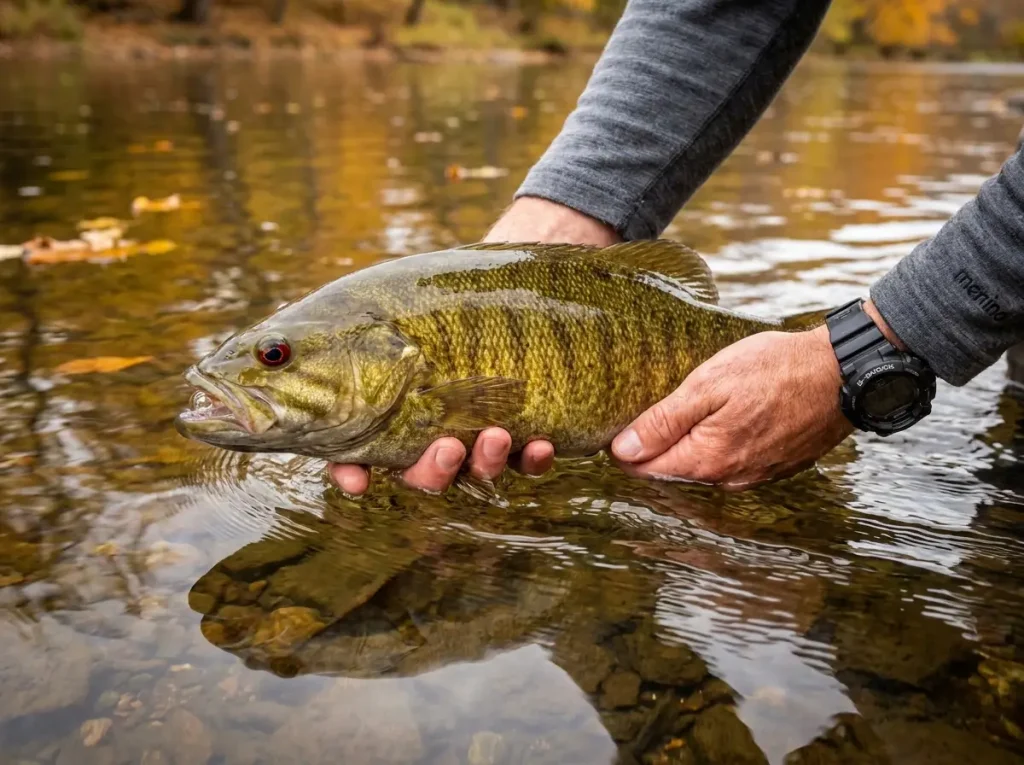
Fall smallmouth are building fat reserves they’ll live on through winter. A fish that dies after release in November is a fish that won’t spawn in May. Cold-water handling requires more care than warm-water release, and most anglers don’t adjust their approach.
Why Cold Water Changes the Equation
Below 50°F water temperature, smallmouth metabolism slows to the point where recovering from the stress of being caught takes significantly longer. Lactic acid buildup from the fight doesn’t clear as quickly. A fish that would recover in 30 seconds during summer might need two or three minutes of careful revival in 45-degree water. Factor that into every fish you land.
The Handling Rules
Wet your hands before touching the fish — always, but especially now. Dry hands strip mucus faster from cold-water fish because the protective slime layer thins in low temperatures. Support the belly. No lip grips that let the fish hang vertical — the internal organs compress and the jaw joint strains under the fish’s full weight. Keep the fish in the water as much as possible. If you need a photo, lift, shoot, and get the fish back in the current within ten seconds.
The Revival
Face the fish upstream into gentle current — not fast water that overwhelms a tired fish, and not dead-still water that doesn’t push oxygen across the gills. Hold the fish upright with one hand on the belly and one hand lightly gripping the tail. Wait until the fish kicks hard against your hand before letting go. If it rolls on its side, it’s not ready. Pick it up and start again.
For more on why proper handling matters to fishery health, our guide on catch-and-release regulations covers the science behind survival rates.
Pro tip: Barbless hooks aren’t just ethical — they’re practical in cold water. A barbed treble buried in a smallmouth’s jaw at 45°F means extended handling time, forceps work, and a fish that goes back stressed. Pinch your barbs before your first cast. The hookup rate barely changes, and the release goes from a wrestling match to a two-second operation.
Conclusion
Fall river smallmouth fishing comes down to three things: track the water temperature because it tells you which phase the fish are in and how to adjust, learn to read the transition zones and wintering holes that concentrate fish during the migration, and slow your presentation speed until it feels almost painfully slow — then slow it down a little more.
The angler who checks water temps, fishes the migration corridor instead of summer spots, and has the patience to let a Ned rig sit on the bottom for ten seconds between hops will outfish everyone else on the river. These fish are predictable once you understand the pattern.
Pick a stretch of river. Fish it every week from September through November. The education is worth more than anything you’ll read — including this.
Q1 What water temperature triggers fall smallmouth migration in rivers?
Smallmouth bass begin their downstream fall migration when river water drops to approximately 61°F. The move happens in stages as temperatures continue falling, with fish reaching wintering holes by the time water hits the mid-40s.
Q2 How far do river smallmouth bass migrate in fall?
USGS tracking studies document an average fall migration of 18 miles, though distance varies by river. Fish in rivers with abundant deep pools move shorter distances, while those in shallow stretches may travel considerably farther.
Q3 What is the best lure for fall smallmouth bass in rivers?
A 3.5-inch tube jig on a 3/8-ounce mushroom head is the most consistent fall producer across all temperature phases. Supplement with jerkbaits in the early phase and Ned rigs in the late phase as water cools below 48°F.
Q4 When is the best time of day to catch fall smallmouth?
The first two hours after sunrise produce the most consistent action. Overcast days extend this window. The 12 to 24 hours before a cold front — when barometric pressure is falling — creates the strongest feeding response of the fall season.
Q5 How do you safely release smallmouth bass in cold water?
Wet your hands, support the belly, keep the fish in the water, and face it upstream into gentle current until it kicks free. Cold-water fish need longer revival time because slowed metabolism delays lactic acid recovery. Use barbless hooks to minimize handling.
Risk Disclaimer: Fishing, boating, and all related outdoor activities involve inherent risks that
can lead to injury. The information provided on Master Fishing Mag is for educational and informational purposes
only. While we strive for accuracy, the information, techniques, and advice on gear and safety are not a substitute
for your own best judgment, local knowledge, and adherence to official regulations. Fishing regulations, including
seasons, size limits, and species restrictions, change frequently and vary by location. Always consult the latest
official regulations from your local fish and wildlife agency before heading out. Proper handling of hooks, knives,
and other sharp equipment is essential for safety. Furthermore, be aware of local fish consumption advisories. By
using this website, you agree that you are solely responsible for your own safety and for complying with all
applicable laws. Any reliance you place on our content is strictly at your own risk. Master Fishing Mag and its
authors will not be held liable for any injury, damage, or loss sustained in connection with the use of the
information herein.
Affiliate Disclosure: We are a participant in the Amazon Services LLC Associates Program, an
affiliate advertising program designed to provide a means for us to earn advertising fees by advertising and linking
to Amazon.com. As an Amazon Associate, we earn from qualifying purchases. We also participate in other affiliate
programs and may receive a commission on products purchased through our links, at no extra cost to you. Additional
terms are found in the terms of service.