

In this article
I still remember the sound. It wasn’t the scream of a drag peeling under the weight of a tuna; it was the sickening, gritty crunch of a pinion gear disintegrating inside a “saltwater-ready” reel I had neglected for a season. That sound costs money, but importantly, it costs fish.
Saltwater angling demands vigilance; the salt does not wait for permission to destroy your equipment. It begins its work the moment the first sea spray hits the deck. The ocean is effectively a massive, conductive battery, and your gear is a collection of anodes and cathodes waiting to equalize.
In my decades on the water, I’ve learned that a simple freshwater rinse is just a band-aid. To truly preserve the tools of our trade and ensure boating longevity, we must move beyond reactive marine maintenance and adopt a proactive discipline rooted in electrochemical reality. This isn’t just about cleaning; it is about understanding why saltwater corrosion prevention fails and how to stop saltwater corrosion by fighting physics with chemistry.
What Actually Happens to Gear in Saltwater? (The Science of Decay)
Why does saltwater act like a battery for fishing tackle?
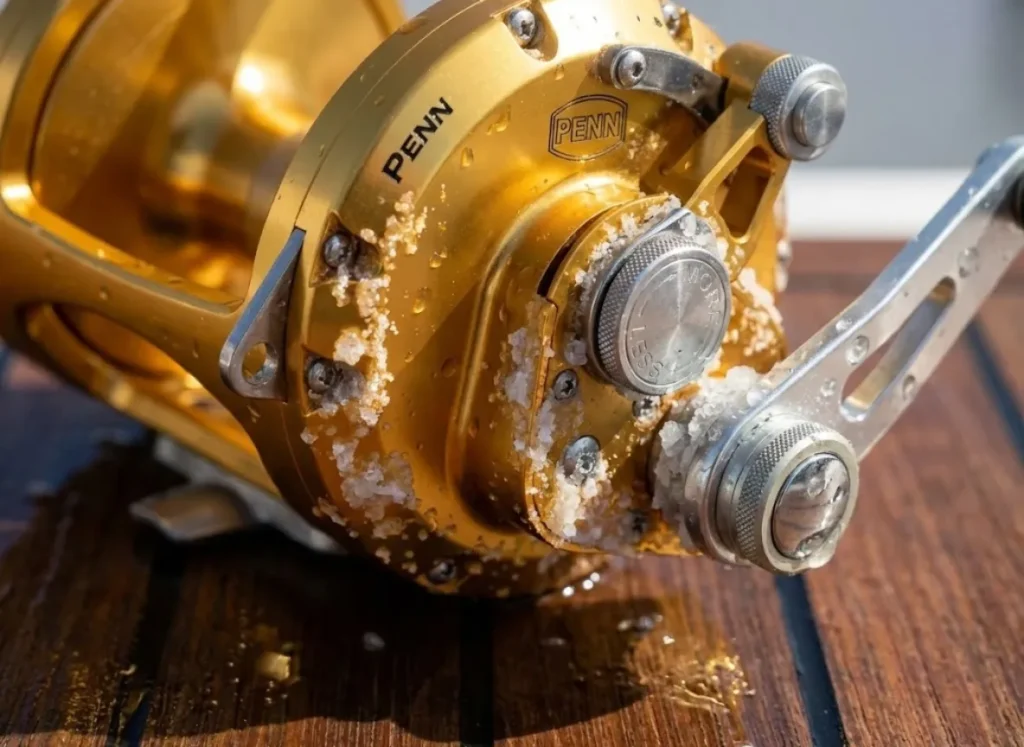
Saltwater acts as a saltwater electrolyte, a solution rich in dissolved ions that facilitates the flow of electrons between different metals, effectively turning your reel into an electrical circuit.
When you look at your reel, you see a machine. Chemistry sees a battery driven by high salinity levels. When two dissimilar metals—like a marine-grade stainless steel screw and an aluminum body—are connected in the presence of this electrolyte, they form galvanic cells. This creates an electrical potential of metals.
In this scenario, the “active” metal corrodes sacrificially to protect the “noble” metal. This process, known as galvanic corrosion (or electrolysis in common parlance), is the primary driver behind seized reels, stuck side-plate screws, and pitted reel feet. It is rarely simple metal oxidation; it is electricity at work.
The speed of this decay is determined by the voltage difference between the materials. Government data on electrochemical interactions between dissimilar metals highlights how the further apart two materials are on the galvanic series, the faster the destruction occurs.
Once you realize that your reel is generating its own destructive current, you understand why a quick hose-down isn’t enough. It reduces the surface salts, but it doesn’t change the metallurgy. This is a fundamental concept when comparing saltwater vs freshwater durability, as the latter rarely faces such aggressive electron flow.
Which Materials Are Most Vulnerable to the Salt? (Asset Triage)
How does the “Galvanic Hierarchy” dictate your maintenance routine?
Materials in fishing tackle exist in a hierarchy of nobility: Graphite and Carbon Fiber are the most noble (protected), while Magnesium and Zinc are the most active (sacrificial).
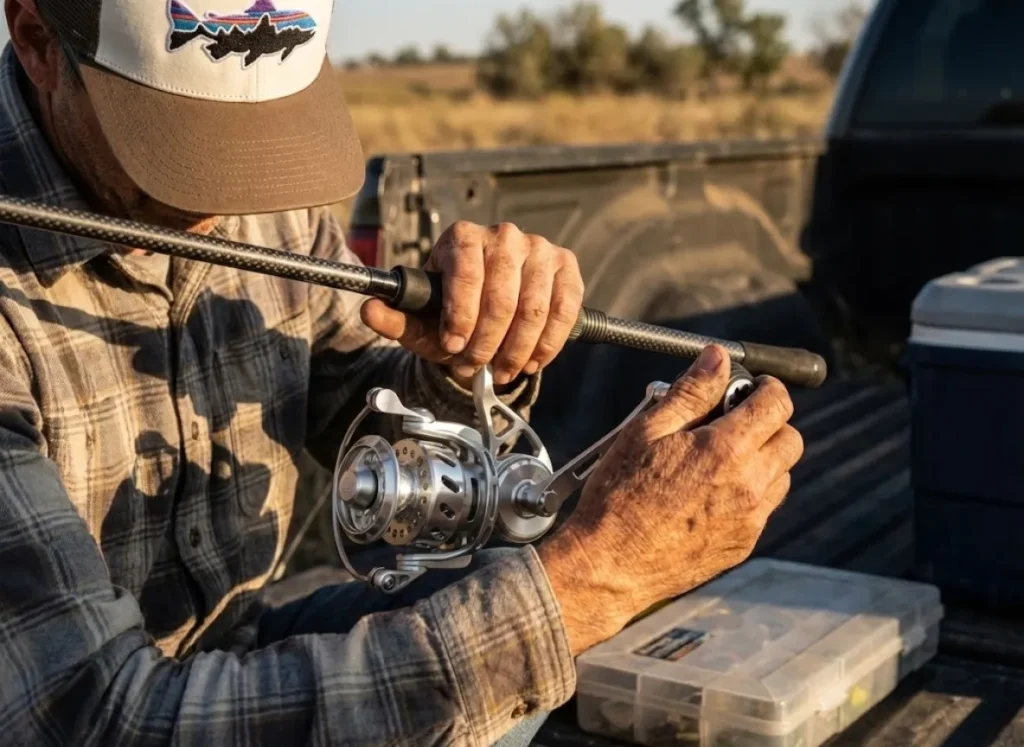
We often think of carbon fiber as the ultimate material for durability, but chemically, it acts as a “Super-Cathode,” similar to noble metals. Because it is so noble, it will aggressively drive corrosion in any aluminum or magnesium parts it touches if the protective resin barrier is breached. This is similar to why boat hulls use sacrificial anodes (zincs) to protect the transom.
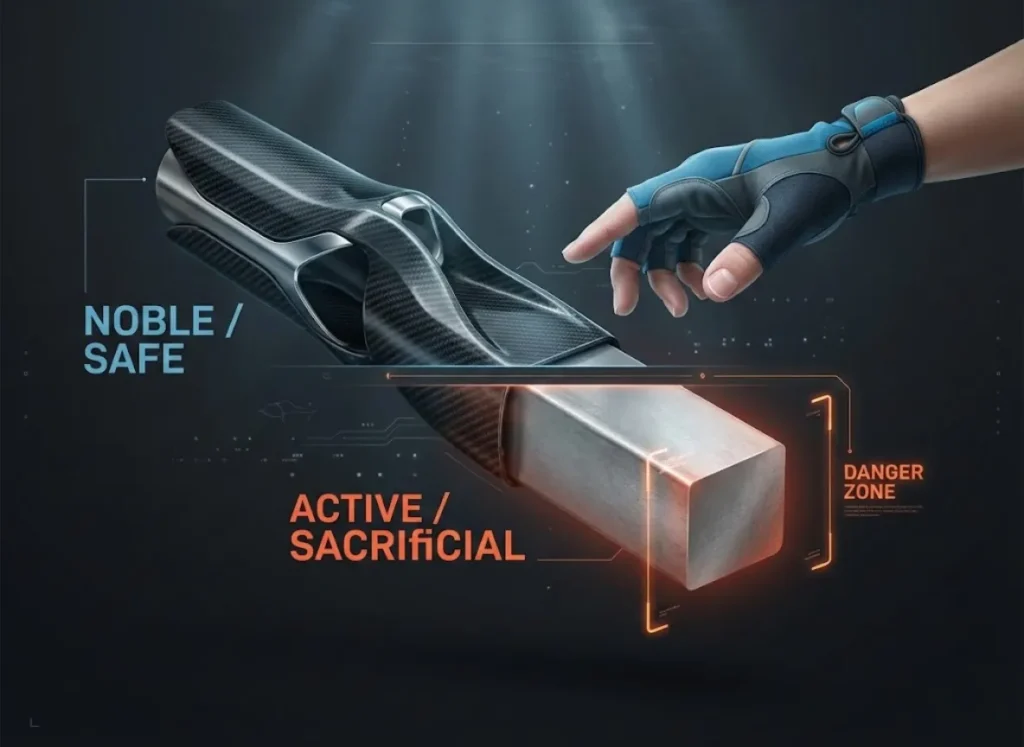
This brings us to Magnesium, the “Super-Anode” of the angling world. It is incredibly light and rigid, but it is also highly reactive, acting much like magnesium anodes used in freshwater flush ports on outboards. It relies entirely on surface coatings to prevent violent dissolution in saltwater.
Pro-Tip: If you fish with magnesium reels, inspect the reel foot and body weekly. If you find a deep scratch exposing raw silver metal, seal it immediately with clear nail polish or marine epoxy. Leaving it exposed can lead to structural failure in weeks.
Research on the degradation of carbon fiber reinforced polymers corroborates that once the resin matrix is damaged, the decay accelerates. This is why selecting durable saltwater spinning reels often involves choosing gear with specialized coatings, material compatibility, or isolation gaskets that separate these reactive materials.
How Do Lubricants Act as the First Line of Defense? (Chemical Warfare)
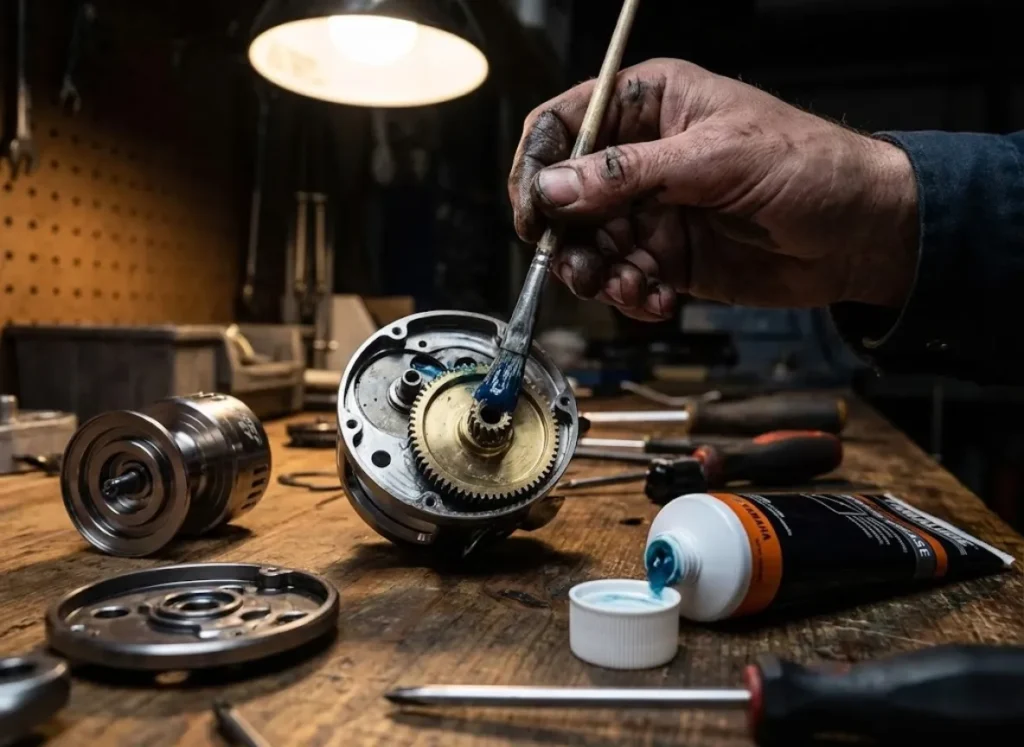
Why is Calcium Sulfonate superior to Lithium grease for marine use?
Standard Lithium-based greases tend to emulsify in saltwater, turning into a milky sludge that traps corrosive brine against the gears, whereas Calcium Sulfonate grease is naturally hydrophobic and chemically repels water intrusion.
For years, blue marine grease (Lithium complex) was the industry standard. However, Lithium relies on additives for water resistance. Under the high pressure of cranking a large fish, these additives can break down. Once the factory grease emulsifies, it holds salt directly against the gear teeth, bypassing the mechanical layer meant to protect them.
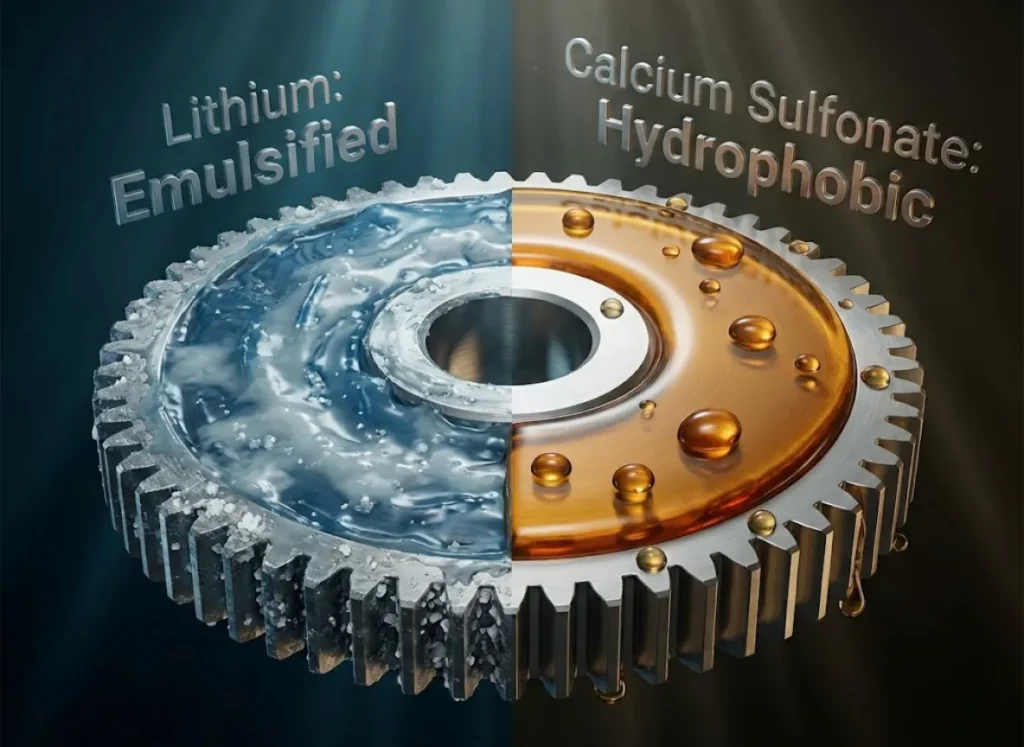
Calcium Sulfonate grease uses a thickener that naturally sheds water. It possesses superior “shear stability” and lubricant viscosity, ensuring the protective film remains intact even under extreme loads.
When we look at recycling carbon fibre with chemical solvents, we see how easily chemical barriers can be stripped. A grease that washes out leaves your gears defenseless against pitting. By transitioning your fleet to Calcium Sulfonate, you eliminate the risk of “hidden emulsion” corrosion inside the gearbox.
This hydrophobic barrier is also critical for managing friction. Understanding reel drag systems heat physics shows us that heat thins grease. A lubricant that stays stable under heat is the only thing standing between your gears and destruction.
What is the Correct Protocol for Post-Trip Decontamination? (The Wash Down)
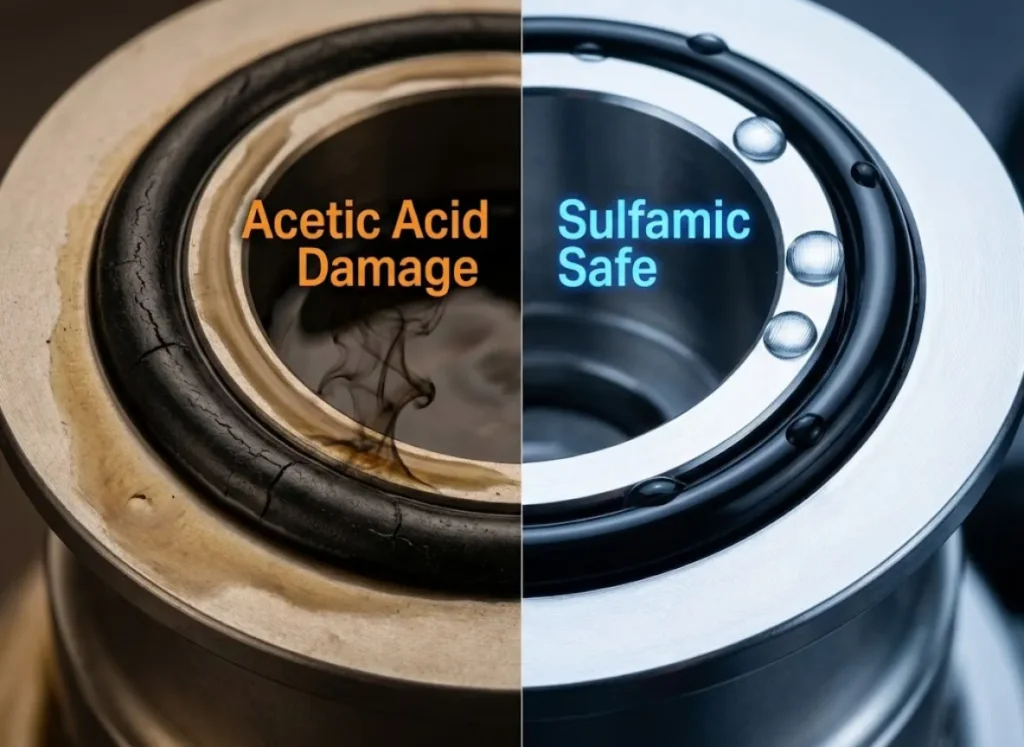
Why is the “Vinegar Soak” a dangerous myth for modern reels?
Vinegar (acetic acid) is chemically aggressive toward Nitrile (Buna-N) rubber seals, causing them to swell, soften, and eventually crack, which destroys the reel’s watertight integrity.
I see this advice constantly in forums regarding post-trip rituals, and it ruins reels. If you soak your reel in vinegar and see the water turn dark, that isn’t just dirt coming off. That is dissolved carbon black leaching out of your rubber components. You are literally dissolving your seals.
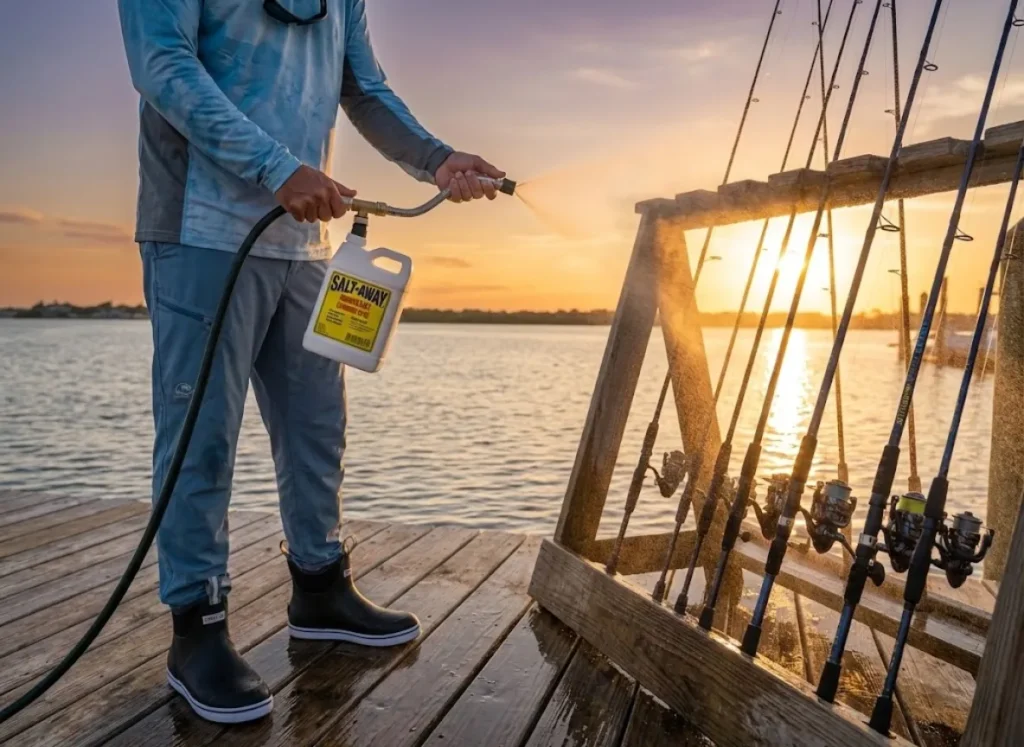
The chemically correct alternative is a buffered solution containing Sulfamic or Citric acid, often found in products like Salt-Away. These agents convert insoluble chloride deposits into soluble forms without attacking the polymer chains of your seals or etching soft metals.
A study on the deterioration behavior of composites exposed to chloride emphasizes how specific ions, like chloride ion penetration, attack structural integrity. We need to neutralize salt without attacking the composite or rubber.
Proper chemical maintenance is a pillar of sustainable fishing gear maintenance. Using a dedicated salt remover also leaves a corrosion-inhibiting surfactant film, preventing the “flash rust” that often occurs on bare metal after acidic cleaning. A review of a Safety Data Sheet for Sulfamic Acid used in professional products confirms its safety profile for these applications compared to raw vinegar.
How does the “Thermos Effect” damage sealed reels from the inside?
The “Thermos Effect” occurs when rapid temperature changes create a pressure differential inside a sealed reel, sucking in moisture that condenses and cannot escape.
“Sealed” reels are designed to keep water out, but they often act as pressure vessels. Imagine your reel sitting on a hot boat deck in the sun. The air inside expands. Then, you hit it with a blast of cold freshwater from the dock hose. The air inside contracts rapidly, creating a vacuum.
This vacuum sucks moist air or water past the seals. Once inside, that moisture has nowhere to go. When the temperature drops at night, it condenses on the cool metal surfaces of your reel bearings and gears. This leads to “invisible rot” or “standstill corrosion,” where bearings rust from the inside out despite the reel never being dunked.
Pro-Tip: Never rinse a hot reel with cold water. Let your gear acclimate to the ambient shade temperature before washing. Furthermore, store your reels with the drag backed off to relieve pressure on the seals.
This is why winterizing fishing gear storage is so vital. Storing reels in a long-term climate control area prevents the temperature fluctuations that turn your high-end reel into a condensation chamber.
Conclusion
Preserving saltwater gear requires us to think like chemists rather than just cleaners. To summarize the tactical shifts we discussed:
- Chemical Isolation: Switch to Calcium Sulfonate grease to prevent emulsification and maintain a hydrophobic barrier.
- Acid Management: Abandon vinegar in favor of Sulfamic/Citric acid blends to protect vital rubber seals.
- Environmental Control: Store sealed reels in climate-controlled areas to prevent internal reel condensation caused by pressure differentials.
- Galvanic Awareness: Treat carbon fiber and magnesium as a volatile couple; keep coatings intact to prevent rapid electrolysis.
The ocean is relentless, but with the right science and marine-grade materials, your gear can outlast the elements. Share your own maintenance war stories or ask specific questions about your reel model in the comments below to help build our community knowledge base.
FAQ – Frequently Asked Questions about Saltwater Corrosion Prevention
Is WD-40 safe to use as a saltwater corrosion inhibitor on fishing reels?
No. Standard WD-40 is a solvent, not a lubricant. It strips away factory grease and leaves a thin film that washes off quickly in saltwater. It should only be used for cleaning or displacing water, followed immediately by the application of a proper marine grease, CorrosionX, or oil.
Can I use magnesium reels in saltwater if I rinse them immediately?
Yes, but it carries a high risk. Magnesium is an ultra-anode that corrodes violently if the protective coating is scratched. It is safer to reserve magnesium gear for freshwater and use aluminum or composite reels for salt applications.
Does vinegar actually damage fishing reels?
Yes. The acetic acid in vinegar attacks Nitrile (Buna-N) rubber O-rings and seals, causing them to swell and crack over time. This compromises the reel’s waterproofing. Use a buffered salt remover product instead to neutralize salt safely.
Why do my reel bearings rust even though I never dunk the reel?
This is often due to internal condensation (the Thermos Effect) caused by temperature fluctuations sucking moist air past the seals. Storing reels in a consistent, dry temperature helps prevent this sweating inside the gearbox. Consider using VCI-infused tackle boxes for added protection.
Risk Disclaimer: Fishing, boating, and all related outdoor activities involve inherent risks that
can lead to injury. The information provided on Master Fishing Mag is for educational and informational purposes
only. While we strive for accuracy, the information, techniques, and advice on gear and safety are not a substitute
for your own best judgment, local knowledge, and adherence to official regulations. Fishing regulations, including
seasons, size limits, and species restrictions, change frequently and vary by location. Always consult the latest
official regulations from your local fish and wildlife agency before heading out. Proper handling of hooks, knives,
and other sharp equipment is essential for safety. Furthermore, be aware of local fish consumption advisories. By
using this website, you agree that you are solely responsible for your own safety and for complying with all
applicable laws. Any reliance you place on our content is strictly at your own risk. Master Fishing Mag and its
authors will not be held liable for any injury, damage, or loss sustained in connection with the use of the
information herein.
Affiliate Disclosure: We are a participant in the Amazon Services LLC Associates Program, an
affiliate advertising program designed to provide a means for us to earn advertising fees by advertising and linking
to Amazon.com. As an Amazon Associate, we earn from qualifying purchases. We also participate in other affiliate
programs and may receive a commission on products purchased through our links, at no extra cost to you. Additional
terms are found in the terms of service.