
In this article
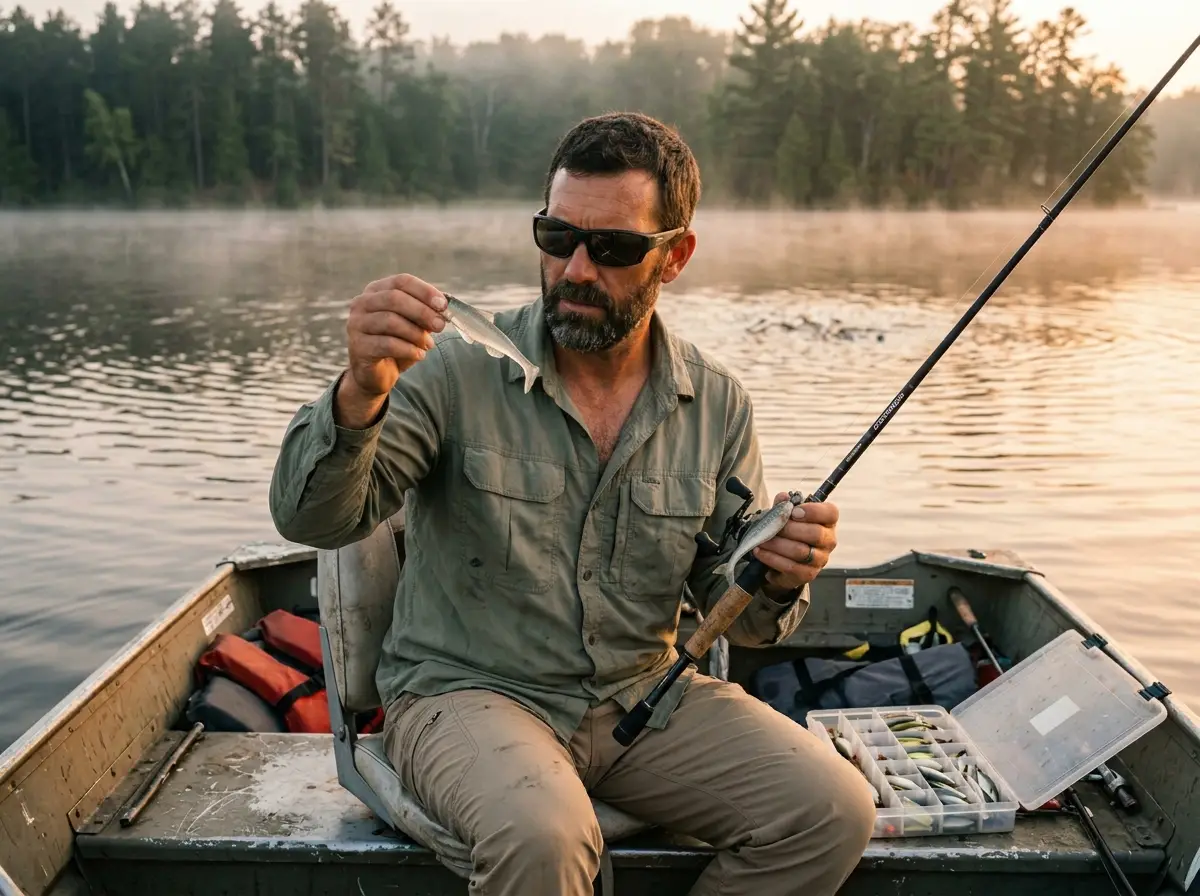
Two boats, same lake, same cove — the guy thirty yards from you has been catching fish all morning while you’re on your third bait change with nothing to show for it. He didn’t find a secret spot. He spent five minutes watching the water before his first cast, and that told him everything he needed to know. That habit is what most lure anglers skip when they talk about matching the hatch — they jump straight to color, and color is the last step.
Quick Answer: Matching the hatch for lure anglers means selecting a lure that mimics the specific forage fish are actively eating — not just the color, but the size, profile, depth zone, and swimming action. Most anglers get the color close but miss the other three, which is why the concept fails them on the water.
What “Matching the Hatch” Actually Means for Lure Anglers
Where the Term Comes From (and Why Lure Anglers Use It Differently)
Fly fishermen coined this phrase. For them, it means tying on an artificial fly that replicates the exact aquatic insect hatching on a trout stream at that moment. The precision is borderline obsessive — matching the wing shape, body length, and color phase of a single mayfly species.
Lure anglers borrowed the term but use it loosely. For most, “match the hatch” means throwing something shad-colored when there are shad in the lake. That’s a starting point, not a strategy.
What a “Hatch” Really Is in Lure Fishing
In lure fishing, the “hatch” isn’t an insect emergence. It’s a forage event — a moment when a specific prey type becomes concentrated or vulnerable. Shad pushed into a shallow pocket by wind. Crawfish freshly molted and soft-shelled after a spring warm-up. Bluegill stacked on spawning beds in two feet of water.
The forage most recently stressed or made vulnerable is what predators are hunting. Not the entire population of a species — the individuals that are easiest to catch right now.
The Four Dimensions of a True Match
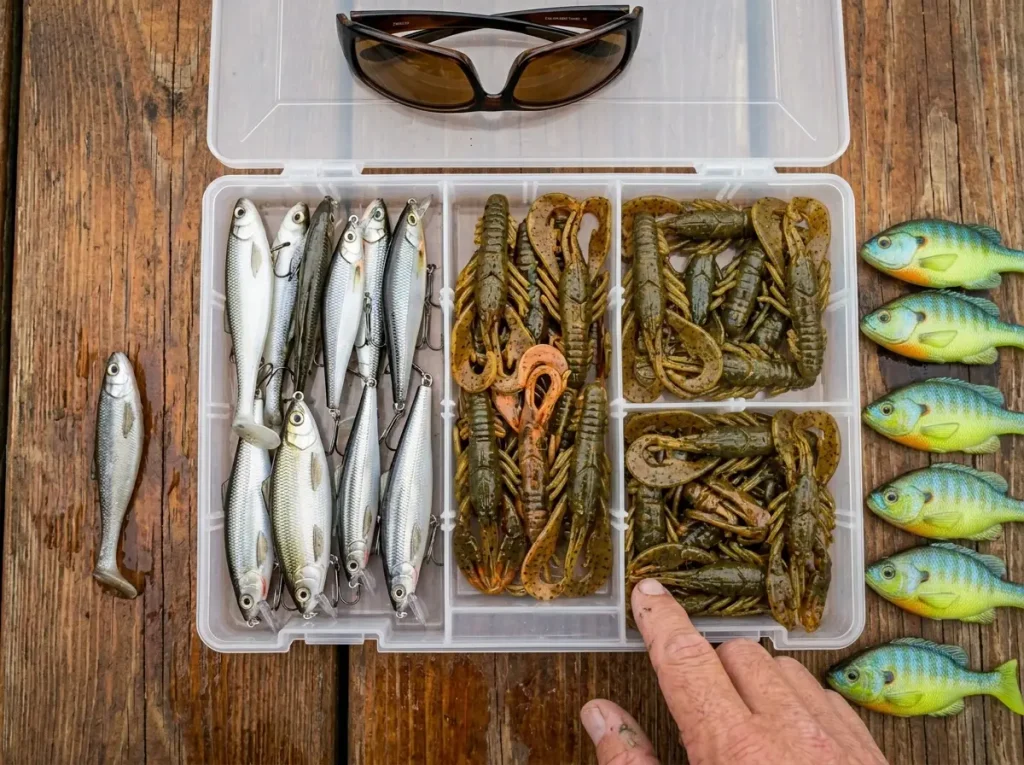
A real match covers four things: color, profile (the silhouette your lure throws in the water), depth zone (where the forage actually sits in the water column), and action (how the forage moves when it’s healthy, fleeing, or dying). Get one right and you might catch a fish. Get all four right and you’ll catch them consistently.
Most anglers nail color and miss the other three. That’s why matching the hatch “doesn’t work” for them.
Read the Water Before You Open Your Tackle Box
Surface Signals: What Baitfish Behavior Tells You Before You Cast
Put on your polarized sunglasses and look at the water for two minutes before you touch a rod. You’re looking for surface disturbance patterns, and each one tells you something different.
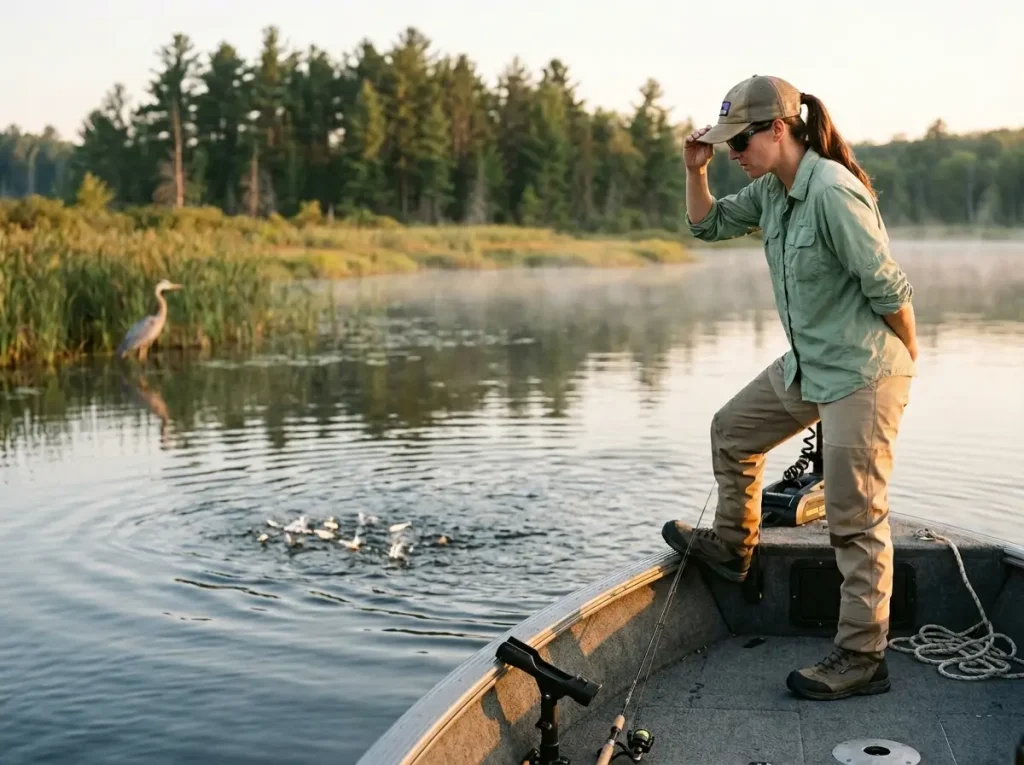
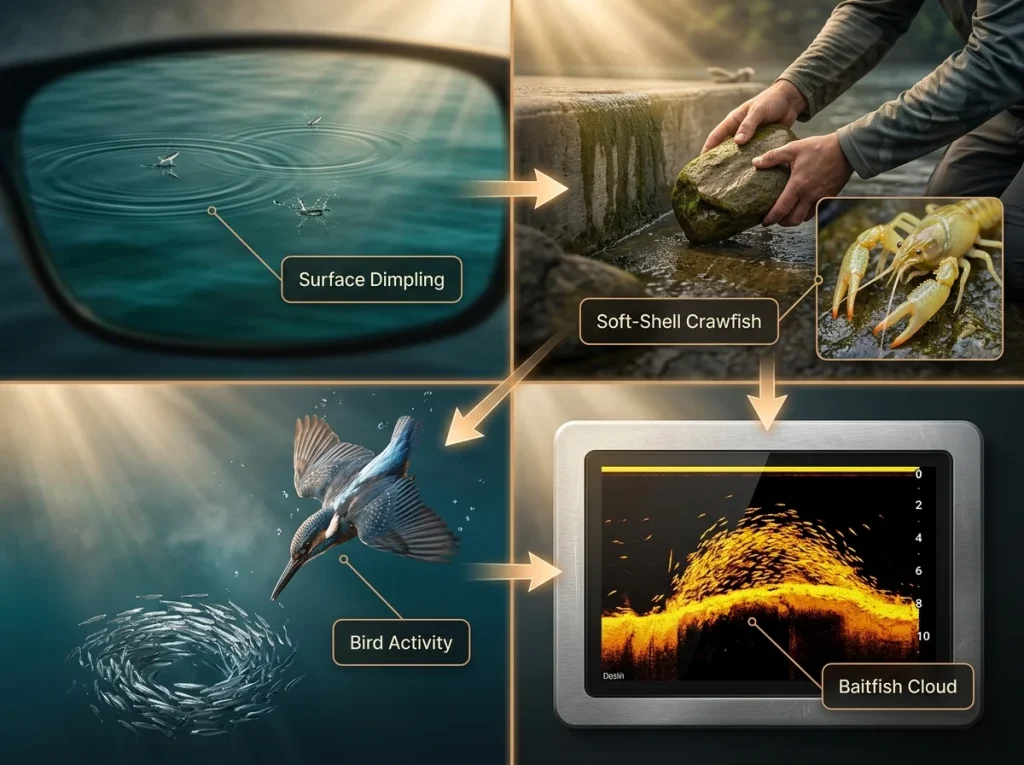
Slow dimpling — small, frequent rings on the surface — means baitfish are being picked off from below. Something is feeding under that school. Skipping and scattering, where baitfish actually leave the water, means an active chase is happening right now. The direction the bait scatters tells you where the predator came from. Work back toward that source point.
If nothing is moving on the surface, check wind as a forage concentrator. Wind pushes plankton to a bank. Baitfish follow. Bass follow baitfish.
Pro tip: When baitfish are dimpling but you can’t see what they are, watch their body flash as they turn. Silver with a yellow tail flash is threadfin shad. A wider, more oval flash with a dark lateral bar is juvenile bluegill. That one observation tells you whether to reach for a swimbait or a topwater.
The Boat Ramp Check: Rock Flipping and Shoreline Clues
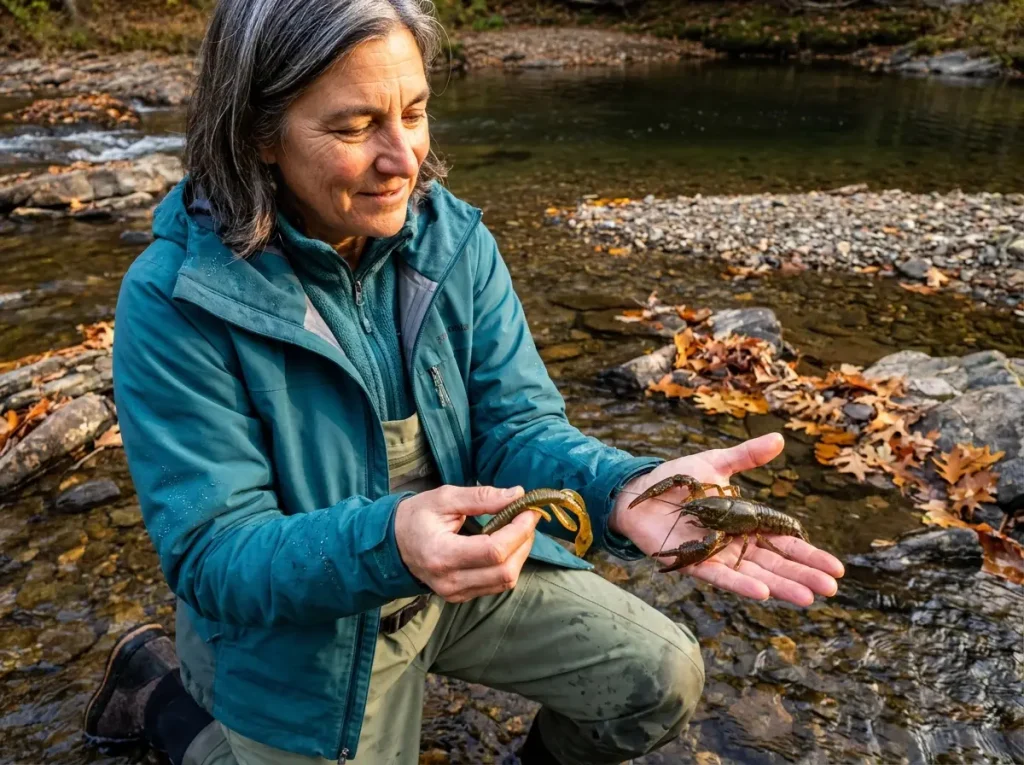
Before you even launch, flip three rocks in the shallows near the ramp. You’re checking crawfish — specifically, their color and shell hardness. Pale yellow-green or light tan with soft shells means a recent molt. Dark olive-brown with hard shells means they haven’t molted recently.
That 30-second check tells you whether to throw pale crawfish imitation colors (sand, light green pumpkin, peach) or the standard dark craw patterns (black/blue, dark green pumpkin). Most bags of crawfish soft plastics come in hard-shell colors. Soft-shell colors are what the fish are actually targeting during the spring and fall molting windows.
Livewell, Electronics, and Birds: Your On-Water Intel Network
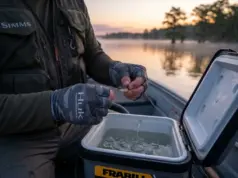
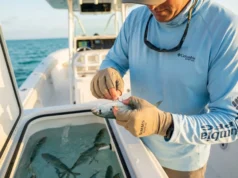
The most reliable forage identification method is also the simplest. Catch two fish early in the session. Keep them in the livewell for 45 minutes. They’ll often regurgitate their last meal, and you can see exactly what they were eating — species, size, color, everything.
On your fish finder, baitfish show up as diffuse clouds of marks separate from the individual arcs that represent gamefish. The depth of that baitfish cloud is your target presentation depth. If the bait is sitting at 8 feet, dragging a crankbait on the bottom at 15 feet is a miss, no matter how good the color match is.
Diving birds mark baitfish better than any electronics. Herons standing still in the shallows, kingfishers hovering over a single spot, or osprey circling the same area are all pointing you to where forage is concentrated.
If none of these methods reveal what fish are eating, check the full troubleshooting checklist when fish won’t bite.
The Three Forage Categories That Drive Most Freshwater Fishing
Shad: Gizzard vs. Threadfin and Why the Difference Matters
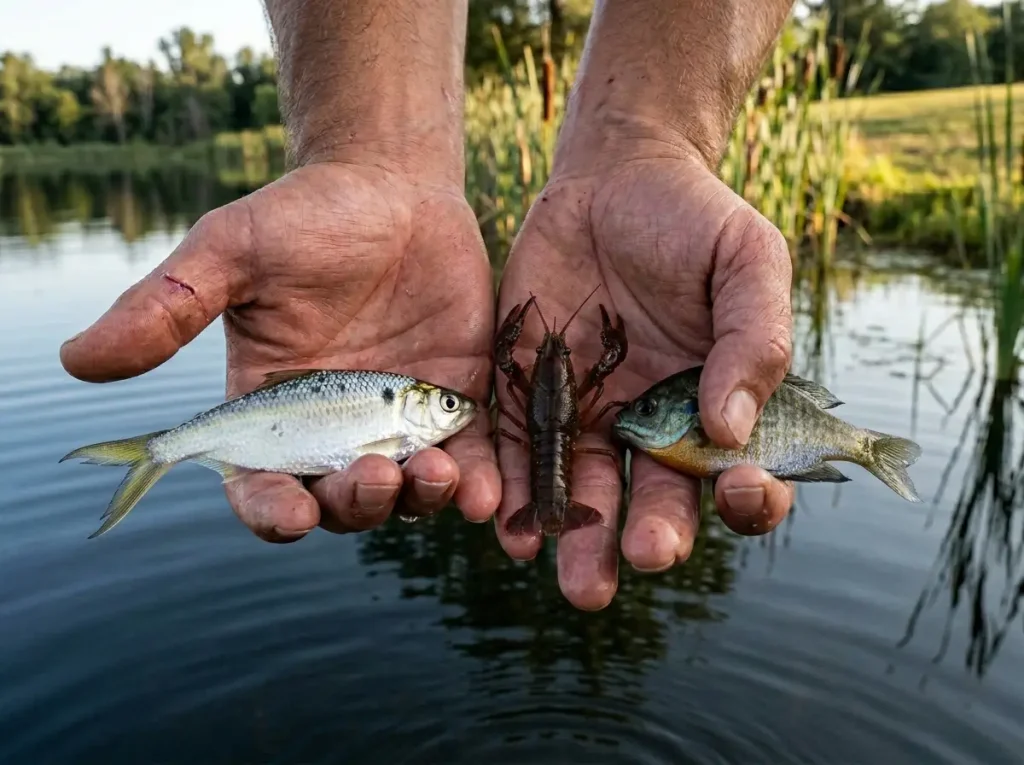
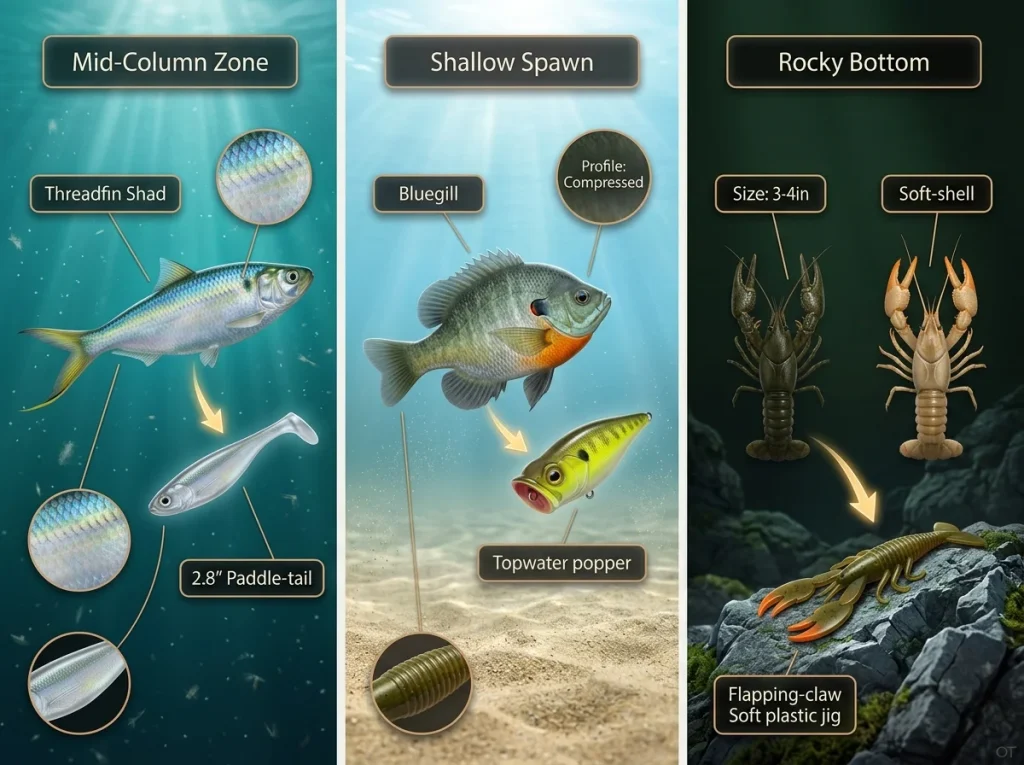
Two species of shad dominate freshwater forage, and they behave differently. Threadfin shad rarely exceed six inches — most of the ones bass eat are three to four inches long. They school in the mid-water column and near the surface, feeding on plankton. According to threadfin shad biology from Texas A&M’s aquaculture program, threadfin are temperature-sensitive and start dying when water drops below 45°F.
Gizzard shad are the bigger, blunt-snouted relatives. Adults grow to 18 inches — far too large for most bass. The juveniles, though, run two to four inches and are significant forage. They feed near the bottom, not in mid-column, which means the correct lure and depth are completely different from what works for threadfin.
For threadfin shad, a Keitech Fat Swing Impact 2.8″ in Threadfin Shad ($9/8-pack) is one of the closest size-and-profile matches you’ll find off the shelf. The paddle tail oscillates at slow retrieves, mimicking the lazy mid-column drift that threadfin have.
Bream and Bluegill: Profile, Color, and the Spawning Bed Pattern
Bluegill have a compressed oval body that looks nothing like a shad silhouette. They’re shorter, wider, and show distinct color — slate or dark green backs, orange gill flashes, and during spawn season, chartreuse-yellow bellies. Bass sit just outside bluegill spawning beds in one to four feet of water and pick them off as they fan.
Matching a bluegill means matching that compressed profile, not the thin cylinder of a shad-imitating bait. Hollow body frogs, bluegill-colored topwater poppers, and compact 3.5-inch swimbaits with orange and chartreuse markings are the closest lure matches.
Crawfish: Two Windows, Two Color Sets, One Retrieve Rule
Bass eat more crawfish by weight than most anglers realize. The key detail: there are two annual windows when crawfish become especially vulnerable, not one. The spring mating cycle starts when water hits 50°F, and crawfish leave their burrows soft-shelled and pale. The fall mating cycle, which most anglers miss entirely, triggers when water drops to the upper 40s.
Soft-shell crawfish are pale yellow-green or tan with orange-tipped claws. Hard-shell crawfish are dark olive, brown, or reddish. Matching the condition matters as much as matching the species. The Strike King Rage Craw 4″ in Green Pumpkin ($6/7-pack) handles both windows — the flapping claw design moves water on the forward drag and the backward hop, and a quick tip dye in orange gets the claw color right for spring soft-shell.
For more on crawfish and shad seasonality, see the full seasonal biology of shad, crawfish, and other key forage species. And if your water has a rocky smallmouth population, tube jigs for smallmouth on crayfish-dominant rocky bottoms covers the presentation side in depth.
Color, Profile, and Depth: The Matching Hierarchy
Getting Specific About Color: The Forage Condition Matters
“Shad color” isn’t one thing. A healthy threadfin has a silver body with a blue-green iridescent back and a yellowish tail. A cold-stressed threadfin turns pale white-silver, almost translucent. A dying one is belly-up white. Each of those conditions calls for a different shade even though the species is the same.
For crawfish, the distinction between soft-shell colors (pale sand, yellow-green, peach with orange accents) and hard-shell colors (dark olive-brown, black-blue) is the difference between matching what bass are hunting and matching what they’re walking past.
Water clarity shifts everything. In clear water, go natural and muted — the fish get a good look. In stained water, add contrast: chartreuse belly on a shad pattern, bright orange tips on a crawfish. In heavy murky water, color matters less than profile and vibration. For a deeper dive on this, check out how water clarity changes what fish can actually see in your lure.
Profile and Silhouette: The Dimension Most Anglers Ignore
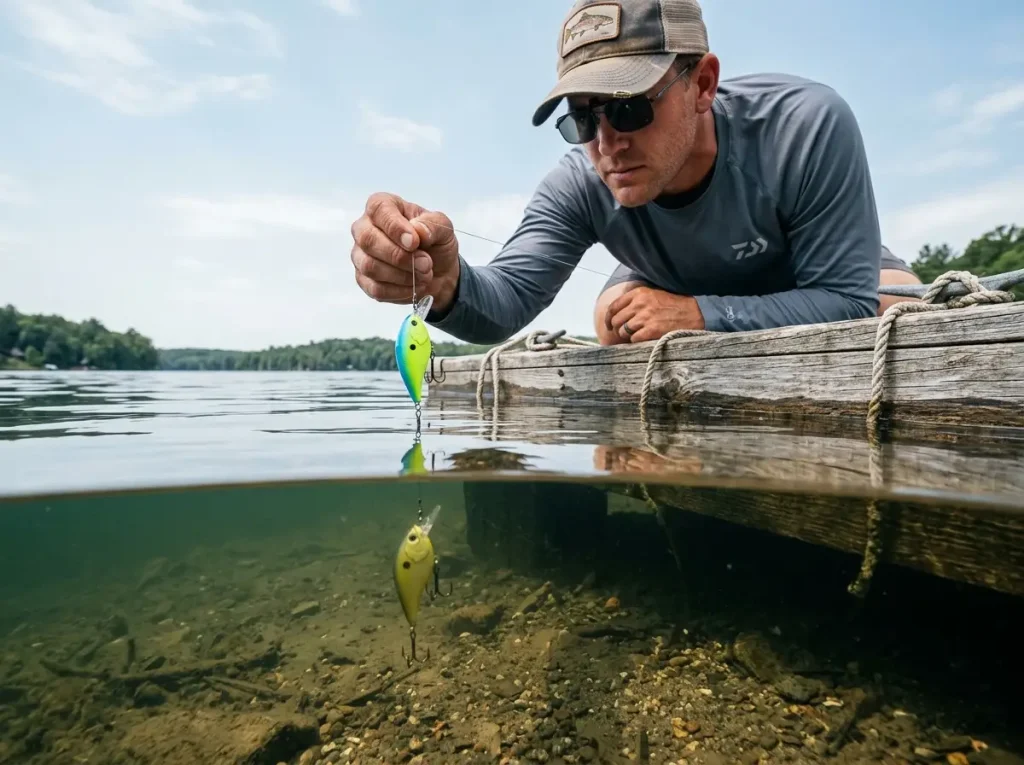
Hold a shad and a bluegill side by side. The shad is thin, cylindrical, and elongated. The bluegill is round, compressed, and deep-bodied. A crankbait designed to look like a shad has a narrow body. One designed for bluegill should be wider and shorter.
Anglers who grab any bait in the right color are still getting the profile wrong half the time. In clear water, bass compare the silhouette of your lure against what they’ve been eating all week. A round-bodied crankbait thrown at bass that have been chasing threadfin gets a look and a refusal. The color was right, the shape was wrong.
Learn how water temperature shifts the optimal crankbait color choice alongside the correct profile for each season.
Depth Zone: Why Right Color in the Wrong Column Catches Nothing
This is the non-negotiable dimension. Threadfin school at the surface and mid-column. Crawfish live on rocky bottoms. Bluegill hold in shallow cover. If your lure is in the wrong vertical zone, nothing else matters.
A shad-colored lipless crankbait dragged across 15 feet of bottom will catch far less than the same lipless crankbait yo-yoed through eight feet of water where the baitfish actually are. Use your electronics to confirm forage depth and match your lure selection accordingly.
Pro tip: The matching hierarchy in order of importance: correct depth zone first, correct profile second, correct color third, correct action fourth. Most anglers reverse this because color is what they see in the tackle shop. Depth is what you see on the water.
Action and Presentation: How Your Retrieve Completes the Match
Shad Retrieve: Matching Mid-Column Swimming Action
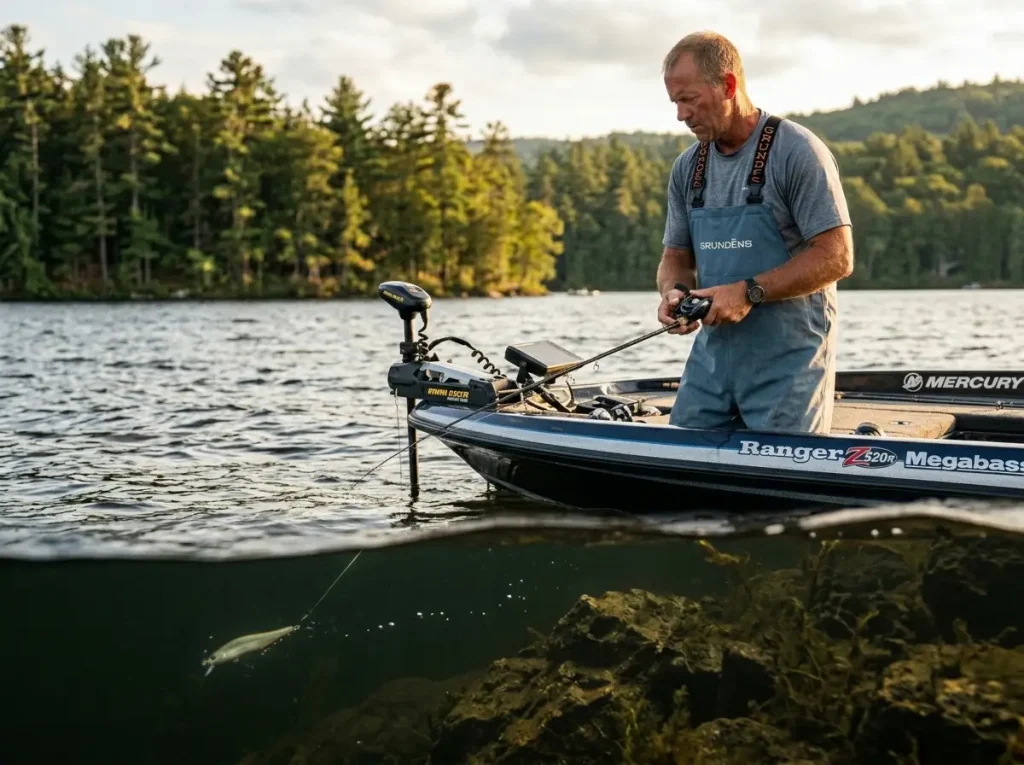
Shad swim horizontally with a steady, subtle tail oscillation. They don’t dart, jerk, or pause unless something has cornered them. An even retrieve at moderate speed, with occasional two-second pauses to mimic a dazed individual, is the baseline shad presentation.
For swimbaits imitating shad, the key is finding the retrieve speed where the paddle tail just barely kicks. Too fast and it looks frantic. Too slow and the tail drags. That sweet spot is different for every bait, and you find it by watching the rod tip — when you feel a faint rhythmic pulse, you’re in the zone. For more on dialing in speed and sink rate, see how to fish swimbaits for big bass with the right speed and sink rate.
Crawfish Retrieve: Hop-and-Pause vs. Drag vs. Tailflip
Crawfish move three ways. A foraging crawfish drags slowly forward along the bottom — mimic this with a slow, steady pull. A fleeing crawfish does a sharp backward tailflip followed by a settle — mimic this with a quick pop of the rod tip, then let the bait fall on slack line. A spooked crawfish hops erratically — short, random rod pops.
The pause is as important as the movement. Bass eat crawfish when they stop moving, not when they’re hopping. Most bites come in the first three seconds of the pause after a hop. Hold steady through that window.
The Dying Baitfish Presentation: Most Anglers Skip This
When threadfin shad get cold-stressed or injured, they don’t swim away. They suspend. They list sideways. They sink slowly. This is the single most productive forage state to imitate, and almost nobody does it because it feels like you’re not fishing.
A jerkbait worked with long pauses — five, eight, even ten seconds of dead stillness between twitches — matches this behavior perfectly. The Strike King Red Eye Shad 1/2 oz ($9) in a natural shad color, slow-rolled through 1–3 feet of water, is the go-to for fall die-off windows. The sinking design mimics a threadfin that’s given up fighting the cold.
Pro tip: The hard part about dead sticking is trusting it. Every instinct says keep moving. But a dying shad doesn’t move. Let the bait sit. When you get bit on a ten-second pause after doing nothing, the whole concept clicks.
The Seasonal Forage Rotation Calendar
Spring: Two Crawfish Windows That Most Anglers Know Only One Of
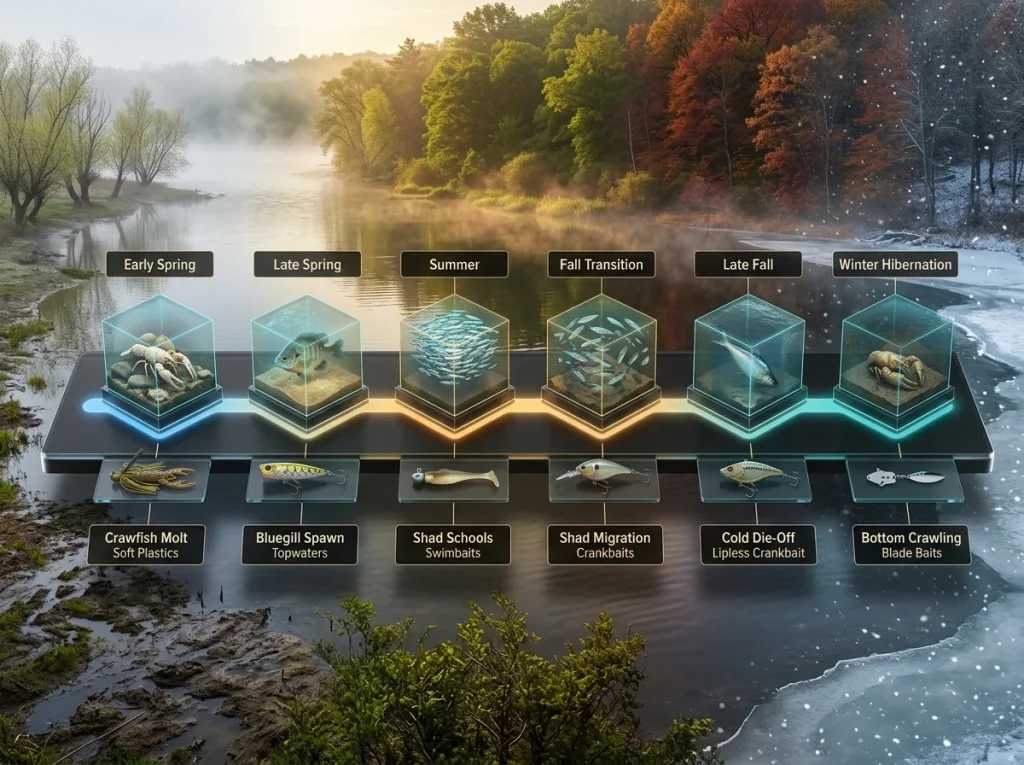
When water hits 50°F, crawfish leave their burrows for the first mating cycle of the year. They’re soft-shelled, pale colored, and nearly defenseless. This is the crawfish window everyone knows about, and it’s why jig-and-craw combos produce so well in early spring.
The window most anglers miss is the second mating cycle in fall, when water drops back to the upper 40s. Crawfish emerge again, and bass that have been chasing shad all summer suddenly shift to rocky bottoms and crawfish patterns. If you’re still throwing shad colors in late October, you’re matching a forage that bass have stopped prioritizing.
Summer Through Early Fall: The Shad School Hierarchy
From June through September, threadfin shad dominate the forage base in most southern and central reservoirs. The detail that matters: threadfin school by size. Juveniles running three to four inches are what bass eat most often. The bigger adults that surface in schools at dawn are visible but less targeted.
Throw smaller shad imitation lures than you think you need. A 2.8-inch swimbait outfishes a 5-inch swimbait when the forage is juvenile threadfin. As fall approaches and water cools below 60°F, shad push toward the shallows. This is the window to read how to follow fall shad migrations to bass and position yourself where the bait is headed, not where it was last week. See also when bass move shallow in fall and why.
Cold-Water Forage: Late Fall Die-Offs and Winter Bottom Patterns
The threadfin die-off is the most explosive and shortest-lived feeding event of the year. When water drops below 45°F, threadfin start dying in the shallows. According to gizzard shad cold tolerance data from the USGS Nonindigenous Aquatic Species database, gizzard shad tolerate cold water that threadfin cannot — so after the die-off window closes, gizzard shad juveniles and crawfish become the primary winter forage.
If you fish a reservoir with threadfin, mark the first hard cold front of fall on your calendar. The morning after that front, get on the water early with lipless crankbaits and suspend baits. The window can last as little as two days. Fish it while it’s open.
Through winter, crawfish remain available near rocky bottom structure. Slow, bottom-contact presentations — a finesse jig dragged across rock — match what bass can actually find in cold water.
When Off-the-Shelf Isn’t Close Enough: Lure Modification
Most matching problems are 10–20 percent away from right. The color is close but not exact. The buoyancy is off for the presentation you need. You don’t need a new lure — you need to modify the one you have. Start with how base crankbait color selection changes with water temperature for the starting-point selection, then use these tools to close the gap.
Soft Plastic Dye: The 10-Minute Color Customization
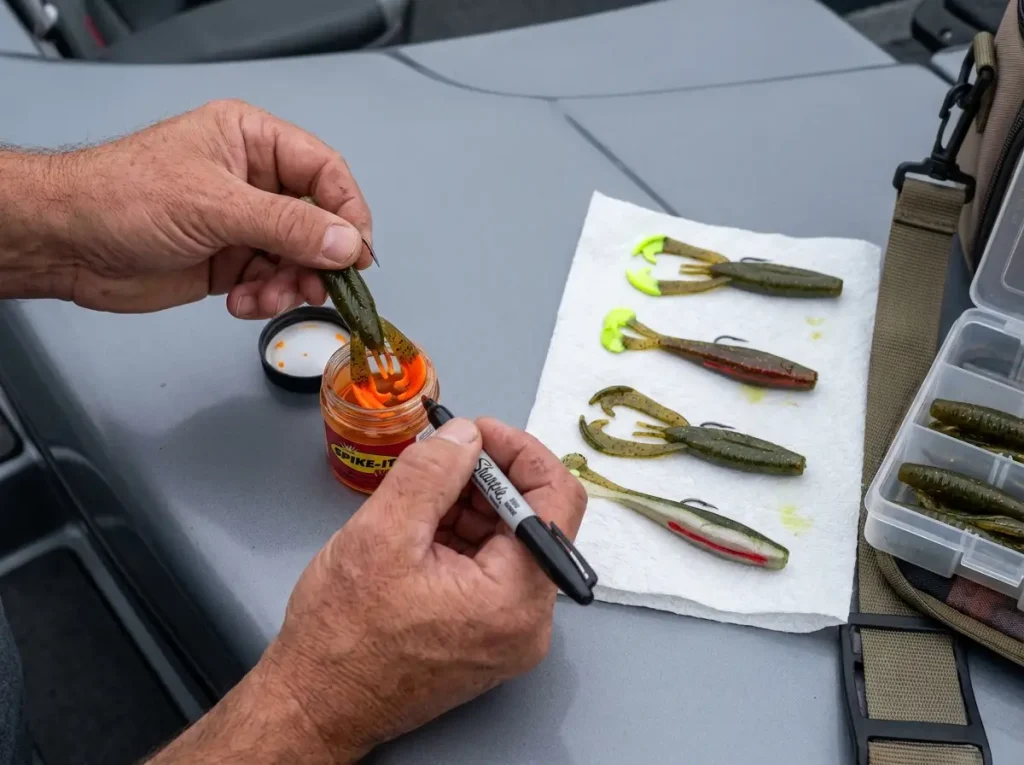
Spike-It Dip-N-Glo in Chartreuse ($6) is the single most useful modification tool in any tackle bag. Dip the claw tips of a green pumpkin crawfish bait into the jar three to four times, let it dry ten seconds between dips, and you’ve got a perfect match for a soft-shell crawfish with orange-chartreuse claw highlights.
Want to match a bluegill spawning color? Dip the tail of a dark green swimbait in yellow. Want a shad with a darker back? Use black dye on the dorsal side only. The dye is permanent on standard plastisol soft plastics — but it does not work on Z-Man Elaztech material. Test one lure before you commit a whole bag.
Markers and Paint: Quick Field Edits for Hard Baits
A permanent marker does more on the water than most people realize. A black Sharpie adds a dark lateral line to a white crankbait — instantly closer to a real threadfin shad profile. An orange Prismacolor marker adds gill flash to a bland shad bait. A red marker puts a wound mark on the belly of a crankbait, mimicking an injured baitfish.
These modifications take thirty seconds, cost nothing beyond the markers you already own, and they wash off hard baits after a few trips. Think of markers as temporary field tuning — good enough for today’s conditions.
Suspend Weights and Buoyancy Tuning
A floating jerkbait rises to the surface during the pause. A dying shad doesn’t rise — it suspends or slowly sinks. Storm SuspenDots ($5/80-count) fix this. Stick two or three dots on the belly of a floating jerkbait and it hangs in the water column instead of popping up.
This single modification changes the bait from a surface-returning twitch bait to a suspend-and-die imitation. For fall die-off patterns and cold-water fishing, that buoyancy shift is the difference between short strikes and committed eats. The dots peel off clean if you want to switch back.
Pro tip: Keep a small modification kit in the boat — one bottle of Spike-It dye, three Sharpies (black, orange, red), and a strip of SuspenDots. Total cost: about $20. That kit lets you fine-tune any lure to match the forage you just identified on the water.
Conclusion
Matching the hatch starts before you open the tackle box. Five minutes of watching the surface, flipping rocks, and checking your electronics tells you more about what to throw than any gear catalog.
The seasonal rotation is predictable — spring crawfish windows, summer shad dominance, fall die-offs, winter bottom patterns. Once you’ve fished your home water through a full year with this framework, you’ll start anticipating forage shifts instead of reacting to them.
And when your lure is close but not exact, a $6 bottle of dye and a Sharpie close the gap faster than buying a new bait. Next trip out, try the observation system first. You’ll fish differently before you’ve made your first cast.
Q1 What does matching the hatch mean in fishing?
Matching the hatch means selecting a lure that imitates the specific forage fish are actively eating at that moment — including color, size, profile, and movement. The term originated in fly fishing for trout but applies to lure anglers targeting bass, walleye, and other gamefish across all forage types.
Q2 How do I know what forage fish are actively eating?
Flip rocks at the ramp to check crawfish color and shell hardness. Watch for surface disturbance patterns that signal baitfish activity. Keep your first two catches in the livewell for 45 minutes — they’ll often spit up their last meal, giving you exact forage ID including species, size, and color.
Q3 Does lure color really matter for bass and other gamefish?
Color matters, but less than most anglers think. In clear water, it can make or break a bite. In stained or turbid water, profile, vibration, and depth zone matter more than exact color. The matching hierarchy in order of importance: depth first, profile second, color third, action fourth.
Q4 How do you match the hatch in murky or stained water?
In stained water, add contrast to your standard forage colors — chartreuse accents on shad patterns, bright orange tips on crawfish. In heavy murky water, shift focus from color to vibration and displacement. Spinnerbaits with larger blades and lipless crankbaits move enough water for bass to find them by lateral line alone.
Q5 What lures work best when bass are feeding on shad?
The answer depends on the shad species and size. For threadfin shad in mid-column, 2.8–3.3 inch paddle-tail swimbaits in natural silver are the closest profile match. For fall die-off patterns, slow-rolled lipless crankbaits in 1–3 feet of water mimic cold-stressed threadfin. For gizzard shad juveniles, deeper-running crankbaits in a blue-backed white pattern work near the bottom.
Risk Disclaimer: Fishing, boating, and all related outdoor activities involve inherent risks that
can lead to injury. The information provided on Master Fishing Mag is for educational and informational purposes
only. While we strive for accuracy, the information, techniques, and advice on gear and safety are not a substitute
for your own best judgment, local knowledge, and adherence to official regulations. Fishing regulations, including
seasons, size limits, and species restrictions, change frequently and vary by location. Always consult the latest
official regulations from your local fish and wildlife agency before heading out. Proper handling of hooks, knives,
and other sharp equipment is essential for safety. Furthermore, be aware of local fish consumption advisories. By
using this website, you agree that you are solely responsible for your own safety and for complying with all
applicable laws. Any reliance you place on our content is strictly at your own risk. Master Fishing Mag and its
authors will not be held liable for any injury, damage, or loss sustained in connection with the use of the
information herein.
Affiliate Disclosure: We are a participant in the Amazon Services LLC Associates Program, an
affiliate advertising program designed to provide a means for us to earn advertising fees by advertising and linking
to Amazon.com. As an Amazon Associate, we earn from qualifying purchases. We also participate in other affiliate
programs and may receive a commission on products purchased through our links, at no extra cost to you. Additional
terms are found in the terms of service.