
In this article
Most anglers read a bigger IM number or a higher “ton” rating on a rod blank and figure it must be the better rod. It isn’t, at least not the way the marketing copy wants you to believe. The same confusion shows up at every tackle counter and in every rod-building forum, and rod builders keep correcting it the same way. Here’s what carbon fiber modulus actually is, how to decode IM6, IM7, and IM8 and the tonnage system, the trade-offs the spec sheet hides, and how to match modulus to the way you actually fish instead of chasing the biggest number. Think of it as one piece of the larger job of learning how to pick a rod without overpaying.
What Rod Modulus Actually Means
Stiffness Is Not Strength
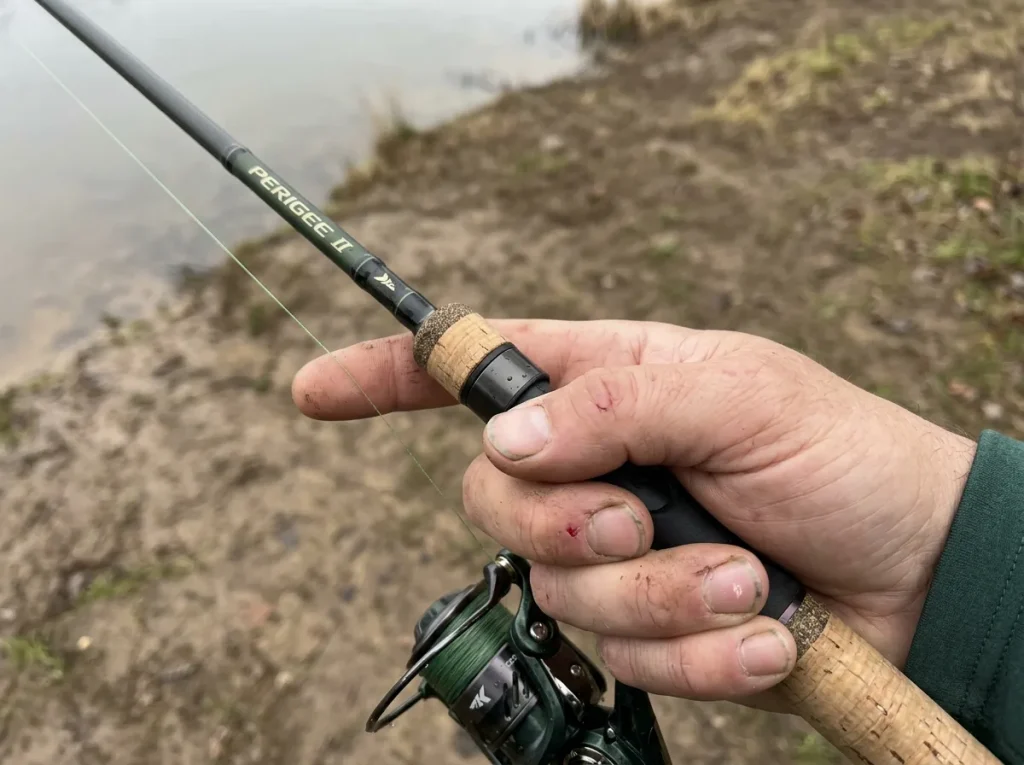
Modulus is a measure of how much a material resists bending under load. That’s it. It tells you how stiff the carbon fiber in a blank is, and it says nothing about how much force that blank can take before it snaps. Stiffness and strength are two different properties, and mixing them up is the single most common reason people buy the wrong rod.
Engineers call the number Young’s modulus, or tensile modulus. A rod maker calls it the reason one blank feels crisp and another feels like a wet noodle. The higher the modulus, the less the material flexes for a given load. Tensile strength is the separate question of when it fails, and as you’ll see, the two often move in opposite directions.
Why a Stiffer Blank Feels Different
High-modulus carbon fiber stretches less than 1% before failure, while fiberglass stretches more than 2%. That tiny difference in stretch is the whole reason a stiff blank telegraphs a bite the instant it happens instead of soaking it up. When a jig ticks bottom, the tap arrives sooner and sharper on a stiffer rod. That’s the sensitivity everyone is paying for.
Anglers have a phrase for a very high-modulus rod that transmits almost no give under load: dead in the hand. No mush, all signal. If you want the deeper science of how carbon and glass behave under load, we broke down the physics of how graphite and glass actually feel in its own piece. For now, hold onto one idea: stiffness is a tool, not a grade.
From Standard to Ultra-High, the Modulus Ranges
Here’s the number behind the number. Carbon fiber gets sorted into tiers by modulus, usually written in Msi (million pounds per square inch, sometimes just called “million psi”). Standard modulus runs 33 to 36 Msi with a tensile strength of 500 to 700 ksi. Intermediate modulus climbs to 43 to 47 Msi at 800 to 1,000 ksi. High modulus sits around 57 Msi, but here the strength drops to roughly 640 ksi. Ultra-high modulus reaches about 110 Msi, with strength falling further to around 425 ksi.
Read that sequence again, because it hides the whole argument. As the fiber gets stiffer, it gets weaker in raw strength. The two properties trade against each other. A blank built from 110 Msi fiber is dramatically more rigid than a 33 Msi blank, and dramatically less able to absorb a sudden overload. That inverse relationship is the hard data behind “bigger number is not better rod,” and a carbon-fiber manufacturer’s own modulus-vs-strength breakdown lays out the same figures.
Most fishing rods live in the 33 to 47 Msi band, which covers the vast majority of what you’ll ever cast. The 90 to 110 Msi ultra-high stuff is specialty territory, and paying for it without a reason is how you end up with a fragile rod that doesn’t actually fish any better than the one you already own.
Cracking the IM6, IM7, and IM8 Code (and Tonnage)
The IM6, IM7, and IM8 Trade Names
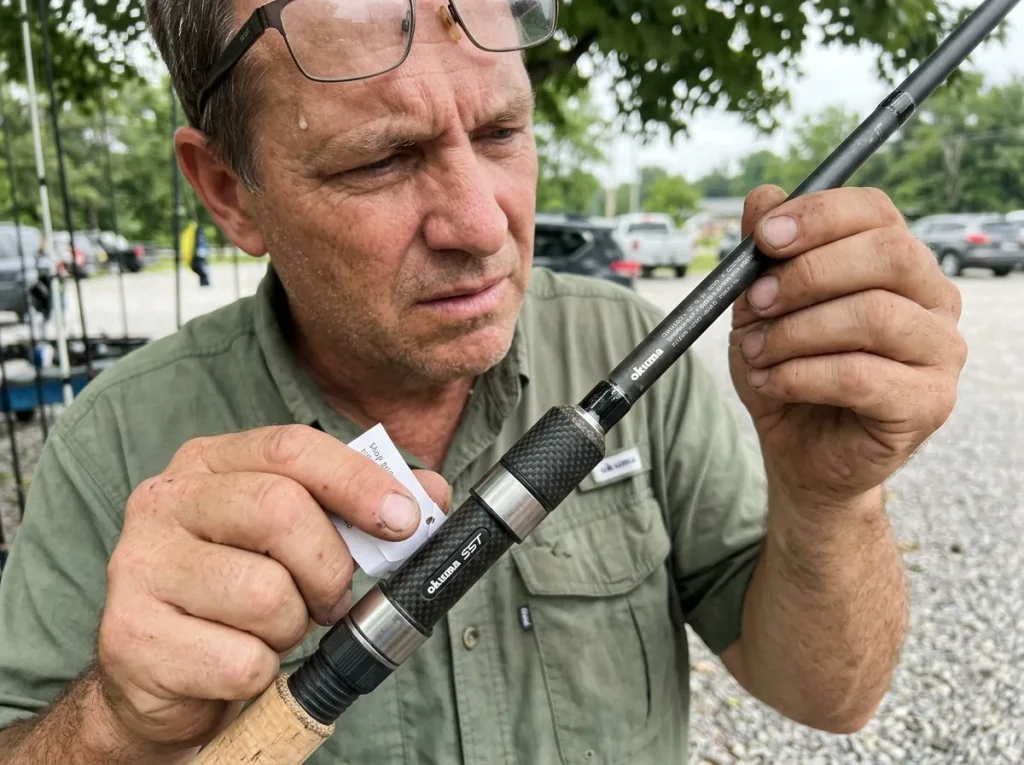
Here’s the part the tackle shop won’t tell you. IM6, IM7, and IM8 are not an industry quality scale. They are Hexcel Corporation’s trade names for its own graphite fibers. A rod stamped “IM8” by a company that isn’t actually building with Hexcel fiber is using a label that means whatever the marketing department wants it to mean.
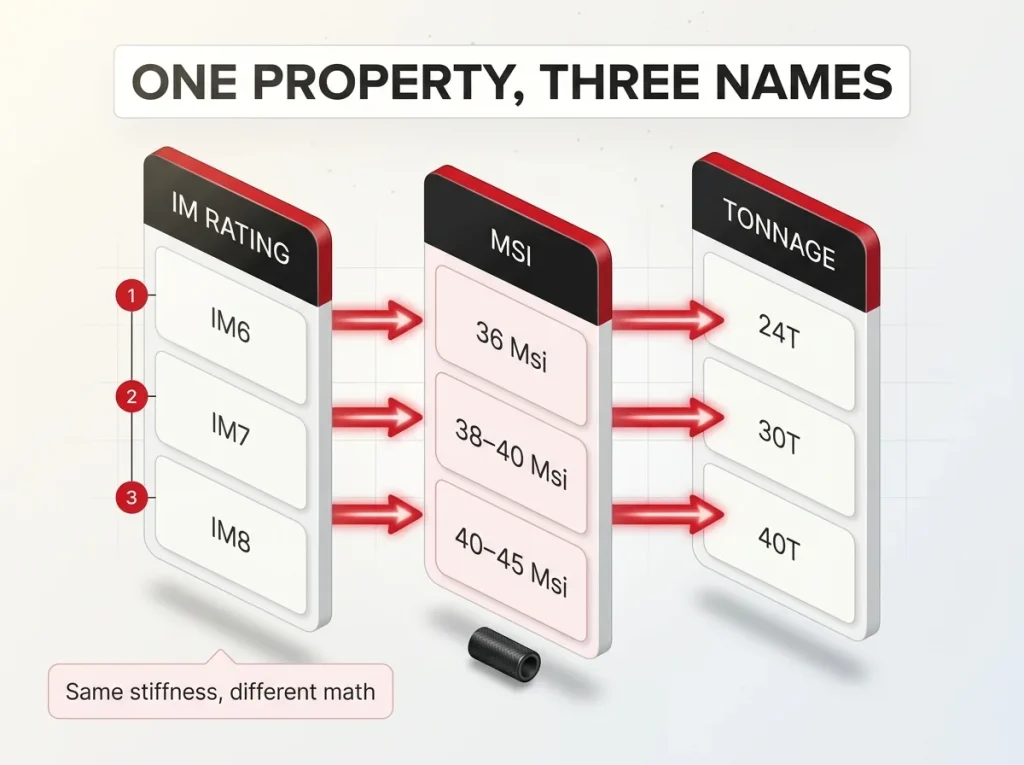
When the label does line up with the real material, the rough anchors look like this: Hexcel’s IM6 runs around 36 Msi, the standard grade most affordable rods are built on. IM8-class fiber runs roughly 40 to 45 Msi, noticeably stiffer and lighter because the blank wall is thinner. That extra stiffness is real, but it isn’t magic, and it isn’t a guarantee across brands.
The Tonnage System
You’ll also see rods rated in “tons”: 24T, 30T, 40T and up. The Asian tonnage system describes the exact same physical property as Msi and IM, just with different math. Standard 24-ton carbon lands around 33 Msi, right in IM6 territory. Tonnage isn’t a rival scale competing with IM ratings. It’s a translation of the same spec.
That’s why the guy at the counter insisting on the IM8 rod “because the number’s bigger” can walk out with a blank no stiffer than a 30-ton rod next to it. Two rods both stamped IM8, from two different companies, can feel completely different in your hands. The stamp is a starting point, not a promise. For the rest of the code printed on a blank, we decoded everything else stamped on a rod label separately.
Why Higher Modulus Means a Lighter, Faster Rod
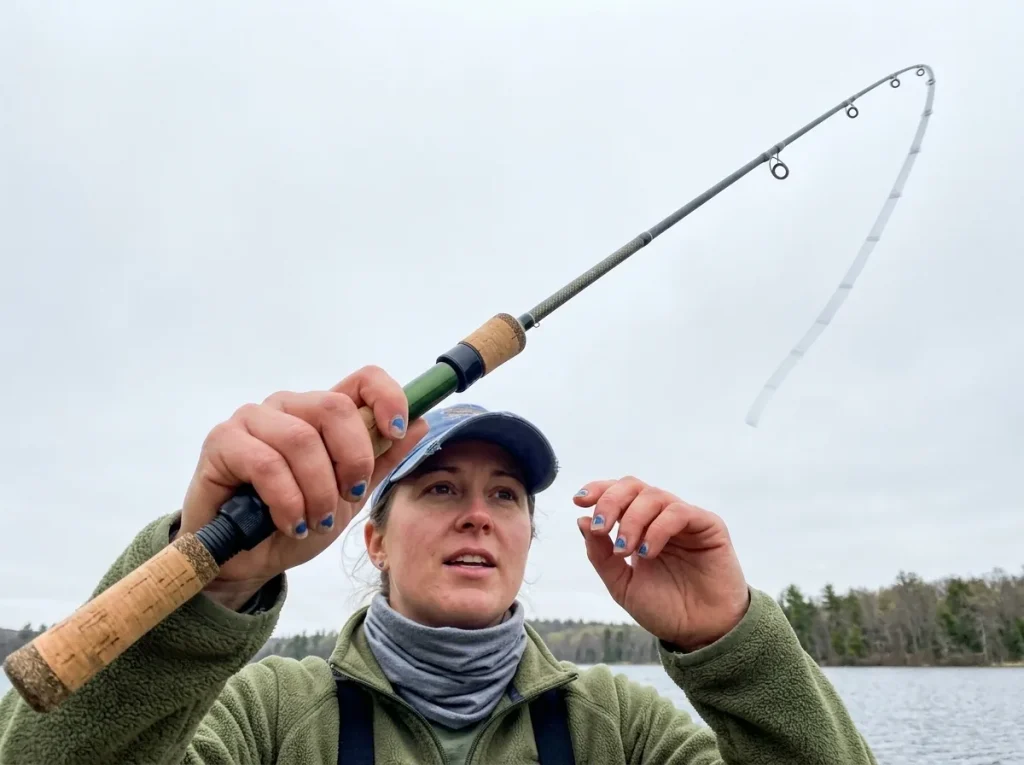
Let’s be fair to the high-modulus rod, because there’s a real payoff. Higher modulus needs less material to reach the same stiffness. Less material means a lighter blank with thinner walls, which means less fatigue over a long day of casting, a little more casting distance and casting accuracy while your arm is still fresh, and faster tip recovery after every twitch. That faster recovery is where the sensitivity and the quicker, sharper hookset come from.
Where does it actually matter? Light-line finesse presentations, deep vertical jigging, anything where feeling the bottom or detecting a soft take is the entire game. Pick up a true high-modulus rod and it nearly disappears in your hand. That weightlessness is real, and it’s a big part of what the premium price buys. The only honest question is whether your fishing needs it.
Sensitivity you can’t use is money you didn’t need to spend. If you fish mostly moving baits and cut bait, the extra “feel” of an ultra-high-modulus blank never reaches you through a chunk of shad or a moving crankbait. Save it for the days you’re dead-sticking a drop shot.
The Brittleness Trade-Off Nobody Advertises
Stiffer Means More Brittle
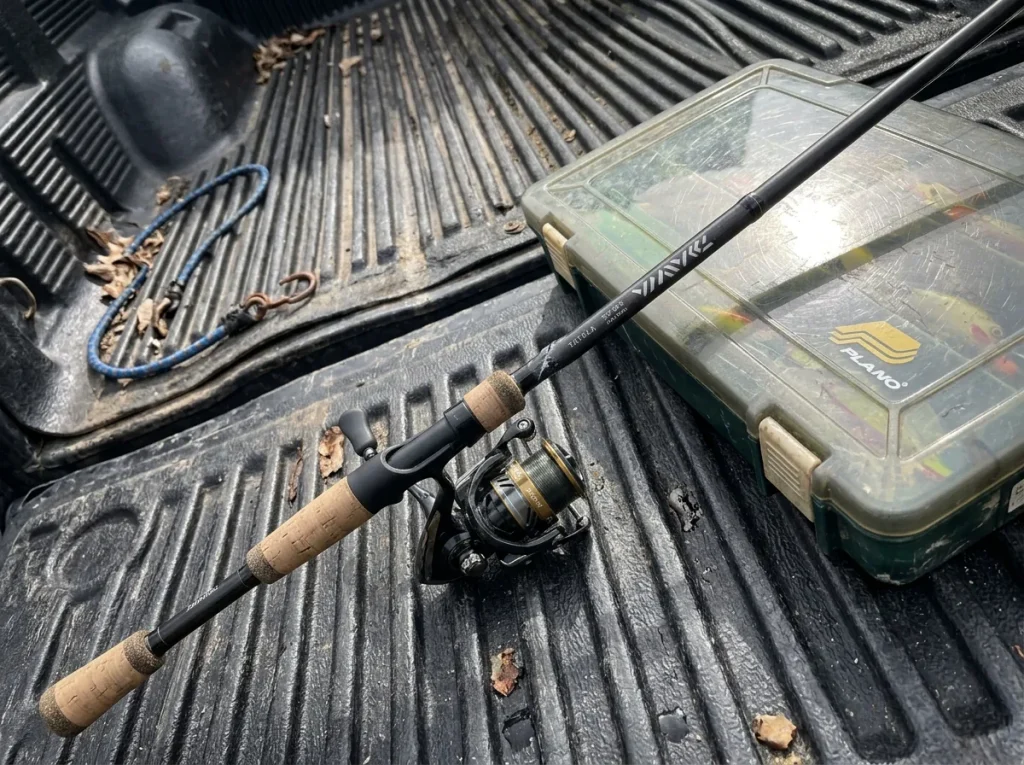
This is the part the spec sheet leaves off. Because higher modulus means less stretch before failure, a very stiff blank is more prone to cracking or shattering abruptly instead of bending and warning you first. The stretch that a fiberglass or composite blank gives you is also a grace period. Ultra-high-modulus fiber trades that grace period away for stiffness.
That doesn’t mean high-modulus rods are fragile toys. Modern high-strain-rate engineering means today’s better high-modulus rods rarely ever break under normal fishing. Most breaks trace back to an impact that compromises the blank’s hoop strength, not to the fiber grade.
The Resin Does Half the Work
The fiber sets the ceiling, but the resin system decides how much of that ceiling survives real use. Modern epoxy resin and nano-silica resin are what let a manufacturer push modulus up without the blank turning to glass. Two rods can use the same fiber grade and behave completely differently because one has a smarter resin.
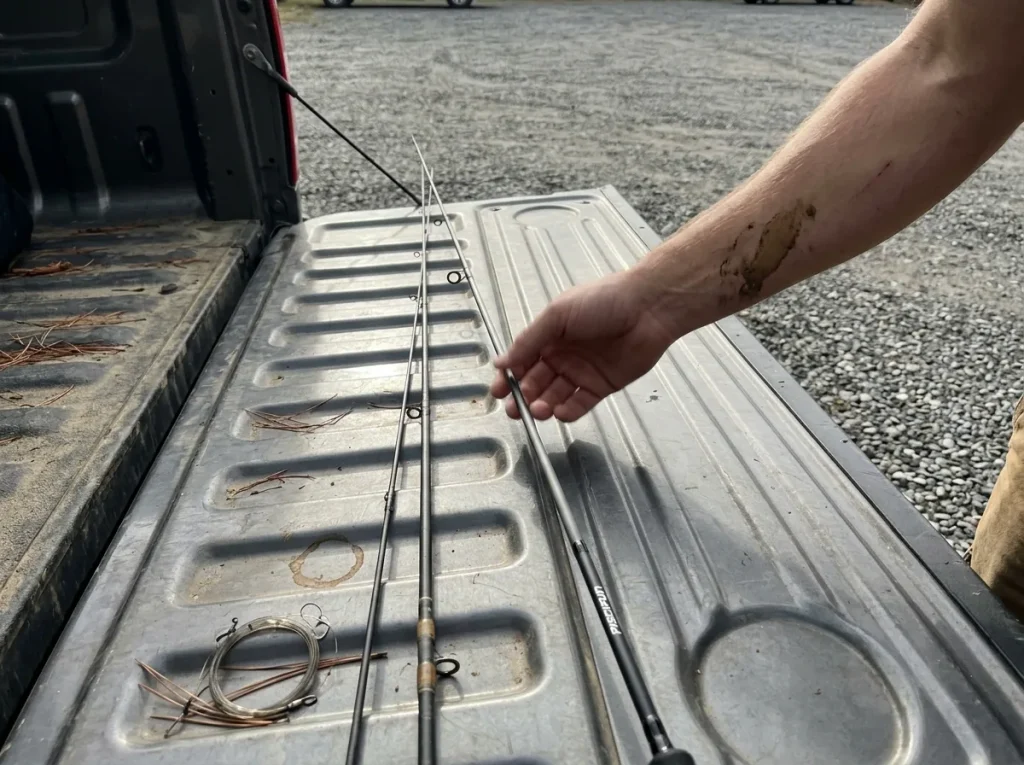
The common mistake is blaming “cheap modulus” when a rod actually snapped from being stepped on, shut in a car door, or crushed under a sliding tackle box in the truck bed. A hairline crack from an impact can sit invisible for weeks, then let go mid-fight for no apparent reason. A quick tap test, running a coin along the blank and listening for a dull thud instead of a clean ring, catches the worst of them before they fail.
The modulus gets blamed. The car door was the culprit. There’s peer-reviewed research on carbon fiber’s tensile behavior if you want the materials-science version, and on the practical side, knowing how to spot a cracked blank before it fails will save you more rods than any spec upgrade.
How a Carbon Rod Blank Is Actually Made
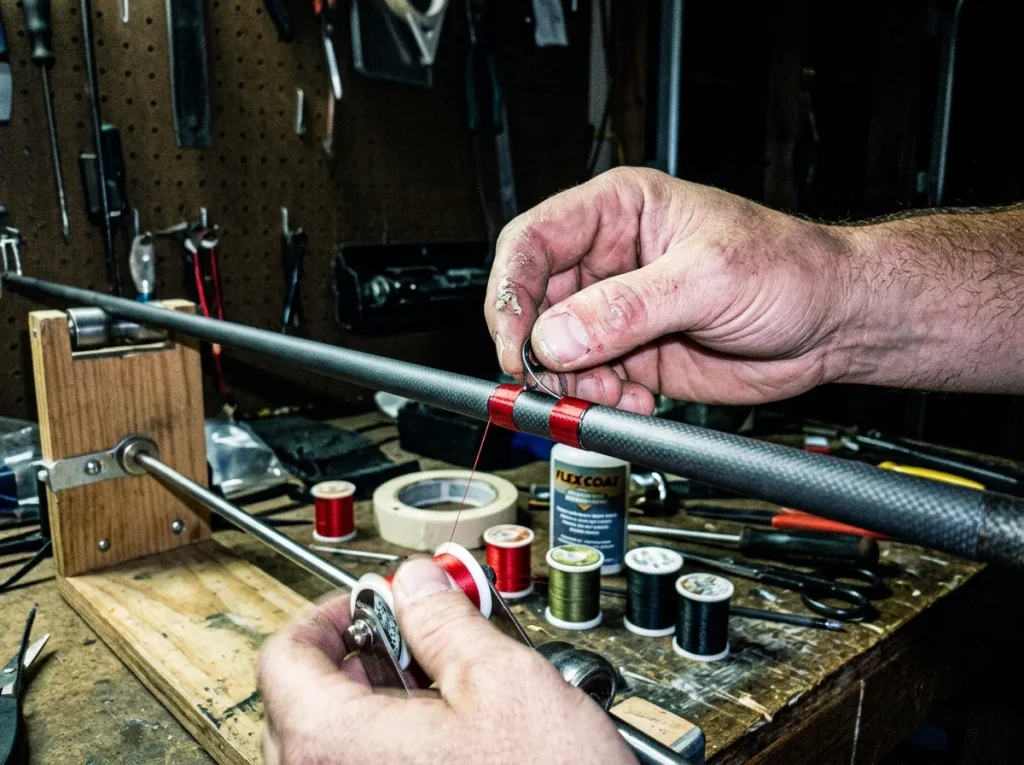
Strip the paint off and a blank is simpler than the marketing makes it sound. It’s carbon-fiber cloth, woven at a given modulus, pre-impregnated with resin, rolled tight around a tapered steel mandrel, wrapped under tension, and heat-cured. Then the mandrel gets pulled and you’re left with a hollow, tapered tube that becomes the rod blank.
The fiber grade sets the stiffness ceiling. The resin, the wall thickness, the taper, and the fiber orientation decide how much of that stiffness actually reaches your hand. This is exactly why two rods both labeled IM8 can feel nothing alike: same fiber, different roll and resin.
It’s also why a well-built mid-modulus rod can out-feel a cheaply-built high-modulus one. Construction quality can beat raw fiber grade, and that fact should make you suspicious of any rod sold on its modulus number alone. A good custom rod builder will tell you the same thing: the number on the label is only ever half the story.
Modulus, Action, and Power Are Three Different Things
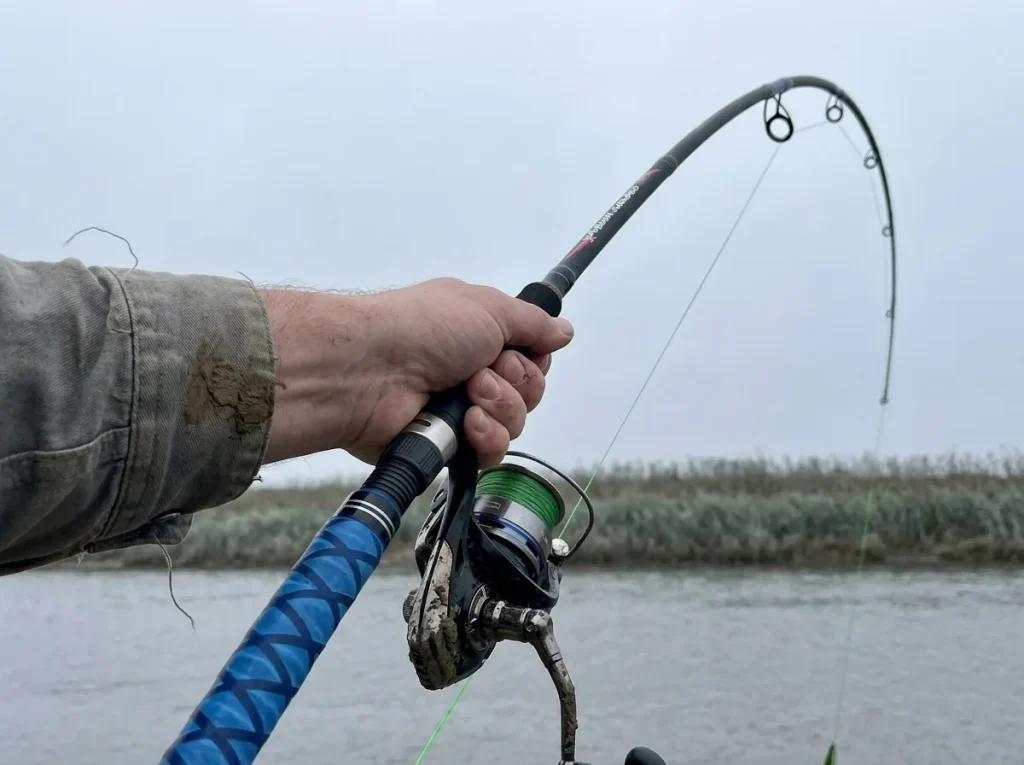
Think of three separate knobs, not one. Modulus is the stiffness of the material, a manufacturing spec. Rod action is where along the blank it bends: a fast action bends near the tip, a moderate action bends into the middle, and a slow action flexes all the way down into the butt. Rod power is how much force it takes to bend the blank at all, from ultralight to heavy. They’re related, but they are not the same thing, and treating them as one number is the biggest labeling mix-up in the whole category.
High modulus tends to correlate with fast action, because less material concentrates the flex up near the tip. But modulus does not set power by itself. You can build a high-modulus, fast-action, light-power rod, which is a sensitive finesse stick, and you can build a high-modulus, fast-action, heavy-power rod, which is a flipping stick. Same modulus, completely different tools.
The angler who reads “high modulus” on a listing and assumes it means a stiff, heavy broomstick is going to be surprised when a whippy light-power finesse rod shows up. If you want the clean version of that second knob, we covered why action and power aren’t the same thing in its own breakdown.
Match the Modulus to How You Actually Fish
This is where the spec finally becomes a buying decision. Stop asking “what’s the highest modulus I can afford” and start asking “what does my fishing actually reward.” The answer changes everything.
Finesse and Light Presentations
If you fish drop shots, Ned rigs, deep jigs for walleye, trout, crappie, or other panfish, sensitivity is the whole game, and a higher-modulus blank earns its keep here. This is the one scenario where paying up genuinely pays off, because you’re feeling for takes you’d otherwise never detect.
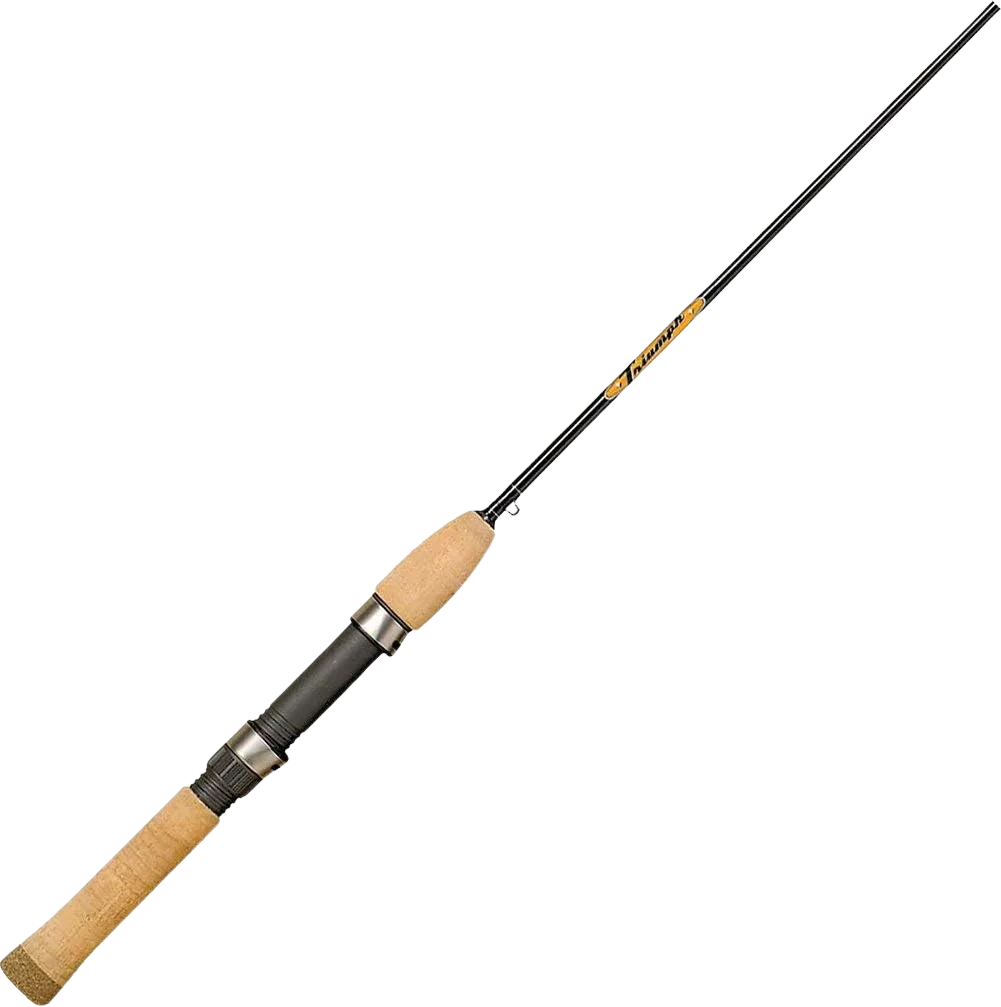
The St. Croix Triumph sits in that mid-modulus tier on purpose. You get the crisp tip and quick recovery that finesse fishing wants, without paying for 90-plus Msi fiber that would only make the rod more fragile. For lighter trout and panfish work where you want an ultralight that still telegraphs everything, the HANDING M1 Trout ultralight covers the same idea at the budget end. Neither rod is chasing a spec sheet. Both are matched to the technique.
Reaction and Treble-Hook Baits
Now flip it. If you throw crankbaits, topwater, or anything with treble hooks, you want the opposite of maximum stiffness. A too-stiff, ultra-high-modulus blank rips trebles free on a headshake instead of absorbing it, and you lose fish at the boat you should have landed. This is the blunt part nobody in the marketing wants to say out loud: for reaction fishing, a lower-modulus, more forgiving blank is the better tool, full stop.
Modern hardware muddies this a little in a good way. The PURELURE ACUTEVIOLET pairs a 36-ton carbon blank with a titanium guide frame, and that kind of upgraded hardware and resin claws back some of the durability a higher-modulus blank normally gives up. The old “high modulus equals fragile” rule is softening for well-built rods. But the base material trade-off still holds: read the spec, then match it to the technique, not the other way around.
Big-Fish and Shock Absorption
Surf fishing, catfish, carp, and toothy brawlers like pike and musky live at the far end from finesse. Here you want toughness and give, a blank that absorbs the shock of a big fish surging rather than one tuned for maximum rigidity. A travel surf rod like the Fiblink 12′ 3-piece leans toward that shock-absorbing, fish-fighting job instead of chasing feel. The takeaway across all three ends of the spectrum is the same: the right rod is the one built for your technique, not the one with the biggest number on the blank.
Buy the rod for the technique you fish most, not the one you fish twice a year. Anglers talk themselves into a high-modulus finesse stick and then throw crankbaits with it all summer, losing fish and blaming the rod. Match the blank to your real Saturday, not your fantasy tournament.
Why High-Modulus Rods Really Snap (High-Sticking)
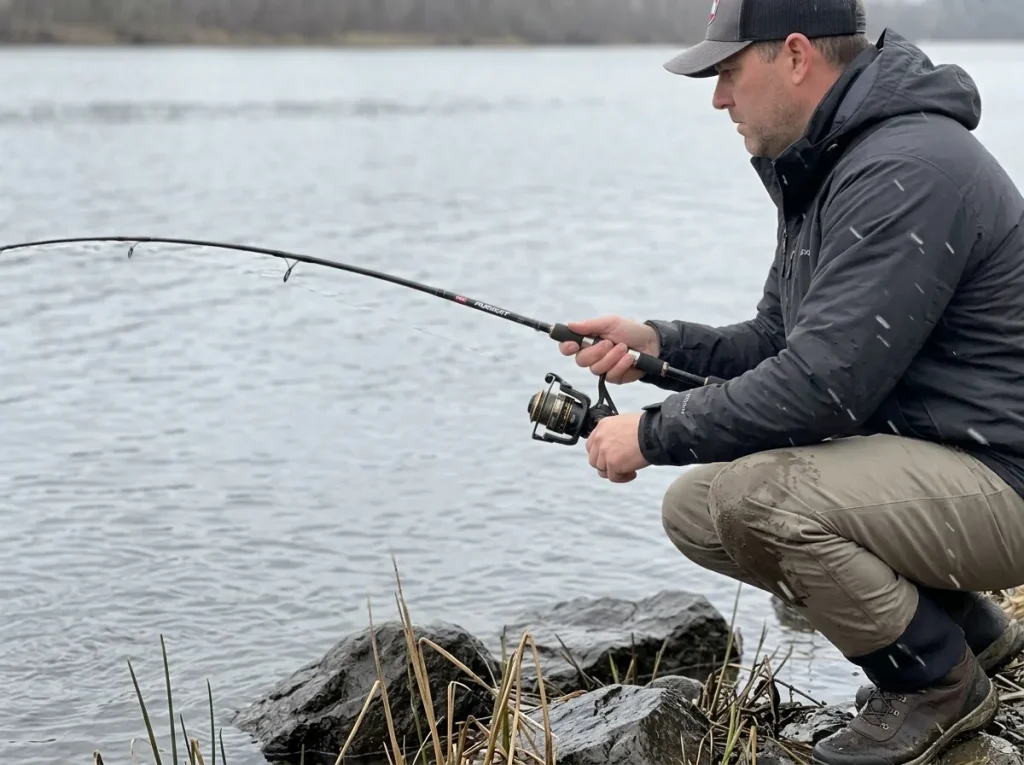
Why the Angle Matters More Than the Fish
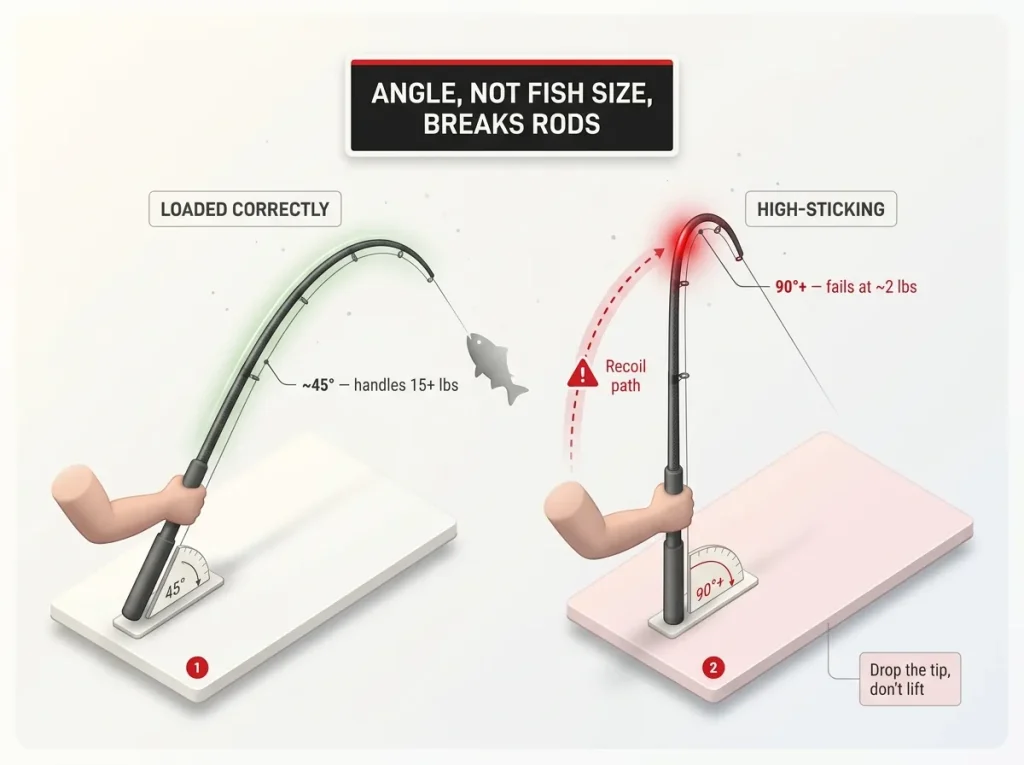
Here’s the failure mode the spec sheet never mentions, and it has nothing to do with manufacturing defects. A graphite rod that handles 15 pounds or more when loaded properly along its length can fail at as little as 2 pounds of force when it’s held near-vertical at 90 degrees. Angle, not fish size and not modulus, is the dominant variable in most “random” breaks. This habit has a name: high-sticking.
Fast and extra-fast action blanks, the profile most high-modulus rods use, are the most high-sticking-prone of all, because only the tip flexes before the stiff backbone engages.
Then there’s the line problem. Modern braided and fluorocarbon lines commonly test 30 to 50% over their labeled rating, so your “10-pound” braid might really be closer to 15. The line rating printed on the spool, in other words, isn’t the real breaking point. Under a hard hookset or a snag, the rod becomes the weak link instead of the line, and the leverage physics of a rod tip held high multiplies the load fast, something we get into in the leverage physics behind it.
There’s a safety angle here that zero competitors mention, and it’s the real reason to care. A rod that fails under high-sticking load usually snaps at or near the tip, and the recoil whips that broken tip back toward your hand and face. Keeping the angle low isn’t only about protecting the rod.
The Fix
The fix is two seconds of habit. Keep the tip at or below roughly 45 degrees once a fish or a jig is close, never letting it climb to straight up. Back off the drag pressure when you’re fishing vertically, because there’s no rod flex left in that position to cushion a sudden run. And never try to reel a fish in past the length of the rod.
Landing a fish quickly matters for the rod and for the fish, since landing a fish quickly matters for its survival on the release. Understanding what actually voids a rod warranty drives the same point home: manufacturers see these fracture patterns constantly, and they know user angle when they see it.
When a fish is thrashing at the rod tip, drop the rod low and reel, don’t lift. Every angler who has ever popped a rod tip on a fish at the boat did it by raising the rod to horse the last two feet. That last lift is where expensive rods die.
When a Cheaper Rod Out-Fishes a Premium One
The Beginner and Loaner Rod
Here’s the honest recommendation the tackle shop won’t lead with. Standard-modulus and composite blank rods carry more raw tensile-strength margin than ultra-high-modulus fiber, which means more forgiveness for the average weekend angler‘s technique lapses: a bit of high-sticking, a drag set wrong, a rough car-door moment. A budget rod built on that margin survives things a premium rod won’t.
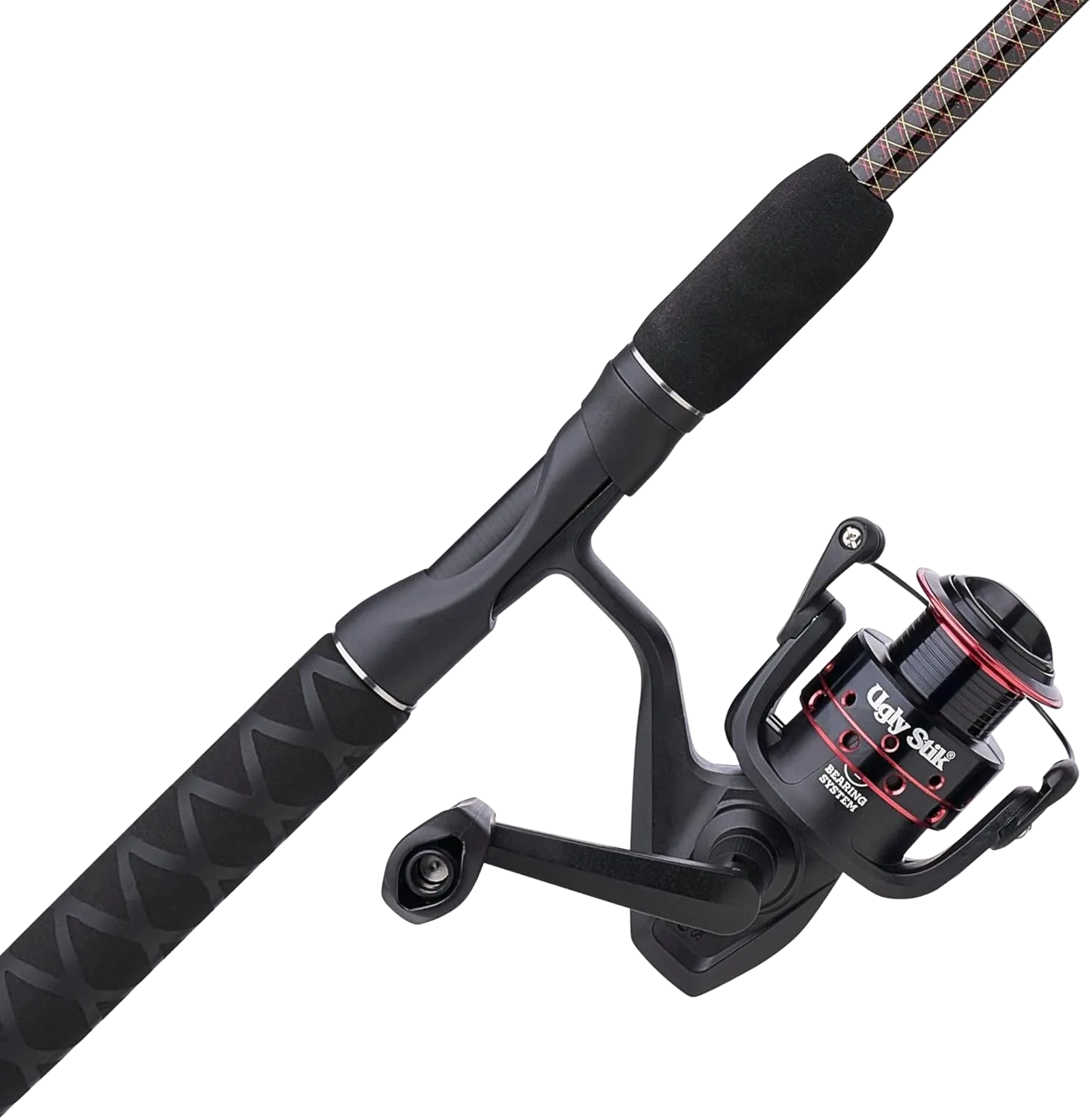
The Ugly Stik GX2 is the concrete example. Its composite blank deliberately blends in lower-modulus fiberglass to trade some sensitivity for durability. That’s a design choice, not a compromise, and it’s exactly why it’s the rod to hand a beginner or a kid who’s going to learn on it. For a travel or backup setup where you just want something that packs down and catches fish, a budget telescopic like the PLUSINNO combo makes the same point: a modest-modulus rod is genuinely good enough for a huge share of real fishing, and how telescopic rods actually hold up is a fair question worth its own read.
Chasing IM8 or 50-ton specs without matching them to your technique wastes money and breaks more rods. That’s the whole anti-sell in one line. Buy the fiber your fishing will actually feel, and not a dollar more.
The Tackle-Counter Feel Test (No Spec Sheet Needed)
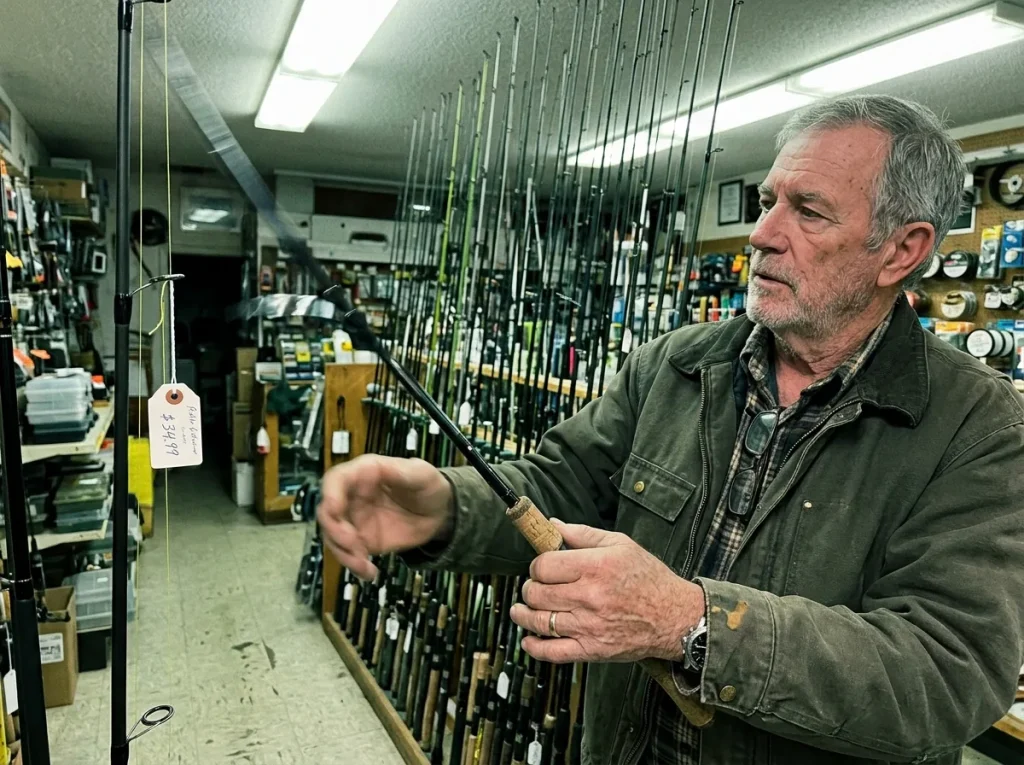
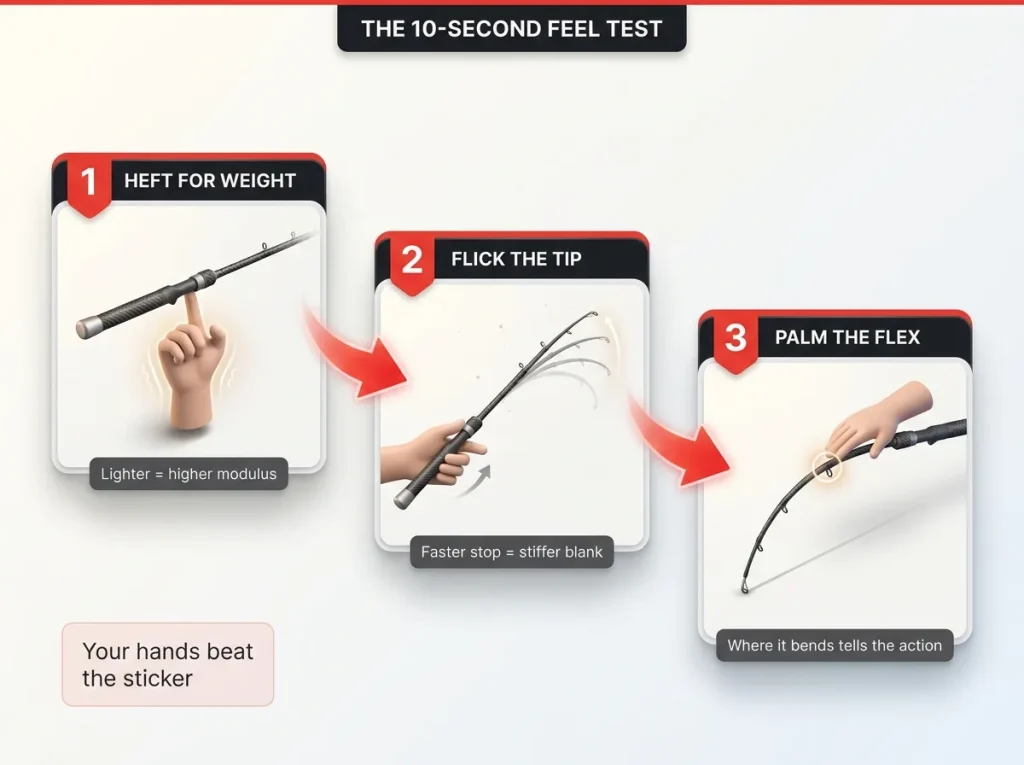
Sometimes the blank has no clear IM or tonnage label, or you flat out don’t trust the sticker. Good news: you can read relative modulus tier with your hands in about ten seconds, whether it’s a spinning rod or a casting rod. Here’s the routine a veteran runs at the counter.
- Weight-for-length: heft it. Lighter for the same length and power usually means higher modulus.
- Recovery snap: flick the tip and watch how fast it stops quivering. A faster stop means a higher-modulus blank.
- Flex point: press the tip against the floor and watch where it bends. Flex concentrated near the tip versus bending progressively into the mid-section tells you the action and hints at the build.
None of this is guesswork. You’re feeling the actual material properties: the stiffness-to-weight ratio and the strain rate that the whole spec sheet is trying to describe in numbers. Do it enough and your hands will out-read the sticker every time.
Conclusion
Modulus is stiffness, not quality, and definitely not strength. The biggest number on the blank is often the wrong buy, because stiffness and strength trade against each other and most fishing never needs the top tier. Match the modulus tier to your technique, keep the rod angle low when a fish is close, and you’ll catch more and break fewer rods than the angler who bought on the spec sheet alone.
Next time you’re at the counter, skip the sticker and run the ten-second feel test. Heft it, flick it, palm the flex, and buy the rod your fishing actually needs instead of the one with the biggest number printed on the side.
Frequently Asked Questions
01What does modulus mean on a fishing rod?
Modulus measures how stiff the carbon fiber in a blank is, technically its Young’s modulus. It is not a measure of strength or overall quality, just how much the material resists bending under load.
02Is higher modulus carbon fiber better for a fishing rod?
Not automatically. Higher modulus is lighter and more sensitive, but also more brittle and weaker in raw strength. It only helps if that extra sensitivity matches how you actually fish.
03What is the difference between IM6, IM7, and IM8 rods?
IM6, IM7, and IM8 are Hexcel’s proprietary trade names for its graphite fibers, roughly rising in stiffness. They are not a universal industry standard, so the label alone does not guarantee performance across different brands.
04Why do high-modulus fishing rods break so easily?
Usually it is high-sticking or impact damage, not the modulus itself. A stiff blank held near-vertical can fail at as little as 2 pounds of force. Keep the tip below 45 degrees with a fish close.
05What modulus is best for bass fishing?
It depends on technique. Higher modulus suits finesse and jig work where sensitivity matters, while a lower-modulus or composite blank is better for crankbaits and treble-hook reaction baits that need forgiveness.
Risk Disclaimer: Fishing, boating, and all related outdoor activities involve inherent risks that
can lead to injury. The information provided on Master Fishing Mag is for educational and informational purposes
only. While we strive for accuracy, the information, techniques, and advice on gear and safety are not a substitute
for your own best judgment, local knowledge, and adherence to official regulations. Fishing regulations, including
seasons, size limits, and species restrictions, change frequently and vary by location. Always consult the latest
official regulations from your local fish and wildlife agency before heading out. Proper handling of hooks, knives,
and other sharp equipment is essential for safety. Furthermore, be aware of local fish consumption advisories. By
using this website, you agree that you are solely responsible for your own safety and for complying with all
applicable laws. Any reliance you place on our content is strictly at your own risk. Master Fishing Mag and its
authors will not be held liable for any injury, damage, or loss sustained in connection with the use of the
information herein.
Affiliate Disclosure: We are a participant in the Amazon Services LLC Associates Program, an
affiliate advertising program designed to provide a means for us to earn advertising fees by advertising and linking
to Amazon.com. As an Amazon Associate, we earn from qualifying purchases. We also participate in other affiliate
programs and may receive a commission on products purchased through our links, at no extra cost to you. Additional
terms are found in the terms of service.