
In this article
The buoy data indicated 22 knots. The app promised a “breezy” morning. I’d launched at 5 a.m. chasing a falling barometric pressure window, but the front had stalled. By 9 a.m. I was staring at a flat-lined rod, watching the barometer tick upward. The weather hadn’t lied. I just hadn’t known how to read it.
After twenty years guiding, I’ve seen this exact situation endlessly. This guide decodes the atmospheric variables that dictate fish behavior—barometric pressure, wind dynamics, surface optics, temperature shifts, and the forecasting tools pros rely on. You can stop guessing and calculate your time on water.
⚡ Quick Answer: Standard apps offer delayed data that ruins trips. To locate feeding fish, track real-time barometric trends for swim bladder expansion, read wind direction to find current seams, and match lure presentation to metabolic recovery time. A falling barometer creates prime feeding windows; a rising barometer forces deep-water finesse tactics.
The Swim Bladder Equation — How Pressure Controls Depth
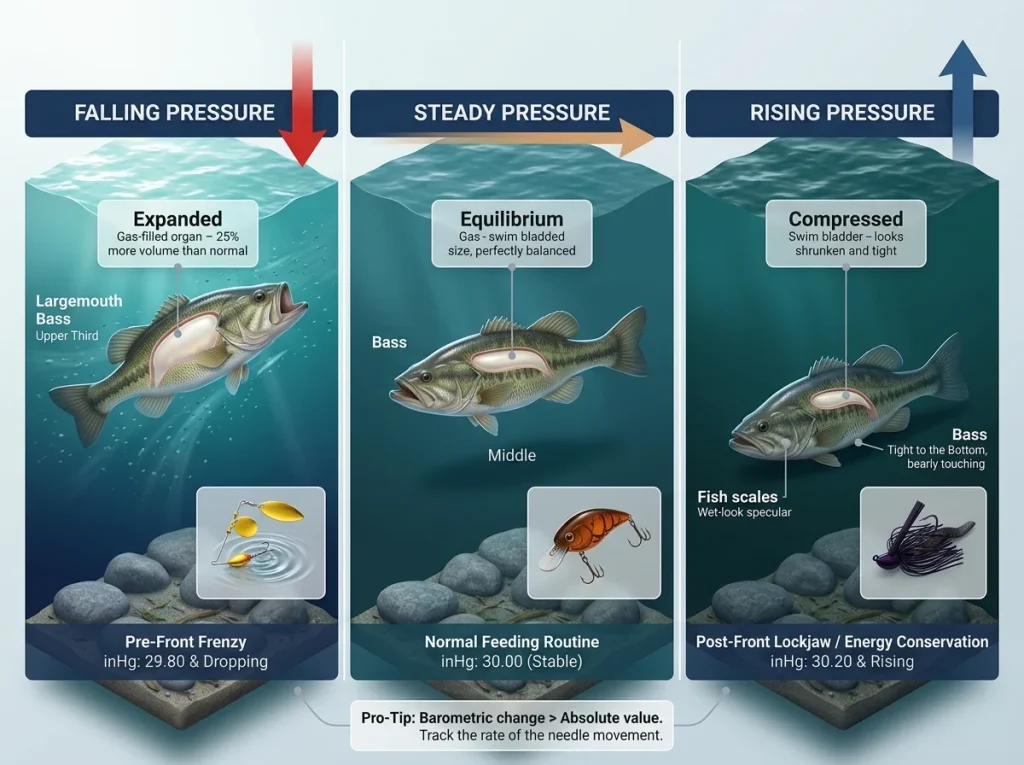
Gas behavior inside a fish follows immutable physics. The foundational question is why barometric pressure alters behavior at a physiological level. It’s a chain reaction: falling barometric pressure triggers swim bladder physics, forcing gas expansion that drives a pre-front feeding frenzy.
Boyle’s law dictates that when atmospheric pressure drops ahead of a storm, external force decreases and trapped internal gas expands. This alters buoyancy, forcing fish to move and feed aggressively before low pressure stalls them.
Trout can “burp” to equalize rapidly through a pneumatic duct, limiting behavioral disruption. Bass, walleye, and perch rely on slow gas exchange via their blood. This biological bottleneck makes them wildly sensitive to rapid pressure shifts. That notorious post-front “lockjaw” isn’t fish being stubborn. They are physically immobilized, burning spare energy just to maintain neutral buoyancy. Applying fishing tactics by pressure state requires acknowledging this biological tax. A UF/IFAS Extension study on neutral buoyancy in fish confirms hovering can double resting energy consumption. They aren’t lazily ignoring lures—they’re burning calories to avoid floating away.
Boyle’s Law in the Water Column
Gas volume shrinks when pressure rises and expands when it falls. A tiny drop in surface pressure forces a measurable volume change inside the fish. The biological target is an isopycnic state with surrounding water. Any deviation crushes their spare energy reserves.
Pro tip: Track the rate of barometric change on your logger. A 0.10 inHg drop over one hour is a violently different signal than a slow 0.10 inHg decline across six hours.
Species Specifics — Why Target Matters
Targeting bass during a pressure spike is an exercise in frustration. They pin their bellies to the bottom, spending their entire energy budget on buoyancy stabilization. If you winch a deep-water fish up rapidly, gas overexpands, causing massive trauma like gastric eversion. Knowing your target’s physiology modifies where you expect them to hold. Reviewing swim bladder mechanics and deep-water pressure helps mitigate these lethal risks.
When individual costs remain high, fish use structural boundaries and behavioral grouping to endure the physical toll until the next feeding cycle.
The Energy Cost of Pressure Shifts
Maintaining neutral buoyancy demands continuous output. During spikes, fish retreat into thick wood piles, seeking stable microzones to minimize staggering stabilization costs.
Schools group up to rapidly cut individual energy expenditure compared to solitary hovering. You’ll find post-cold-front bass buried in a brush pile, conserving a trashed energy budget. Drop a jig directly on their noses, because they refuse to move two feet. Finding them requires understanding how fronts alter behavior hour by hour, as the biological clock dictates lockjaw duration.
Wind, Current Seams, and Reading the Water’s Energy Map
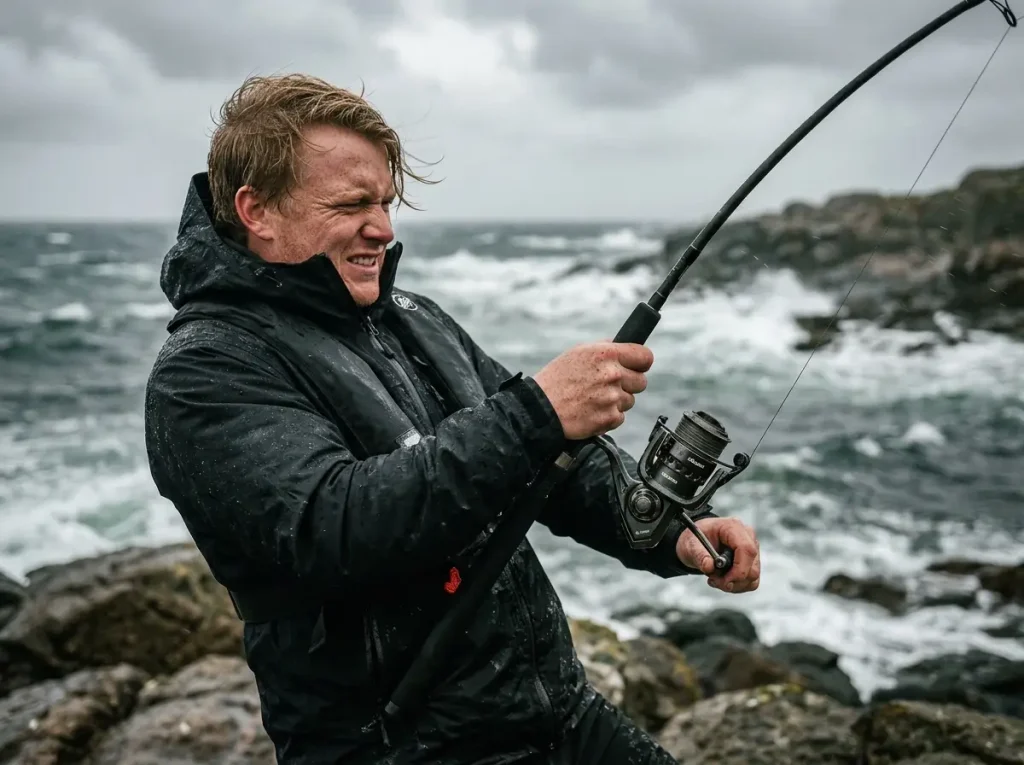
Wind writes the energy map of the lake. It heavily concentrates plankton on exposed windward shorelines, generating predictable predator ambush zones.
Understanding wind speed requires examining fluid dynamics. The standard for flow velocity over surface roughness is Manning’s n. Boulders and submerged weeds spike resistance, slowing water, compounding turbulence, and creating distinct current seams. This conveyor belt effect drives high dissolved oxygen and nutrients against rocky banks. Baitfish follow, and predators trail right behind. Conversely, protected leeward shorelines become quiet refuge zones for recovering fish. Mastering how wind direction positions fish on your lake separates successful anglers from everyone else.
Surface Roughness and Current Seam Formation
Boulders require high flow energy to surpass, forging pockets of reduced velocity downstream where predators casually hold without burning calories. Dense weed lines create energetically efficient ambush zones. Shoreline surface roughness from waves increases edge drag, causing fish to tighten up along weedline interiors during heavy winds.
Pro tip: In 15 mph winds, check rocky points. Convergence of current seams, oxygenation, and baitfish peaks here.
The Beaufort Scale as an Angling Gear Selector
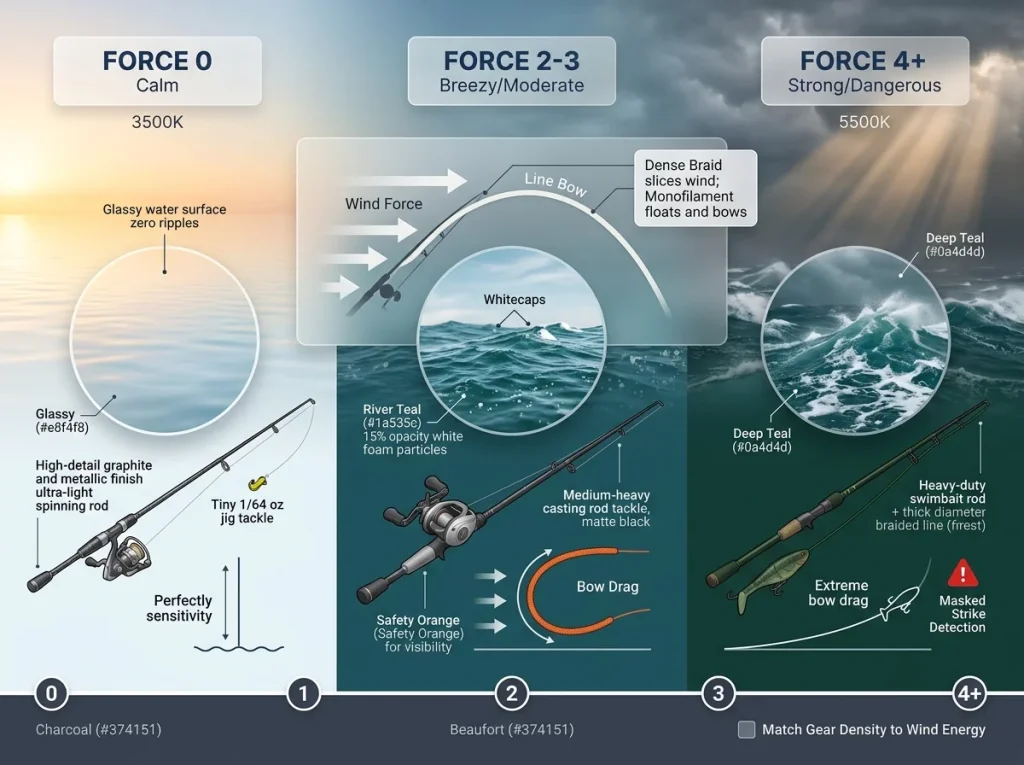
The National Weather Service uses the Beaufort Wind Scale to grade wind speed based on immediate sea conditions—it serves directly as a tackle selector. Force 0 matches mirror-like water, perfect for ultra-light gear. At Force 3, wavelets break, demanding medium-heavy rods.
I lost more good fish relying on thin monofilament in a steady crosswind than I care to admit. When the wind rips across the lake, the bow in the line absorbs all the hook-setting power. Switching to dense braid to slice through the air wasn’t a preference—it was the only way I could feel a light bite.
At Force 4, water turns into whitecaps, generating severe hydrodynamic drag on the line. This outward bow dampens strike vibrations. You must compensate immediately with dense lures and low-diameter braid.
Windward vs. Leeward — Decoding the Lake’s Budget
A battered windward point on a plunging barometer under a 12-knot crosswind is a high-probability feeding event. The windward shore hoards elevated oxygen and highly confused baitfish.
Leeward shores lack that brutal energy, serving as resting targets on rising pressure days. Often, wind-driven turnover on windward banks disrupts the local thermocline entirely, driving fish straight down to the nearest stable oxygen layer.
Snell’s Window and Surface Optics — The Stealth Variable
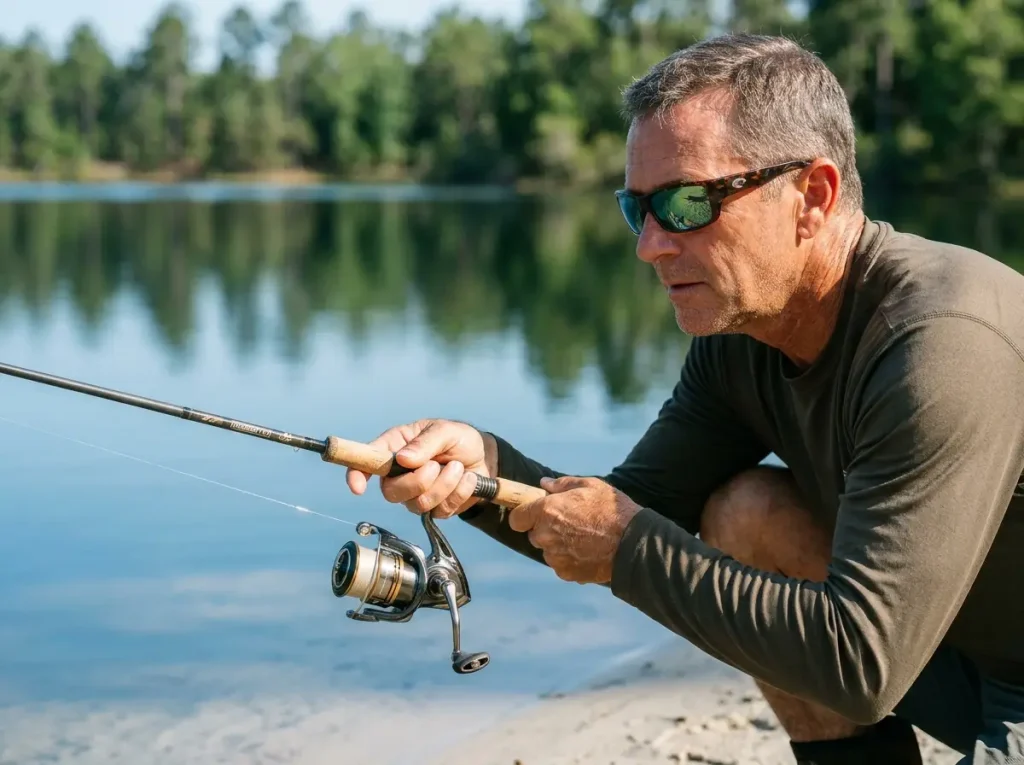
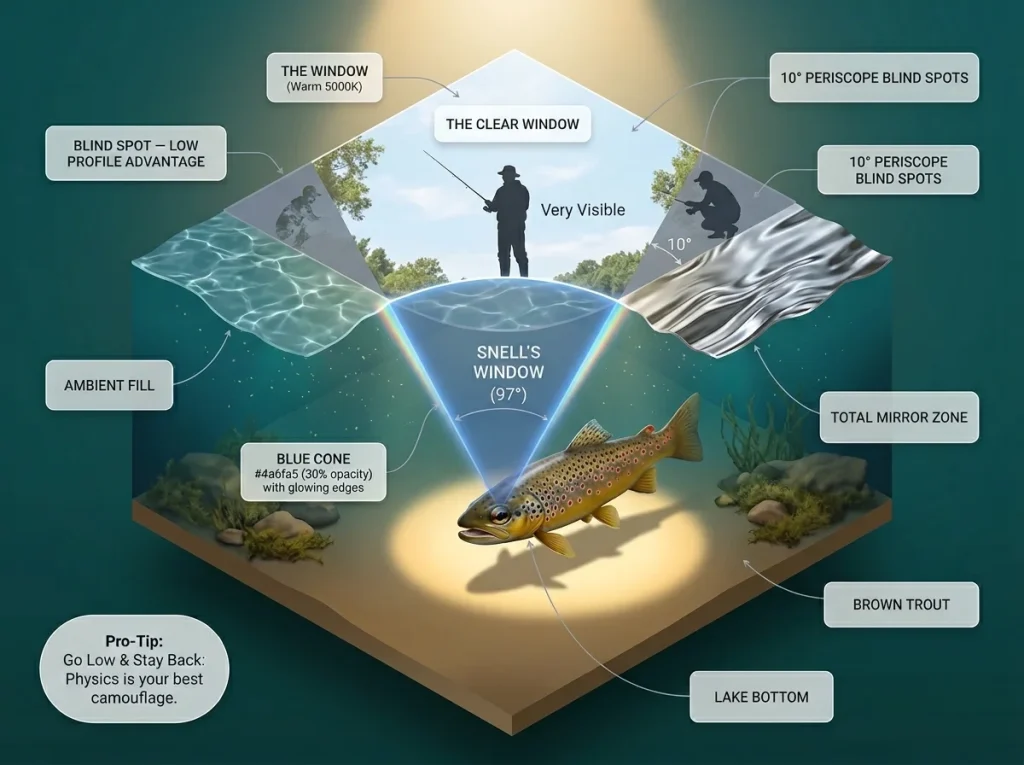
The biggest mistake novices make on glassy mornings is standing tall on the casting deck. It’s optical failure. Light refraction compresses the 180-degree above-water hemisphere into a strict 97-degree cone for the fish—called Snell’s window. Cloud cover dictates surface ripple and visual distortion, controlling whether fish see a silhouette or just unrecognizable shadows.
The 97-Degree Cone — What a Fish Actually Sees
Light bending at the surface causes objects near the horizon to look significantly higher. Your towering rod silhouette is massively obvious. However, an immediate 10-degree periscope blind spot exists. By maintaining a slow, low casting crouch and staying far back, you expertly exploit this blind spot. Outside that 97-degree cone exists a mirror zone where the surface reflects the lake bottom entirely.
Surface Conditions and Visual Fragmentation
On perfectly flat water, your profile remains intact. Following a light chop, your profile bands into pieces. High turbulent flow aggressively shatters the image, completely disintegrating your silhouette. Dead calm, high-pressure bluebird days are the worst-case optical scenario; Snell’s Window sits at maximum integrity, meaning fish see every flinch and spook instantly.
Pro tip: If you’re fishing calm post-front water and fish constantly “pop off” the bait on your approach, the issue is optical. Go low-profile, double casting distance, and utilize fifteen-foot leaders.
Reading Cloud Cover as a Stealth Forecast
Old guides weren’t merely superstitious when praying for overcast days—they applied physics. Heavy overcast breaks up the harsh window ceiling, reducing stabbing glare and increasing predator confidence to hunt open water. Clear skies keep the visual window intact, forcing fish to retreat to shaded cover and rely on ambush dependence.
Weather Model Architecture — Why Your App Is Wrong
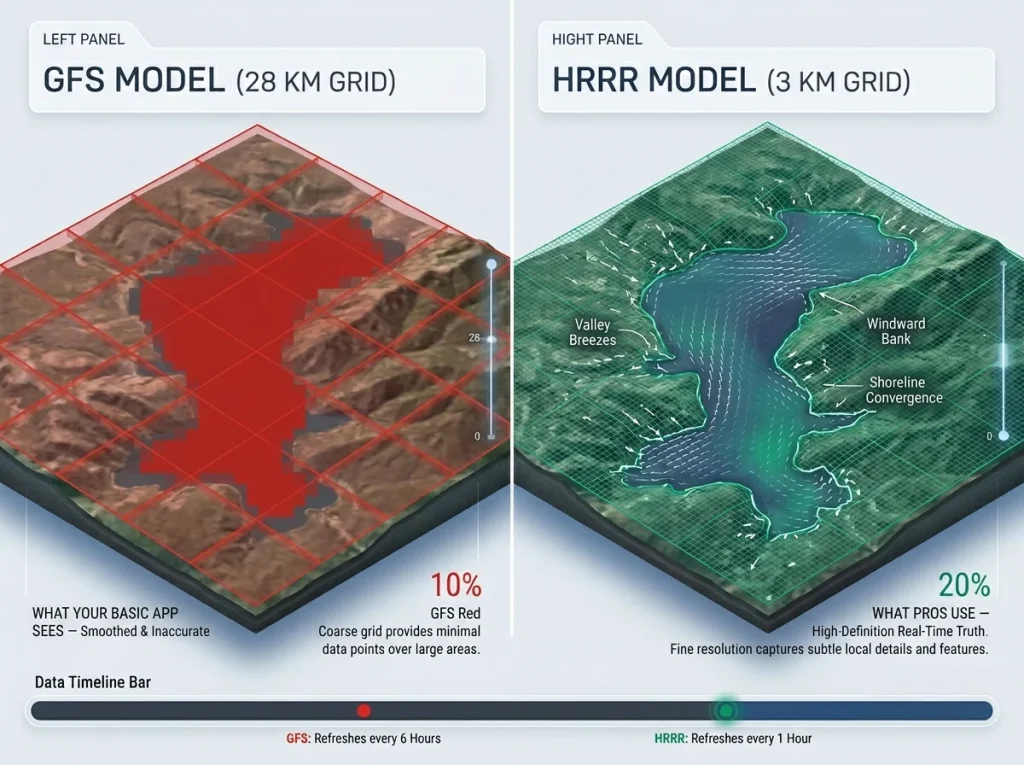
Commercial applications distribute smoothed, low-resolution data. Running a basic NOAA feed through an algorithm doesn’t produce an actionable fishing forecast. The standard GFS interpolates a coarse 28km grid, totally missing hyper-localized fishing microclimate patterns on your lake.
GFS vs. HRRR — Model Resolution as an Angling Variable
The Global Forecast System (GFS) runs a 28-kilometer grid, excellent for predicting frontal arrivals days out, but useless for a tight 5-mile valley reservoir. The High-Resolution Rapid Refresh (HRRR) updates hourly on a tight 3-kilometer grid. It remains the gold standard for same-day angling decisions, accurately resolving terrain-induced winds.
The Forensic Step — Reading Buoy Data
Seasoned professionals ignore standard weather apps on launch mornings. They check the National Data Buoy Center (NDBC) to track raw telemetry. Live buoys provide untouched surface truth: wind direction, wave height, water temp, and barometric pressure. If the buoy logs higher winds than models claimed, the front is moving faster. Divergence proves the buoy always wins.
Building a Pro-Grade Forecasting Stack
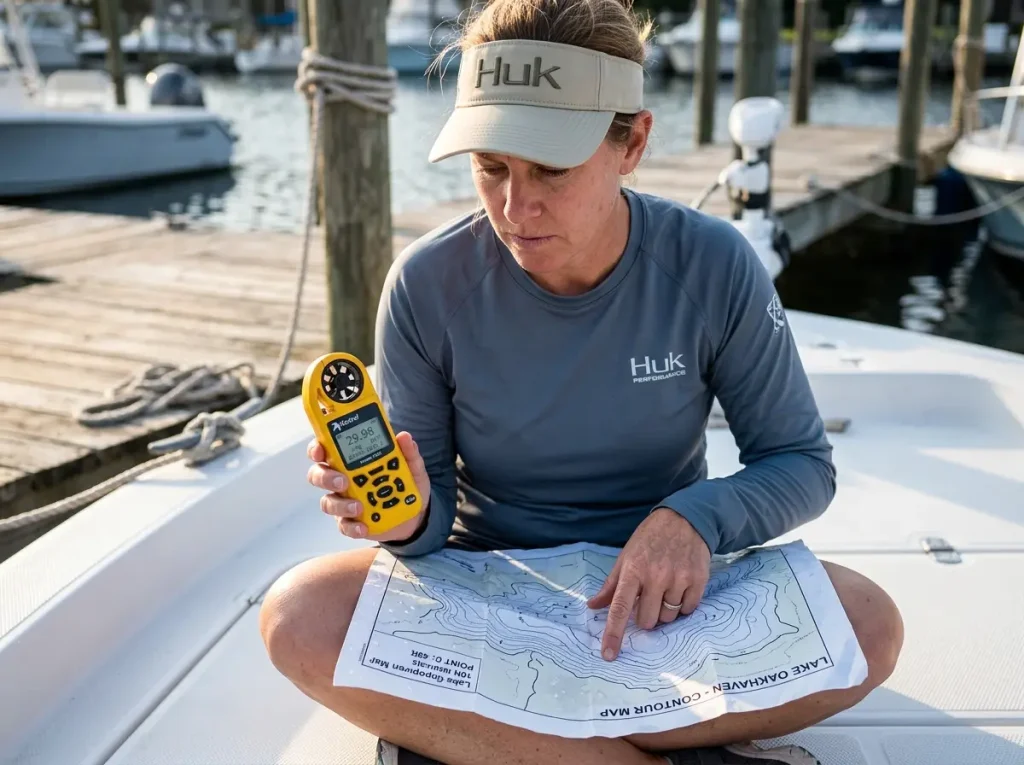
Ditch the single app crutch. Your same-day execution requires HRRR, while real-time ground truth emerges from NDBC buoys. For a tough safety margin, use the raw coastal waters forecast adjusted by meteorologists. Mount a tempest weather system onboard to capture exact pressure gradients. When models miss and storm cells erupt, rapid thunderstorm safety protocols for on-water anglers must be perfectly memorized to get off the water fast.
Bioenergetics and Thermal Gradients — Your Depth Map
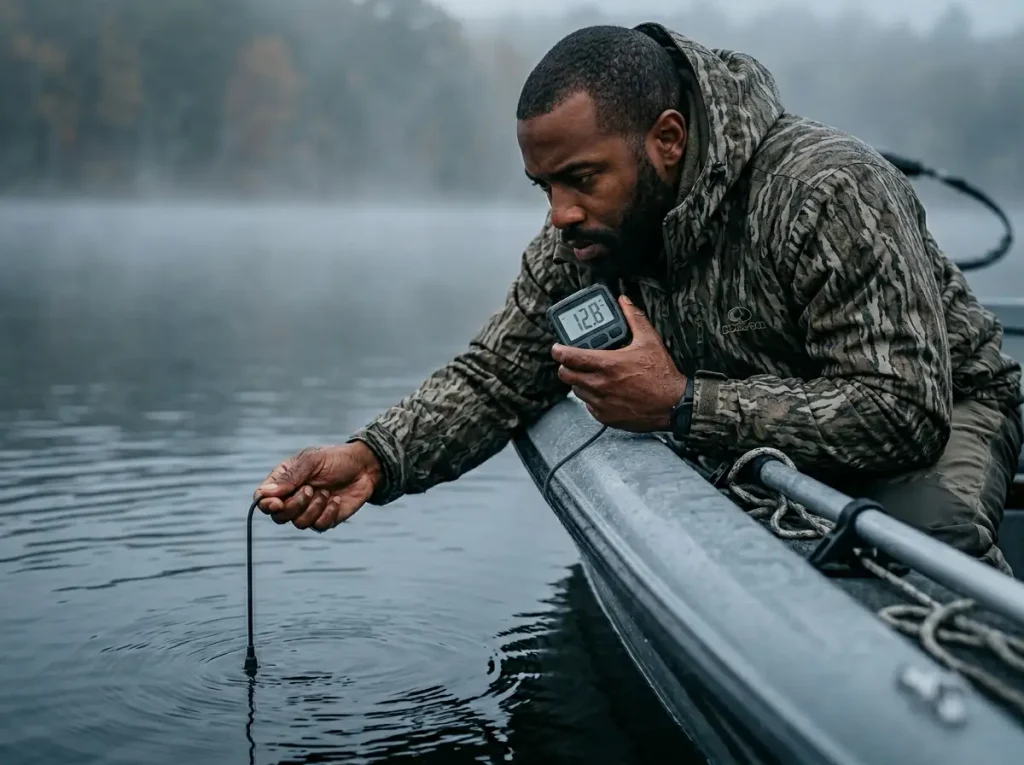
Water temperature dictates the total biological machinery of an ectothermic fish. It throttles their metabolic rate, commanding their activity level and driving exactly what depth they must occupy.
Aerobic Scope — The Energy Budget That Governs Feeding
Aerobic scope is the mathematical gap between maximum active output and resting needs, determining available physiological energy to chase bait. As water warms toward species-specific targets, capability climbs significantly faster than resting needs. The aerobic scope balloons wide open, and fish feed intensely. Past optimum limits, resting costs skyrocket. A study published in the PMC database on climate impacts on fish metabolism details how this contracts the scope tight, forcing severe stress.
As surface temperatures aggressively climb, deep oxygen solubility tanks. Fish hunt an oxygen refuge, frequently marked by your sonar’s thermocline band—a living dissolved oxygen map indicating where that thermal sanctuary sits.
Cold Front Recovery Time — The Reason Behind Lockjaw
Brutal cold fronts trigger severe metabolic depression in deep-water species inside hours. Nighttime air plummets, causing surface water cooling that initiates agonizing metabolic shutdowns. Staggering metabolic recovery time demands brutal patience. Expect 24 to 48 hours of blank screens for moderate systems, and 48 to 72 hours of total lockjaw for severe frontal drops.
The Saturday morning post-front tournament is consistently a grind, whereas the Sunday session often witnesses recovering fish slowly eating again.
Seasonal Thermal Forecasting — Converting Air Temp to Depth
In summer, nighttime cooling below 70 degrees expands the tight aerobic scope for an early bite. In winter, relentless sunny warming pulls lethargic fish onto shallow mud flats. Transition months deliver explosive feeding because conditions park near optimal thermal preferences, but they carry violently shifting frontal passages. When fishing transitions, your surface temp gauge lies—big fish are parked where the active thermal layer sits, completely ignoring the topwater zone.
The Tactical Matrix — Condition-to-Action Mandates
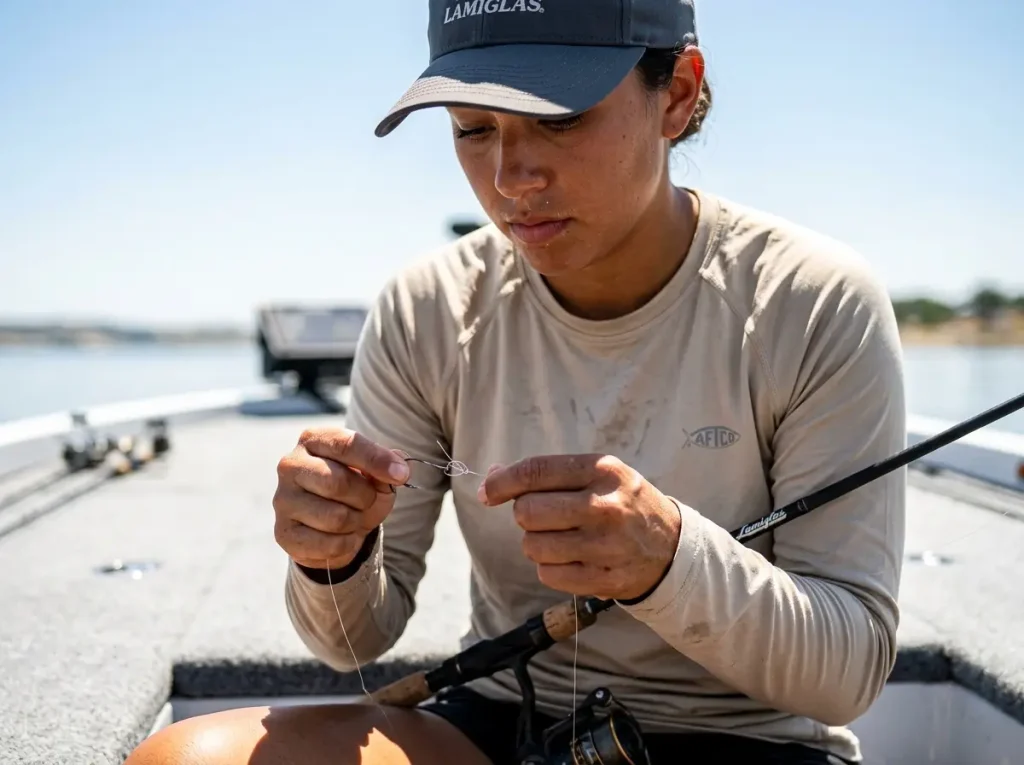
The weather forecast remains raw data until field application mapping delivers a direct condition-to-action mandate. When everything lines up perfectly, companies like Mercury Marine boast photos in catalogs. When skies lock out the bite, tough tactics save the trip.
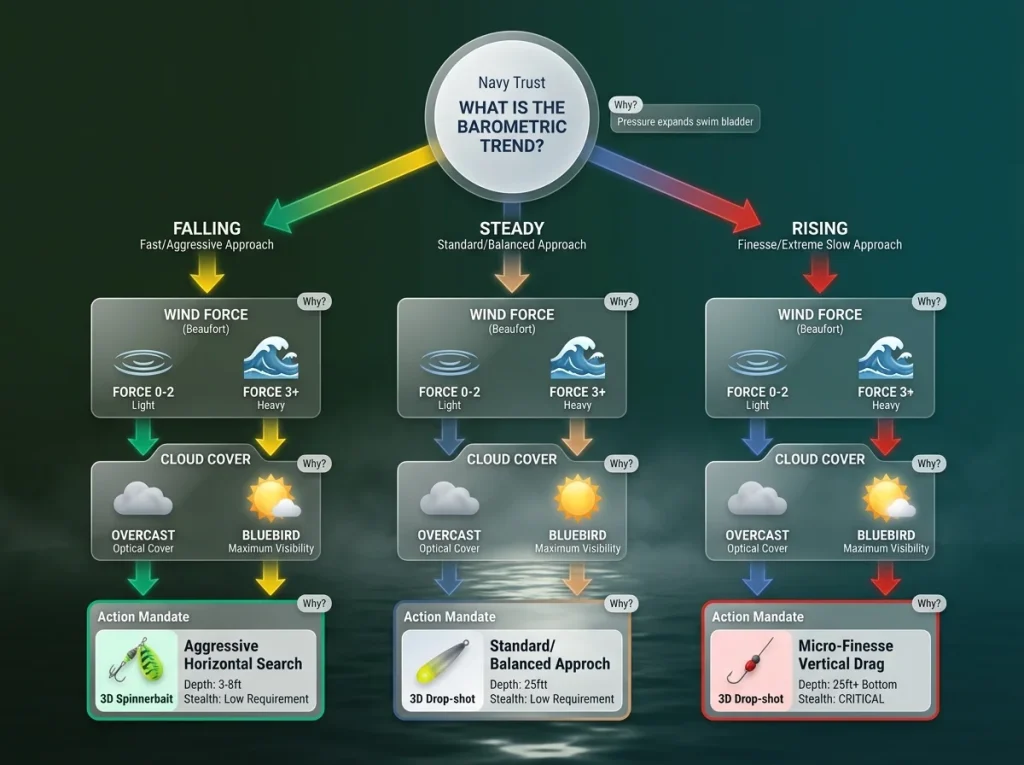
Barometric Trend Matrix — The Most Important Variable
A rapidly falling needle demands fast, violent presentations. Operations stay shallow mid-water; you burn spinnerbaits right up until the cold front wall hits. Extremely low pressure dictates deep dragging—heavy plastics, dead-sticking on the bottom in zero gear.
I used to obsess over finding the exact lure color during a severe pressure spike. It wasn’t until I started mapping the barometric needle that I realized color means absolutely nothing if fish are biologically locked down by high pressure. I stopped changing colors, drastically slowed down my retrieve, and saved dozens of post-front trips.
A rapidly rising pressure forces rigid finesse fishing using miniature drop-shots to literally bump fish into reaction strikes. A long, steady high-pressure system favors dependable routines and natural forage profiles.
Multi-Variable Integration — Reading the Forecast Stack
Every decision point requires checking pressure trend, wind force, cloud cover thickness, thermal shift, and time elapsed since the last cold front. Score them aggressively. Three favorable variables, like falling barometer under offshore chop and active solunar variance, generate a green-light hunt. Two hostile variables dictate micro-finesse pivots. Don’t panic over wind advisories and miss the pre-front flurry. Fish in the rain: it drops barometric weight, and the shattered Snell’s Window provides massive optical cover. Master troubleshooting why fish aren’t biting by simply trusting atmospheric diagnosis over shifting lure locations.
Conservation Imperative — Responsible Release
Extracting a deep-water fish during high-pressure spells triggers severe barotrauma. The swim bladder compresses heavily; raising them fast up a winch causes irreversible overexpansion and gastric eversion. Throwing a weighted release tool on their lip drops them aggressively back to their specific pressure stability zone to recover. Always factor delayed mortality taxes into heavy deep water launch plans.
Conclusion
Pressure remains a strict physiology problem. When the barometer brutally spikes, fish spend metabolic energy managing buoyancy, not chasing prey. Your lure speed and presentation depth must directly accommodate this biological reality.
Your smartphone app shows smoothed generic data usually four hours stale. Stack the HRRR mesoscale models, the NWS Marine Zone, and NDBC buoy telemetry for rigorous ground truth tracking.
Finally, dead calm, post-front bluebird days present the toughest technical situations. Snell’s Window operates perfectly while the fish’s energetic scope is tight. Success comes down to ruthless discipline—fifteen foot long leaders and agonizing patience. Check the buoys and HRRR models next weekend. That single unglamorous habit guarantees more heavy weight in your net than any new graphite rod.
FAQ
What is the best barometric pressure for fishing?
A slowly, steadily falling barometer tracking between 29.70 and 29.90 inHg triggers swim bladder gas expansion, pushing lethargic fish into aggressively violent pre-front feeding patterns before severe pressure eventually forces them deep.
How long after a cold front do fish bite again?
Deep-water species require roughly 24 to 48 hours of completely suppressed feeding to physiologically recover from a front, extending to 72 hours for severe drops. The bite generally resumes six to twelve hours after pressure stabilizes.
Does wind direction matter for fishing?
Yes, wind actively concentrates dissolved oxygen and stacks baitfish against the battered windward shore, generating reliable predator ambush zones while directly dictating your casting efficiency.
Can you fish in the rain?
Absolutely. Heavy rainfall hitting during a falling-pressure pre-front window crushes light penetration, shattering Snell or Window integrity and providing massive optical cover while spiking feeding aggression.
Why are weather apps wrong for fishing?
Standard commercial cell phone apps run heavily interpolated GFS data over a 28-kilometer grid, creating severe model lag. For precision, utilize 3-kilometer HRRR models and live buoy telemetry streams.
Risk Disclaimer: Fishing, boating, and all related outdoor activities involve inherent risks that
can lead to injury. The information provided on Master Fishing Mag is for educational and informational purposes
only. While we strive for accuracy, the information, techniques, and advice on gear and safety are not a substitute
for your own best judgment, local knowledge, and adherence to official regulations. Fishing regulations, including
seasons, size limits, and species restrictions, change frequently and vary by location. Always consult the latest
official regulations from your local fish and wildlife agency before heading out. Proper handling of hooks, knives,
and other sharp equipment is essential for safety. Furthermore, be aware of local fish consumption advisories. By
using this website, you agree that you are solely responsible for your own safety and for complying with all
applicable laws. Any reliance you place on our content is strictly at your own risk. Master Fishing Mag and its
authors will not be held liable for any injury, damage, or loss sustained in connection with the use of the
information herein.
Affiliate Disclosure: We are a participant in the Amazon Services LLC Associates Program, an
affiliate advertising program designed to provide a means for us to earn advertising fees by advertising and linking
to Amazon.com. As an Amazon Associate, we earn from qualifying purchases. We also participate in other affiliate
programs and may receive a commission on products purchased through our links, at no extra cost to you. Additional
terms are found in the terms of service.