In this article
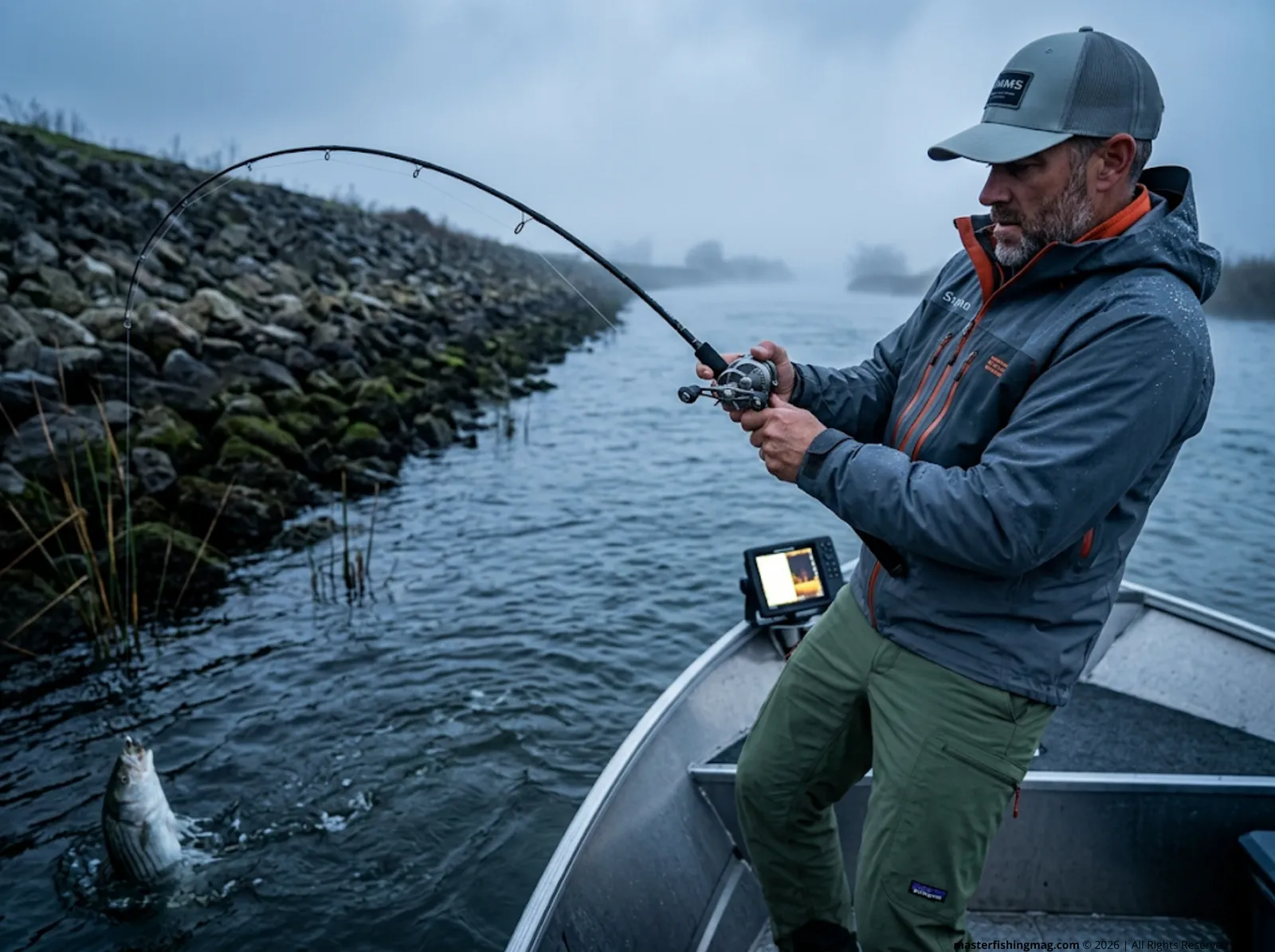
The outgoing tide had dropped the flat by two and a half feet. Where there’d been four feet of water an hour ago, there was now a narrow seam along the levee face — maybe six inches of depth between the rock wall and the main channel. That’s where the bait was. And that’s where the 28-pound fish came from. She hadn’t moved two yards in three hours. She didn’t need to.
That fish wasn’t a coincidence. She was there because the physics of the Delta put her there. Understanding those physics — tidal energy, thermal triggers, the hydraulic advantage of a rock levee — is the difference between chasing stripers on a calendar and finding them on purpose.
⚡ Quick Answer: The Sacramento-San Joaquin Delta rewards anglers who read tide gauges and water temperature data, not fishing calendars. The 3-foot outgoing tide concentrates baitfish and stripers into predictable seams — that’s your primary bite window. Threadfin shad works best during the active spawn; sardines outperform during the post-spawn recovery when fish prioritize the easiest calorie. The San Joaquin Delta peaks about 15 days ahead of the Sacramento mainstem — if you move north as water temperatures climb, you can fish two distinct peak windows in a single season.
The Biology of the Run — What Actually Moves Stripers Into the Delta
Striped bass (Morone saxatilis) showed up in the Bay in 1879 — 132 fish transplanted from the Neversink River in New Jersey. The fishery that developed from that introduction is entirely self-sustaining today. No stocking. No safety net. The run that exists right now is the run that survived last year’s spawn, and the year before that. That’s worth keeping in mind every time you’re sizing up a big female on the surface.
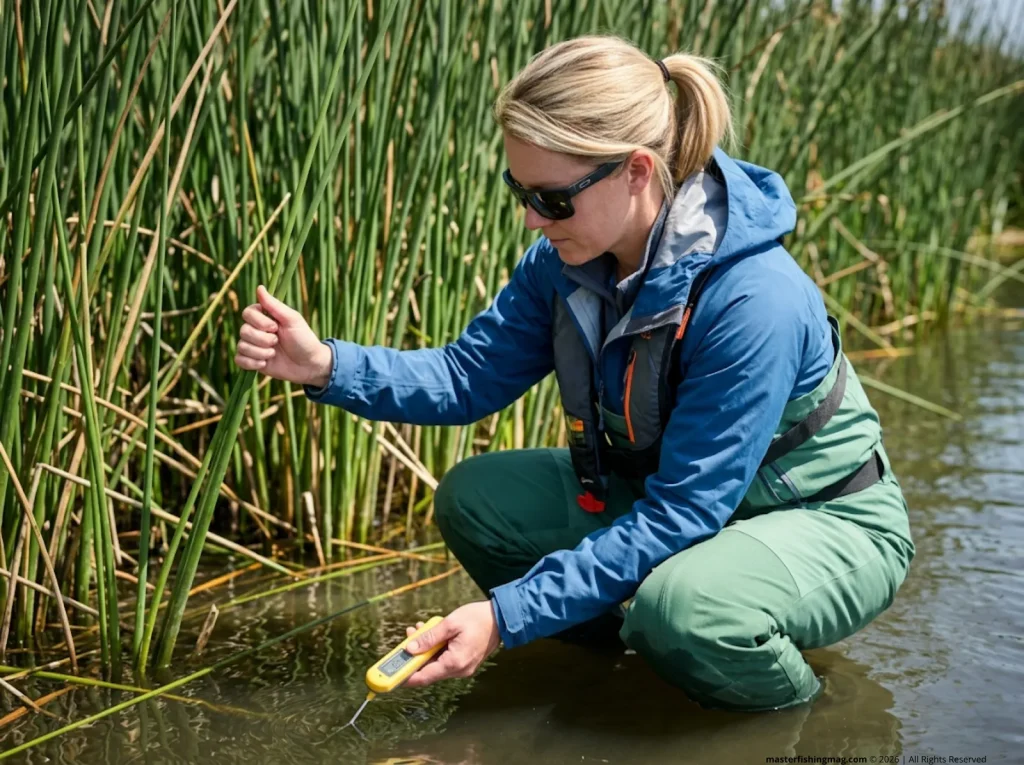
Fish start pushing upstream when water temperatures touch the low-to-mid 50s°F in late winter, typically around March. But that early movement isn’t the spawn — it’s the migration. A longitudinal CDFW study spanning 1963 to 1972 confirmed that 90% of observed spawning activity occurs between 63 and 68°F. That’s a tight band. Below it, fish are present but sluggish. Above it, they’re done. The window matters.
What triggers the migration itself is freshwater flow from the Sacramento River. High-CFS years push the Low Salinity Zone (X2 index) westward into Suisun Bay, which correlates with dramatically better juvenile survival. That’s why you should be watching the CDEC (California Data Exchange Center) flow gauges, not the date on your phone. A wet year with 20,000+ CFS in April outperforms any historical average. To understand the broader context of striped bass biology fundamentals every angler should understand, the CDFW’s temperature thresholds align closely with what drives these migratory decisions.
Pro Tip: Pull up CDEC stations at Freeport and Verona before you launch. Surface temperature and channel temperature can differ by 4–6°F when Shasta’s cold-water releases are running — that gap shifts where spawning fish actually hold.
The Thermal Lag Strategy — Chasing the Season Northward
Here’s the edge most weekend anglers leave on the table: the San Joaquin Delta warms roughly 15 days faster than the Sacramento River. The San Joaquin’s shallower channels heat up with the spring sun; the Sacramento runs deep and is fed by cold-water releases managed out of Shasta and Keswick. CDFW biologist Jerry L. Turner documented this lag precisely: “The middle of the spawning period in the Delta averaged 15 days earlier than in the Sacramento River.”
Start in the lower San Joaquin system — Antioch, Sherman Lake, Frank’s Tract — when water first touches 63°F in mid-April. As May progresses, shift north on the Sacramento toward Verona, Colusa, and the Tractor Hole scour point. By the time the lower Delta sloughs feel slow, the Sacramento mainstem is just hitting peak. You haven’t missed the season. You’ve moved to find it.
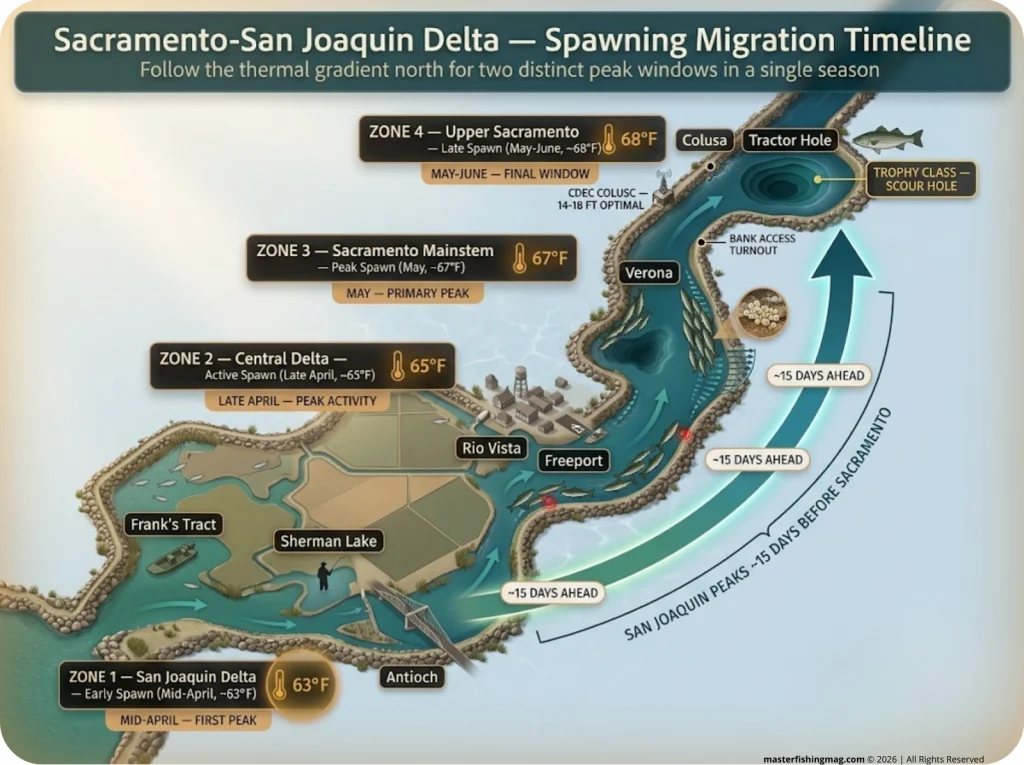
Post-spawn fish moving back downstream in late June are in a caloric deficit and actively feeding. Rio Vista and Freeport become what guides call “recovery zones” — high-traffic areas where depleted fish hit high-calorie presentations hard before they start their return to the Bay.
Reading the Delta as a Hydraulic System — Tides Over Seasons
The Delta tide isn’t a clean in/out pulse. It’s a function of tidal head, channel geometry, and the export pumping operations of the State Water Project and Central Valley Project. Those pumps can reverse net tidal direction at key confluences like Three Mile Slough — what’s called net negative tidal flow — with serious consequences for juvenile survival and adult feeding patterns.
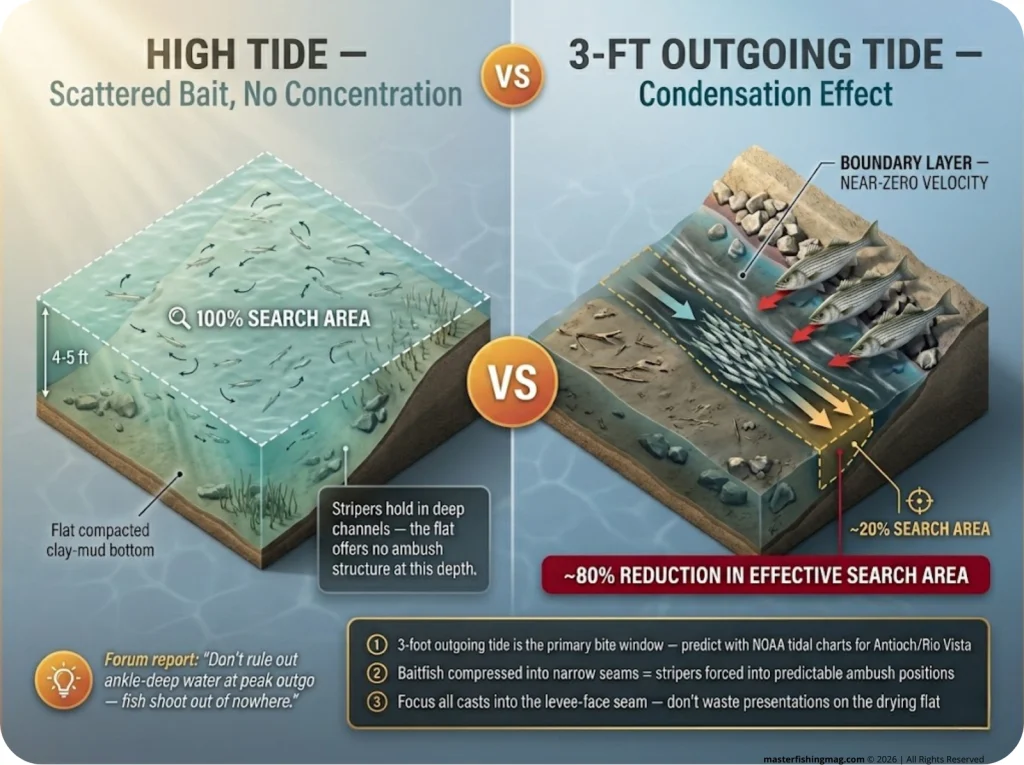
What professional guides consistently identify as the most productive tidal state is the 3-foot outgoing tide. Not a 1-foot drop. Not a full ebb. The 3-foot window specifically. The reason is physical: the Delta’s expansive flats run only 4–5 feet deep in many areas. When 3 feet drains off, you’ve removed most of the usable water from those flats. Baitfish that were scattered across acres of open flat are now compressed into narrow deep channels. Stripers follow. The angler’s effective search area collapses by roughly 80%, and the fish trapped in those current seams have to feed to hold position.
Forum anglers in r/Sacramento put it plainly: “Don’t rule out ankle-deep water at the peak outgo — there’s been times I’ve thrown into less than a foot and watched a fish shoot out of nowhere to take a big bait.” That’s not luck. That’s the condensation effect at its extreme. The USGS physics of fish habitat in the San Francisco Estuary documents exactly this relationship between estuarine flow patterns and predator positioning.
Captain John Richardson of Here Fishy Fishy Guide Service, writing from March 2026: “Until the salmon decide to turn on, I’d focus down river.” Guides like Richardson integrate real-time tidal and thermal data into every decision. That’s the standard to aim for.
The Hydraulic Jump — Where Two Sloughs Create a Feeding Station
Where two sloughs of differing velocity merge, flow transitions from fast and shallow to slow and deep. That transition releases energy in a turbulent mixing zone — a hydraulic jump. The turbulence disorients threadfin shad. Stripers park just downstream in the decelerating flow, making minimal effort to intercept prey that the current delivers.
You won’t always see this on the surface. Look for foam lines and floating debris accumulation — those mark the transition zone. Classic Delta examples include the confluence of Old River and the San Joaquin near Stockton, and the Frank’s Tract sloughs merging into the main channel. Drop a bait just downstream of the foam line and wait.
The Rock Levee Advantage — Why the Fish Sits Exactly There
The Delta’s riprap levees have a roughness level significantly higher than straight earthen channels. That roughness — what engineers call Manning’s n — isn’t just a civil engineering detail. It creates a boundary layer within 1–2 feet of the rock face where current velocity drops to near-zero even during a strong 2–3 knot ebb. The rocks absorb the current energy. A 20-pound striper can hold position there while burning a fraction of the calories it would need in the main channel.
The fish isn’t near the rocks for cover. It’s using the rocks as an energy management system.
Pro Tip: Cast parallel to the levee face, not at a 90-degree angle to it. A lure or bait dragged along the rock face stays in the boundary layer longer — more time in the fish’s ambush zone. A perpendicular cast crosses that zone in under a second. You’re wasting the cast.
To understand how tidal coefficient determines predator feeding windows more broadly, the boundary layer model here is a local expression of the same bioenergetic principle: fish seek the position where the caloric math works in their favor.
Arsenal for the Delta — Rigs, Lures, and the Physics of Presentation
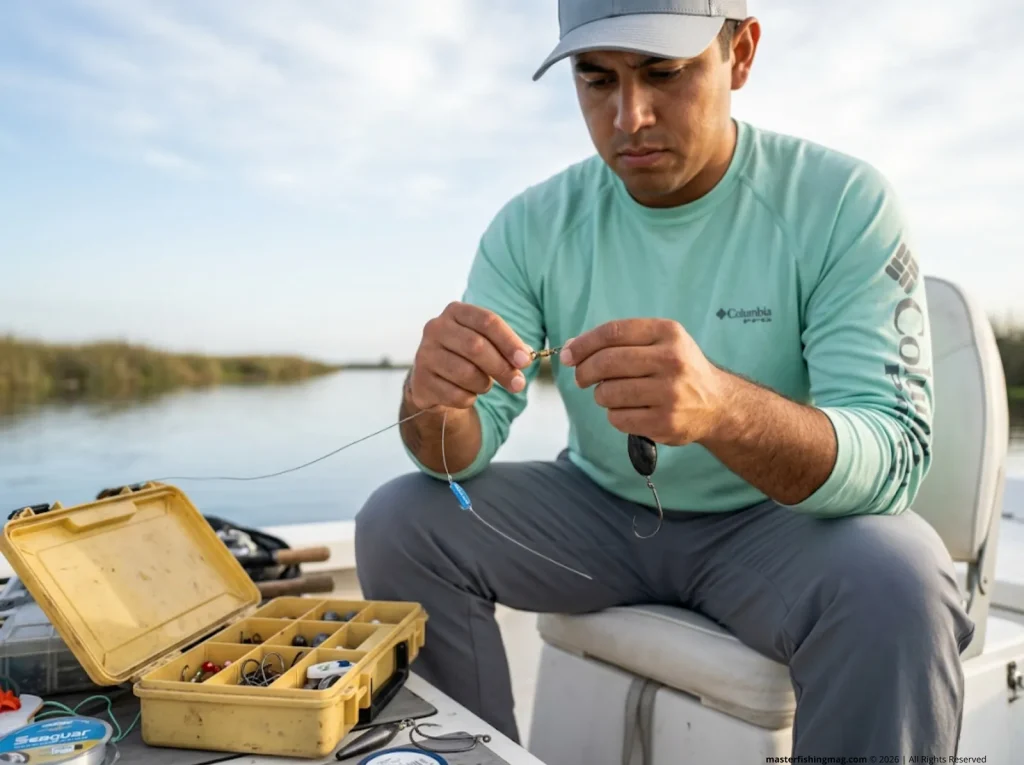
Delta striper fishing splits cleanly into two tool sets: bait rigs for bottom-holding fish and trolling spreads for actively hunting fish in moving water. You’ll need both, and the conditions determine which one to rig first.
The sliding sinker rig is non-negotiable for bait fishing. Thread a 1–3oz egg sinker onto the main line, stop it with a swivel, and run 18–24 inches of fluorocarbon leader to the hook. The sinker anchors against the current. The bait — sardine, threadfin shad, or mackerel — floats unweighted above. When a striper picks up the bait, the line slides freely through the sinker. The fish feels the weight of the bait only, not the sinker. That zero-resistance pickup is critical. Sensitive Delta fish will drop a presentation that telegraphs drag during that first moment of contact.
Use circle hooks in 4/0–6/0 sizes with sardines. They significantly reduce deep hooking and improve release survival on the cows you’ll want to put back.
One practical note: use tungsten or steel sinkers in tule-lined interior Delta areas. Lead sinkers lost in shallow water are ingested by waterfowl — loons, mergansers, swans — where even small amounts cause fatal neurological damage.
Trolling Plug Selection — Depth vs. Current
A 1oz P-Line Predator minnow is rated for 12–13 feet at 3mph — in still water. In a moving Delta, that number shifts depending on which direction you’re trolling relative to the current.
Trolling with the tide reduces effective water speed over the lure’s lip. The plug runs shallower than rated depth. Trolling against the tide does the opposite — water pressure on the lip increases, and the lure dives deeper. Push too hard against a strong ebb and you risk blowing out the lure’s action entirely. The practical fix for controlling trolling depth with line diameter and speed comes down to this: thinner braid creates less drag. 30lb braid dives deeper at the same boat speed than 50lb braid. In high-flow conditions on the Sacramento, that difference matters.
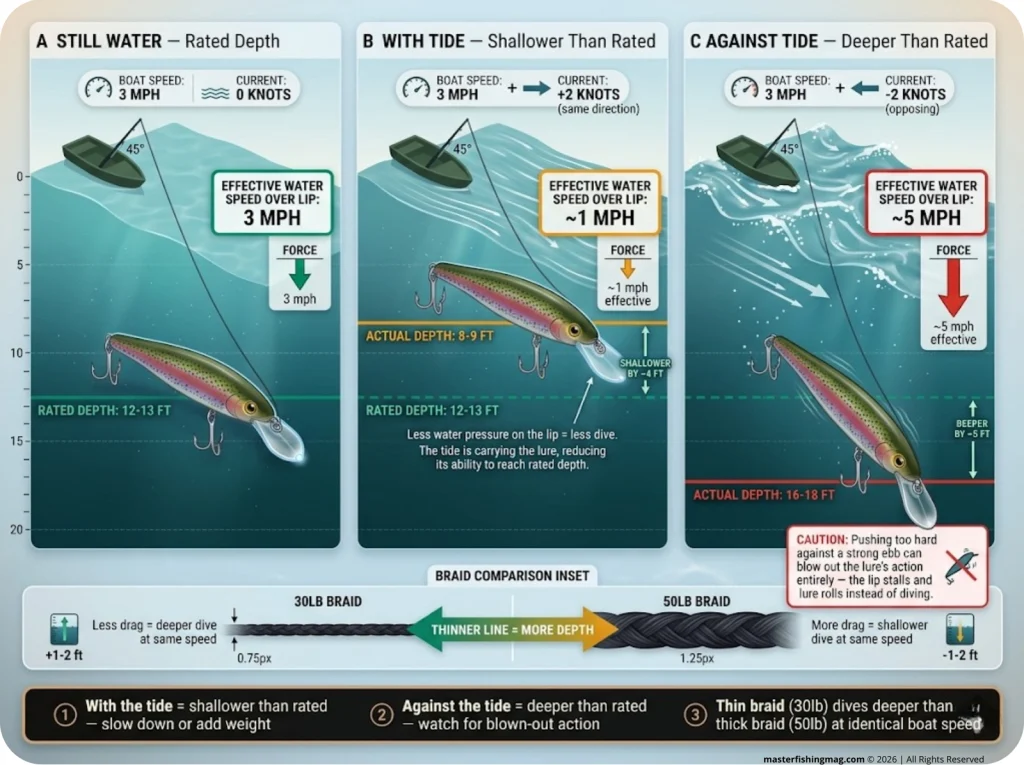
Jeff Goodwin, a Sacramento and Feather River guide, positions the boat upstream of scour holes and drifts the lure back into the hole. The current controls lure action; the motor holds position. At the Tractor Hole near Colusa, target moderate trolling speeds — 2 to 2.5mph against a knot-and-a-half of current — to reach 8–10 feet of depth in the scour point.
Pro Tip: The Delta’s riprap destroys lures. Pack twice the number of Yo-Zuri Crystal Minnow diving plugs you think you need. This isn’t a suggestion. The rocks don’t negotiate.
Bait Selection and the Post-Spawn Window
Live threadfin shad matched to local forage size is the primary producer during the active spawn. Fish are hunting. Moving bait makes sense.
Post-spawn is different. A female striper may lose 10–15% of her body mass in eggs alone, on top of the caloric cost of fighting 15,000–20,000 CFS currents for weeks. When those fish hit the recovery phase in late June and July, they’re after the easiest high-calorie meal available. That means sardines and mackerel — stationary, high-oil baits that deliver maximum calories with minimum chase. Delta guides who’ve worked this pattern long enough see sardines outperform live shad 3-to-1 on post-spawn fish. The biology predicts it.
Store sardines properly. Refrigerate, don’t repeatedly freeze and thaw. Oil content and scent intensity drop fast with poor handling, and that’s the whole point of the bait.
The Geography of the Delta — Location Intelligence by Water Type
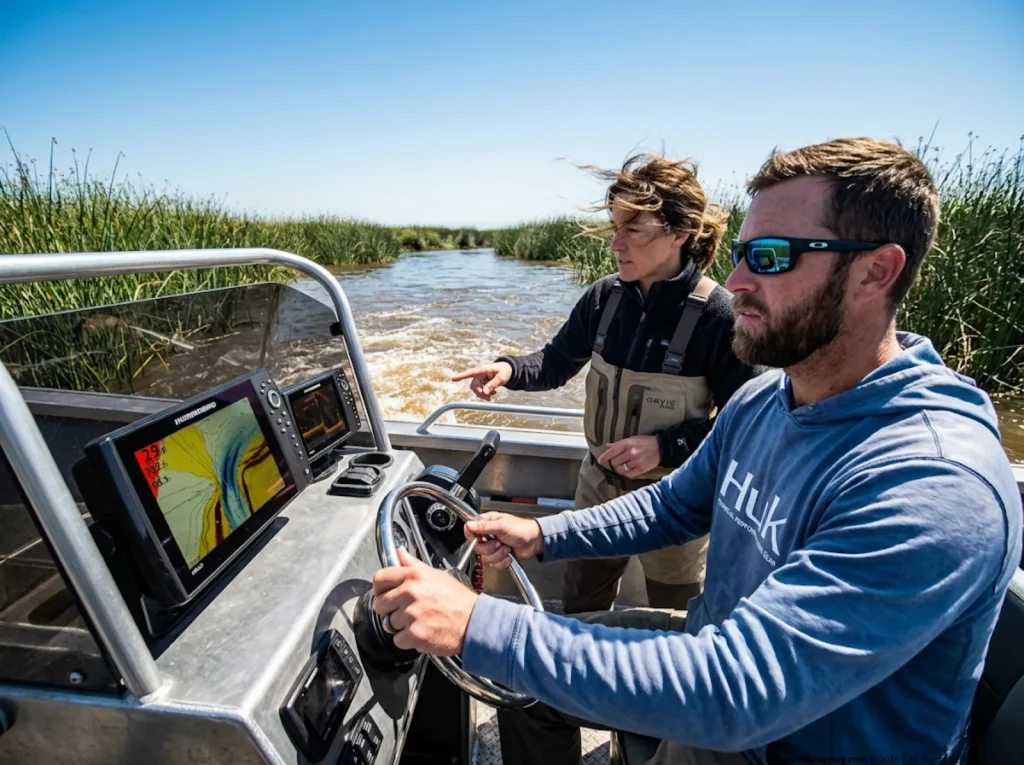
The Delta isn’t one fishery. It’s four overlapping systems: the tidal delta proper (Antioch to Sacramento), the Sacramento River mainstem (Freeport to Colusa), the San Joaquin channels near Stockton, and the interior island sloughs — Frank’s Tract, Sherman Lake. Each produces under different conditions.
Rio Vista and Isleton run a year-round schoolie fishery on deep channel seams adjacent to tule edges, best on an incoming tide as cold Bay water pushes baitfish into the warmer sloughs. Sherman Lake and Frank’s Tract are the classic spring cow locations — shallow warming flats attract pre-spawn fish early April. A standard aluminum boat will go aground in Frank’s Tract. You need a flat-bottomed sled (Alumaweld Super Vee with a jet outboard) to access the most productive 2-foot flats. Running aground in tule habitat isn’t just inconvenient — it’s irreversible ecosystem damage.
The Tractor Hole near Colusa is a scour hole carved by high-velocity Sacramento current beneath a river bend. It holds trophy-class fish in May and June — the terminus of the thermal gradient, where the river has fully warmed and spawning fish stack at the top of their run. For understanding reading pool-riffle sequences and thalweg seams in river systems, the Tractor Hole is the Delta expression of that universal hydrology — a scour depression where current concentrates fish the same way any river bend does.
Bank anglers: park at the roadside turnout near Colusa. Do not block the levee gate. That’s how access gets shut down permanently.
Check CDEC gage height at Colusa Station (COLUSC). A reading between 14–18 feet corresponds to the flow conditions that produce the best thermal window at the Tractor Hole.
The Bioenergetics Edge — Why Fish Choose Their Exact Position
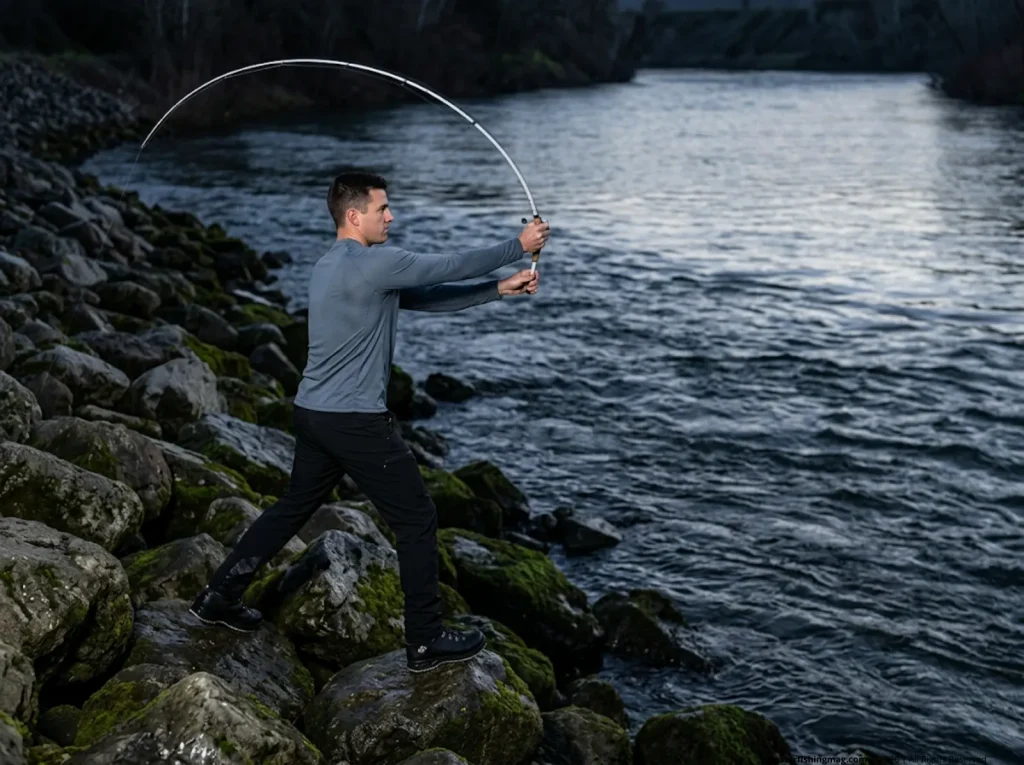
Most fishing content will tell you stripers “prefer rocks.” That’s not wrong, but it understates what’s actually happening.
A striper’s position is a metabolic decision. Fish are constrained by their metabolic scope — the difference between resting metabolism and maximum aerobic output. Every holding position has to yield a caloric surplus, or the fish moves. In the main channel during a strong flow event, a fish burns 3–5 times the calories it burns in a boundary layer position. To survive in the main channel, it has to capture proportionally more baitfish — and baitfish are moving fast in that current.
The fish on the rock face isn’t resting. It’s executing a high-burst, low-duration strike from a zero-velocity ambush position into a high-velocity current seam. Maximum caloric return for minimum energy expenditure. According to bioenergetic modeling of striper context-dependent feeding in the Delta, this feeding behavior explains why fish in boundary layers can be taken on stationary naturals while fish in main channel current require reaction-strike presentations — diving plugs, fast-moving lures.
That’s also why fish in different positions need different tackle. You’re not solving the same problem with the same rig. The fish’s position tells you what it’s doing metabolically, and that tells you what presentation it’s in the mood for.
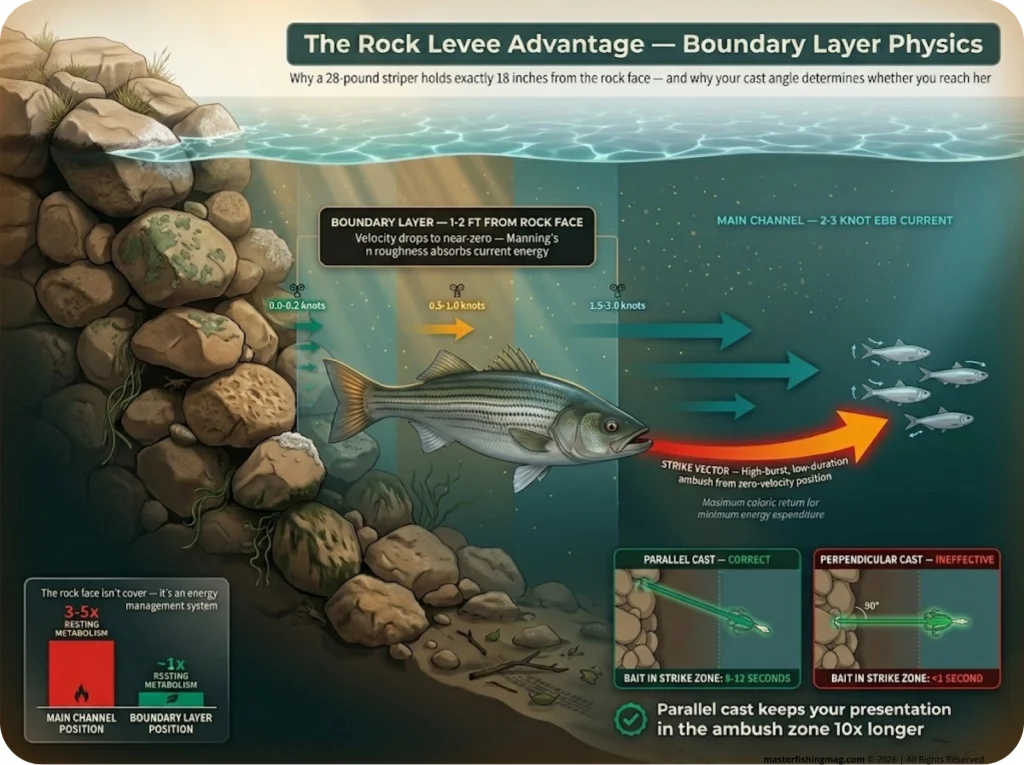
For a deeper look at how water temperature shapes fish metabolic scope and lure cadence, the relationship between thermal state and metabolic scope underlies every casting decision you make in this system.
Conservation and the Ethics of the Delta Fishery
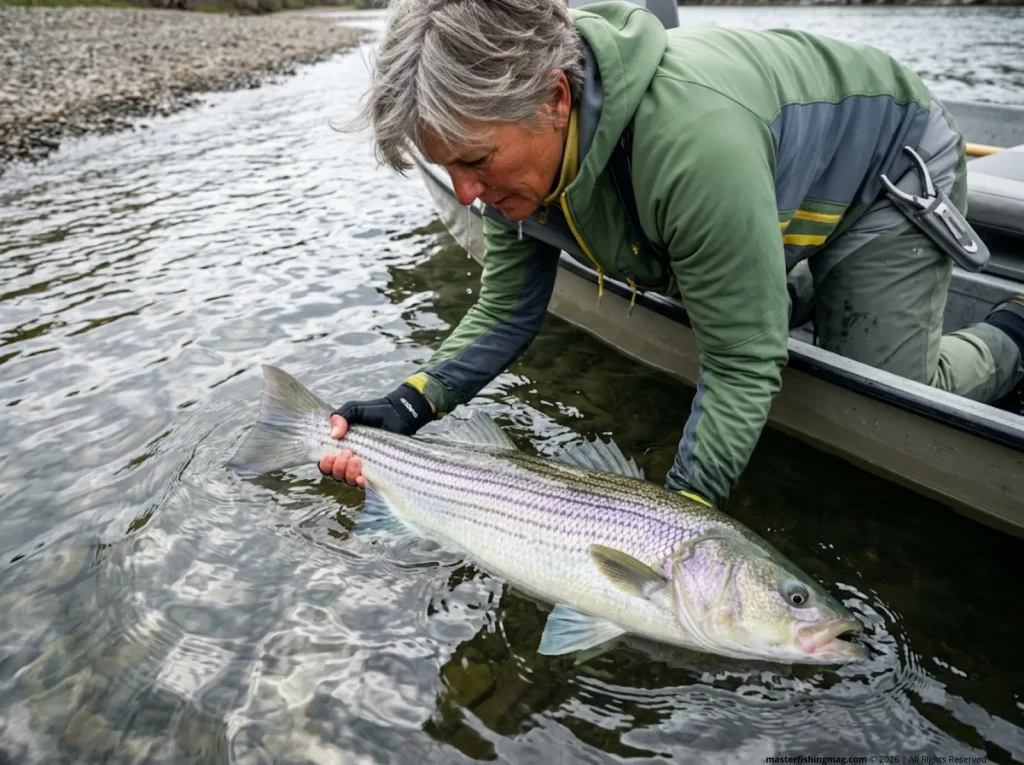
The Delta striper population is entirely self-sustaining. No stocking. When a large female is lost — through harvest, improper handling, or post-release mortality — that’s not just one fish. A 28-pound female produces orders of magnitude more viable eggs than a 10-pound fish. The math on releasing cows is not ambiguous.
There’s also a management tension worth understanding. NOAA Fisheries has documented that striped bass remain among the most significant predators of listed Chinook salmon in the estuary. The NOAA report on striped bass predation on listed fish in the Bay-Delta Estuary puts it plainly: “Striped bass likely remains the most significant predator of Chinook salmon due to its ubiquitous distribution in the Estuary and its tendency to aggregate around water diversions.” The Delta striper fishery exists inside a complex ecological equation. That’s not a reason to stop fishing — it’s a reason to handle fish carefully and think about harvest.
Release protocol matters. For post-spawn cows, revive head-facing upstream in a current seam — oxygenated flow — not in slack tule water. Air exposure above 30 seconds on any fish showing visible stress elevates cortisol, delays feeding recovery, and increases mortality risk significantly. The “hold your breath” rule is a practical field constraint: if you can’t breathe comfortably holding the fish, it’s been out of the water too long. Wet your hands, your net, every surface the fish contacts.
If you’re targeting deep-channel fish in 20-plus feet during high-flow periods, carry a descending device. Barotrauma from rapid pressure change — stomach eversion, eyes bulging — leaves a fish unable to swim down unassisted. A surface release on a fish in that condition is not a release. It’s a delayed harvest. For the full science-based catch-and-release handling for stressed fish, the physiology of cortisol response and mucus coat damage explains why techniques matter as much as timing.
Pro Tip: In water temperatures above 68°F, dissolved oxygen drops. Reviving a post-spawn cow in warm, shallow tule water is significantly harder than reviving it alongside a current seam. Choose your release location deliberately — a 30-second swim in oxygenated flow beats a two-minute hold in dead water every time.
What It Actually Comes Down To
Three things decide whether you find fish in the Delta.
First: tide governs, season suggests. The 3-foot outgoing tide’s condensation effect is a mechanical, repeatable event. Predict it with NOAA tidal charts for Antioch or Rio Vista. Intercept it. That’s your primary variable.
Second: position is a bioenergetics decision. A striper on a specific rock face is there because the rock boundary layer created a metabolic advantage. Cast parallel to the levee. Keep the bait or lure in the boundary layer. A perpendicular cast wastes the presentation.
Third: there are two separate peak seasons. The 15-day thermal lag between the San Joaquin and Sacramento systems is a built-in double window for the angler who reads CDEC data and moves north as the temperature climbs.
The next time you’re on the Delta and the tide hasn’t moved in an hour, check your CDEC app instead of changing lures. If the tidal gauge shows only a 1-foot drop, the fish aren’t stacked in the seam yet. They’re waiting. So should you.
FAQ
What is the best bait for stripers in the Sacramento Delta?
Threadfin shad matched to local forage size is the top live bait during the active spawn, when fish are aggressively hunting. Sardines and mackerel outperform during the post-spawn period when calorie-depleted fish seek high-oil, stationary prey. The biological switch between the two tracks directly to the striper’s metabolic scope state — a well-nourished spawning fish chases prey; a depleted post-spawn fish minimizes energy expenditure and takes the easy meal.
Where can I fish for stripers from shore in the Sacramento River?
The Tractor Hole near Colusa is the most productive bank location on the Sacramento mainstem, accessible from the roadside levee turnout — do not block the gate. Freeport and Verona have accessible bank spots with productive channel-edge structure. Rio Vista’s public bank areas produce schoolie stripers year-round. In the interior Delta, public levee roads on the San Joaquin system provide access to tule-edge seams, particularly productive during the 3-foot outgoing window.
What lures work best for Delta striped bass?
Diving minnow plugs — Yo-Zuri Crystal Minnow 4.5, P-Line Predator 1oz for trolling spreads — dominate the mid-column active bite. Surface plugs like the Zara Spook and pencil poppers produce strikes during low-light blitz conditions when fish push bait to the surface. For deep scour holes at the Tractor Hole, use heavy sliding sinker rigs with sardine or cut shad. The key variable is current velocity: faster current favors weighted bait presentations; slower slack windows favor unweighted topwater.
Do I need a special license to fish the Delta for stripers?
A valid California Freshwater Fishing License is required for most of the Delta system. No separate striper stamp is needed, though regulations govern size limits (18-inch minimum) and bag limits (2 fish per day in most zones). Portions near Suisun Bay and the Carquinez Strait may fall under tidal water regulations requiring a saltwater endorsement — verify current CDFW regulations for your specific access point before fishing.
Why do stripers seem to disappear from the lower Delta after May?
They haven’t disappeared — they’ve migrated upstream following the thermal gradient. The lower Delta warms past the optimal temperature band for post-spawn striper comfort in late May–June, pushing fish north on the Sacramento toward Verona and Colusa where Shasta’s cold-water releases maintain cooler temperatures. Simultaneously, post-spawn fish in the Bay begin their return to saltwater. The thermal lag dynamic converts a perceived bite shutoff into a deliberate northward pursuit.
Risk Disclaimer: Fishing, boating, and all related outdoor activities involve inherent risks that
can lead to injury. The information provided on Master Fishing Mag is for educational and informational purposes
only. While we strive for accuracy, the information, techniques, and advice on gear and safety are not a substitute
for your own best judgment, local knowledge, and adherence to official regulations. Fishing regulations, including
seasons, size limits, and species restrictions, change frequently and vary by location. Always consult the latest
official regulations from your local fish and wildlife agency before heading out. Proper handling of hooks, knives,
and other sharp equipment is essential for safety. Furthermore, be aware of local fish consumption advisories. By
using this website, you agree that you are solely responsible for your own safety and for complying with all
applicable laws. Any reliance you place on our content is strictly at your own risk. Master Fishing Mag and its
authors will not be held liable for any injury, damage, or loss sustained in connection with the use of the
information herein.
Affiliate Disclosure: We are a participant in the Amazon Services LLC Associates Program, an
affiliate advertising program designed to provide a means for us to earn advertising fees by advertising and linking
to Amazon.com. As an Amazon Associate, we earn from qualifying purchases. We also participate in other affiliate
programs and may receive a commission on products purchased through our links, at no extra cost to you. Additional
terms are found in the terms of service.