
In this article
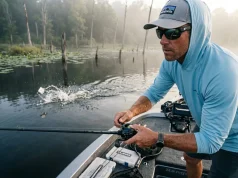
The blow-up was textbook — an explosion of white water the size of a dinner plate. The frog disappeared. You ripped back. Nothing. Then it happened again on the next cast. And the one after that. At some point you stopped blaming the fish and started wondering if you were the problem.
You were. But not in the way you think.
The geometry of a failed frog hook-up isn’t random. There’s a chain of events — biological, mechanical, and human — that breaks at predictable points. I’ve watched it happen hundreds of times from the front of a boat, and after enough missed fish you start to see the pattern. Most anglers are fighting four or five separate problems at once without knowing it. This guide breaks that chain open, section by section.
⚡ Quick Answer: Most frog hook-up failures come from four stacked problems: a body that’s too stiff to collapse under strike force, hooks sitting flush against the body instead of exposed 1/16 inch, a hookset motion that sweeps sideways instead of straight up, and mono or fluoro line absorbing the energy before it reaches the hook. Fix the body compliance first. Bend the hooks second. Switch to 65lb braid third. When you see the blow-up, count “There… He… Is…” before you set. That four-step sequence solves most of what’s hurting your hook-up ratio.
Why Bass Miss Frogs — The Biology Behind Every Blow-Up
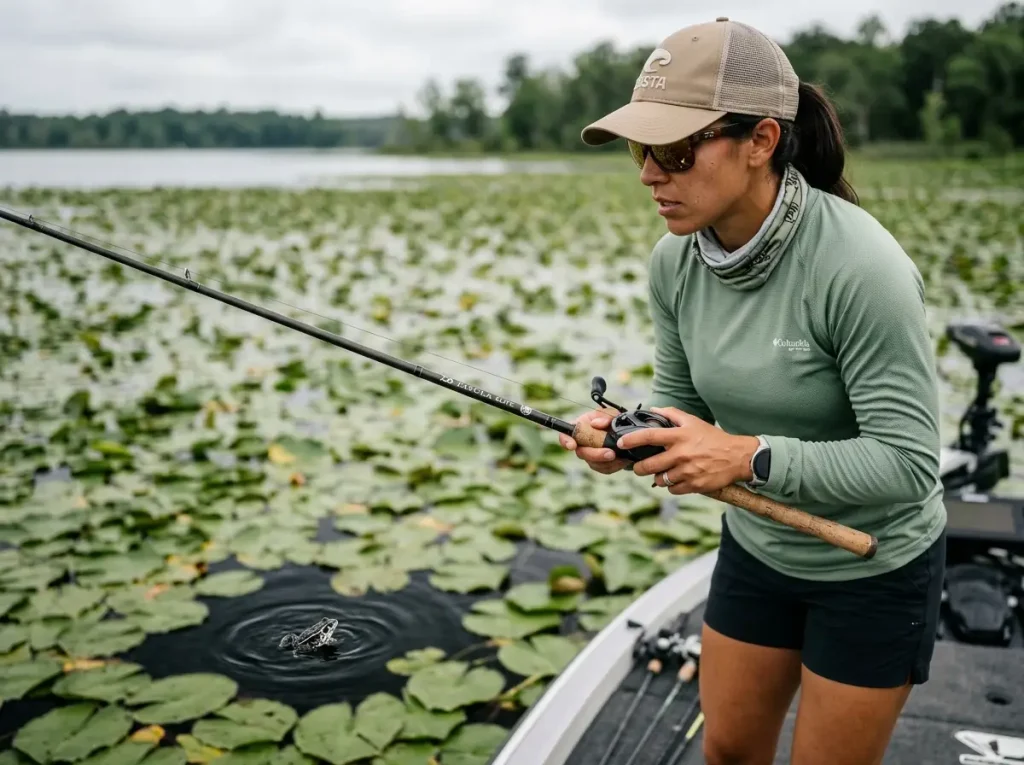
Here’s what nobody tells you about a bass strike: by the time you see the explosion, the suction event is already over.
A largemouth bass doesn’t bite a surface lure. It inhales it. The entire cranial skeleton expands in 4 to 40 milliseconds, generating subambient pressure that pulls water and prey into the buccal cavity. Up to 95% of the power driving that expansion comes from the bass’s axial body muscles — not the jaw. Peak suction output ranges from 2.0 to 15.0 watts depending on fish size. The mouth volume expands by 247% during the event.
That vacuum has to overcome your lure’s buoyancy and any friction the body creates against the mat. If your frog is too stiff, too heavy, or fouled in vegetation, the bass generates suction — but the frog doesn’t move fast enough to complete the ingestion. The result: a strike signature on the surface, hook points never engaged.
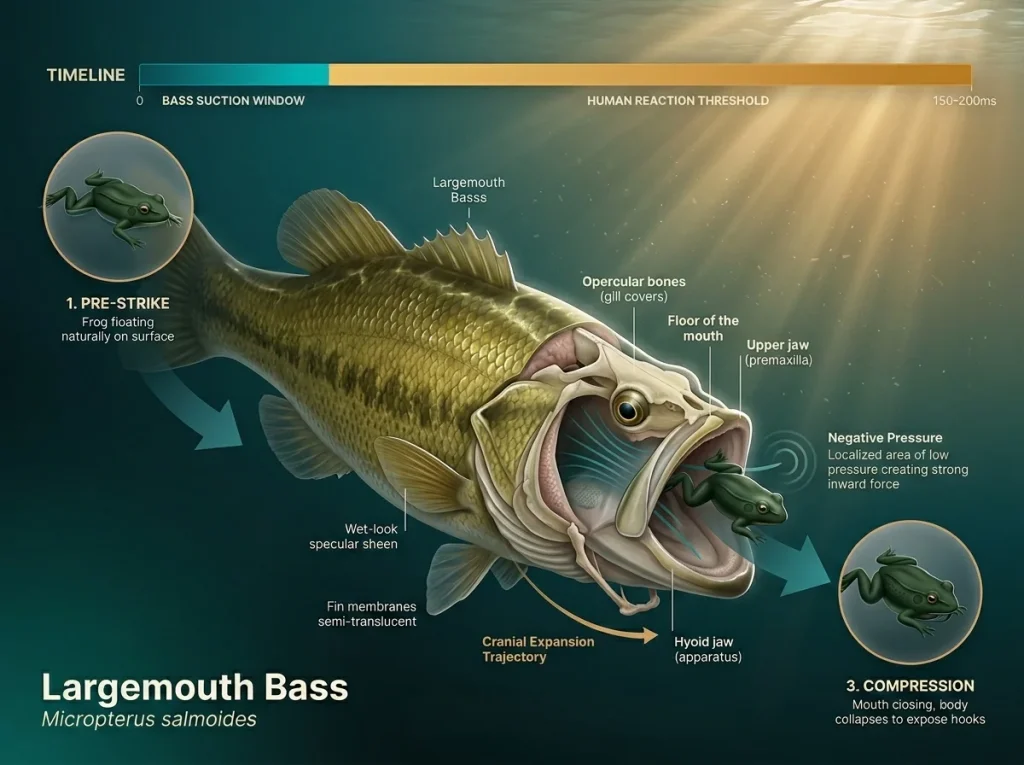
The second trap is what happens when ram feeding combines with suction feeding. In clear water, a bass overtakes prey with forward momentum before opening its mouth. That forward motion creates a bow wave of positive pressure — and that wave can physically push a wide-bodied frog away from the open mouth microseconds before the vacuum phase begins. Anglers blame timing. It’s actually a lure-design problem. Wide frogs like the “King Daddy” profile are most vulnerable here. In open water with good visibility, switch down to a narrower profile like the Jackall Kaera to reduce that bow-wave risk.
In dense vegetation the equation flips. Bass under heavy hydrilla mats can’t see the frog at all — they’re running entirely on lateral line input. The suction vector has to pull the frog free of any mat friction before it can complete the ingestion. You already know how bass use suction feeding to inhale surface prey — so you know why mat friction is a direct cause of failed strikes, not just a minor inconvenience.
I’ve had fish break the frog loose from a thick hydrilla pad but never get the hooks. The body was stiff enough that the suction moved the lure without collapsing it. Changed to a boiled Pad Crasher and the same fish hit solid on the next cast into the same hole.
Your hardest hooksets are worthless if the body is acting as a shield. The fish wins that physics fight every time.
The Material Science Mistake — Shore A Hardness and Why Your Frog Won’t Collapse
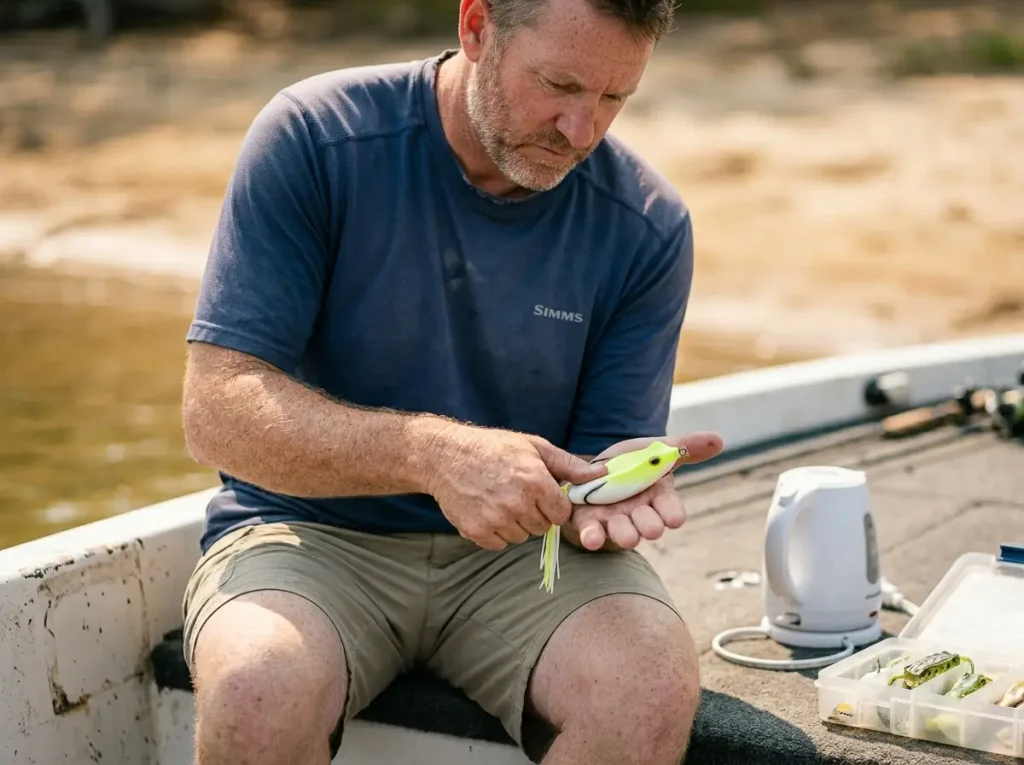
Squeeze the frog in your hand right now. If it doesn’t compress to about 50% of its width with moderate thumb pressure, you have a problem.
Professional-grade hollow-body frogs target a Shore A hardness of 20 to 30. That’s the compliance range where bass-generated suction force can collapse the body and expose the hooks in real time. Budget manufacturing — and even some mid-tier frogs — regularly land at Shore A 40 or higher. The body bounces. The fish strikes it, the body resists, and the hooks never clear the lure.
The Booyah Pad Crasher sits on the soft end of the commercial range and hooks up well because of it. A $15 boiled Pad Crasher will consistently outperform a $25 unmodified SPRO Bronzeye in cold conditions — not because it’s better built, but because it collapses. Compliance beats brand loyalty every time.
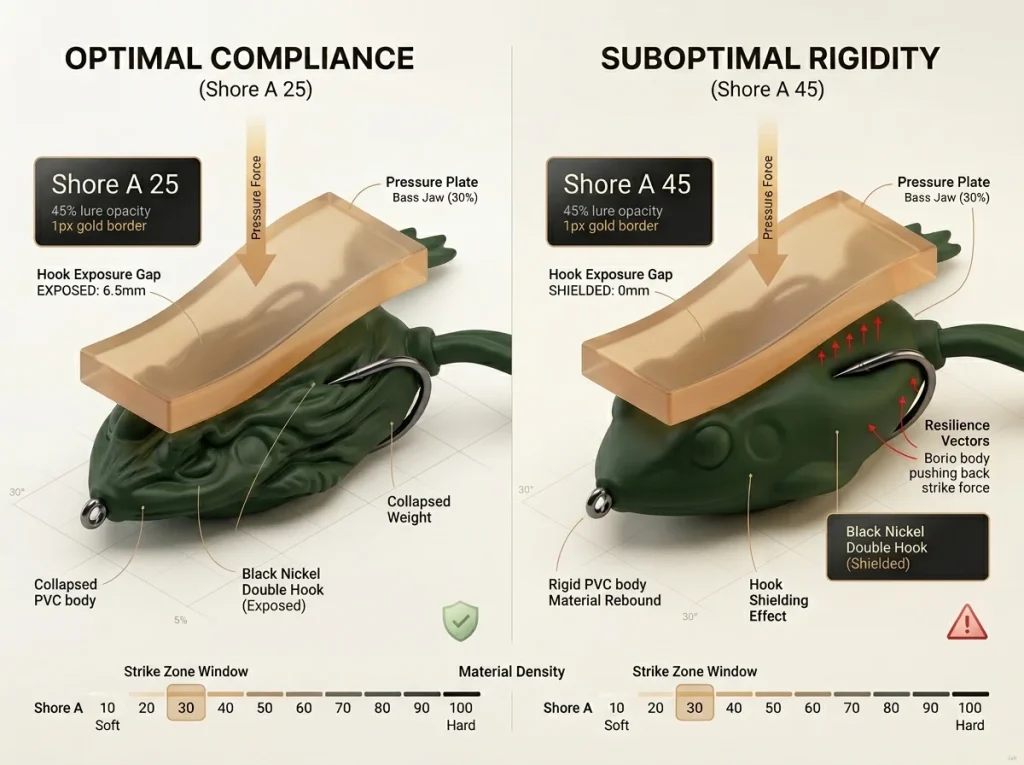
Temperature makes this worse. PVC is viscoelastic. A frog that performs at Shore A 28 in August may be sitting at Shore A 38 by November. The material stiffens as water temp drops, and in that early spring or late fall window where bass are actively feeding on mats, they’re also generating less suction force because cold water slows their metabolism. A rigid frog in a cold fish’s mouth is a recipe for a missed blow-up every time.
Pro tip: Keep a small electric kettle in your boat’s dry storage. Boil frogs for 30 to 60 seconds before heading to your first spot in cold weather — let them cool in air, not cold water, or the PVC re-stiffens immediately. This redistribution of plasticizers can drop a frog from Shore A ~35 to ~25. You can run the same lure through this process three or four times before body fatigue shows.
One material detail nobody talks about: silicone and TPR cannot be stored together. The chemical incompatibility triggers a reaction that turns both into a useless melted gel. Keep your silicone frogs in a separate tray. Open your tackle bag after a season of mixed storage and you’ll find out the hard way.
For how lure material and buoyancy affect presentation accuracy, the short version is: test compliance before you fish, not after you miss.
The Rojas Protocol — Hook and Leg Modifications That Change the Physics
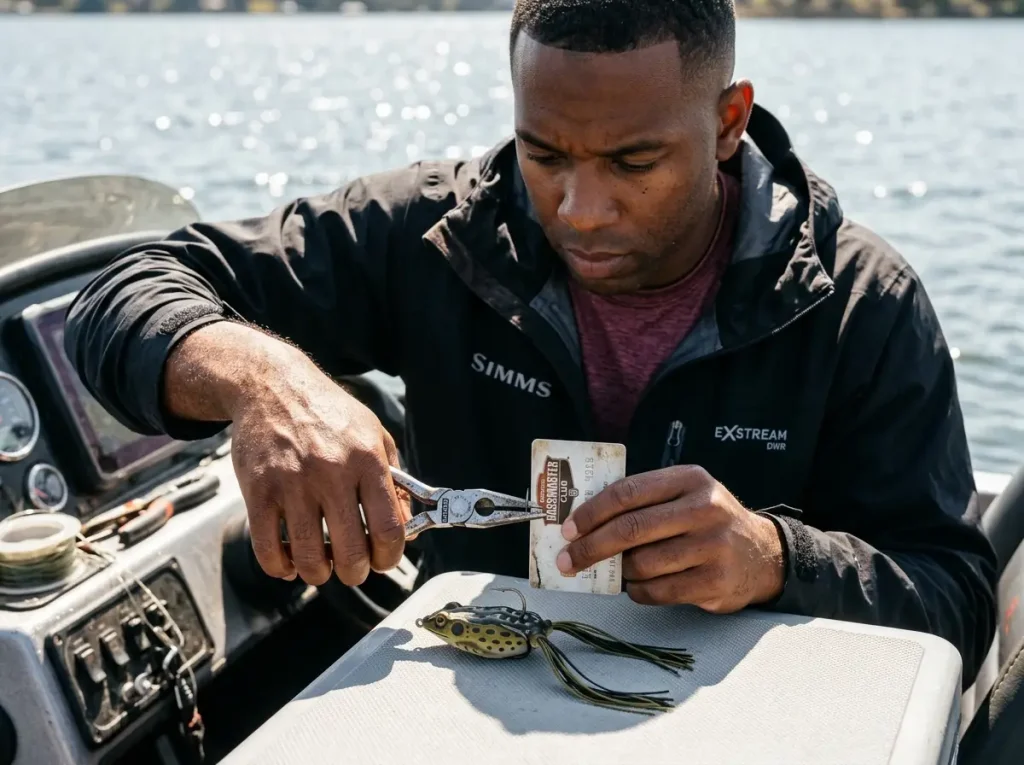
Dean Rojas won the 2004 Bassmaster Classic on Lake Wiley throwing a SPRO Bronzeye. He also modified every frog before it hit the water. The factory setup is a starting point, not a finished product.
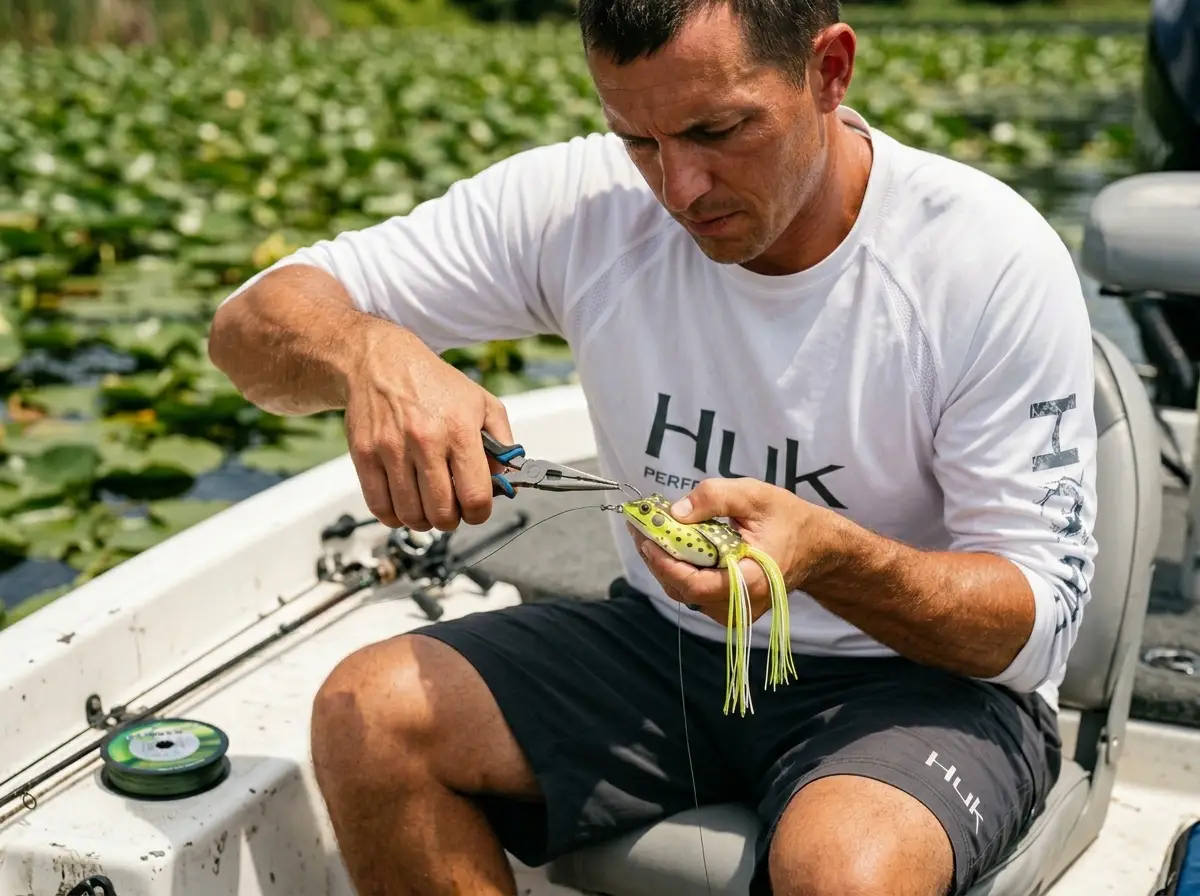
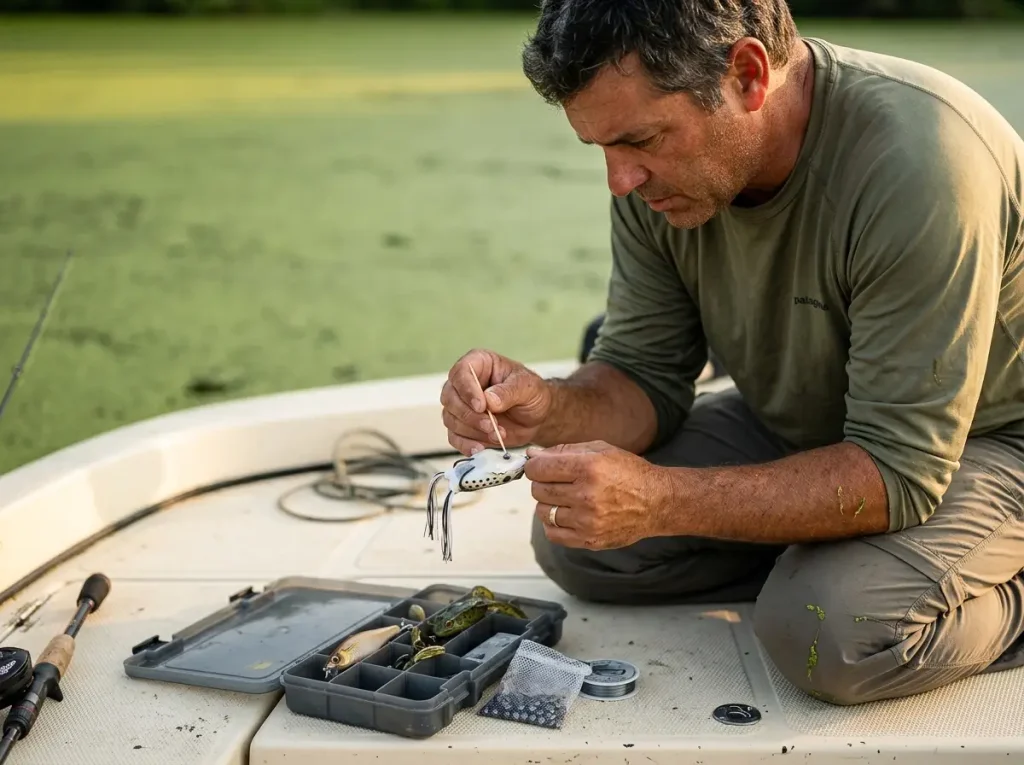
The most important modification is bending hooks. Factory hook position places the points flush against the body — maximum weedlessness, but the shielding effect during a strike means hooks can’t engage even when the body collapses. The fix: grip the bend of the hook with sturdy needle-nose or hook-bending pliers, and slowly rotate the points upward and outward. No jerking, no ratcheting leverage. Slow, controlled.
The metric is 1/16 inch of displacement — approximately the thickness of a credit card. Less than that and the hooks still shield. More than that and you’re snagging every pad stem the frog touches. After bending, re-sharpen the hook points. Bending micro-fatigues the tip, and a dull hook on a stiff upper palate slides instead of penetrates. Check hook geometry and point sharpening before every frog session — bent hooks need more attention, not less.
The 1/16-inch bend sounds like almost nothing. It’s the difference between landing tournament fish and staring at a hole in the mat.
The second modification is the asymmetric leg trim. Stretch the legs taut and cut approximately one inch off ONE leg, not both. This creates a hydrodynamic imbalance that lets the frog pivot in place with less forward motion. A symmetrically trimmed frog walks in a wide arc. An asymmetrically trimmed frog stays in a small pocket and walks tight circles. In mat fishing where the strike zone is a six-inch hole, that difference is the whole game.
Long, untrimmed skirt length also creates short strikes. Bass target the trailing material instead of the body. When legs are folded forward and reach past the nose, they’re too long. When they reach the nose tip, that’s right.
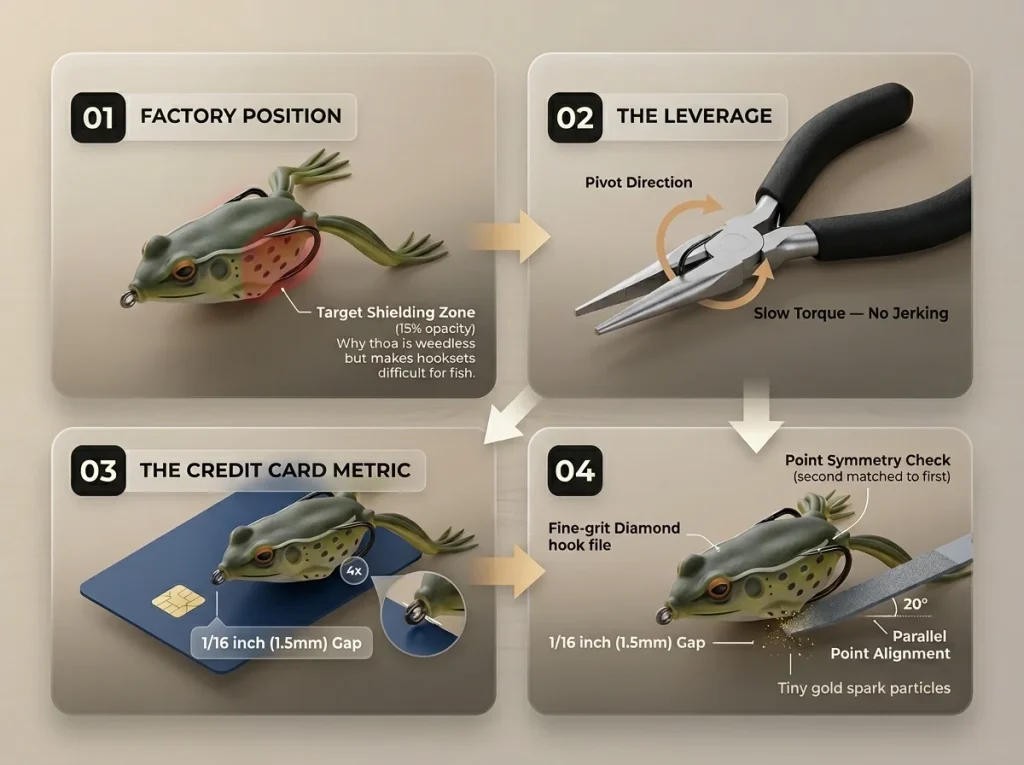
Pro tip: Check both hooks after bending — factory hooks are rarely symmetric. The left and right points often need slightly different angles to sit evenly. Spend two minutes verifying both, or one hook fires and the other doesn’t on the set.
The Kinetic Chain — Rod, Reel, and Line as a Single System
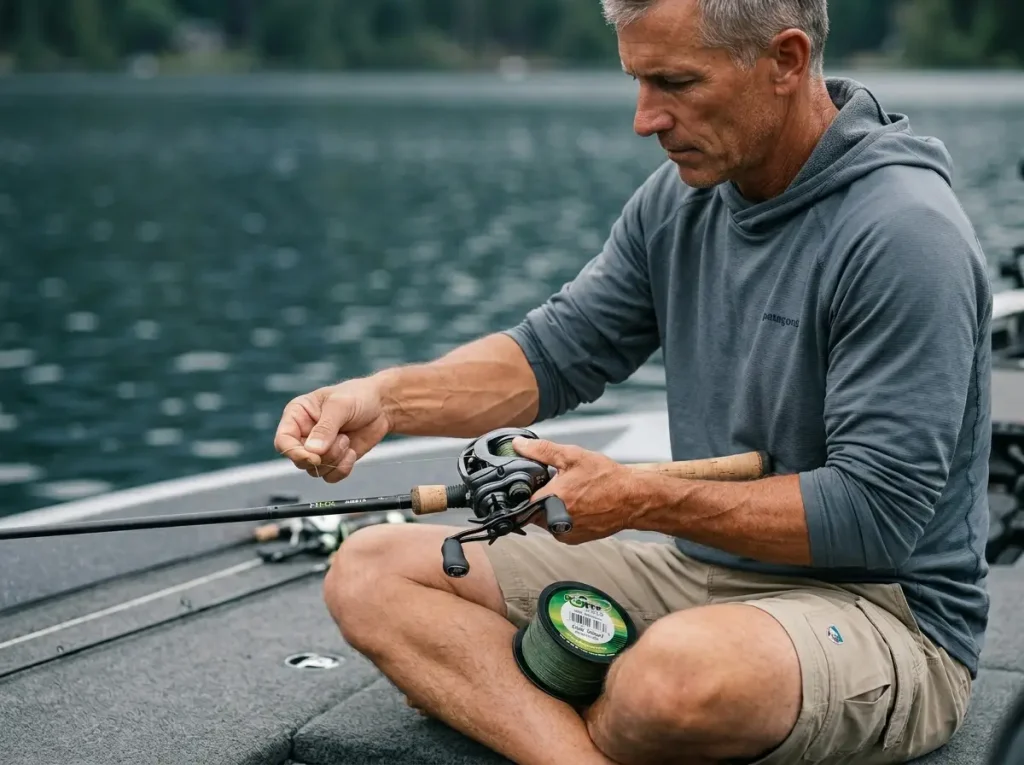
I watched a guy lose four fish in a row on a perfectly modified frog — bent hooks, trimmed legs, soft body. Then I noticed he had 17lb mono on his reel. Mystery solved.
The hookset is not a moment. It’s a chain: arm force → rod blank → line → hook point. Every weak link absorbs energy that should be reaching the hook. Monofilament stretches up to 25% of its length under load — at 30 feet of line you’re losing nearly a third of your hookset energy. Fluorocarbon has less stretch, but it’s denser than water and drags the frog’s nose down, ruining the walking action entirely.
Heavy braid is the only option. Minimum 50lb. Professional standard: 65lb to 80lb. Three reasons this matters. Zero stretch means the kinetic transfer is instantaneous. Braid’s serrated texture cuts through hydrilla and pad stems like a saw, so a diving bass can’t use vegetation as leverage to throw the hook. And braid floats — that surface bow is visible and easy to eliminate before you set. With sinking line, the slack hides under the surface.
According to research on predatory fish strike mechanics, the force transmission requirements for driving heavy hooks into bone demand instantaneous power delivery — any system with stretch built in bleeds the energy before it arrives. For a full breakdown of why braided line’s zero-stretch profile is non-negotiable for frog fishing, read the line engineering piece. Palomar knot directly to a split ring on the hook eye. No leader.
The rod: 7’3″ to 7’11”, heavy action with a fast tip. The fast tip loads for accurate casting and lets you work slack-line twitches. The stiff mid and butt section turns a diving bass’s head before it gets three feet into the mat. A rod that’s stiff all the way to the tip can’t cast accurately, can’t walk the frog, and paradoxically doesn’t have backbone where it counts because the stiffness is distributed wrong.
Reel: 7.1:1 to 7.3:1 gear ratio. Too slow (5:1) can’t pick up slack fast enough after a blow-up. Too fast (9:1+) sacrifices the internal torque you need when a 5-pound bass is buried in ten pounds of matted grass. It’s the same reason a cyclist shifts down on a steep climb.
The gear ratio argument used to seem abstract to me until I put a 9:1 reel on a frog rod for a weekend tournament. I could pick up slack fine. But when a four-pounder buried herself in a mat, I was winding as fast as I could and going nowhere. Switched back to 7.1:1 the next morning.
The Hookset Execution Failures — Timing, Vector, and Slack
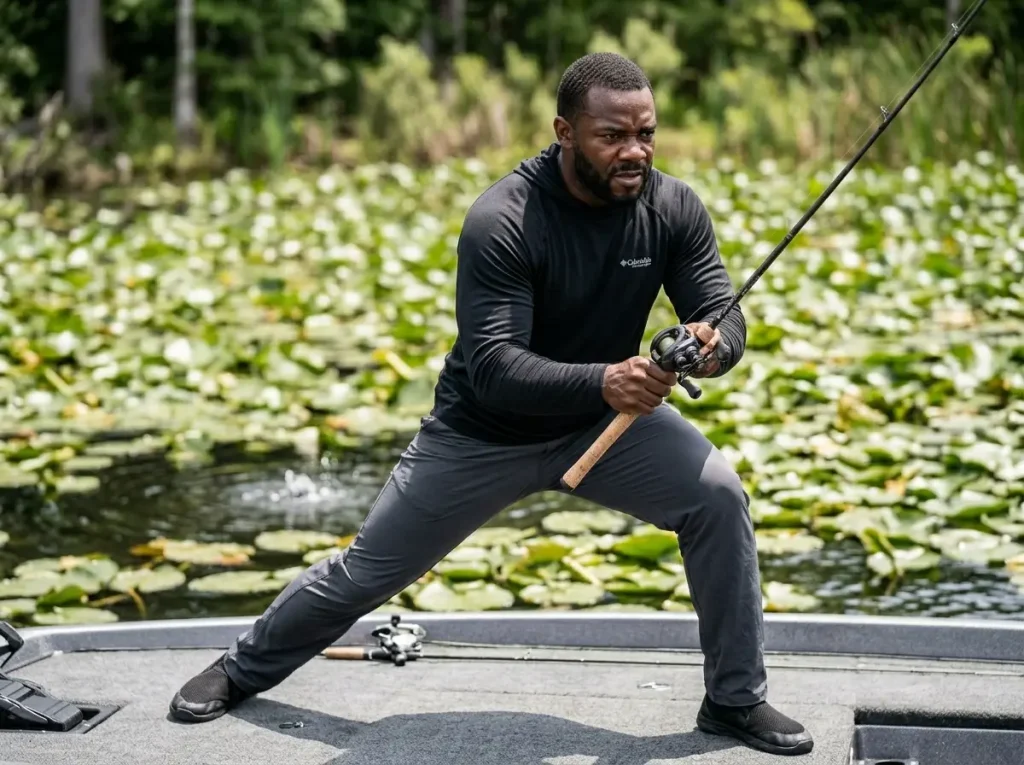
Every angler knows to wait. Nobody does. Your body doesn’t care what you know.
The blow-up triggers a fight-or-flight response. The instinct is to snatch the rod the second the water explodes. That snatch pulls the frog away from the bass before the suction phase has finished — before the bass has closed its mouth, turned its head, or positioned the hooks against the palate. The physics of hookset timing, rod angle, and line tension apply across all lure types, but frog fishing has a specific variable: the 2 to 3 second delay isn’t for the suction event. It’s for the three mechanical events that follow.
The “There He Is” Protocol is how veterans override the instinct: when the frog disappears, count internally “There… He… Is…” — roughly 2 to 3 seconds. That delay lets the bass complete the suction phase, close its mouth, turn its head, and begin diving. The head turn positions the upward-facing hooks to contact the hard upper palate. Set before the turn and you’re dragging hooks across soft tissue with no purchase.
In cold water below 65°F, extend the wait to 4 to 5 seconds. Slower metabolism means slower feeding sequence. The research on bass suction feeding closure time and prey positioning supports that delay adjustment.
Before you set, reel down until you feel the weight of the fish. Setting against slack line is the second-most common execution mistake. The rod’s kinetic energy goes into clearing the slack bow instead of driving the hooks. With 65lb braid, you’ll feel the fish’s weight the moment it closes its mouth — that’s your trigger, not the visual cue.
The third mistake is hookset vector. A sideways sweep — the natural motion for crankbaits and trebles — pivots the frog body horizontally across the bass’s mouth. The body shields both hooks. A vertical, upward sweep — rod tip at water level, sweeping from 6 o’clock straight to 12 o’clock — compresses the frog body against the top of the mouth. The hooks, already bent 1/16 inch outward, contact the hard bony upper palate immediately.
Sideways hookset with a frog is the single most common mistake in all of frog fishing. The geometry of the lure makes it worse than useless — it actively prevents the hooks from engaging.
Pro tip: Before heading to a mat, practice the rod movement with your hands. Start tip-down, parallel to the water. Sweep straight up. That vertical arc has to be automatic when the blow-up happens. If you’re thinking about it in the moment, you’ve already waited too long.
Environmental Rigging Adjustments — Matching the Setup to the Cover
The frog that murdered fish on October 1st will get nothing but bumps and missed blow-ups by November 15th — if you haven’t changed the retrieve and softened the body.
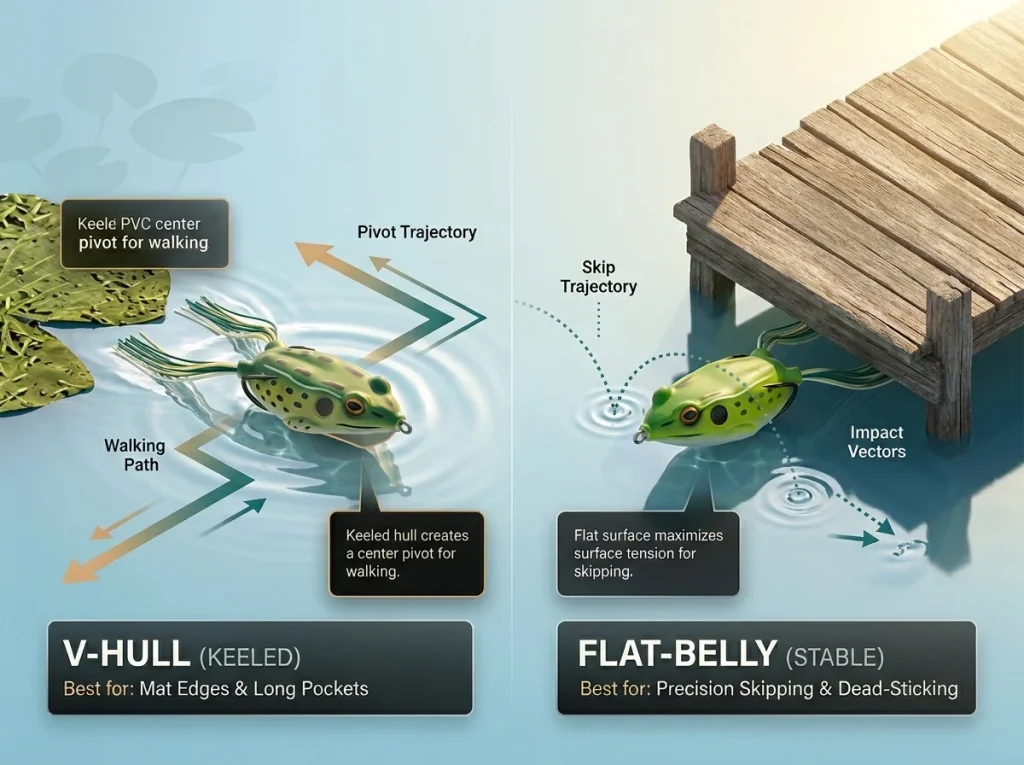
Hull design determines where a frog works. A V-hull — like the SPRO Bronzeye or Strike King KVD Sexy Frog — has a keel that creates a center pivot for walking action. Less rod movement per step, efficient for long mat edges and open pockets. A flat-belly — like the Booyah Pad Crasher — sits flush on the surface. Better for dead-sticking and skipping under docks, where a flat lure stays oriented on contact instead of tumbling. Flat-belly frogs skip 20 to 30% more predictably on dock entries.
In thick duckweed “cheese” or algae mats, the bass can’t see the frog. Surface tension disruption and lateral line vibration are the only inputs it has. A stock frog floating on top without denting the surface is essentially invisible from below. The fix is internal weight distribution: insert 2 to 3 #6 or #7 lead BBs through the hook holes into the rear air chamber. Two functions: creates a physical dent that registers from below, and generates an acoustic rattle as the lure is worked. Rattling chambers matter proportionally more in stained water than any visual factor. Tungsten putty works too — easier to remove and non-toxic. Keep it in the rear chamber only. Front-loading shifts the center of gravity forward and the lure nose-dives on the walk.
In stained or muddy water, switch to a popping action frog with a concave mouth. The “bloop” of a cupped mouth on each pull creates an auditory trail a bass can follow from 10 feet away. Add a nose split ring to a standard hollow body if you don’t have a dedicated popping model — the split ring hinge sharpens the pop considerably.
Cold water changes everything about the retrieve. Below 65°F, bass will nose a fast-moving frog rather than commit. Switch to dead-sticking: pause the frog 8 to 12 seconds between twitches. How water temperature slows bass metabolism and changes your frog retrieve explains the biology in depth, but the field reality is simple — if you’re working it fast and they’re bumping without committing, slow down and add time. The aggression window sits at 75°F to 82°F. Below that, patience is your primary tool.
The Follow-Up Failure — What to Do After a Missed Blow-Up
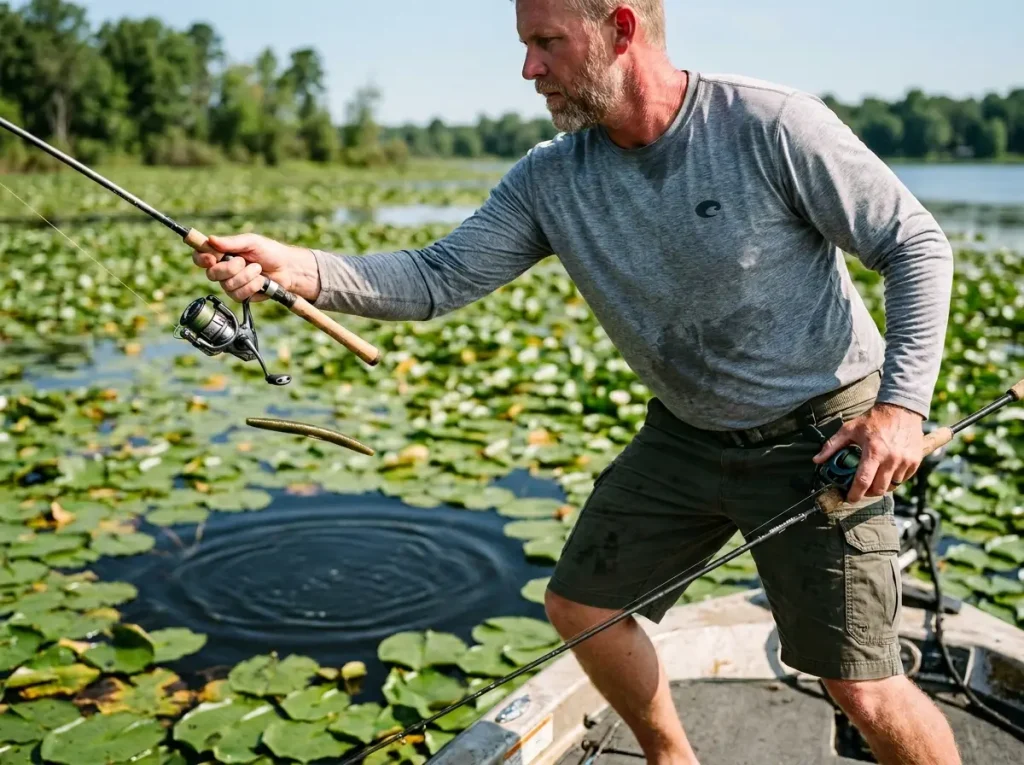
That hole in the mat isn’t just where the fish was. It’s a window to where the fish still is.
Why fish miss topwater lures and the visual mechanics behind near-strikes explains the optics, but the practical fact from tournament observation is this: a bass that misses a frog stays in the strike zone for an average of 15 to 30 seconds. That’s your window.
Most anglers waste it.
After the missed blow-up, don’t move the frog. Let it sit dead for a count of “one-thousand-one, one-thousand-two.” Real prey doesn’t immediately escape after an attempted strike. The bass occasionally re-strikes the dead frog in this window. If it doesn’t, reel in quickly and make the follow-up cast within 8 to 10 seconds. Drop the follow-up bait into the exact hole left by the blow-up. Not three feet to the side. In the hole.
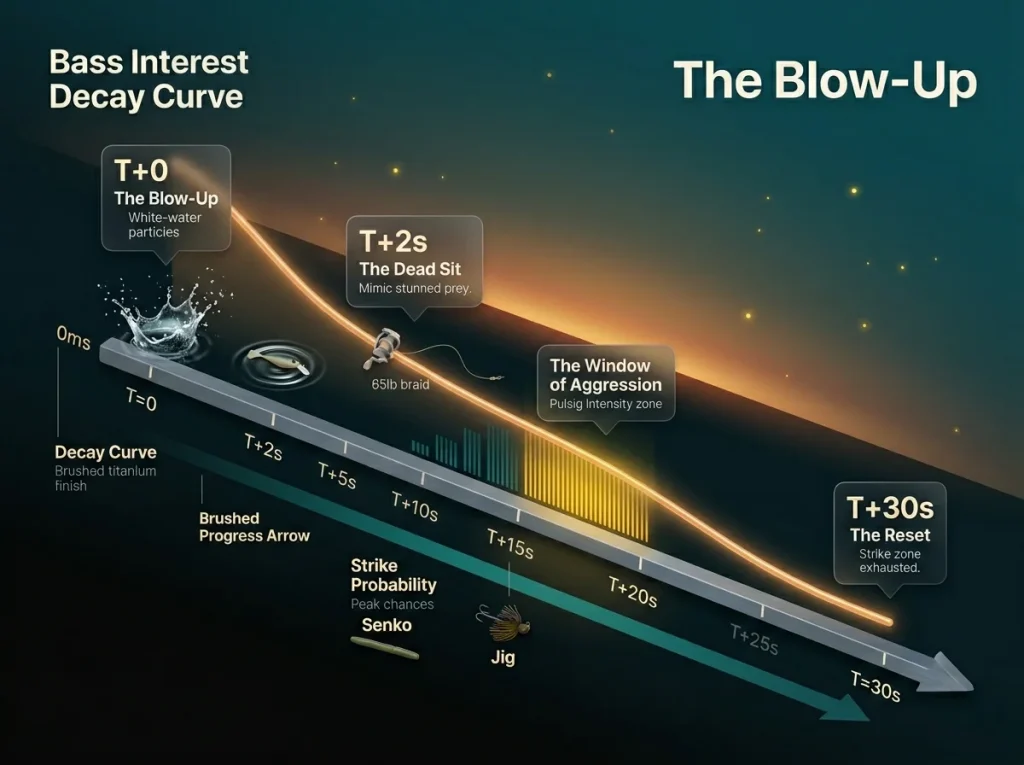
The best follow-up baits are a weightless Senko (4″) in shallow mat situations — natural fall rate, minimal splash, no retrieve needed. Or a football jig (3/8 oz) for deeper mats where the fish are sitting on bottom. Both mimic stunned, sinking prey — exactly what the bass expects to see.
The “Search and Destroy” method — frog rod in one hand, follow-up rod already rigged on the deck — can double your landing percentage in heavy cover. That follow-up rod has to be there before you enter the zone. Cast into the hole. Not near it.
Conclusion
Three things to take from this.
First, a low hook-up ratio on frogs is a system failure, not a technique failure. One stiff body, one wrong hookset angle, or one stretch of mono breaks the entire chain. You don’t need to fix everything at once — but you do need to find your specific break point and fix that.
Second, modify before you fish, not after you miss. Bend the hooks 1/16 inch, trim one leg shorter, boil the body in cold weather. Four minutes of prep. The fish don’t care how much the frog cost out of the package.
Third, the frog is a search tool. The follow-up bait is your closer. Treat every blow-up — hit or miss — as information about where a feeding fish is sitting. That hole in the mat is worth a second look.
Pick up one frog from your bag right now. Check the hook displacement — a credit card’s thickness between point and body. Squeeze the body with one hand. If it resists, boil it. Check the drainage holes — if a hook point doesn’t pass through easily, clear it. Fold the legs forward. If they reach past the nose, trim one. Do that today. The fish will test the rigging the next time you’re on the water.
FAQ
What is the best line for hollow body frogs?
65lb braided line is the professional standard minimum, with 80lb preferred in heavy hydrilla or lily pad cover where the sawing effect matters most. Monofilament stretches up to 25% of its length under load — that’s hookset energy that never reaches the hook. Fluorocarbon sinks and drags the nose of the frog down, hurting the walking action entirely. Tie braid directly to a split ring with a Palomar knot. No leader.
How do you stop a frog from filling with water?
Squeeze the frog body after every cast that contacts vegetation — drainage hole pointing down, hold for a count of three. A plugged drainage hole is the first thing to check. Clear it with a hook point before the session. If the hole is open and the frog still takes on water, check the nose seal — repeated strikes can crack PVC noses and compromise the seal. A waterlogged frog refuses to walk and sinks nose-down.
How long should I wait to set the hook on a frog?
Wait until the frog disappears and count internally There… He… Is… — roughly 2 to 3 seconds. In cold water below 65°F, extend to 4 to 5 seconds. Setting before the bass has completed the head turn means hooks dragging across soft tissue with no angle to bite the hard palate. The suction event itself is already over before you see the blow-up — the delay is for everything that happens after.
Do you need a leader for frog fishing?
No — and adding a leader actively hurts your hook-up ratio. Any stretch in the system bleeds hookset energy before it reaches the hooks. Fluorocarbon leader also causes nose-sinking issues by adding density at the connection point. Palomar knot on a split ring, braid direct. That’s the whole terminal setup.
Why does my frog sink after a few casts?
The drainage hole is the most likely culprit — plugged holes cause trapped air during a strike, which then vents improperly and leaves water inside. Clear it with a hook point. If the frog still takes on water after the hole is clear, check for hairline cracks in the nose seal (common on PVC after repeated hard strikes) or stress fractures from hook-bending near the hook exit points. A frog showing structural damage after modification should be retired.
Risk Disclaimer: Fishing, boating, and all related outdoor activities involve inherent risks that
can lead to injury. The information provided on Master Fishing Mag is for educational and informational purposes
only. While we strive for accuracy, the information, techniques, and advice on gear and safety are not a substitute
for your own best judgment, local knowledge, and adherence to official regulations. Fishing regulations, including
seasons, size limits, and species restrictions, change frequently and vary by location. Always consult the latest
official regulations from your local fish and wildlife agency before heading out. Proper handling of hooks, knives,
and other sharp equipment is essential for safety. Furthermore, be aware of local fish consumption advisories. By
using this website, you agree that you are solely responsible for your own safety and for complying with all
applicable laws. Any reliance you place on our content is strictly at your own risk. Master Fishing Mag and its
authors will not be held liable for any injury, damage, or loss sustained in connection with the use of the
information herein.
Affiliate Disclosure: We are a participant in the Amazon Services LLC Associates Program, an
affiliate advertising program designed to provide a means for us to earn advertising fees by advertising and linking
to Amazon.com. As an Amazon Associate, we earn from qualifying purchases. We also participate in other affiliate
programs and may receive a commission on products purchased through our links, at no extra cost to you. Additional
terms are found in the terms of service.