

In this article
The line goes slack. It is the hollowest feeling in angling—that sudden adrenaline crash following the unbuttoning of a heavy fish. It wasn’t the knot that failed, and the line didn’t break. The point simply failed to stick.
In my years on the water, from chasing redfish in the marsh to muskie in the north, I’ve learned that this failure is rarely bad luck; it is a failure of physics. A dull hook cannot generate the pounds per square inch (PSI) required to breach the hard cartilage of a jaw, regardless of how hard you set the hook.
True outdoor competence isn’t just about reading the water; it’s about applying advanced sharpening strategies to your terminal tackle. By the end of this guide, you will move from blaming chance for lost fish to mastering the hook geometry required to keep them pinned. We will cover the specific file grit required for different wire gauges, the “Trocar” triangulation technique, and the conservation ethics behind surgical hook points.
Why does hook geometry determine penetration success?
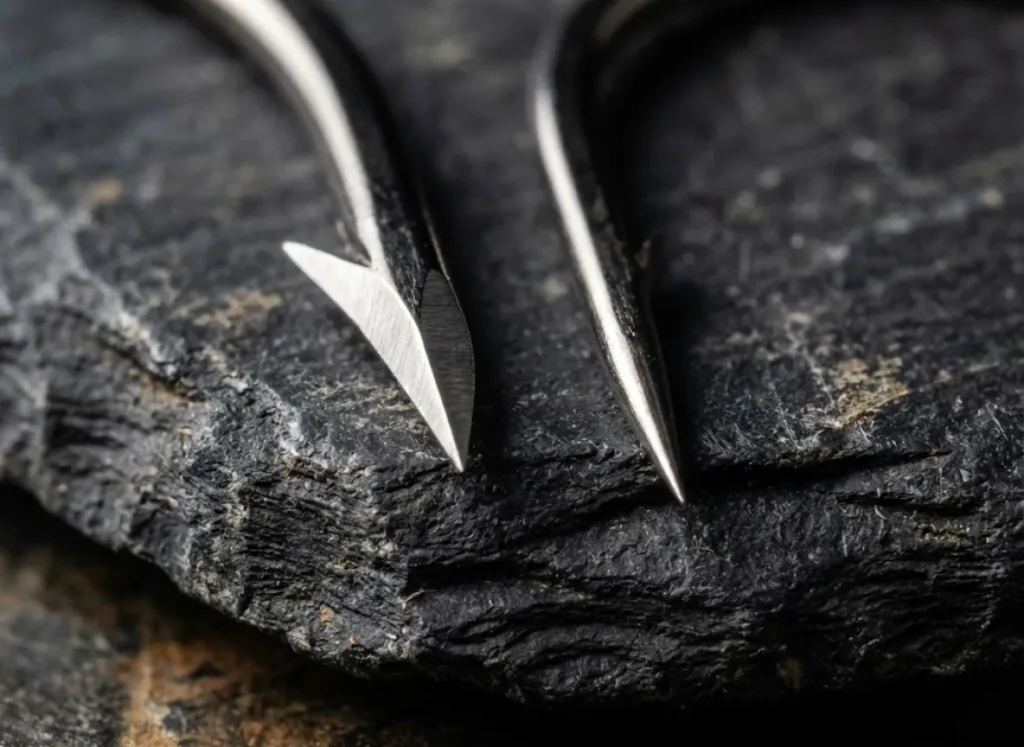
Hook geometry dictates hook penetration success because it determines whether the point displaces tissue or slices through it. A sharp hook minimizes the energy required to drive the barb past the jawbone, relying on cutting planes rather than brute force.
How does the “Trocar” point differ from the factory needle point?
Factory hooks, particularly chemically sharpened hooks, typically utilize a needle-shaped hook point. This shape relies on radial displacement, meaning it must push tissue outward in all 360 degrees to penetrate. While effective on soft tissue, this hook point shape requires significant force to breach hard structures like bone or jaw plates.
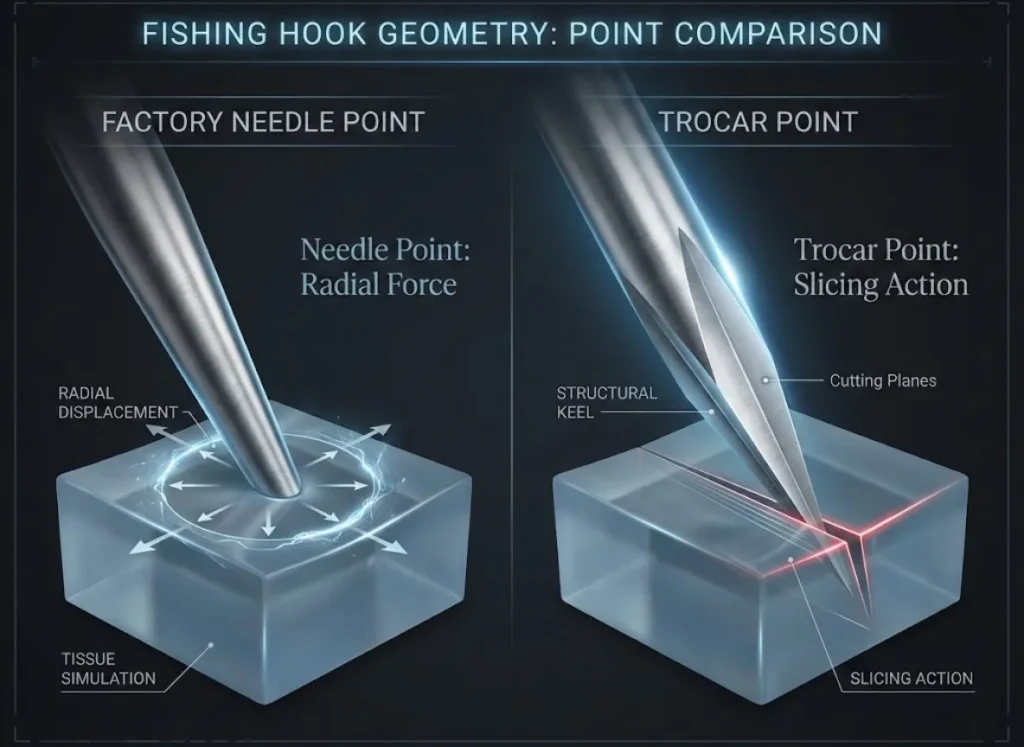
Conversely, the Triangular (Trocar) point—the geometry achieved through manual sharpening—utilizes three distinct cutting planes. This shape functions like a broadhead arrow or a medical scalpel, slicing through fibers rather than pushing them aside. A study from the Journal of Experimental Biology corroborates that these cutting edges significantly reduce the energy work required for puncture compared to smooth conical shapes. The shape of the hook point is what makes all the difference in how easily it pierces the fish. Because of this specific design, you don’t need to strike hard to get the hook started. The point is shaped to slide into the mouth with barely any pressure, allowing the hook to grab instantly without needing a massive hook-set to break the skin.
Attempting to replicate a perfect needle-point by hand is a mistake; human motor control cannot consistently file a perfect circle. The triangular profile is not only mechanically superior for cutting hard mouths but is also the most stable shape a human can file reproducibly. This geometry creates a “keel” on the underside of the point (the wire facing the bend). This keel adds structural rigidity, preventing the hook tip from folding over when it impacts hard bone—a failure often seen when understanding how hook anatomy—gap, shank, eye, and wire gauge—directly dictates hook-up rate.
Which tools and grit are required for specific hook sizes?
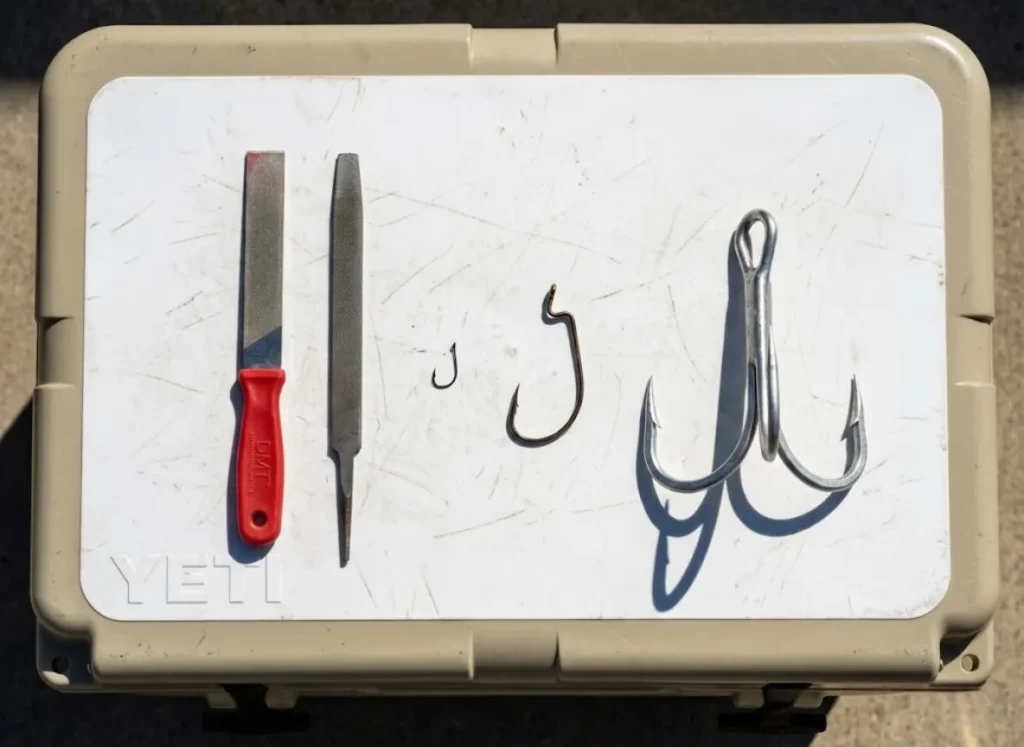
You must match the file grit to the hook’s wire diameter to avoid destroying delicate points or wasting time on heavy steel. Using a coarse file on finesse trout flies will ruin them instantly, while a fine stone on a shark hook is ineffective.
How do you match file grit to wire gauge?
Effective hook sharpening requires matching the abrasive grit to the metallurgy. For small hooks (Sizes #10 – #22), use a Fine/Ultra-Fine Diamond Hone (600-1200 grit). The goal here is polishing and realignment; a coarse file will remove the entire point in a single pass.
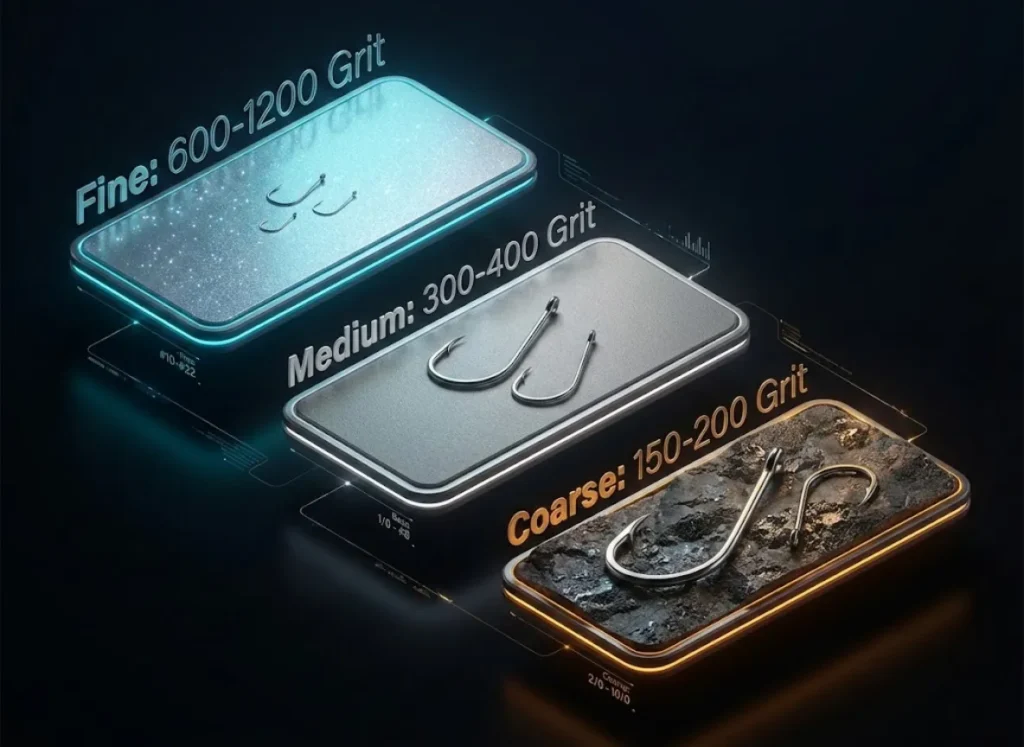
For General Freshwater/Bass hooks (Sizes 1/0 – #8), a Medium grit (300-400 grit) is the workhorse standard. It removes enough metal to reshape a rolled point but leaves a finish smooth enough to penetrate without excessive friction. Just as you would carefully select sinks and swivels in a strategic breakdown of terminal tackle, selecting the right sharpening tool—whether a Dr. Slick hook file, a Lansky multi-groove sharpener, or a Work Sharp guided field sharpener—is a prerequisite for success.
Heavy Game/Saltwater hooks (Sizes 2/0 – 10/0) require Coarse grit (150-200 grit) initially. These heavy gauge hooks are often made of vanadium steel; a fine file would simply slide over the surface without removing material. However, you must be careful not to leave the surface too rough. A NASA technical document on tribology explains that surface roughness increases friction coefficients, meaning “micro-serrations” left by traditional files can actually hinder penetration and create stress risers where the tip can snap.
What is the step-by-step protocol for manual sharpening?
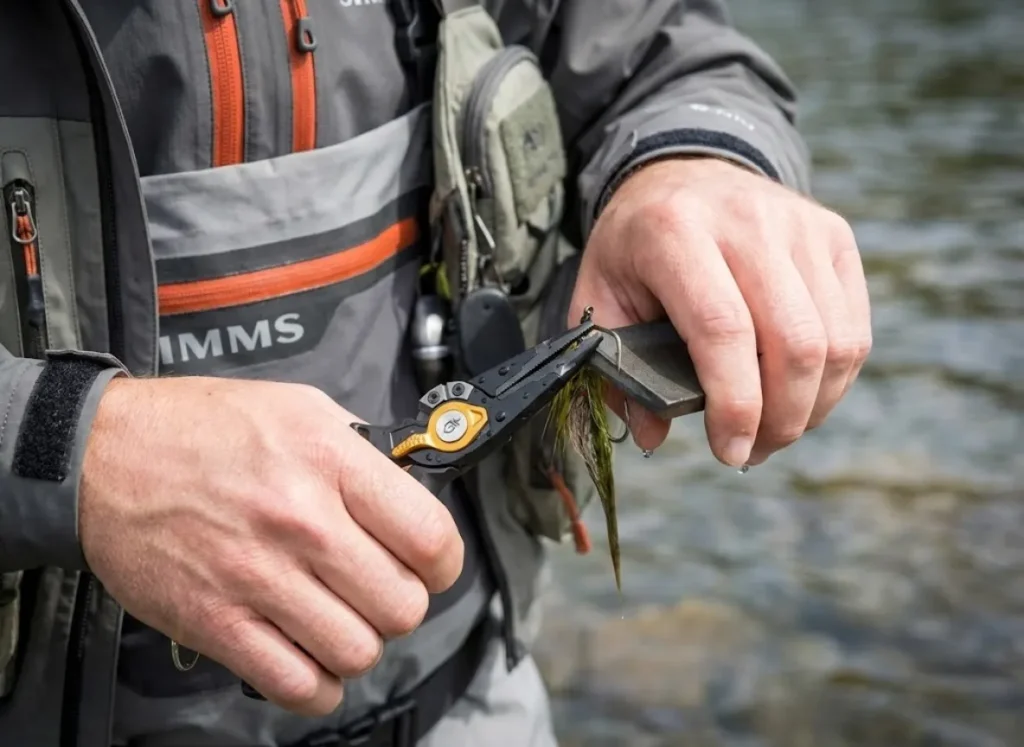
The manual sharpening approach involves a pass/fail diagnostic test followed by a specific three-step filing motion to create a triangular point.
How do you perform the initial “Thumbnail Test” diagnosis?
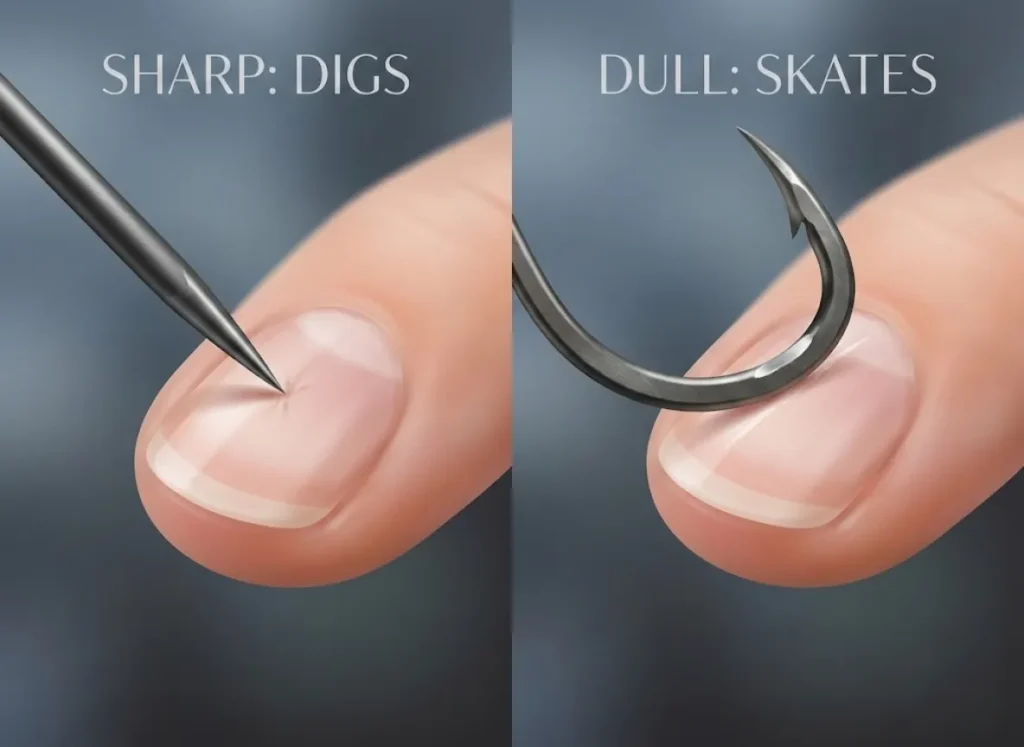
The “Thumbnail Test” remains the gold standard for field diagnosis. Place the point of the hook gently against your thumbnail at a 45-degree angle. Do not apply heavy pressure; simply let the weight of the hook rest on the nail.
Drag the hook lightly across the nail. A truly sharp hook will catch and dig in immediately with zero slide. If the hook slides or skates across the surface, even slightly, it is too dull to penetrate a fish’s mouth reliably. Organizations like Keep Fish Wet outline how these mechanics are critical for clean entry. If the point slides, you must sharpen it before ensuring that when you execute the mechanics of the hookset, the point finds purchase immediately.
Beyond the tactile test, perform a visual inspection. Look for “light reflection” at the very tip. A sharp point is infinitely small and reflects no light; a dull or rolled point presents a flat surface that flashes like a mirror. Check specifically for a “rolled” tip—where the microscopic apex has bent over like a hook. This damage requires filing down past the bend to reach solid metal again.
How do you execute the “Three-Face” filing technique?
Step 1 (Top Face): Immobilize the hook firmly, preferably in a hook vise or strong hemostats. Using a dedicated file from your essential fishing tools toolkit, file the “back” or “top” of the hook point (the side facing away from the barb) completely flat. This creates a tangent to the curve of the hook.
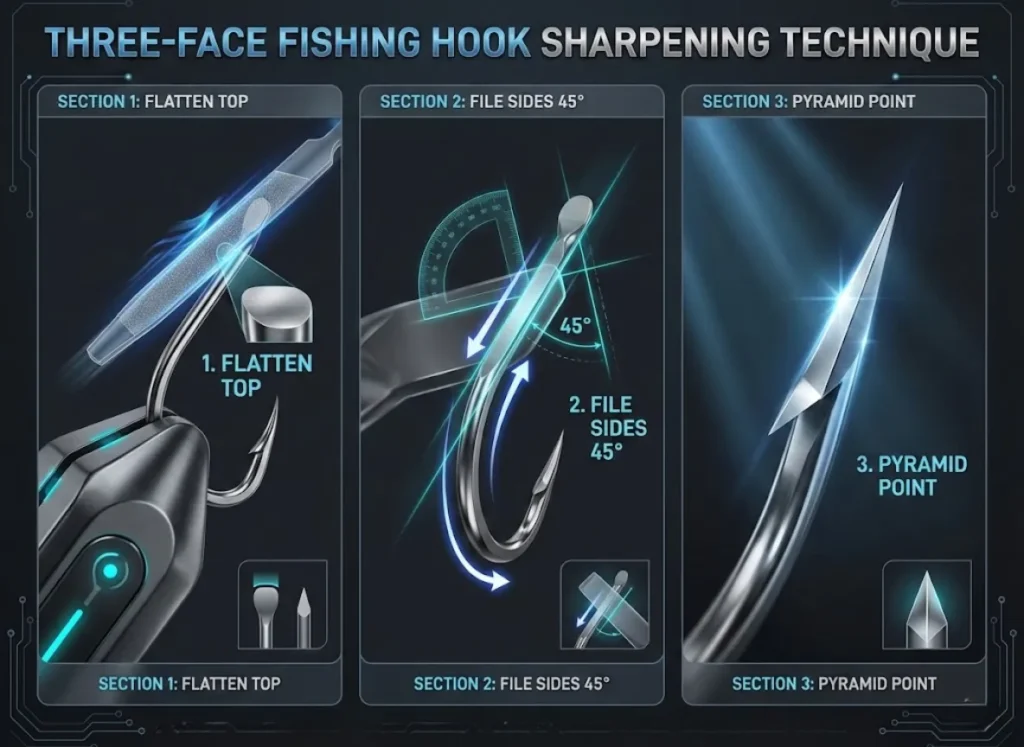
Step 2 (The Triangulation): File the two remaining sides at a 45-degree angle relative to the flat top face you just created. You are essentially sculpting a pyramid. Ideally, file towards the point (from bend to tip). This supports the metal and prevents a “wire burr” from hanging off the back of the tip.
Pro-Tip: Count your strokes to ensure symmetry. If you take 5-7 passes on the left face, take 5-7 on the right. An asymmetrical point will drift sideways under load, dissipating energy and reducing the hookup ratio.
This triangulation creates a cutting edge that outperforms standard conical points. An AFS Journal article regarding catchability reinforces how hook types and mechanics influence efficiency, validating the need for this precise geometry.
Can you sharpen chemically sharpened hooks like Gamakatsu or Owner?
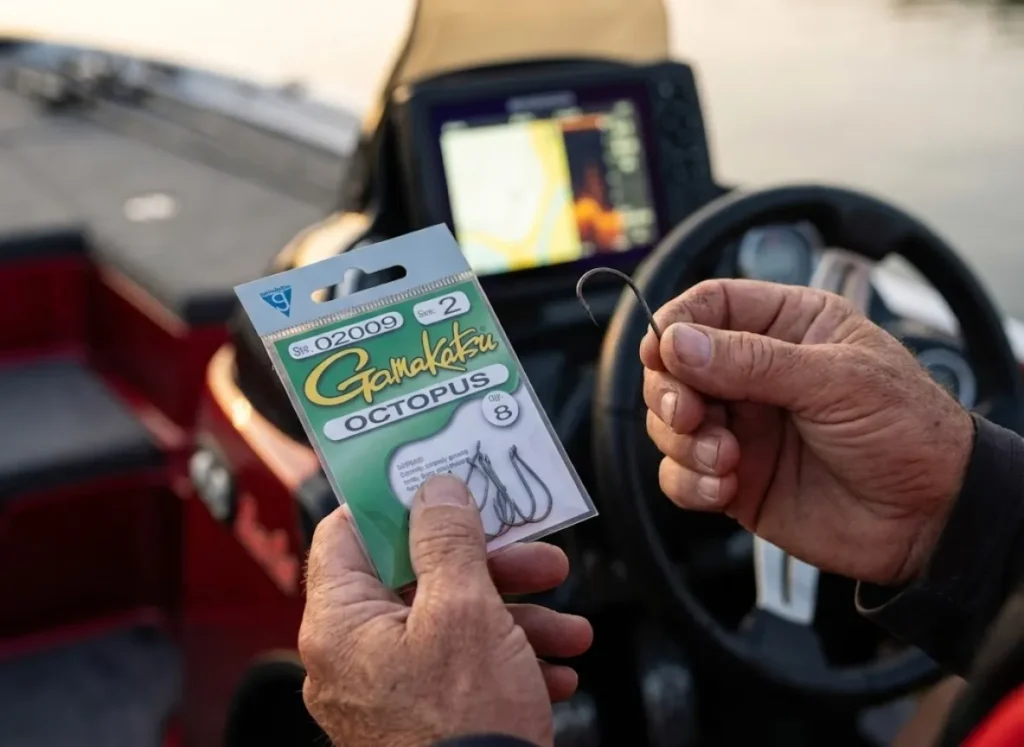
You can sharpen chemically sharpened hooks for minor touch-ups, but significant damage usually requires replacement due to the brittle nature of the acid-etched point.
When should you restore a chemically sharpened hook versus replacing it?
Modern hooks from brands like Gamakatsu hooks or Owner are created in an acid bath that eats away metal to form a perfect needle point. This process leaves the tip incredibly sharp but often thinner and more brittle than mechanically ground points.
The “Touch-Up” Rule: If the point is only slightly dulled from use, it can be restored using an Ultra-Fine (600-1000 grit) Diamond Hone. Use extremely light pressure. You are not reshaping the metal; you are honing the edge.
The “Replace” Rule: If the point is “rolled” (bent over) or chipped, throw it away. Because the acid-etched tip is so thin, filing it down to remove the damage usually requires removing too much material. This shortens the hook and exposes softer, un-tempered metal beneath the hardened surface. An NC Sea Grant analysis on hook damage reinforces the importance of using uncompromised gear for effective hooksets.
Pro-Tip: Sharpening removes the black nickel or tin anti-corrosion coating. To extend the life of a sharpened hook, coat the exposed steel with a permanent marker immediately after filing. This acts as a temporary lacquer barrier against saltwater oxidation and rust.
This practice should be part of a broader sustainable fishing gear maintenance routine that prevents lost gear and wasted resources.
How does hook sharpness impact conservation and fish survival?
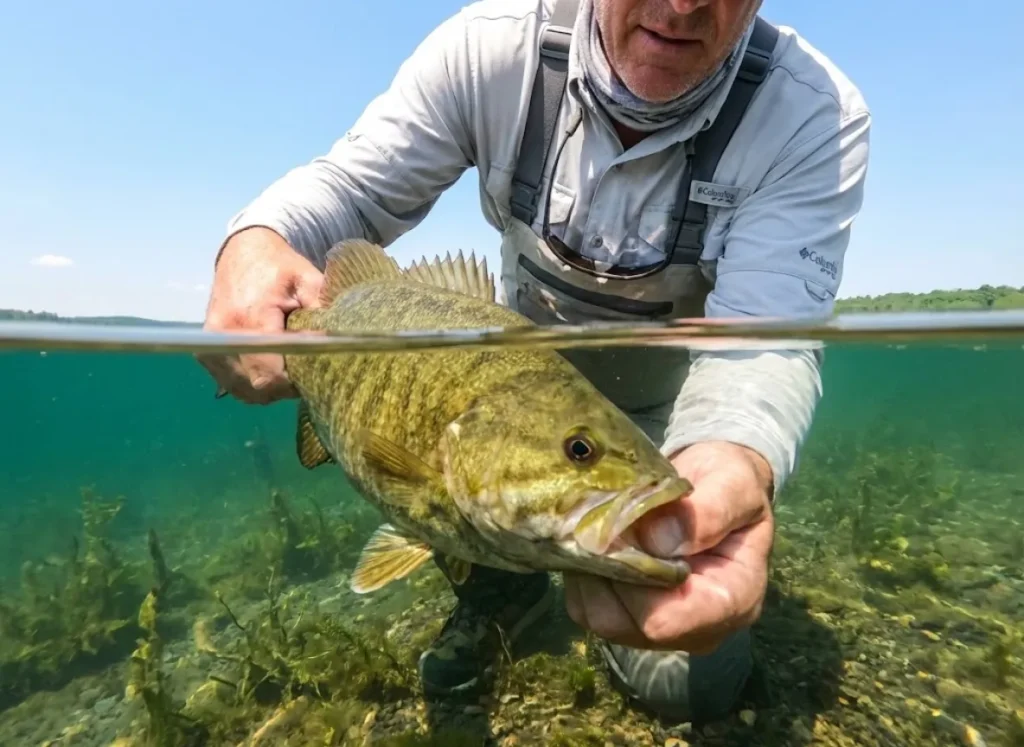
Sharper hooks reduce fish mortality rates by minimizing handling time and tissue damage, aligning with the principles of ethical stewardship.
Why do sharper hooks reduce mortality rates in catch-and-release fishing?
A dull hook often fails to penetrate initially, leading to “scratching” or superficial wounding. This results in the angler striking repeatedly or fighting the fish longer as the hook migrates, causing excessive tissue tearing. A surgical-sharp point penetrates instantly, often finding purchase in the jaw hinge or lip. This clean hook set minimizes handling time and air exposure, the two primary factors in post-release mortality.
A secure hookset allows the angler to land the fish efficiently. Prolonged fights caused by poor hook holds lead to lactic acid acidosis in the fish’s muscles. An academic study from Bemidji State University links hook types and handling stress to survival rates, showing that efficiency is key to recovery.
Combining a triangular point with a crushed barb creates the ultimate conservation tool. The cutting point enters effortlessly, and the barbless hooks allow for instant removal. This is the practical application of adhering to the science of catch and release to slash post-release mortality.
Conclusion
Mastering hook sharpening turns a game of chance into a discipline of physics. By manually creating a Triangular Trocar Point, you leverage cutting planes that require less force to penetrate than factory cones. Remember to match your grit—600+ for fines, 300-400 for general use, and 150 only for heavy gauge hooks.
The Thumbnail Test is your non-negotiable entry ticket to the water; if it slides, you will miss the fish. But beyond the catch, a sharp hook is a conservation tool. It reduces fight time, minimizes tissue damage, and ensures the fish you release can thrive. Before your next trip, take five minutes to inspect your tackle. That small investment honors the fish you pursue.
FAQ – Frequently Asked Questions
What is the best angle for sharpening a fish hook?
The optimal sharpening angle for the two side faces of the hook point is 45 degrees. This creates a durable keel that is sharp enough to cut but strong enough to resist rolling over on bone.
Can you sharpen chemically sharpened hooks?
Yes, for minor touch-ups, use a fine diamond hook sharpener (600+ grit) to polish the edge. However, if the point is bent or significantly rolled, replace the hook, as filing it down will compromise its structural integrity.
Does sharpening a hook make it rust faster?
Yes, sharpening removes the protective anti-corrosion coating (tin, nickel, or gold). To prevent rust, coat the sharpened point with a permanent marker or a drop of oil immediately after filing as a form of rust prevention.
Is it better to file towards or away from the hook point?
Ideally, file towards the point (from the bend to the tip) to provide support and prevent a burr from forming. If you file away for safety, you must perform a light lateral stroke to remove the metal shavings or wire burr that forms at the tip.
Risk Disclaimer: Fishing, boating, and all related outdoor activities involve inherent risks that
can lead to injury. The information provided on Master Fishing Mag is for educational and informational purposes
only. While we strive for accuracy, the information, techniques, and advice on gear and safety are not a substitute
for your own best judgment, local knowledge, and adherence to official regulations. Fishing regulations, including
seasons, size limits, and species restrictions, change frequently and vary by location. Always consult the latest
official regulations from your local fish and wildlife agency before heading out. Proper handling of hooks, knives,
and other sharp equipment is essential for safety. Furthermore, be aware of local fish consumption advisories. By
using this website, you agree that you are solely responsible for your own safety and for complying with all
applicable laws. Any reliance you place on our content is strictly at your own risk. Master Fishing Mag and its
authors will not be held liable for any injury, damage, or loss sustained in connection with the use of the
information herein.
Affiliate Disclosure: We are a participant in the Amazon Services LLC Associates Program, an
affiliate advertising program designed to provide a means for us to earn advertising fees by advertising and linking
to Amazon.com. As an Amazon Associate, we earn from qualifying purchases. We also participate in other affiliate
programs and may receive a commission on products purchased through our links, at no extra cost to you. Additional
terms are found in the terms of service.