

In this article
The open ocean doesn’t care about your wax job, but it ruthlessly penalizes inefficiency. I learned this the hard way twenty miles offshore, watching my fuel gauge drop faster than expected while fighting a head current. A chalky, oxidized hull is more than an aesthetic failure; it is a tactical liability that creates microscopic drag, stripping knots off your top speed and burning fuel on the long run to the blue water.
Worse, that rough surface generates a turbulent noise signature that announces your arrival to wary gamefish long before you cut the engines. Boat hull oxidation restoration isn’t about vanity—it’s about reclaiming range, stealth, and the “blood-proof” performance required for serious angling.
In this guide, we will move beyond simple cleaning. We will analyze the physics of drag, diagnose resin failure using material science, and apply a decontamination protocol that stops the chemical decay of your vessel. Whether you run a bass boat or a center console, true marine maintenance requires turning theoretical knowledge into practical action.
Why Does Hull Condition Matter for Fishing?
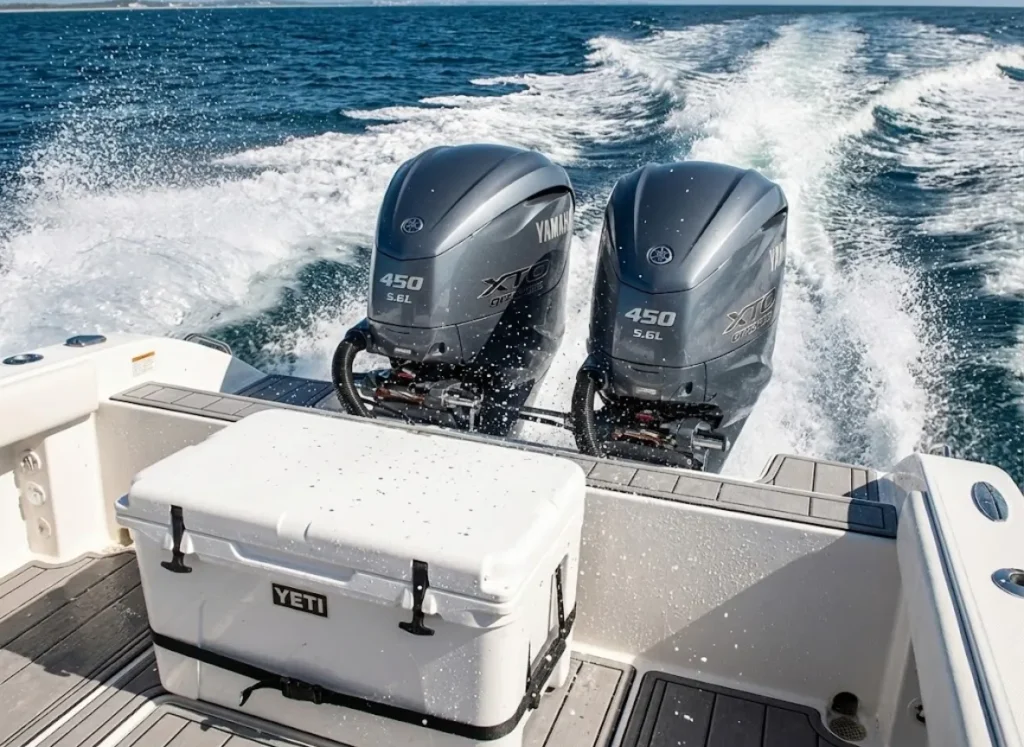
We often view boat maintenance as a chore separate from the act of fishing, but the two are mechanically linked. A degraded fiberglass boat creates friction and holds scents, two factors that work directly against your presentation.
How does oxidation impact range and stealth?
Microscopic pitting creates “skin friction drag,” disrupting the laminar flow of water over the hull surface. When gelcoat oxidizes, it doesn’t just fade; it becomes rough at a microscopic level. Research on ship hull roughness and fuel consumption indicates that a roughness increase of just 50 microns—common in moderate oxidation—can result in a drag penalty of up to 10%.
For the offshore angler, this inefficiency translates directly to higher RPMs required to maintain planing speeds. You are effectively driving with the parking brake on. This drag also sabotages electric propulsion; a smooth hull is critical for maximizing your trolling motor battery runtime when stalking fish on the flats or holding position over a wreck. Hull drag reduction is essential for fuel economy.
Beyond fuel, there is the issue of sound. A rough hull trips the water’s boundary layer into turbulence earlier than a smooth hull, generating broadband hydrodynamic flow noise. Fish detect prey and threats via their lateral line systems, which are highly sensitive to the pressure waves generated by this turbulence. Restoring the hull creates a “Silent Platform,” aiding stealth trolling by reducing the acoustic signature during the critical approach.
Why do fish blood and slime stain oxidized gelcoat?
Oxidized gelcoat is characterized by high porosity; as the resin breaks down, it forms a microscopic sponge-like structure. This is due to UV photo-degradation of polymer coatings, a chemical process where sunlight severs the molecular chains of the resin, leaving gaps in the surface.
Organic contaminants like tuna blood, squid ink, and protein stains from chum are rich in complex chains. When these fluids dry on a porous gelcoat, the proteins physically interlock with the open pores, creating a mechanical bond that soap cannot break. This is why scrubbing harder often fails; you are abrading the surface but not removing the protein anchored deep in the matrix.
Pro-Tip: If a stain refuses to lift with soap, do not reach for the bleach immediately. Bleach degrades gelcoat further. Instead, keep a spray bottle of distilled water on board to keep the blood wet until you can wash it properly.
Standard cleaners may bleach the color of the stain, but they leave the protein structure behind to rot and attract future dirt. This links directly to sustainable fishing gear maintenance protocols, where the goal is to preserve the equipment’s integrity rather than just cleaning it for appearance. The goal of gelcoat restoration is to create a hydrophobic surface tension where these contaminants bead up and rinse off without adhesion.
How Do You Diagnose and Prep the Surface?
Before grabbing a buffer, you must understand the depth of the damage. Visual inspection is often misleading; a hull may look white but still possess significant surface drag and dead resin.
What are the stages of decay and the “Baggie Test”?
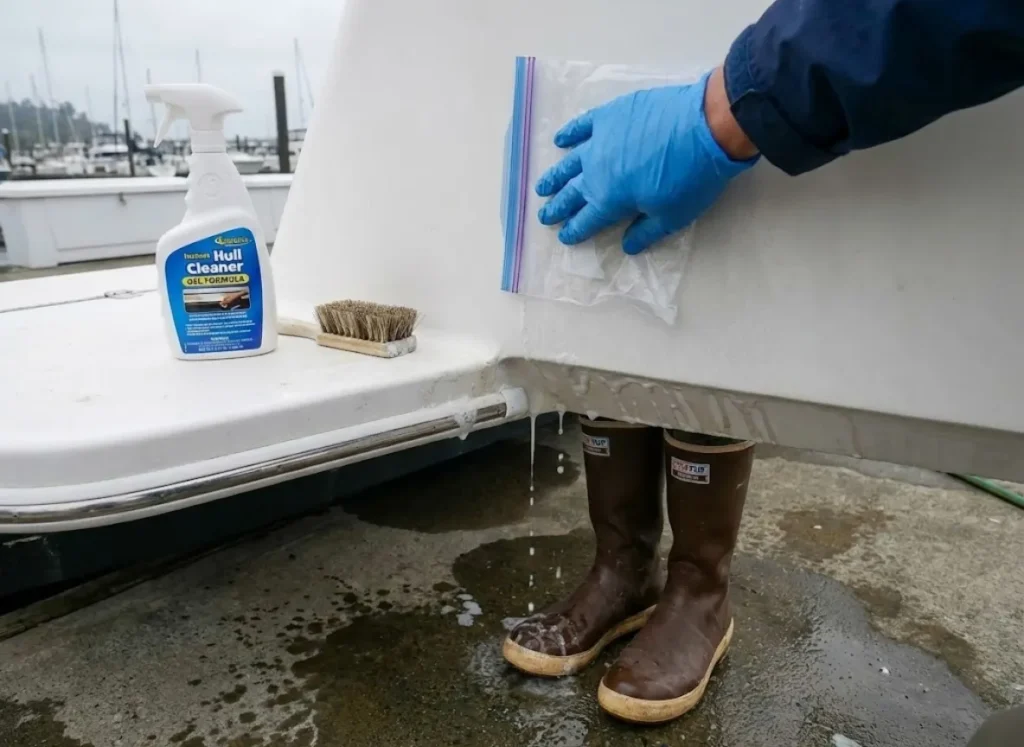
Oxidation severity is not binary; it exists on a spectrum from Type I (Surface Haze) to Type IV (Structural Pitting). To accurately assess this, we use the “Baggie Test.” Place your hand inside a thin sandwich plastic bag and run it over the washed gelcoat. The plastic magnifies your tactile sensitivity, allowing you to feel contaminants your bare fingers would miss.
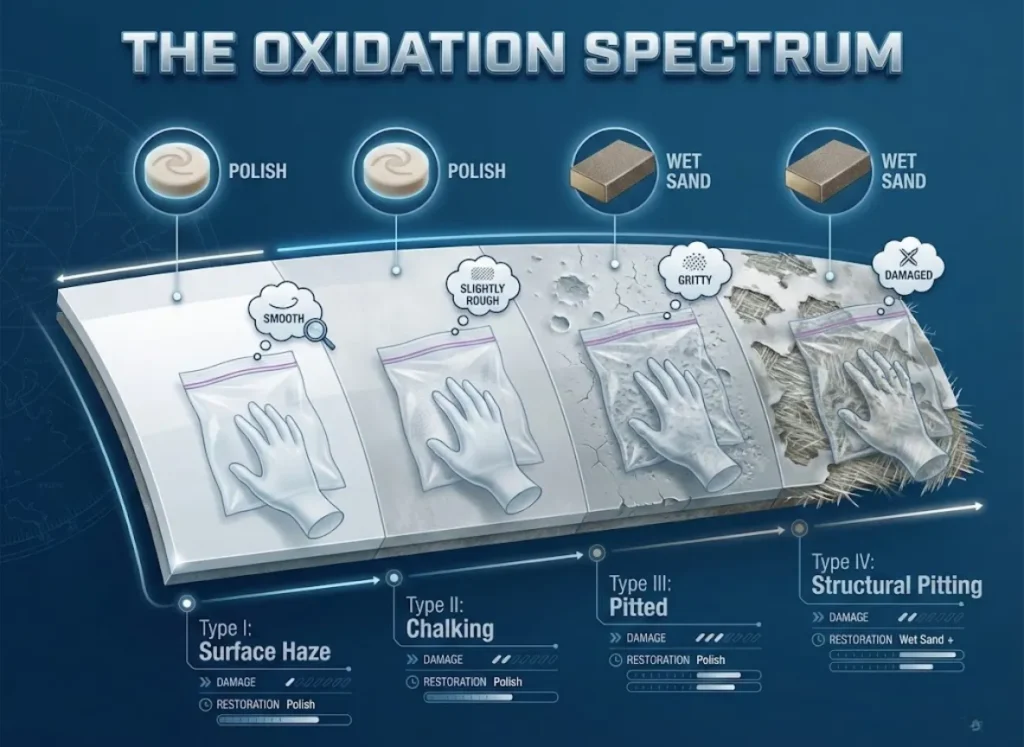
Type II oxidation feels dry and creates a chalky hull sensation through the bag, indicating that “chalking” or pigment release has begun. This is often accompanied by the catalytic degradation of dye and organic pollutants, causing the hull to hold onto environmental grime.
Type III and IV reveal a sandpaper-like texture, signaling that the resin matrix has eroded enough to expose glass fibers or deep pits. This diagnosis dictates the protocol: Type I/II can be fixed with rubbing compound, while Type III/IV mandates the surgical removal of material via wet sanding. This is a critical check to perform when understanding hull design and construction materials on a used boat you might be considering purchasing.
How do you perform the “Chemical Purge” safely?
Mechanical abrasion cannot fix chemical staining; you must purge the hull first. You likely have a “scum line” or “ICW Mustache”—the brown tannin and iron oxide stain at the waterline. This requires an acid-based cleaner (typically Oxalic acid or Muriatic) to dissolve the iron.
Organic stains require a different approach. Use an enzymatic cleaner containing protease to hydrolyze the protein bonds rather than just bleaching them. Whether tackling salt-water oxidation or fresh-water scum, the chemistry matters.
CRITICAL WARNING: Muriatic acid is highly corrosive. It will strip the galvanization from trailer bunks instantly and can damage aluminum trailers. Strict containment and rinsing are required. Always consult the safety data sheet for phosphoric/oxalic acid cleaners before handling these chemicals.
The “Acid Trap” is a common failure point. This occurs when anglers acid-wash a hull to whiten it but fail to neutralize the surface. This leaves the gelcoat with a low pH and open pores. An un-neutralized hull will re-oxidize at double the speed, turning yellow within weeks.
Always follow an acid wash with a marine-safe soap bath to stop the chemical reaction. This thorough cleaning process also aligns with the protocols for preventing the spread of aquatic invasive species by ensuring no biological material remains on the hull.
What Is the Protocol for Mechanical Restoration?
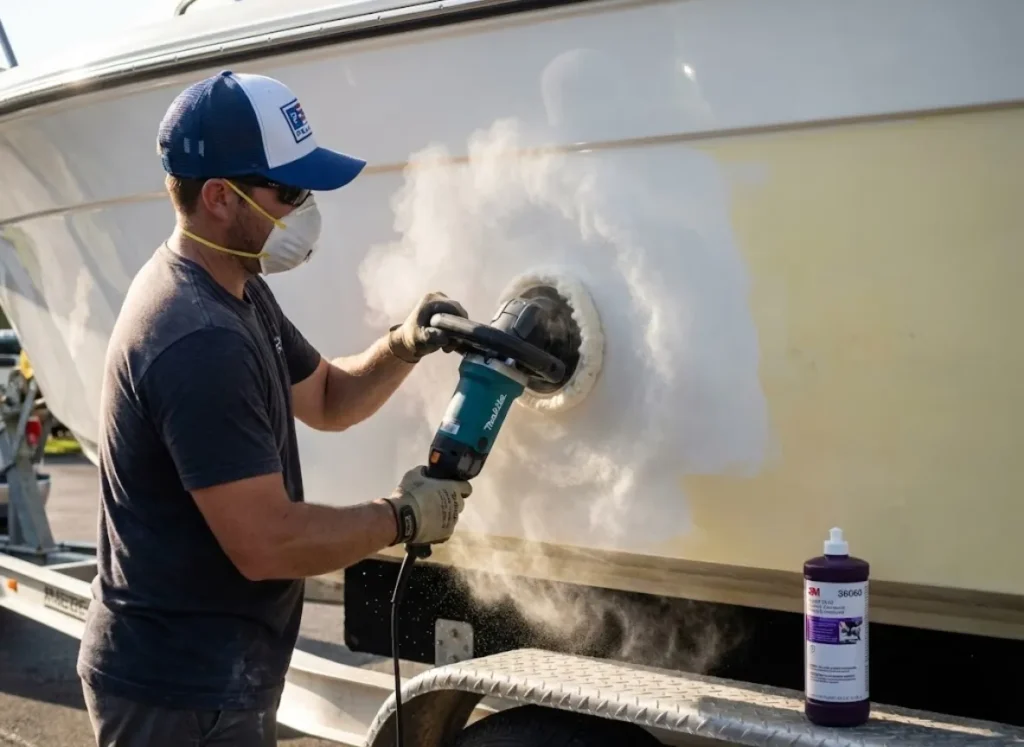
Once the surface is chemically clean, we must physically remove the dead gelcoat. This is not about covering up the damage; it is about leveling the surface.
When should you wet sand versus compound?
Compounding is effective for surface restoration, but it cannot fix the deep pitting and porosity found in heavy oxidation. If the “Baggie Test” revealed a sandpaper texture, you need to wet sand. Wet sanding is a leveling process that surgically removes the layer of dead, porous resin to reveal the fresh, dense gelcoat beneath.
Begin with the least aggressive grit necessary—typically grit 800 or grit 1000—using foam-backed discs (like Mirka Abralon sanding discs) to follow hull contours. Sanding creates a uniform “scratch pattern” that is actually easier to buff out than deep oxidation.
Pro-Tip: Monitor the “slurry” (the run-off water) while sanding. White, milky runoff indicates you are removing gelcoat (good). Clear runoff suggests you aren’t cutting deep enough or the sandpaper is clogged.
Always respect the gelcoat thickness. Aggressive sanding on corners or chines can lead to “burn through,” exposing the fiberglass laminate. Refer to Boston Whaler maintenance and gelcoat care guidelines or your specific manufacturer’s manual to understand the thickness tolerances of your vessel’s finish.
How do you select the right machine and compound?
The Rotary Polisher (think Makita or DeWalt) is the “Surgeon’s Scalpel.” It spins on a fixed axis to generate the friction and heat needed for heavy cutting. It is the tool of choice for removing sanding marks. The Dual Action Polisher (DA) is the “Finishing Tool,” using a random orbit to disperse heat and prevent holograms or swirl marks.
Marine Buffing Compounds
Heavy-duty gelcoat restoration products compared by performance and technology.
Abrasive Tech
Diminishing Abrasive: Particles break down from coarse to fine during use.
Key Insight
The modern benchmark. Cuts P800 marks efficiently with low dust production. Finish: 6/10.
Abrasive Tech
Aluminum Oxide: Standard industrial abrasive for rapid material removal.
Key Insight
Fast cut but generates massive dust (“dust bowl”). Requires frequent cleanup. Finish: 5/10.
Abrasive Tech
SMAT (Super Micro): Abrasives do not break down, keeping cut aggressive throughout.
Key Insight
Oily/Wet work time. Constant cutting power due to micro-abrasive stability. Finish: 6/10.
Abrasive Tech
Diminishing: Starts as a coarse paste and breaks down into a polish.
Key Insight
“Foolproof” for beginners but slower than professional compounds. Finish: 7/10.
Abrasive Tech
Non-Diminishing: Hard abrasives that provide a consistent cut until rinsed away.
Key Insight
Highly aggressive “wet system.” No fillers used. Pure cutting power. Finish: 4/10.
Wool buffing pads are for cutting, while foam cutting pads are for refining. Modern compounds use diminishing abrasives or Super Micro Abrasives (SMAT) to cut consistently. Checking the Presta Products technical catalog for finishing products can help you match the specific grit level of your compound, such as heavy cut compound or 3M Marine Finesse-it, to the sanding marks you need to remove.
Understanding “Tip Speed” physics prevents burning the hull. The outer edge of a spinning pad moves faster than the center, generating more heat. Keep the rotary moving and manage RPM settings (avoiding the danger zone above 2000 RPM for beginners) based on your arm speed to avoid scorching the gelcoat.
How Do You Lock in the Restoration?
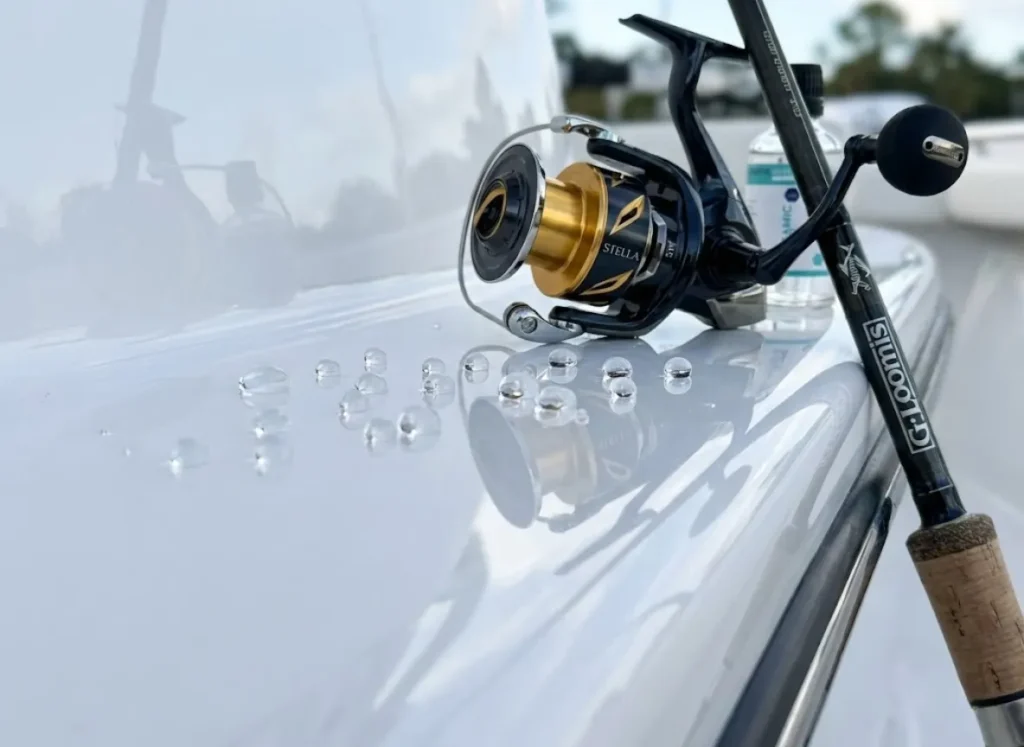
You have restored the surface to a showroom shine, but without a shield, the salt and sun will reclaim it in weeks.
Why is ceramic coating the angler’s tactical choice?
Traditional carnauba wax offers a warm shine but has a low melting point (~180°F). In the tropical sun, a dark hull can exceed this temperature, causing the wax to degrade rapidly. Polymer sealants offer better longevity (4-6 months) but eventually wash away.
Nano-ceramic coatings form a covalent bond with the gelcoat, curing into a hard, glass-like solid that physically fills the micropores. By capping the pores, ceramics create a surface that is chemically impervious to blood protein adhesion; the “Blood-Pore Nexus” is broken.

Ceramics withstand high-pH detergents and even mild acid washes. This allows for aggressive cleanup without stripping the protection. While the initial application is labor-intensive—often requiring a cure time of 24-48 hours—the maintenance reduction makes it the superior choice for active fishing vessels. This durability is why Yamaha maintenance matters guide regarding coatings and other OEMs are increasingly recommending ceramics over traditional boat waxes.
When you are selecting saltwater gear with marine-grade durability, you expect corrosion resistance from your reels; you should demand the same resilience from your marine maintenance products.
Final Assessment
A restored hull is a tactical advantage. By eliminating oxidation, you reduce the skin friction that kills your range and the turbulence that alerts your quarry. We have walked through the physics of drag, the chemical diagnosis of resin failure, and the surgical protocol of wet sanding.
But the most critical takeaway is the shift from temporary wax to permanent ceramic sealing. This solves the “Blood-Pore” problem, ensuring that your boat remains a clean, efficient platform for years. The ocean is unforgiving of neglect, but it rewards preparation.
Have you transitioned from wax to ceramic on your rig? Share your hull restoration results or ask questions about specific compound combinations in the comments below. Let’s help the community refine their techniques.
FAQ – Frequently Asked Questions
Is it better to wet sand or just compound a heavily oxidized boat?
Wet sanding is required for heavy (Category 3 or 4) oxidation because compounding alone cannot remove the deep pitting and dead resin effectively. Sanding saves time and material by leveling the surface quickly, allowing the compound to polish rather than cut.
How often should I wax or coat my boat to prevent oxidation?
Carnauba waxes require re-application every 2-3 months, while polymer sealants last 4-6 months. Nano-ceramic coatings provide the longest protection, lasting 18-36 months depending on environmental exposure.
Can I use bleach to remove fish blood stains from my gelcoat?
Avoid using bleach as a primary cleaner; it degrades the resin matrix over time and strips wax protection. Use enzymatic cleaners containing protease to digest the protein bonds of the blood safely.
What causes the brown stain mustache on the boat’s waterline?
This stain is caused by tannins in the water and iron oxide (rust) attaching to the gelcoat. It requires an acid-based cleaner (like Oxalic acid) to chemically dissolve the deposits, followed by a thorough neutralization wash.
Risk Disclaimer: Fishing, boating, and all related outdoor activities involve inherent risks that
can lead to injury. The information provided on Master Fishing Mag is for educational and informational purposes
only. While we strive for accuracy, the information, techniques, and advice on gear and safety are not a substitute
for your own best judgment, local knowledge, and adherence to official regulations. Fishing regulations, including
seasons, size limits, and species restrictions, change frequently and vary by location. Always consult the latest
official regulations from your local fish and wildlife agency before heading out. Proper handling of hooks, knives,
and other sharp equipment is essential for safety. Furthermore, be aware of local fish consumption advisories. By
using this website, you agree that you are solely responsible for your own safety and for complying with all
applicable laws. Any reliance you place on our content is strictly at your own risk. Master Fishing Mag and its
authors will not be held liable for any injury, damage, or loss sustained in connection with the use of the
information herein.
Affiliate Disclosure: We are a participant in the Amazon Services LLC Associates Program, an
affiliate advertising program designed to provide a means for us to earn advertising fees by advertising and linking
to Amazon.com. As an Amazon Associate, we earn from qualifying purchases. We also participate in other affiliate
programs and may receive a commission on products purchased through our links, at no extra cost to you. Additional
terms are found in the terms of service.