
In this article
The bait swims perfectly for thirty seconds—then turns and heads straight back to the hull. You watch, frustrated, as your carefully selected Blue Runner ignores the open water and seeks the shadow of the boat like a homing pigeon. I’ve seen this happen hundreds of times during twenty years of guiding offshore. It’s not the bait’s fault. It’s not bad luck. It’s physics.
When a live bait is tethered to your line, it becomes a hydrofoil subject to drag, tension, and ballast. The hook placement determines the “tow point”—the mechanical pivot that dictates whether your bait swims away into the strike zone or circles back to safety. Once you understand the forces at play, you can fix it every time.
⚡ Quick Answer: The best way to stop bait from swimming back to the boat is anal or vent hooking. By placing the hook near the anal vent, you create a rudder effect where the line drag makes swimming away the path of least resistance. For calm water freelining, this is the single most effective solution.
The Physics Behind the Problem: Why Bait Returns to the Boat
The Tow Point: Your Bait’s Steering Wheel
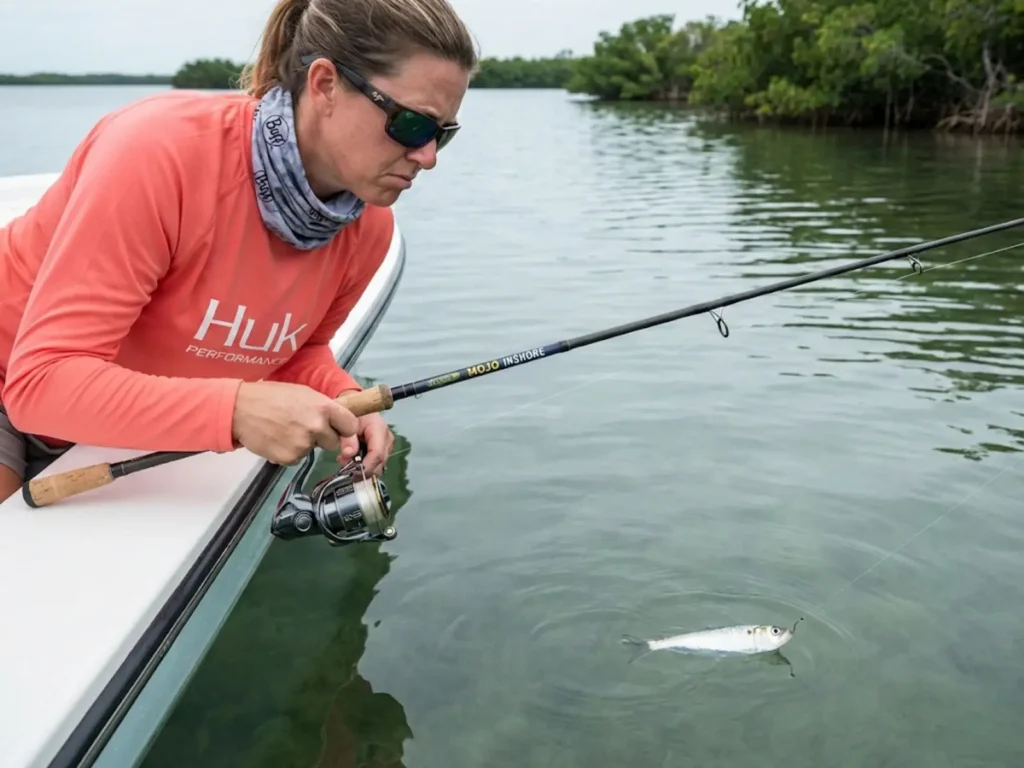
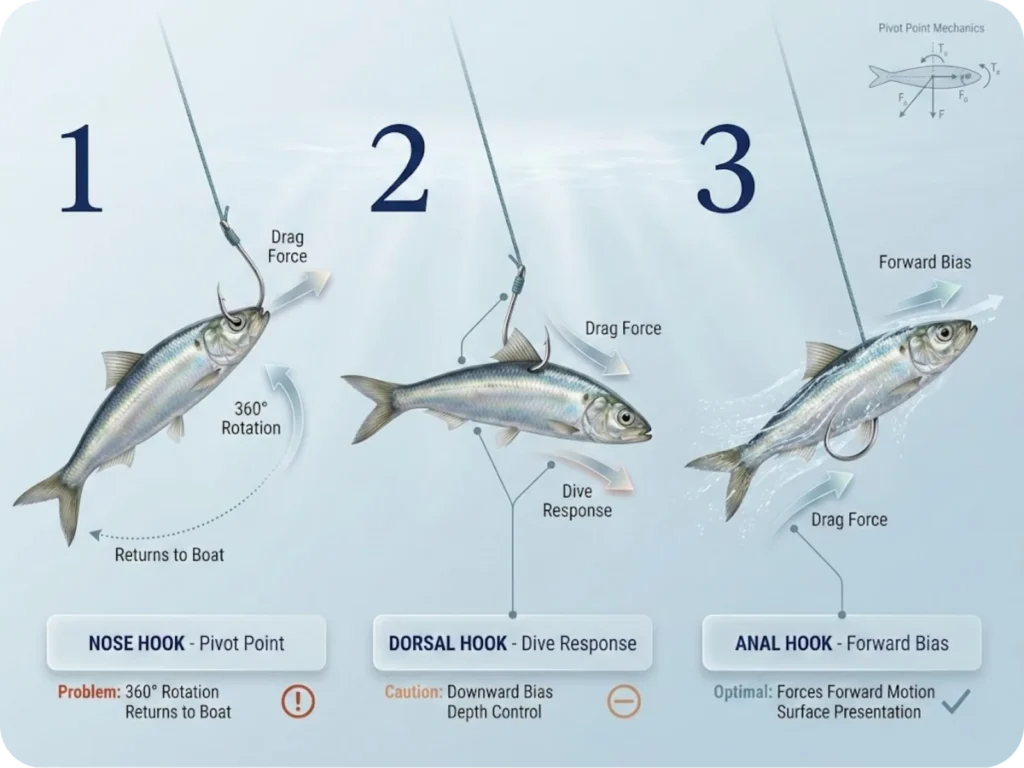
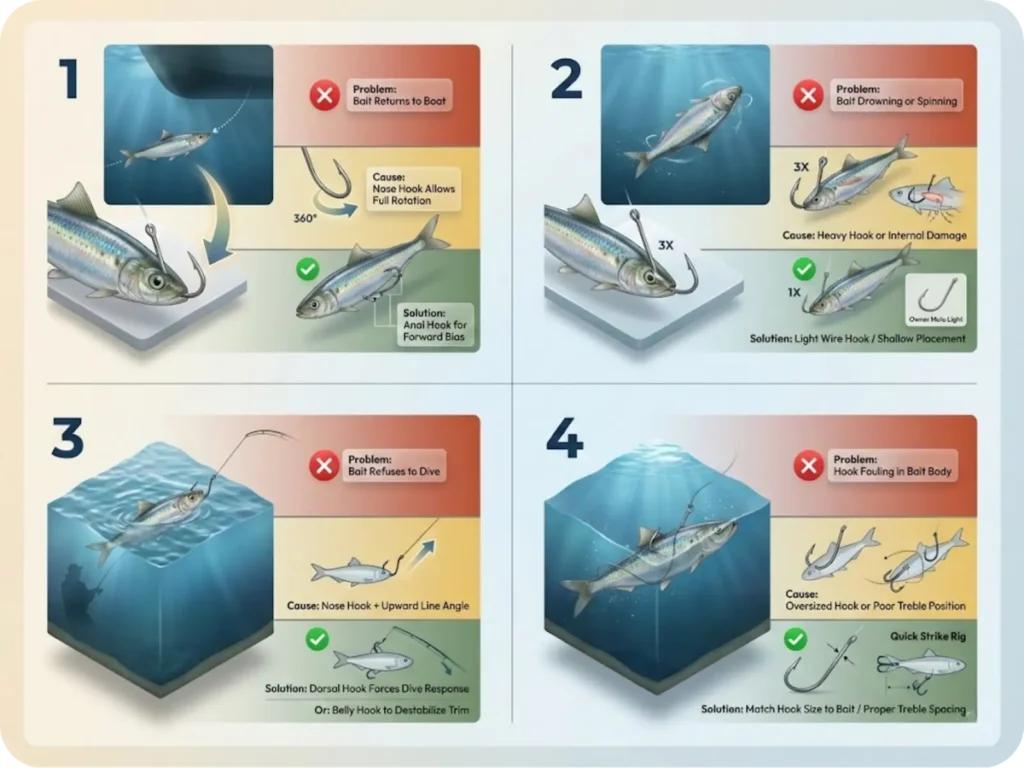
When you hook a baitfish, you’re not just securing it—you’re installing a control surface. The location of the hook acts as a pivot point, and the drag from your line manipulates the bait’s pitch and yaw. A nose-hooked bait in slack water can rotate 360 degrees around the hook, allowing it to turn tail-first and propel itself back to the boat.
The problem gets worse when the bait perceives open water as a threat. Schooling baitfish like Pilchards and Menhaden instinctively seek cover when separated from the pod. Your boat hull provides that cover. Without a rigging method that mechanically forces forward motion, the bait will exploit the slack line and return to the shadow.
Drag, Tension, and Ballast: The Three Forces
Three forces govern bait behavior:
Drag is the resistance created by the line trailing through water. Placement at the rear (anal fin) streamlines drag when the bait swims away, making forward motion energetically favorable. Understanding these principles comes down to understanding current seams and drag forces that act on your presentation.
Tension is the pull from the rod tip. Dorsal hooking converts upward tension into a diving response as the bait tries to relieve the pressure.
Ballast is the weight of the hook itself. Throat hooking adds weight to the front-bottom area, forcing the head down and compelling a steep dive.
The goal is simple: make swimming away from the boat the path of least resistance.
The Pivot Problem: Nose Hooking in Slack Water
Nose hooking is the most common method, but it’s vulnerable to the “return loop” phenomenon. When the line is slack—common in static presentations or light current—the bait pivots freely around the nose hook. The drag is concentrated at the extreme forward edge, so the rest of the body rotates without resistance.
In a trolling scenario with constant tension, nose hooking mechanics in slack water work because the bait is forced to face the direction of the pull. But in freelining or anchored situations, nose hooking is the least effective method for forcing a bait away from the vessel.
Pro tip: If you’re stuck with nose hooking, add a small float 18 inches above the hook. The constant upward tension prevents the bait from completing its pivot and turning back.
The Fix: Hook Placements That Force Bait Away
Anal/Vent Hooking: The Steering Solution
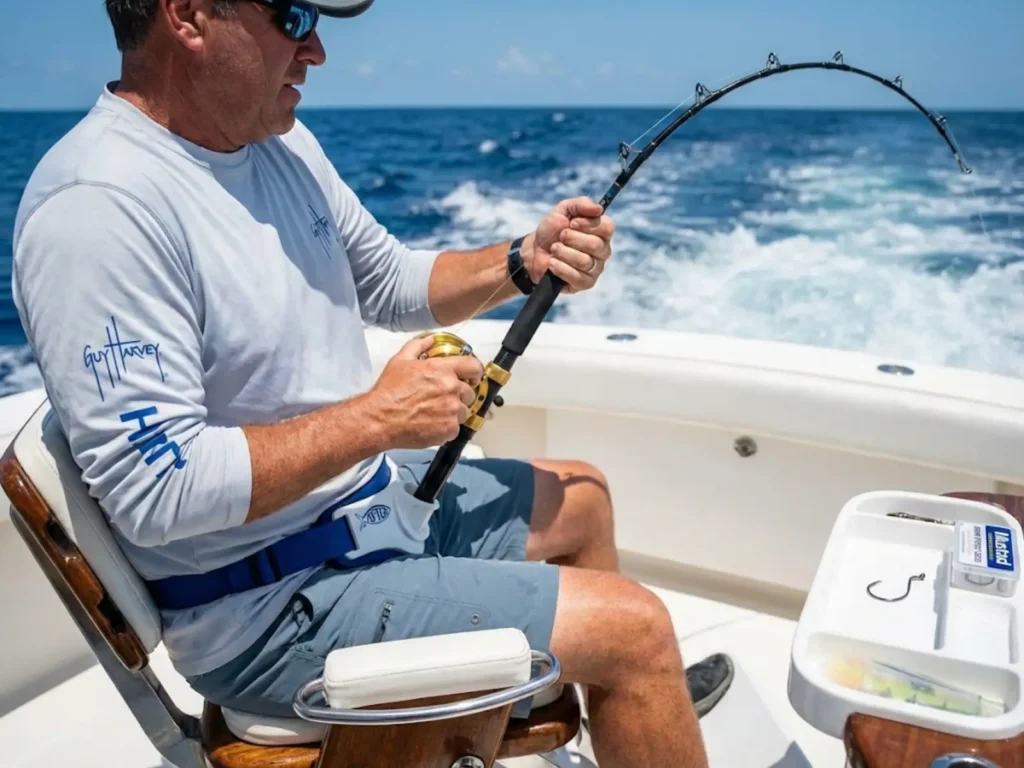
For the specific problem of bait swimming back to the boat, anal or vent hook placement is the most robust solution. By inserting the hook through the “hard place” near the anal vent, you place the weight of the hook and the drag of the leader at the bottom rear of the fish.
This acts as a stern keel. For the fish to swim toward the boat, it would have to execute a turn against the resistance of the line dragging under its belly—energetically unfavorable. Swimming away from the boat streamlines the drag as the line trails naturally behind.
Hook size must match bait size, not target species. Use circle hook mechanics and fish survival techniques to avoid deep hooking. Insert the hook through the hard place posterior to the anal fin, and avoid penetrating the lateral line, which causes rapid mortality.
Dorsal Hooking: Forcing the Dive
Dorsal hooking shifts the tow point to the bait’s back, creating a fulcrum. When tension is applied from the elevated rod tip, the force pulls upward on the bait’s back. To relieve this tension, the bait’s natural reaction is to swim downward.
This method forces the bait out of the upper water column where it might drift back to the boat. The struggle against dorsal tension creates low-frequency vibrations that mimic an injured fish, triggering lateral line predation responses.
Hooking in front of the dorsal fin is ideal for kite fishing—it keeps the bait horizontal relative to the surface. Hooking behind the dorsal fin improves hook-up ratios for short-striking predators that attack from the rear. Avoid the spine entirely—you’ll paralyze the bait.
Tail Hooking: The Panic Response
Tail hooking through the caudal peduncle triggers a predator escape reflex. The bait perceives the line tension as a predator grasping its tail, triggering frantic forward flight away from the angler.
This method works particularly well for casting—the head leads aerodynamically, improving distance. On inshore flats, tail hooking forces aggressive swimming away from shore structure. For walleye fishing, it creates high-frequency tail beats that generate vibration in low-visibility water.
Match hook weight to bait size carefully. Too heavy, and you’ll impair swimming efficiency.
Bridling: Maximum Bait Life with Exposed Hook
Bridling involves passing a rubber band or floss loop through the cartilage above the eye (the “horn”) or through the nostrils, allowing the hook to sit fully exposed on the forehead.
This leaves the jaw unencumbered for natural respiration, maximizes hook-up ratios with a fully exposed point, and extends bait life through minimal tissue damage. Bridling is mandatory for Goggle Eyes due to their large, light-sensitive eyes—direct nose hooking risks puncturing the orbital membrane, which is fatal.
Species-Specific Rigging Protocols
Blue Runners (Hard Tails): The Hardy Pelagic
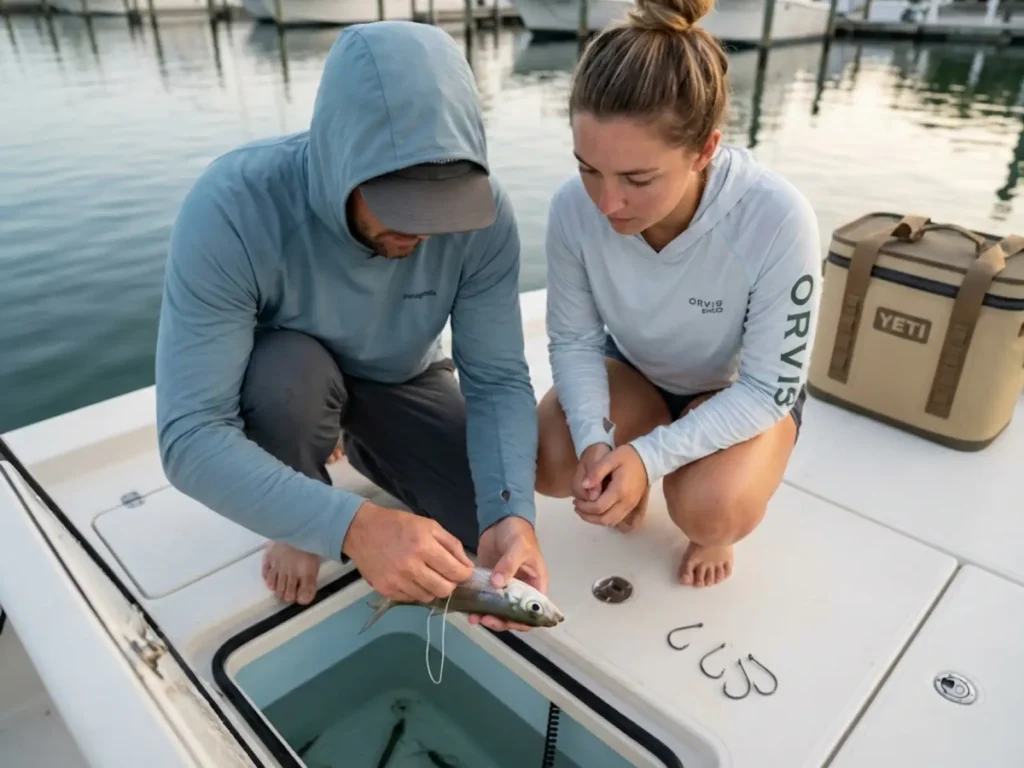
Blue Runners are the workhorses of offshore fishing—durable, aggressive, and prone to tangling if rigged incorrectly. Catch them with Sabiki rigs (sizes 15-22), NOT cast nets, which remove the slime coat. Deploy a de-hooker to avoid skin contact and maintaining optimal livewell conditions above 60°F.
To force a dive, hook through the dorsal area. For surface swim, use a dorsal hook plus float. For anti-return rigging, back hooking is superior to nose hooking.
For Wahoo, use Titanium wire over stainless steel. Titanium’s flexibility allows natural swimming without kinking, which can cause the bait to spiral back to the main line.
Pilchards, Sardines, and Menhaden: The Delicate Shoal
These Clupeid species have deciduous scales and fragile skeletons. They’re prone to “helicoptering” (spinning) if rigged with hooks that are too heavy or off-center.
Wet your hands before contact and avoid squeezing. Use light wire hooks (1X or Light gauge). Capt. Scott Crippen’s method hooks through the collar (shoulder region) or tail instead of the nose. This achieves aerodynamic casting and a strong “swim away” response—the Blue Runner bait care protocols apply here too.
For trolling, the hook must pass horizontally through nostrils. Vertical jaw hooking locks the mouth open, drowning the fish by preventing operculum pumping.
Pro tip: A tail-hooked Pilchard perceives the line as a predator. Use this to your advantage—the panic response sends it sprinting away from the boat.
Goggle Eyes (Bigeye Scad): The Nocturnal Prize
Large orbital sockets make nose hooking risky. For kite fishing and surface trolling, pass rubber band or floss through cartilage above the eye. This “unicorn” position maximizes hook exposure while leaving the jaw free for respiration.
For deep presentation without heavy lead, use belly hooking. This destabilizes trim, encouraging the fish to struggle downwards.
Freshwater Applications: Walleye and Esox Strategies
Walleye Systems: Creek Chubs and Leeches
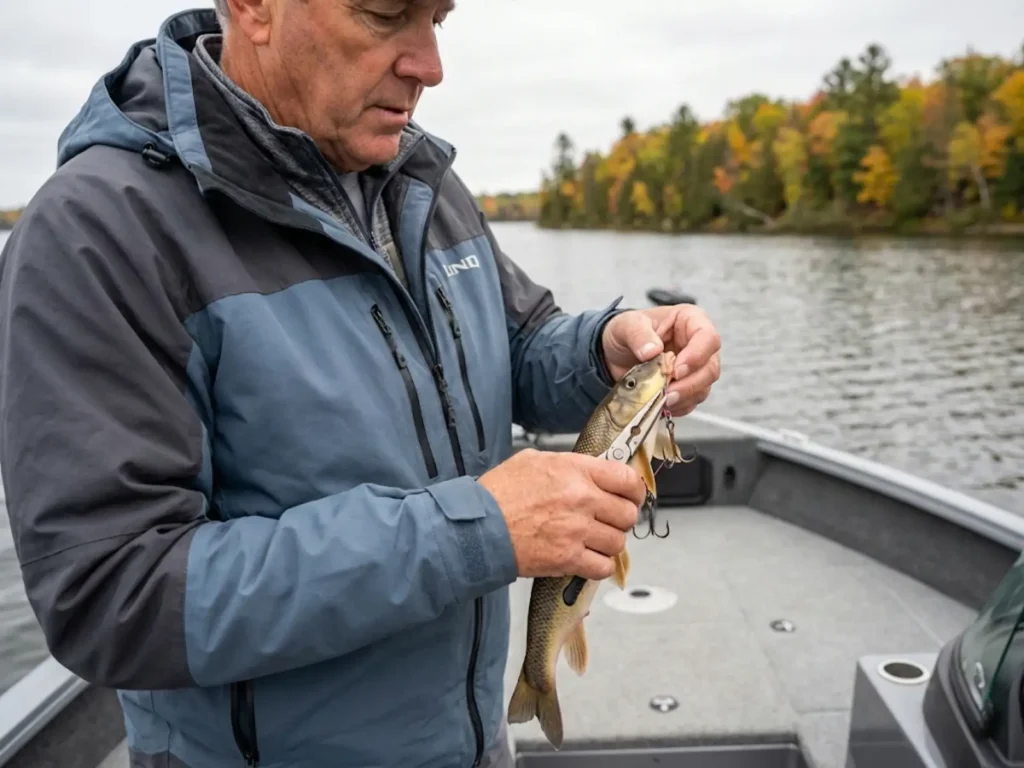
While lip hooking is standard for active jigging, tail hooking through the caudal peduncle is superior for static or slow-moving rigs. It creates a distress signal via high-frequency tail beats and prevents the chub from burying its head in bottom debris.
For leeches, hook through the sucker disc (tail end), NOT the head. This forces the leech to extend its body to swim, creating the undulating ribbon motion that triggers strikes. Head hooking causes the leech to curl around the hook shank.
The Esox Factor: Quick Strike Rigs
The single hook through the snout is obsolete—and in many states, illegal for good reason.
Quick Strike Rigs use a lead hook through the nose plus trailing treble hooks along the flank or dorsal. This allows immediate hook set with no waiting. Distributed hooks increase probability of mouth hooking during the initial “T-bone” attack.
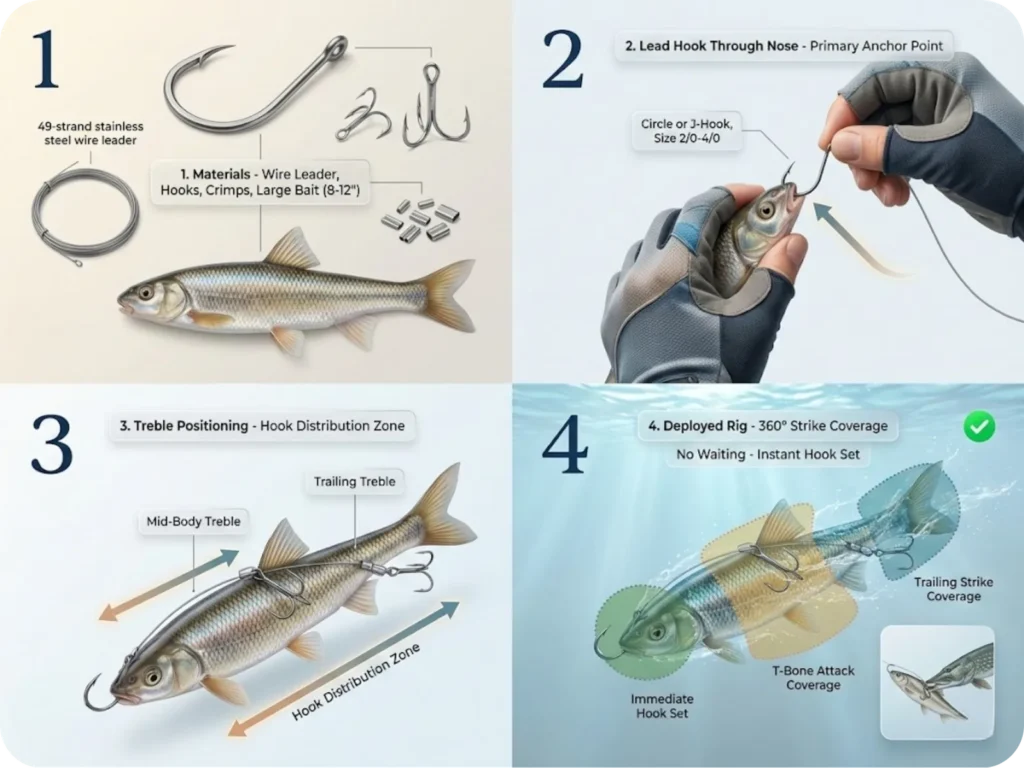
Wisconsin and other states require Quick Strike Rigs for baits larger than 8-10 inches. Learn safe pike and musky handling techniques to complete the ethical release.
Hook Type and Mortality: The Conservation Imperative
The Deep Hooking Crisis
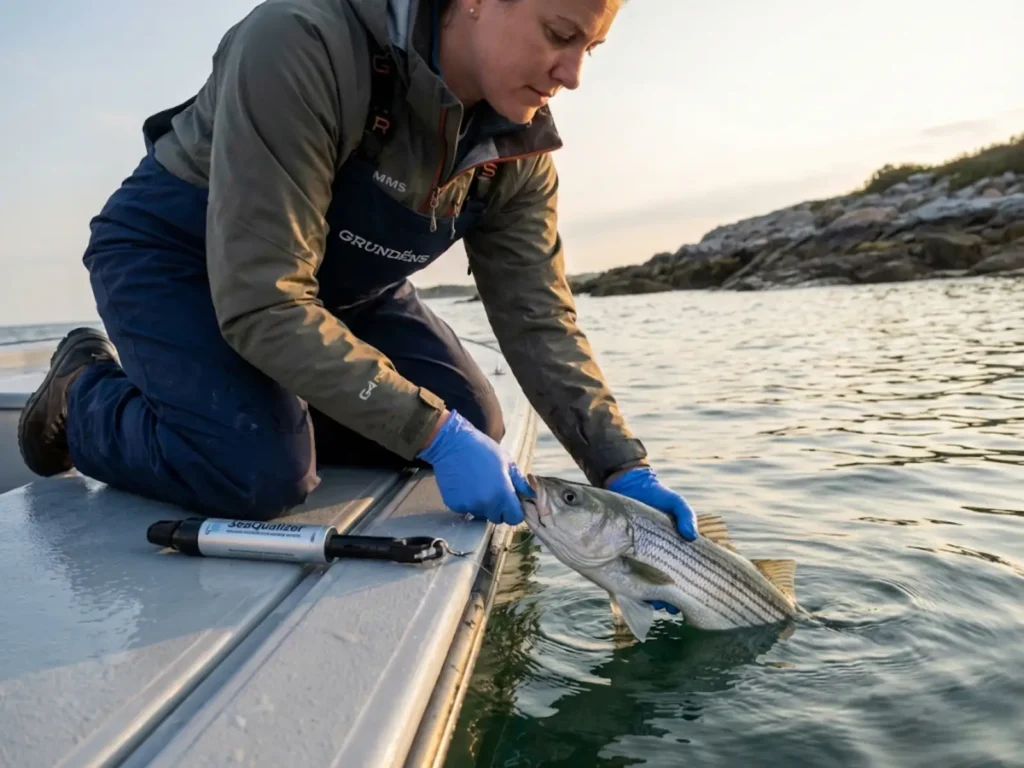
Anatomical hooking location is the single most significant variable in post-release mortality. Throat-hooked fish face a 48% mortality rate. Mouth-hooked fish drop to 20%. If the fish is bleeding, expect 50% mortality.
The discrepancy comes down to damage near vital organs (heart, liver) and excessive bleeding from gill arches. For a comprehensive analysis of hook location and fish survival, the data is clear.
Live bait angling carries inherently higher risk of deep hooking because the predator attempts to ingest the prey entirely. This is why circle hooks exist.
The Circle Hook Solution
Circle hooks rely on the fish’s movement, not the angler’s force. The point is rotated perpendicular to the shank. If swallowed, the curved design slides out of soft esophageal tissue without snagging. It only engages when it wraps around the jawbone as the fish turns away.
For sharks, 91% hooking rate with only 3% deep hooking versus 6% with J-hooks. Catch rates are actually higher with circle hooks (0.9 versus 0.7 sharks per interaction). For billfish, circle hooks significantly increase probability of mouth hooking—the strongest predictor of post-release mortality study by hooking location survival.
Regulatory Compliance: The Legal Mandate
Atlantic Striped Bass regulations (Maine to North Carolina) require non-offset circle hooks when fishing with any natural bait—live, dead, whole, or cut.
Gulf of Mexico reef fish under the DESCEND Act require non-stainless steel, non-offset circle hooks. Non-stainless ensures the hook corrodes and falls out if the fish breaks off. You must have a venting tool or descending device rigged and ready.
California Halibut and White Seabass have strict size limits (White Seabass: 28 inches) that necessitate careful release. Circle hooks are preferred for live Squid presentations.
Terminal Tackle Engineering: Hook Selection Matters
Wire Gauge: Fine vs. Heavy
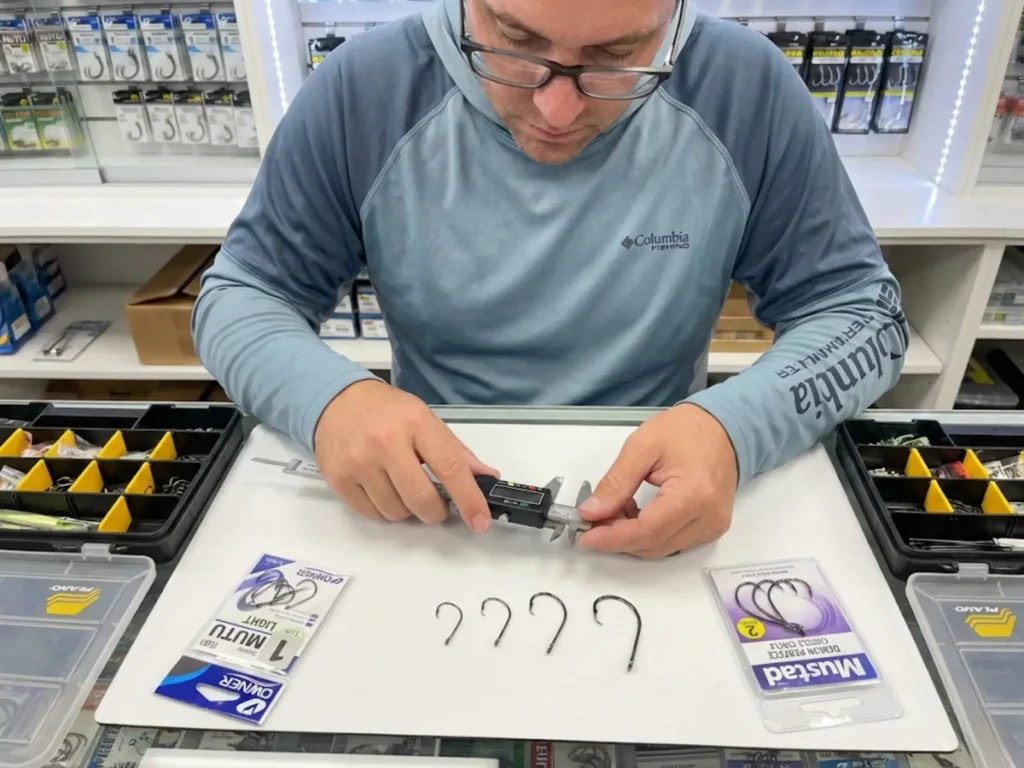
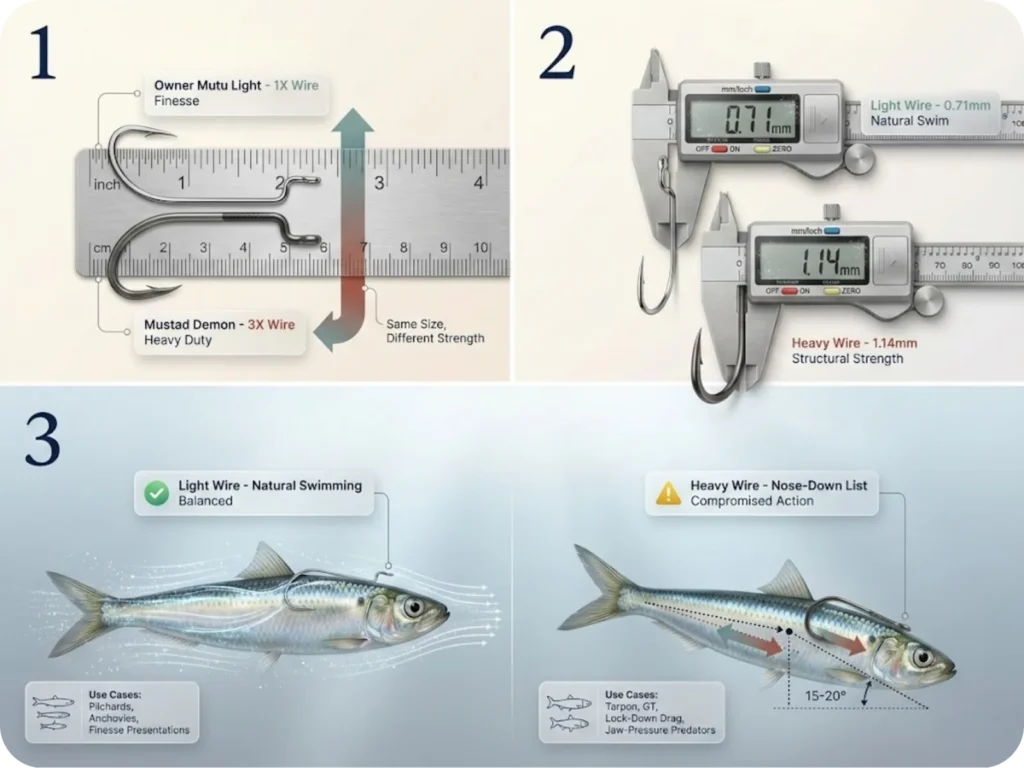
Fine wire (1X/Light) is essential for delicate baits like Pilchards and Anchovies. A heavy wire hook acts as a sinker on the nose, drowning the bait and killing its action.
Owner Mutu Light is the benchmark for finesse live baiting. Light wire allows natural swimming, but it’s prone to straightening under heavy drag when targeting Tunas or Sharks.
Heavy wire (3X/4X) is required for jaw-pressure predators like Tarpon or GT, or for lock-down drag settings. Mustad Demon Perfect Circle (3X) is structurally robust but significantly heavier.
The Brand Divide: Mustad vs. Owner
A Mustad 2/0 is NOT equivalent to an Owner 2/0. Mustad hooks run significantly larger—a Mustad 2/0 may be comparable to an Owner 4/0.
This “sizing drift” can be catastrophic if ordering hooks based on nominal size. Always verify actual hook dimensions before purchase. For a complete guide to terminal tackle selection, matching physical dimensions matters more than catalog numbers.
Owner hooks feature “Cutting Point” and “Super Needle Point” technology—exceptionally sharp out of the package. Mustad uses “Opti-Angle” technology—durable, chemically sharpened, and rust-resistant at lower cost per unit.
Troubleshooting Common Rigging Failures
Bait Seeking Cover (Returns to Boat)
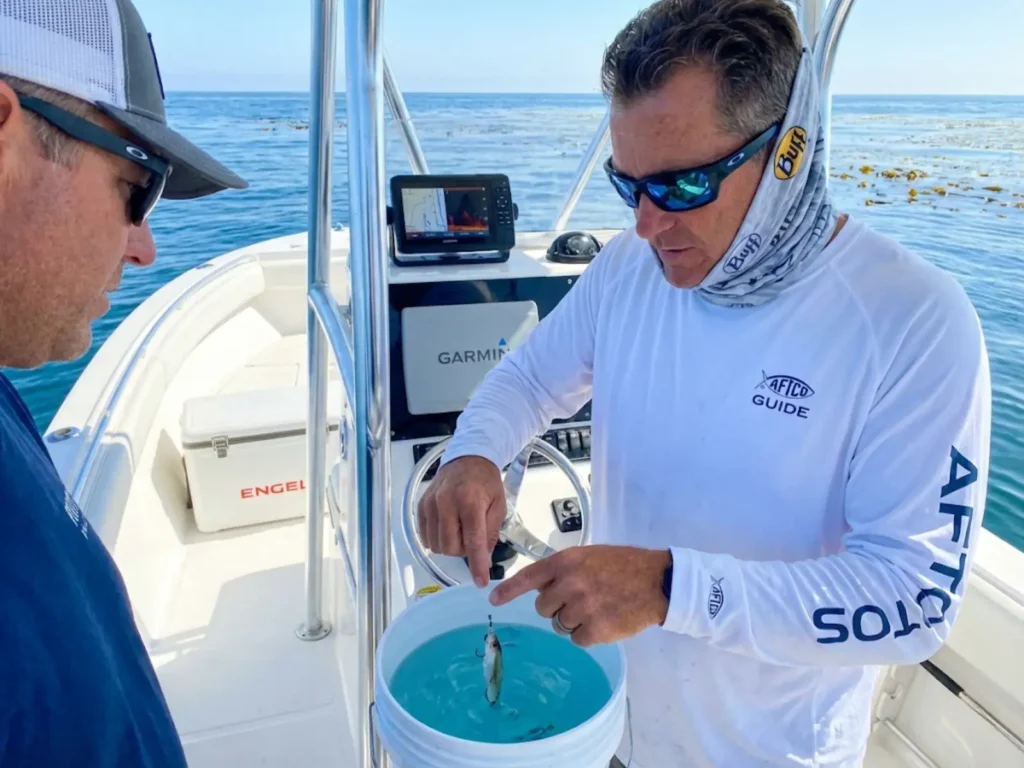
Symptom: Bait swims to hull, seeks shadow or structure.
Solution: Anal/Vent Hooking. Rear drag creates a “rudder” effect, steering bait outward. This is the most effective mechanical override for cover-seeking behavior.
Bait Drowning or Spinning
Symptom: Bait rolls, spins, or swims erratically on surface.
Solution: Collar/Shoulder Hooking. Move the tow point back to the shoulder to stabilize. Switch to lighter wire hook.
Bait Won’t Dive
Symptom: Bait refuses to descend despite angler intent.
Solution: Dorsal Hooking. Upward pull from the elevated rod tip forces bait to swim down. Alternative: Belly Hook to destabilize trim.
Bait Sluggish on Retrieve
Symptom: Bait doesn’t swim aggressively when retrieved.
Solution: Tail Hook. Triggers “predator escape” reflex—bait swims away from angler with high-frequency tail beats.
Pro tip: If your hook keeps fouling back into the bait’s body, downsize the hook. Match bait size, not target species. Wide gap hooks are less prone to fouling than standard gaps.
The Decision Matrix: Scenario-Based Rigging
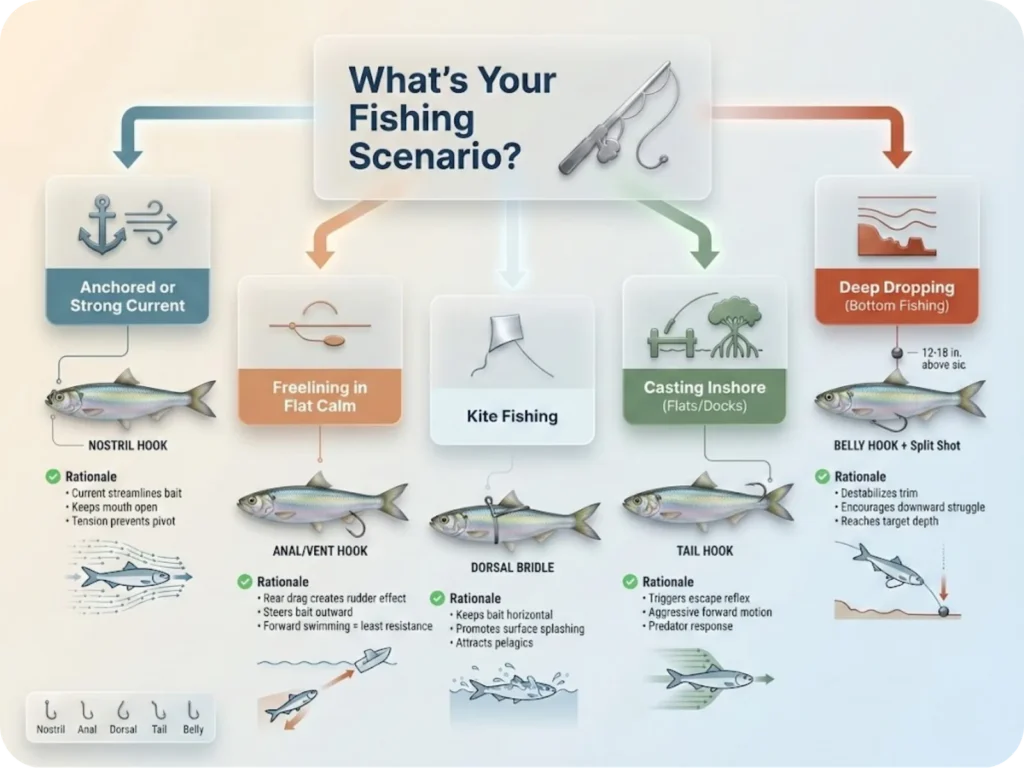
Here’s your quick reference for reading current for optimal bait placement and matching scenarios to hook placement:
Anchored or Strong Current: Use nostril hook. Current streamlines bait and keeps mouth open for oxygen. Tension prevents pivot behavior.
Freelining in Flat Calm: Use anal/vent hook. Rear drag creates rudder effect, steering bait outward. Forward swimming becomes path of least resistance.
Kite Fishing: Use dorsal bridle. Keeps bait horizontal, promotes surface splashing that attracts pelagics.
Casting Inshore (Flats, Docks): Use tail hook. Triggers predator escape reflex with aggressive forward motion.
Deep Dropping (Bottom Fishing): Use belly hook. Destabilizes trim and encourages downward struggle. Alternative: Add split shot 12-18 inches above nose hook.
Conclusion
The “return loop” is a solvable problem. By shifting the tow point from the nose to the dorsal or anal regions, you install a control surface on the baitfish, using drag and tension to steer it into the strike zone instead of back to the hull.
Mechanical manipulation must be balanced against biological imperatives and legal mandates. The modern angler selects a specific hook—an Owner Mutu Light 2/0, for example—applies it to a precise anatomical coordinate (the anal fin of a Blue Runner), and does so within conservation law.
Three outcomes: the bait swims true, the predator is hooked cleanly in the jaw, and the fishery remains sustainable. Master the physics, respect the biology, and your bait will never swim back to the boat again.
FAQ
What’s the best hook placement to stop bait from swimming back to the boat?
Anal or vent hooking is the most effective solution. By placing the hook through the hard area near the anal vent, you create a rudder effect where the drag of the line makes swimming away from the boat the path of least resistance.
Why does nose hooking fail in calm water?
Nose hooking creates a pivot point at the bait’s extreme forward edge. In slack water, the bait can rotate 360 degrees around this pivot, turning tail-first and swimming back. Nose hooking works best in trolling or strong current where constant tension prevents pivoting.
Do I need circle hooks for live bait fishing?
In many regions, it’s legally required. Atlantic Striped Bass fisheries mandate non-offset circle hooks for all natural bait. Beyond legal requirements, circle hooks reduce deep hooking mortality from 48% to approximately 20%, making them the ethical choice.
How do I know if my hook is too heavy for my bait?
If your bait drowns (rolls on its side), spins, or swims head-down unnaturally, the hook is too heavy. Switch to light wire hooks (1X or Light gauge). Match hook weight to bait size, not target species.
What’s the difference between bridling and direct hooking?
Bridling uses a rubber band or floss loop through the bait’s cartilage, with the hook attached to the loop. This leaves the jaw free for respiration, extends bait life, and keeps the hook point fully exposed. Bridling is mandatory for fragile baits like Goggle Eyes and preferred for kite fishing.
Risk Disclaimer: Fishing, boating, and all related outdoor activities involve inherent risks that
can lead to injury. The information provided on Master Fishing Mag is for educational and informational purposes
only. While we strive for accuracy, the information, techniques, and advice on gear and safety are not a substitute
for your own best judgment, local knowledge, and adherence to official regulations. Fishing regulations, including
seasons, size limits, and species restrictions, change frequently and vary by location. Always consult the latest
official regulations from your local fish and wildlife agency before heading out. Proper handling of hooks, knives,
and other sharp equipment is essential for safety. Furthermore, be aware of local fish consumption advisories. By
using this website, you agree that you are solely responsible for your own safety and for complying with all
applicable laws. Any reliance you place on our content is strictly at your own risk. Master Fishing Mag and its
authors will not be held liable for any injury, damage, or loss sustained in connection with the use of the
information herein.
Affiliate Disclosure: We are a participant in the Amazon Services LLC Associates Program, an
affiliate advertising program designed to provide a means for us to earn advertising fees by advertising and linking
to Amazon.com. As an Amazon Associate, we earn from qualifying purchases. We also participate in other affiliate
programs and may receive a commission on products purchased through our links, at no extra cost to you. Additional
terms are found in the terms of service.