

In this article
The fishing rod loads under the heavy weight of a sudden run. The drag screams, and for a moment, the connection is the only thing that matters. But that connection changes the instant the game fish breaks the surface. If the fishhook is buried deep in the oesophagus, bleeding out the gills, the victory feels like a waste.
This is the reality for modern recreational anglers. The line between sport and responsible stewardship is drawn by the fishing gear at the end of your leader. I have spent decades on the water, and I’ve learned that true skill isn’t just about the number of fish caught; it’s about ensuring high survival rates after the release.
Switching to circle hooks isn’t just about following regulatory mandates. It is a smarter fishing technique, designed to balance the thrill of the fight with the need for sustainable fishing practices. By the end of this guide, you will understand how to choose the right circle hook, tie the correct knot, and use the tackle correctly to ensure catch and release success.
Why is the Shift to Circle Hooks a Biological Imperative?
We need to stop looking at hooks regulations as just annoying rules. Instead, let’s look at the fish anatomy and what actually happens during the fight. The goal is simple: stop the hook point from damaging vital organs.
How does hook shape dictate survival rates?
Traditional J-hooks are designed to grab whatever they touch first. When you pull back to execute a hard strike, the barbed hook spikes the first piece of flesh it hits. If a fish swallows the natural bait, that first point of contact is often the throat or stomach.
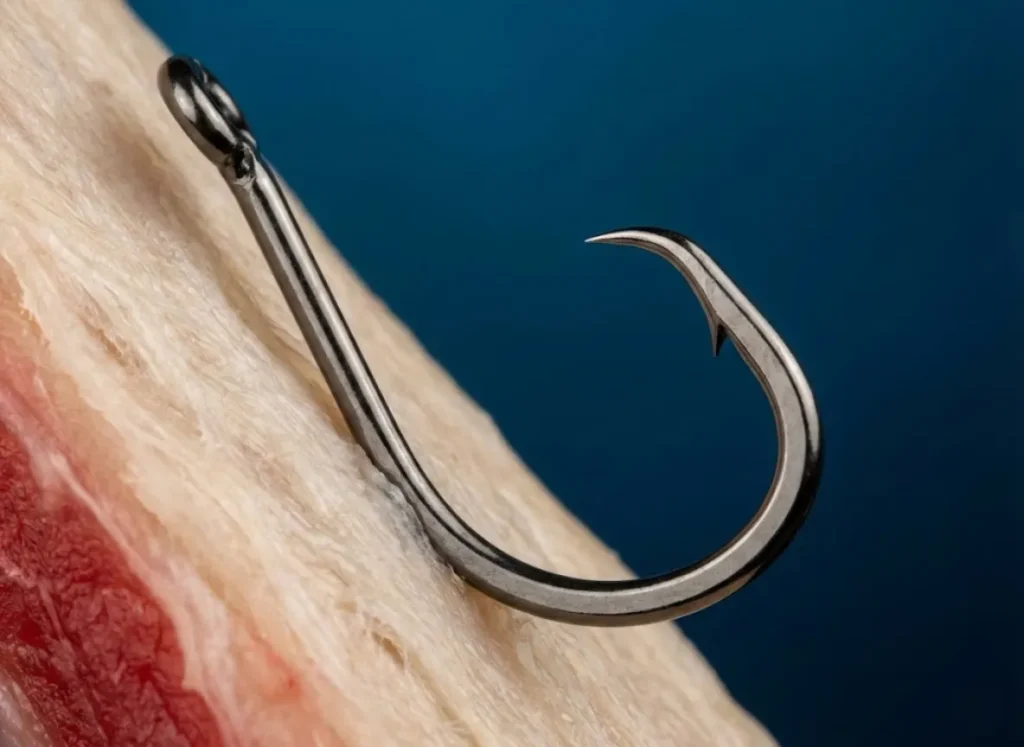
A true circle hook works differently. It functions more like a precise medical tool. It has an inward-facing point that curves back toward the hook shank, which shields soft tissue while the fish swallows the bait. The main goal is to avoid gut-hooking, where a puncture can damage the heart or liver.
The numbers back this up. NOAA Fisheries reports confirm significant mortality reductions, showing that deep-hooking frequency drops by roughly 400% in species like striped bass when anglers use circle hooks.
The design is meant to catch the maxillary, or the corner of the mouth. This area is made of hard bone and tough skin, so there is very little bleeding. Jaw hooking a fish here protects its ability to breathe and keeps blood loss to a minimum. Mastering these catch and release science principles is the first step toward better fishing.
What is the “Inline” requirement and why does it matter?
Not all fishing hooks are the same. An inline circle hook is flat. If you place it on a table, the point and the shank will both touch the surface.
An offset circle hook has the point bent out to the side. This shape creates a snagging hazard that brings back the risk of gut hooking or snagging the stomach wall.
Pro-Tip: Perform the “Flat Table Test” on every pack of hooks you buy. Lay the hook on a smooth surface. If the point rises off the table, it is offset and likely illegal for specific regulated species.
The risk changes drastically with an offset circle. A bend as small as 10 degrees can make the hook act like a J-hook again, catching the throat on the way out. Strict rules, such as those for striped bass, require non-offset circle hooks when using natural baits.
Agencies like the NSW Department of Primary Industries and The Florida Fish and Wildlife Conservation Commission clarify gear rules for snapper, grouper, and other reef fish. They note that following these rules isn’t just about avoiding tickets; it is about making sure the conservation gear works as intended. Before you head out on your next fishing trip, make sure you are understanding state fishing regulations regarding hook definitions.
How Do Circle Hooks Actually Work? (The Physics)
Ideally, the hook slides out of the oesophagus and locks into the corner of the mouth. This isn’t luck; it is a specific mechanical process known as the self-hooking mechanism.
What is the biomechanics of the “Corner-of-the-Mouth” rotation?
The hook relies on a turning force rather than a hard pull. As the fish turns away, the fishing line tension pulls the hook from the throat. The inward bend acts like a skid, sliding harmlessly over the soft skin without snagging.
The important moment happens when the eye of the hook clears the lips. The tension on the line flips the hook shaft, driving the point inward. Research reviewed by Carleton University analyzes hook mechanics and confirms that this pivot physics happens automatically—provided the gap size is large enough.
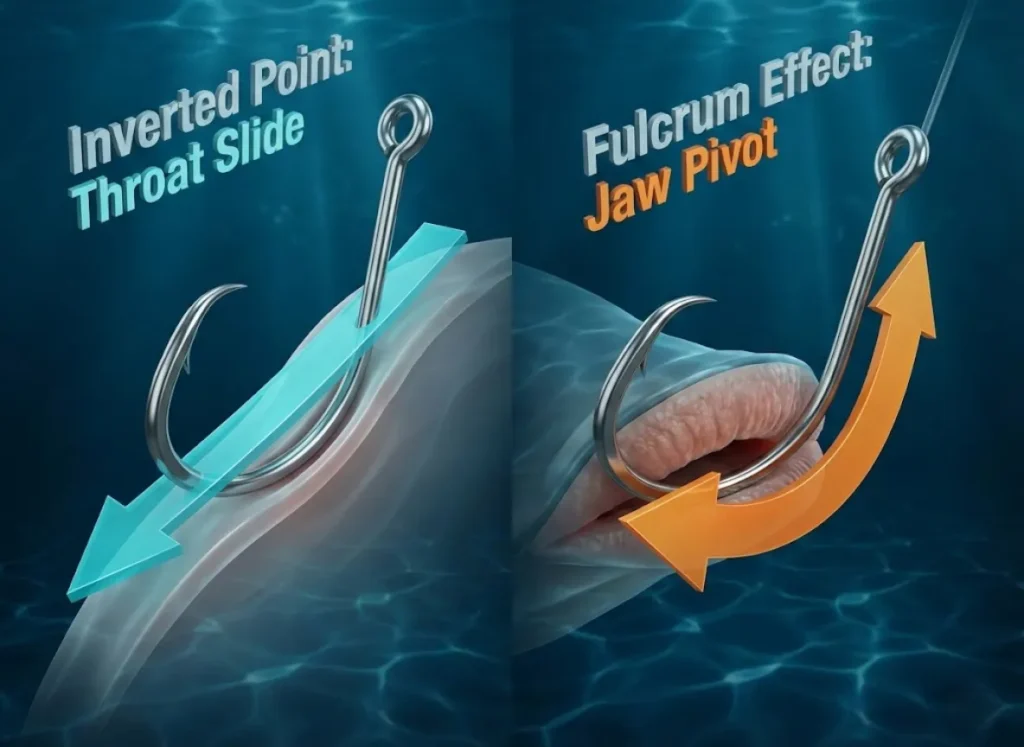
If the “Gap Width” (the space between point and shank) is too narrow for the jawbone, the hook cannot pivot. It will just slide out of the mouth entirely. This explains why circle hooks are great for game fish that turn and run, like tuna or tarpon, but you must get the size right. You can see a detailed breakdown of terminal tackle mechanics to understand how these parts work together.
Why is the Snell Knot critical for performance?
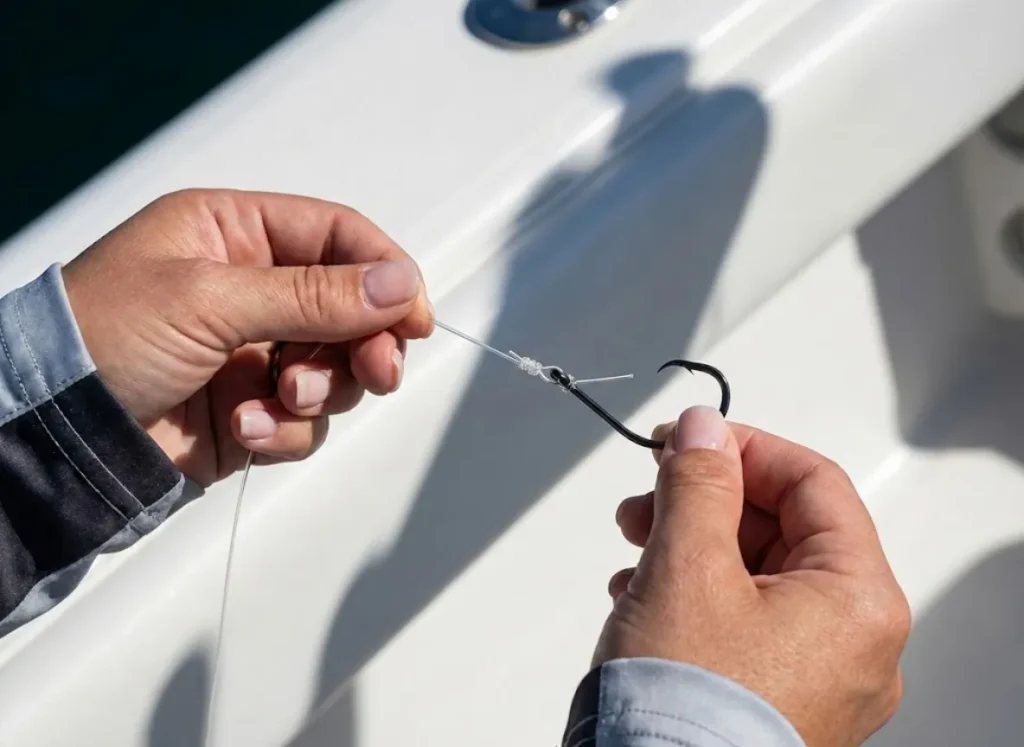
For hooks with a bent eye, the knot you tie changes how the hook moves. The Snell Knot works much better than a standard clinch knot for this.
The leader must enter the eye from the front (the side with the hook point). This creates a lever. When you apply steady pressure, the line forces the hook to pivot toward the fish’s jaw. The South Carolina Department of Natural Resources highlights rigging importance for Red Drum, noting that tying it wrong leads to a poor hookup ratio.
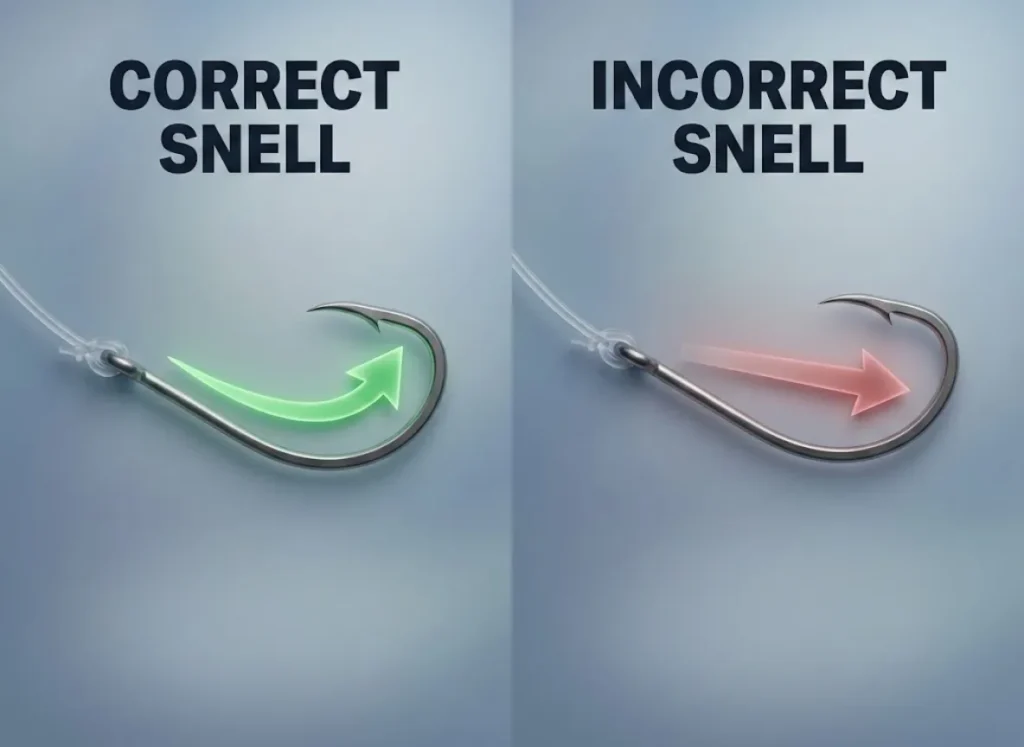
If you tie the knot so the line exits the back of the eye, you can lose 20-25% of your fish. This “back-entry” mistake pulls the hook flat, preventing it from grabbing the jaw. While physics-based knot selection is always important, it is absolutely vital here to maximize hook-up potential.
Which Circle Hook Should You Choose? (Selection & Sizing)
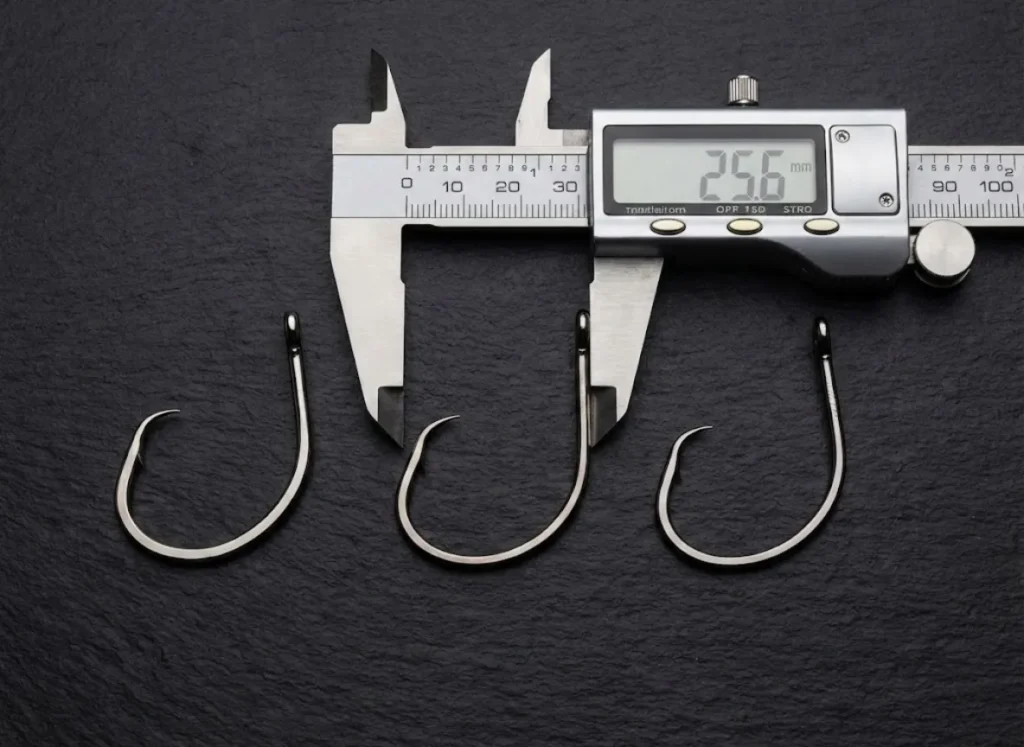
Choosing the right circle hook is tricky because companies don’t use the same sizing standards. A 4/0 Mustad hook might be half the size of a 4/0 from Eagle Claw.
How do you navigate the “Sizing Standardization Void”?
If you only look at the “Trade Size” number on the box, you might accidentally use a hook that is too small. A small hook can be swallowed easily, leading to gut-hooking fish. The only number that matters is “Gap Width”—the actual distance in millimeters between the point and the shank.
Data from the Maine Department of Marine Resources suggests specific species-specific sizing, but the rule applies to all fish. For inshore species like speckled trout or slot limits Redfish, a gap width of roughly 16-18mm is often needed. Larger ocean fish like swordfish require gaps of 22mm or more to fit around their thick jawbones.
Fishing Hook Size Comparison
Comparative Guide by Target Gap Width and Functional Category
Mustad Demon Circle
Size 6/0 features a 12.7 mm gap, ideal for light tackle applications.
Owner & Gamakatsu
Owner Super Mutu 4/0 (13.4 mm) and Gamakatsu Octopus 5/0 are the equivalents.
Mustad 39950NP-BN
8/0 size provides a 16.2 mm gap, suitable for standard coastal species.
Technical Note
Owner 6/0 (13.4 mm) uses heavy wire with a narrower gap relative to its size. Gamakatsu uses 8/0.
Dimensions
Mustad 10/0 (22.4 mm Gap) vs Owner 8/0 (18.8 mm) to 9/0. Gamakatsu uses 10/0.
Best Use
Heavy duty hook sets for powerful pelagic species requiring wider gaps.
Hook Spec
Mustad 12/0 features a wide 26.6 mm gap. Owner 10/0 offers a 21.5 mm gap. Gamakatsu N/A in this class.
Maximum Sizes
Mustad leads this category with 14/0 (34.0 mm) and 16/0 (39.9 mm) gap widths. Owner/Gamakatsu N/A.
Don’t just guess based on the number on the package. Compare the physical hooks from brands like Owner hooks, Gamakatsu, and Mustad circle hooks to ensure you have the right fit. It is worth spending time understanding hook sizing standards to ensure you are buying the right tool.
What are the specific model recommendations for compliance?
Some models are known to be “Inline” compliant, such as the Gamakatsu Inline Octopus Circle (Model 2214) or Mustad Demon Perfect Circle. Be careful with hooks labeled “Mutu Light” or standard “Octopus Circle.” These often have a slight offset unless the package says otherwise.
Checking for the “Tournament” or “Inline” label on the packaging is the safest way to ensure the hook is legal and safe for catch-and-release practices. Also, look at the wire thickness or hook gauge. Use thin wire (1X) for light tackle to ensure the hook penetrates easily.
Heavy-duty circle hooks (3X+) are needed for big game fish, but you need a heavy rod to set them. NOAA explicitly recommends barbless circle hooks to further reduce injury, and understanding the mechanics of barbless hook penetration can help you choose the right gauge.
How Must Your Technique Change to Ensure Success?
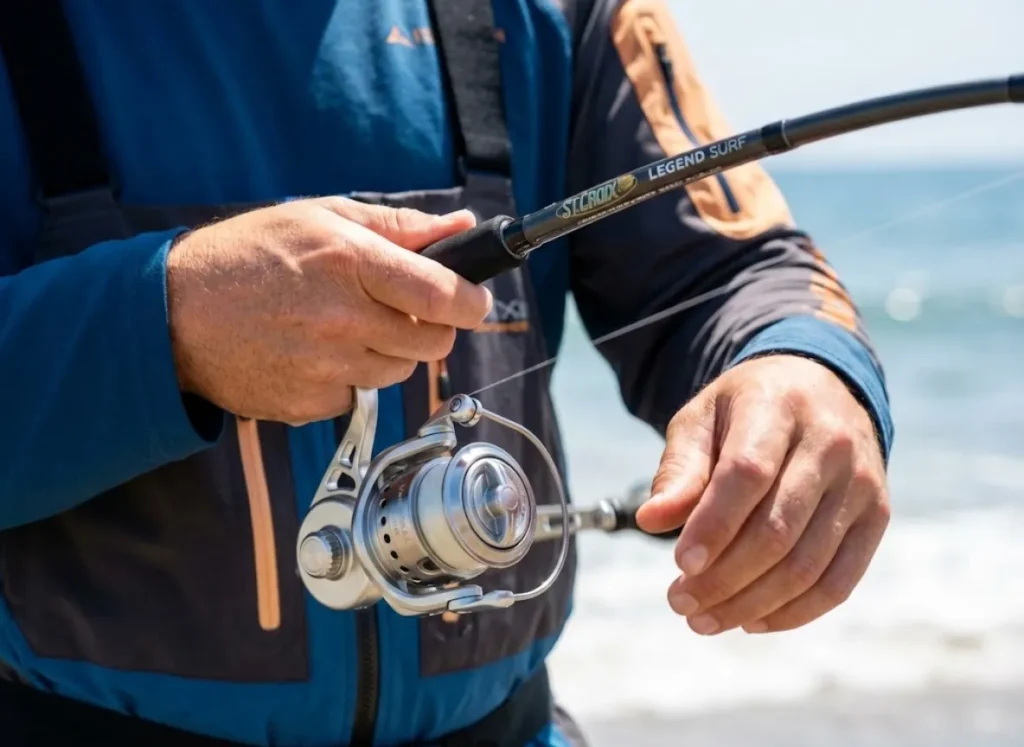
You have the right hook, the right size, and the right knot. Now, you have to change your fishing technique.
Why is “Setting the Hook” the enemy of the circle hook?
The “Jerk” or hard upward strike is a habit many of us learned using j-hooks. But with circle hooks, it causes failure. A fast, hard pull yanks the hook out of the fish’s mouth before it has time to rotate and catch the corner.
The correct technique is passive hook-setting, often called the “Reel Set.” Simply point the rod tip at the fish and reel steadily until the fishing line gets tight and the rod bends. Massachusetts Division of Marine Fisheries guidelines emphasize steady pressure instead of violent strikes.
This steady reel technique uses the water drag and the fish’s movement to turn the hook. Once the rod is fully bent, a slow, firm lift is all you need. Patience is the main skill here. Striking too early just pulls the live bait away. Review the mechanics of the hookset to visualize the difference between reeling vs jerking.
How do you handle deep hooking or removal if it happens?
If a fish swallows the hook, do not try to tear it out. This often causes fatal bleeding. FWC research on catch-and-release mortality highlights that cutting the leader close to the mouth gives the fish the best chance of survival. Studies show many fish can shed the hook or survive with it over time.
Pro-Tip: If you are fishing specifically for catch-and-release, crush the barb on your circle hook. This makes removal instantaneous if the hook is in the jaw, and causes less damage if the hook ends up deep.
Use long-handled hook removal tools to keep the fish in the water while you work. Using specialized dehooking tools allows you to unhook a fish without touching it, which protects its slime coat and ensures a healthy release.
Conclusion
Switching to circle hooks completes the cycle of responsibility for the responsible angler. It links the fun of the catch to the future of the fishery. We’ve looked at the biology behind the design, why you must use inline circle hooks, the importance of gap size, and how to change your technique shift.
Open your tackle box today. Do the flat table test on your hooks. Bend back any offset circle hooks or replace them with barbless hooks, and get your gear ready for a season of safer releases.
FAQ – Frequently Asked Questions
Do circle hooks result in fewer fish caught compared to J-hooks?
No. For many species like tuna, sailfish, and marlin, circle hooks actually catch more fish because they lock securely in the corner of the jaw. Missed fish are usually caused by the angler striking too hard, not the hook failing.
Can I use circle hooks with artificial lures?
Yes, but they work best with natural bait. Circle hooks work best when the fish has a chance to fully swallow the bait and turn. For lures, single inline hooks are often better than treble hooks, but the mechanics are slightly different.
What is the difference between an Inline and an Offset circle hook?
An Inline hook is flat. The point lines up perfectly with the shank. An Offset hook has the point bent to the side. Inline circle hooks are safer for the fish and required by law in many places.
Should I use a Snell knot or a Loop knot for circle hooks?
Use a Snell knot for hooks with a bent eye to help the hook turn. Use a Non-Slip Loop Knot or crimp for ringed circle hooks so the bait can move naturally.
Risk Disclaimer: Fishing, boating, and all related outdoor activities involve inherent risks that
can lead to injury. The information provided on Master Fishing Mag is for educational and informational purposes
only. While we strive for accuracy, the information, techniques, and advice on gear and safety are not a substitute
for your own best judgment, local knowledge, and adherence to official regulations. Fishing regulations, including
seasons, size limits, and species restrictions, change frequently and vary by location. Always consult the latest
official regulations from your local fish and wildlife agency before heading out. Proper handling of hooks, knives,
and other sharp equipment is essential for safety. Furthermore, be aware of local fish consumption advisories. By
using this website, you agree that you are solely responsible for your own safety and for complying with all
applicable laws. Any reliance you place on our content is strictly at your own risk. Master Fishing Mag and its
authors will not be held liable for any injury, damage, or loss sustained in connection with the use of the
information herein.
Affiliate Disclosure: We are a participant in the Amazon Services LLC Associates Program, an
affiliate advertising program designed to provide a means for us to earn advertising fees by advertising and linking
to Amazon.com. As an Amazon Associate, we earn from qualifying purchases. We also participate in other affiliate
programs and may receive a commission on products purchased through our links, at no extra cost to you. Additional
terms are found in the terms of service.