
In this article
I watched a bass kick off strong — tail driving, perfectly upright, disappearing into the green. Textbook release. Thirty minutes later it was belly-up against the bank, fins barely moving. The fish had already been done for before it left the net. I just didn’t know it yet.
That’s the thing about post-release mortality in warm water. The damage is done between the strike and the moment you open your hands. By the time the fish swims away, the verdict is already in.
After two decades on these waters — guiding, competing, watching fish go down from mistakes I used to make myself — I can tell you exactly where that verdict gets written. It’s not random. It’s physics and biology running their course. Here’s how to read them before it’s too late.
| Fish Thermal Thresholds and Mortality Risk | ||
|---|---|---|
| Species Group | Critical Thermal Threshold | Mortality Risk |
| Coldwater (Trout/Char) | 68°F (20°C) | >20% above 70°F |
| Coolwater (Musky/Pike) | 80°F (26.7°C) | 33.3% on James River (VA DWR) |
| Warmwater (Bass/Sunfish) | 85°F+ (29.4°C+) | PRM increases sharply with air exposure |
| Striped Bass (Fresh) | 70°F (21°C) | Up to 67% at 88°F in zero-salinity water |
| Striped Bass (Salt) | 75°F+ (24°C+) | 9% baseline PRM; swimming impaired above 75°F |
⚡ Quick Answer: Warm water fish release failures come down to four problems: starting above the species’ critical thermal threshold, fighting the fish too long on light tackle, holding it in the air, and reviving it backward. Check water temperature before you rig up. Use gear heavy enough to land the fish in under a minute. Keep it horizontal and submerged. When reviving, face it into current or move it forward in a slow figure-eight — never back and forth. The fish tells you when it’s ready. Wait for it.
The Physics of a Warm Summer Lake (Why Heat Is Already Winning Before You Cast)
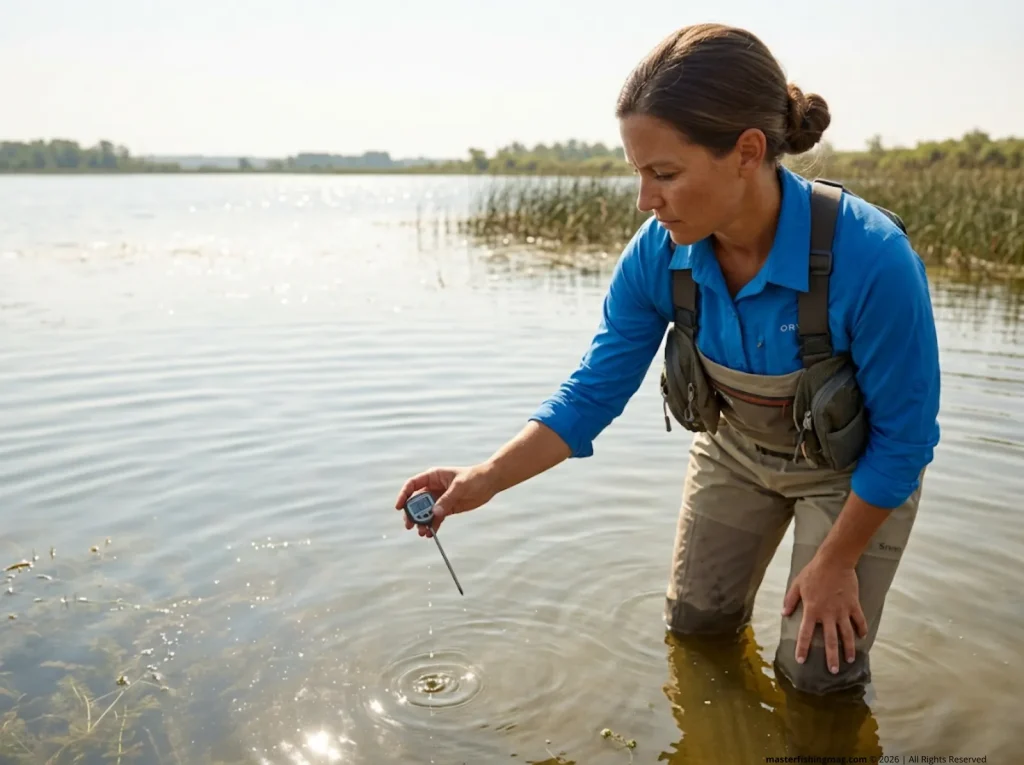
The water is already working against you on a July afternoon. Pull out a thermometer — not the screen on your fishfinder, which reads depth-specific temp from the transducer — and measure the surface. At 25°C (77°F), that water holds only 8.24 mg/L of dissolved oxygen. Drop in a trout that needs a minimum of 6–7 mg/L just to breathe at rest, then make it sprint for three minutes on the end of your line, and the math stops working in its favor.
The core problem is simple: hot water holds less oxygen. The hotter it gets, the faster heat energy breaks the bonds holding oxygen in solution and drives it into the air. A 15-degree summer climb costs the water roughly 25% of its oxygen-carrying capacity. Those dissolved oxygen levels that govern fish behavior are not a technicality — they set the ceiling for how much stress a fish can absorb and still recover.
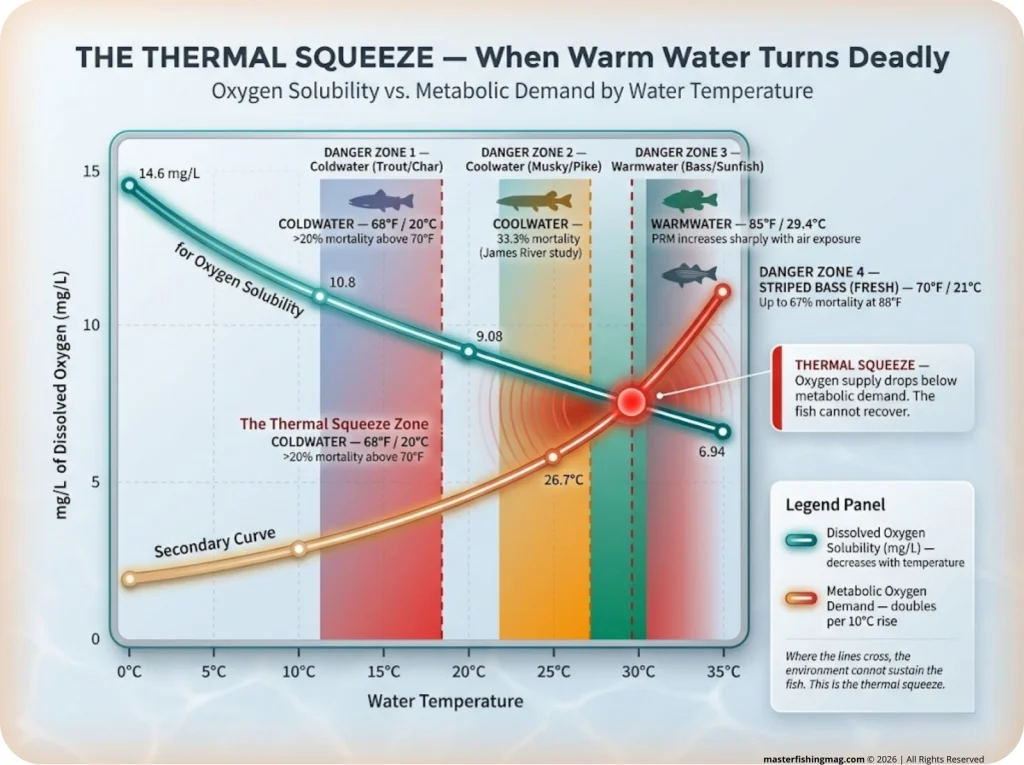
The cruelty of the situation is that exactly when the water has the least oxygen, the fish needs the most of it. For most freshwater fish, metabolic oxygen demand roughly doubles for every 10°C rise in temperature. A trout at 25°C is burning through oxygen twice as fast as it would at 15°C — in water that’s offering 10% less of it. That’s the thermal-hypoxic squeeze, and it’s why how water temperature controls every metabolic function in a fish matters before the first cast, not after the release.
In my experience, anglers arrive at the water with a scale, a tape, and a net. No thermometer. That single omission accounts for more fish going down in July than bad release technique ever will.
Pro tip: Use an inexpensive digital stream thermometer — not the fishfinder’s displayed temp — to get a true surface reading before you rig up. If the number is near or above your target species’ threshold, that data changes every decision you make that morning.
Henry’s Law — The Formula That Decides If Your Release Survives
The numbers are worth knowing even if formulas aren’t your thing. At 20°C your water holds 9.08 mg/L of oxygen. At 30°C, that drops to 7.54 mg/L. At 35°C, 6.94 mg/L. This isn’t a trend — it’s a hard ceiling set by chemistry. The hotter the water, the less oxygen the system can hold, period. According to EPA laboratory investigations on temperature thresholds for aquatic life, those numbers hold regardless of what the fish needs.
The Metabolic Debt Trap
The metabolic scope of a fish — the gap between its resting oxygen burn and its maximum — collapses in warm water. When that scope shrinks to zero, the fish has no energy budget left for recovery. A fish that swims away strong after a long fight in warm water has not recovered. It has borrowed time against an oxygen debt it may not be able to repay.
Reading Your Thermometer — The Go/No-Go Decision by Species
Trout and char: no-go above 68°F. Ethically indefensible above 70°F, where documented mortality exceeds 20% regardless of how careful your technique is. Musky and pike: 80°F is the cutoff — the Virginia DWR James River study found 33.3% catch-and-release mortality above that point. Bass and sunfish have more buffer, but PRM increases sharply above 85°F when you add air exposure. Freshwater striped bass are the outlier: up to 67% post-release mortality documented at 88°F in zero-salinity water.
Pro tip: When water temps hit the threshold, shift targets or shift time. Dawn and dusk mean cooler surface temps. Find the tailwater. Fish the riffles. There is always a thermal refuge if you’re willing to move your feet.
The Fight Is the First Threat — How Anaerobic Exercise Becomes a Fatal Trap
Most anglers watch a fish swim away and feel relief. The fight is over. What they don’t see is the chemical wreckage inside that fish — blood acidified by lactic acid buildup, muscle tissue struggling to shed the debt, a heart working against chemistry that’s turned hostile. The fight doesn’t end when the fish leaves your hands. For a stressed fish in warm water, it may never end.
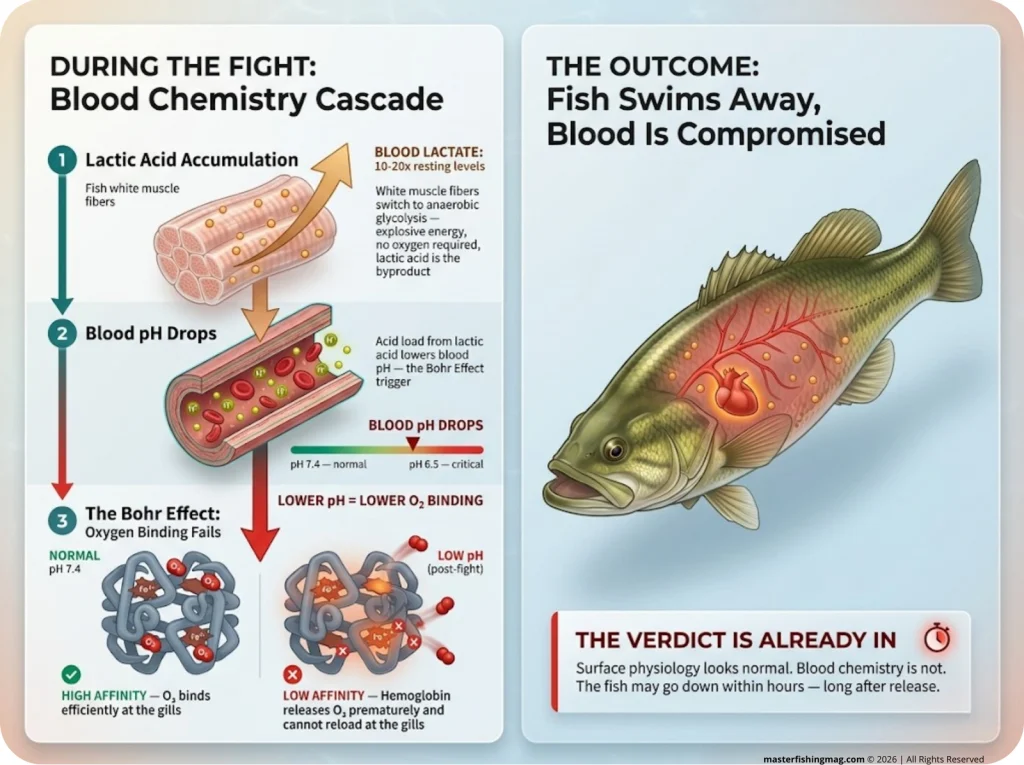
When a hooked fish goes into its burst run, it switches entirely to white muscle fibers running on anaerobic glycolysis — explosive energy with no oxygen required, at the cost of lactic acid accumulating in the tissue. Peak blood lactate concentrations after a prolonged fight can reach 10–20 times resting levels. That acid load drops blood pH, and here’s where most write-ups stop explaining. What actually puts the fish down is the Bohr Effect: as blood pH drops, hemoglobin’s binding affinity for oxygen decreases. The fish surfaces. Its gills are working. Water is flowing. But the blood is chemically impaired from picking up oxygen at all. That’s why a fish can show strong opercular movement and still go down within hours. Surface physiology looks normal. Blood chemistry is not.
Research connecting post-release mortality to physiological stress responses documents this cascade in detail. It’s the same mechanism in sharks — where blacktip shark shore-based fight duration mortality runs 45.5% — as in your summer bass. The fight time is what loads the gun. The cortisol clock that starts ticking the moment a fish is hooked runs parallel to the lactate curve, compounding the damage.
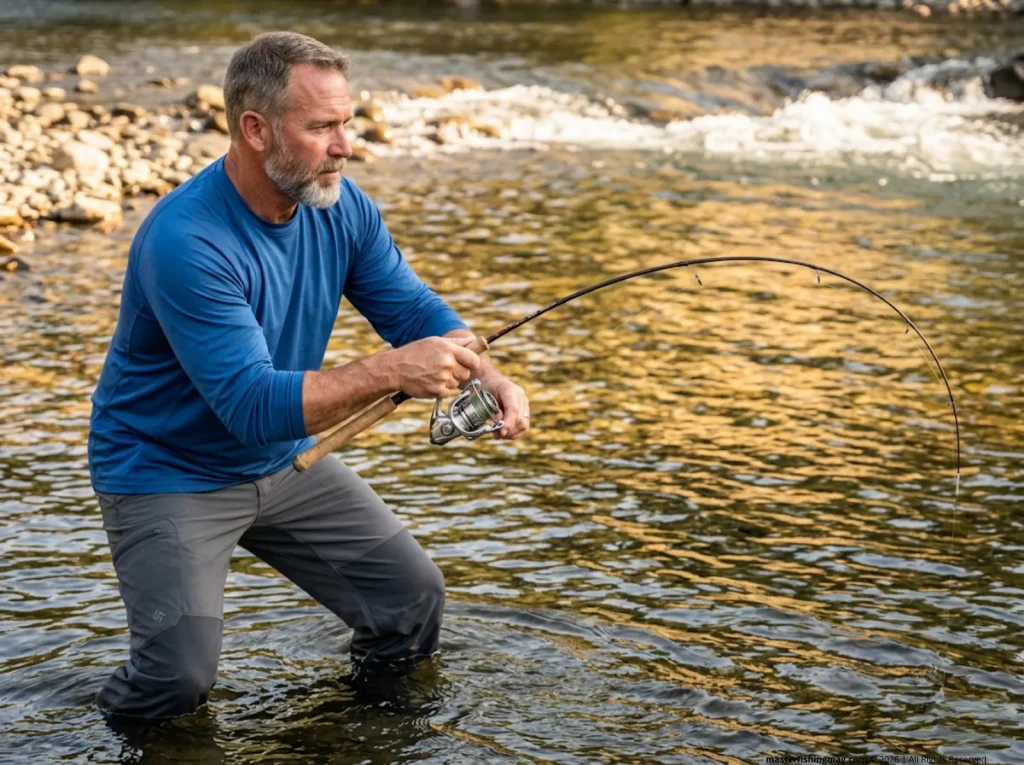
The fix is simple and most anglers resist it: gear up in warm water, not down. A fish landed in 60 seconds on 10 lb test has dramatically better survival odds than one fought for 10 minutes on 2 lb test. Minimize fight time — it’s the single most controllable variable you have. Circle hooks reduce hooking depth and eliminate many of the worst jaw placement scenarios. Barbless hooks cut dehooking handling time by 50% or more, often letting you release without ever taking the fish out of the water. Use landing fish quickly using proper rod angle and side pressure as your tactical baseline whenever temps are elevated.
Pro tip: If a fish needs more than 45 seconds of revival in warm water, it has a significant oxygen debt. Keep it submerged. Wait. Don’t let go until it swims away with force on its own — not when you decide to open your hand.
Anaerobic Glycolysis — The Burst Mode That Burns Out Fast
White muscle equals burst energy with no oxygen required, but lactic acid is the price. Recovery from a full lactate load takes 4–8 hours in cool water. In warm, oxygen-depleted water, that recovery may never happen. Delayed mortality is not random. It is the predictable outcome of a lactate load the environment cannot help clear.
The Bohr Effect — Why the Fish Can’t Breathe Even When You’re Reviving It
At lower blood pH, hemoglobin releases oxygen to tissues more readily but binds it less efficiently at the gills. Net result: water passes through the gills, the equipment is running, but the blood isn’t loading oxygen properly. This is why metabolic recovery time after a warm-water fight must be measured in minutes, not seconds.
Tackle as a Conservation Tool — Matching Gear to Temperature, Not to “Fun”
Even 60 extra seconds of fight time at 80°F may push blood lactate past the recovery point for trout and striped bass. Ultralight fishing for species near their trout thermal limit in summer is not a technique preference — it is documented mortality.
Air Exposure and Gill Collapse — The 10-Second Rule Explained by Physics
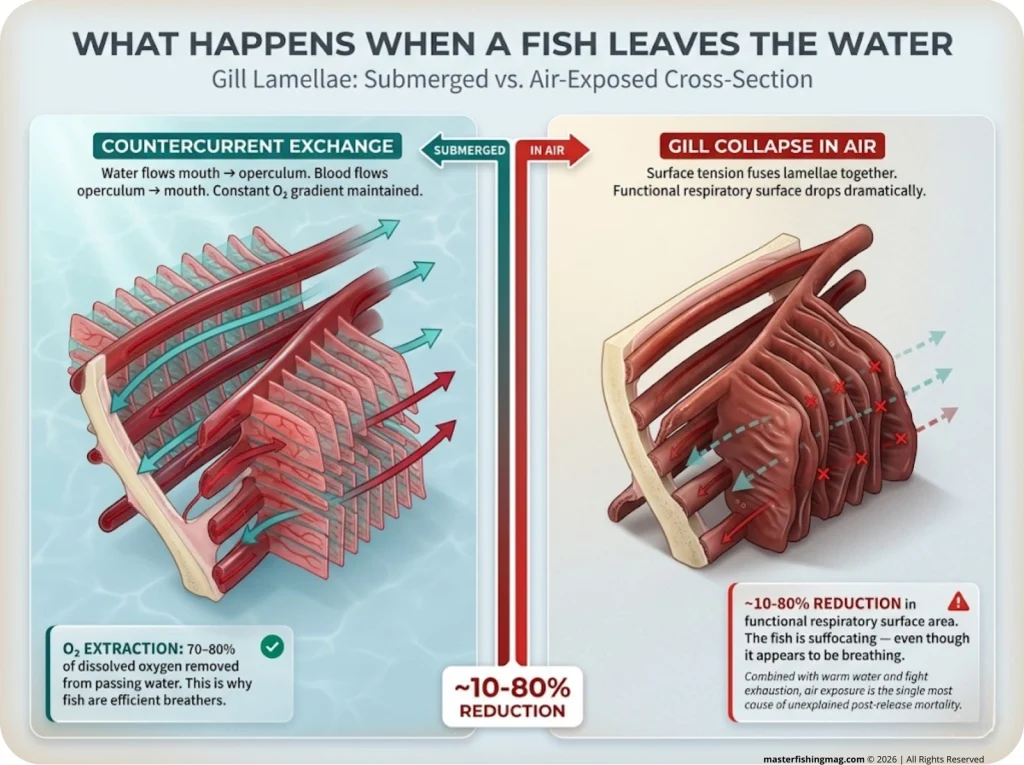
Here’s what happens the moment a fish breaks the surface. In water, buoyancy holds the gill lamellae open — those thin, permeable plates packed with capillaries that extract oxygen from passing water. In air, surface tension causes adjacent lamellae to fuse and collapse like wet paper. Functional respiratory surface area drops to a fraction of its submerged capacity. The fish is not gasping for breath; it is suffocating while simultaneously dealing with an anaerobic oxygen debt from the fight.
The data from interactive effects of air exposure duration and water temperature on fish survival (Gingerich et al. 2007) is precise: at 27.4°C (81°F), delayed mortality in bluegill reached 80% under the longest air exposure time durations tested. In cool water, that same species survived extended exposure with minimal mortality. Heat and air exposure together aren’t additive — they multiply each other. This combination is the single most common cause of unexplained post-release loss.
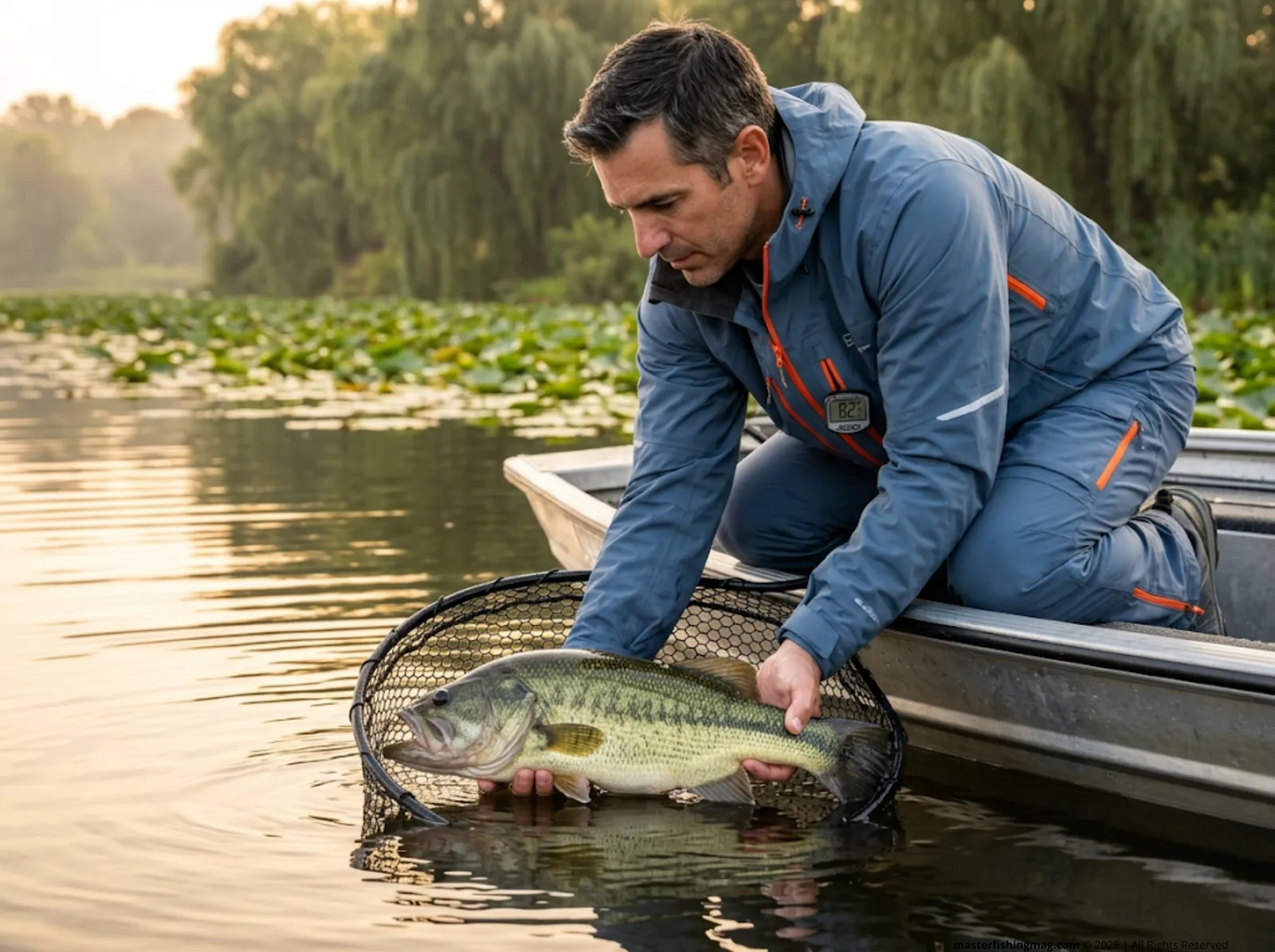
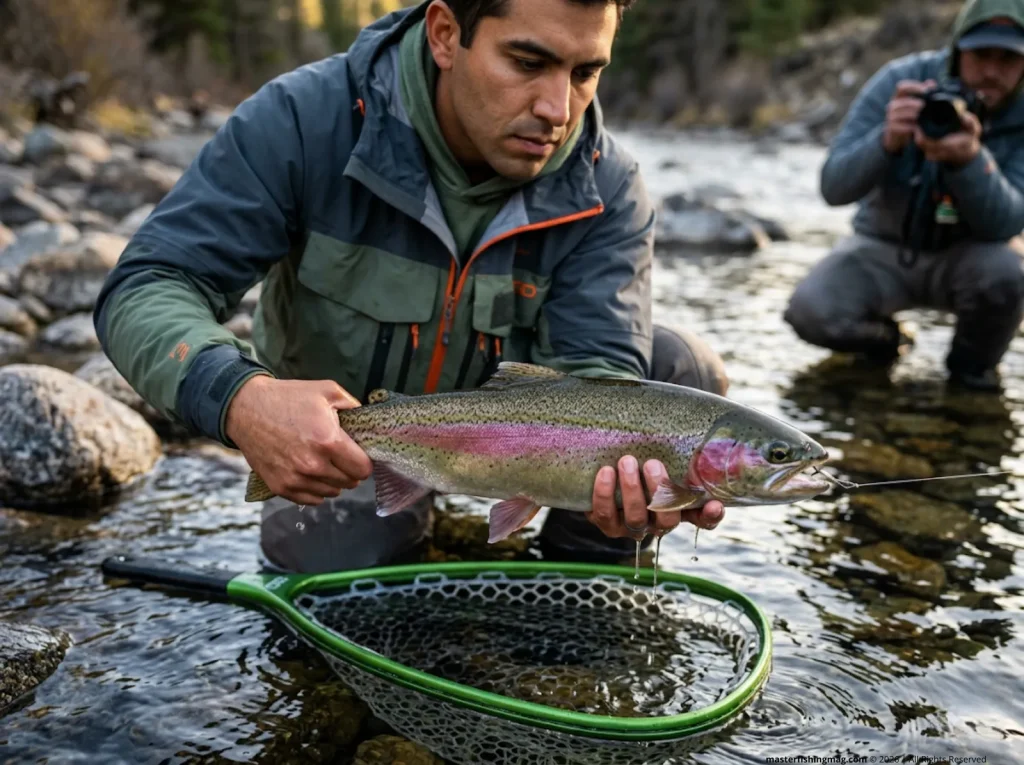
The keep ’em wet protocol isn’t a suggestion. A fish should never fully leave the water. If a photo is unavoidable, compose the shot before the fish comes out of the water, camera in hand and ready — then follow the 3-2-1 photo protocol that keeps your fish in the water. Water dripping from the fins when the shutter clicks means you’re within tolerance. Hold your own breath when the fish comes out. When you need to breathe, so does it.
The Lamellae Collapse — What Your Fish Is Actually Suffocating From
Think of the gill lamellae as a set of lungs that only work when submerged. In air, those surfaces fuse. A large fish doesn’t have more resilience than a small one — in many cases, its greater body mass and longer frame make internal organ displacement worse when it’s lifted out of the water.
The Gravity Problem — Vertical Holds, Lip Grippers, and Internal Organ Displacement
In water, a fish’s organs are buoyant, suspended by delicate mesenteries. Out of water, gravity pulls everything toward the tail. In a 10-pound bass held vertically, that force can tear mesenteries and bruise the liver and heart. Peer-reviewed research showed 100% of bonefish held vertically by a lip gripper sustained jaw injuries — mandible splitting, tongue detachment from the floor of the mouth. Barramundi X-rays showed permanent vertebral separation from the same technique. Largemouth bass handled with mechanical lip grippers showed significantly longer recovery times than those handled with a two-handed horizontal cradle.
Check the survival matrix for holding fish correctly by species and size before you pick up anything over 5 pounds. The rule is simple: support the belly as one continuous angle from jaw to tail. If the pectoral fins hang straight down under gravity, you’re holding it wrong.
The Slime Coat — Surface Chemistry Your Hands Are Destroying
The mucus layer on a fish is not slippery residue — it’s a bioactive barrier containing antibodies and antimicrobial peptides that hold infection off. Fluorescein dye research makes the damage visible: dry hands, knotted nylon nets, and boat carpet all cause immediate large-scale epithelial abrasion. The science behind this matters — read the biochemistry of fish slime coat and why it decides infection risk before dismissing it as angler folklore.
Nylon knotted nets strip slime and split fin rays. Knotless rubber or molded silicone mesh causes minimal damage. Boat carpet (common on bass boats) causes more damage than bare metal due to absorbency and friction. Use rubber or silicone mesh. Wet your hands before any contact, every time. In cool water, slime damage alone is rarely fatal. In warm water, it becomes a cascade multiplier — the fish enters the water already immunocompromised, with osmoregulation impaired. The secondary bacterial infection arrives at hour six, when the angler is long gone.
The Revival Myth — Why “Pumping” the Fish Is Actually Working Against It
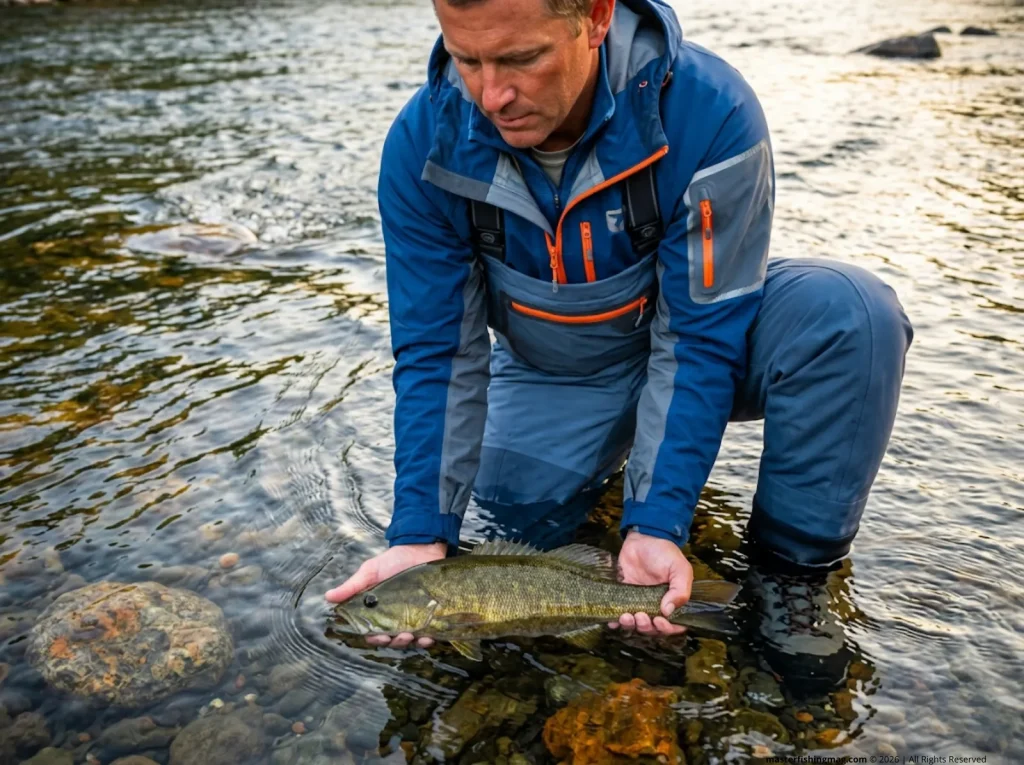
Every angler has done it. Fish is tired, hold it by the tail in the water, move it back and forth, back and forth. Feels productive. It isn’t. It’s actively impeding oxygen uptake, and the mechanism is basic fluid dynamics.
Fish gills use a countercurrent exchange system. Water flows in one direction — mouth to operculum. Blood in the capillaries runs the opposite direction. This arrangement keeps a constant oxygen concentration gradient across every lamella, which is why fish can extract 70–80% of available dissolved oxygen from passing water. Flip the flow — move the fish backward — and you create concurrent flow: blood and water heading the same direction. The gradient collapses. Oxygen extraction drops to approximately 25–30%. You are not reviving the fish; you are starving it of the oxygen it needs to recover.
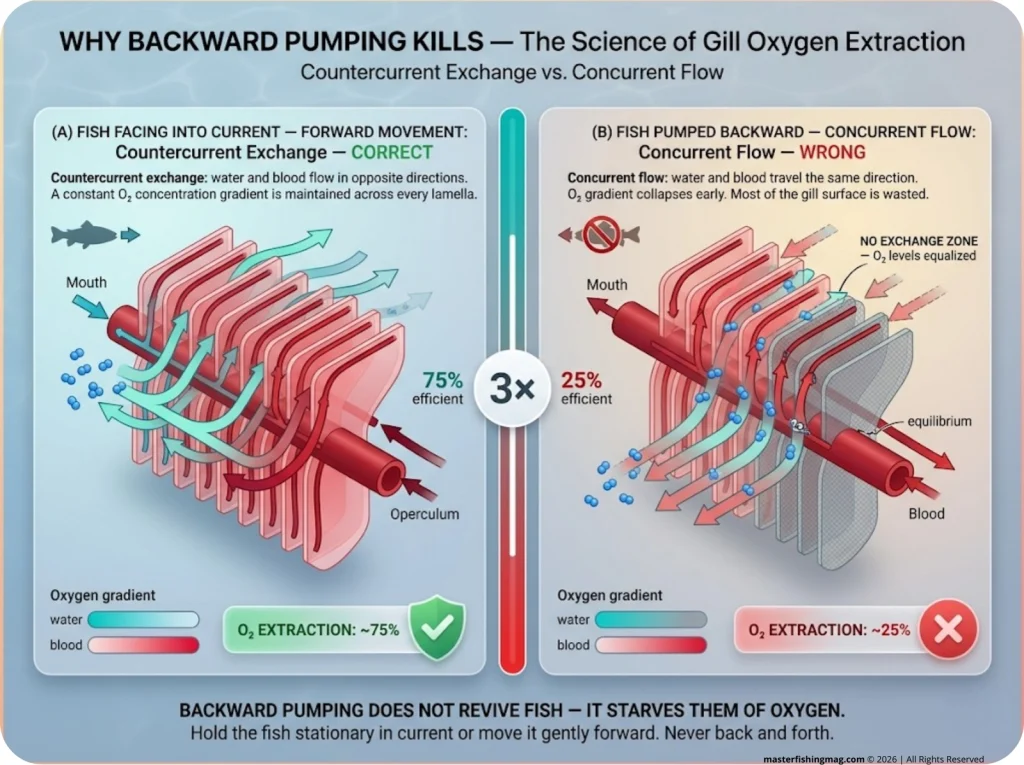
NOAA Fisheries catch-and-release best practices document the correct orientation. The right methods are RAM ventilation — hold the fish stationary or move it gently forward, letting water flow passively mouth to operculum — or the figure-eight motion in still water. In lakes or ponds with no current, gently swim the fish in a wide arc, always moving forward, never reversing. In rivers, find a velocity seam where current is fast enough to drive laminar flow through the gills but slow enough that the fish doesn’t have to fight the current. Hold it stationary and let the river do the work.
For the science-based catch-and-release protocol that covers revival from fight to release, the decision rule at the end of revival is this: strong, rhythmic opercular movement AND a forceful, purposeful kick away. Not a drift. Not a list to one side. If the fish lists, support it and wait.
Pro tip: I’ve held fish in recovery for 8–10 minutes in high summer. Anglers 20 feet down the bank let go at 2 minutes. The mortality rate on those fish is not zero. The fish tells you when it’s ready — wait for it to tell you.
Countercurrent Exchange — The Biological Engineering Behind Every Breath a Fish Takes
Forward water movement extracts 70–80% of available oxygen. The back-and-forth revival myth in action: concurrent movement drops this to 25–30%. A fish you pump backward for 60 seconds is extracting one-third the oxygen of a fish held stationary in moderate current. This is not a style preference — it is static hold vs pumping played out at the cellular level.
RAM Ventilation and the Figure-Eight — The Only Correct Options
RAM ventilation: forward motion, passive water flow, no buccal pumping required. Ideal for larger exhausted fish where the buccal muscles are compromised. Figure-eight in still water: always moving forward, wide arc, no stalling. In riffled areas with boulder substrate — high roughness, high turbulence, high dissolved oxygen — even a stationary hold in the current seam works. The riffles are doing the work.
When Revival Fails — Recognizing the Point of No Return
Signs that recovery will not happen: eyes rolled, no tail response to gentle release, opercula absent or very shallow, fish sinks nose-down. A fish that cannot be revived is better harvested than released to go down in the shallows where it becomes bait for herons. Know your regulations. In warm, shallow water, post-release predation risk is high for any impaired release. A lethargic, thermally stressed fish draws predators within minutes.
The Tool Audit — What the Research Says About Your Net, Hooks, and Gripper
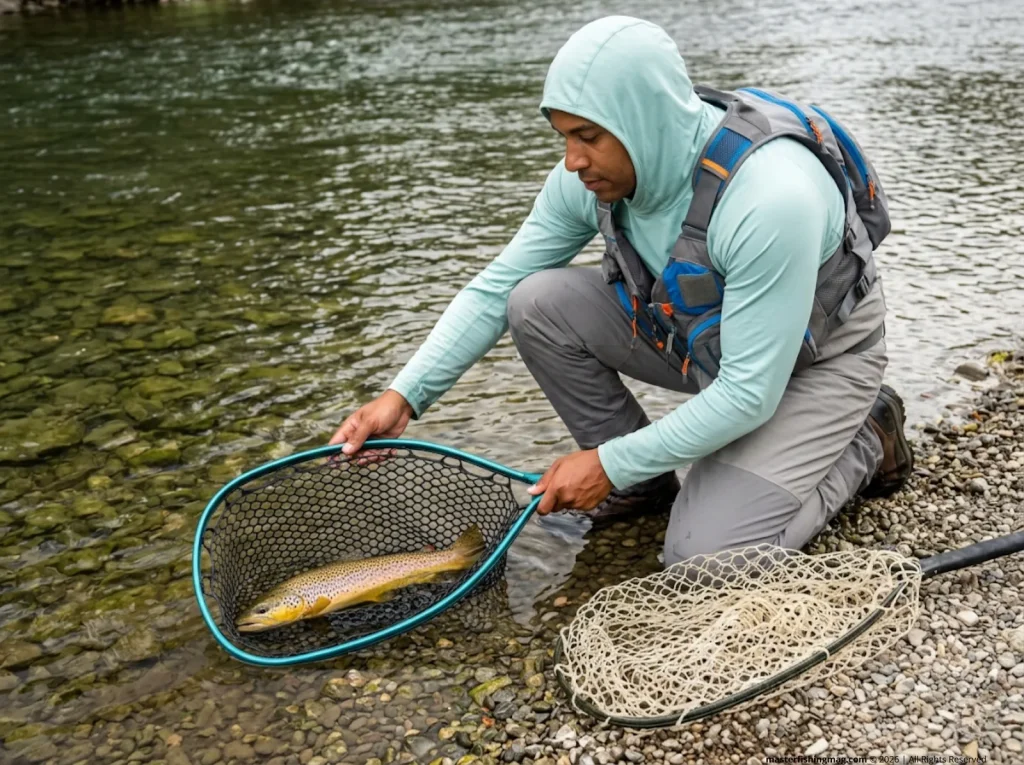
The gear market is full of products claiming to protect fish. The biology has a different audit result.
Knotted nylon nets: reject. Friction knot points strip mucus and split fin rays under fluorescein dye observation. Replace with molded clear silicone or knotless rubber mesh — EGO and Frabill offer solid options in the $50–$150 range. That upgrade from a $12 knotted net to a $65 rubber mesh model is the single highest-impact conservation purchase you can make. The net selection guide that ranks mesh materials by slime coat damage has the full comparison.
Metal lip grippers for vertical lifting: reject outright. Danylchuk et al. peer-reviewed research on lip gripper jaw injuries in bonefish is unambiguous — 100% jaw injury rate. Vertebral separation documented in barramundi. Significantly longer recovery times in bass. A lip gripper used to suspend a fish in the air is a jaw-fracture tool.
Circle hooks: science-backed default for most catch-and-release species. Corner-of-mouth hooking dramatically reduces gut-hook incidence. Learn why circle hooks change the hooking mortality equation before dismissing them as inconvenient.
Barbless hooks: the penetration physics that make barbless hooks a conservation tool, not a compromise is the argument for skeptics. In field experience across hundreds of catches, a properly set barbless hook holds as well as a barbed one. The difference in handling time is real — often the fish releases without ever coming out of the water.
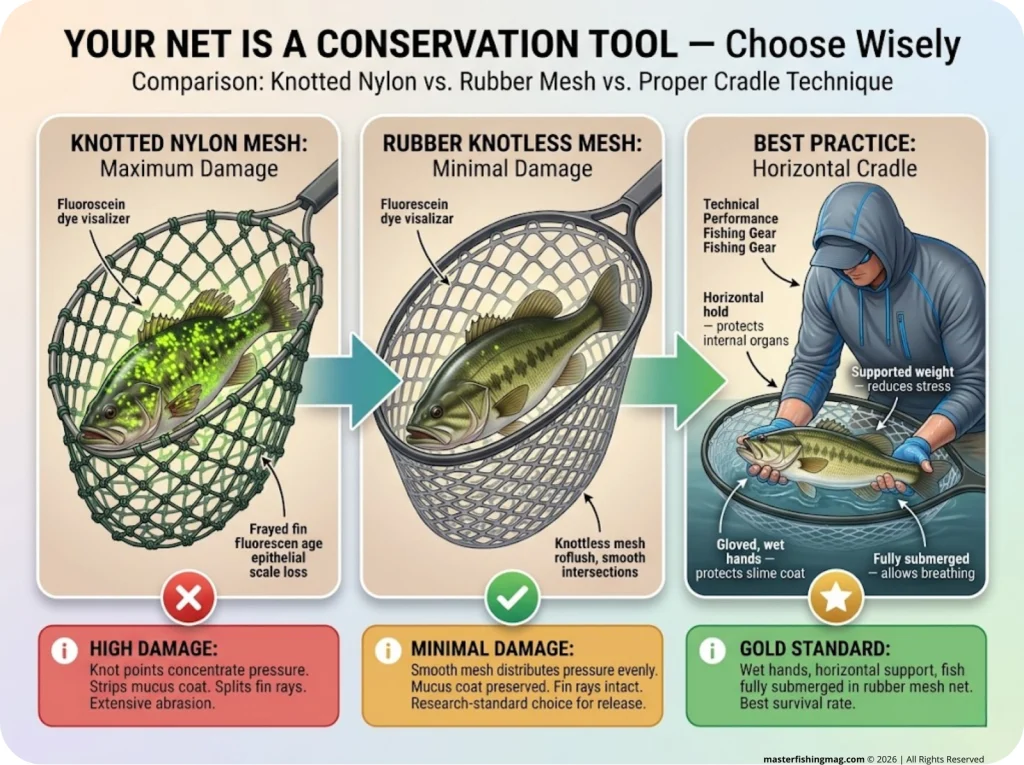
The Net Decision — Silicone vs. Rubber vs. Nylon (With Data)
Fluorescein dye studies map epithelial damage precisely. Nylon knotting creates consistent high-pressure abrasion at contact points along the lateral line. Boat carpet causes more slime loss than bare metal due to absorbency and friction. In northern pike research, rubber mesh caused the least skin and fin damage of all materials tested. Buy a net hoop one size larger than you think you need — a hoop too small forces the fish to fold, increasing tail and dorsal damage.
Dehooking Without Damage — Tools, Timing, and the Cut-Line Protocol
Standard pliers work for corner-of-mouth barbless hooks. Dedicated T-bar or rotating dehookers let you eject the hook without gripping the fish — the right tool for toothy species and deep placements. Use the dehooking tool comparison tested for one-handed use and fish safety to choose your tool before you need it.
The gut-hook rule is non-negotiable: do not attempt to remove a deeply swallowed hook. Cut the line as close to the eye as possible. Research is consistent that cutting leads to significantly higher survival than prolonged removal attempts. The hooking location data that decides whether to fight the hook or cut the line has the survival rates by hook position. A gill-hook with arterial involvement means harvest if regulations allow.
Barotrauma in Deep-Water Releases — Boyle’s Law and the Descending Device
When you pull a fish from 60+ feet, external pressure drops and swim bladder gas expands — sometimes catastrophically. Stomach eversion (stomach pushed out the mouth), exophthalmia (bulging eyes), inability to dive back down — these are barotrauma in action. The old venting/fizzing method is outdated and high-risk; a misplaced needle can puncture the heart, liver, or gonads.
The modern standard is a descending device. The SeaQualizer uses a pressure-activated jaw clamp that releases the fish at a preset depth. Standard rule: return to at least 50% of catch depth. Check the complete barotrauma survival guide from physics to descending device selection for the depth math, then use the 2026 descending device comparison rated for one-handed operation to choose your model. In summer, deep-structure fish face a double threat: barotrauma from the ascent plus thermal stress at the surface. The descending device resolves both — it recompresses the fish and returns it to its thermal refuge.
Species-Specific Protocols — Where the Blanket Rules Break Down
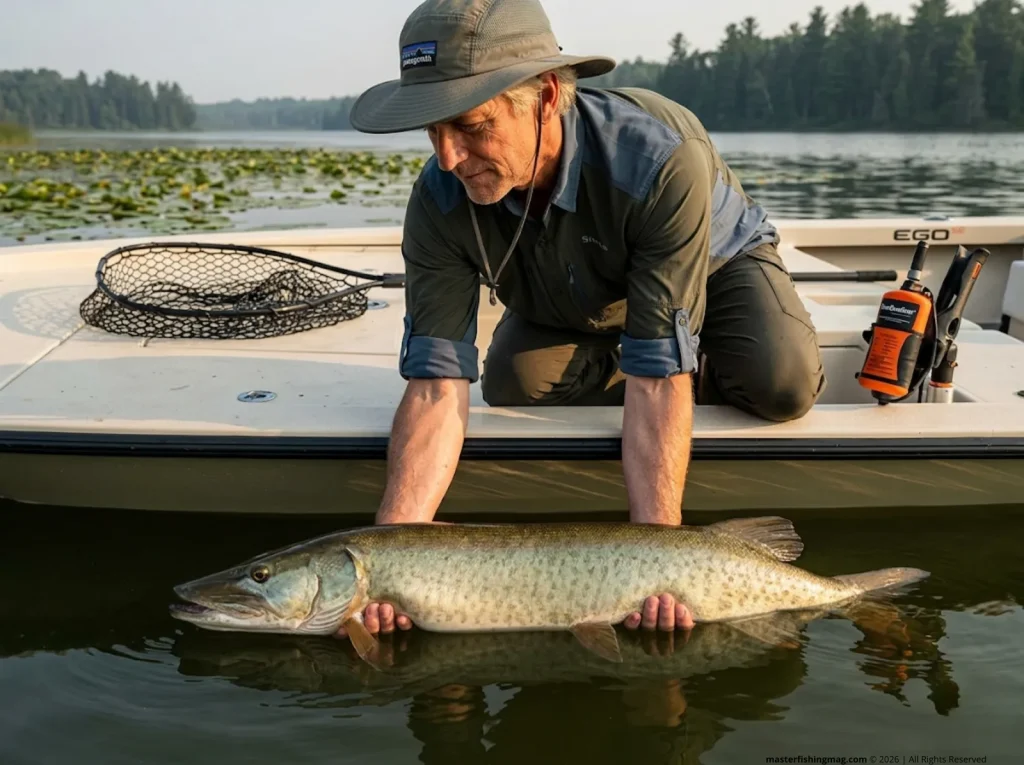
The thermal data is species-specific, and the blanket catch-and-release advice doesn’t account for those differences. Here’s where that gap matters.
Trout are the least forgiving species in a warm-water scenario. The trout thermal limit is 68°F — above 70°F, documented mortality exceeds 20% independent of technique. You cannot handle your way out of that number. Barbless hooks, minimum fight time (land in under 60 seconds where possible), revival only in the coldest, most oxygenated section of water. Zero air exposure — net, mat, or keep it submerged. If the thermometer reads over 68°F at the trout stream, go home. Or go to the coffee shop and plan tomorrow’s dawn trip. Voluntary cessation of fishing when temperatures are above threshold isn’t optional for a conservation-minded angler — it’s the protocol.
Musky and pike are long, heavy fish with high internal organ displacement risk during any vertical hold. Two-handed support is mandatory: one hand at the jaw (not inside the gill plate — never inside the gill plate), one hand supporting the mid-body near the pectoral fins. Never lift either species vertically, even briefly. Jaw support is critical for musky over 40 inches. Silicone or rubber mat for any out-of-water photography. Temperature cutoff: 80°F. According to Virginia DWR muskellunge warm-water C&R mortality study results, 33.3% of muskellunge caught and released above that threshold went down. Read the jaw support and horizontal hold protocol for pike and musky that prevents internal injury before targeting either species in summer.
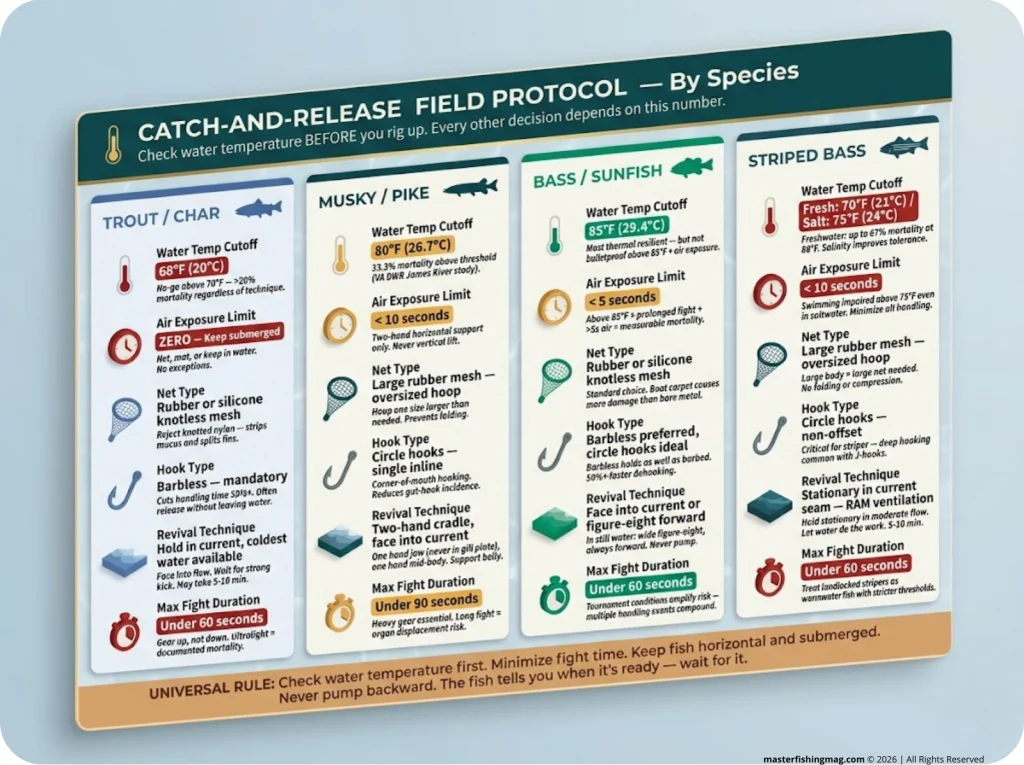
Bass and sunfish have the most thermal resilience, but resilient isn’t bulletproof. Above 85°F plus prolonged fight time plus more than 5 seconds of air exposure: measurable mortality. Tournament conditions amplify this — multiple handling events (net, livewell, transfer bag, weigh-in bag) are cumulative. A tournament bass in a 90°F livewell in August is not tough. It’s going down in slow motion. The aerators buy minutes, not hours. Read what tournament fish livewell management gets wrong in summer heat before your next summer tournament.
The striped bass equation changes based entirely on where you’re fishing. Estuarine fish with salinity at 2 ppt or above have measurably better thermal tolerance — in the Chesapeake Bay, the striped bass thermal limit effect was statistically insignificant between 59°F and 83°F. In zero-salinity freshwater at 88°F, documented mortality runs up to 67%. A striper caught in the Chesapeake Bay at 80°F has fundamentally different survival odds than one caught at the same temperature on the Susquehanna Flats. The Chesapeake Bay striper guide that includes the thermal squeeze survival window puts that data into a tactical context. Landlocked stripers should be treated as warmwater fish with stricter thresholds than their saltwater counterparts — their osmoregulatory systems are already under maximum load in fresh water.
Conclusion
Three things, remembered before every warm-weather trip:
The thermometer is the most important conservation tool in your bag — ahead of the net, ahead of the hook selection, ahead of everything else. Check the water temperature before you rig up. Every other part of this protocol is irrelevant if you’re fishing above the species’ critical thermal thresholds by species.
Fight time and air exposure are the two variables you can actually control. Gear up enough to land the fish fast. Wet hands. Fish horizontal and in the water. That’s the entire protocol reduced to its core.
Backward pumping does not help fish recover. Countercurrent exchange requires unidirectional forward flow. Hold the fish stationary in current or swim it forward in still water. Never back and forth. The back-and-forth revival myth is one of the most persistent bad habits in warm-weather C&R, and it costs fish their lives.
When you hit the water this summer, check the temp before rigging up — the same way you check the barometer or the tide chart. That one habit, applied consistently, will save more fish than any other single thing you can do on a hot day.
FAQ
At what water temperature is it too hot to catch and release trout?
The practical cutoff is 68°F (20°C). Above 70°F, documented mortality for trout exceeds 20% regardless of handling quality. At those temperatures, dissolved oxygen is too low and metabolic demand is too high to allow recovery from any fight — even a short, well-handled one. If the stream reads over 70°F, the ethical move is to walk away.
Does pumping a fish back and forth in the water help it recover?
No — the back-and-forth motion actively impairs oxygen uptake. Fish gills rely on into-the-current revival orientation and unidirectional water flow. Moving the fish backward reverses that flow and reduces oxygen extraction efficiency by roughly three times. Hold the fish stationary in current, or move it forward in a slow figure-eight in still water. The static hold vs pumping comparison is not close.
How long can a fish survive out of water before it is too late to save it?
Species and temperature determine the answer. In cool water, rainbow trout begin showing measurable reflex impairment after about 70 seconds. At 81°F, bluegill delayed mortality reached 80% under the longest air exposure durations tested in peer-reviewed research. The warm-water rule of thumb is 10 seconds maximum — and under high heat plus prior fighting stress, even that may be too long.
What is the best way to revive an exhausted fish in warm water?
Face it into the current in a velocity seam — fast enough to drive water through the gills, slow enough that the fish does not have to fight it. Hold it stationary. RAM ventilation does the work passively. In still water, swim it forward in a wide figure-eight. Do not release until the fish shows strong, rhythmic gill movement and kicks away forcefully without assistance. Metabolic recovery time in warm water can run 5–10 minutes. Don not rush it.
Are lip grippers safe to use for catch-and-release?
Lip grippers used to lift a fish vertically are documented injury devices. Research found 100% of bonefish suspended vertically by a lip gripper sustained jaw injuries. Barramundi X-rays showed permanent vertebral separation from the same technique. If you use a grip device for fish control during unhooking, the fish stays horizontal and in the water — never suspended by the jaw in the air.
Risk Disclaimer: Fishing, boating, and all related outdoor activities involve inherent risks that
can lead to injury. The information provided on Master Fishing Mag is for educational and informational purposes
only. While we strive for accuracy, the information, techniques, and advice on gear and safety are not a substitute
for your own best judgment, local knowledge, and adherence to official regulations. Fishing regulations, including
seasons, size limits, and species restrictions, change frequently and vary by location. Always consult the latest
official regulations from your local fish and wildlife agency before heading out. Proper handling of hooks, knives,
and other sharp equipment is essential for safety. Furthermore, be aware of local fish consumption advisories. By
using this website, you agree that you are solely responsible for your own safety and for complying with all
applicable laws. Any reliance you place on our content is strictly at your own risk. Master Fishing Mag and its
authors will not be held liable for any injury, damage, or loss sustained in connection with the use of the
information herein.
Affiliate Disclosure: We are a participant in the Amazon Services LLC Associates Program, an
affiliate advertising program designed to provide a means for us to earn advertising fees by advertising and linking
to Amazon.com. As an Amazon Associate, we earn from qualifying purchases. We also participate in other affiliate
programs and may receive a commission on products purchased through our links, at no extra cost to you. Additional
terms are found in the terms of service.