
In this article
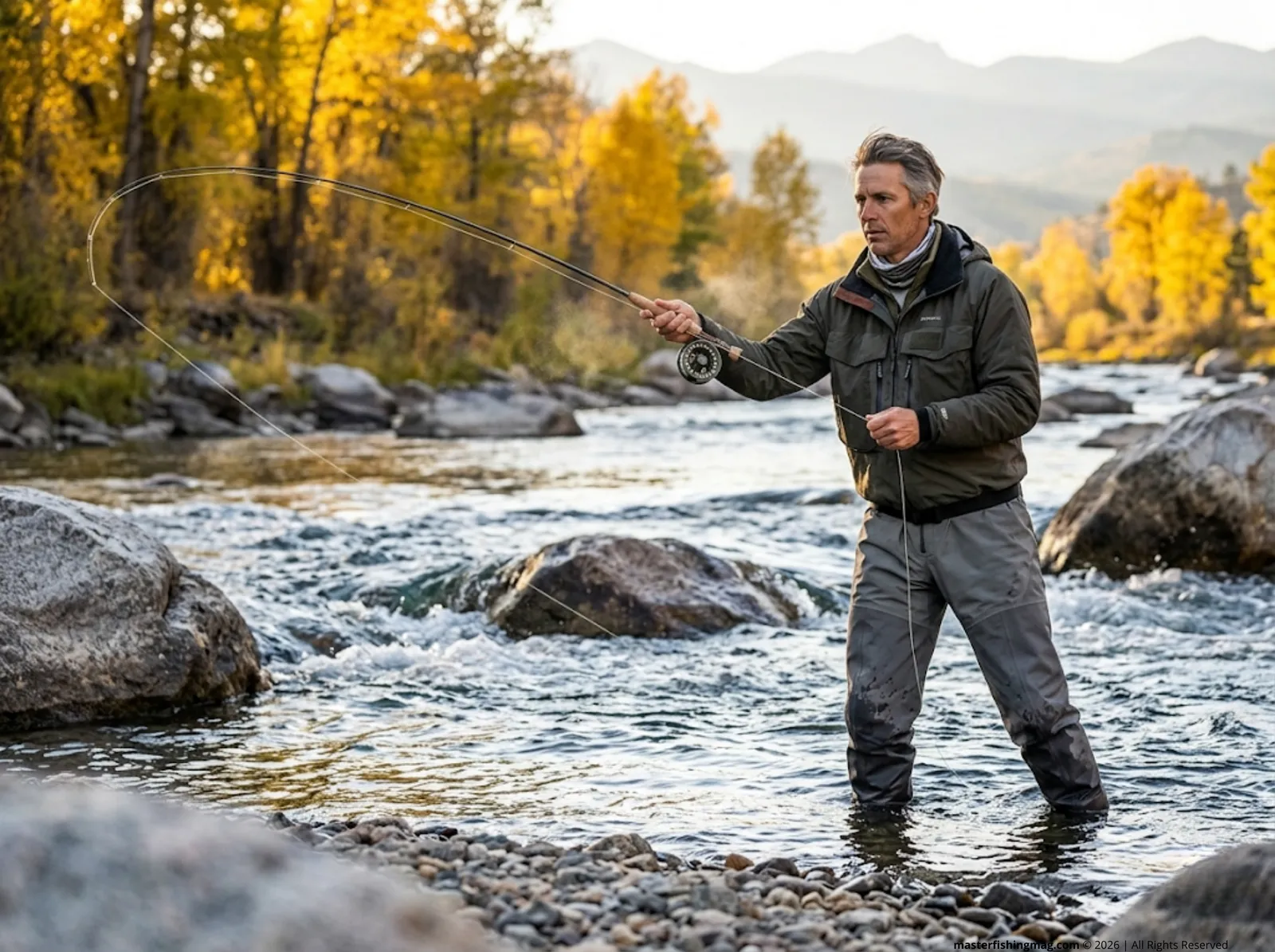
The current ripped the nymph sideways the moment it hit the surface. I’d already missed two fish from this pool — both unmistakable flashes of gold-brown in the tailout — and I could feel the 6X tippet go tight against the wrong angle of drift. The brown didn’t spook. It simply returned to its lie mid-current, burning almost no energy, waiting for something the river brought to it on its own terms. That fish wasn’t unlucky for me. It was running a calculation I hadn’t solved yet.
After two decades chasing river brown trout across the West, I’ve stopped thinking about them the way most anglers do. Wily trout aren’t mystical creatures. They’re metabolic machines operating inside a fluid dynamics equation. When you stop guessing and start calculating — bio-energetics, hydrodynamics, optics — the water stops feeling like a mystery and starts feeling like a system you can read.
Here’s the framework that moved me from reactive to predictive, every session.
⚡ Quick Answer: Brown trout hold where caloric intake exceeds metabolic cost — not where the water looks “fishy.” Focus on the focal point downstream of large boulders (where current plumes converge), fish at low light or after dark for fish over 30 cm, use drag-free drift with the right tippet material, and keep any released fish in the water under 10 seconds of air exposure. Those four principles cover 80% of what separates consistent anglers from occasional ones.
The River as an Energy Equation — How Brown Trout Actually Think
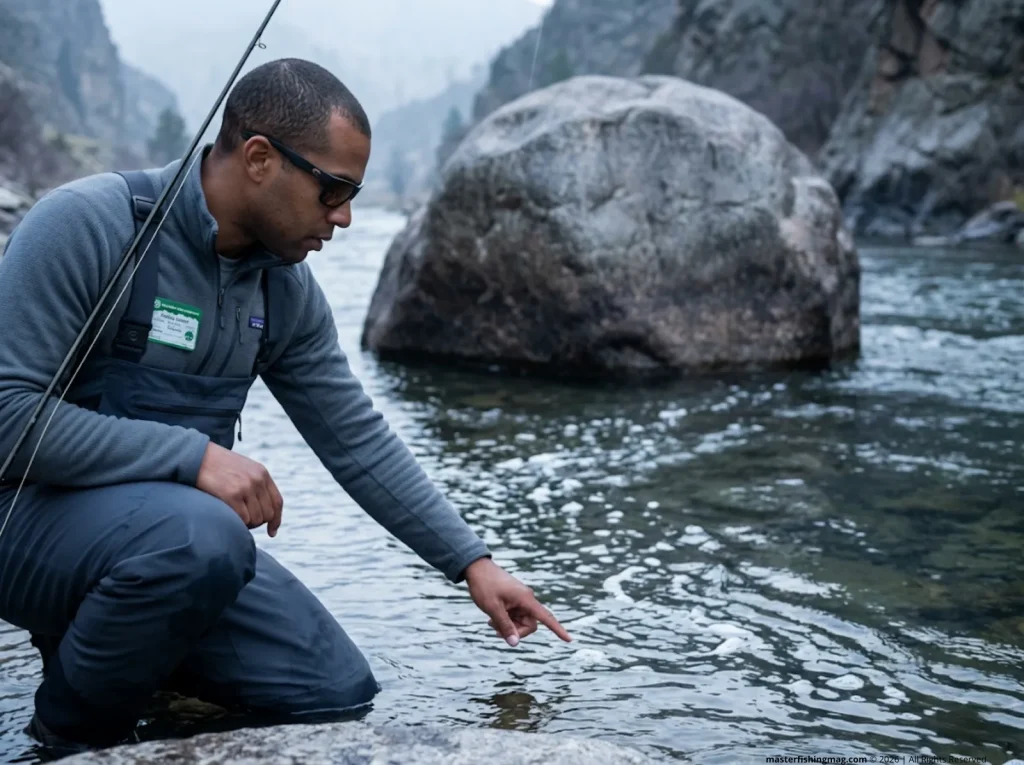
Here’s where most anglers go wrong: they think about where a trout might want to be. The fish doesn’t care about your intuition. It’s running the energy management hypothesis in real time — balancing the caloric cost of holding a position against the predicted yield of whatever the conveyor belt theory sends its way.
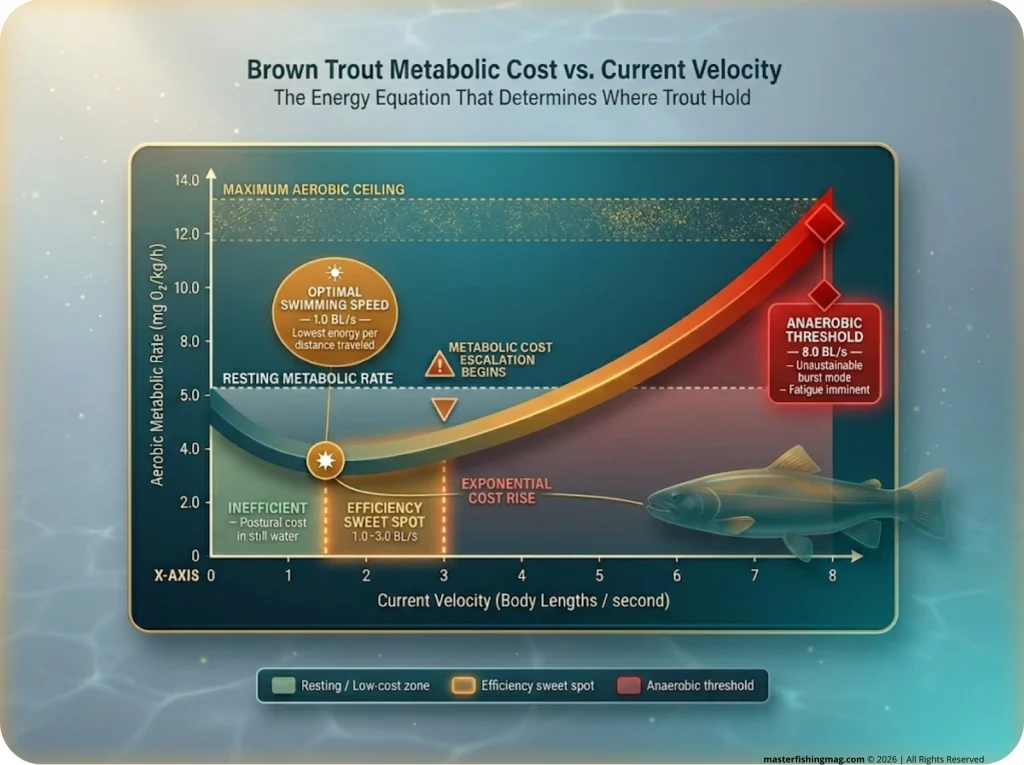
Optimal swimming speed for brown trout sits around 1.0 body lengths per second. Counterintuitively, slight current is cheaper for a trout than dead slack water — in still water it burns constant energy on postural adjustments just to stay upright. Once current velocity climbs past 3.0 body lengths per second, the metabolic cost starts rising fast. Push above 8.0 and the fish hits its fatigue threshold, forced into anaerobic burst mode it can’t sustain.
This tells you something concrete. That beautiful, fast, white-crested chute? You’re not finding fish there. You’re looking for the seam two feet off the torrent where energy expenditure drops to a manageable window and drift-prey funnels through on schedule.
The math varies by water type. Fish in cold, lean headwaters run lower resting metabolic rates as a survival adaptation — around 4.51 mg O₂/kg/h versus the 5.39 of fertile tailwaters. Lean-water fish have a narrower energy margin. They’re more selective. They refuse imperfect presentations not because they’re educated, but because they genuinely can’t afford the mistake. Understanding water temperature and metabolic scope is the first step to predicting where a brown will hold in any given river reach.
Pro tip: On a hot August afternoon, stop hammering the main run. Find cold tributary inputs — even a 2°C drop refreshes the fish’s aerobic capacity enough to trigger a reaction. The thermometer in your vest pocket is worth more than five fly changes.
Reading the Architecture — Where the River Builds a Trout’s House
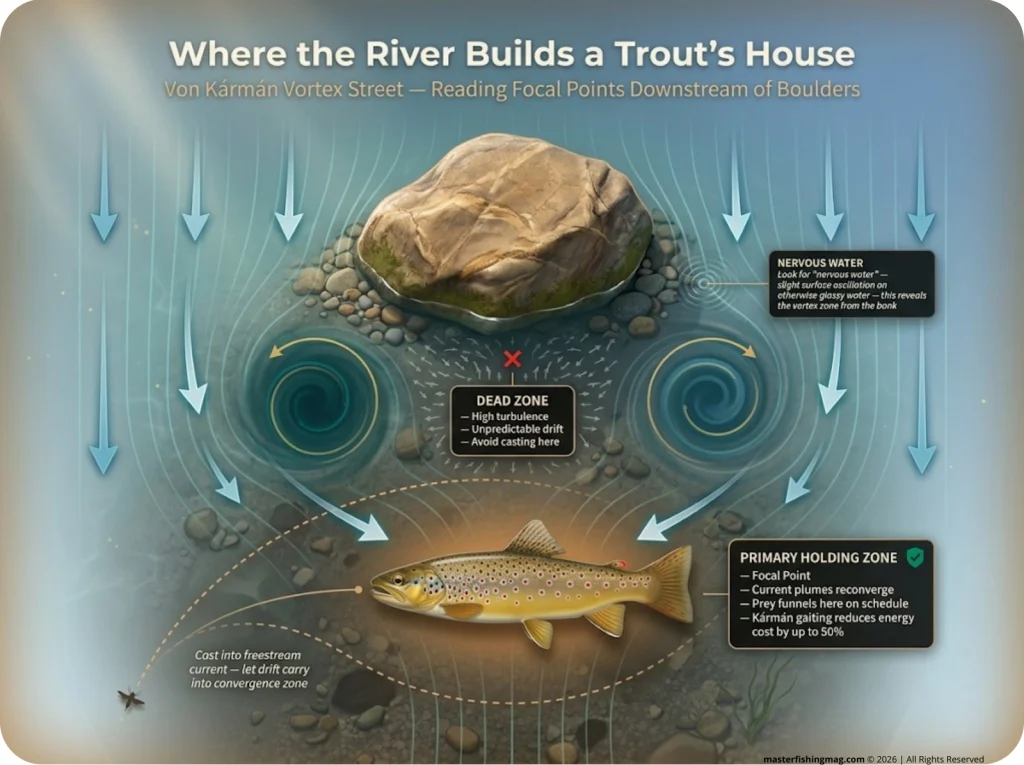
Most people cast to the dead zone directly behind a boulder. I did this for two full seasons and kept catching small fish. The apex fish were 4 feet farther downstream, sitting at the focal point where the two current plumes reconverge — charging out to intercept prey, then sliding back without burning a calorie.
The physics behind this is the Von Kármán vortex street. Water flowing past a boulder sheds alternating vortices on either side. Trout have evolved to exploit this through what researchers call Kármán gaiting — slaloming between those vortices, cutting their own energy cost by up to 50% compared to holding in open current. They’re surfing the wake, letting the river do the work.
You can spot this from the bank. Look for “nervous water” — a slight surface oscillation on otherwise glassy water downstream of a mid-boulder on calm days. That’s the vortex zone. Cast your fly into the freestream current 12–18 inches upstream and let it drift into the convergence. That’s the strike window.
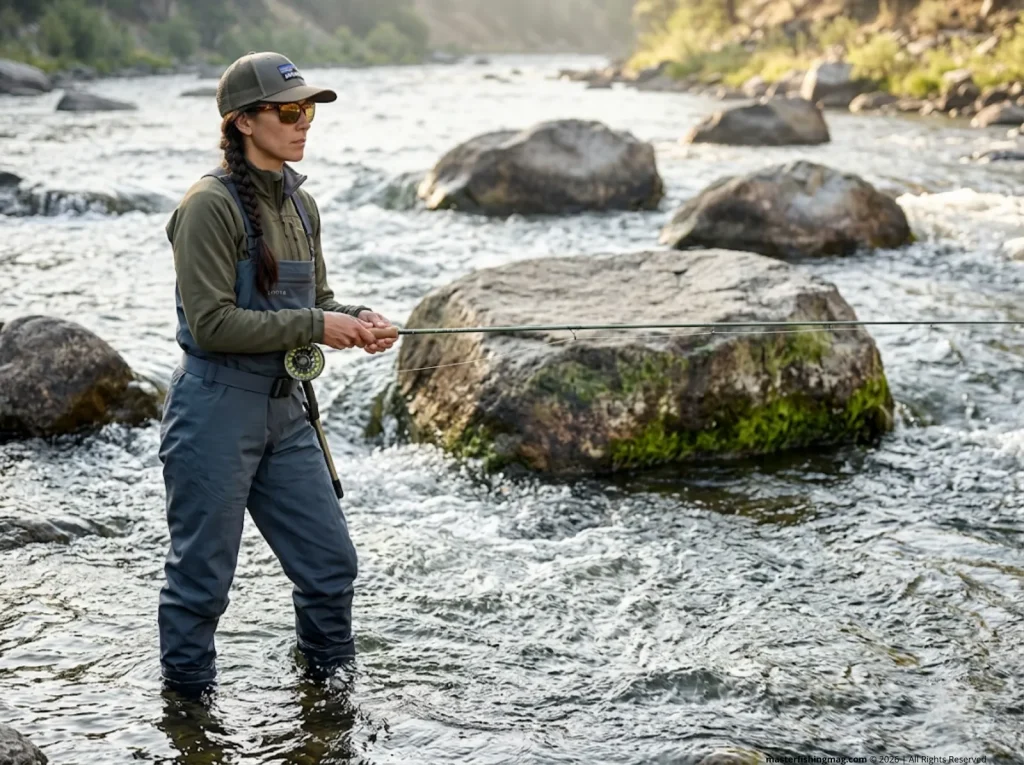
Manning’s roughness coefficient gives you a structural rating system for any river reach. Boulder-strewn mountain streams create the highest density of low-velocity microhabitats per linear meter — that’s why you find large resident browns stacked in cobble and rock, not in smooth-bottomed channels that offer almost none. The current seam physics behind foam lines and thalweg positioning are documented in our hydrodynamics guide — worth reading before your next wading trip.
Undercut banks are ambush staging zones, especially at dusk when a brown’s overhead visibility cone narrows and it can exploit overhead cover without exposure risk. If you can approach an undercut from above and look down at 15 degrees through polarized lenses, you can count the fish holding under the lip without ever stepping in the water.
Pro tip: After a flood event, re-scout familiar boulder fields. Displaced material reshapes the focal point locations, and fish are often temporarily visible while re-establishing their territories. Post-runoff is some of the best sight-fishing of the year.
The Trophic Ladder — One Fish, Three Completely Different Strategies
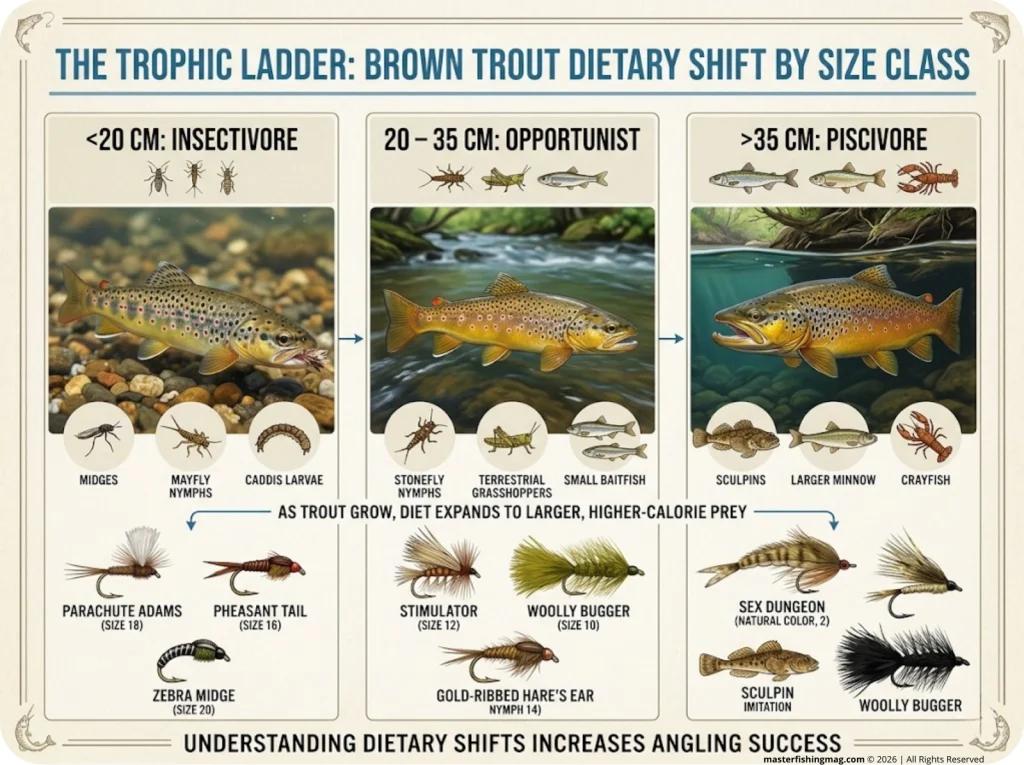
This is the piece of biology that most articles get wrong by treating it as fishing folklore. The 30-centimeter piscivory threshold — the 12-inch threshold — is a data-validated inflection point, not a saying.
Brown trout under 25 cm eat benthic invertebrates — ephemeroptera, trichoptera, caddis larvae, surface insects. Diurnal, surface-focused, match the hatch territory. These fish sit at trophic position 3.60.
Fish in the 25–30 cm transitional zone are opportunistic. Nymphs, soft-hackle wet flies, small streamers — anything is worth trying.
Fish over 30 cm? Stomach content analysis and stable isotope mixing models confirm a decisive ontogenetic shift to fish-based prey. Peer-reviewed research published via NIH/PubMed confirms this shift happens around the 30 cm mark, with brown trout growth rate jumping to 9–11 cm per year once they transition. These animals target sculpins, minnows, other trout. Fish above 60 cm — the Leviathan class — sit at trophic position 4.5 or higher. Mice, crayfish, large baitfish. Feeding windows compress to specific nocturnal prime windows.
Once I watched a 20-inch brown hold in a foam lane during a Baetis hatch, ignoring hundreds of drifting duns. Twenty minutes in, a 4-inch whitefish fry came through. That fish moved three feet and hammered it. The hatch meant nothing to it. The biological transition to piscivory was complete. For the complete biological profile of Salmo trutta — including how the lateral line processes vibration from baitfish imitations — see our dedicated biology guide.
Matching presentations to life stage:
- Tier 1 (sub-25 cm): Dry flies (size 14–18 Elk Hair Caddis, Parachute Adams), small nymphs (size 16–20 Pheasant Tail), 1/32–1/16 oz in-line spinners. Match the hatch is the rule.
- Tier 2 (25–30 cm): Soft-hackle wet flies, small woolly buggers (size 10–12), small spinners with white or chartreuse blades.
- Tier 3 (>30 cm): Articulated streamers (Sculpzilla, Sex Dungeon), large inline spinners (Panther Martin #6+), soft-plastic swimbaits in sculpin patterns. Night presentations dominate.
On entomology: carry a small net and seine a riffle for 30 seconds. The benthos sample tells you more about what transitional-zone fish are eating than a full day of trial-and-error fly changes. Knowing your nymph species also pays dividends during spring runoff conditions when tungsten nymphs fished tight to soft-water breaks out-produce dry flies by a wide margin.
Presentation Physics — Why the Fish Refuses Before It Even Sees Your Lure
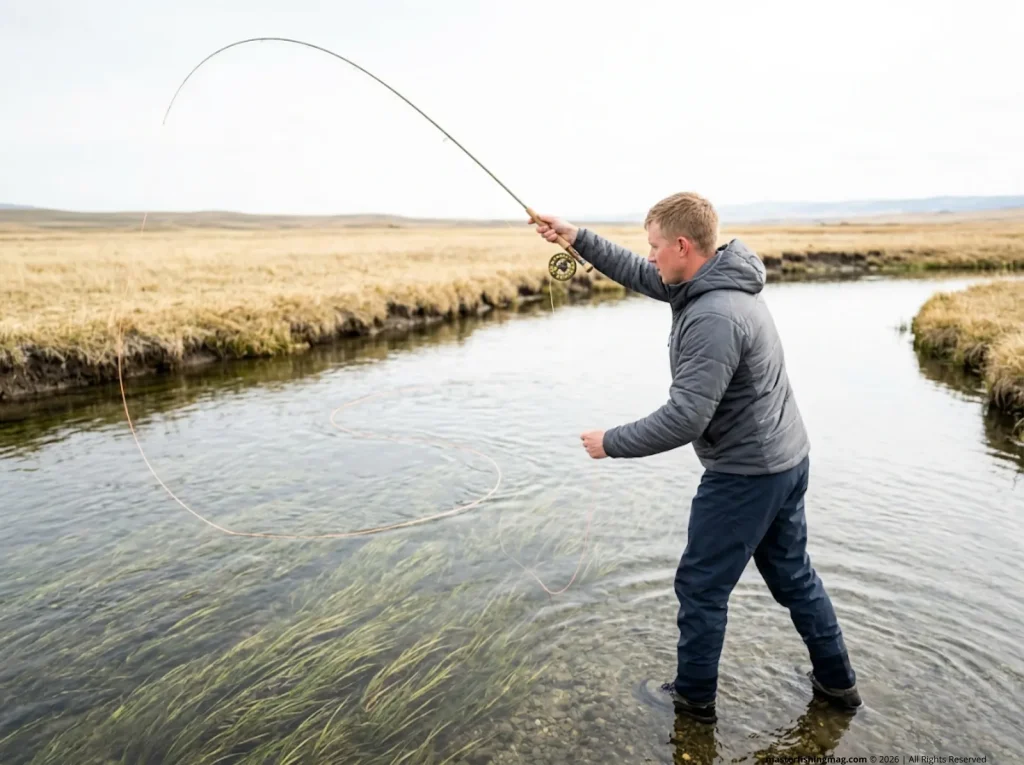
Here’s the thing about refusals: most anglers change flies. The problem is almost never the fly. It’s drag.
I’ve come to believe that drag creates more than 70% of all refusals — more than fly pattern, more than tippet size. A perfectly mended 5X monofilament tippet will out-fish a dragging 7X fluorocarbon leader every single time.
The reason comes down to tippet physics. Nylon monofilament has a refractive index of 1.52–1.63. Fluorocarbon sits at 1.42 — closer to water’s refractive index of 1.33, which makes it far less visible as a distortion in the fish’s visual field. In clear water with good light, that difference matters. In stained or turbid water, it collapses, and diameter becomes the controlling variable. The optical physics of fluorocarbon visibility — including exactly what happens to that visibility advantage in stained versus clear water — is documented in our optics guide.
One thing fluorocarbon’s density creates: it sinks three times faster than monofilament. On dry-fly work, a fluorocarbon tippet attached to a surface fly pulls it under, introducing subtle drag that wily trout detect and refuse. Use monofilament for the final 18–24 inches on any dry-fly rig.
Drag-free drift is a vector correction problem. Varying current speeds across the river pull the line into a drag curve — the fly skates across the surface at a speed nothing biological moves at. The upstream mend corrects for faster mid-river current pulling line anchored in slower near-bank water. The downstream mend slows a fly cast from slow nearshore water into a faster lane. Over-mend and you create slack that kills strike detection. Under-mend and the fly drags. Learn to identify the dominant current lane before you cast.
Pro tip: Stake out a specific fish and make 15 mending attempts with no fly attached — pure line management practice — before presenting the fly. The discipline breaks the habit of casting before diagnosing the current problem. It’s uncomfortable. It’s also the fastest way to improve.
The Gear Anti-Sell — What the Physics Actually Requires
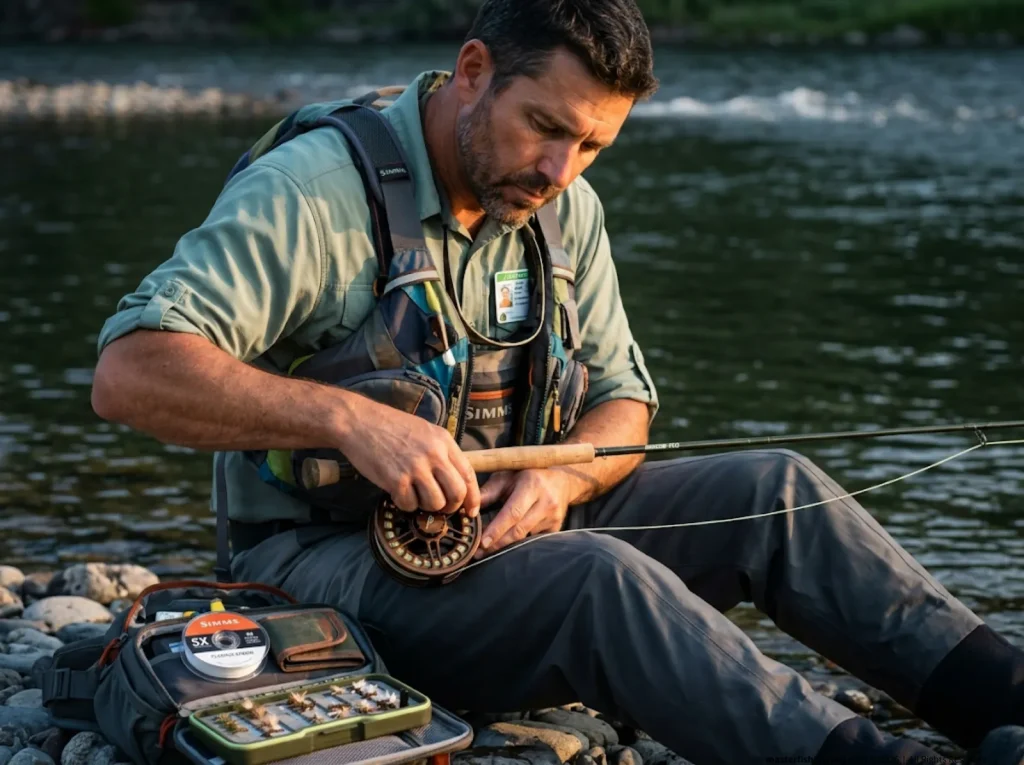
Manufacturers love selling you stopping power. “20 lbs of max drag!” Here’s what that number means for trout fishing: nothing.
The metric that actually matters is startup inertia — the force required to get a reel’s spool moving from a static position. A reel with high startup inertia snaps 6X tippet (around 3.5 lb breaking strength) at the moment of hookup, before the drag disc even engages. You never know what ended the fish. You just feel the pop.
I’ve watched guides with $800 reels lose fish that a $150 reel with a dialed-in disc drag would have held. The number on the spec sheet is marketing. The smoothness at 2 lbs of tension is the actual test.
Drag system matching by water:
- Small freestone streams: a click-and-pawl drag handles sub-20 cm fish. Any startup inertia spike is absorbed by the current’s natural drag on the fly line.
- Medium tailwaters: sealed disc drag, set to 1.5–2.5 lbs. Large-arbor to maintain even tension during 30–60 ft runs.
- Big-river, big-brown hunting: sealed disc drag, 2.5–3.5 lbs. Large-arbor mandatory. Minimum 100 yards of 20-lb Dacron backing.
The large-arbor geometry matters more than most anglers realize. On a narrow-arbor reel, as line peels off, the effective spool radius shrinks — which means drag pressure increases mid-fight, often at the worst possible moment. Large-arbor keeps tension consistent. In water below 40°F, test drag pressure at the actual water temperature before fishing — sealed disc drags still stiffen on initial engagement in cold conditions. Matching drag tension to current speed is inseparable from understanding subsurface current speed and drift presentation.
On single barbless hooks: Many anglers think going barbless means losing fish. Field data says otherwise. Loss rates are equivalent when you maintain continuous rod tension — the technique that keeps a barbless hook in is the same technique that keeps a barbed one in. The difference is that barbless hooks require significantly lower penetration force to drive home, which means better hookups on lighter tippet and corner-of-mouth placements with lower tissue damage. The full breakdown — penetration force and fish survival data for barbless hooks — is in our dedicated guide. Three seconds with a flat-jaw pliers crimp per fly. Zero effect on landing ratios when technique is sound.
The Low-Light Equation — Targeting Piscivorous Browns After Dark
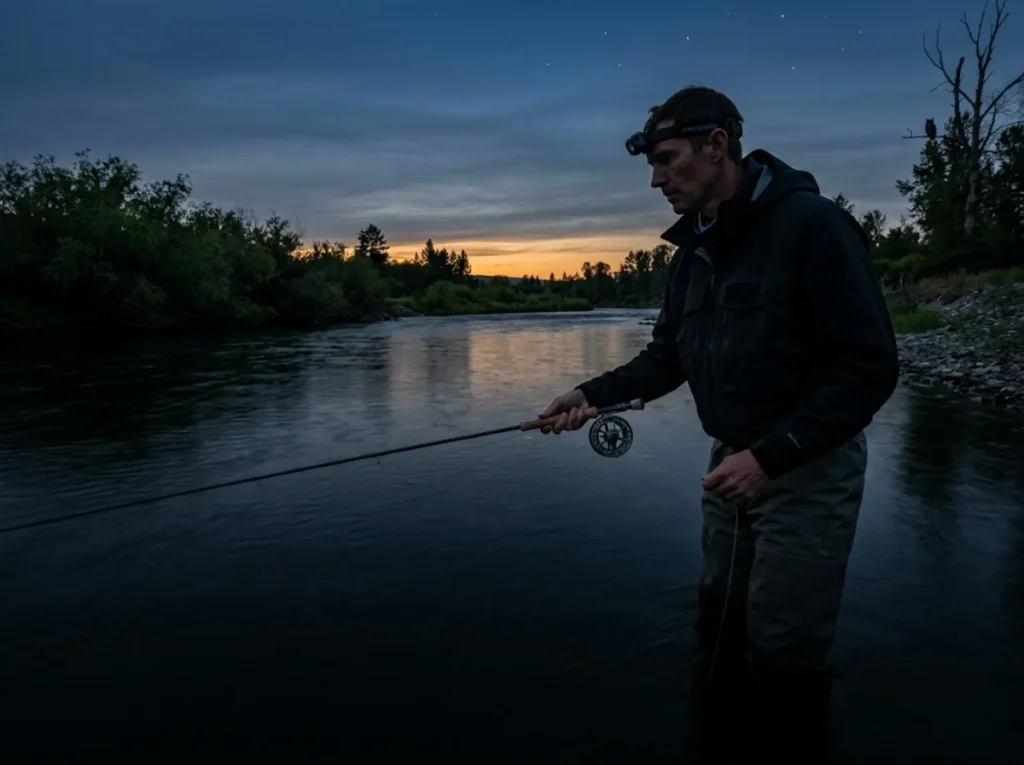
The first time I waded a familiar pool at 10 PM — headlamp off, rod loaded with a Midnight Yogi — I heard three surface explosions before I even started casting. Large fish, feeding through the pool. They’d been completely invisible at 6 PM. The river had a separate ecology running in the dark.
Large piscivorous browns have a primary feeding window that is crepuscular-to-nocturnal: the 45 minutes before and after sunset, extending into the first two hours of full darkness. Low-light vision in trout is enhanced by a tapetum lucidum — a reflective layer that amplifies available light. Nocturnal predation works because contrast against the sky gradient matters more than color. Use dark, silhouetted patterns (Black Ghost, Midnight Yogi) — not bright-colored streamers. The trigger is silhouette, not hue.
Solunar timing adds a precision layer. Major solunar periods correlate with elevated predator activity in field studies. Stack a solunar major period with water temperature in the 55–60°F sweet spot and cloud cover, and you’ve got the conditions large browns respond to most. Our review of full moon lockjaw and solunar feeding cycles separates the data-supported claims from the folklore. Executing these strategies safely requires the full toolkit of low-light fishing tactics and safety protocols — a discipline that rewards preparation and punishes improvisation.
Rigging for after-dark streamer fishing:
Leader: 7.5 ft, 2X–3X fluorocarbon — short and stout. Large browns at night are not tippet-shy. They key on silhouette, movement, and vibration. Use 3–5-inch articulated streamers weighted with lead eyes for a jigging swim motion, or unweighted with sink-tip line for a neutral-buoyancy swing. Use a loop-to-loop connection between fly line and leader — fumbling knots at the junction in low light ends the session fast.
Pro tip: On full-moon summer nights, fish deep pocket water below the riffle rather than the pool. Piscivorous browns retreat to depth where the moon’s illumination is diffused, making their back-lit ambush viable again. The pool will feel dead. The pocket water won’t.
The Release Protocol — Conservation Science, Not Angling Courtesy
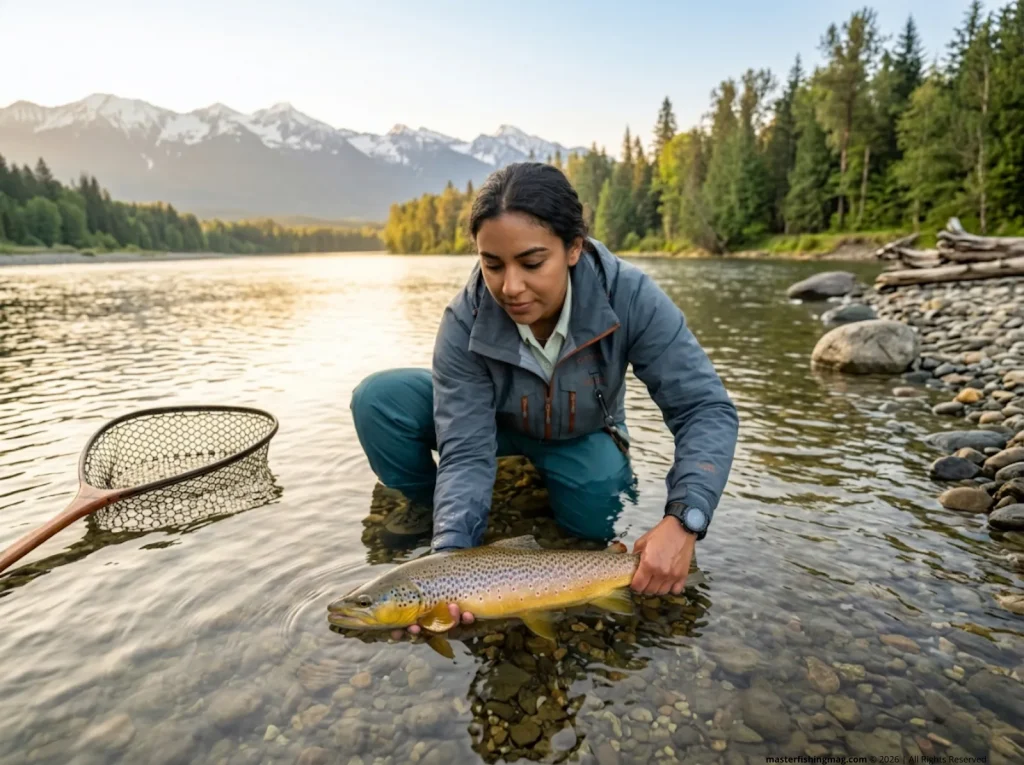
The release is the hardest part of the catch. Most anglers don’t treat it that way.
When a brown fights, it transitions from aerobic to anaerobic metabolism. Lactic acid buildup — acidosis — drops blood pH to potentially lethal levels. The metabolic debt is proportional to fight duration and water temperature. Air exposure exceeding 60 seconds causes significant reflex impairment. At 300 seconds, mortality rates spike. The fish is essentially suffocating on its own metabolic byproducts.
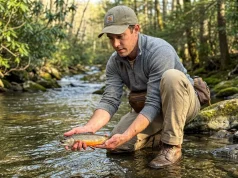
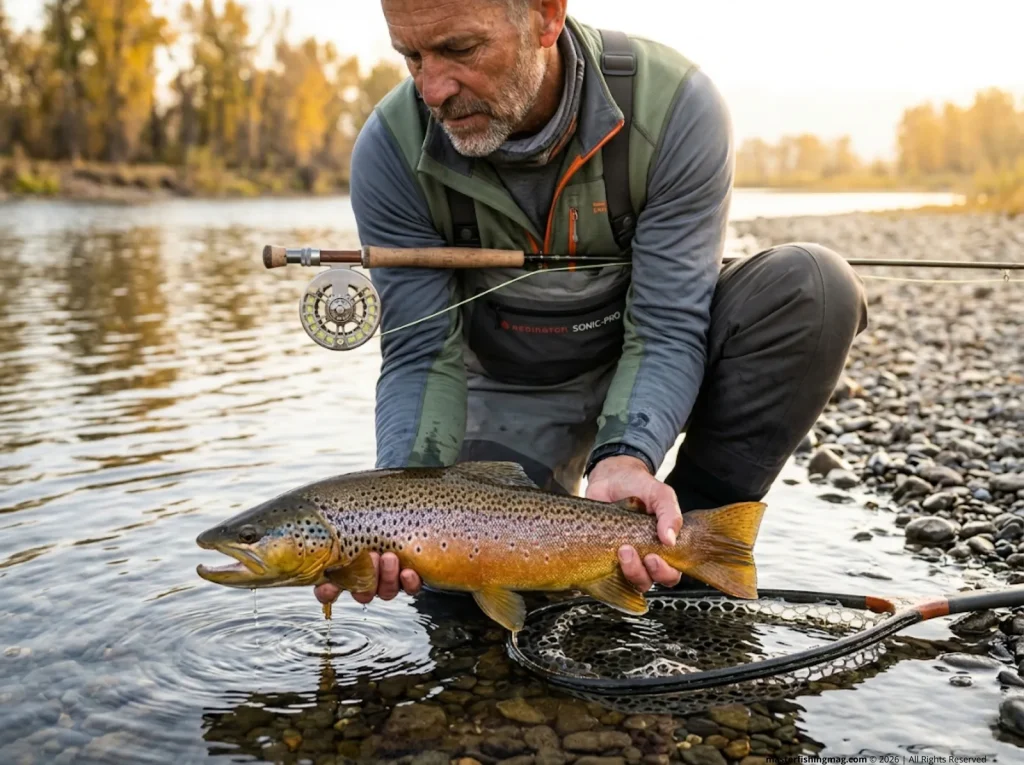
The numbers are concrete: fight under 2 minutes, air exposure under 10 seconds, wet hands and rubber net, release facing upstream. I fish with a timer clipped to my wading pack. When a large brown comes to the net, the timer starts. No exceptions. And I’ve had to stop looking at certain hero photos and asking myself whether they were worth 45 seconds of exposure.
The ultralight gear trap is biologically brutal. Extended fights on 7X tippet or light ultralight rods accumulate more acidosis than a short, decisive fight on 4X–5X. “Light tackle” on large brown trout is not sporting. It’s lethal in warm water. According to Idaho Fish & Game research on warm-water trout survival, mortality was significantly higher for trout landed in warm temperatures compared to those caught in cooler conditions. At 22°C (71.6°F), post-release survival rates drop sharply even with perfect protocol. Consider not targeting large fish on high-summer afternoons.
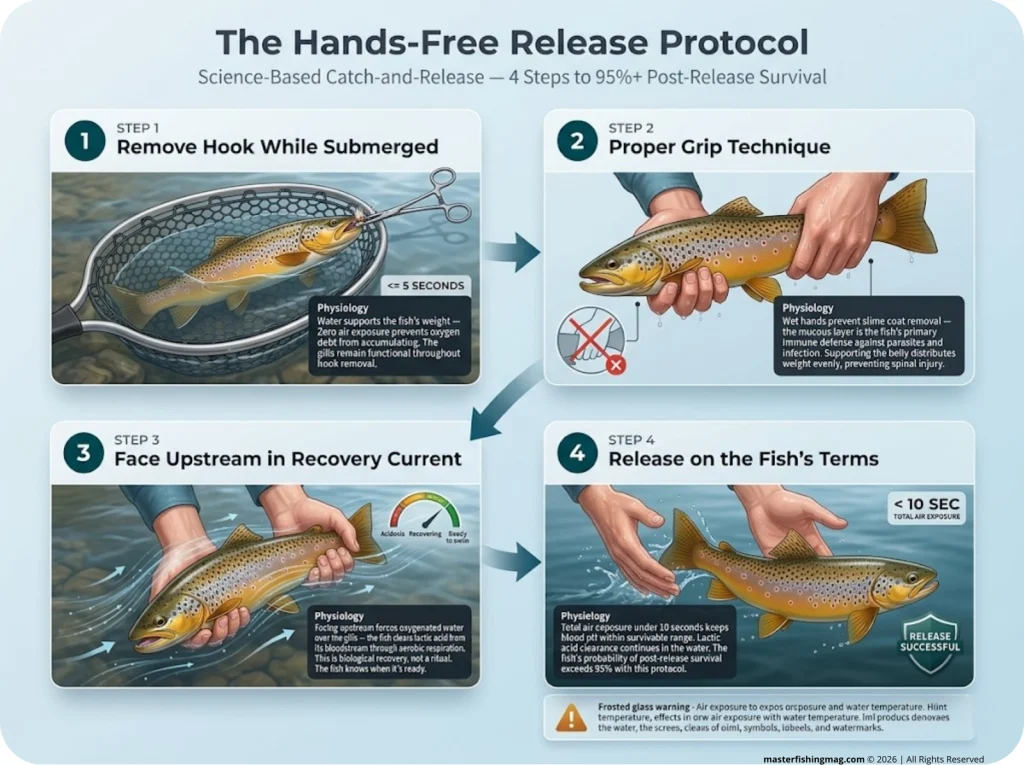
The hands-free release protocol:
- Keep the fish in the rubber net, submerged, while removing the barbless hook with hemostats — typically 2–5 seconds.
- Grasp the fish gently by the wrist of the tail with wet hands; support the pectoral region with the opposing hand.
- Position facing upstream in the recovery current; allow the fish to fin away of its own volition.
- Air exposure counter: if the fish isn’t ready to depart in 20 seconds, submerge completely for 30 seconds before re-attempting.
Holding a fish upright in current is not recovery. It’s stress under pressure. The fish knows when its lactic acid has cleared enough to swim. Let it go when it decides. The full evidence base for science-based catch-and-release handling — including circle hook selection, hook location data, and post-release survival rates — is required reading alongside this section.
Conclusion
Three things to carry off this page:
The river is an energy ledger. Brown trout don’t hide — they position at the exact hydrodynamic node where caloric intake exceeds metabolic cost. Calculate that node using Kármán vortex principles and focal point geometry, and you’ve located the fish before you’ve wet a line.
The 30 cm threshold changes everything. Stop floating insect imitations past fish over 30 cm. Those fish are piscivores at trophic position 4.15. Fish like a piscivore-hunter: streamers, low light, near-substrate, high-silhouette presentations. The hatch is irrelevant to them.
Drag ends more opportunities than bad fly selection ever will. Master the upstream mend as a vector calculation, match tippet material to conditions, and the refusal problem that no pattern-change can fix starts to disappear.
On your next session, spend the first 20 minutes at the river not fishing. Read the hydrodynamic architecture. Find the focal points downstream of the largest boulders. Note the solunar timing window. Then fish with a decision tree, not a hope. The river rewards calculation.
FAQ
What is the best bait for brown trout in a river?
It depends entirely on the fish’s size, not your preference. Brown trout under 25 cm respond to insect imitations — nymphs and dry flies matching the current hatch. Fish over 30 cm have crossed the piscivory threshold and respond primarily to baitfish imitations: articulated streamers, large Panther Martin spinners, and soft-plastic swimbaits near the substrate at low light. Match the trophic level, not just the lure.
What time of day are brown trout most active in rivers?
Biologically, the peak window is crepuscular-to-nocturnal — the 45 minutes before and after sunset, extending into the first 2 hours of darkness. Daylight feeding peaks at dawn during warmer months and mid-afternoon on winter days when water temperature edges upward. Full midday sun plus high temperatures pushes large fish into thermal refugia and shuts feeding down.
How do you catch a really big brown trout — over 20 inches?
Target fish above the 30 cm piscivory threshold using articulated streamers or large inline spinners, fished at the focal point downstream of large boulders during the low-light window (dusk through 10 PM). These fish don’t share the best holds and don’t feed out of schedule. Match the time window, not just the fly pattern.
Does fluorocarbon tippet really make a difference for brown trout?
In clear water above 55°F, yes — fluorocarbon’s refractive index (1.42 versus monofilament’s 1.52–1.63) meaningfully reduces visual signature. In stained or high-turbidity water, that advantage collapses and diameter matters more. Never use fluorocarbon as your final tippet on a dry fly — its density pulls the fly under, introducing subtle drag that brown trout detect and refuse.
Is catch-and-release safe for brown trout in warm summer conditions?
Not without qualification. When water temperature exceeds 62.6°F (the chronic stress threshold), brown trout are already metabolically stressed. A fight of even 90 seconds combined with air exposure can push acidosis into the non-recoverable range. Above 18°C: apply the under-10-second air exposure rule absolutely, or voluntarily stop targeting large fish until temperatures drop below 60°F. Conservation science here is not a gray area.
Risk Disclaimer: Fishing, boating, and all related outdoor activities involve inherent risks that
can lead to injury. The information provided on Master Fishing Mag is for educational and informational purposes
only. While we strive for accuracy, the information, techniques, and advice on gear and safety are not a substitute
for your own best judgment, local knowledge, and adherence to official regulations. Fishing regulations, including
seasons, size limits, and species restrictions, change frequently and vary by location. Always consult the latest
official regulations from your local fish and wildlife agency before heading out. Proper handling of hooks, knives,
and other sharp equipment is essential for safety. Furthermore, be aware of local fish consumption advisories. By
using this website, you agree that you are solely responsible for your own safety and for complying with all
applicable laws. Any reliance you place on our content is strictly at your own risk. Master Fishing Mag and its
authors will not be held liable for any injury, damage, or loss sustained in connection with the use of the
information herein.
Affiliate Disclosure: We are a participant in the Amazon Services LLC Associates Program, an
affiliate advertising program designed to provide a means for us to earn advertising fees by advertising and linking
to Amazon.com. As an Amazon Associate, we earn from qualifying purchases. We also participate in other affiliate
programs and may receive a commission on products purchased through our links, at no extra cost to you. Additional
terms are found in the terms of service.