
In this article
You had the fish. You watched it materialize out of the green depth — eight pounds of muscle hovering three feet off the bottom — and it followed your swimbait for a full twenty-foot glide. Then it turned and disappeared. No eat. No flare. Just gone.
That moment is not bad luck. I’ve guided trophy bass fisheries long enough to know: that fish made a calculation, and your presentation came up short. The good news is the calculation is solvable. This guide breaks down the three-layer system — bio-energetics, hydrodynamics, and mechanical setup — that separates trophy bass that commit from trophy bass that just watch.
⚡ Quick Answer: Trophy bass ignore swimbaits when the bait fails their internal cost-benefit test. The fix is threefold: use a bait in the 6″–10″ range to clear the caloric threshold, slow your retrieve until you hit the Rate of Stall, and eliminate any mechanical noise that scrambles the lateral line signal. Match those three variables to water temperature and clarity, and follows become strikes.
| Bass Fishing Technical Variables | |
|---|---|
| Key Variable | Data Point |
| Minimum effective swimbait size (trophy bass) | 6″–10″ |
| Dead-stick retrieve threshold | Below 55°F |
| Bass near-point focus distance | 13.5 cm (~5.3″) |
| Peak lateral line sensitivity frequency | 1–80 Hz |
| Manning’s n (ribbed soft plastic) | 0.018–0.025 |
The Metabolic Logic That Drives Every Trophy Strike
Here’s where most anglers get it wrong: they think a trophy bass follows and turns off because it’s “finicky.” It’s not. It’s running a metabolic calculation — and you lost the math.
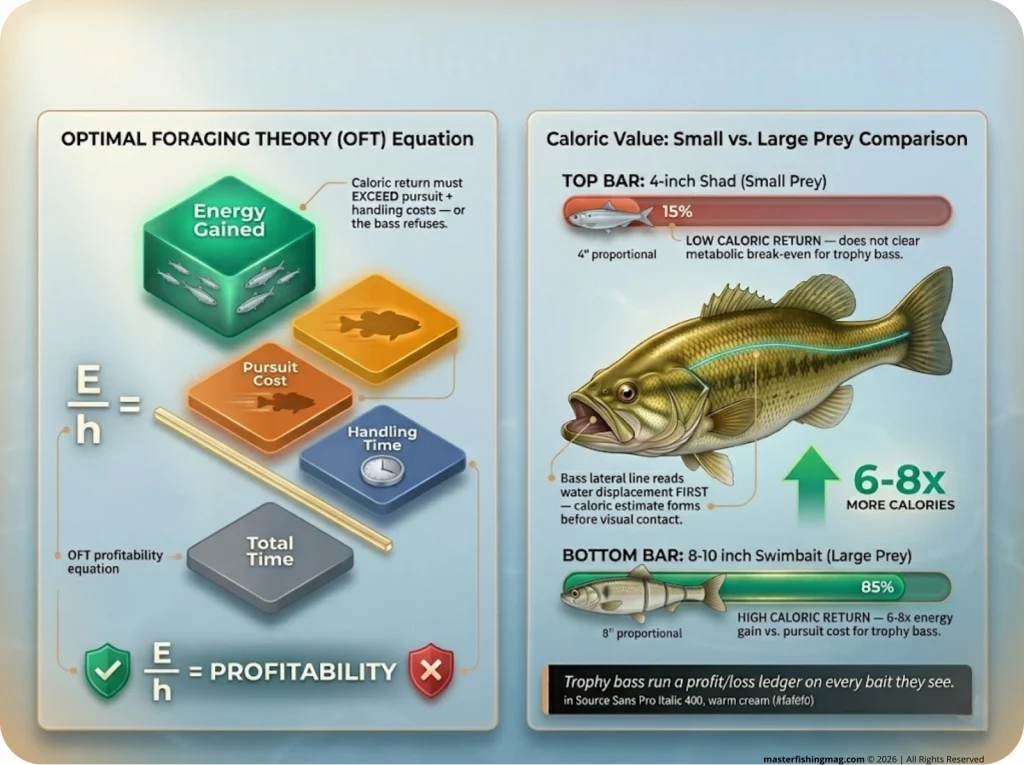
Trophy-class largemouth bass operate under what biologists call Optimal Foraging Theory (OFT): every predatory decision is governed by whether the caloric return justifies the energy spent pursuing it. Research on glycolytic enzyme research on largemouth bass foraging costs shows that LDH activity — the enzyme proxy for anaerobic effort — runs 20% higher when bass hunt large prey versus small. Every sprint to eat a big swimbait costs the fish. It only pays off if the meal is worth it.
For a 6–8 lb bass, a 4″ swimbait simply doesn’t clear the metabolic break-even. The energy expended to chase it exceeds what the fish gains. Understanding largemouth bass sensory and metabolic biology helps frame why swimbait fishing demands a fundamentally different size logic than standard bass tactics.
Why Trophy Bass Reject Small Baits (The Caloric Math)
A 4″ shad imitation versus a 10″ glide bait isn’t a minor size difference — the larger profile offers roughly 6–8x the energy return. And the fish knows before it ever sees the lure. The lateral line reads water column displacement and body volume first. By the time the bass is looking at your swimbait, it’s already formed a preliminary opinion based on the pressure wave.
Cold water tightens this threshold fast. Below 60°F, the metabolic calculation becomes more conservative. The acceptable prey window shrinks unless the reward is large and easy.
Pro tip: If you’re moving from a 5″ bait to a 7″ and still not getting committed follows, jump to 9″ first. Sometimes you need to overshoot to fire the profit response. The fish isn’t being cautious — it’s being efficient.
The Rate of Stall — The Only Retrieve Metric That Matters
The Rate of Stall is the lure’s ability to maintain action at the edge of zero forward motion. That’s the zone where metabolic cost for the chasing fish drops to its lowest point. Hard baits go dead the moment you stop reeling. A properly weighted soft swimbait — a Keitech Swing Impact FAT, a Huddleston, a Berkley Nessie — keeps a slow tail pulse even as the line goes slack.
Temperature changes everything here. At 65°F water, a moderate slow-rolling retrieve works. At 50°F, that same speed is 30% too fast for the fish’s thermal state. Use your reel’s IPT to calibrate — a 5.8:1 at 24″ IPT gives you maximum control to hover right at the stall threshold.
The fish that follows and turns is not being mysterious. Your retrieve speed was 15% too fast. That’s the fix.
Environmental Variables That Shut Down Trophy Bass
A cold front aftermath is a deadlock situation. Barometric drop followed by rise triggers metabolic inertia — bass feed briefly before going silent for 12–36 hours. The only presentation that cuts through is near-stationary dead-stick, bait sinking slowly on a slack line with almost no imparted movement.
Pressured lakes add another layer. Trophy bass in these fisheries “specialize” — they lock onto a specific forage profile, shad-pattern or trout-pattern, and ignore anything outside that search image. Wrong forage imitation on a specialized fish equals automatic rejection regardless of how perfect your gear is.
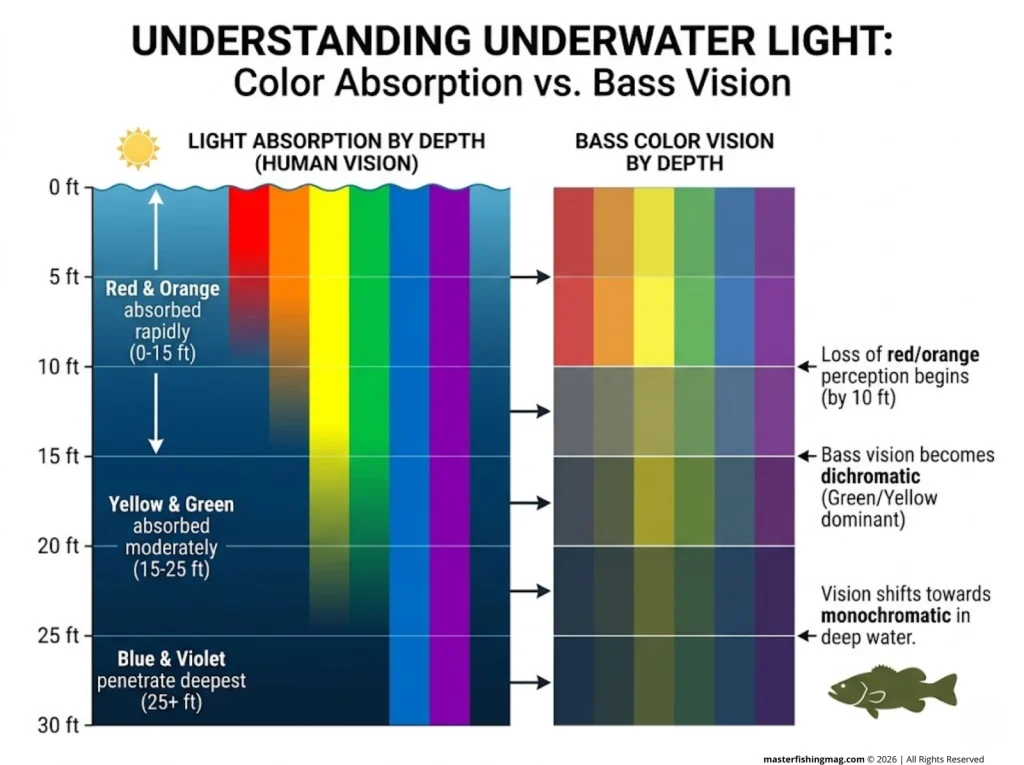
Depth changes color perception. As the fish moves deeper, green light dominates and visual detail loses relevance. That’s when you shift from naturalistic patterns to high-contrast silhouettes.
The Hydrodynamic Truth — What Your Swimbait Is Actually Saying Underwater
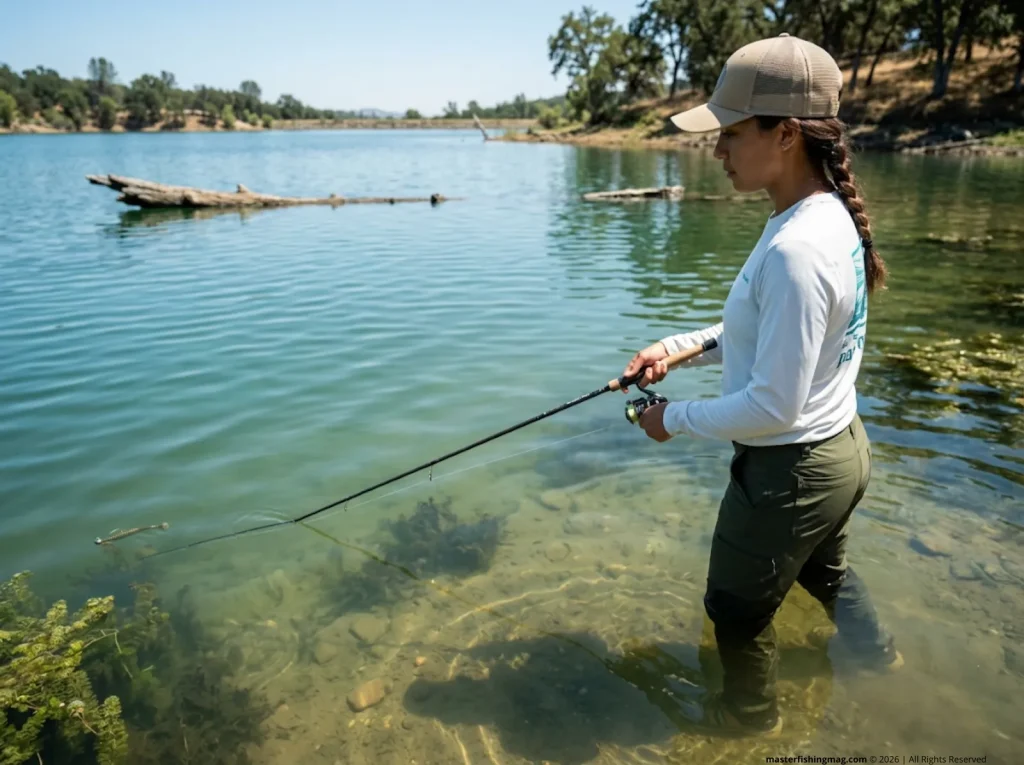
Most anglers think swimbait fishing is a visual game. It starts acoustic.
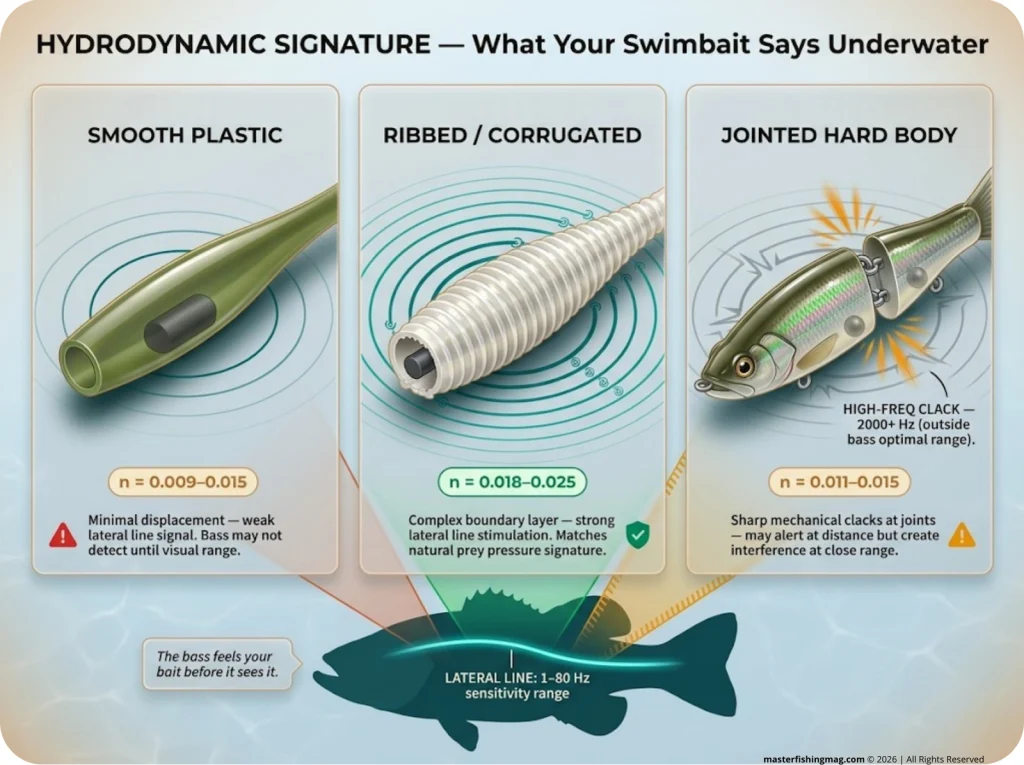
The bass’s lateral line — a row of neuromast cells running head to tail — detects pressure waves from 1 to 80 Hz. That’s exactly the frequency range of a swimming shad or trout. Understanding how bass use their lateral line to detect lures explains why the bass has already formed an opinion about your bait before it ever comes into visual range.
The problem is that most lures are built for the tackle store shelf, not the bass’s lateral line.
Manning’s n — Reading Surface Roughness Like a Biologist
In hydraulic engineering, Manning’s roughness coefficient (n-value) describes how a material interacts with moving fluid. Applied to surface roughness soft plastic, it tells you exactly how much acoustic “grip” a swimbait body generates — and how strong a pressure signature it puts into the water. Think of it as the difference between dragging a smooth glass plate through water versus a ribbed cheese grater. One pushes almost nothing. The other throws a wake you can feel three feet away.
| Material Properties and Acoustic Effects | ||
|---|---|---|
| Material | Manning’s n | Acoustic Effect |
| Smooth plastic | 0.009–0.015 | Minimal displacement, weak signal |
| Ribbed/corrugated plastic | 0.018–0.025 | Complex boundary layer, strong lateral line stimulation |
| Hard resin | 0.011–0.015 | Sharp mechanical clacks at joints |
| Vegetation/algae | 0.020–0.150 | High resistance, dampens vibration |
The Keitech Swing Impact FAT and Berkley Nessie use ridge architecture to increase n-value deliberately. They create a pressure wave that more closely matches the low-frequency swimbait displacement of natural prey.
Pro tip: Run your glide bait over your submerged hand in the shallows before you fish it. If you can’t feel the water displacement, the bass can’t either. Switch to a ribbed soft body.
Joint Architecture — Hard Clack vs. Soft Pulse
Here’s the thing about rattling lures that nobody says out loud: most clacks and rattles are high-pitched, over 2,000 Hz, which sits well outside the bass’s optimal hearing range of around 100 Hz. High-frequency clatter from hard joints — Bull Shad, S-Waver, Deps Slide Swimmer — travels through the water column and may alert a fish at distance. But at close range, it becomes interference that prevents the lateral line from accurately localizing the bait.
That’s the scientific reason behind the soft glide bait trend. Remove the hard joint, remove the interference. The bass then tracks the bait on pure low-frequency displacement alone — a cleaner, more convincing signal.
The acoustic signatures of joint-clack materials matter. Tacky joint issues in some Trick Shad batches break the acoustic rhythm and signal artificiality long before the fish gets close enough to see the bait. Inspect joints before every session.
Pressure Wave Manipulation — Controlling the Signature
Glide baits should produce a smooth, sinusoidal pressure pattern — exactly what a large baitfish creates when swimming slowly or wounded. Line management is how you protect that pattern in the field.
Excess line belly pulls the bait’s nose sideways, breaking the S-wave geometry into an irregular pattern. Trophy bass don’t eat irregular patterns. They’re programmed to identify them as non-living.
Fluorocarbon’s higher density forces the line trace below the surface, keeping the bait’s nose tracking true. Submerging your rod tip adds another level of directional control through cover.
Visual Mechanics — What the Bass Sees at Close Range
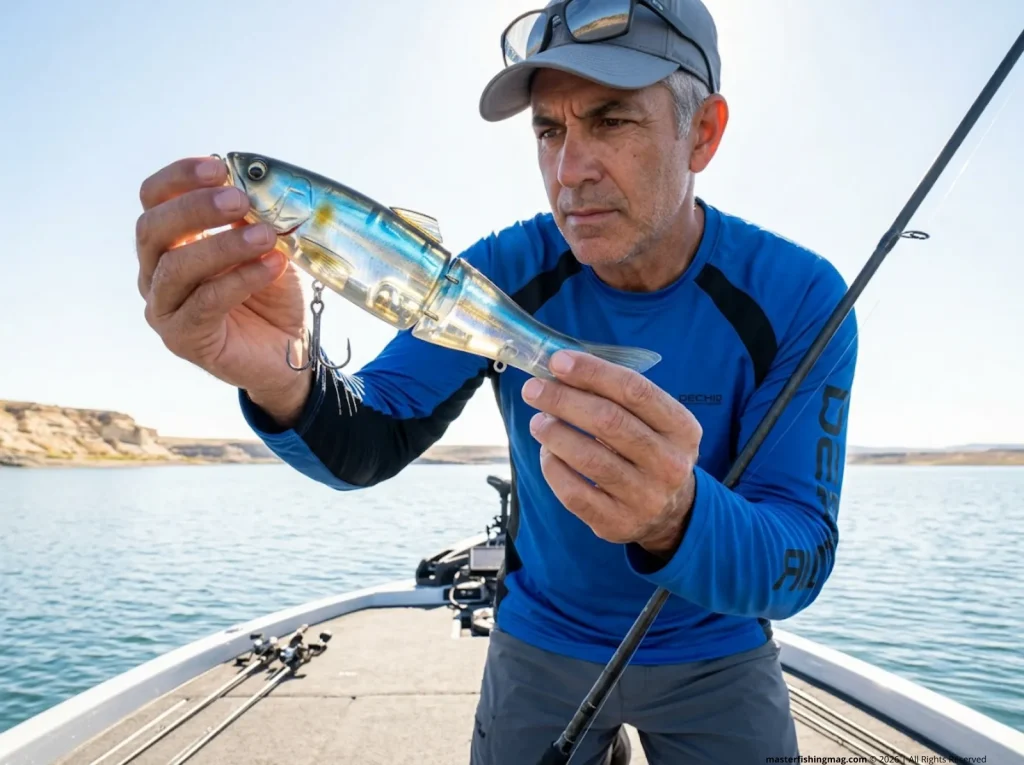
When the bass finally closes to visual range, the picture changes fast.
Bass have dichromatic vision: peak single cone sensitivity at 535 nm (green spectrum), twin cone at 614 nm (red spectrum). Research on largemouth bass dichromatic color vision and spectral sensitivity confirms these peaks and defines the near-point threshold that governs strike triggering. Color selection here isn’t about matching the hatch — it’s about maximizing contrast against the ambient light environment the fish is actually looking through.
How water clarity changes what bass can actually see connects the spectral sensitivity data to practical lure color decisions in any water condition.
Reading Water Clarity to Choose Color
Clear water over 10 feet of visibility: natural shad, trout, or bluegill patterns. Photorealistic patterns and scale detail matter here because the bass can actually see them.
Stained water under 5 feet of visibility: Bone/White or Chartreuse. Maximum contrast against a green-shifted light environment is worth more than any naturalistic pattern. At 20 feet or deeper, red pigments are fully absorbed — all warm colors converge into dark silhouettes. White or blue-black from depth.
The sweet zone most swimbait anglers live in — 8 to 15 feet in summer — calls for a natural-pattern dorsal with a white belly. You get realistic top-half detail and high-contrast ventral silhouette simultaneously.
The Near Point Problem and the Mauthner Trigger
A bass following your swimbait at 6–8 inches is not committed. It cannot focus — its near point is 13.5 cm (about 5.3″). It’s using macro-pattern and silhouette only, tracking by momentum and shape. And here’s where most presentations fail.
A perfectly consistent retrieve tells the bass’s brain: non-living object. Natural prey have micro-movements. Mechanical regularity is an alarm signal. The bass classifies the bait and turns off.
What you need is a Mauthner cell trigger. The Mauthner cells are dedicated neural circuits for rapid-reaction strikes. They fire on sudden, unpredictable motion change — a stall, a sharp direction change, a “chop.” Without this trigger, a following bass will not commit.
The most reliable close-range trigger: a 2-second dead-stop followed by a single sharp 6-inch pull. That pause-and-pop breaks the steady visual pattern and fires the reflex before the fish has time to think.
Pro tip: Time your trigger move when you see the fish accelerate toward the bait — that’s the commitment window. Too early, and it hasn’t locked in; too late, and it’s already classified your bait as a decoy.
Seasonal Color Calendar for Swimbaits
Pre-spawn (February–April): crawfish-orange belly on a neutral body in clear lakes, white or chartreuse in stained water. Post-spawn through summer: shad-pattern in clear, bone in stain. Adding foil tape to the dorsal side on bright overcast days adds a flash trigger without changing the base pattern.
Fall: golden shiner and trout patterns follow the available forage. Pacific and California fisheries lean toward trout. Midwest and Southern reservoirs favor shad. Winter dead-white with subtle flash — maximize contrast in low-light, sluggish metabolism conditions.
The Mechanical Setup — Torque, IPT, and the Equipment Equation
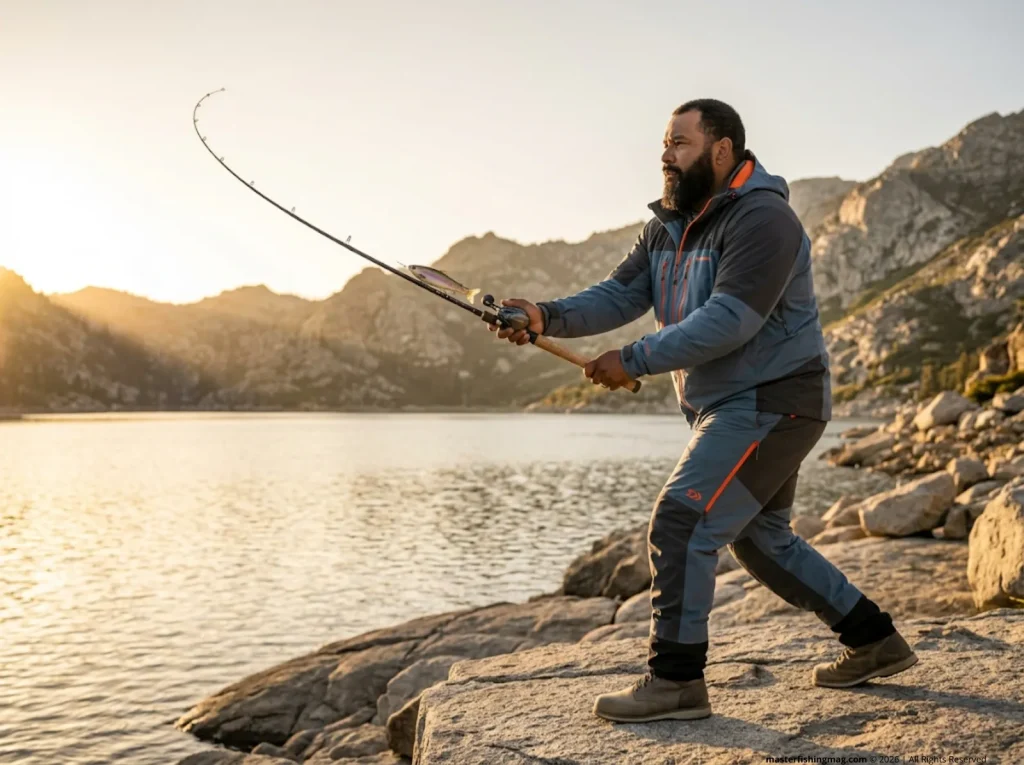
Standard bass tackle doesn’t work for swimbait rod reel setup. A medium-heavy 7’0″ with a 6.4:1 gear ratio cannot manage the torque of a 4 oz glide bait, can’t load and cast properly, and can’t maintain a consistent retrieve cadence. You need purpose-built gear or you’re fighting the system.
The reel discussion almost always starts with gear ratio. That’s the wrong metric. What matters is Inches Per Turn (IPT). A 5.8:1 on a large spool can out-IPT a 7.1:1 on a small spool. Matching gear ratio and IPT to your swimbait retrieve speed is the framework to build from before selecting a reel.
I’ve lost two double-digit bass on stock hooks on premium resin baits. The hardware is always the weakest link on a $120 lure.
Rod Power and Action for Every Swimbait Type
For soft swimbaits like Keitech and Huddleston-style baits: 7’10″–8’0″, XX-Heavy, Moderate-Fast. The Megabass Orochi XX and Dobyns Champion XP (4–10 oz rating) are the field standards.
For hard-jointed glide baits like the S-Waver and Bull Shad: 7’9″–8’0″, Heavy to XX-Heavy, Moderate/Parabolic action. The parabolic bend is not marketing language — it’s the rod’s ability to flex through its full blank length and absorb violent headshakes without turning the heavy bait into a prying lever.
Test your rod’s parabolic quality: load it against a wall and watch where it bends. If more than 40% of the blank is stiff, you will lose fish. That’s not a technique issue — it’s a physics problem.
Reel Selection — The Transmission That Runs the System
The Shimano Tranx 300 at 5.8:1 with 24″ IPT is the gold standard for slow-rolling soft swimbaits in the 3–6 oz range. Maximum torque, manageable line capacity, and enough control to hover right at the stall threshold over a 6-hour session without burning out your arm.
For glide bait “chopping” — the rapid direction-change retrieve — the Abu Garcia Beast 300 at 7.3:1 takes up slack instantly between movements. The Daiwa Lexa HD 400 at 8.1:1 handles magnum capacity for 8–10 oz baits. On any 300-size reel, fill the spool within 1/8″ of the lip with 20 lb fluorocarbon. Under-filled spools reduce effective IPT and generate friction on the cast.
Line Science — Why Fluorocarbon Is Not Optional
Low-stretch fluorocarbon sinks. That’s the fundamental property that makes it the only viable choice for swimbaiting. Its density (1.78 g/cm³) forces the line to track below the surface, killing wind-induced drag that pulls the bait off its intended track. Its refractive index (1.42) is close enough to water (1.33) that it becomes near-invisible at depth — critical in clear-water fisheries.
20 lb test is the floor. For 8-inch swimbaits and larger, go 25 lb. Line failure during a multi-second fight with an 8+ lb fish on a heavy bait and high drag tension is unacceptable. You don’t get a second chance at a fish like that.
The Anti-Sell — Critical Weakness Report on Top Swimbaits
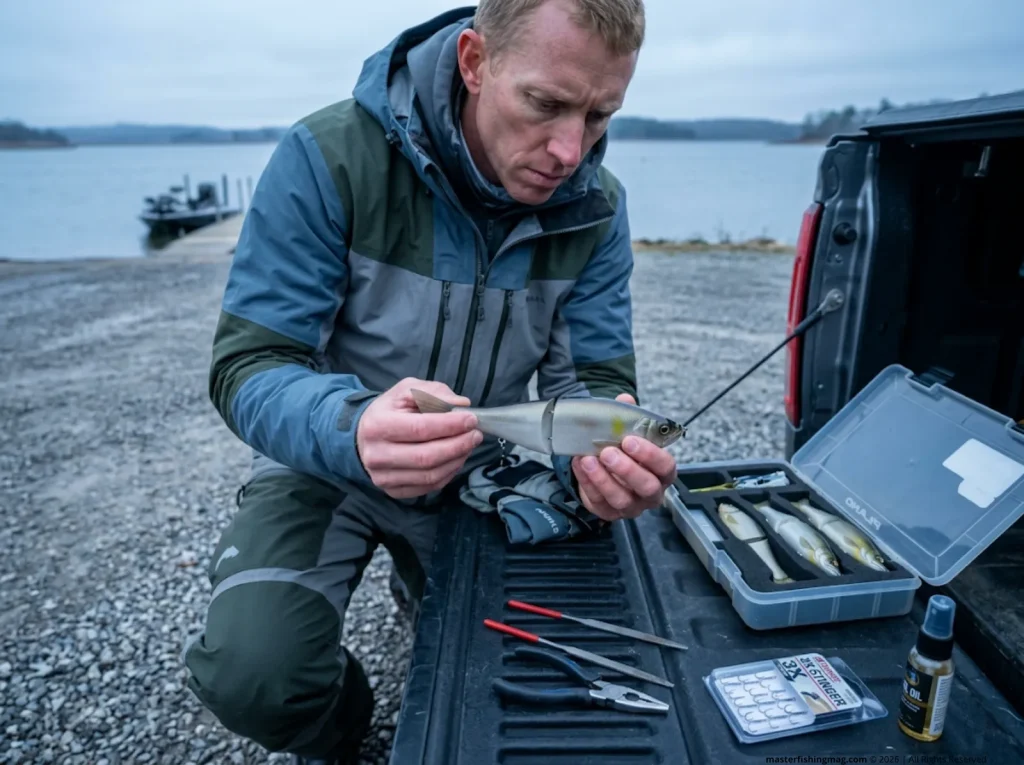
Price doesn’t equal performance in the swimbait niche. Every serious swimbait angler I respect has a bait-prep ritual before they touch the water. The fish doesn’t care how much you paid.
Here’s the honest breakdown on the baits everyone is throwing. Selecting the right swimbait jighead to maintain proper action connects to these hardware decisions directly.
Resin and ABS Structural Defects — What to Fix Before You Fish
Bull Shad: Resin flashing in hinge joints is a common production-run issue. The flashing causes the rear tail section to seize mid-retrieve, dropping the lateral line sensitivity signal to near-zero. Fix: file flash from joint pockets, realign screw eyes with pliers, and test each bait in flat water before fishing it. Hinge pins work loose — tap them back with a punch and sight down the bait’s length to confirm the rear section tracks straight. Even a 5° off-center track collapses the S-wave.
Huddleston Deluxe: Improper storage warps the wedge tail, creating an asymmetrical hydrodynamic signature. One side pushes more pressure than the other. Trophy bass identify this as artificial before they’ve closed to visual range. Fix: boil the tail 3–5 seconds, then cold-water dip while holding it perfectly flat. The plastic memory sets in about 30 seconds. Store all soft swimbaits flat — never coiled, never bent. You’re pre-loading the warp if you stack them wrong.
Trick Shad: Tacky clear coat causes joint lockup in some batches. Rock the joint repeatedly until resistance clears. Sand lightly if the problem persists.
Component Reliability — Hardware Upgrades By Model
| Glide Bait Maintenance & Modification Guide | ||
|---|---|---|
| Bait Model | Known Weakness | Fix |
| River2Sea S-Waver | Stock trebles and split rings undersized | Owner 3X Stinger trebles, 60 lb Spro split rings |
| Deps Slide Swimmer | Joint mechanical clack creates high-frequency interference | Line-through treble system, eliminates the harness |
| Bull Shad | Faulty hinge pins, resin flashing | File joints, realign screw eyes |
| Any resin glide bait | Internal ballast shifting after impacts | Check, re-seat, or file ballast before each session |
After upgrading hooks, always verify Rate of Fall in a pool or tank. Added hook weight shifts the sink rate. You may need to file or remove internal ballast to restore original ROF — the entire retrieve strategy is calibrated around it.
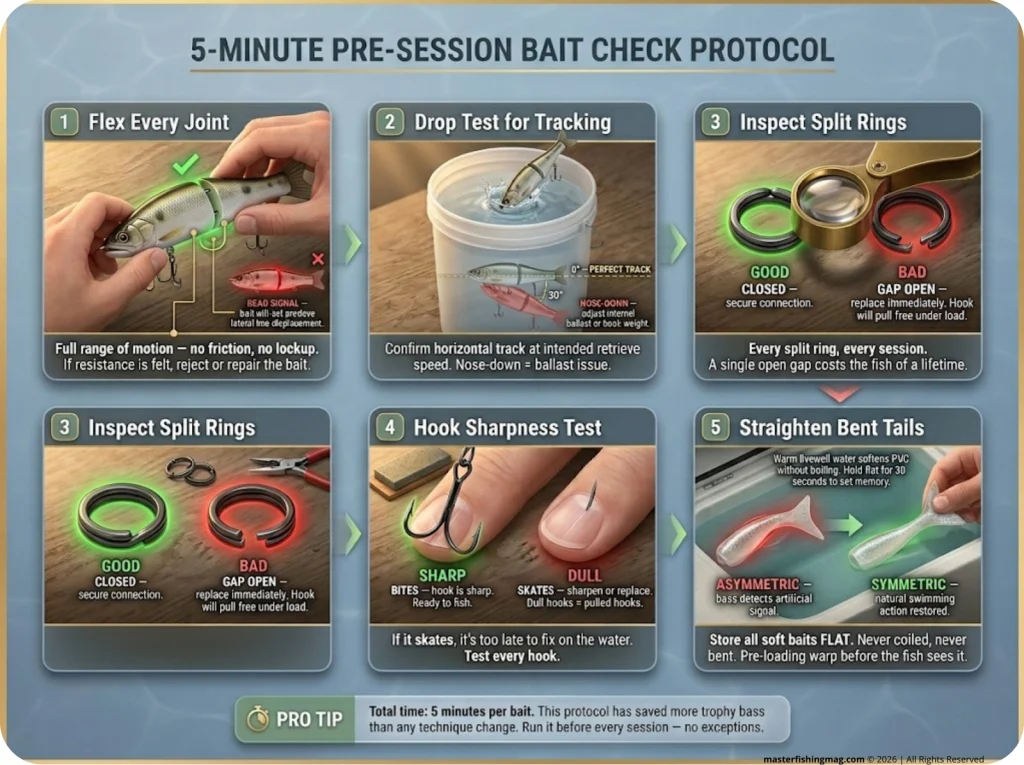
The Pre-Session Bait Check (5-Minute Protocol)
- Flex every joint through its full range. Any friction or lockup means a dead lateral line signal in the water. Reject or repair.
- Drop test in a bucket or clear shallows — confirm the bait tracks horizontal at your intended retrieve speed.
- Inspect all split rings for gap openings. Replace anything not fully closed.
- Hook sharpness check — drag the point across your thumbnail. If it skates, sharpen or replace.
- Straighten bent tails using warm livewell water. Soft plastic softens enough to reset without boiling.
Field Execution — Spot Management, Line Control, and Trophy Stealth
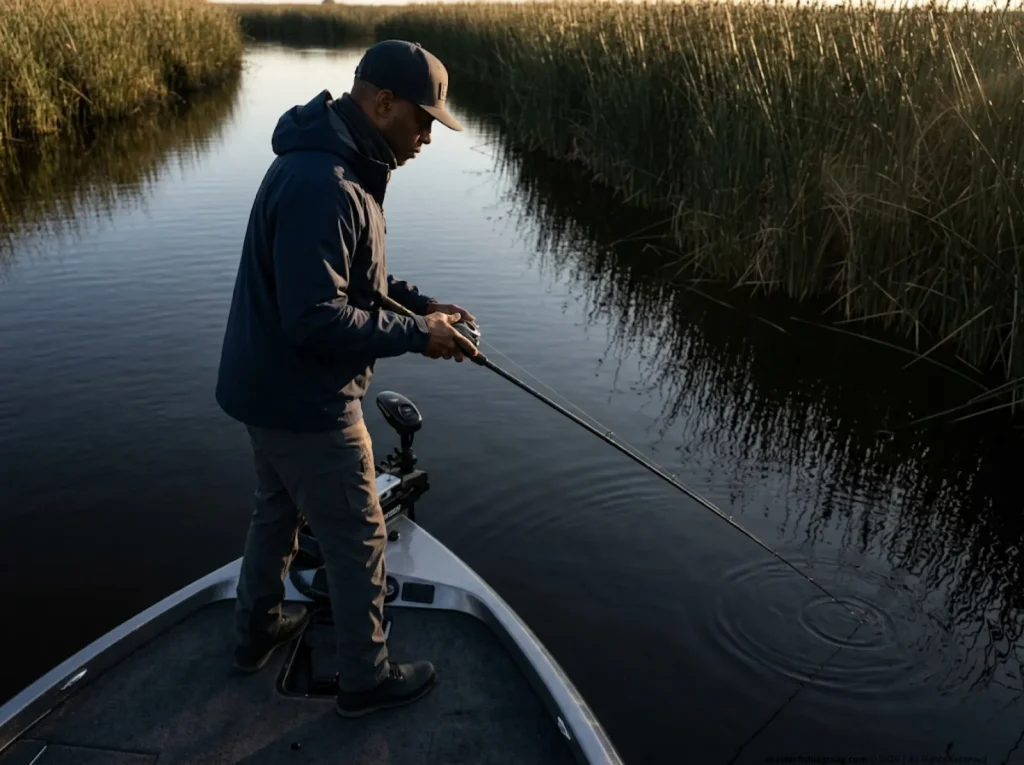
The spot is the asset. Trophy bass are structure-specific. They return to the same laydowns, eddy seams, and shade pockets. You can have perfect gear and perfect presentation and still leave empty-handed if you blow the spot.
The Penalty Box Theory, developed by Mike Gilbert of Working Class Zero, works like this: releasing a caught bass immediately at the spot causes stress signals and physical commotion that shuts down the remaining school. Instead, transfer the fish to a livewell — on oxygenated water, not ambient — and continue fishing the spot with minimum boat presence. Release the group 200+ yards from the structure, downcurrent. The recovery window before the school’s alarm state elevates to lockdown is roughly 15–20 minutes per fish.
For livewell management and thermal stress prevention for bass during multi-hour trophy sessions, temperature control is the critical variable.
I’ve seen Mike Gilbert stop fishing a spot the moment a boat ran within 100 yards of his target. Noise travels faster in water than in air. Your trolling motor at low speed is a dinner bell. Kill the electric 40+ yards out and drift into position. Research on the physiological impacts of catch-and-release angling on largemouth bass confirms that handling stress disrupts osmoregulation for 24–72 hours — pressured fish are effectively uncatchable during recovery regardless of what you throw.
Reading the Spot — Structure and Cover Hierarchy
Deep-water laydowns adjacent to spawning flats, eddy seams behind large boulders, thermocline-adjacent shade pockets — these are singular trophy fish locations, not school spots. Trophy bass are largely solitary.
Position the boat so the retrieve runs parallel to the structure, not perpendicular. A parallel retrieve maximizes time in the strike zone. Fan-cast from shallow to deep — trophy bass often suspend 2–3 feet above structure. A bait that drops too deep on the first cast blows through the strike zone entirely.
Forward facing sonar (FFS) has changed swimbait efficiency at the high end. You can watch the fish react to each presentation in real time and confirm correct ROF before committing to a retrieve pattern.
Line Control on the Retrieve — Preventing Bait Track Failure
The “drape and tighten” move before each retrieve: let the lure settle, then tighten smoothly until you feel the bait’s weight register on the rod tip. This ensures straight-track from the first crank.
During the glide phase, excess slack makes the bait pivot on the line’s contact point instead of tracking freely. You want just enough tension to feel the bait — not enough to pull it off the glide arc.
Pro tip: In crosswind conditions, drop the rod tip to the water’s surface. This eliminates wind bow in the line and keeps it in a single plane, preserving S-wave geometry through the full retrieve. A line belly in crosswind conditions is one of the most common reasons for unexplained follows that don’t convert.
The Swimbait Conservation Protocol — Handling Trophy Bass at Scale
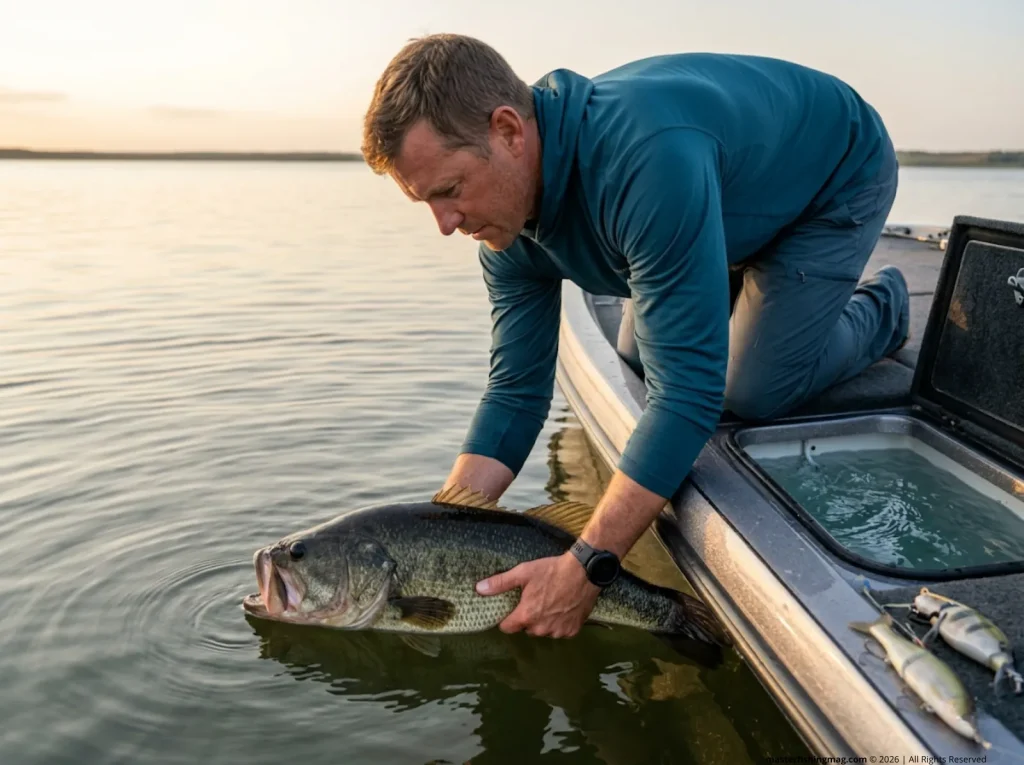
This section matters more than any gear discussion.
Large bass on heavy swimbaits fight longer and accumulate more lactic acid than the same fish on lighter tackle. Every additional 30 seconds of fight time adds hours of unresponsiveness post-release. Livewell temperature oscillations and bass stress physiology research from the ACES Illinois study confirms a 5°C temperature change creates significant stress as measured by tissue chemistry analysis.
Science-based catch-and-release handling for trophy bass provides the full physiological framework behind these handling rules.
The fish you just caught will be eight years old next time. It’s irreplaceable. Handle it like you know that.
The Science of the Bass Fight — Managing Lactic Acid
Every second of fight time increases lactic acid accumulation in the muscle tissue, and high water temperature slows clearance. Above 75°F, recovery to baseline can take 24 hours or more. Under 3 minutes of fight time for fish over 5 lbs is the target. Use 50–60% of line test for drag — the parabolic rod protects the hook-hold.
“Pump and reel” beats sustained pressure. Short decisive pumps tire the fish faster than constant loading, which the fish can match muscle-to-muscle. In the last 15 feet, bring the boat to the fish — not the fish to the boat. That final surge accretes the most metabolic fatigue.
Livewell Management for Trophy Retention
Fill with fresh lake water. Run the aerator on full-cycle immediately. Dissolved oxygen depletion is the first mortality mechanism. Add G-Juice or a similar osmoregulatory protectant to buffer the chloride disruption that begins at capture.
Do not add ice. The 5°C threshold is not a guideline — it’s a documented stress ceiling. If ambient water temperature is critical, use frozen-and-thawed canned goods in sealed bags placed against the outside of the livewell wall. No direct temperature oscillation inside the tank.
Non-Toxic Weight Modification for Swimbait ROF Tuning
Adding internal ballast to adjust ROF is standard practice. Lead is not the material to use. It leaches into the ecosystem from lost or discarded baits, and why lead tackle threatens aquatic wildlife and legal alternatives lays out the documented ecological cost.
Tungsten nail weights for soft swimbaits and tungsten putty for hard glide baits provide identical density with zero toxicity. For precise small-increment additions, bismuth shot is the field option.
Test ROF changes in a bucket in 1/4 to 1/2 gram increments. One gram can shift a Huddleston from a 4-second fall to a 3-second fall — and that changes your entire retrieve cadence around it.
Pro tip: Store all soft-body swimbaits flat in original packaging or a dedicated swimbait box with flat compartments. Never coiled, never bent. You’re pre-loading a warp defect before the fish even sees the bait.
Conclusion
Three things to take to the water next session.
First: match bait size to caloric opportunity. If you’re not getting committed follows, go larger — not smaller. The metabolic math doesn’t lie. A 4″ bait doesn’t clear the threshold for a fish that survived ten winters.
Second: the lateral line decides before the eyes do. Choose ribbed or corrugated body materials, run fluorocarbon to keep your line trace submerged, and eliminate any mechanical joint clatter that scrambles the acoustic signal. The bass feels the bait first. Get that right.
Third: every swimbait needs a pre-session inspection. Flex the joints, verify the ROF in still water, check the hardware. A seized hinge joint or a warped tail cancels every technical advantage you built getting to the water.
Before your next session, pull one swimbait from the box and run the full 5-minute protocol. Verify the ROF. Fish it with one deliberate retrieve style — slow-roll below 60°F, glide-and-chop above 65°F. Compare the result to your last three trips. The difference won’t be marginal.
FAQ
What size swimbait is best for big bass?
For trophy-class largemouth bass, 7–10 is the functional range. Large enough to clear the metabolic cost calculation, not so large that the hydrodynamic signature becomes inconsistent with available forage. In practice: start at 7 in clear water, move to 8–10 in stained or deep water where larger pressure displacement is needed to activate the lateral line.
What rod do I need for 8-inch swimbaits?
A rod rated 2–8 oz, XX-Heavy power, Moderate (parabolic) action, in the 7’10–8’0 range. The Megabass Orochi XX and Dobyns Champion XP are the field-tested options. Parabolic bend is non-negotiable — a fast-action tip turns a heavy bait into a prying lever during the fight.
Do swimbaits work in cold water?
Yes, but the retrieve changes completely. Swimbaits in cold water — below 55°F — require a near-dead-stick presentation: cast, let the bait sink to depth on a slack line, barely impart movement. The Huddleston Deluxe on a Tranx 300 at the absolute minimum retrieve speed is the classic cold-water setup. The fish’s metabolic inertia is high; the bait’s energy demand has to be lower.
Why does a trophy bass follow a swimbait but not eat it?
Three causes, in order of frequency. First: retrieve speed is slightly above the fish’s metabolic cost threshold — slow down. Second: no Mauthner cell trigger — add a stall, a chop, or a direction change. Third: acoustic interference from mechanical joint clatter is disrupting lateral line localization. Address them in that order and the follows will convert.
What is the difference between a glide bait and a soft swimbait for big bass?
A hard glide bait produces a horizontal S-wave and requires active handle manipulation to create the direction-change trigger. A soft swimbait produces vertical tail undulation with minimal input and is most effective on a slow steady retrieve. Glide baits work best when bass are active and following. Soft swimbaits work when bass are lethargic or suspended and need the lowest possible metabolic commitment to eat.
Risk Disclaimer: Fishing, boating, and all related outdoor activities involve inherent risks that
can lead to injury. The information provided on Master Fishing Mag is for educational and informational purposes
only. While we strive for accuracy, the information, techniques, and advice on gear and safety are not a substitute
for your own best judgment, local knowledge, and adherence to official regulations. Fishing regulations, including
seasons, size limits, and species restrictions, change frequently and vary by location. Always consult the latest
official regulations from your local fish and wildlife agency before heading out. Proper handling of hooks, knives,
and other sharp equipment is essential for safety. Furthermore, be aware of local fish consumption advisories. By
using this website, you agree that you are solely responsible for your own safety and for complying with all
applicable laws. Any reliance you place on our content is strictly at your own risk. Master Fishing Mag and its
authors will not be held liable for any injury, damage, or loss sustained in connection with the use of the
information herein.
Affiliate Disclosure: We are a participant in the Amazon Services LLC Associates Program, an
affiliate advertising program designed to provide a means for us to earn advertising fees by advertising and linking
to Amazon.com. As an Amazon Associate, we earn from qualifying purchases. We also participate in other affiliate
programs and may receive a commission on products purchased through our links, at no extra cost to you. Additional
terms are found in the terms of service.