

In this article
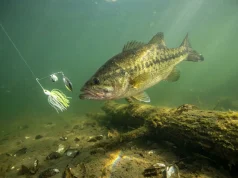
You are reeling a spinnerbait through pitch-black water when the rod loads up with violence. The fish didn’t see the flash, and it didn’t smell the plastic. It felt the water moving against its side long before the lure arrived.
This is the reality of the lateral line system. It is a biological radar that allows predators to hunt with incredible precision, even when they can’t see a thing. Over my years on the water, I’ve learned that understanding this “sixth sense” changes how you fish. You stop hoping for a bite and start controlling the strike zone.
While a fish’s eyes handle the approach, the lateral line handles the attack. By understanding how water moves, we can pick the right lures and stop spooking fish we never knew were there. This knowledge of predator-prey dynamics is what separates the lucky angler from the consistent one.
What Exactly is the Lateral Line System?
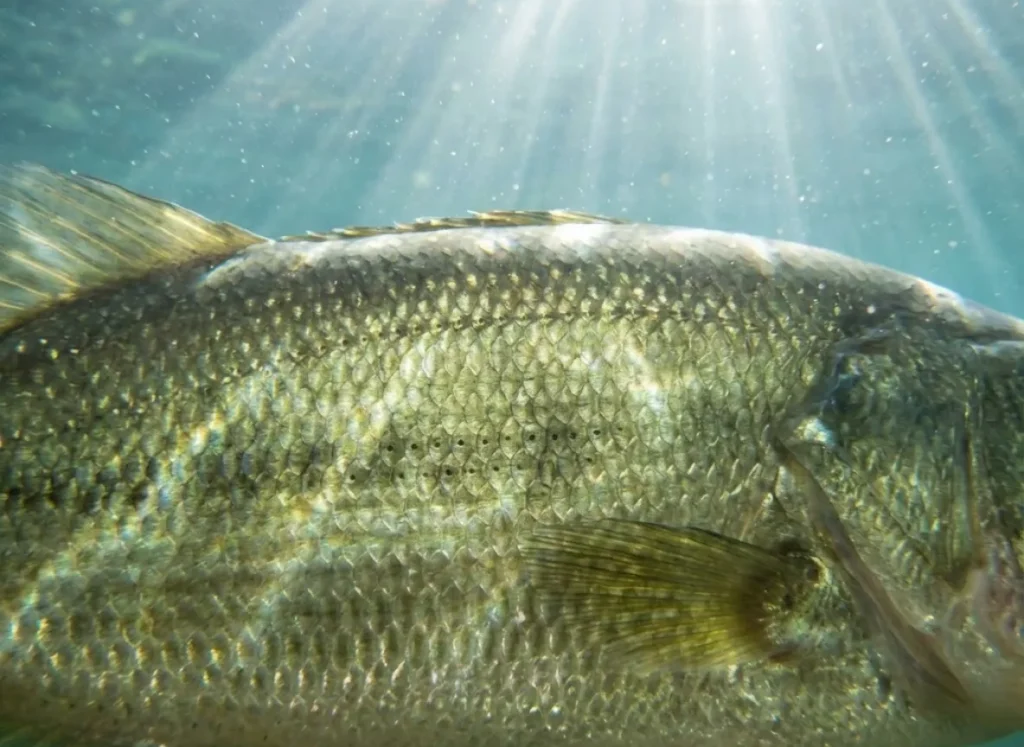
To catch the predator, you have to understand its sensors. This system isn’t magic; it is a highly developed mechanosensory organ found in fishes designed to detect movement without light.
Is the lateral line a form of hearing or a sense of touch?
Scientifically, the lateral line is classified as “distant touch.” It doesn’t hear sound like an ear does. Instead, it feels the physical sloshing of water, known as particle acceleration or water displacement. It operates almost exclusively at close range, usually only working within one or two body lengths of the fish.
Think of it like a subwoofer at a concert. Your ears hear the music, but your chest feels the bass. The lateral line is that feeling in the chest. Because it relies on physically moving water, the signal gets weak very fast as you move away. This is distinct from the inner ear or vestibular system, which handles balance and hearing.
This explains why fish often follow a lure. They might track it with their eyes from a distance, but they won’t strike until it gets close enough to “feel” right. Anglers need to know that while a loud rattle calls fish in with sound, research on the detection thresholds of particle motion vs. pressure shows that water displacement is what actually triggers the bite.
This system covers the gaps in a fish’s senses. Understanding how light absorption impacts fish vision gives you the full picture: when their eyes fail in the dark or mud, the lateral line takes over.
How do the different types of neuromasts function in various water conditions?
The lateral line is made up of tiny sensory units called Neuromasts. These are basically tiny hair cells with cilia covered in a gelatinous cap called a cupula that bends when water moves them.
First, you have Surface Sensors (Superficial Neuromasts). These sit right on the epithelium (skin). They are incredibly sensitive to tiny movements in still or slow water. Fish like Goldfish (Carassius auratus) and Catfish rely on these “free neuromasts” to find food in murky, stagnant ponds. Since the water isn’t moving, any vibration they feel usually means food.

Second, you have Tube Sensors (Canal Neuromasts). These are hidden inside the fluid-filled canals (subdermal canals) running down a fish’s side, connecting to the water via small pores. Evolutionary adaptations of the mechanosensory lateral line show that this design helps predators like Snook, Pike, or Trout ignore the rushing current.
Because the canal walls block out the background noise of the river, these fish can focus purely on the sudden movement of prey. This biology changes your strategy. You should use subtle vibration for fish in still water, but aggressive, snappy lures for fish in heavy current. This helps you understand how boundary layers and velocity gradients form specifically to hide predators using these tube sensors.
Pro-Tip: If you are fishing a fast-moving river, avoid steady-retrieve lures. The constant flow stimulates the fish’s sensors too much. Instead, use a “jerk-pause” retrieve. The pause allows the fish’s sensors to reset, making the next dart of the lure trigger a reaction.
Why Does Hydrodynamics Matter for Lure Selection?
Biology builds the sensor, but physics creates the signal. We need to choose lures based on their vibration to match what the fish identifies as food.
What is the “Magic Frequency” range for triggering a predatory strike?
The lateral line is tuned to a specific channel. It works best between 10 Hz and 100 Hz. This range matches the tail beat of a swimming forage fish and the struggling of wounded prey. A lure vibrating in this “Magic Frequency” feels real to a predator, triggering instant forage recognition.
Steady Swimming (5-10 Hz): Low-frequency hums signal a calm school. You can mimic this by slow-rolling spinnerbaits with large Colorado blades.
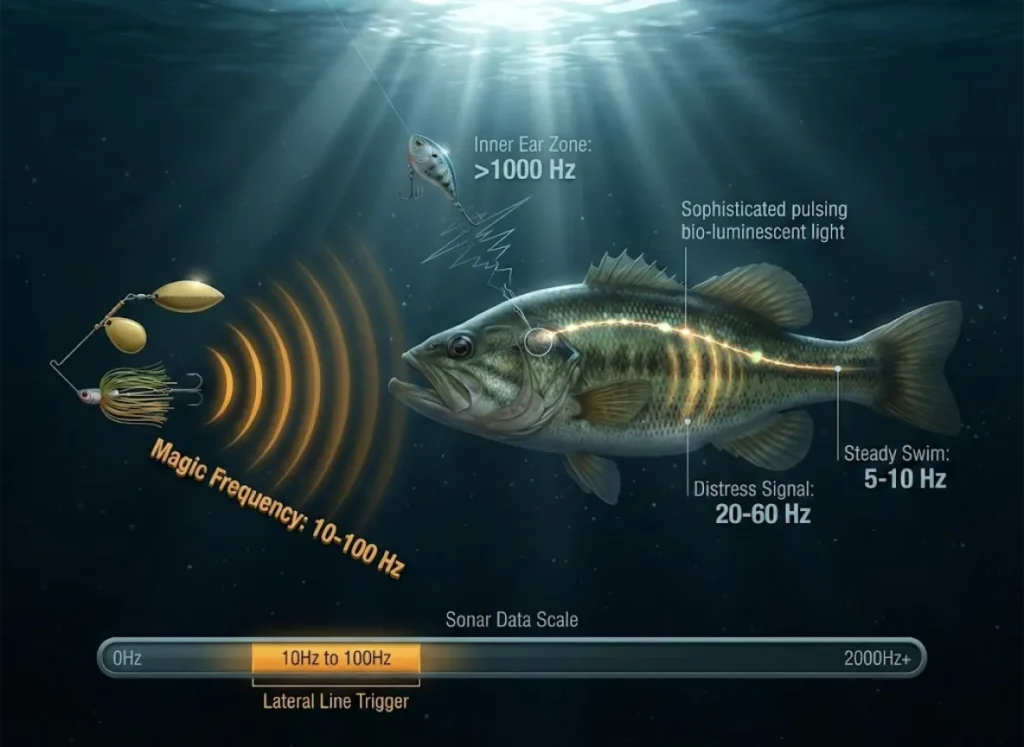
Distress Signals (20-60 Hz): Fast, irregular bursts in this range signal a vulnerable target. Squarebill crankbaits and vibrating jigs often replicate this panic pulse.
Lures that vibrate way above this range, like high-pitch BB rattles, are audible to the ear but don’t trigger the lateral line. In fact, frequency response properties of superficial neuromasts confirm that sensitivity drops off sharply around 200 Hz. This data helps anglers utilize the Biological Acoustic Match (BAM) strategy, distinguishing between the “thud” a fish feels and the “rattle” a fish hears.
Why do “silent” soft plastics often out-perform rattling hard baits?
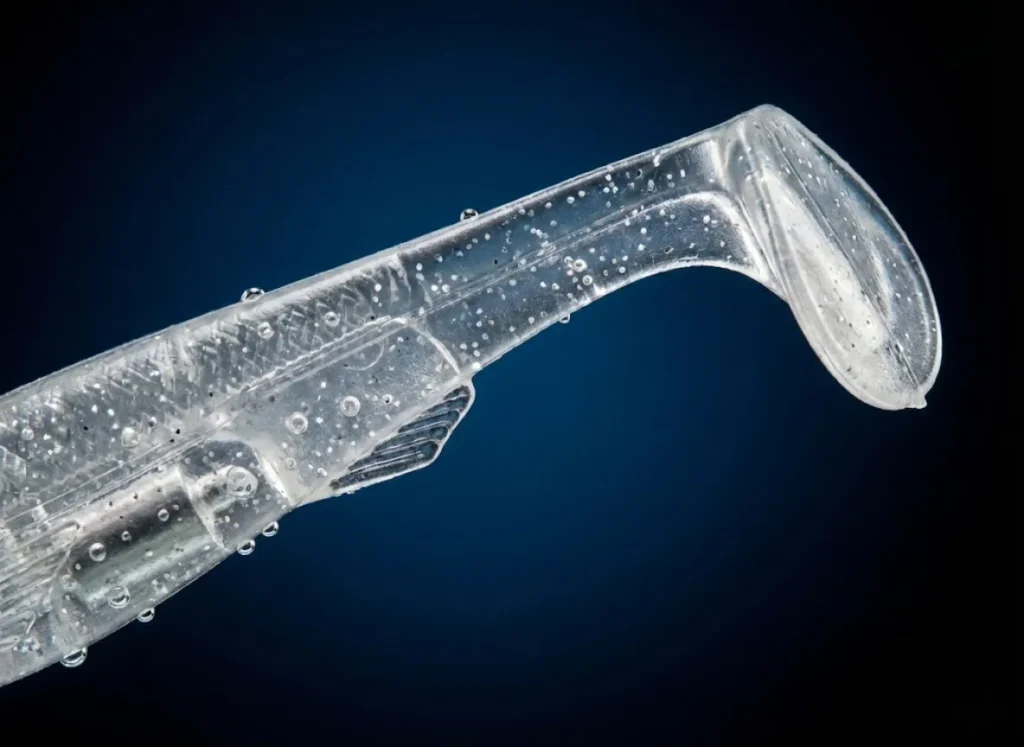
Many “silent” lures are actually very loud in terms of water movement. They push a lot of water without making a sound we can hear. Soft plastic paddle tails and swimbaits produce a “thump” that matches the natural feeling of a swimming fish.
This signals “live meat” to the lateral line. On the other hand, a plastic rattle sounds like an artificial object to the fish’s inner ear.
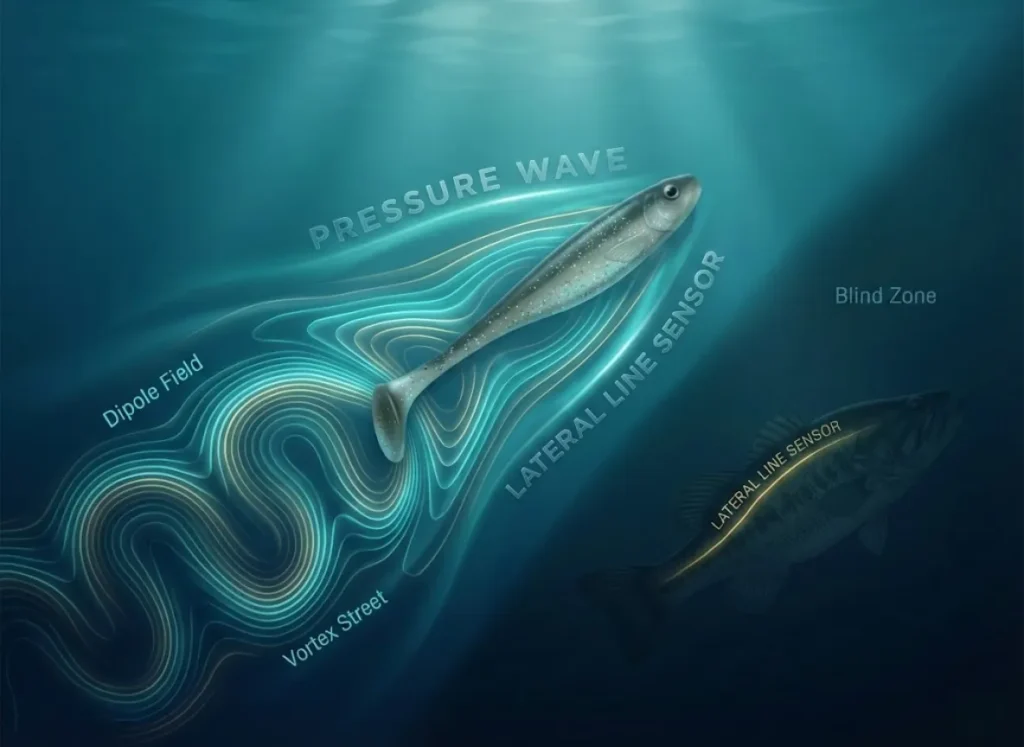
It comes down to pressure waves. The lure body pushes water, creating a wave that predators can track in total darkness. Hydrodynamic imaging capabilities in blind fish (like blind cavefish) prove that predators can detect these silent gliders just by the pressure gradients they push ahead of them. In pressured waters, matching the displacement (feel) rather than the volume (sound) is the key to fooling smart fish.
This is similar to how water displacement turns lures into triggers in topwater fishing, where the surface wake provides the target lock.
How Can Anglers Manipulate the Lateral Line for Better Results?

Even the perfect lure won’t work if you spook the fish first. We call this the Stealth Protocol.
How does boat noise “mask” the prey signal?
Masking is what happens when background noise ruins the signal. Think of it like trying to have a conversation in a loud bar. Trolling motors and waves slapping the hull create low-frequency hydrodynamic noise. This noise overlaps with the sensitivity of the lateral line.
This creates a “fog” in the water. The predator can hear the boat, but the noise hides the subtle wake of your lure. Research on the impact of boat noise on fish listening space indicates that man-made noise can cut a fish’s sensing range in half.
To fix this, you need to manage your spook distance. Kill the main engine 400 yards out and drift the final stretch. Using drift socks or poling, rather than constant trolling motor thrust, keeps the water quiet enough for the fish to find your bait. When you must use power, consider brushless trolling motor technology for stealth to keep things as quiet as possible.
How should you adapt your retrieval tactics for different species?
The Snook: These fish have a massive lateral line stripe. They are experts at filtering out current noise. Use sharp, erratic snaps with jerkbaits. This creates sudden spikes of movement that cut through the background flow.
The Catfish: Their head is covered in exposed pores. Use steady, low-frequency baits suspended off the bottom. This maximizes the vibration trail in the still water they prefer. This is critical when targeting catfish using nocturnal wake tracking.
The Bass: They use both sight and touch. “Kill” the bait (stop it completely) to trigger a visual reaction. However, in dirty water, keep a thump going so they don’t lose track of it.
The Salmon: Atlantic Salmon and other river species use the lateral line for rheotaxis (facing upstream) to navigate currents. In murky glacial water, the lure must swing slowly and close to the head to be detected.
Understanding how fish sense the world around them allows you to customize your retrieve. If you can match the speed of your lure to the natural swimming rhythm of a real fish, you will trigger instinctual strikes.
Pro-Tip: When fishing for Bass in muddy water with a crankbait, switch to a “wide wobble” squarebill. The wide movement pushes more water, effectively making the lure feel “bigger” to the fish in the dark.
Conclusion
The lateral line is a short-range system. Your lure must be close—usually within a foot or two—to be “felt.” By matching your lure’s vibration to the low-frequency “thump” of natural prey, you stop guessing and start engineering a bite. Remember that silence is often better than noise. Soft plastics move water mass without the unnatural sound of rattles.
Next time you are on the water, close your eyes and focus on what your lure feels like through the rod tip. That is exactly what the fish feels, too. Explore our full library of Advanced Fishing Strategies to continue refining your approach.
FAQ – Frequently Asked Questions
Can fish hear my lure rattles with their lateral line?
No. The lateral line generally detects low vibrations below 200 Hz. High-pitched rattles are much higher than that and are detected by the fish’s inner ear, not the lateral line.
How far away can a fish detect a lure using its lateral line?
The range is very short, typically only 1 to 2 body lengths of the fish. Beyond this distance, the water movement is too weak to be useful, and the fish relies on hearing or sight.
Does a trolling motor scare fish away?
It does more than scare them; it blinds them. The vibration of the motor acts like static interference, making it difficult for fish to pinpoint exactly where your lure is.
What is the best lure vibration for muddy water?
You want lures that push a lot of water with a low frequency. A spinnerbait with a large Colorado blade is perfect. The strong thump cuts through the interference and helps the fish locate the bait without seeing it.
Risk Disclaimer: Fishing, boating, and all related outdoor activities involve inherent risks that
can lead to injury. The information provided on Master Fishing Mag is for educational and informational purposes
only. While we strive for accuracy, the information, techniques, and advice on gear and safety are not a substitute
for your own best judgment, local knowledge, and adherence to official regulations. Fishing regulations, including
seasons, size limits, and species restrictions, change frequently and vary by location. Always consult the latest
official regulations from your local fish and wildlife agency before heading out. Proper handling of hooks, knives,
and other sharp equipment is essential for safety. Furthermore, be aware of local fish consumption advisories. By
using this website, you agree that you are solely responsible for your own safety and for complying with all
applicable laws. Any reliance you place on our content is strictly at your own risk. Master Fishing Mag and its
authors will not be held liable for any injury, damage, or loss sustained in connection with the use of the
information herein.
Affiliate Disclosure: We are a participant in the Amazon Services LLC Associates Program, an
affiliate advertising program designed to provide a means for us to earn advertising fees by advertising and linking
to Amazon.com. As an Amazon Associate, we earn from qualifying purchases. We also participate in other affiliate
programs and may receive a commission on products purchased through our links, at no extra cost to you. Additional
terms are found in the terms of service.