
In this article
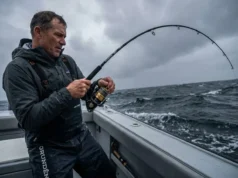
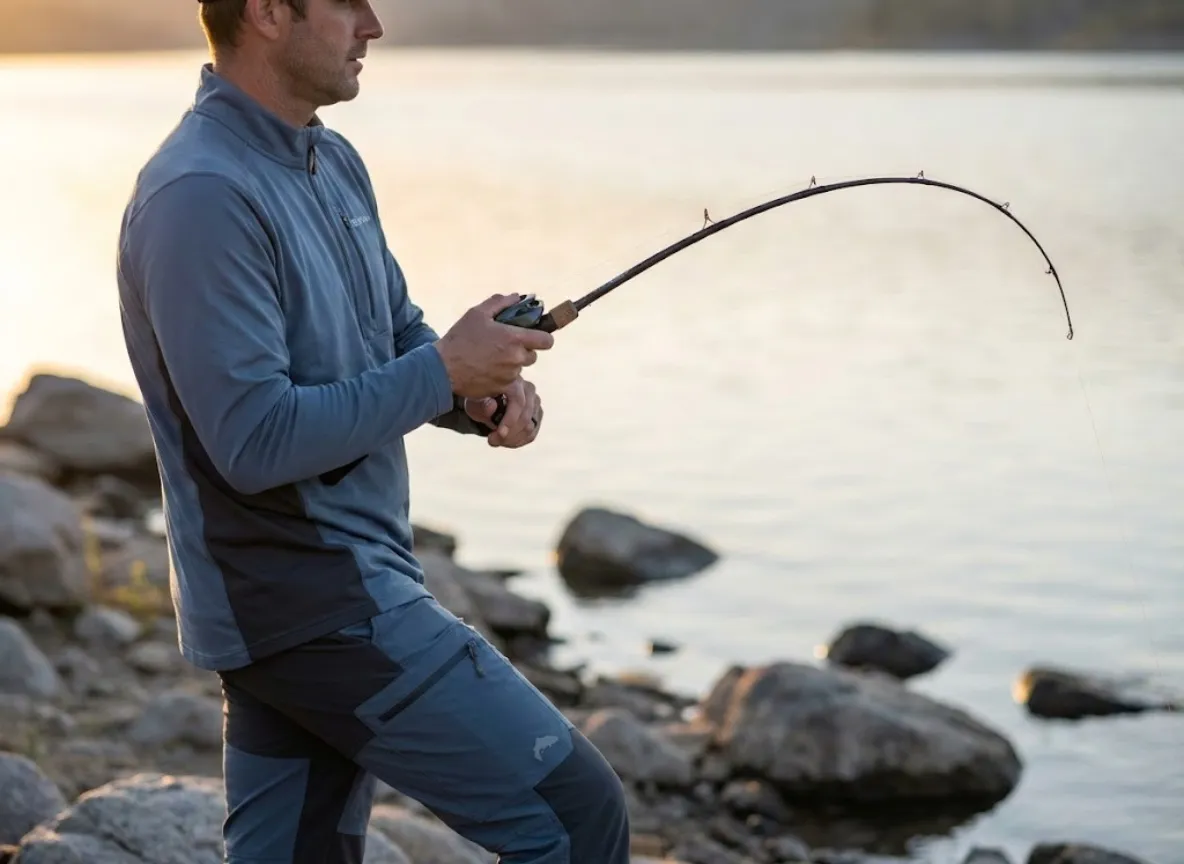
The scale read 18 pounds. My drag was set to 4. The fish was 80 feet out, bulldogging toward a submerged brush pile, and every time I swept the rod, the pressure felt mushy. Not the solid thunk of a proper hookset, but a delayed, rubbery resistance that made me question if the hook had even penetrated.
After twenty years on the water, I’ve felt that frustration countless times. And for most of those years, I blamed the wrong thing. I assumed my monofilament line was stretching 25%—because that’s what the package said. That’s what every tackle shop employee told me. That’s what I read in every fishing magazine.
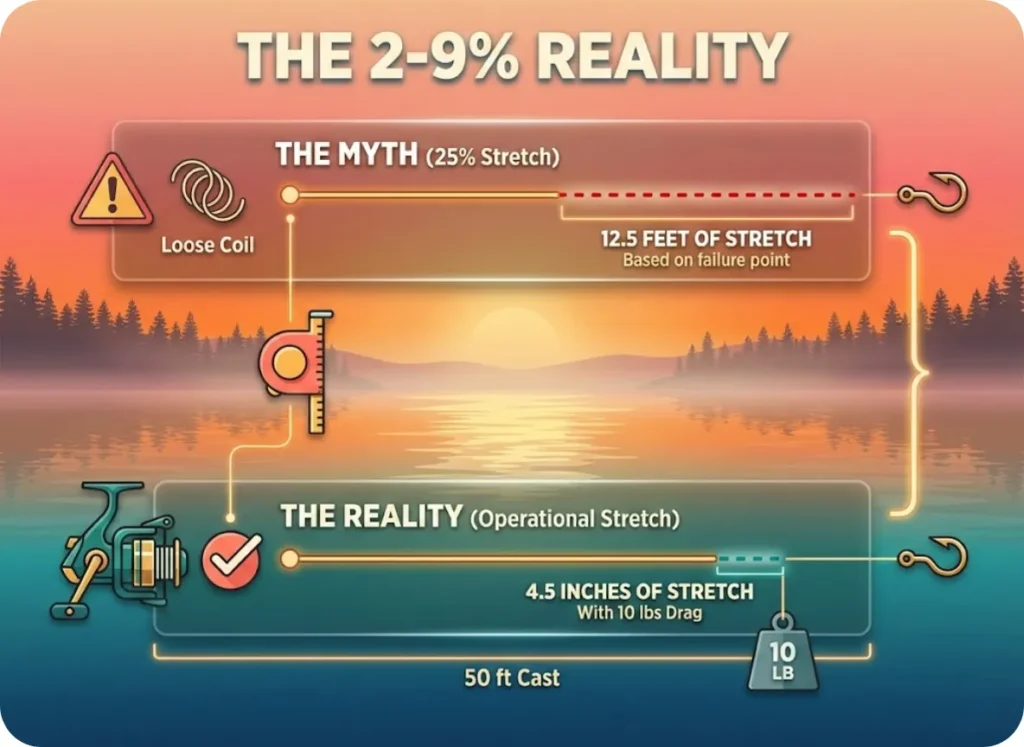
But here’s the truth: that 25% figure is a laboratory number measured at the exact moment the line snaps. It has almost nothing to do with how mono behaves when you’re actually fighting a fish. The real line stretch—what you experience under normal drag settings—is somewhere between 2% and 9%. Understanding this changes everything about how you set hooks, select line weights, and approach long-distance presentations.
⚡ Quick Answer: Monofilament stretches only 2-9% under normal fishing drag settings, not the 25-35% stated on packaging. That marketing figure represents “stretch to break”—the elongation at the exact moment of line failure. Real-world operational stretch is much lower, which affects hookset efficiency at distance. Beyond 100 feet, you may lose 25-66% of your hook-setting pressure due to the damping effect of even this modest stretch.
The Polymer Science Behind Monofilament Stretch
Why Nylon Stretches: The Molecular Architecture
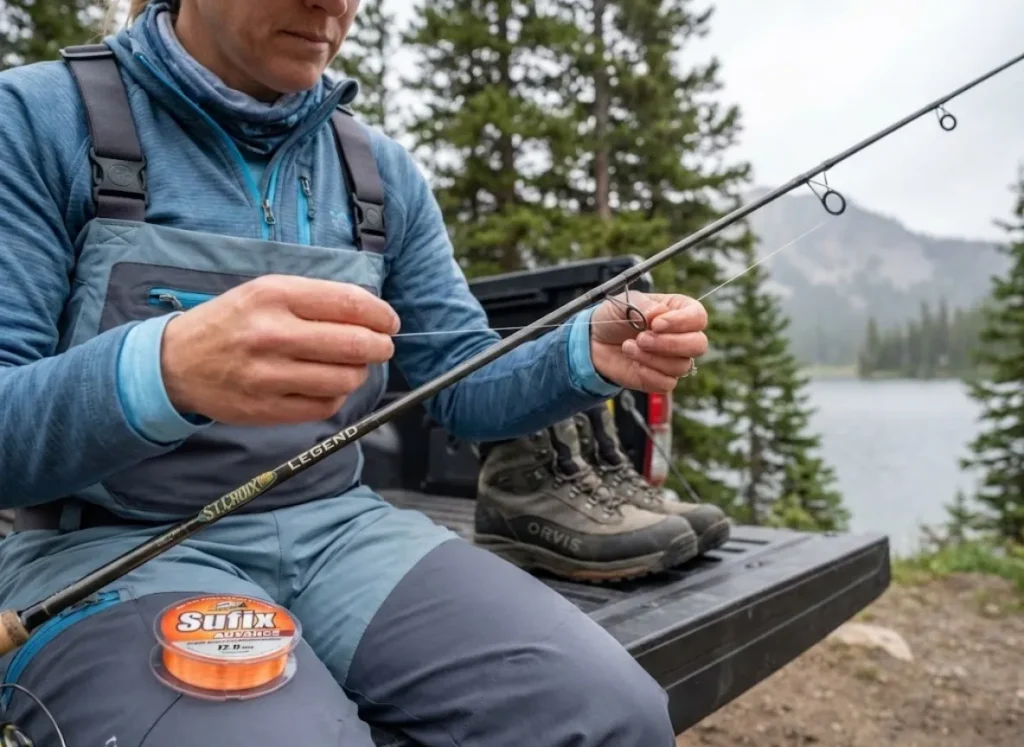
Every spool of monofilament fishing line starts as a polymer—specifically, a polyamide that most of us call nylon monofilament. But not all nylon is created equal. The fishing line industry uses two main formulations: Polyamide 6 (PA6) and Polyamide 66 (PA66).
The difference comes down to how the material is built. PA6 creates a more flexible material—this is what you’ll find in lines marketed as “extra light” or “extra limp”—think Berkley Trilene XL. PA66 is about 12% harder and more resistant to heat. When a manufacturer mixes these two—or adds high-modulus polyethylene into the blend—you get what they call a copolymer.
What matters for fishing is this: both formulations exhibit elastic force behavior. When you put pressure on the line, the polymer chains stretch. When you release that pressure, they return to their original shape without damage. This is fundamentally different from fluorocarbon, which undergoes permanent weakening under heavy loads.
Pro tip: Tournament anglers often pre-stretch new mono by pulling 50 feet of line between wet fingers after spooling. This “wet finger pull” aligns the molecular chains, removes the most elastic portion of the stretch, and dramatically improves sensitivity.
This elastic property is why mono has earned its reputation as “Old Reliable.” It can absorb shock. It can handle the violent headshake of a largemouth without snapping. But that same property becomes a liability when you’re trying to drive steel into a bony jaw at 100 feet.
Understanding the physics of fishing line selection helps you choose the right material for each situation.
The Critical Difference: Elastic vs. Plastic Deformation
Here’s something most anglers don’t realize: the “low stretch” claim on fluorocarbon packaging tells only half the story. Fluoro is stiffer than mono—so it feels more sensitive. But push it too hard, and it enters a phase where it permanently weakens.
You’ve probably seen this without knowing what it was. That “necking” you notice when you pull on a section of fluoro that took a heavy hit? That’s permanent damage. The line will never return to its original strength. Monofilaments, by contrast, can stretch and recover repeatedly without structural failure—as long as you stay below the breaking point.
This is why experienced anglers still reach for heavy mono as mainline when trolling for king mackerel or fighting surging carp. Repeated stress over a long fight favors a material that recovers rather than degrades.
The 25% Myth vs. The 2-9% Reality
Where the 25% Number Comes From
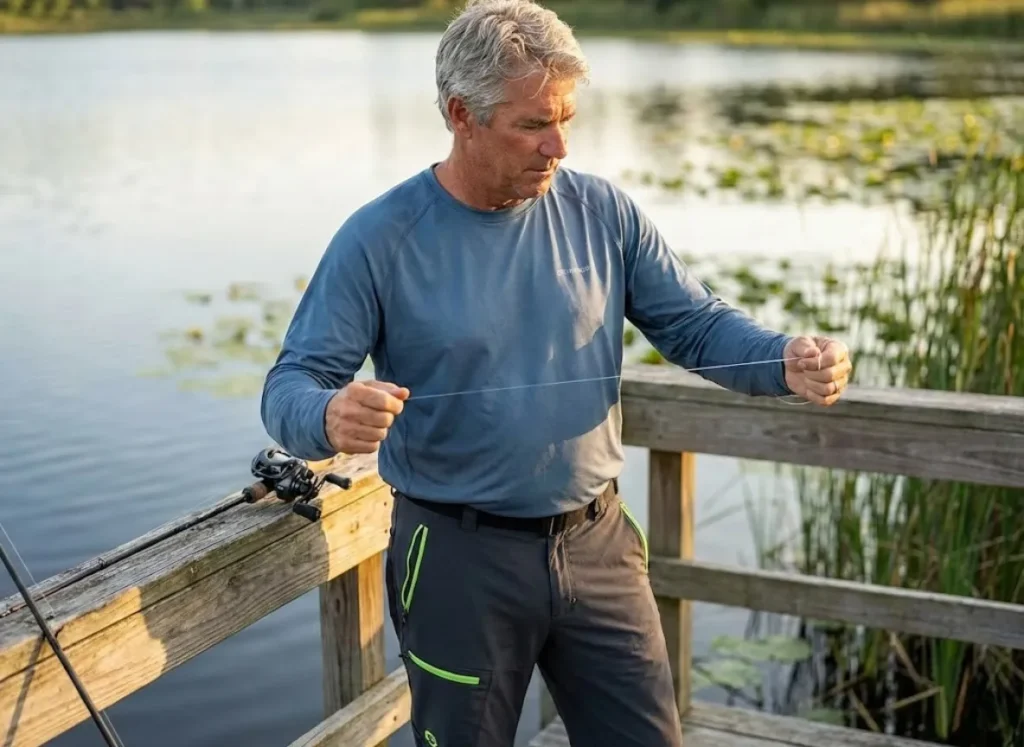
That “25% stretch” printed on your monofilament package isn’t a lie—it’s just taken from a test that has nothing to do with fishing. In laboratory conditions, technicians clamp a 1-meter sample of line into an Instron tester—basically a high-precision stretching device—and pull until the line breaks. The stretch percentage they record at the moment of failure is typically 25-35%, depending on the brand.
But here’s the obvious problem: you don’t fish at the breaking point. If you did, you’d lose every fish.
Effective angling happens in a completely different zone. Your drags should be set at 25-33% of the line’s rated breaking strength. Under those conditions—the actual conditions where you fight fish—the stretchiness drops dramatically.
The Real Numbers: Independent Testing Results
Independent tests tell a completely different story than the marketing materials. When researchers applied 5 pounds of pressure to 15-pound test mono—a realistic drag setting—they measured stretch of just 12 inches over 50 feet. That’s exactly 2%.
Even when anglers pushed the gear hard, using heavy rods and maximum practical drag, the stretch rarely exceeded 9% before the drag released more line. The 2-9% operational stretch is your actual working range, not the catastrophic 25-35% at failure.
This matters because anglers who believe the 25% myth often over-compensate with their hooksets. Meanwhile, those switching from mono to braid expect the same feel and wonder why mono seems “mushy.” The truth is more subtle: the delayed connection you feel at distance isn’t purely line stretch—it’s a combination of stretch, rod flex, and the energy required to overcome the bow your line makes in the water.
Understanding the relationship between stretch and setting your drag correctly can transform your hookup ratio overnight.
The Distance Problem: Hookset Force Loss
The Damping Effect at Distance
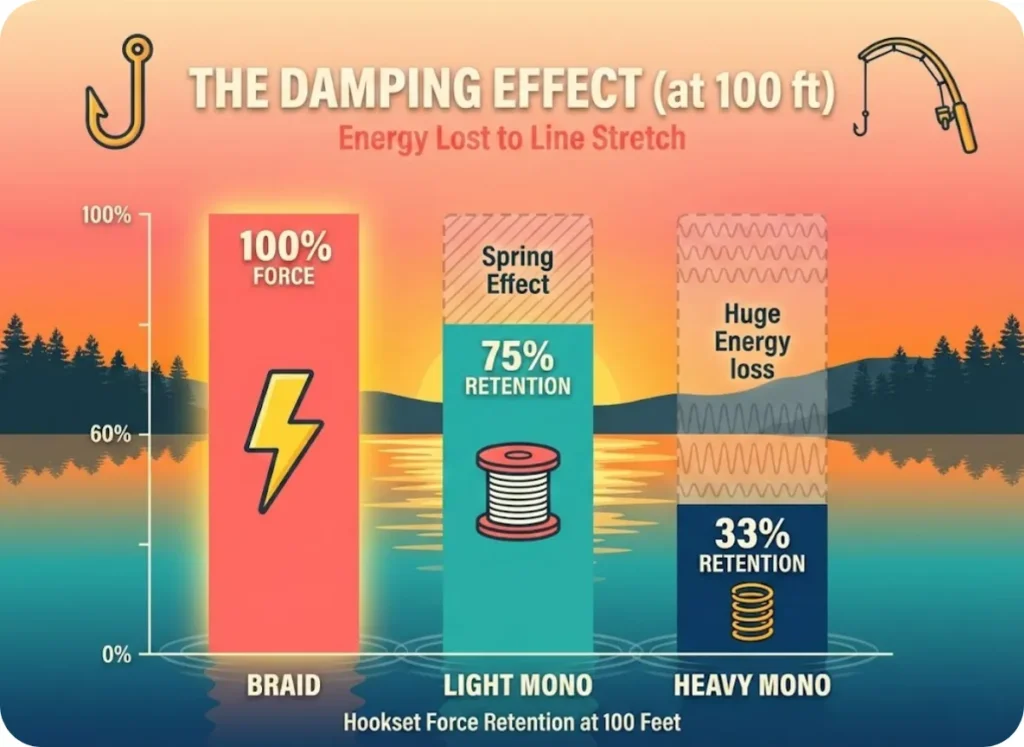
Here’s where the 2-9% stretch becomes a real handicap: hookset force loss at distance. Even a small percentage of elongation translates to significant energy absorption when you’re working with 100 feet of line.
Controlled testing reveals a brutal reality. At 100 feet:
- Braided line retained 100% of the drag’s potential punch—the fish felt the same force as if it were at 20 feet.
- Light mono lost approximately 25% of hook-setting force due to the “bungee effect.”
- Heavy mono stretch lost up to 66% of the hookset pressure.
Why does heavy line perform worse? Because heavier mono allows for higher drag settings, which means more absolute force stretching the line. The actual inches of elongation increase even though the line percentage might be similar. That creates a massive damping effect that can prevent a hook from driving home, especially in bony mouths.
Pro tip: When fishing beyond 100 feet with monofilament, switch from a “sweep” hookset to a “snap” hookset. Build momentum before contact to overcome the damping effect. On really long presentations, consider high-modulus copolymers like Sufix Advance, which offers 50% less stretch than standard nylon.
The Three-Zone Framework: Distance-Based Line Selection
After years of testing different lines at different distances, I’ve developed a simple framework:
Zone 1 (0-50 feet): The 2-9% stretch is your friend here. It acts as a shock strength absorber during violent strikes and prevents treble hooks from ripping out during headshakes. Mono shines in close-quarters combat.
Zone 2 (50-100 feet): Stretch starts working against you. If you’re consistently fishing this range, consider copolymer formulations—hybrids that blend nylon with HMPE to cut stretch by about half while maintaining easy-to-tie knots.
Zone 3 (100+ feet): Monofilament becomes a liability. Switch to braid as mainline with a mono or fluoro shock leader, or commit to aggressive hook-set techniques that account for the energy loss.
For tournament anglers, knowing the physics of hook setting at various distances separates consistent performers from frustrated also-rans.
Environmental Degradation: Sun, Water, and Line Death
The UV Degradation Timeline
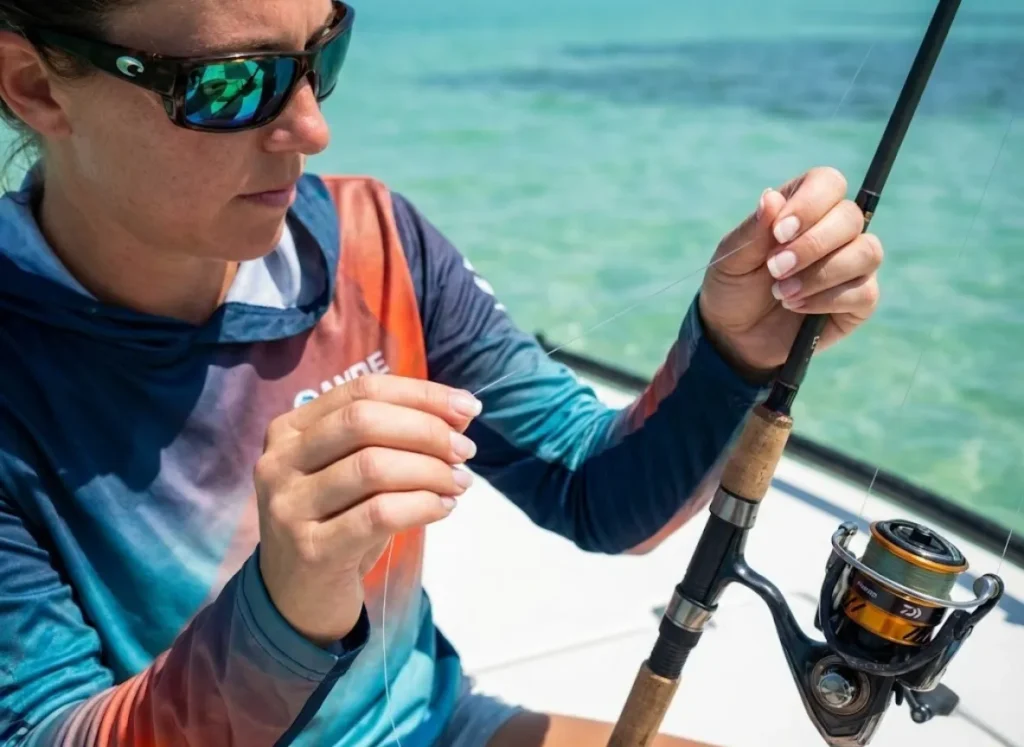
Your monofilament is dying while you fish with it. That sounds dramatic, but it’s accurate. Nylon polymer is organic, and UV radiation from sunlight breaks the bonds that give it strength.
Testing data paints an uncomfortable picture:
- First 100 hours of direct sun exposure: approximately 20% strength loss
- After 300 hours: strength loss can reach 40-50%
That rod you leave in the boat rod holder? The reel sitting on your deck during tournament days? Every hour compounds the damage—the sun literally breaking apart the polymer’s backbone.
This is why serious anglers store reels in dark, temperature-controlled environments. It’s also why you should replace mainline every 12-18 months, even if you haven’t used it hard. That spool has been silently degrading.
The Water Absorption Problem
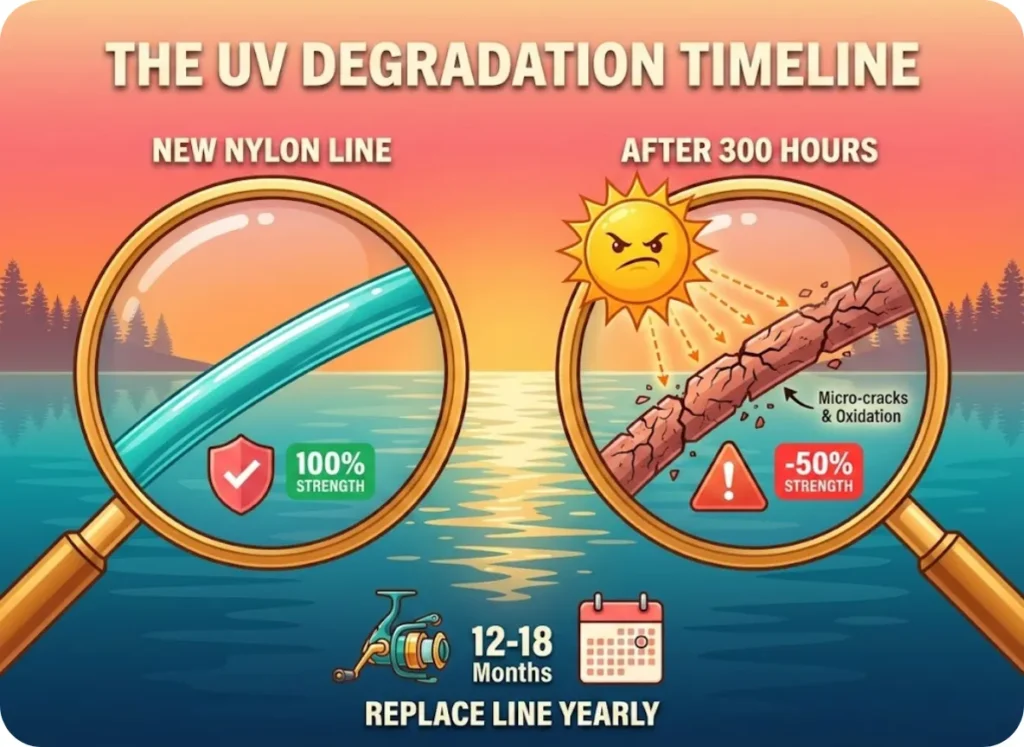
Unlike braid and fluorocarbon, nylon monofilament lines are hygroscopic—they attract and absorb water. Submerge a section of mono, and within hours it will absorb 3-10% of its weight in water molecules.
Those water molecules slide between the polymer chains, acting as a softener. The results:
- Dimensional changes: The thicker line swells, increasing in diameter and weight
- Softening: Stiffness drops by up to 40%, increasing operational stretch and decreasing sensitivity
- Strength reduction: A wet line tests 15-20% weaker than a dry one
Functional impact starts at about 2 hours of submersion. By that point, you’re fishing with a materially different line than what came off the spool dry.
The good news? This softening makes mono more supple and easier to cast. Many anglers actually prefer how “broken-in” mono lines handle. Just know that you’re trading some strength and sensitivity for that improved castability.
For related maintenance issues, check out techniques for fixing line memory problems in older monofilament.
Pro tip: The IGFA line class testing protocols provide standardized methods for measuring line strength—understanding these helps you evaluate line manufacturers claims.
When Stretch Is Your Friend: The Strategic Applications
Treble Hooks and Reaction Baits
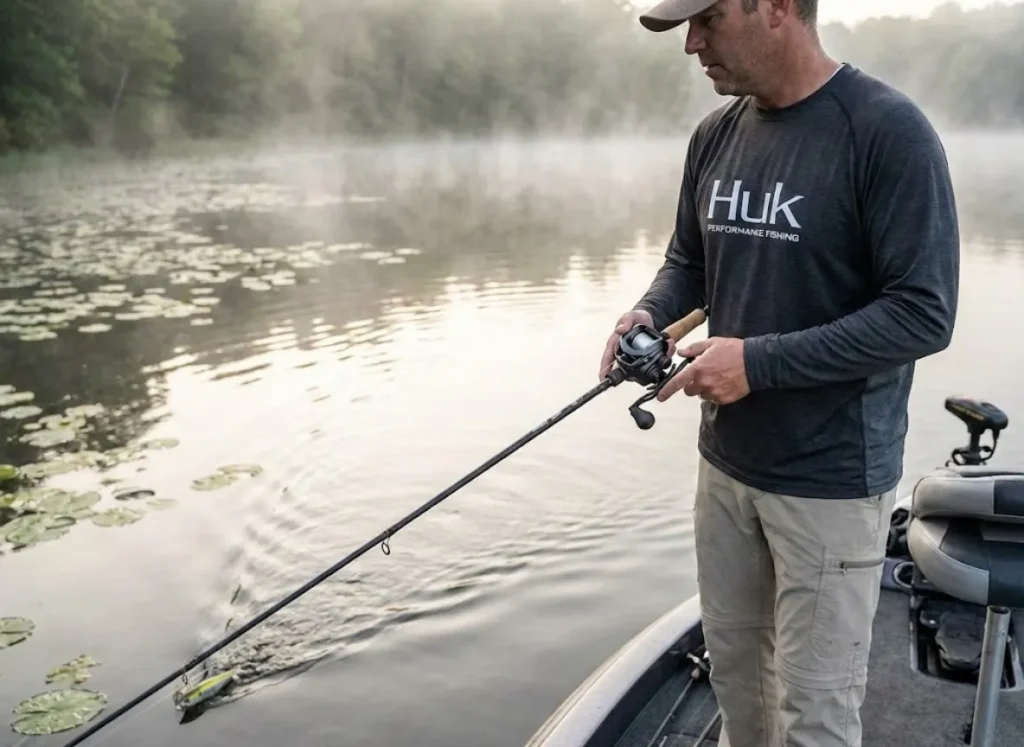
Crankbaits. Jerkbaits. Topwater plugs. Anything with treble hooks benefits from mono’s 2-9% stretchability. The elasticity functions as a shock absorber, preventing hooks from ripping free during violent direction changes.
Consider what happens when a bass inhales a crankbait and immediately reverses. That creates a massive instantaneous load—exactly the kind of force spike that tears trebles from soft tissue. Mono’s stretchy nature absorbs that spike, giving the hooks time to find solid purchase.
Bassmaster analysis confirmed this: “A diving crankbait fished on stretchless piano wire-type line will noticeably lose some of its ‘bass appeal’ because it will look like it’s being dragged through the water rather than swimming.” The stretch of mono creates a more natural lure action—an overlooked benefit beyond just shock absorption.
Topwater Applications and Buoyancy
Monofilament’s buoyancy makes it nearly neutrally buoyant—denser than water, but much lighter than fluorocarbon. For topwater presentations, this is critical.
Mono keeps poppers and walkers on the surface. Fluorocarbon drags the nose down, ruining the side-to-side “walking the dog” action that triggers explosive strikes. In fly fishing, nylon leaders are non-negotiable for proper dry fly presentation—anything heavier sinks your fly.
For deeper understanding of topwater fishing, see the science of topwater fishing.
Short-Line Fighting and Boat-Side Battles
When a fish is near the boat, mono’s stretch becomes an insurance policy. Those sudden dives and direction changes that happen when a fish sees the net? Stretch absorbs the shock and prevents snap-offs.
At 20-30 feet, even 9% stretch represents only 20-30 inches of elongation—enough to absorb shocks, not enough to compromise control. Berkley Trilene Big Game has become legendary in catfish and carp communities precisely for this short-line forgiveness factor. Anglers regularly report landing 20-pound fish on 12-pound test lines, trusting the shock strength to handle the close-range chaos.
DIY Testing: Measuring Your Line’s Actual Stretch
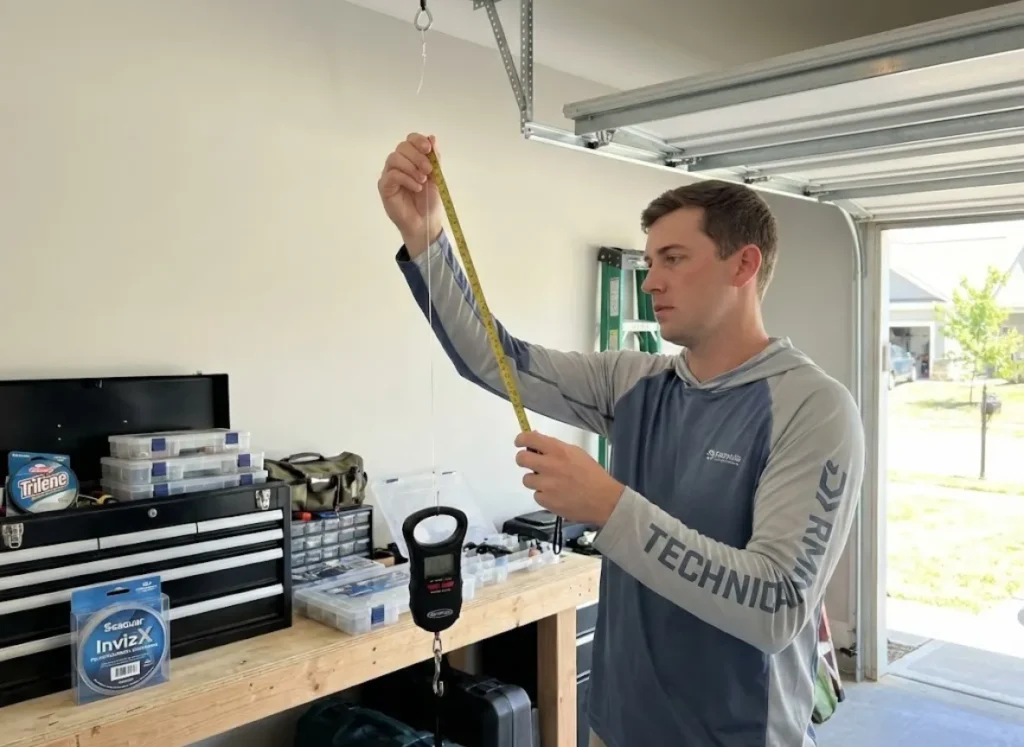
Method 1: The 1-Meter 50% Load Test (Katran Method)
Want to know exactly what your line does under pressure? Here’s how to test it yourself.
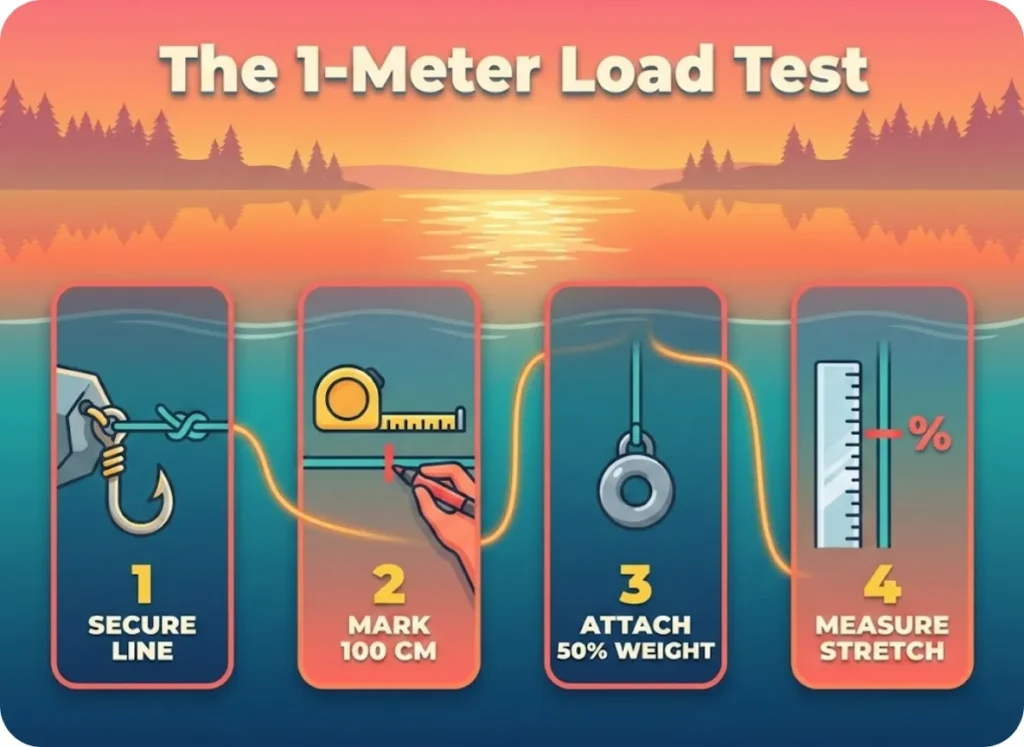
- Secure a 1-meter (100 cm) sample of line to a fixed point—a sturdy hook works well.
- Mark the 0 cm and 100 cm points clearly with a tape measure or marker.
- Attach a weight equal to 50% of the line’s actual breaking strength (not the label weight—most mono breaks significantly higher than rated).
- Measure the new length using your drag-applied measure.
- Every centimeter of elongation equals 1% stretch.
If your line measures 106 cm under load, you’re looking at 6% operational stretch—right in the middle of the expected 2-9% range.
Method 2: The Pre-Stretch Stabilization (BassBlaster Method)
This technique conditions new line for improved fishing performance:
- Pull 50 feet of line off the reel
- Apply a slow, steady pull to approximately 75% of breaking strain
- Hold for 60 seconds
- Re-spool under tension
This process aligns polymer chains, increases breaking strength by up to 1 pound, and permanently removes the most elastic portion of the stretch. The result: more sensitive line with reduced elongation under normal fishing loads.
Safety note: Stretching line near the breaking point creates risk of failure. Wear eye protection during pre-stretching.
For proper line management after conditioning, follow the zero-twist spooling method to maintain performance.
Conclusion
The 25% stretch myth has survived for decades because it’s technically true—in a laboratory, at the moment of catastrophic failure. But you don’t fish at failure. You fish at 25-33% of your line’s rated strength, where stretch drops to a workable 2-9%.
Three takeaways for your next trip:
First, distance is the decider. Within 50 feet, mono’s stretch is an asset. Beyond 100 feet, it becomes a liability that demands either technique adjustment or a switch to lower-stretch materials.
Second, monofilament is a “living” material. UV degradation takes 20% of your strength in the first 100 hours of sun exposure. Water absorption drops stiffness by up to 40%. Store your gear right, and replace line annually—even if it looks fine.
Third, stretch is a feature, not a bug, when used correctly. For treble hooks, topwater baits, and boat-side battles, that 2-9% elasticity provides shock absorption that neither braid nor fluorocarbon can match.
Stop compensating for stretch that doesn’t exist. Set your hook with confidence, knowing exactly what your monofilament line stretch is—and isn’t—doing beneath the surface.
FAQ
How much does monofilament line actually stretch while fishing?
Under normal fishing conditions with drag set at 25-33% of line strength, monofilament stretches only 2-9%—far less than the 25-35% stretch to break figure on packaging. The higher number represents elongation at the exact moment of line failure, not operational performance.
Does monofilament stretch more when wet?
Yes. Wet monofilament absorbs 3-10% of its weight in water, which softens the polymer and increases operational stretch while reducing breaking strength by 15-20%. Sensitivity also decreases as the line becomes more supple.
Is monofilament stretch good or bad for fishing?
It depends entirely on application. Stretch benefits treble hook lures (prevents hook pull), topwater presentations (maintains action), and short-line fighting (absorbs shock). It hurts long-distance hookset beyond 100 feet, where 25-66% of hookset pressure is lost to the damping effect.
What fishing line has the least stretch?
Braided line (PE) has near-zero stretch at less than 1%, followed by fluorocarbon at 1-4%, then monofilament at 2-9% operational. High-modulus copolymers like Sufix Advance offer 50% less stretch than standard mono while maintaining knot-friendliness.
How can I reduce my monofilament’s stretch?
Pre-stretch new line by pulling 50 feet to 75% of breakstrength for 60 seconds—this aligns polymer chains and permanently removes the most elastic portion. Alternatively, use high-modulus copolymers designed with HMPE integrated into the nylon extrusion for reduced stretch out of the box.
Risk Disclaimer: Fishing, boating, and all related outdoor activities involve inherent risks that
can lead to injury. The information provided on Master Fishing Mag is for educational and informational purposes
only. While we strive for accuracy, the information, techniques, and advice on gear and safety are not a substitute
for your own best judgment, local knowledge, and adherence to official regulations. Fishing regulations, including
seasons, size limits, and species restrictions, change frequently and vary by location. Always consult the latest
official regulations from your local fish and wildlife agency before heading out. Proper handling of hooks, knives,
and other sharp equipment is essential for safety. Furthermore, be aware of local fish consumption advisories. By
using this website, you agree that you are solely responsible for your own safety and for complying with all
applicable laws. Any reliance you place on our content is strictly at your own risk. Master Fishing Mag and its
authors will not be held liable for any injury, damage, or loss sustained in connection with the use of the
information herein.
Affiliate Disclosure: We are a participant in the Amazon Services LLC Associates Program, an
affiliate advertising program designed to provide a means for us to earn advertising fees by advertising and linking
to Amazon.com. As an Amazon Associate, we earn from qualifying purchases. We also participate in other affiliate
programs and may receive a commission on products purchased through our links, at no extra cost to you. Additional
terms are found in the terms of service.