
In this article
The game warden’s flashlight swept across my cooler, and my stomach dropped. Inside were three fish I was certain were Sand Seatrout—unregulated, legal, no worries. But as he held one up, his headlamp catching the faded spots along its flank, I realized my “certainty” was about to cost me $500. That fish wasn’t a Sandie. It was a stressed, pale juvenile Speckled Trout. And in Florida, “I thought it was…” doesn’t hold up in court.
After two decades on the water and too many close calls watching fellow anglers get cited, I’ve learned that fish identification isn’t about memorizing pretty pictures from a field guide. It’s about understanding the specific anatomical markers that hold up when color fades, spots disappear, and that game warden is waiting at the boat ramp. Here’s the systematic approach that will keep you legal—and keep more fish in the population where they belong.
⚡ Quick Answer: The BAMFAD method (Body, Appearance, Mouth, Fins, Area, Demeanor) provides a systematic, repeatable protocol for accurate identification in the field. Stop relying on color—it changes with stress and water depth. Instead, check structural features: the maxillary extension (jaw hinge relative to the eye) for bass, the anal fin ray count for seatrouts, and the tongue tooth patch for Spotted Bass. These physical markers don’t lie, and they’re the difference between a fish fry and a $500 citation.
The High Cost of a Wrong ID: Why This Matters

The “Strict Liability” Reality
Here’s what most anglers don’t understand until the citation is in their hand: fish misidentification is a strict liability offense in most states. That legal phrase means intent doesn’t matter. You can’t argue that you tried your best or thought it was a different species. If the wrong fish is in your cooler, the violation is complete, and your wallet is about to get lighter.
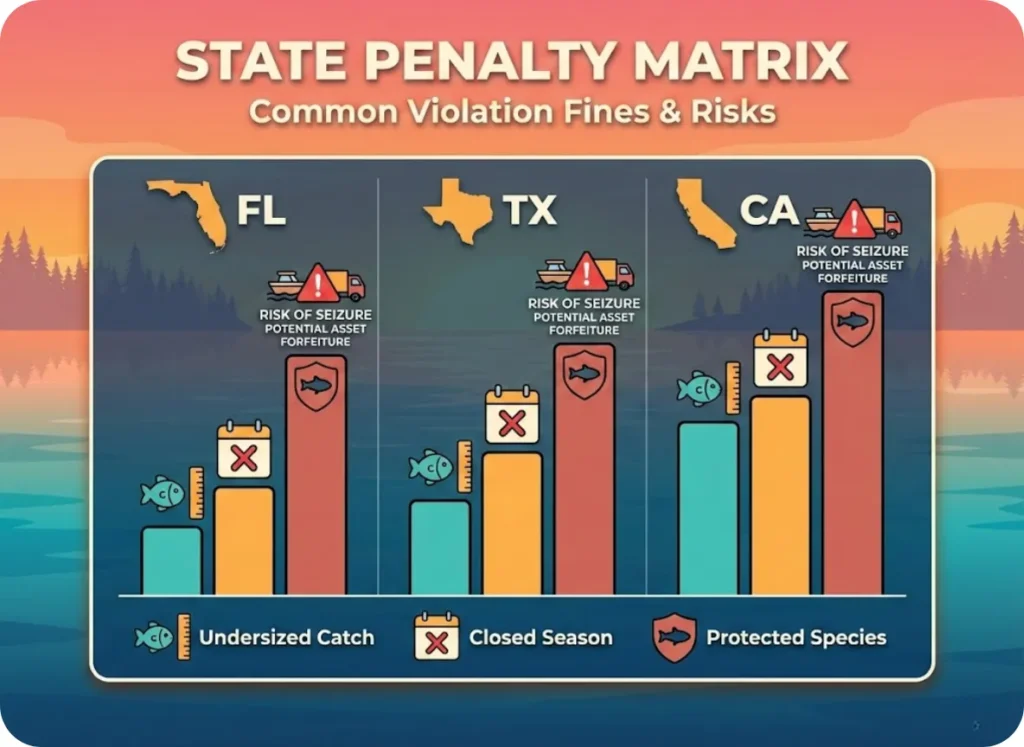
The numbers are brutal. In Florida, harvesting a protected or endangered species runs $2,500 or more. A closed season violation? That’s $500 per person. Over the bag limit? Another $500 base plus $100 for every undersized fish. And those are just the civil penalties.
Texas isn’t any more forgiving. Standard violations start as Class C misdemeanors—$25 to $500—but escalate quickly. Class B infractions carry $200 to $2,000 and up to 180 days in jail. Then there’s the separate “Civil Restitution” bill for the value of the wildlife you’ve illegally harvested. California? Even steeper. Undersized halibut will cost you $1,000 per fish plus gear forfeiture.
And in extreme cases—FL Level 4 violations, for instance—misidentification becomes a felony. Officers can seize your boat, your truck, your tackle. The Texas Parks & Wildlife penalty schedules spell out exactly how fast “an honest mistake” can turn into losing everything you drove to the ramp with.
Why Color Fails You
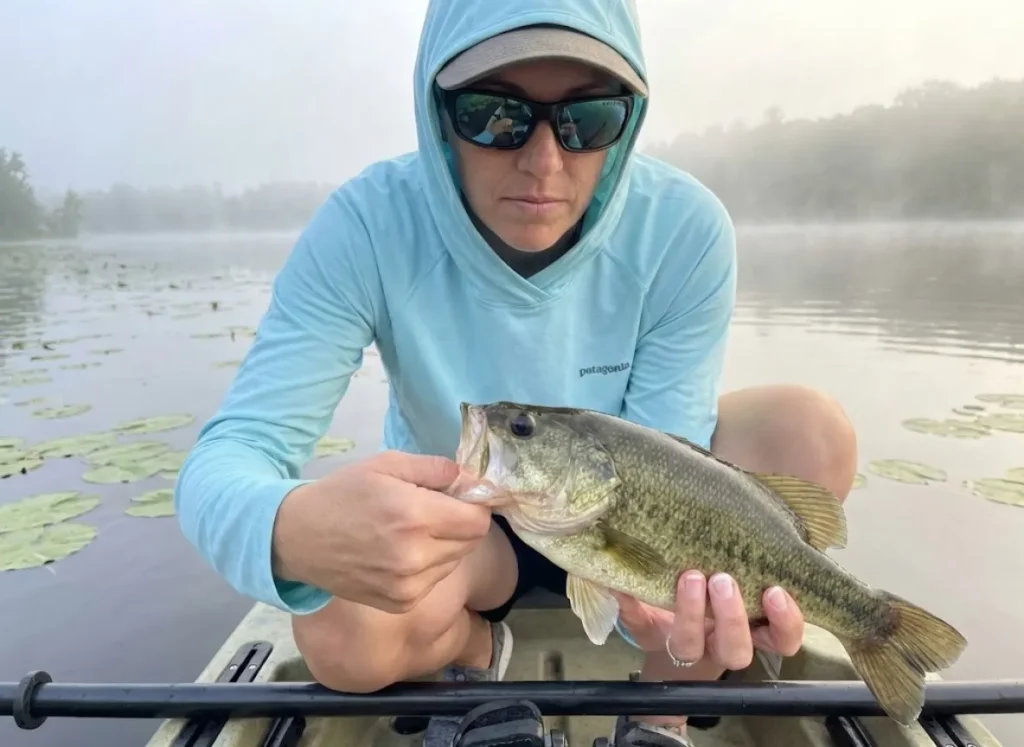
Color is the most dangerous identification tool you can rely on. I’ve watched a Spotted Bass fade from dark green with vivid lateral markings to a washed-out pale specimen that looked just like a Largemouth Bass after 20 minutes in a livewell. That’s stress coloration in action—and it happens faster than you’d believe.
It gets worse. Red Snapper caught in deep water are significantly redder than those pulled from shallow structure. A freshwater fish like the Largemouth will look nearly black in clear, vegetation-heavy water but pale as a ghost in muddy conditions. Relying on “It looks red, so it’s a Red Snapper” is the leading cause of identification errors that put anglers on the wrong side of a citation.
Pro tip: Never trust color alone. A muddy water bass looks completely different than a clear water bass. Run the structural checks—every time.
The BAMFAD Method: A Systematic Approach
The BAMFAD mnemonic was developed by naturalist Koaw as a framework for moving beyond unreliable species identification based on color. Each letter represents a check you run on any fish before it goes in the cooler: Body, Appearance, Mouth, Fins, Area, Demeanor. Master this sequence, and you’ve got a repeatable protocol that works when field identification guides fail.
B – Body Shape
Start with the silhouette. A fusiform body—spindle-shaped, tapered at both ends—belongs to fast swimmers like tuna and mackerel. Laterally compressed fish (deep body, narrow profile) include snappers and most panfish. Red Snapper has a distinctive “wedge” shape with a steep forehead. Demersal fish like Red Drum are more elongated, built for nearshore structure rather than open-water speed.
This first check narrows your options before you even look at color or markings. At dawn, at dusk, in murky water where you’re working off silhouettes anyway—body shape is your anchor.
A – Appearance (Markings)
Now you can look at markings, but with skepticism. The ocellus—that black “false eye” spot on a Red Drum’s tail—is reliable. Most have one, though individuals can carry anywhere from zero to twelve. The lateral line spots on Spotted Bass are distinct when the fish is fresh but fade rapidly under stress.
The critical rule: Spotted Seatrout have spots on their caudal peduncle and tail fin. Sand and Silver Seatrout do not. But remember—a stressed, faded Speck can lose enough color to pass for a Sandie to the untrained eye. Appearance is a secondary check, never your final answer.
M – Mouth Position & Anatomy
Here’s where proper identification gets reliable. Mouth position tells you immediately what kind of feeder you’re holding. Inferior (downward-facing) mouths belong to bottom feeders like Red Drum. Terminal mouths (end of snout) are found on bass. Supraterminal (upward-angled) means surface feeders like Tarpon.
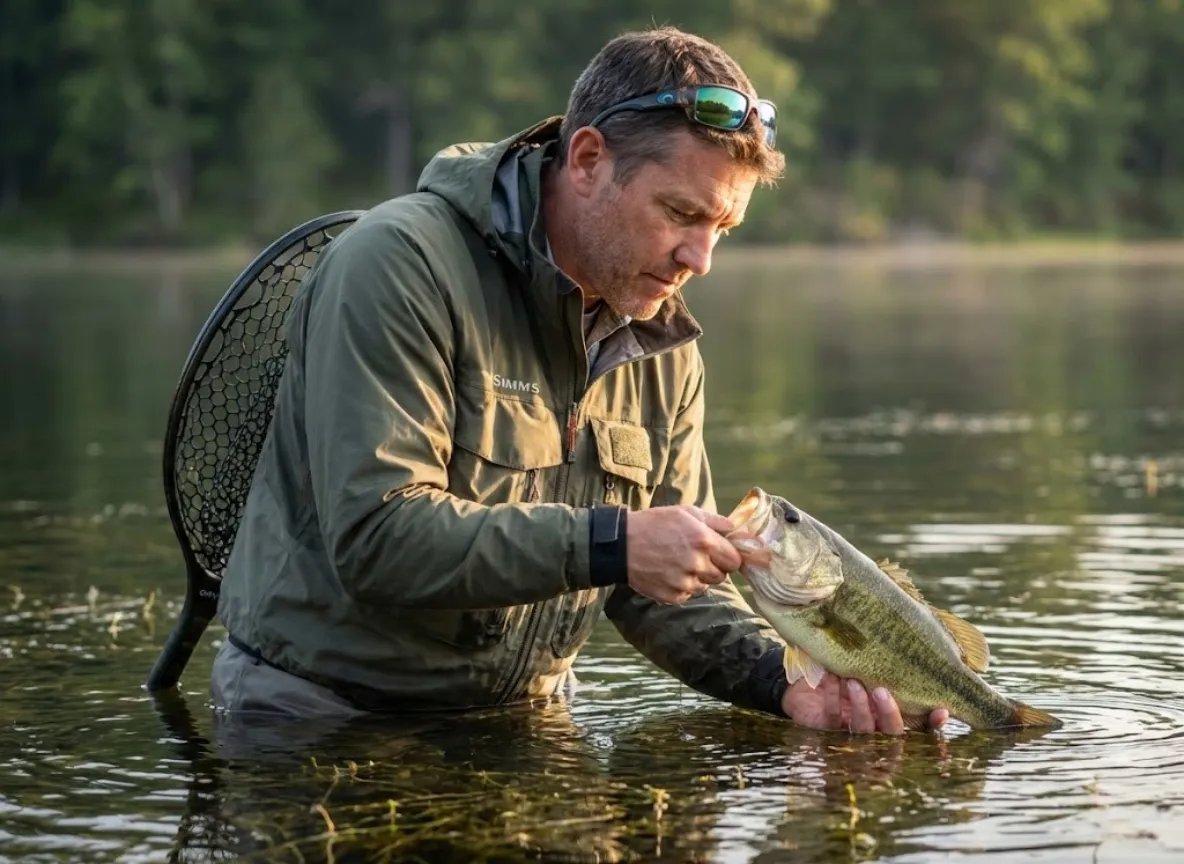
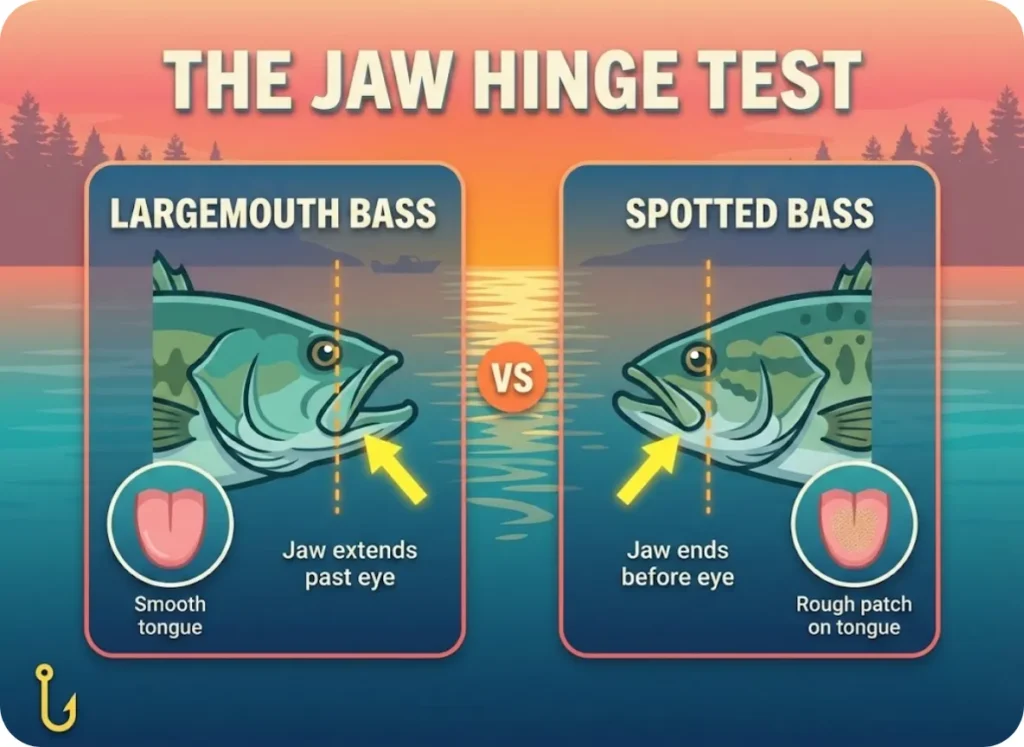
For bass anglers, the maxillary extension is your definitive check. Gently close the fish’s mouth and look from the side. On a Largemouth, the upper jaw extends well past the rear margin of the eye. On a Spotted Bass, it does not reach past the eye. It’s that simple—and that important.
Want confirmation? Run the tongue test. Spotted Bass have glossohyal teeth—a rough, sandpaper-like patch in the center of the tongue. Largemouth tongues are smooth. You can feel the difference with your thumb in two seconds.
Pro tip: If the tongue feels like sandpaper, it’s a Spot. If it’s smooth like your thumb, it’s a Largemouth.
F – Fins: Configuration & Counts
Fins don’t lie. On bass, check the dorsal fin connection. Spotted Bass have their spiny and soft dorsal fins connected by membrane—they’re continuous. Largemouth have a deep notch that makes them appear as two separate fins.
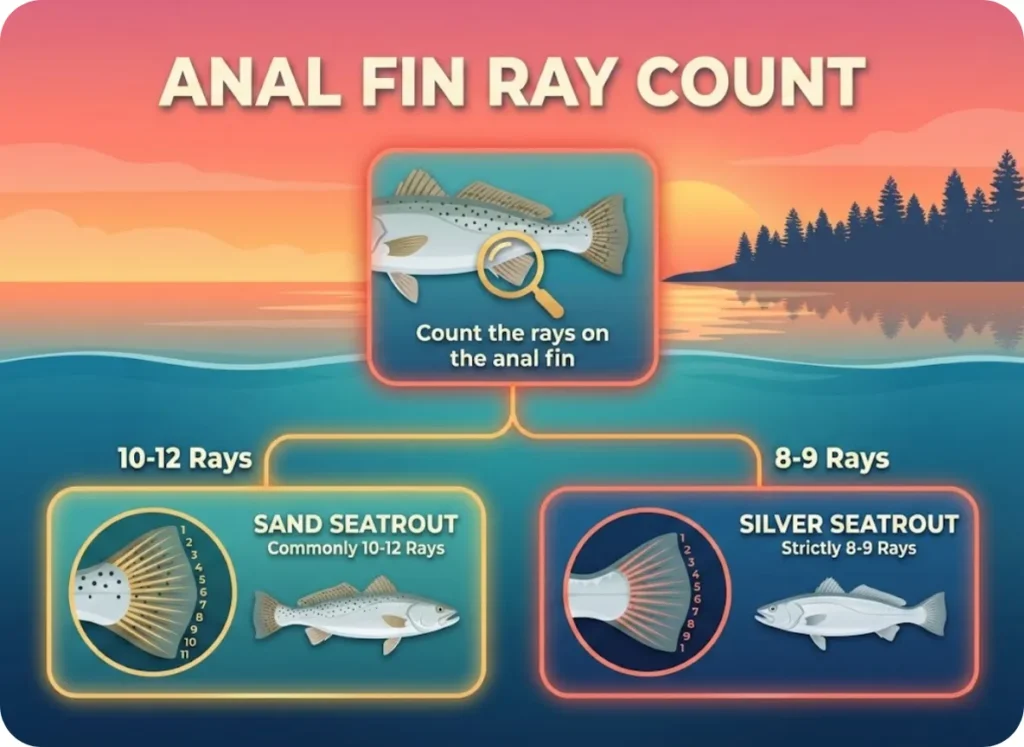
For the seatrout complex, you need the anal fin ray count. Sand Seatrout have 10 to 12 soft rays. Silver Seatrout have only 8 to 9. Spotted Seatrout typically fall in the 10-11 range, but you’ll ID them by spots before you need to count rays. The ray count becomes critical when distinguishing Sand from Silver—especially in jurisdictions where one might be regulated and the other isn’t.
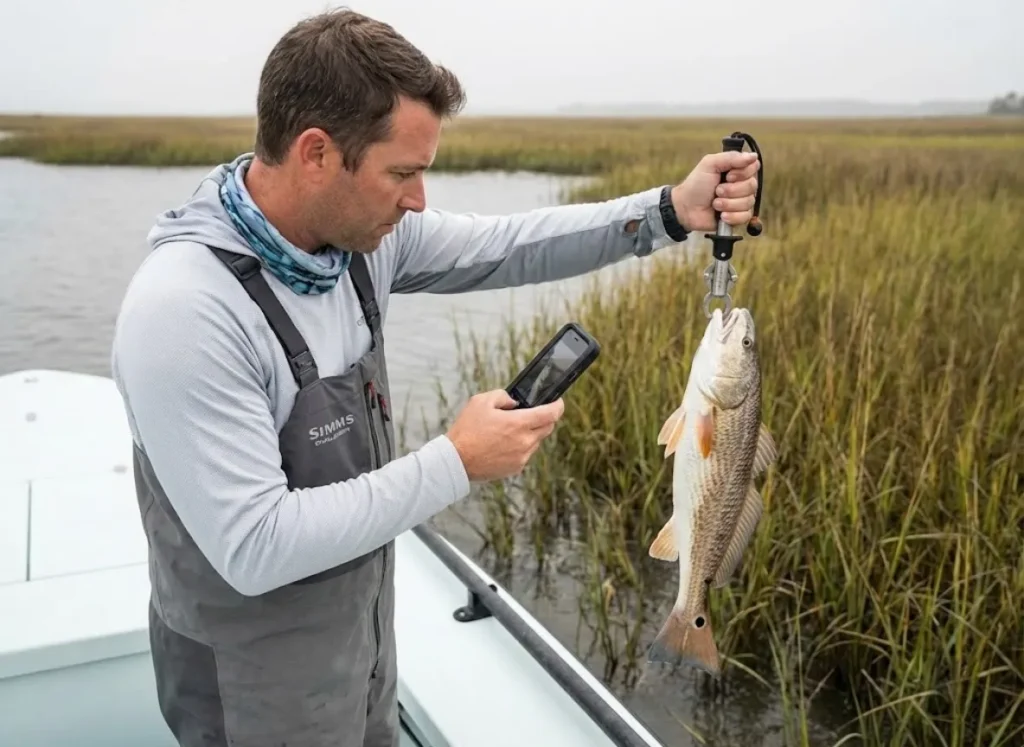
The technique matters: don’t try to count rays on a flopping fish. Snap a photo, zoom in, count from the base. Your phone camera is a more accurate tool than your eyes when adrenaline is pumping.
Pro tip: Use your phone’s camera zoom. Don’t try to count rays on a kicking fish. Snap a pic, zoom in, count, then release.
A – Area (Habitat Context)
Habitat provides useful context, but ranges overlap too much to rely on exclusively. Sand Seatrout favor estuaries and brackish environments. Silver Seatrout prefer deeper offshore waters. Red Drum move through brackish water ecosystems following prey and temperature gradients, with tagged fish returning to Tampa Bay spawning sites year after year.
Area is a secondary check—useful for narrowing possibilities, never for confirming identity.
D – Demeanor (Behavior)
Schooling patterns and fight characteristics can provide supplementary clues, but they’re the least reliable element of BAMFAD. Some juvenile fish school; their adult counterparts don’t. Use demeanor to inform your guess, not to confirm it.
Species Deep Dives: The Most Costly Confusions
Largemouth vs. Spotted Bass: The Freshwater Felony
This is the most common freshwater species misidentification, and it has real consequences. Tournament anglers have been disqualified for weighing in the wrong species. Size limits often differ—12″ for Spots versus 15″ for Largemouth in some states. Get it wrong, and you’re either over-limit or holding a short fish.
Run the checks in order. First, the jaw hinge: close the mouth, draw an imaginary vertical line from the back of the eye. Does the jaw extend past it? Largemouth. Short of it? Spotted. Second, the tongue patch: rough equals Spotted Bass, smooth equals Largemouth. Third, if you’re still uncertain, check the dorsal fin connection (connected vs. notched) and cheek scale size (smaller on Spotted than on body; uniform on Largemouth).
Combined, these four checks are 95%+ accurate even when stress coloration makes the fish look identical.
Spotted vs. Sand vs. Silver Seatrout: The Gulf Trap
In the Gulf of Mexico, “White Trout” is a catch-all term for Sand and Silver Seatrout—both often unregulated. Spotted Seatrout (Specks) are highly regulated with strict bag and possession limits. Keep a juvenile Speck thinking it’s a Sandie, and you’ve got a violation.
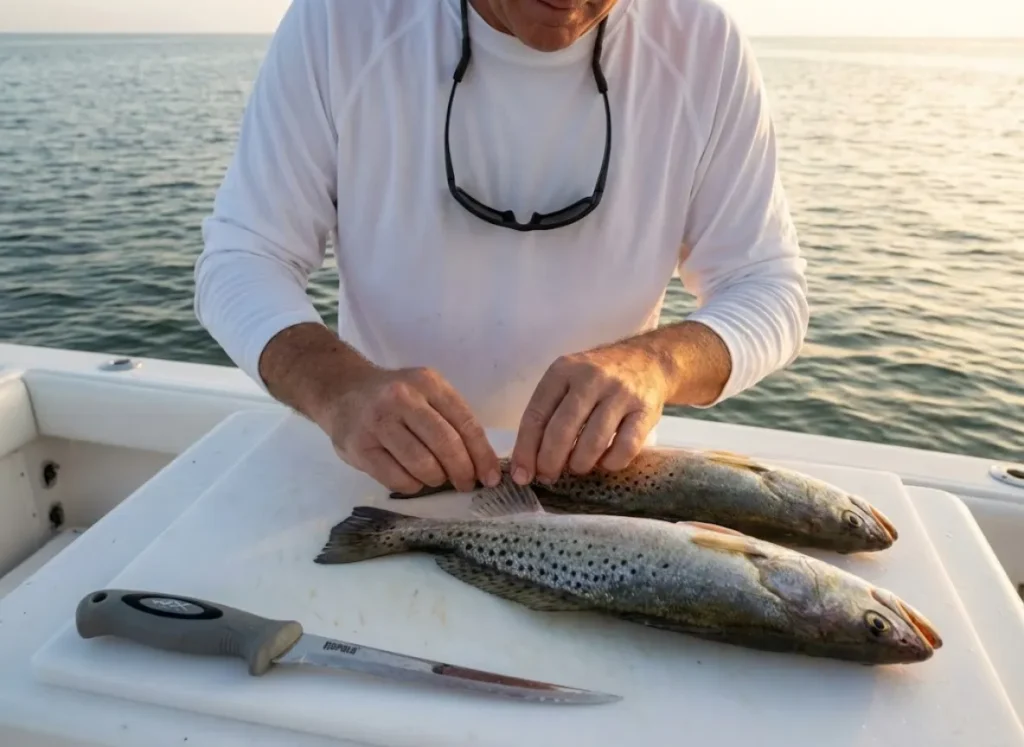
The “spots trap” catches anglers constantly. Spotted Seatrout have distinct round black spots on the back, dorsal fin, and caudal fin. Sand and Silver lack spots entirely. But here’s the problem: stress-faded Specks can lose so much color that their spots become nearly invisible.
Your failsafe is the anal fin ray count. Sand Seatrout: 10-12 rays. Silver Seatrout: 8-9 rays. Count twice before you put anything in the cooler.
Red Snapper vs. Vermilion Snapper: The Offshore Error
Red Snapper seasons last days—sometimes hours. Vermilion Snapper (Beeliners) are open year-round. Confusing the two during a closed season is an expensive mistake that NOAA Fisheries takes seriously.
The shape difference is obvious once you know what to look for. Red Snapper have a triangular head, steep profile, and deep “wedge” body. Vermilion are more streamlined, football-shaped, with rounded heads. Check the eyes: Vermilion have huge, bloodshot-red eyes that look too big for the head. Red Snapper eyes are proportional and pinkish.
Finally, teeth. Red Snapper have prominent canine teeth—that’s where “snapper” comes from. Vermilion have small mouths with villiform teeth (brush-like), no canines.
If your ID confirms it’s a Red Snapper and the season is closed, handle the release carefully. These fish suffer from barotrauma when brought up from depth, and proper descending technique matters.
Red Drum vs. Black Drum: The Juvenile Mix-Up
Adults are distinct, but juvenile fish can look similar. The ocellus settles it—Red Drum have that signature black tail spot on the caudal peduncle. Black Drum don’t. If you’re still unsure, check for chin barbels (whiskers). Black Drum have them for bottom feeding; Red Drum’s mouth is smooth.
The Field Protocol: A Pre-Cooler Checklist
Step 1: Silhouette Check (Body Shape)
Before the fish clears the water, assess the overall shape. Compressed, elongated, or fusiform? This first impression narrows your suspect list to a family of fish species before you run detailed checks.
Step 2: Structural Verification (Mouth & Fins)
Now the hands-on work. Close the mouth for the maxillary extension check. Run your thumb across the tongue. Count anal fin rays if you’re in seatrout territory. Check dorsal fin connection as backup.
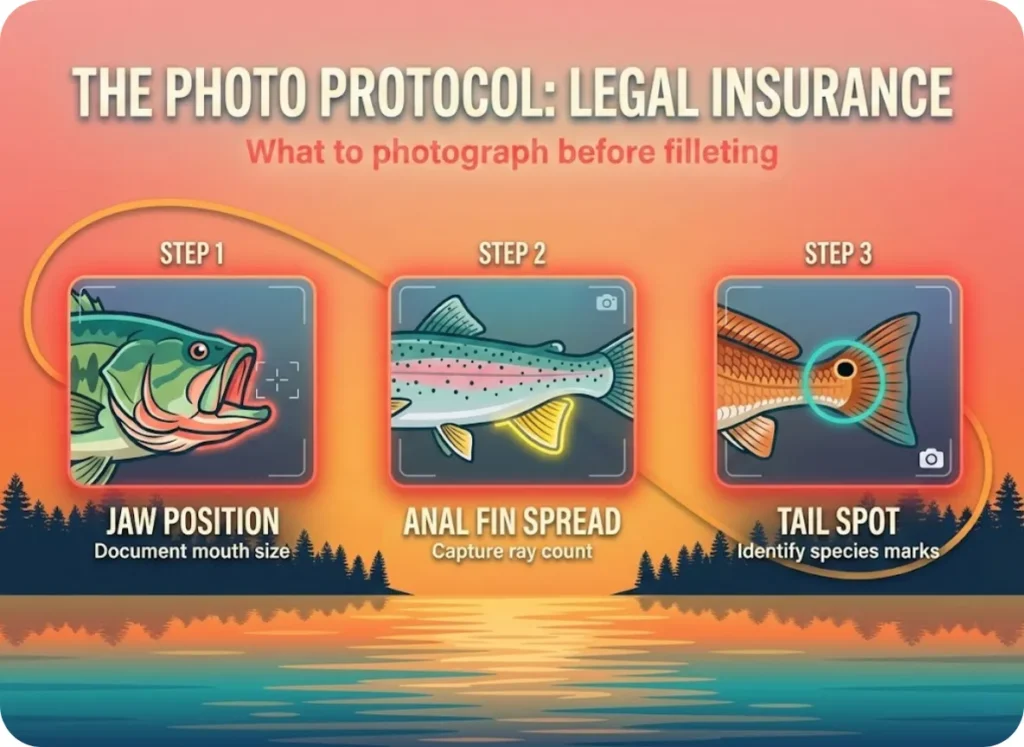
Step 3: The Photo Protocol (Legal Insurance)
Here’s a gap in most anglers’ habits: documentation. Take a photo of every caught fish before you fillet it. Focus on the key identification feature—jaw position for bass, spread anal fin for trout, tail spot for Redfish. This digital evidence can save you if a game warden questions a fillet you can no longer identify.
The Hybrid Problem & AI Limitations
When Species Lines Blur: Meanmouth & Intergrades
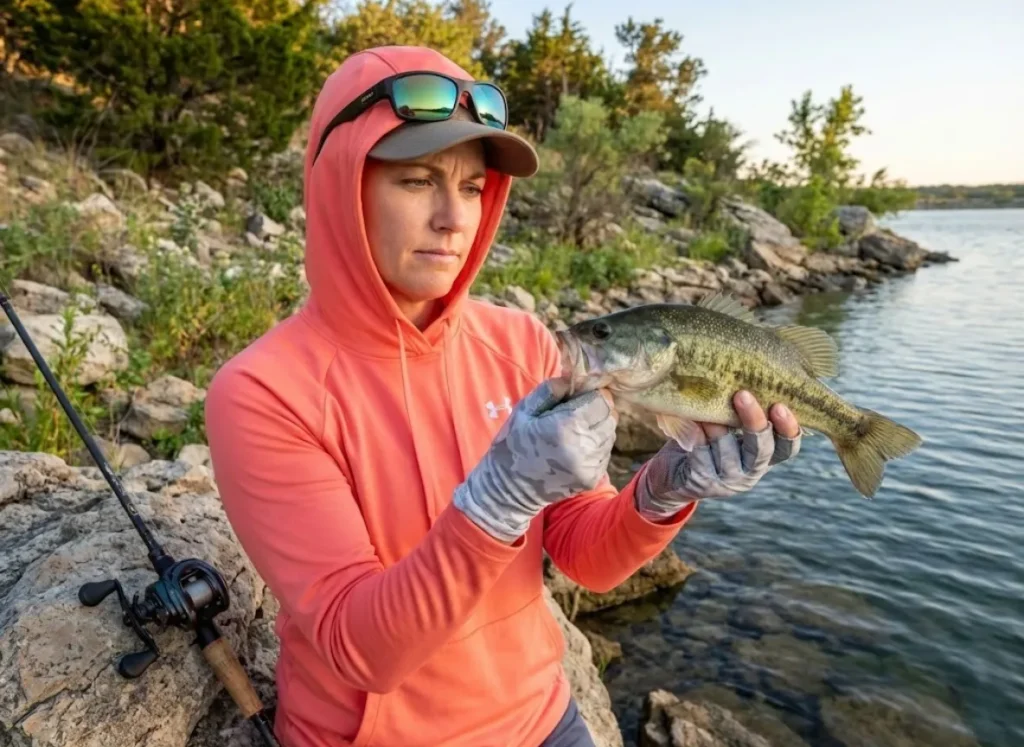
Genetic hybrids like the “Meanmouth” (Smallmouth x Spotted Bass) complicate field identification. These fish display mixed characteristics—maybe the jaw of a Spotted with the coloration of a Smallmouth. Most state fisheries management regulations follow a simple rule: if a fish has characteristics of a regulated species, treat it as regulated.
The practical application? When in doubt, throw it out. If you can’t confidently identify a fish using BAMFAD, release it. No keeper is worth the risk of illegal fishing charges.
Why AI Apps Can’t Replace BAMFAD
Fish identification apps are improving, but they’re not failsafe. A muddy lens, poor lighting, or an unusual angle can cause misidentification. And apps require data signal—often unavailable offshore or in remote areas.
Use apps for regulations lookup—the geolocation-based limits in tools like FishRules are invaluable. But for actual species identification, BAMFAD is your offline backup, a memorized protocol that works without Wi-Fi. Check out the essential fishing apps for regulations and navigation that complement your manual identification skills.
Conservation: Beyond the Fine
Juveniles: The Future You’re Removing
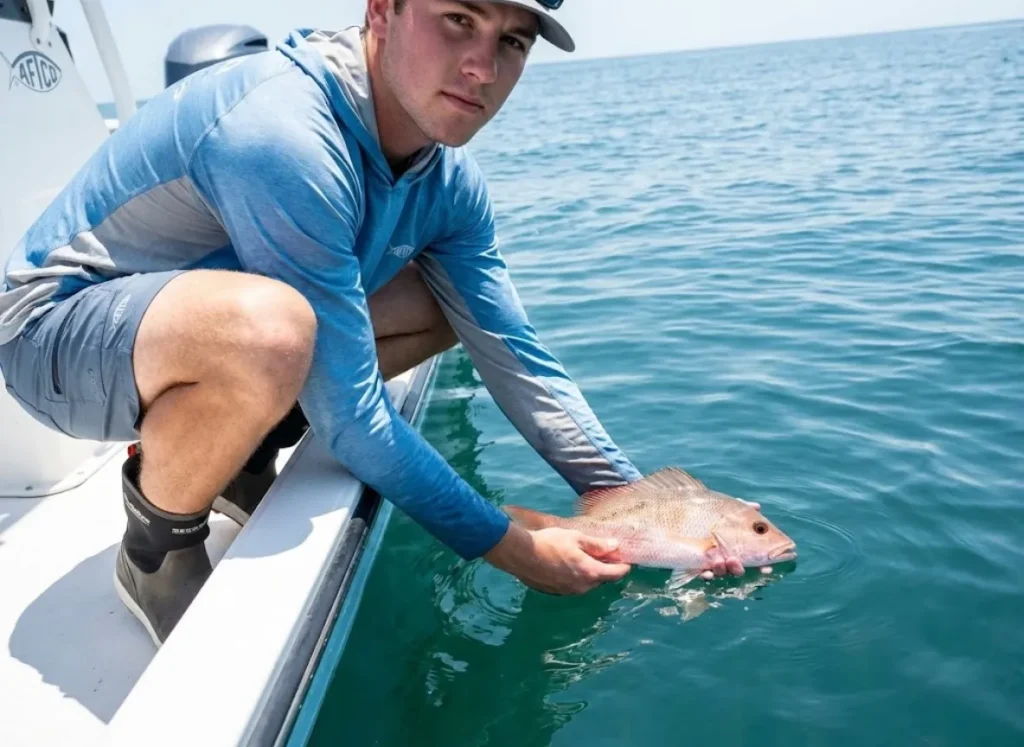
Misidentifying juvenile fish isn’t just a personal legal risk—it’s a conservation problem. That undersized Red Snapper you mistakenly kept as a different species won’t spawn for another two years. But once mature, it could live 50+ years and contribute to the population for decades. Removing it as a juvenile eliminates all that reproductive potential.
Here’s what complicates things: juveniles often don’t look like miniature adults. Shape changes as fish mature. Spot patterns vary. A fish identification guide designed for adult fish might not help you with a 6-inch version of the same species.
Ethical Identification: Minimize Handling
Every second a fish spends out of water increases catch-and-release mortality. The identification process itself can be deadly if you’re holding a flopping fish in the air while staring at a chart.
The solution: identify in the water whenever possible. If you need to handle the fish, use wet hands and science-based catch and release techniques to preserve the protective slime coat. Quick photo, quick check, quick release. If you can’t ID in 20 seconds, photograph and release anyway. A live fish you weren’t sure about beats a dead fish in a cooler you’ll have to explain.
Conclusion
Color is a liability, not an ID tool. Stress, depth, and water clarity change fish coloration constantly. Structural checks—jaw position, tongue patch, fin ray counts—are your only reliable markers.
BAMFAD is your legal defense. Body, Appearance, Mouth, Fins, Area, Demeanor. Run the sequence on every fish that looks even slightly ambiguous. A three-second jaw check beats a $500 citation.
Document before you fillet. A quick photo of the identifying feature is your insurance policy when questions arise at the cleaning station.
The next time you’re standing at that cutting board, cooler full of fish, take a breath. Close that bass’s mouth and check the jaw. Spread those seatrout fins and count the rays. It takes seconds—and those seconds are the difference between a fish fry and a court date.
FAQ
Can you get a ticket for misidentifying a fish?
Yes—fish and wildlife violations are strict liability offenses in most states. Intent doesn’t matter. If the wrong species is in your cooler, you’re liable. Fines range from $500 to over $2,500 depending on species and jurisdiction.
What is the BAMFAD method?
BAMFAD is a mnemonic for systematic fish identification: Body shape, Appearance (markings), Mouth position and anatomy, Fins (configuration and ray counts), Area (habitat), and Demeanor (behavior). Developed by naturalist Koaw, it provides a repeatable framework that works when color-based identification fails.
How do I tell the difference between a Spotted Bass and a Largemouth Bass?
Close the fish’s mouth and check if the upper jaw extends past the back of the eye—Largemouth jaw extends past; Spotted does not. For confirmation, run your thumb on the tongue: Spotted Bass has a rough, sandpaper-like tooth patch; Largemouth tongue is smooth.
What’s the best app for identifying fish?
Apps like FishRules are excellent for regulation lookup (bag limits, seasons by GPS location) but shouldn’t be relied upon for species identification. Poor lighting and camera angles cause errors. Use apps for regs; use BAMFAD for ID.
Why do fish change color after being caught?
Fish undergo stress coloration—physiological changes triggered by capture stress, handling, and air exposure. A Spotted Bass can fade to resemble a pale Largemouth within minutes. This is why structural identification (jaw hinge, tongue patch, fin rays) is essential rather than relying on color.
Risk Disclaimer: Fishing, boating, and all related outdoor activities involve inherent risks that
can lead to injury. The information provided on Master Fishing Mag is for educational and informational purposes
only. While we strive for accuracy, the information, techniques, and advice on gear and safety are not a substitute
for your own best judgment, local knowledge, and adherence to official regulations. Fishing regulations, including
seasons, size limits, and species restrictions, change frequently and vary by location. Always consult the latest
official regulations from your local fish and wildlife agency before heading out. Proper handling of hooks, knives,
and other sharp equipment is essential for safety. Furthermore, be aware of local fish consumption advisories. By
using this website, you agree that you are solely responsible for your own safety and for complying with all
applicable laws. Any reliance you place on our content is strictly at your own risk. Master Fishing Mag and its
authors will not be held liable for any injury, damage, or loss sustained in connection with the use of the
information herein.
Affiliate Disclosure: We are a participant in the Amazon Services LLC Associates Program, an
affiliate advertising program designed to provide a means for us to earn advertising fees by advertising and linking
to Amazon.com. As an Amazon Associate, we earn from qualifying purchases. We also participate in other affiliate
programs and may receive a commission on products purchased through our links, at no extra cost to you. Additional
terms are found in the terms of service.