

In this article
The sonar screen exploded at 2:47 AM—a solid wall of bait suspended twenty feet below the Bay Bridge. Within seconds, my jig was falling through the darkness, and then the rod buckled. Somewhere beneath Span 42, a cow striper had made her decision. After twenty-five years chasing striped bass up and down this estuary, that moment still hits different.
But here’s what that screen didn’t show: the years of declining runs, the emergency closures, the fish that float up belly-white after a July release. The Chesapeake Bay isn’t what it was in 2015—and pretending otherwise helps no one.
This guide maps the Bay’s most productive striped bass fishing locations through a seasonal lens—where to position your boat, when the bite peaks, and equally important, when to stay home and let the fishery recover.
⚡ Quick Answer: Fish the spawning tributaries (Potomac, Choptank) in spring, the upper Bay chumming ledges (Tolchester, Love Point) in summer, and the mid-Bay during fall’s “Rocktober” blitzes. Avoid targeting stripers when water exceeds 70°F—catch-and-release mortality spikes dramatically. The 2025 Maryland slot is 19-24 inches, one fish per person.
The Biology Behind Location: Why Stripers Move Where They Do
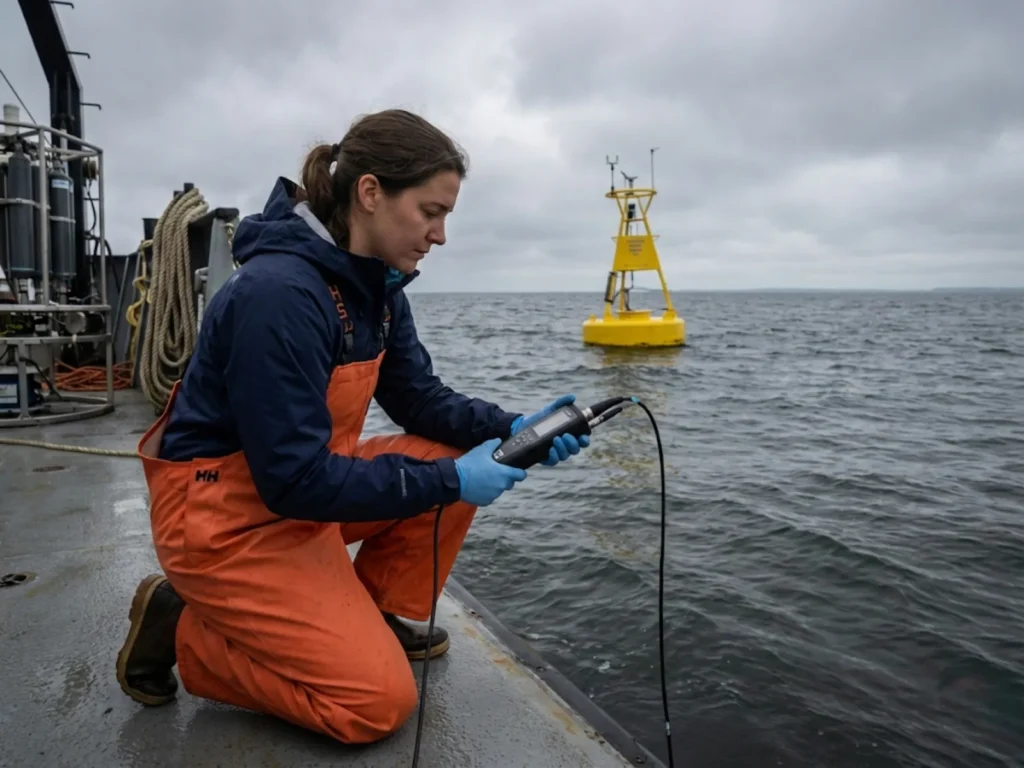
Understanding why rockfish stack where they do is the difference between random casting and strategic positioning. Three biological forces drive every location decision these fish make.
The 70%-90% Rule: Why the Bay Is Ground Zero
Between 70% and 90% of the entire Atlantic coast striped bass population originates from Chesapeake Bay tributaries. That’s not a typo. When you’re fishing the Bay, you’re fishing the nursery for the entire Eastern Seaboard’s migratory stock.
The numbers tell a sobering story. Female spawning stock biomass stood at 191 million pounds in 2023—below the 197 million pound threshold that triggers management action according to ASMFC’s striped bass rebuilding plan. The 2025 Maryland Young-of-Year index recorded 4.0, the seventh consecutive year below the long-term average of 11.0.
If you’ve fished the upper Bay in the last five years, you’ve felt this decline. The “fish every cast” days aren’t coming back soon.
The 80cm Threshold: When Trophies Leave the Bay
Here’s something most articles won’t tell you: approximately 50% of striped bass migrate out of the Bay once they exceed 80 cm (31.5 inches) in total length. This explains why “trophy season” in the Bay is concentrated—the big migratory fish are only present during specific windows.
Pro tip: If you’re trophy hunting, you need to be on the water before they leave. By May, most 40-inch fish are headed north toward New England.
The Thermal Squeeze: Summer’s Invisible Prison
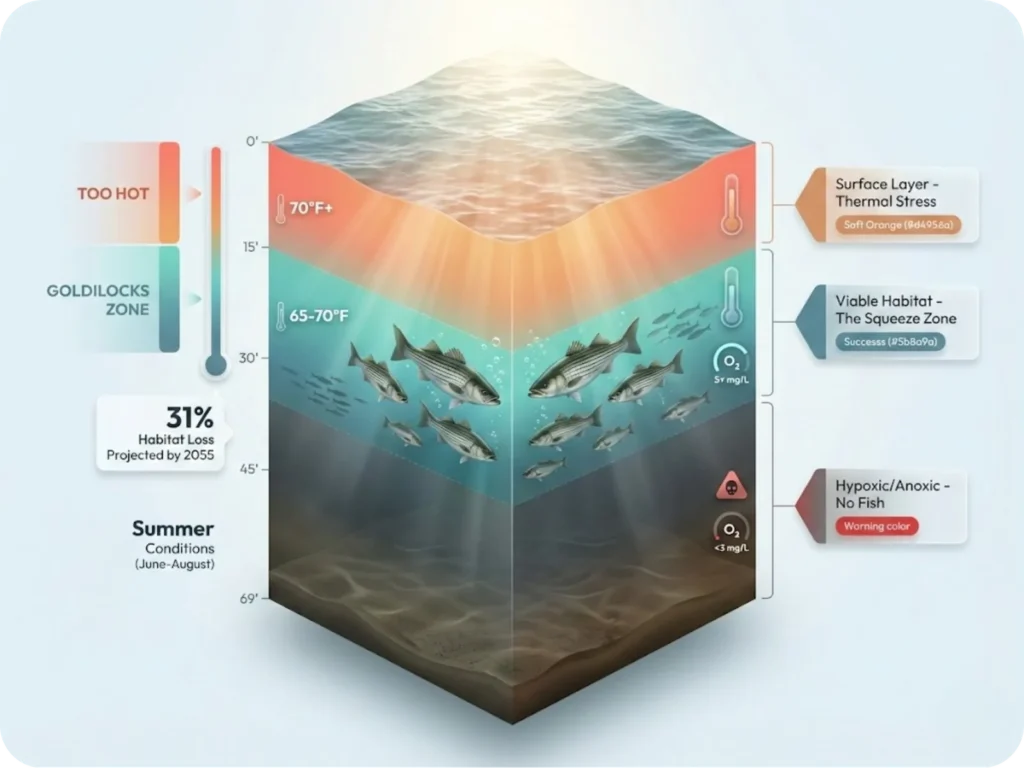
Summer creates what biologists call the “thermal squeeze.” When surface temps exceed 70°F and deep water goes anoxic (below 3 mg/L dissolved oxygen), fish compress into a narrow mid-water band.
The Chesapeake Bay Program projects this suitable habitat volume will shrink by 31% by 2055. You can track current conditions in real-time using Maryland DNR’s real-time fishing conditions map.
At the Chesapeake Bay Bridge (station CB3.3C), the entire 69-foot water column may be fishable on cooler days. Further south, the anoxic “dead zone” may start at just 30 feet. Understanding dissolved oxygen’s impact on fish metabolism is critical for summer success.
The Seasonal Playbook: Where Fish Stack by Month
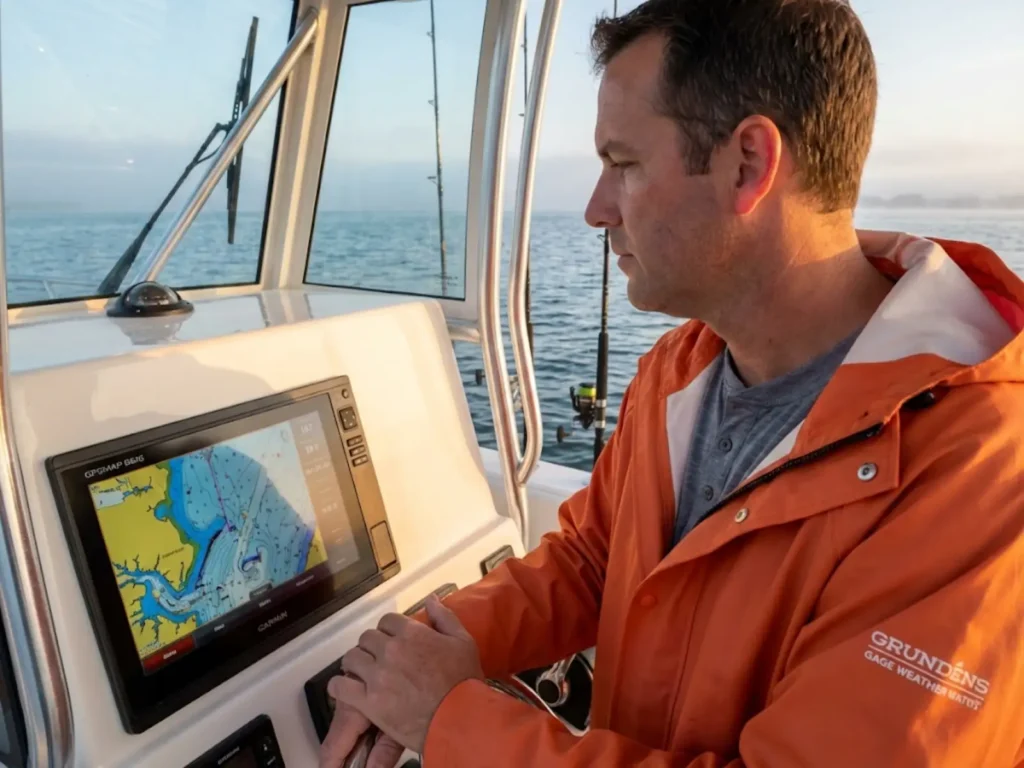
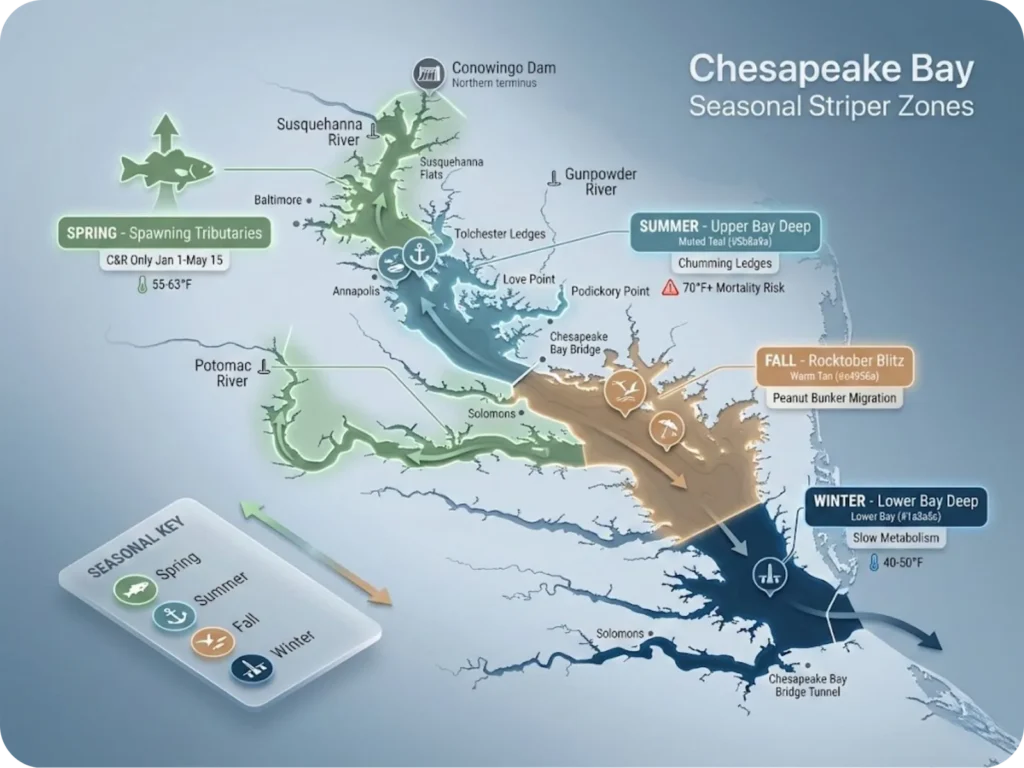
Fish the wrong water at the wrong time and you’re just making casts. Here’s the month-by-month breakdown.
Spring (March–May): The Spawning Tributaries
Spring targets the large migratory contingent entering rivers to spawn. Primary focus zones include the Susquehanna Flats (critical northern nursery), the Potomac River, and the Choptank River. All are catch-and-release only from January 1 through May 15.
Spawning triggers require water temperatures between 11.4°C and 17.5°C and salinity below 0.5 ppt. For more on striped bass spawning behavior and temperature triggers, see our biology guide.
Pro tip: Watch the Conowingo Dam release schedule. Heavy flow flushes debris and scatters fish. Light, stable flow? Get there at dawn.
Summer (June–August): Go North or Go Deep
Since 2005, summering rockfish have concentrated in the upper Bay—from the Bay Bridge north to the Gunpowder River. Prime summer fishing spots include the chumming ledges at Tolchester, Love Point, and Podickory.
Successful chumming requires anchoring up-current of structure (humps or troughs) so scent sweeps over holding fish. But here’s the reality check: catch-and-release mortality averages 9% but spikes dramatically when water exceeds 70°F according to Virginia DWR’s catch-and-release best practices.
I’ve watched fish swim away looking fine in July, only to float up belly-white ten minutes later. The water is warm enough to cook them from the inside. Consider the “no-cull” strategy: keep the first legal fish and target bluefish or blue catfish for the rest of the trip.
Fall (September–November): Rocktober and the Baitfish Blitz
This is the most aggressive feeding frenzy window of the year. Baitfish (“peanut bunker”) migrate out of rivers, triggering surface blitzes that are visible from a mile away.
The mid-Bay dominates fall action—Annapolis, Deale, and Solomons Island become the primary hubs for reading structure and identifying fish-holding water. Tactics shift to trolling umbrella rigs or jigging under breaking fish (bird shows).
Learn to read birds. Gulls diving on bunker means big fish deep. Terns hovering low? Smaller forage, but still worth a cast.
Winter (December–February): The Patience Game
Resident fish become lethargic as metabolism slows. Lower Bay Virginia waters hold more action—particularly around the Chesapeake Bay Bridge Tunnel. Deep structure and slow presentations are key.
Many serious anglers use this period to scout, maintain gear, and plan the spring spawn campaign. Check current regulations before any trip—the 2025 Maryland slot limit is 19-24 inches, one fish per person.
Structure Fishing Mastery: Bridges, Reefs, and the CBBT
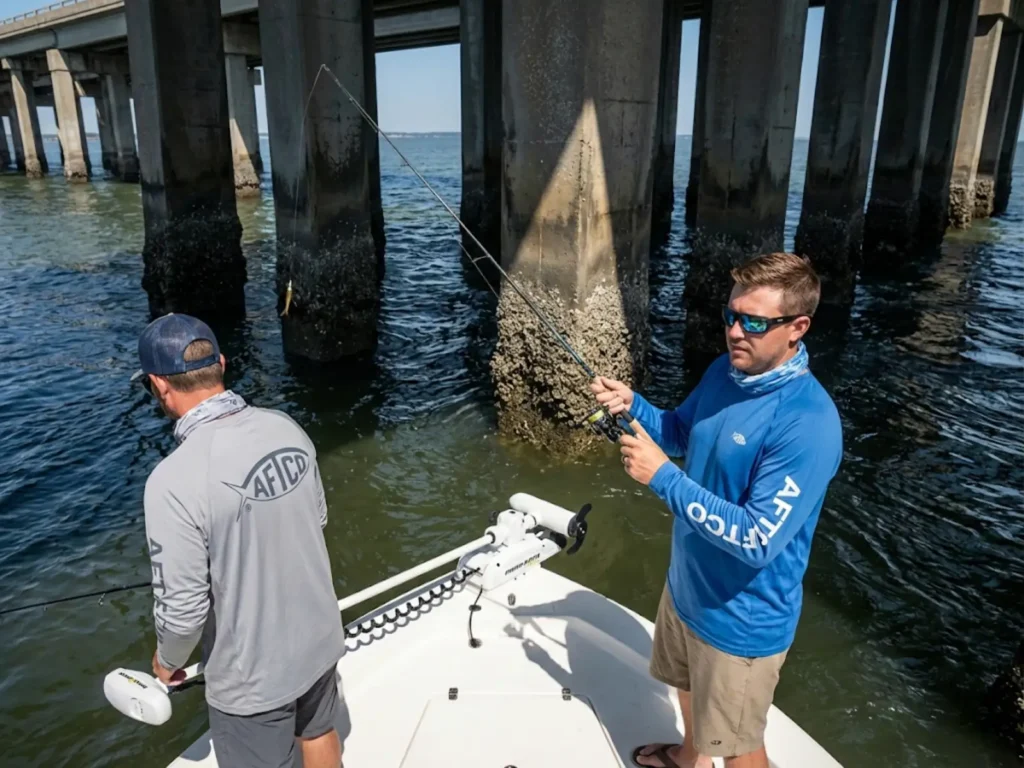
Random casting produces random results. Structure fishing produces consistent fish.
The Bay Bridge: Piling Tactics That Produce
Captain Tom Weaver puts it simply: “The No. 1 thing for fishing our bridge is having moving water. Whether incoming or outgoing doesn’t matter—you have to have current.”
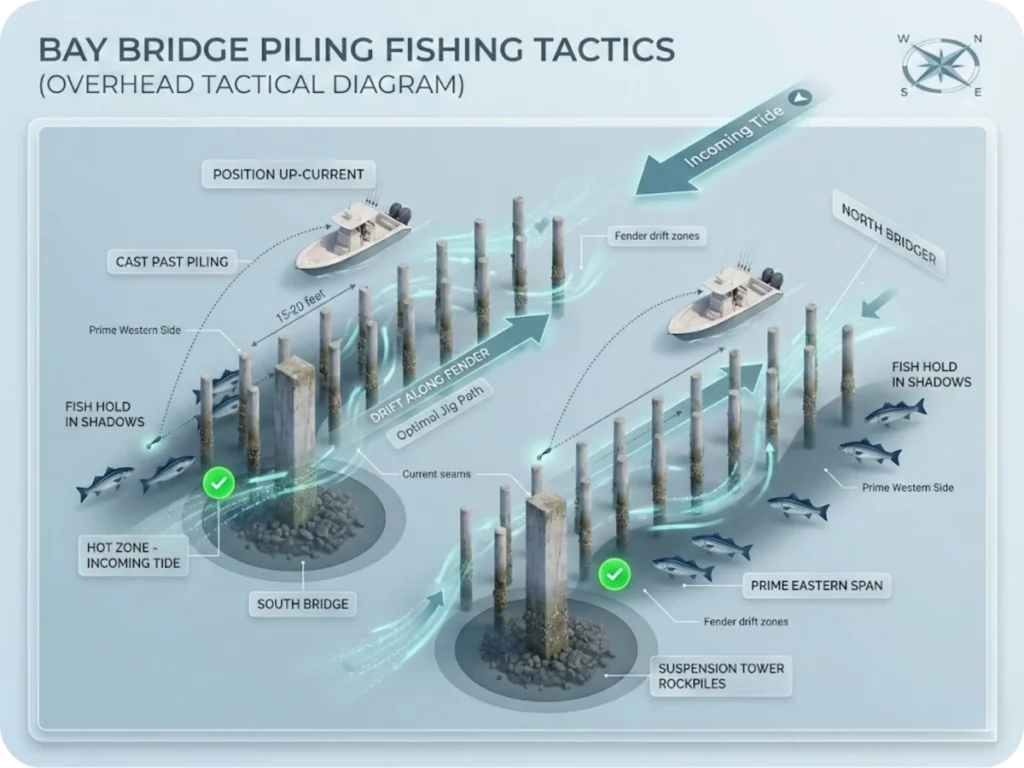
Position the boat up-current of pilings and cast past them, allowing the jig to drift along the “fenders.” Here’s the insider beta: south bridge pilings are more productive on the western side; north bridge performs better on the eastern side. On an incoming tide, the western south span is often the hot zone.
The rockpiles at the base of suspension towers hold resident fish year-round. Pitch live spot or soft crabs directly into the shadows. Understanding how tidal currents position predatory fish makes the difference between a slow day and a hero shot.
The MARI Artificial Reef Network: GPS Coordinates That Pay
Maryland’s artificial reef initiative has created fish magnets across the Bay. Tilghman Reef (1.5 miles due west of Tilghman Island) features 500+ reef balls and bridge rubble—a multispecies hotspot. Cedar Point Reef off the Patuxent River mouth covers 155 acres of Woodrow Wilson Bridge material in 15-27 feet. Love Point Reef sits near the Chester River mouth in the northern Bay.
You can verify exact coordinates through the Maryland DNR artificial reef coordinates database.
Pro tip: Don’t just fish the center marks. Work the edges where structure meets sand—that’s where predators stage ambushes.
The CBBT: Virginia’s Underwater Highway
The Chesapeake Bay Bridge-Tunnel represents the Bay’s largest intentional reef structure. It holds fish year-round due to depth variety and consistent current flow.
Trolling and jigging both produce—match tactics to season and bait presence. The tunnel islands can hold warmer water pockets in winter, making the CBBT a refuge when the upper Bay is too cold. For deep work, check our vertical jigging in deep water guide.
Light Tackle Jigging: The Modern Chesapeake Method
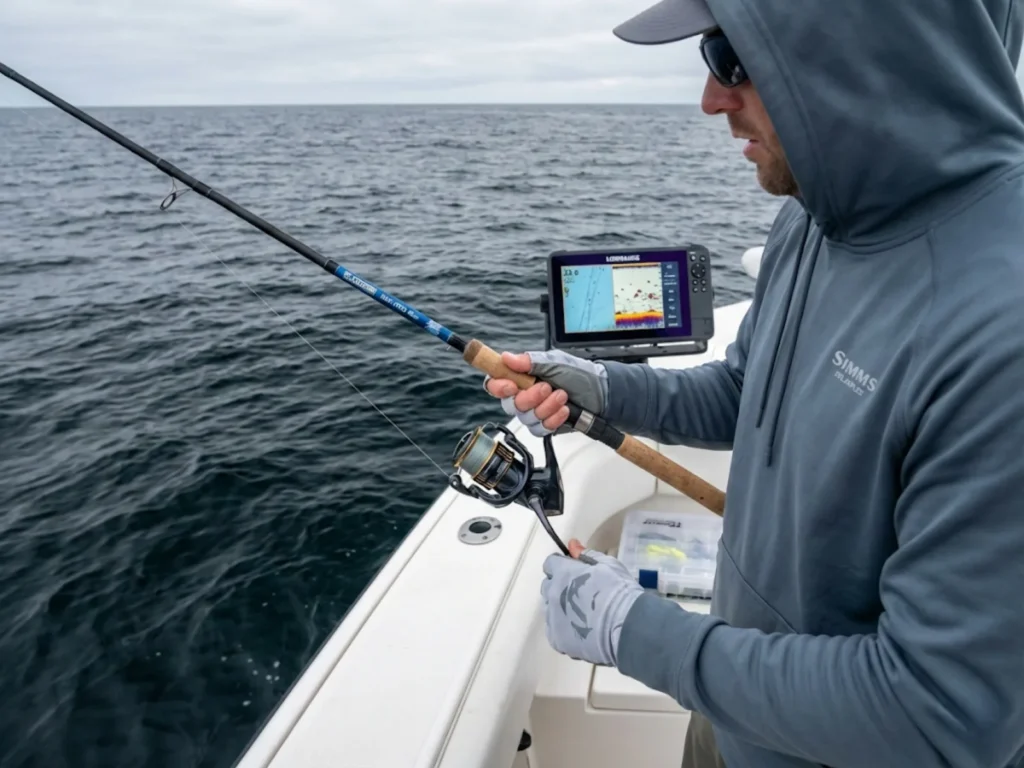
Light tackle jigging has become the dominant method for serious Bay anglers. Here’s the equipment matrix and technique breakdown.
The Gear Matrix: Rod, Reel, Line, Leader
A 7-foot medium power, fast action rod (like the G.Loomis IMX-PRO 843S) provides backbone for deep hooksets and accurate casting in wind. Pair it with a 3000-4000 series spinning reel—Shimano Stradic or TwinPower class—with a high-quality drag essential for aggressive bursts.
Run 15-20 lb braided mainline for minimal stretch and maximum sensitivity to “thumps” at depth. Add 3-4 feet of 20-40 lb fluorocarbon leader for stealth and abrasion resistance against pilings and rocks.
The G-Eye jig with a Z-Man DieZel Minnow is a proven combo. Teaser hooks positioned 12-18 inches above the main jig can double your hookup rate when bass key on smaller forage. For fundamentals, see mastering the basics of jig fishing.
The Drop-and-Snap: Why Most Strikes Come on the Fall
This technique excels when fish hold deep (10-60 feet) during summer heat or winter cold. Drop the jig straight to bottom structure and work with short, sharp rod lifts (12-24 inches).
Here’s the critical insight: most strikes occur on the “drop”—the momentary flutter as the lure sinks. Maintain enough tension to feel the bite, yet enough slack for the lure to flutter naturally.
I’ve fished with guys who reel the second the jig hits water. They miss the monsters lurking below the schoolies. Let it sink. Understanding hookset physics and timing prevents those heartbreaking “I had him” moments.
Kayak Access: Safety, Stealth, and Launch Points
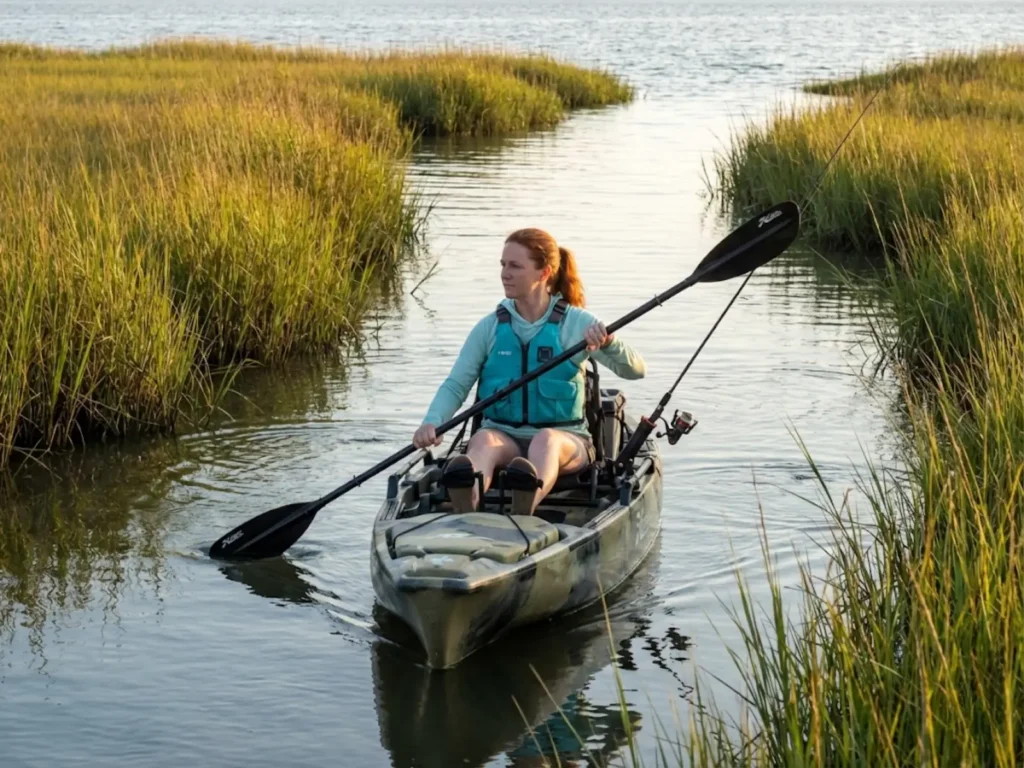
Kayak fishing access opens water that boat anglers can’t reach—but the Bay demands respect.
The “Fetch” Safety Calculus
“Fetch” means the distance wind travels over open water. Even winds under 10 mph can create dangerous, breaking waves with miles of unimpeded fetch. Pedal-driven kayaks are strongly preferred because “tides are always producing current in the Bay,” making it difficult to maintain position while paddling.
Move up inlets as the tide comes in; exit as it goes out to avoid fighting current. The 3-point kayak anchor safety rig is essential gear for Bay conditions.
I’ve seen paddle kayaks blow a mile off-target in 20 minutes on a “light breeze” day. The Bay doesn’t forgive hubris.
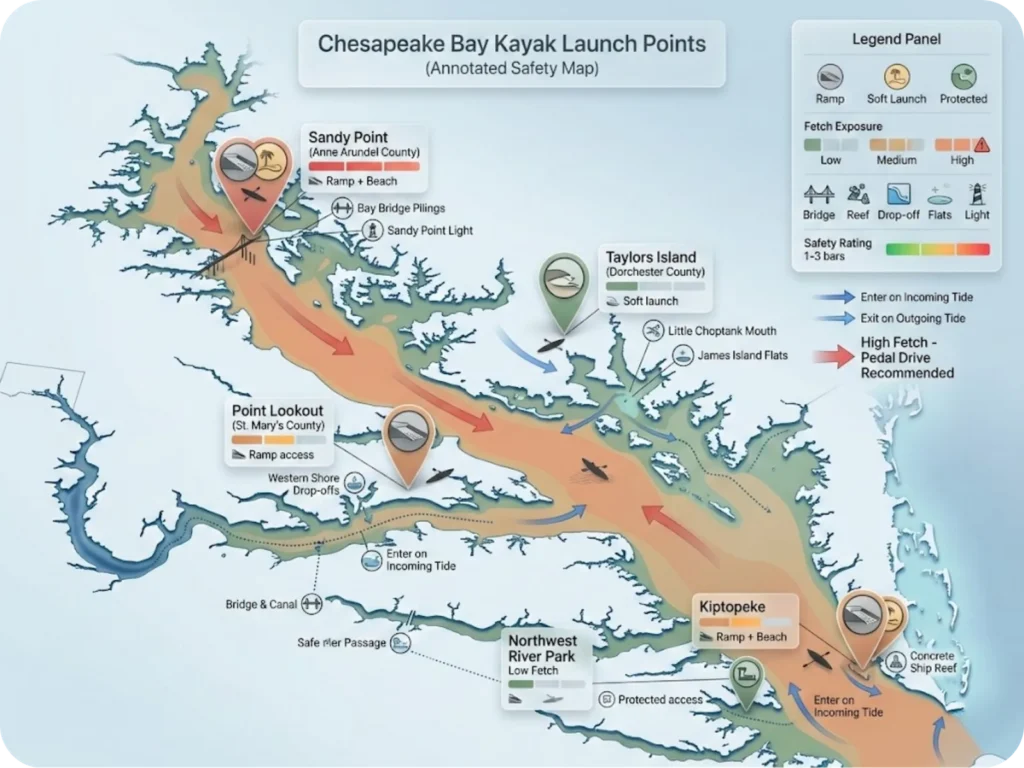
Kayak-Specific Launch Points
Point Lookout (St. Mary’s County, MD) offers boat ramp access to western shore drop-offs and humps. Taylors Island (Dorchester County) provides soft launch access to the mouth of Little Choptank and James Island flats. Sandy Point (Anne Arundel County) has ramp and beach access to Bay Bridge pilings and Sandy Point Light.
In Virginia, Kiptopeke offers beach and ramp access to the concrete ship artificial reef, while Northwest River Park provides protected bridge and canal fishing. For kayak selection guidance, see our choosing the right fishing kayak breakdown.
When to Stay Home: The Conservation Imperative
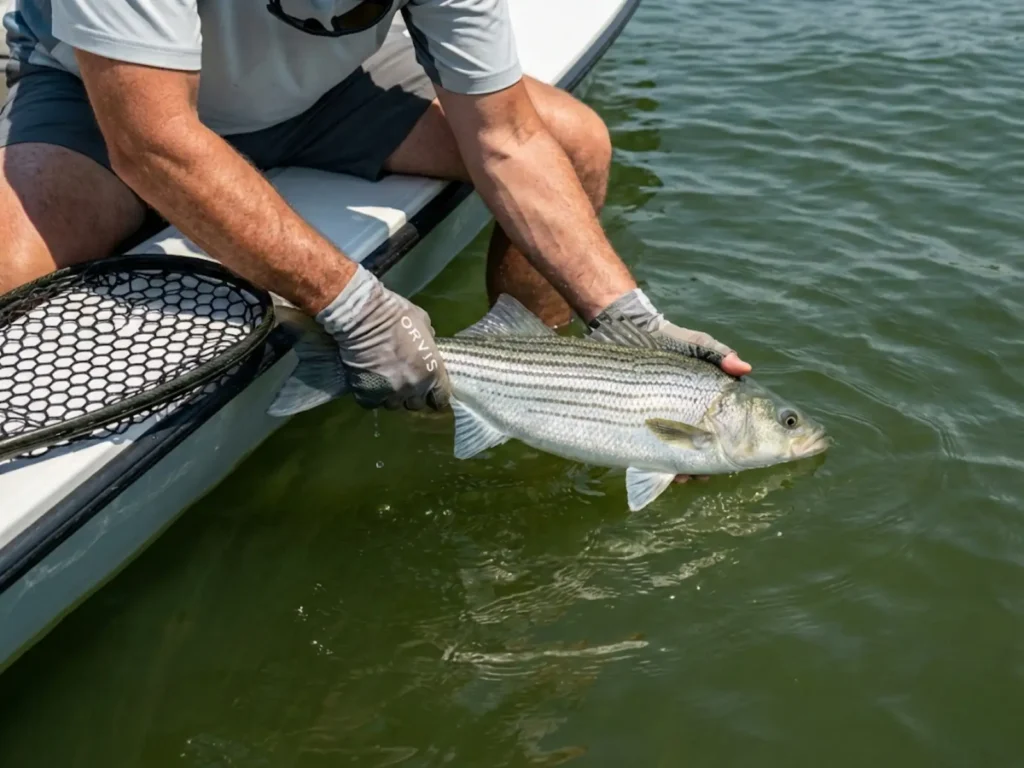
Sometimes the right call is not to fish at all.
The Thermal Mortality Problem
Catch-and-release mortality isn’t a fixed 9%. It’s dynamic, spiking when water exceeds 70°F. High temps plus fight stress equals lactic acid buildup beyond the fish’s recovery capacity in low-oxygen water.
Circle hooks are required by law when using whole or cut natural bait—they reduce gut-hooking significantly. For the science behind this requirement, see circle hook mechanics for safer releases.
If a fish is gut-hooked, cut the line close to the hook. Removal attempts cause more trauma than leaving the hook.
The “Inhuman Hours” Advantage
Statistical tracking shows 95% of large striped bass caught in shallow water were taken during low or no-light conditions. During daytime, big fish hold in deep, shaded areas under bridges. At night, they move into water under 10 feet to ambush baitfish.
Night fishing tactics include trolling shallow-running plugs or casting surface flies and poppers at daybreak, sunset, or in fog and rain. Check our low-light fishing tactics and safety guide before heading out in darkness.
Pro tip: The “inhuman hours” aren’t just about fish behavior. They’re also about pressure. At 3 AM, you’ve got the whole Bay to yourself.
Conclusion
The Chesapeake Bay striped bass fishery exists in a state of managed recovery. Maryland and Virginia have aligned regulations with ASMFC Addendum II, maintaining a 19-to-24-inch slot limit and a 1-fish bag limit for the 2025-2026 seasons. Emergency closures in April and May protect breeding-age fish during their most vulnerable period.
Three takeaways:
Match your location to the season. Spring means tributaries. Summer means go north or go deep. Fall means follow the birds.
Fish the structure, not open water. Bridge pilings, reef balls, and channel edges concentrate fish. Random casting produces random results.
Know when to stay home. When water temps exceed 70°F, your catch-and-release fish have a diminishing chance of survival. Choose to not fish, or target other species.
The success of the “rebuilding by 2029” goal depends not only on harvest restrictions but on individual anglers making smart decisions on the water. The fish you release correctly today may be the trophy someone catches in 2030—or the spawner that produces the next great year-class.
FAQ
What is the current slot limit for striped bass in Maryland?
The 2025 Maryland recreational slot limit is 19 to 24 inches with a daily bag limit of one fish per person. Regulations vary by season and area, so check the Maryland DNR website before each trip.
When is the best time to fish for striped bass in Chesapeake Bay?
Fall (September–November) offers the most consistent action as baitfish migrate and fish feed aggressively. Spring (March–May) targets spawning fish in tributaries. Summer requires careful location selection due to thermal stress and oxygen issues.
Can I fish for striped bass from a kayak in Chesapeake Bay?
Yes, but safety is paramount. Check the fetch (wind-over-water distance), prefer pedal-driven kayaks for hands-free positioning, and always carry proper lighting. Top launch points include Sandy Point, Point Lookout, and Taylors Island.
Why do striped bass die after catch-and-release?
Post-release mortality increases dramatically when water temperatures exceed 70°F. The combination of fight stress, lactic acid buildup, and low dissolved oxygen prevents recovery. Use circle hooks, minimize air exposure, and avoid targeting stripers during peak summer heat.
What is the Thermal Squeeze in Chesapeake Bay?
The thermal squeeze occurs when rising surface temperatures and deep-water oxygen depletion (hypoxia) force striped bass into a narrow mid-water band. This concentration can make fish easier to locate but also increases stress and mortality—especially for catch-and-release fishing.
Risk Disclaimer: Fishing, boating, and all related outdoor activities involve inherent risks that
can lead to injury. The information provided on Master Fishing Mag is for educational and informational purposes
only. While we strive for accuracy, the information, techniques, and advice on gear and safety are not a substitute
for your own best judgment, local knowledge, and adherence to official regulations. Fishing regulations, including
seasons, size limits, and species restrictions, change frequently and vary by location. Always consult the latest
official regulations from your local fish and wildlife agency before heading out. Proper handling of hooks, knives,
and other sharp equipment is essential for safety. Furthermore, be aware of local fish consumption advisories. By
using this website, you agree that you are solely responsible for your own safety and for complying with all
applicable laws. Any reliance you place on our content is strictly at your own risk. Master Fishing Mag and its
authors will not be held liable for any injury, damage, or loss sustained in connection with the use of the
information herein.
Affiliate Disclosure: We are a participant in the Amazon Services LLC Associates Program, an
affiliate advertising program designed to provide a means for us to earn advertising fees by advertising and linking
to Amazon.com. As an Amazon Associate, we earn from qualifying purchases. We also participate in other affiliate
programs and may receive a commission on products purchased through our links, at no extra cost to you. Additional
terms are found in the terms of service.