
In this article
The sun drops below the horizon, and the aquatic world undergoes a violent shift. One moment, you are visually scanning for weed lines and bait balls; the next, the water turns into an inky void where your eyes are the least useful tool on the boat. While the human eye struggles to resolve shapes in the gray scale of civil twilight, the predator’s advantage spikes.
I have spent decades navigating these dark waters. I can tell you that success in this environment requires you to abandon the visual reliance of the day and embrace a sensory inversion. Night fishing is not simply fishing in the dark. It is a discipline of vibration, silhouette, and tactile precision where the angler who understands the physics of the shadow line becomes the apex predator.
In this night fishing guide, we will break down the biological transition fish undergo at dusk, why dark lures are more visible than white ones, and the strict safety protocols required when visibility drops to zero. This is low-visibility angling for the adaptive angler.
Why Does Fishing Strategy Change After Sunset? (The Biological & Physical Framework)
The transition from day to night isn’t just a loss of light; it is a fundamental change in the biological rules of engagement. Fish do not hunt the same way at 2:00 AM as they do at noon. Understanding this physiological shift—or sensory adaptation—is the first step to consistent success.
How do fish see and track prey in the dark? (The Purkinje Shift)
As solar illumination decays, predatory fish undergo a biological process known as the Purkinje Shift. Most species possess a “duplex retina” containing both cones (for color) and rods (for low-light sensitivity). As light fades, dominance transfers from color-sensitive cones to high-sensitivity rods.
This biological switch increases light sensitivity significantly but sacrifices visual acuity. The fish effectively sees a grainy, monochromatic image. This means hyper-realistic lure details—scales, eyes, gill plates—are largely invisible and wasted at night.
Species like Walleye, Snook, and Speckled Trout possess a tapetum lucidum, a reflective layer behind the retina that bounces light back through photoreceptors. According to research on the retinal development of nocturnal fish, this adaptation effectively doubles their natural night vision capabilities compared to their prey.
Because visual resolution is low, fish rely heavily on spatial summation. This process involves pooling signals from multiple rod cells to detect faint objects. This makes “contrast” the single most important visual variable. A solid shape is easier to track than a complex pattern.
As vision blurs, the Lateral Line System becomes the primary long-range sensor. This organ detects pressure waves and hydrodynamic wakes, allowing fish to track the “thump” of a lure long before they can see it. Therefore, mastering the art of understanding the science of fish vision requires you to prioritize vibration dependence. You must choose lures that displace water and cast strong shadows over those that rely on color matching.
Why is lure color less important than silhouette? (The Physics of Light)
Water acts as a selective filter for light. Red wavelengths are absorbed first, turning red lures dark gray or black within feet of the surface, while blues and greens penetrate deeper. However, the most critical factor at night is not color, but the direction of the light source.
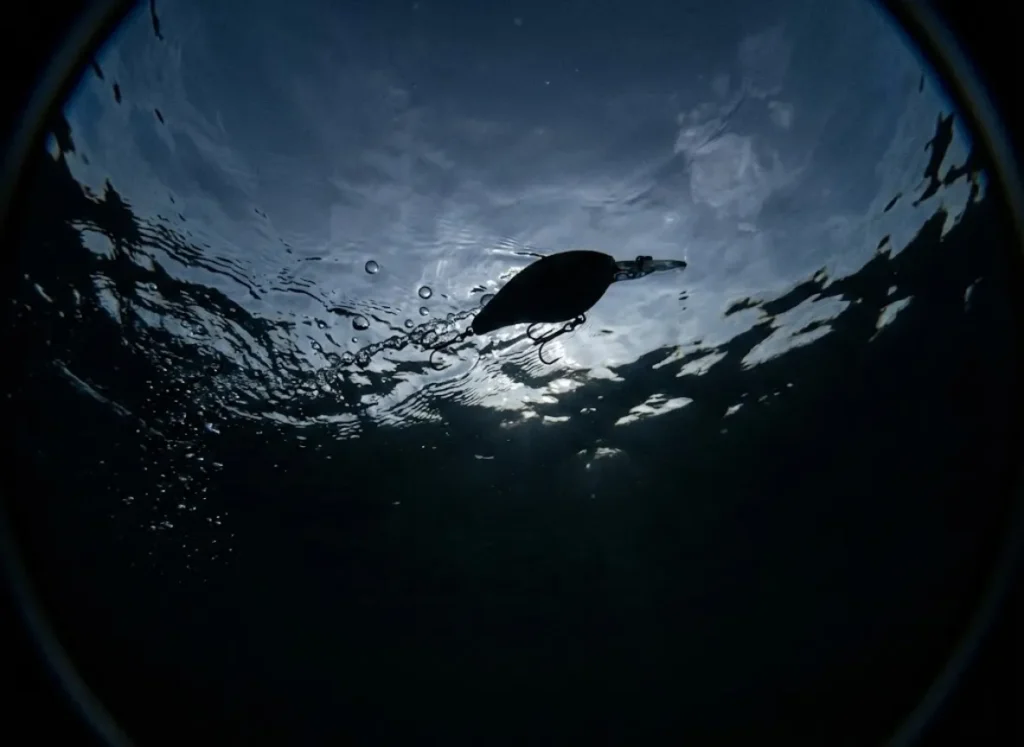
At night, the primary light source—moonlight or starlight—comes from above. Predatory fish often hunt by looking up toward the surface. The “Silhouette Theory” states that a solid black or dark blue lure provides the maximum contrast against the lighter night sky. This creates a crisp, trackable silhouette of a baitfish. NOAA’s analysis of light attenuation in aquatic environments confirms how quickly color information is lost, validating the need for contrast over pigment.
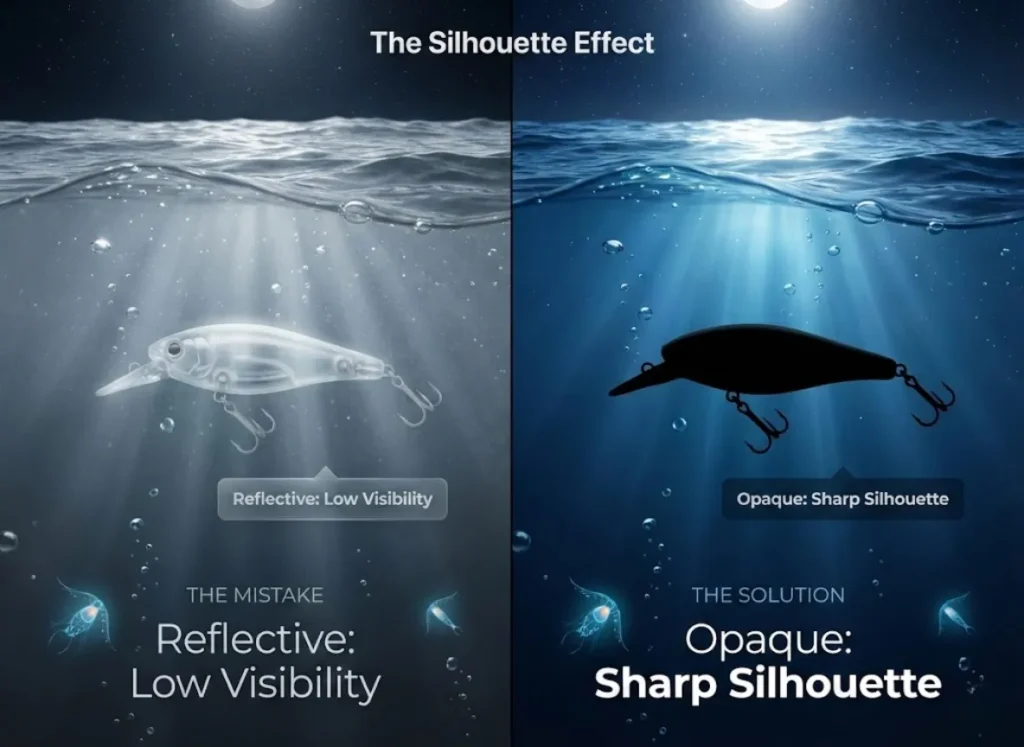
Conversely, white or holographic lures reflect the limited ambient light. This causes them to blur into the background “noise” of the water column, making them harder for the rod-dominant eye to fixate on.
The only exception is fluorescence. If UV lights (black lights) are present, fluorescent colors absorb high-energy photons and re-emit visible light. This creates a “glow” that stands out in deep darkness.
Pro-Tip: If you are fishing a topwater lure at night, take a black permanent marker and darken the belly of the bait. This simple modification increases the contrast against the sky, making it easier for bass or snook to target the strike zone.
Applying these data-backed topwater fishing strategies that rely on silhouette will drastically improve your hook-up ratio when the sun goes down.
What Gear is Essential for Night Fishing Success? (The Nocturnal Utility Score)
Selecting gear for night fishing is about more than just preference; it is about utility in scotopic (low-light) conditions. The best equipment either helps you see without blinding you or helps the fish find your lure without seeing it.
Which lights serve the angler vs. the fish? (The Lighting Matrix)
Lighting serves two distinct and often opposing purposes: attracting fish and preserving angler safety. These goals require utilizing different parts of the light spectrum.
Submersible Green Lights (520 nm) are the industry standard for attraction. Green penetrates turbid water efficiently and attracts plankton (phototrophs). This triggers a food chain effect leading to baitfish and eventually predators like Crappie and Striped Bass.
For visual hunting in murky water, such as flounder gigging or bowfishing for Carp, Amber or Sodium Lights are superior. Their longer wavelength reduces glare and particulate reflection (backscatter).
The Night Fishing Light Spectrum
Analysis of optimal wavelengths, ratings, and technical specifications.
Primary Application
Plankton/Bait attraction in freshwater & estuaries.
Technical Specs (IP68)
Continuous submersion rated, >1500 Lumens, weighted housing to prevent floating.
Primary Application
Surface visibility; Crappie fishing.
Specs & Drawbacks
High floatation, impact resistance. Note: Attracts bugs and has high light scattering.
Primary Application
Pelagic species (Tuna/Swordfish) in clear, deep water.
High Performance Specs
High wattage (100W+), deep penetration capability, corrosion-resistant bronze/aluminum.
Primary Application
Line watching (Bass/Stripers) and fluorescent lure charging.
Strip Specifications
Wide beam angle (no hot spots), mounting stability, specific 395nm output.
Primary Application
Flounder Gigging; cuts through murky water efficiently.
Anti-Glare Specs
Warm color temp (2000K-3000K) reduces particulate reflection and glare.
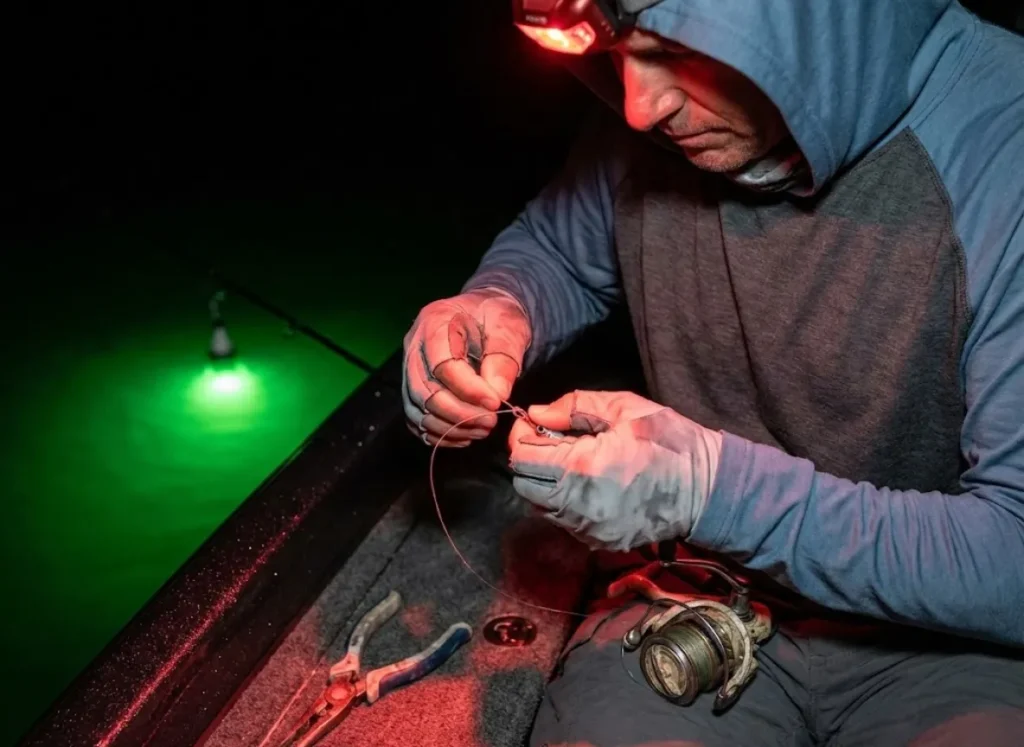
For the angler, white light is the enemy. It bleaches rhodopsin (the retinal pigment for night sight), and once lost, it takes 30-45 minutes for vision to recover. Headlamps with a dedicated Red Light Mode are mandatory for cockpit tasks like tying knots or unhooking fish. Red light does not deplete rhodopsin, allowing the angler to maintain situational awareness of the horizon during civil vs nautical twilight.
Finally, UV Blacklights (395 nm) are a specialized tool used with fluorescent line, specifically clear blue line. They cause the line to glow neon blue for bite detection without illuminating the water column below. Including these items in your kit of essential fishing tools designed for low-light management ensures you are prepared for the unique challenges of the dark.
How do tactics differ by species in low light? (Targeted Strategies)
Fish behavior changes when the lights go out, and your tactics must adapt to their new hunting patterns. The common thread across all species is predictability; in low visibility, fish are less likely to chase an erratic, fast-moving target.
- Bass (Largemouth Bass/Smallmouth Bass): Rely on the “Slow Roll.” Use a single Colorado blade spinnerbait, a dark-colored buzzbait, or a bladed jig (Chatterbait) retrieved just fast enough to thump. The vibration stimulates the lateral line, helping the bass vector in on the lure in pitch darkness. Topwater poppers worked over shallow flats are also deadly.
- Walleye: These “twilight specialists” move from deep basins to shallow sandbars (2-10 ft) to feed. Trolling stickbaits at dead-slow speeds (0.8–1.2 mph) allows them to track the silhouette against the moonlight.
- Snook, Redfish, & Tarpon: These are masters of the “Shadow Line.” They position themselves in the dark water down-current of dock lights or lighted bridges. The tactic is to cast up-current into the dark and drift the lure naturally through the artificial lighting; the strike occurs at the transition point.
- Trout Fishing: While often considered diurnal, large Brown Trout become apex predators at night. Using large, dark streamers or surface lures (mouse patterns) on high-vis fishing line (so you can track it) can produce trophy fish.
Catfish present a different challenge. These are chemosensory (scent/taste) hunters where visuals are secondary. Success relies on static bait placement using scent-heavy baits like cut bait or fish oils. While many species rely on the lateral line system of fishes to track wakes, catfish require patience, bite alarms, and potent bait. For a detailed analysis, you should review specialized strategies for catfish fishing at night.
Flounder require a visual hunt using high-intensity lights to spot their camouflaged outline on the bottom. Tides are critical here; an incoming tide brings clear water and fish, while an outgoing tide muddies visibility. Once you have the tactics dialed in, the focus must shift to the platform you stand on.
How Do You Manage Safety and Logistics in the Dark? (Operational Protocol)
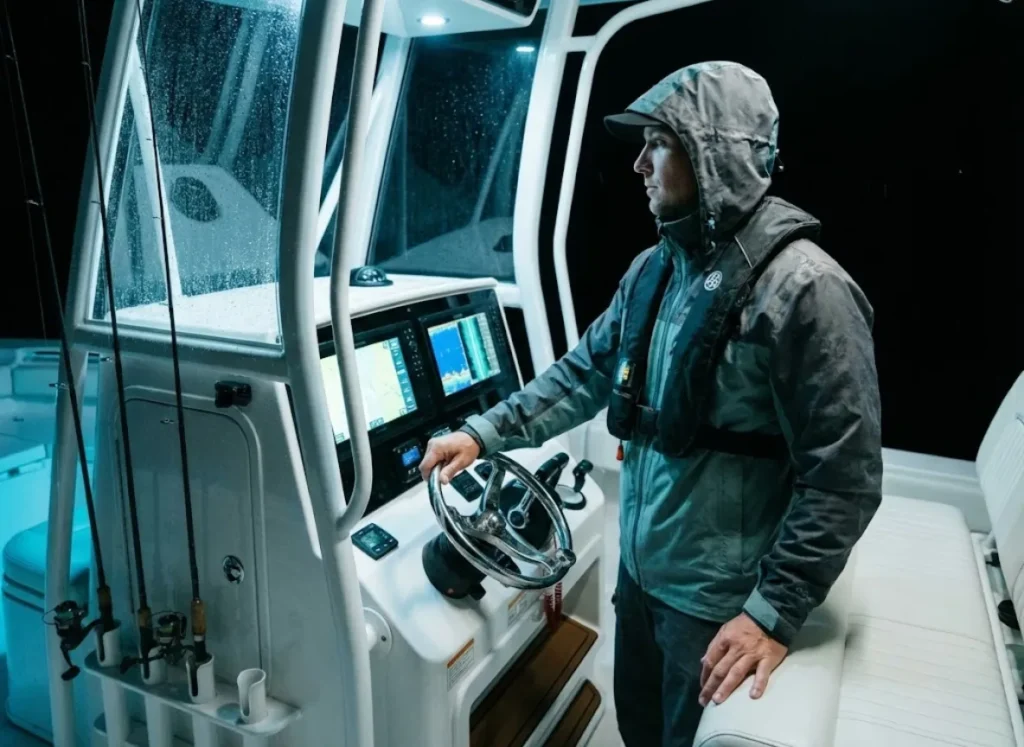
Even the most effective tactics are useless if the angler cannot operate safely and efficiently in a sight-deprived environment. The risks of boating and handling hooks increase exponentially when you cannot see what is coming.
What are the critical safety protocols for night angling? (The Fatal Five)
According to U.S. Coast Guard’s 2024 recreational boating statistics, “Improper Lookout” and “Operator Inattention” are top contributors to accidents. At night, the visual horizon disappears, making unlit markers and floating debris invisible.
The “Clean Deck” protocol is non-negotiable. Depth perception is compromised, so a net left on the deck or a tackle bag in a walkway becomes a major trip hazard. Every tool must be immediately re-stowed after use.
Equally important, Life Jacket (PFD) discipline must be absolute. Locating a person overboard in the dark is exponentially harder than during the day. Auto-inflating PFDs should be worn at all times. Always file a Float Plan—let someone on land know your specific fishing spot and return time.
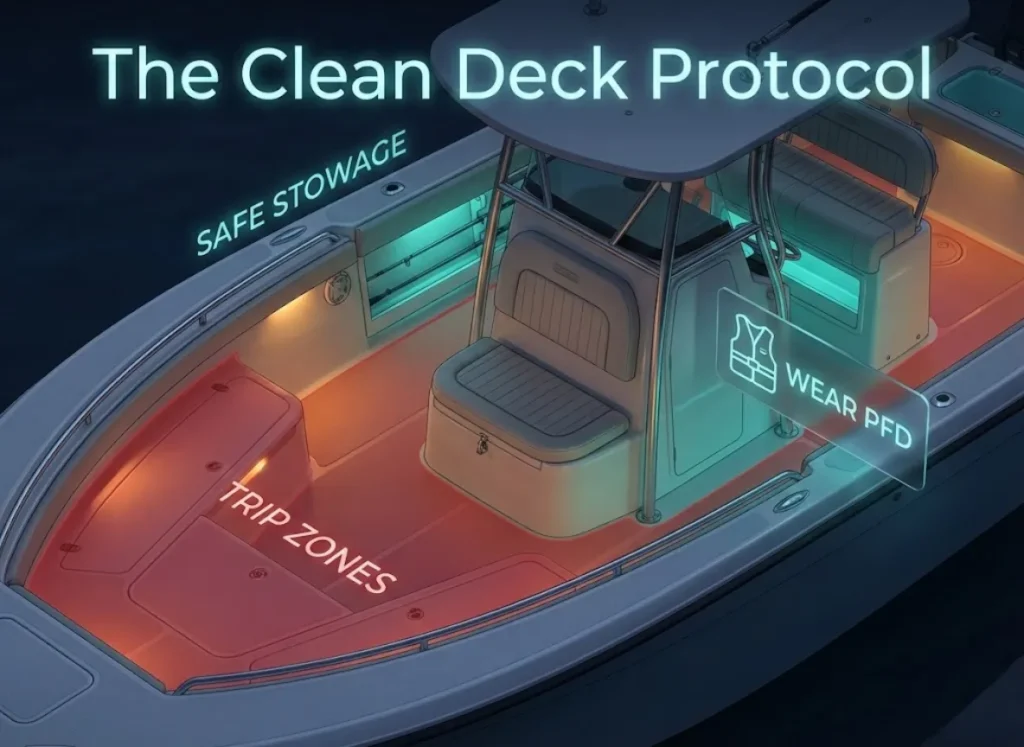
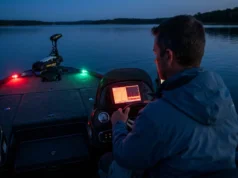
Navigation lights (Red/Green/White) and anchor lights (stern lights) must be functional. However, high-intensity LED light bars should never be used while running on plane. They cause cockpit blindness and destroy the night vision of other boaters.
The “Sober Skipper” rule is critical; the disorientation of darkness combined with alcohol is a lethal multiplier. Pack a first aid kit, warm layers for cooler nights, and bug repellent. For a broader understanding, refer to our definitive guide to fishing safety.
How do you minimize the “Fumble Factor”? (Tactile Proficiency)
Efficiency drops by 50% or more in the dark. To combat this fumble factor, organize gear into “systems” rather than digging through general tackle bags. A specific box for night lures saves valuable time.
Master Tactile Proficiency. You should be able to tie a Palomar or Clinch knot completely by feel. Practice this at home blindfolded; if you can’t do it in your living room, you won’t do it on a rocking boat in the dark. You can start learning the angler’s knot matrix for tactile rigging to build this muscle memory.
Pro-Tip: Pre-rig multiple rods before the sun sets. Have one rod with a topwater, one with a jig, and one with a spinnerbait ready to go. Trying to re-tie a lure while fish are blowing up on the surface in pitch darkness is a recipe for frustration and lost opportunities.
Use retractable gear tethers (zingers) for line cutters and pliers. This ensures tools are always at hand without visual searching or the risk of dropping them overboard. Daytime scouting is also essential; map the area while the sun is up so you know where the channel drop-offs and riprap are located. While temperature-dependent foraging in salmon and other species dictates when you fish, your organization dictates how well you fish.
Conclusion
Night fishing is a test of preparation and sensory awareness. Success requires prioritizing vibration and contrast over the colorful details we obsess over during the day. By understanding the physics of light—specifically why black lures offer the best silhouette against the night sky—and utilizing green lights to stimulate the food chain, you tilt the odds in your favor.
However, the most skilled angler is a safe angler. Adhering to the “Clean Deck” policy and maintaining strict red-light discipline are the hallmarks of competence on the water. Before your next twilight launch, practice your knot tying blindfolded. Mastery of the dark begins in the preparation.
FAQ – Frequently Asked Questions
What is the best moon phase for night fishing?
The Full Moon offers better visibility for anglers and allows predators to hunt aggressively in open water. However, the New Moon (darkness) often concentrates fish tighter to structure and artificial light sources, making them more predictable.
Can fish see red light at night?
Red light is the first wavelength absorbed by water and appears dark gray or black to fish at depth. Using red light for headlamps is less likely to spook fish than white light and preserves the angler’s night vision.
Do I need specialized lures for night fishing?
You generally don’t need special lures, but you should select specific versions of standard lures. Choose baits with rattles, large Colorado blades for vibration, and dark solid colors (black or blue or purple) for maximum silhouette.
Is it safe to fish alone at night?
Solo night fishing increases risk significantly due to the difficulty of self-rescue in the dark. If you must go alone, wear an auto-inflating life jacket, attach the engine kill switch to your person, and file a detailed float plan with a contact on land.
Risk Disclaimer: Fishing, boating, and all related outdoor activities involve inherent risks that
can lead to injury. The information provided on Master Fishing Mag is for educational and informational purposes
only. While we strive for accuracy, the information, techniques, and advice on gear and safety are not a substitute
for your own best judgment, local knowledge, and adherence to official regulations. Fishing regulations, including
seasons, size limits, and species restrictions, change frequently and vary by location. Always consult the latest
official regulations from your local fish and wildlife agency before heading out. Proper handling of hooks, knives,
and other sharp equipment is essential for safety. Furthermore, be aware of local fish consumption advisories. By
using this website, you agree that you are solely responsible for your own safety and for complying with all
applicable laws. Any reliance you place on our content is strictly at your own risk. Master Fishing Mag and its
authors will not be held liable for any injury, damage, or loss sustained in connection with the use of the
information herein.
Affiliate Disclosure: We are a participant in the Amazon Services LLC Associates Program, an
affiliate advertising program designed to provide a means for us to earn advertising fees by advertising and linking
to Amazon.com. As an Amazon Associate, we earn from qualifying purchases. We also participate in other affiliate
programs and may receive a commission on products purchased through our links, at no extra cost to you. Additional
terms are found in the terms of service.