In this article
The open water does not negotiate. When an engine dies in a shipping lane or a boot slips on slime-covered bedrock, the environment reacts with indifferent physics, not mercy. True fishing safety in recreational angling isn’t about buying a lucky hat; it is about engineering a survival protocol that activates the moment panic tries to take the wheel.
I have spent decades on the water, from the crushing surf of the Atlantic to the silent, frozen expanses of the northern lakes. I’ve learned that survival is rarely about heroism. It is about preparation. This guide moves beyond generic advice to establish a rigorous, data-driven framework for risk management—ensuring that your next fishing trip ends at the dock, not in a casualty report.
We will deconstruct the “Fatal Five” causes of boating accidents, master the hydrological physics of wading safety, and detail the medical mechanics of removing a hook buried past the barb.
What are the critical protocols for vessel-based angling safety?
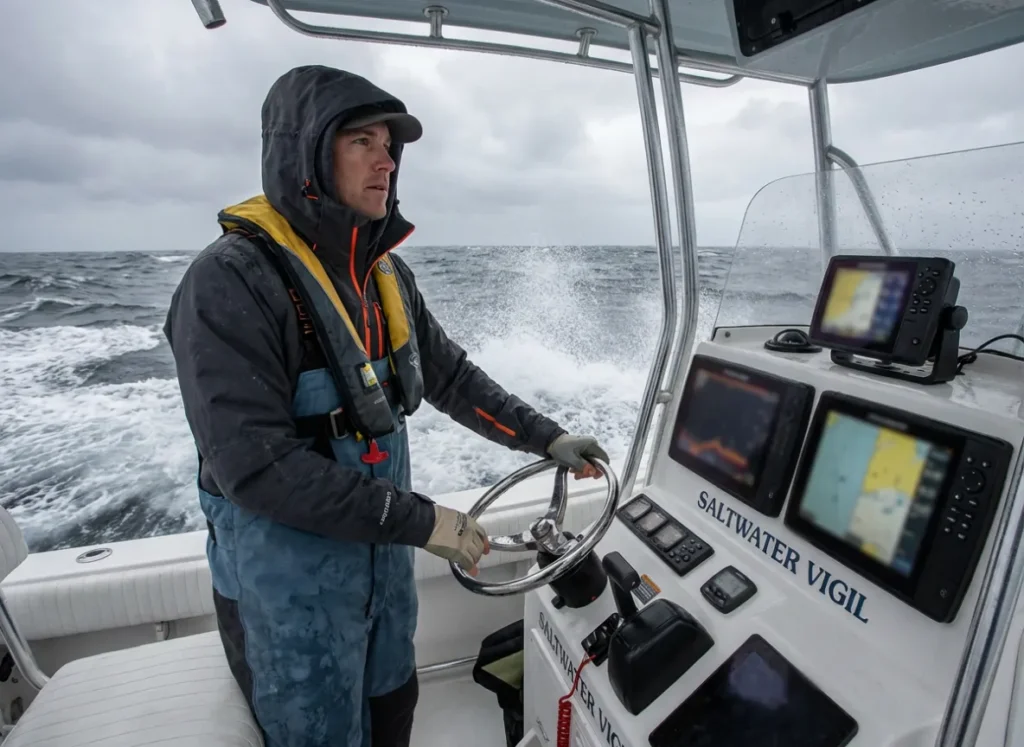
Most accidents on the water are not caused by rogue waves or freak storms; they are caused by administrative failures and lapses in situational awareness. Deconstructing these primary causes allows us to build a system that mitigates them before the lines are even cast.
How do we neutralize the “Fatal Five” contributors to boating accidents?
To survive on the water, you must first understand what is trying to kill you. According to the Coast Guard Foundation’s analysis of the 2024 boating safety report, the “Fatal Five” accident causes are Operator Inattention, Improper Lookout, Operator Inexperience, Machinery Failure, and Navigation Rules Violations.
For anglers, “inattention” is unique. It rarely means texting; it usually stems from hyper-focus on fish finders, trolling spreads, or rigging tackle rather than scanning the horizon. To combat this, implement a “360-degree scan” protocol every few minutes. Specifically look for commercial traffic or converging vessels that may be obscured by T-tops or high bows. Wearing quality polarized sunglasses cuts the glare, allowing you to see obstacles earlier.
Machinery failure is often preventable. It requires a pre-departure checklist that inspects fuel lines, battery voltage, engine cut-off switch, and bilge pump function before you leave the ramp. This maintenance mindset is just as critical as the initial decision process of choosing the right fishing boat for your specific waters.
Regarding Navigation Rules, treat busy fishing grounds and shipping lanes like intersections. Understanding right-of-way prevents high-speed collisions in congested waters. Finally, acknowledge the most sobering statistic: 76% of fatal victims drowned, and 87% of those were not wearing a life jacket. The USCG-approved PFD remains the single most effective tool against the Fatal Five.
What constitutes a tactically effective Float Plan?
A float plan is not a casual note left on the kitchen counter. It is a tactical document that activates the Search and Rescue (SAR) network by establishing a “Time Zero” for overdue status. If authorities don’t know you are missing, they cannot start looking. File a float plan before every fishing expedition, especially for solo angler safety.
Your plan must include critical identifiers to aid aerial visual identification. List the vessel registration, hull color, length, and “distinct features” like a red T-top. In addition to the vessel, list all communication assets on board, including cell numbers, VHF radio frequencies, and PLB/EPIRB registration codes. You can use the standard official USCG Auxiliary Float Plan template to ensure no data point is missed.
Pro-Tip: Define a precise “Overdue Time.” This is the specific moment the holder of the plan must contact authorities if you have not checked in.
Detail your tow vehicle’s description and license plate on the float plan card. Often, a truck left alone at a boat ramp is the first confirmable data point for SAR teams. Always leave this plan with a “reliable person” who understands their duty to act, rather than leaving it on the dashboard where it cannot trigger an emergency response.
When should you carry a PLB versus a Satellite Messenger?
Technology protects you from isolation, but the hardware must match the risk profile. Evaluate your device based on transmission power. Personal Locator Beacons (PLBs) transmit at 5 Watts on the COSPAS-SARSAT government network. They are designed to punch through heavy storms and canopy to get a signal out.
Contrast this with Satellite Messengers (like inReach), which operate on commercial networks at lower power (approximately 1.6 Watts). These generally require a clearer view of the sky. NOAA’s guide to emergency beacons clarifies that PLBs use non-rechargeable Lithium batteries with a 5-7 year shelf life, remaining dormant but guaranteed to work in an emergency.
Satellite Messengers offer “two-way” capability. This allows for logistics coordination, such as messaging family that you are running late, which prevents false alarms and unnecessary rescues. Just as you research choosing the right fish finder for your vessel to find fish, you must research your beacon to ensure you can be found using these emergency location tools.
Many offshore anglers employ a “Redundant Strategy.” They carry a Messenger for logistics and a PLB attached to the life jacket for ultimate fail-safe distress signaling.
How do you master hydrology and biomechanics for wading safety?
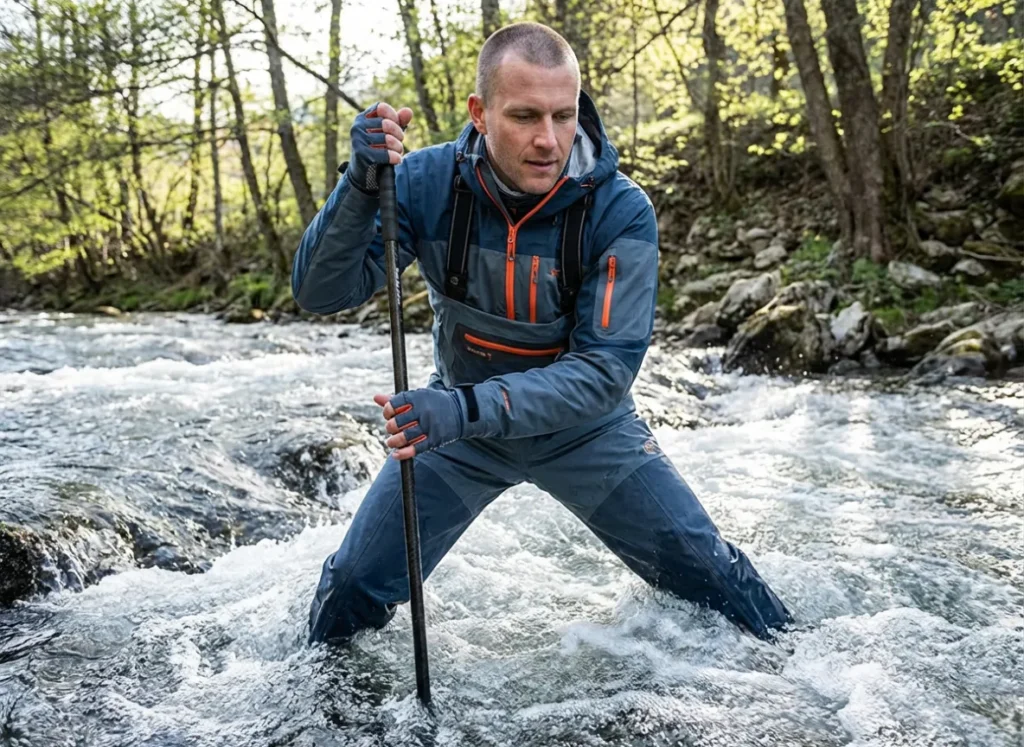
Once you step off the boat or bank and into the river, the situation changes. You are entering a dynamic environment where water weighs 62.4 pounds per cubic foot. Navigating it requires a fundamental understanding of hydrology and body mechanics for wading safety.
How do you read river currents to identify hidden hazards?
Reading water is about interpreting surface patterns to reveal what lies on the riverbed. A “Downstream V”—a smooth tongue of water pointing downstream—indicates a deep, safe channel between obstructions. This is usually your safest path of travel.
Conversely, avoid the “Upstream V.” This is a white water ripple or boil pointing upstream, which signals a submerged rock or log just below the surface—a classic trip hazard. Even more dangerous are “Strainers.” These are fallen trees or root wads that allow water to pass but trap solid objects. According to Carbondale Fire Protection District’s swift water rescue techniques, strainers are among the most lethal hazards in any river environment.
Never wade upstream of a strainer. A slip there allows the current to pin you against the debris with thousands of pounds of pressure, making wader self-rescue nearly impossible. You must also analyze “Eddy Lines,” the turbulent seam between the main current and the calm water. Crossing these requires an aggressive posture to prevent rotational torque on your knees. Understanding these river currents is also critical for success; it is the foundation of reading a river for fishing effectively.
What is the “Tripod Principle” and why is it non-negotiable?
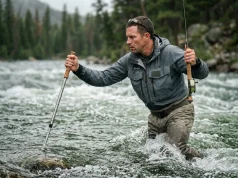
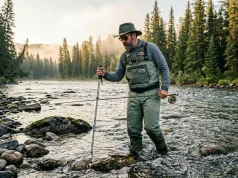
Stability in moving water comes from triangulation. Adopt the “Tripod Principle” to maintain three points of contact with the riverbed at all times: two feet and a sturdy wading staff.
Plant the wading staff upstream of your position. This allows the current to push the staff firmly into the bottom, creating a solid anchor point. If you plant it downstream, the current will skip it across the rocks, rendering it useless. Lean into the current against the staff while moving one foot at a time. US Forest Service water safety guidelines emphasize the importance of proper footing and non-slip footwear in these dynamic environments.
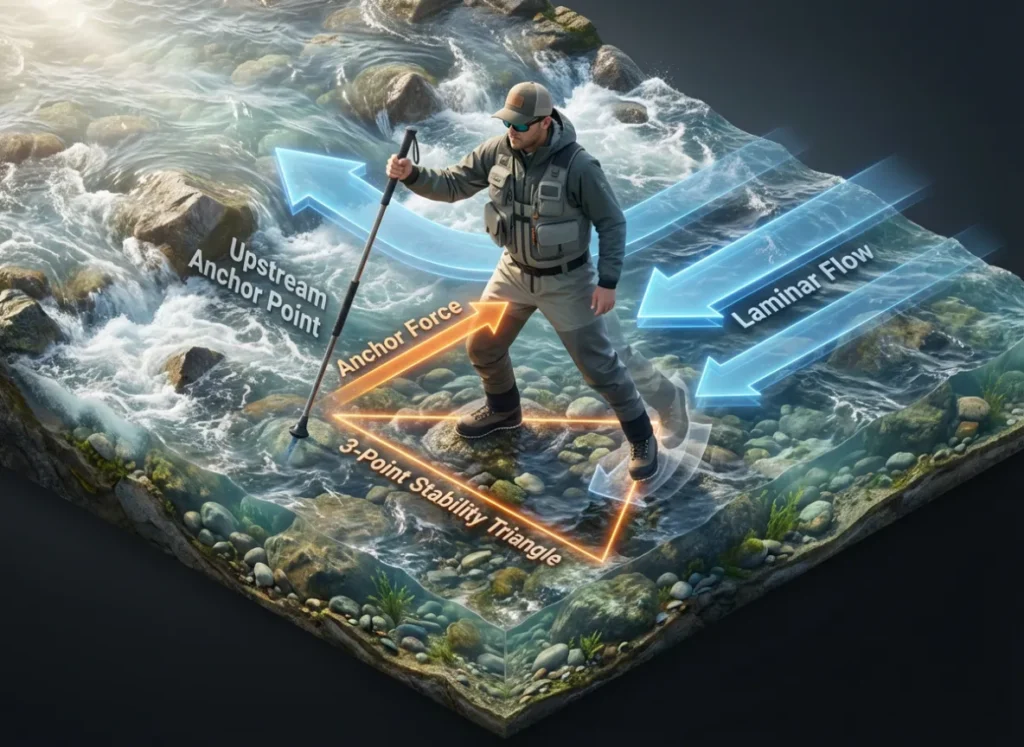
Combine this stance with the “shuffle step.” Slide your feet along the bottom rather than lifting them high. This allows you to verify stability before committing your weight.
Pro-Tip: Wear a wading belt cinched tight. While it doesn’t make waders waterproof, it traps air in the legs to provide temporary buoyancy and prevents the “sea anchor” effect if you go down.
Proper gear selection matters here. When choosing the right fly fishing waders, prioritize those with a quality belt system and studded fishing boots for traction on laminar flows.
How do you manage environmental extremes on Ice and Shore?
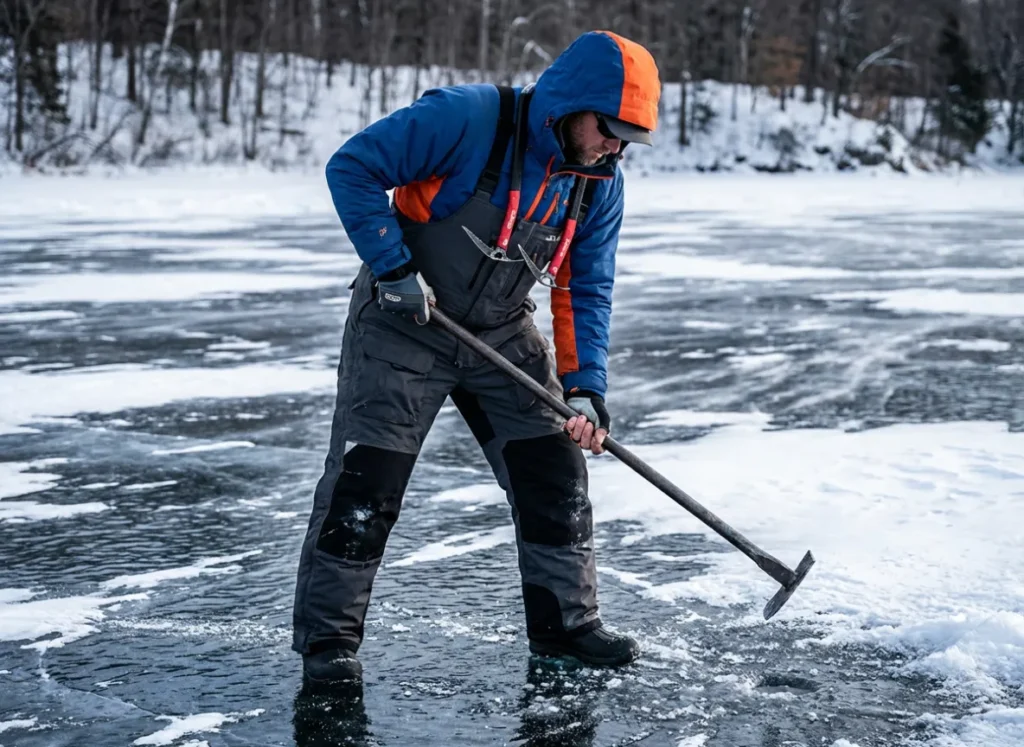
Water isn’t always liquid, and the ground isn’t always stable. Whether dealing with the frozen surface of a lake during ice fishing or the eroding bank of an estuary, you need specific metrics to judge structural integrity. Always check weather conditions and the weather forecast before departure to avoid unexpected storms.
How do you accurately assess ice integrity before committing weight?
Visual inspection is not enough. You must adhere to the “Clear Ice” thickness matrix. Generally, you need 4 inches for walking, 5-7 inches for snowmobiles, and 8-12 inches for small vehicles. However, these metrics apply only to clear, new blue ice.
“White ice” (snow ice) has half the structural strength of clear ice. It requires double the thickness to support the same load. To test this safely, carry a “Spud Bar”—a heavy metal chisel—and strike the ice hard in front of every step. If the bar punches through, retreat immediately along your original path.
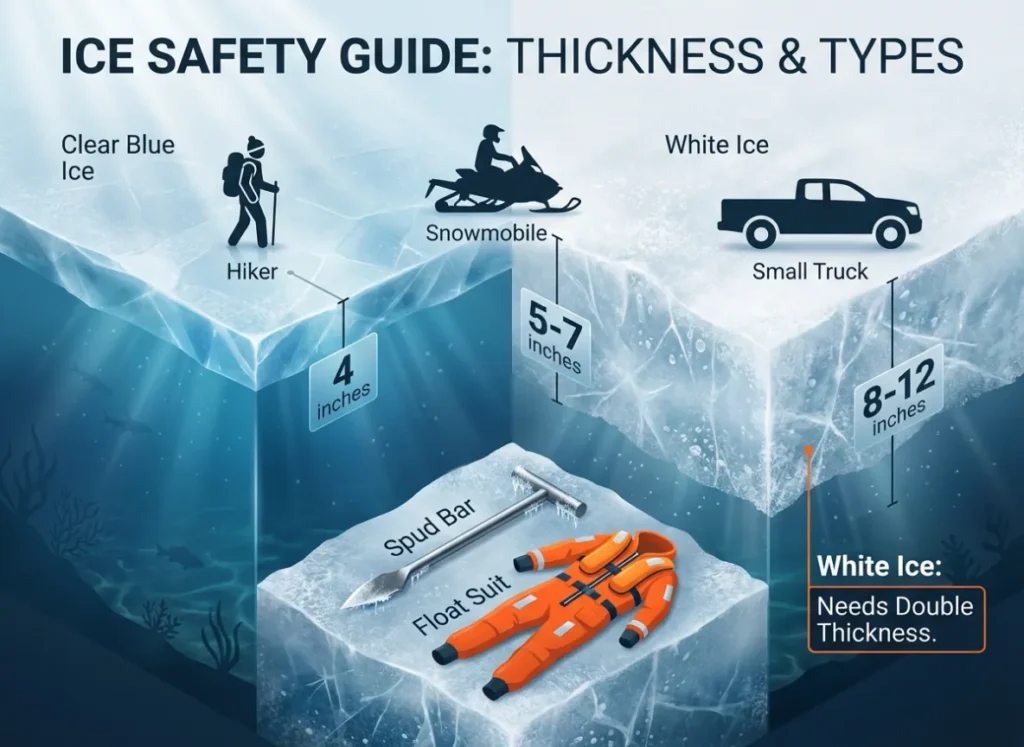
State agencies, such as in the Minnesota DNR’s general ice thickness guidelines, serve as the primary authority for these load data points.
Manage the “Cold Shock” response (the gasp reflex) by wearing a PFD or Float Suit to prevent hypothermia. Keeping your head above water during the first minute of immersion is critical to prevent drowning from inhalation. This safety equipment should be considered part of your best ice fishing combo, just as essential as the rod and reel.
Why are undercut banks and bacterial infections the silent killers of shore fishing?
The grassy banks of a river or estuary often hide geological and biological traps. Inspect riverbanks for “Undercutting”—areas where the current has eroded the soil beneath the grass. This creates a cantilevered shelf that can collapse under an angler’s weight. Look for tension cracks running parallel to the shore as a warning sign of slope failure. Avoid slippery rocks and verify shore stability before settling in.
Biological threats are less visible but equally dangerous. Treat all cuts and scrapes immediately when fishing in brackish or warm saltwater to prevent infection by Vibrio vulnificus.
Vibrio infection symptoms include rapid onset of severe pain, redness, and blistering that spreads quickly. The CDC’s prevention guidelines for Vibrio vulnificus highlight that immunocompromised individuals are at extreme risk.
Pack an antiseptic wash containing Chlorhexidine. It is more effective than standard iodine for neutralizing marine bacteria in the field. These precautions are a vital part of mastering shore fishing techniques safely.
What is the physics-based approach to hook removal?
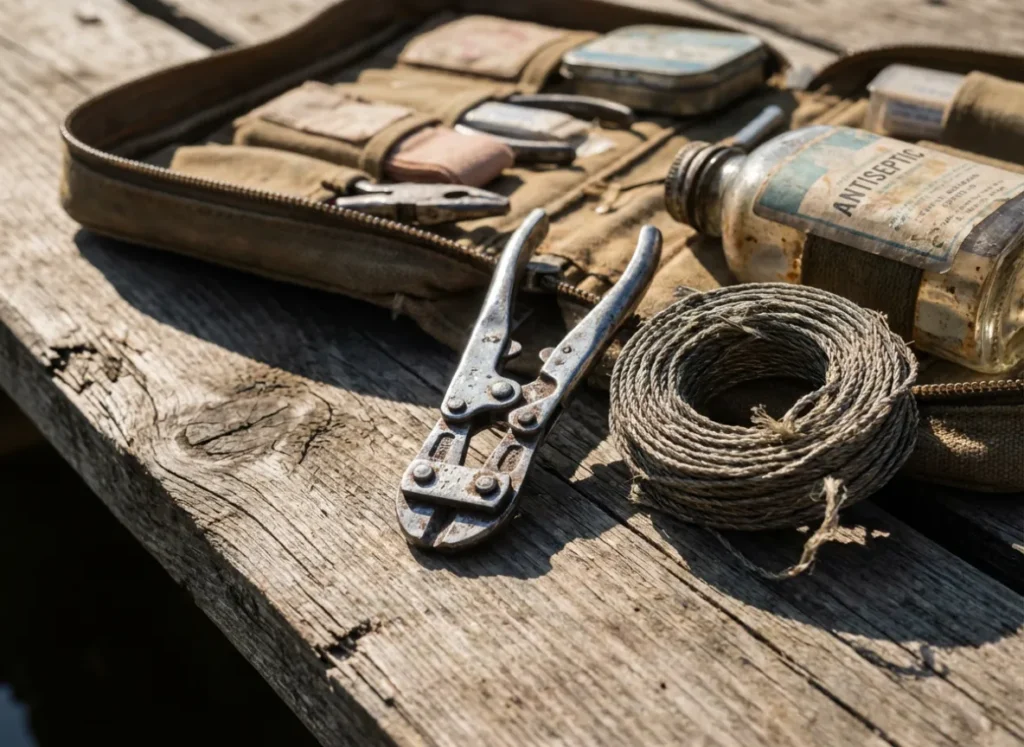
The most frequent injury in fishing isn’t a fall; it’s the tool we use to catch the fish. Removing a hook embedded past the barb requires mechanical precision, not brute force. Handle hooks carefully to avoid this scenario.
How do you execute the “String-Yank” technique safely?
First, assess the hook injury location. Do not attempt removal if the hook is embedded in the eye, eyelid, genitals, or neck. Stabilize the area and seek professional medical care immediately.
For hooks in stable tissue like an arm or leg, utilize the “String-Yank Technique” (Retrograde method). This minimizes tissue trauma compared to cutting it out. Loop a strong line (braid or heavy mono) around the bend of the hook. Depress the eye of the hook down firmly against the skin to disengage the barb.
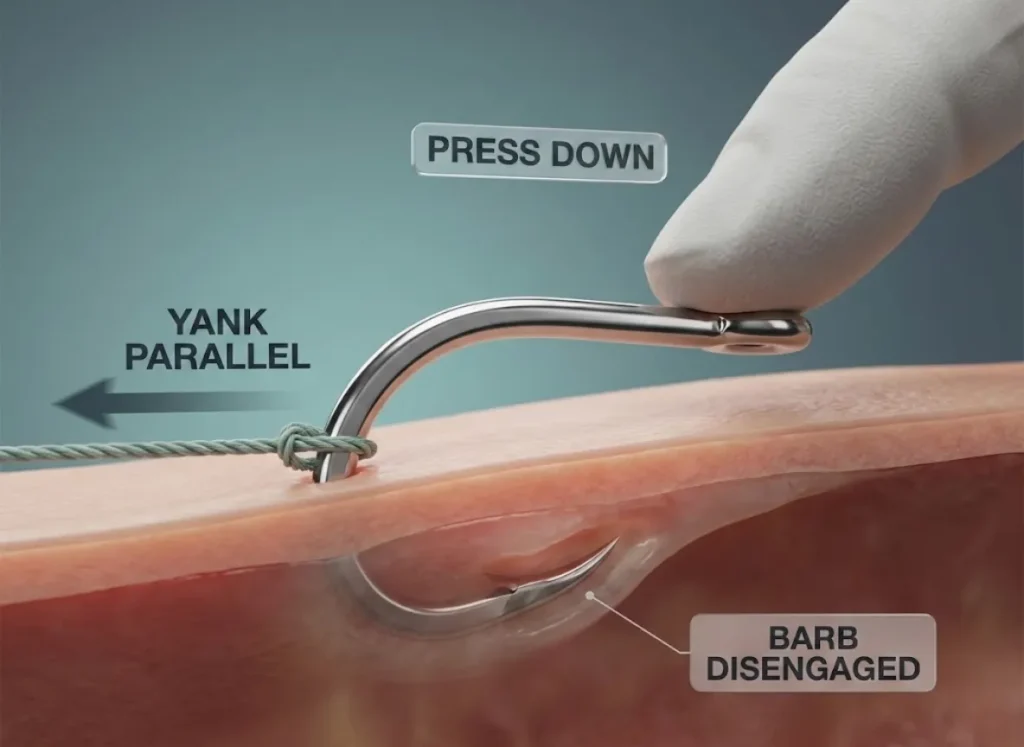
Apply a sharp, high-velocity yank parallel to the skin. Do not pull up. You must use the vector of force to back the hook out exactly the way it entered. An NIH study on the efficacy of the string-yank technique validates this as a legitimate medical procedure.
Mandate eye protection for both the patient and the operator, as the hook often becomes a high-speed projectile upon release. If the hook is a multi-barb treble and the string-yank is not viable, use wire cutters or mini bolt cutters from your best fishing pliers kit to execute the “Advance and Cut” method.
Final Survival Check
Safety is not a passive state; it is an active system. It requires the mitigation of the “Fatal Five,” the discipline to file a float plan, and the physical mastery of the “Tripod Principle” in swift water. From reading ice thickness matrices to understanding the bacterial risks of Vibrio, knowledge is the primary barrier against fishing injuries.
When trauma occurs, having the mechanical tools and physics-based techniques to resolve it differentiates a minor incident from a medical emergency. Review your current fisherman’s first aid module against these protocols. Print the Float Plan card. Share this fishing safety tips guide with your fishing partner—because a safe partner is your best insurance policy.
FAQ – Frequently Asked Questions
What are the most common fishing safety hazards?
Drowning due to a lack of life jacket wear and falls in swift water are the primary lethal risks. Secondary hazards include hook injury, hypothermia (cold shock), and environmental threats like unstable ice or bacterial infections (Vibrio).
How thick does ice need to be for fishing?
Clear, new blue ice should be at least 4 inches thick for a single angler walking on foot. Double this thickness (8 inches) is required for white ice (snow ice). Grey or dark ice is never safe.
Do I really need a life jacket while wading?
Yes. A Type III PFD or an auto-inflatable vest is highly recommended, especially in cold or swift water. If you slip, waders can fill with water or trap air, making it difficult to self-right without the additional buoyancy of a PFD.
What should be in a fishing first aid kit?
Beyond standard bandages, include wire cutters for cutting hooks and an antiseptic like Chlorhexidine for marine wounds. Pack fine-point forceps for splinter removal and a tourniquet for severe bleeding. Always include sunscreen and insect repellent for general protection.
Risk Disclaimer: Fishing, boating, and all related outdoor activities involve inherent risks that
can lead to injury. The information provided on Master Fishing Mag is for educational and informational purposes
only. While we strive for accuracy, the information, techniques, and advice on gear and safety are not a substitute
for your own best judgment, local knowledge, and adherence to official regulations. Fishing regulations, including
seasons, size limits, and species restrictions, change frequently and vary by location. Always consult the latest
official regulations from your local fish and wildlife agency before heading out. Proper handling of hooks, knives,
and other sharp equipment is essential for safety. Furthermore, be aware of local fish consumption advisories. By
using this website, you agree that you are solely responsible for your own safety and for complying with all
applicable laws. Any reliance you place on our content is strictly at your own risk. Master Fishing Mag and its
authors will not be held liable for any injury, damage, or loss sustained in connection with the use of the
information herein.
Affiliate Disclosure: We are a participant in the Amazon Services LLC Associates Program, an
affiliate advertising program designed to provide a means for us to earn advertising fees by advertising and linking
to Amazon.com. As an Amazon Associate, we earn from qualifying purchases. We also participate in other affiliate
programs and may receive a commission on products purchased through our links, at no extra cost to you. Additional
terms are found in the terms of service.