
In this article
The gravel was bright and clean — almost unnaturally so — a pale oval maybe three feet wide against the dark river bottom. I stepped right over it. Didn’t even register it as a redd until the guide downstream held up a fist and said nothing. He didn’t need to. I’d already felt the crunch underfoot.
That moment changed how I think about wading. The question isn’t whether wade fishing is ethical in some abstract sense. The question is whether you know enough physics and biology to make it ethical. Most anglers don’t. They wade the same way they’ve always waded — by feel, by habit, by the assumption that if nothing looks broken, nothing is broken.
This guide breaks down the mechanical, biological, pathogen transfer, and legal dimensions of wade fishing stream bed impact — not to shame you off the water, but to give you the technical framework to wade with intention and zero footprint.
⚡ Quick Answer: Wade fishing is not inherently unethical, but it is never neutral. A single wading event over an active redd can affect up to 43% of the eggs inside it. Twice-daily wading can push that number to 96%. The ethical angler learns to read stream bed substrate, identify spawning redds by their pit-tailspill geometry, apply the Rule of Ten before entering any reach, and choose rubber soles over felt to prevent invasive species transport. Wade with the right technical knowledge and you cause minimal harm. Wade without it and you are a disturbance event on legs.
The Mechanics of Every Step: Benthic Compaction Physics
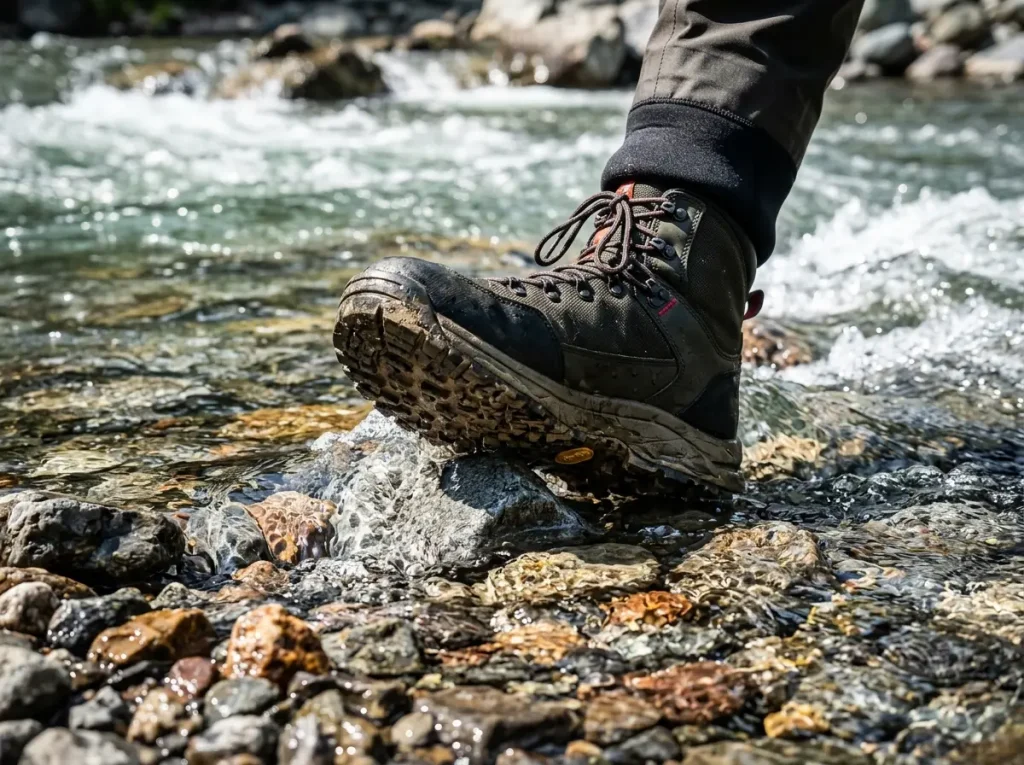
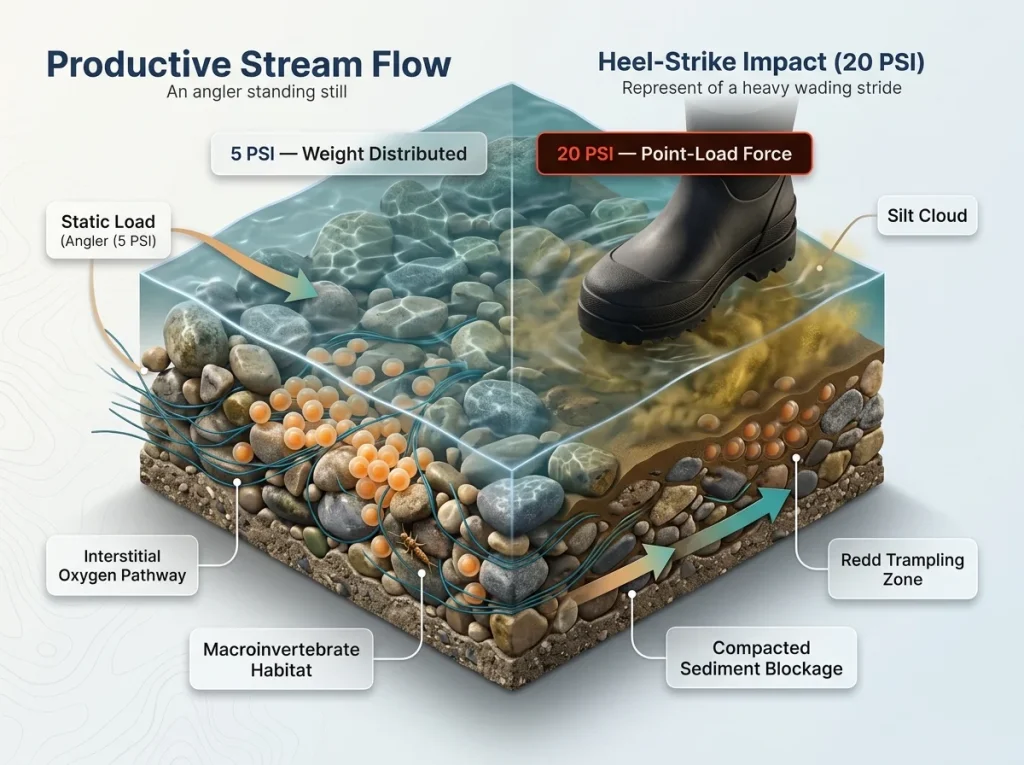
Here’s what your boot does to the stream bed that you can’t see and don’t feel: it crushes it.
A 200-pound angler standing still spreads weight across roughly 40 square inches of sole — about 5 PSI. But a normal wading stride concentrates nearly your full bodyweight on a single heel during the loading response phase: roughly 10 square inches of contact. That’s 20 PSI per step. A 4× amplification from gait mechanics alone.
Benthic compaction is what happens when that pressure hits a saturated stream bed. The interstitial spaces between gravel clasts — the tiny voids that carry oxygenated water to everything living below the surface — collapse. Mayfly nymphs crushed. Stonefly larvae asphyxiated. Salmonid eggs cut off from oxygen. The USDA Forest Service research on redd trampling impact models documents this compaction-to-mortality chain precisely. It doesn’t require a catastrophic event. Just a normal step.
Manning’s n tells you how substrates behave under that pressure. Coarser substrates — cobble at n 0.040–0.050 — absorb impact through the armor layer. Finer substrates — silt and fine sand at n 0.020–0.025 — deform and produce a sediment plume. Those particles stay suspended for hundreds of meters before settling into downstream spawning gravels and blocking the micropores salmonid eggs need for oxygen diffusion. Wading on silt is never neutral — you don’t have to step near a redd to damage one. Knowing which boot sole material minimizes substrate disruption is the next layer of that decision.
Pro tip: Before stepping into any pool tail or shallow riffle, scan the bottom through your polarized glasses 10–15 feet ahead. Rounded cobble gives you purchase. Clean pale gravel in an oval? That’s someone’s spawn. Back out.
Reading Redds Before You Step: A Field Identification System
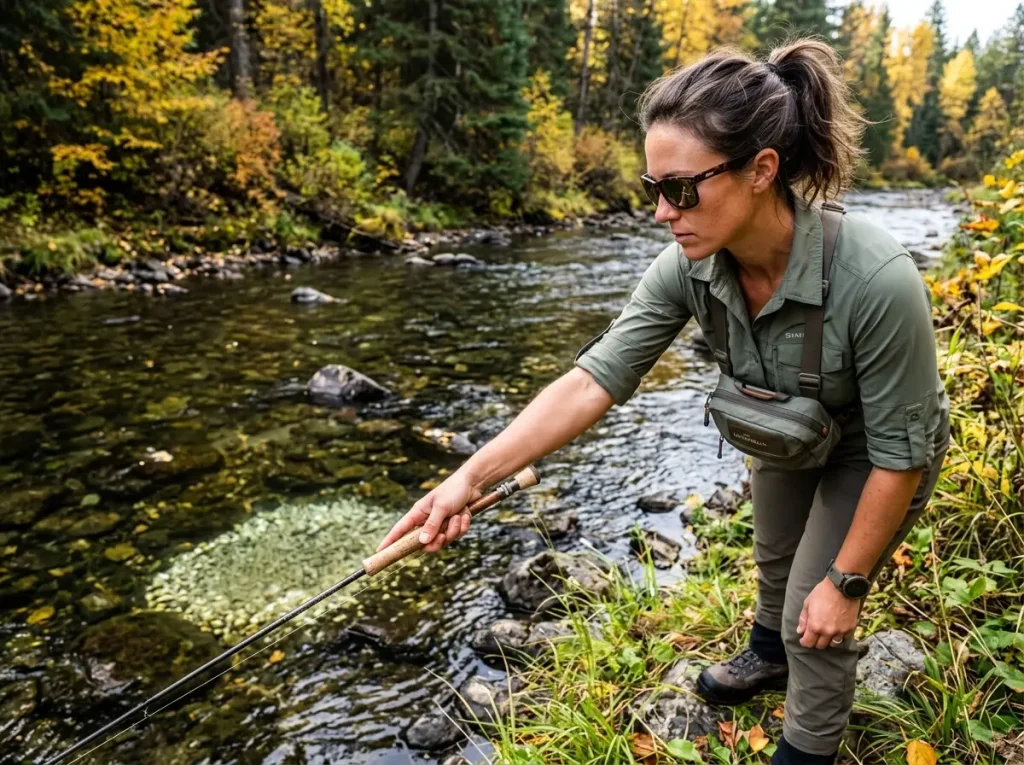
A redd is not just a bright patch. It has geometry — learn it, and you’ll never mistake a natural scour pocket for an active nest again.
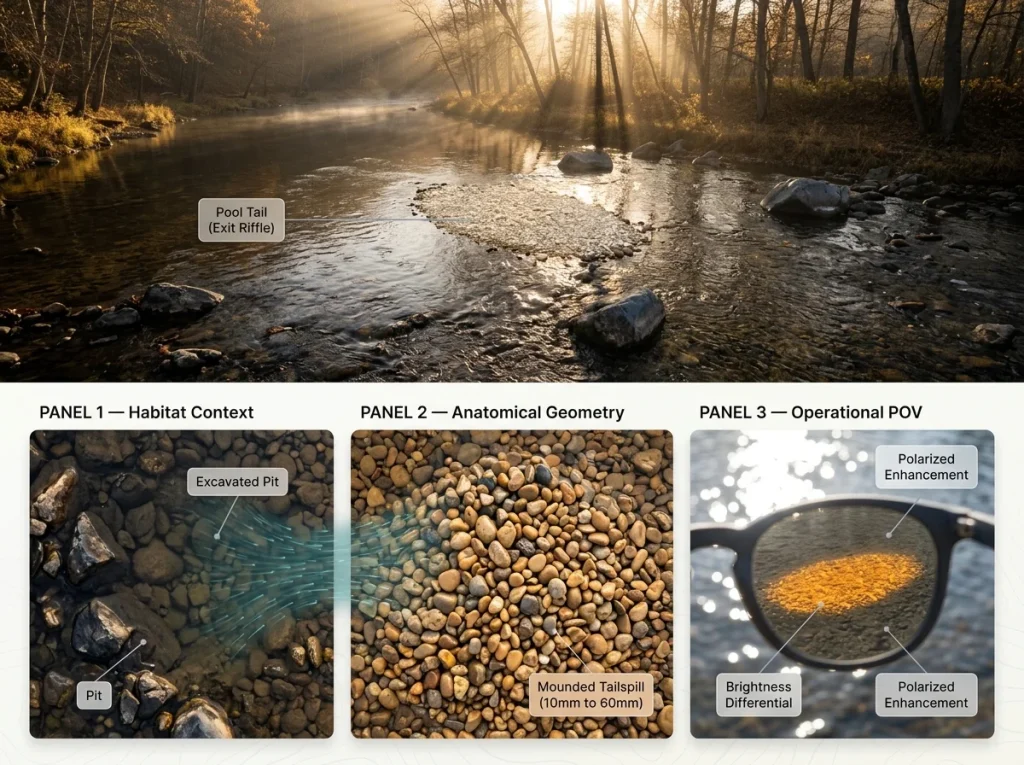
The structure is specific: an upstream pit (a concave depression 5–10 cm deeper than the surrounding bed) connected to a downstream tailspill (a slight gravel mound where the female covered her eggs). From above, the whole complex reads as a pale, bathtub-shaped oval, typically 2–3 feet wide for trout. The female fanned away periphyton and silt, leaving a clean, scrubbed oval distinctly brighter than anything around it. The Wild Trout Trust redd identification advisory documents the grain-size window: 10mm to 60mm — “pea to half-dollar” — that female trout select for optimal oxygen percolation. Clean gravel in that size range, in that oval, is a redd.
Species timing determines which windows you’re managing. Brown and brook trout spawn October through January in pool tails and slow riffles. Rainbows and cutthroats go February through May in shallow gravel bars and headwater reaches. Smallmouth bass sweep circular nests in spring on slow-current sand and gravel. The calendar tells you which species; the substrate geometry confirms they’ve been there.
Most anglers assume the risk ends when the fish leave. It doesn’t. Eggs stay in the gravel for months, through the entire Cumulative Temperature Unit (CTU) development window — the total heat accumulation the eggs need before hatching. A redd that looks finished in November may still contain pre-emergent fry in January — at their most mechanically fragile stage, when a single boot strike causes maximum harm. Understanding how habitat degradation has already erased 80% of brook trout native range puts the stakes of individual redd protection in full context.
The Pit-Tailspill Geometry: What to Look For
Position yourself downstream of any suspected redd and look upstream through polarized glasses. The tailspill mound catches light differently than the surrounding flat substrate — it will show before the pit does. If you see a large female actively fanning gravel with her tail, stop immediately and back out quietly. Natural scour pockets lack the downstream mound; that’s the diagnostic difference.
In murky water above 15 NTU turbidity, polarized optics lose effectiveness. When visibility drops that low during spawning season, default to grid-avoidance: if the substrate is the right size and you’re in a spawn window, treat the entire reach as a redd-risk zone regardless of what you can or can’t see.
Species-Specific Timing and Habitat Windows
Temperature, not the calendar, drives the CTU clock. In a cold spring, brown trout eggs laid in October can remain in the most sensitive pre-emergent stage through February. A mid-winter wade through the wrong riffle section eliminates that cohort entirely. Check stream temperatures against species-specific CTU thresholds — don’t trust the date alone.
The Sediment Plume: Downstream Consequences of Every Wade
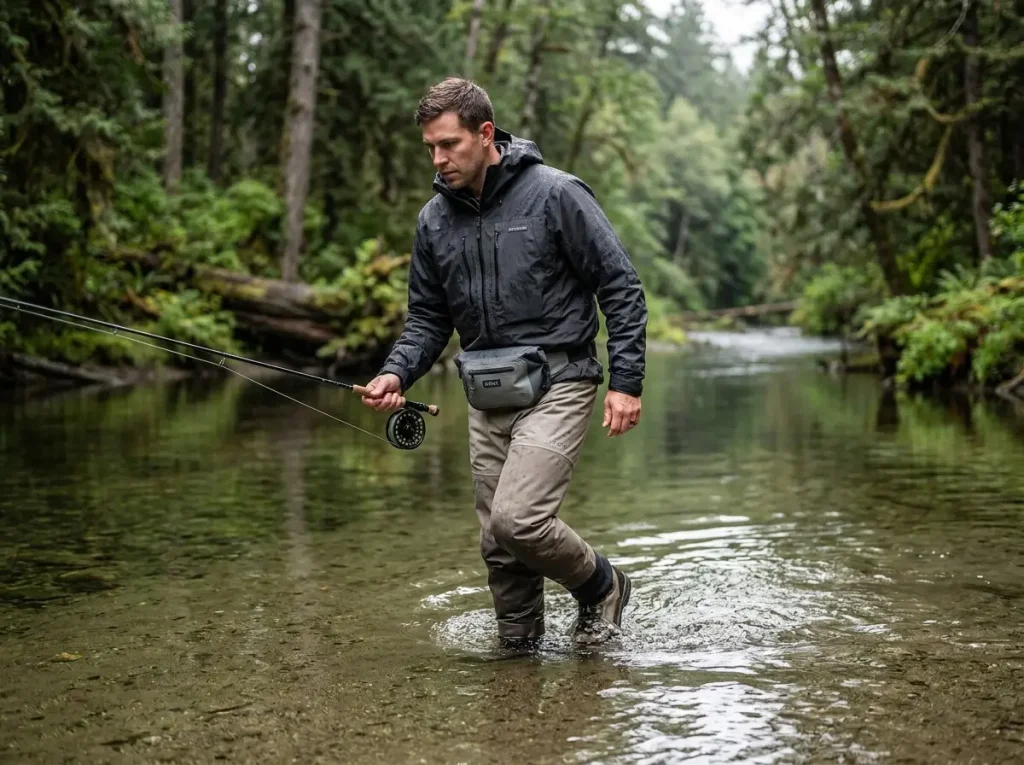
Most anglers think about impact only in terms of what’s directly underfoot. The actual footprint extends much farther.
The human form in moving current acts as a bluff body — a solid obstruction that creates a low-pressure velocity shadow downstream. Every step in fine-sediment substrate resuspends particles that travel hundreds of meters before settling. They don’t settle on bare rock. They settle into the interstitial spaces of whatever gravel is downstream — including spawning gravels you never stepped near.
Benthic infiltration works like this: suspended fine sediment decelerates as it travels downstream, packs into the micropores of existing gravel substrate, and cuts subsurface oxygen flow to whatever is living below. Salmonid eggs suffocate not because anything crushed them, but because the oxygen diffusion pathway was physically blocked. The angler three pools upstream never knew they caused it.
The EPT taxa — mayflies, stoneflies, and caddisflies — take the next hit. Research on macroinvertebrate diversity loss under human disturbance in freshwater systems documents the pattern: increased sedimentation drives out sensitive rheophilic organisms and replaces them with pollution-tolerant taxa that don’t support the same food web. Catastrophic drift compounds this — agitation dislodges nymphs into the current, where predation pressure spikes. You didn’t crush them. You just made them easy to eat.
Turn sideways to the current to shrink your frontal area and reduce the downstream velocity shadow. Learn reading pool-riffle sequences to identify low-impact entry zones before the first step — where you choose to stand matters as much as how you move when you get there.
Pro tip: Shuffle-wade instead of walking normally. Slide your feet along the bottom rather than lifting and planting — this cuts sediment kick dramatically. Every guide who actually cares about the stream teaches this within the first hour.
Boot Soles and Biosecurity: The Physics of Pathogen Transfer
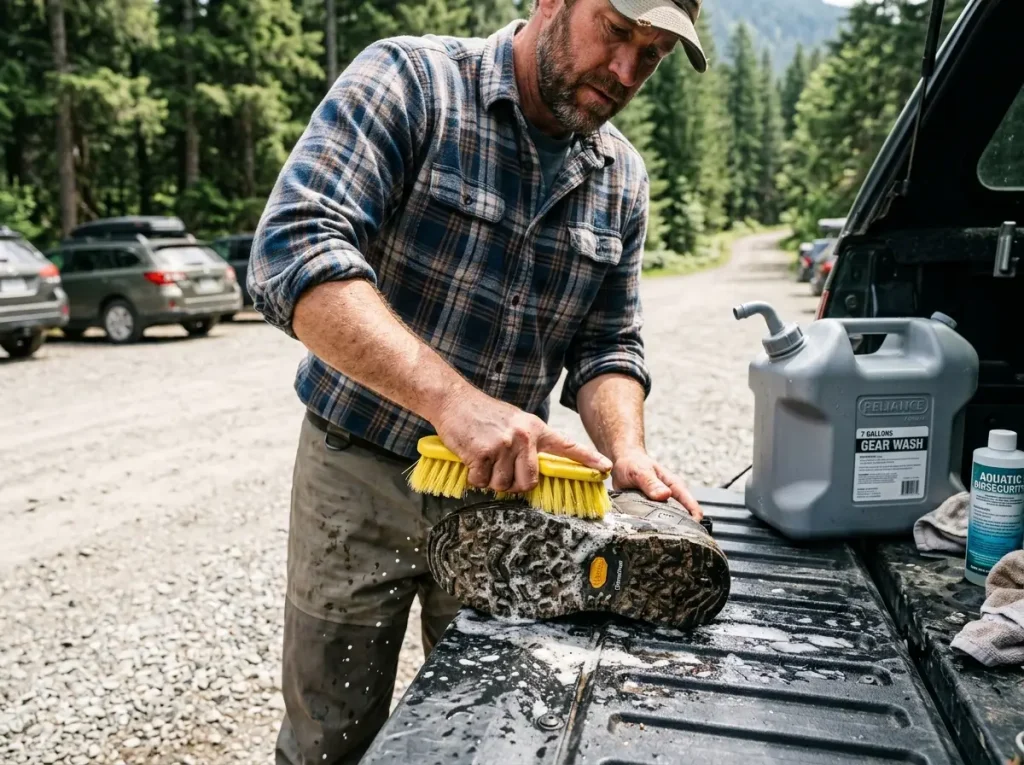
Your boot sole is the single most consequential piece of conservation gear you own. Not your net. Not your release tool. Your sole.
Felt is a non-woven fiber matrix with a mean interstitial space of 31.3 micrometers. Didymo (Didymosphenia geminata) spores average 8.7 micrometers — a nearly perfect mechanical fit for felt’s fiber gaps. Whirling Disease myxospores size comparably. Research from Montana State University demonstrated that felt trapped 100% of exposed whirling disease myxospores. Rubber, with a mean interstitial space of 2.0 micrometers, excluded them at 95%+ efficiency. After five hours of stream exposure, felt retains approximately 11,000 live Didymo cells per boot segment. Rubber retains fewer than 4.
Those numbers end the debate. The Minnesota DNR summary of felt-soled wader AIS risk lays out the regulatory picture — states including California and Maryland have already banned felt soles. But the physics don’t care about legality. Felt is an aquatic invasive species vector by design. The fiber structure that gives it grip is the same structure that catches and holds pathogens through weeks of transport.
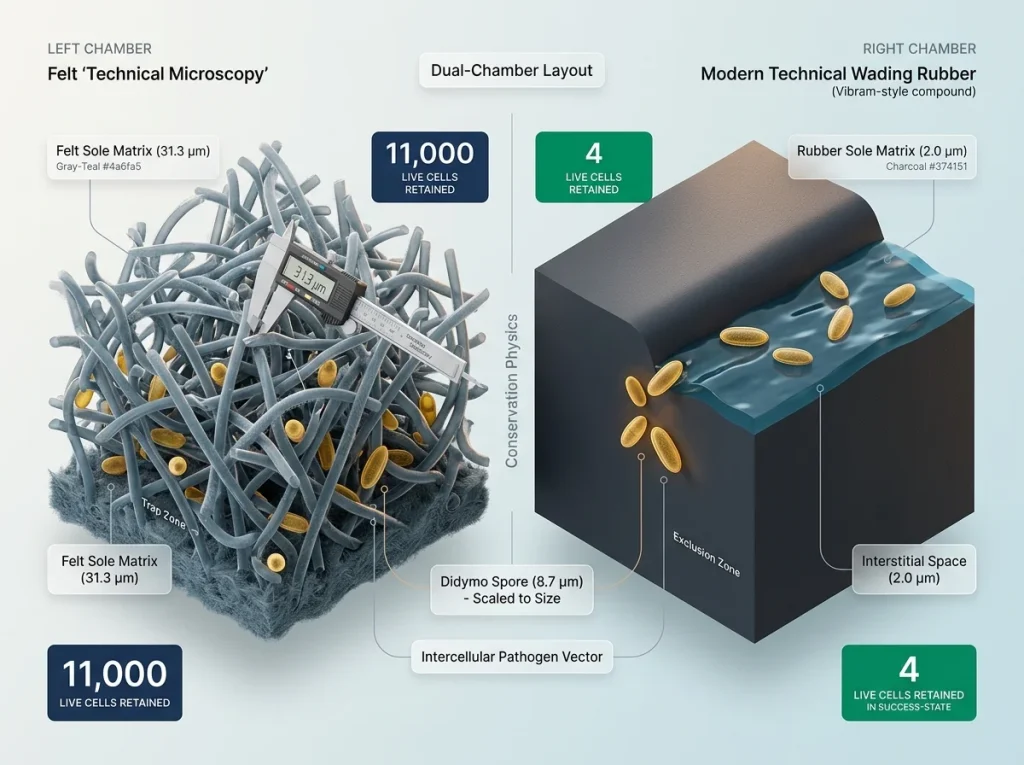
Felt vs. Rubber: The Numbers That End the Debate
The felt defender’s argument has always been grip. That argument was legitimate ten years ago, when rubber sole compounds were slippery on wet basalt. Vibram StreamTread and modern studded rubber compounds have closed that gap in most technical wading environments. The conservation calculus now clearly favors rubber. If you’re still wading felt across multiple watersheds in the same season, you are carrying an undetermined load of live organisms from one drainage to another with every trip. Check the full angler’s field guide to aquatic invasive species for the full scope of what those organisms do when they establish.
Decontamination Protocols by Sole Material
Check, Clean, Dry is not optional. But it is material-dependent, and this is where most anglers get it wrong.
For rubber: hot water plus dish soap scrub at the access point, three minutes on seams, lace holes, and gravel guards. Air dry. Done. Rubber desiccates pathogens quickly and completely because it doesn’t retain interior moisture the way felt does.
For felt: “Dry” means 48+ hours in genuinely dry conditions, not hung in a garage overnight in a humid climate. Heat is the most reliable treatment method — 45°C (113°F) for 20 minutes, or 60°C (140°F) for one minute. Chemical treatment (5% dishwashing solution) needs to saturate the entire felt mat, not just the surface, and 20 minutes of soaking may not reach interior fibers. The most ethical felt protocol if you insist on using it: designate one pair per single body of water and never cross-contaminate.
Pro tip: Keep a quart-sized ziplock in your pack with pre-measured dish soap concentrate. At the access point, add water from a bottle, scrub boot seams, laces, and gravel guards before rinsing. Three minutes. That’s the whole protocol for rubber. Make it a habit before the boots ever leave the streamside.
The Rule of Ten: Engineering Your Safety Margin
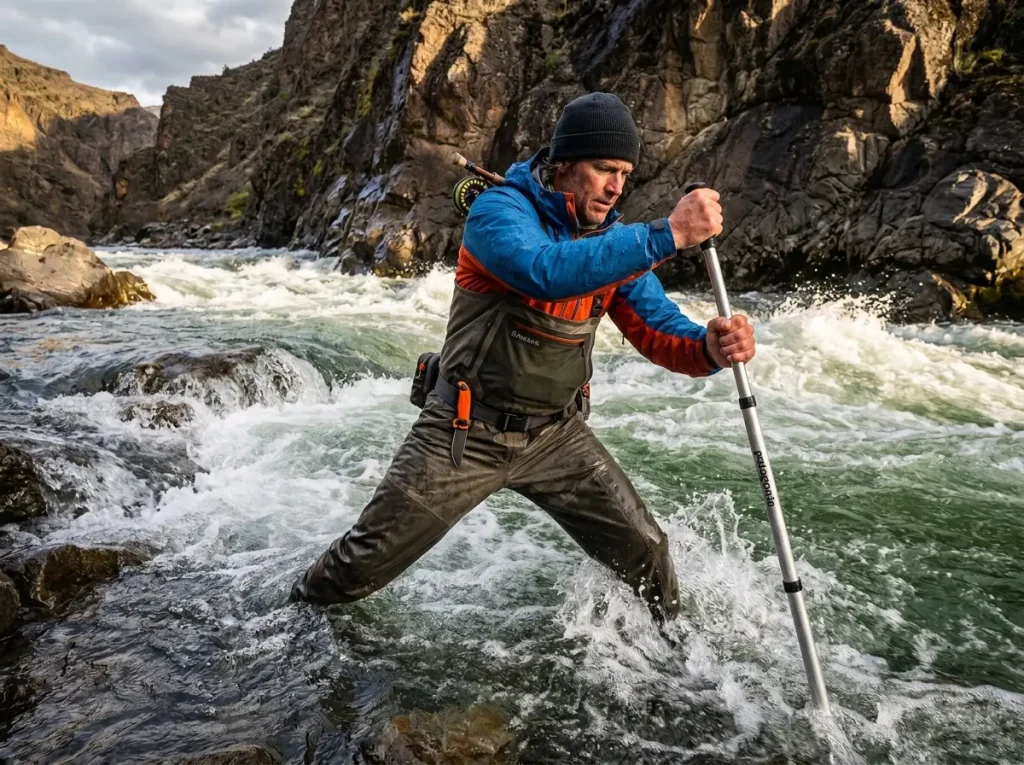
Safe wading is ethical wading. An angler who loses their footing doesn’t just put themselves at risk — they cause a significant disturbance event during the fall: sediment blown, substrate disturbed, whatever spawning habitat happens to be underfoot.
The Rule of Ten gives you a hard threshold before you step in: Depth (ft) × Velocity (ft/s) ≥ 10 = hazardous. This is the stability index used in pedestrian destabilization physics during flood-level wading conditions research. At 2.0 feet deep and 5.0 ft/s current, your stability index is exactly 10.0 — already at the boundary. At 3.0 feet and 3.5 ft/s, the index is 10.5. Many anglers wade this every weekend and chalk it up to experience. They’re one foot slip on algae-covered bedrock away from a swim in 46°F water.
Two physical failure modes lead to a fall. Overturning instability happens when the current’s torque on your form — acting as a bluff body — exceeds your stabilizing moment. Sliding instability happens when hydrodynamic push exceeds boot-substrate friction. Both get worse as velocity increases, as depth increases, and especially as substrate roughness drops. The same gage reading on a cobble reach versus an algae-slicked bedrock slab is a completely different risk profile.
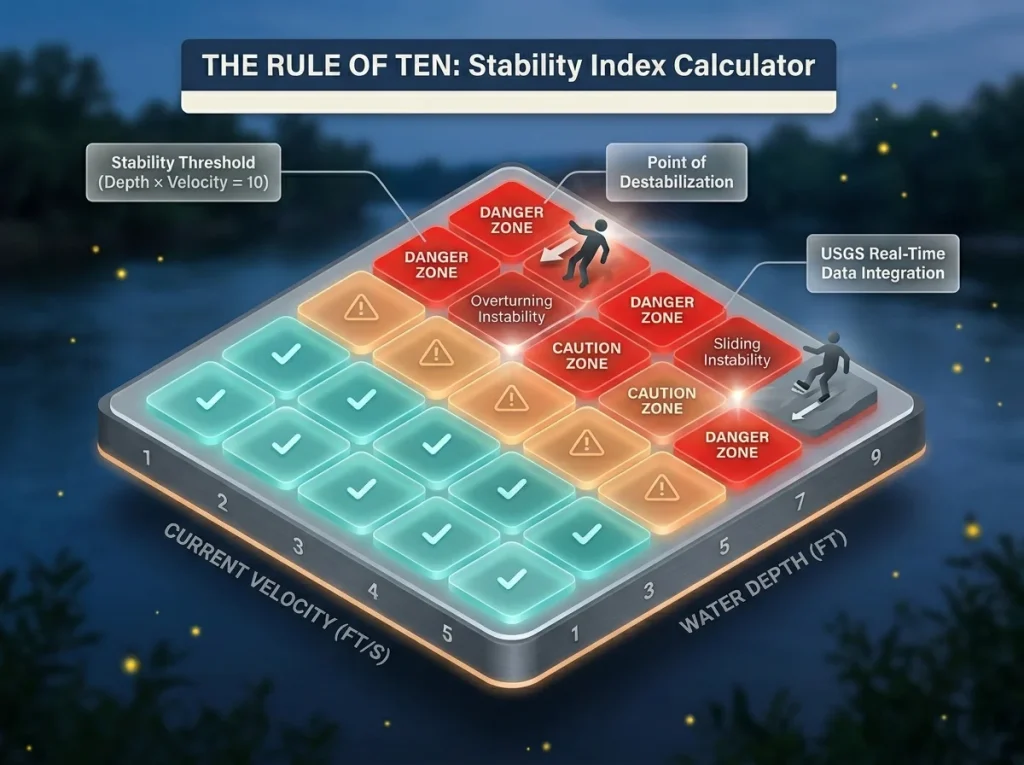
Reading USGS Gage Data Before You Wade
USGS StreamStats provides real-time depth and cubic feet per second for most gauged streams. Converting CFS to approximate mid-channel velocity takes 45 seconds: divide CFS by the product of stream width and mean depth. Most anglers have never done this calculation. It costs nothing and tells you, from your phone in the parking lot, whether the Rule of Ten threshold is already exceeded before you pull on your waders.
Set a personal hard stop. Check the gage the evening before. If conditions exceed your Rule of Ten calculation, fish from the bank. One fish from a bank presentation beats a wading swim in cold water by any metric you want to apply. Why a wading belt is your last line of self-rescue after a fall covers the critical gear for managing the consequences when the rule gets exceeded anyway — and it will, eventually.
Three-Point Contact and Tripod Mechanics
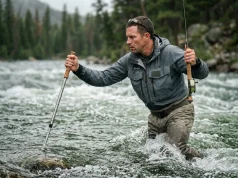
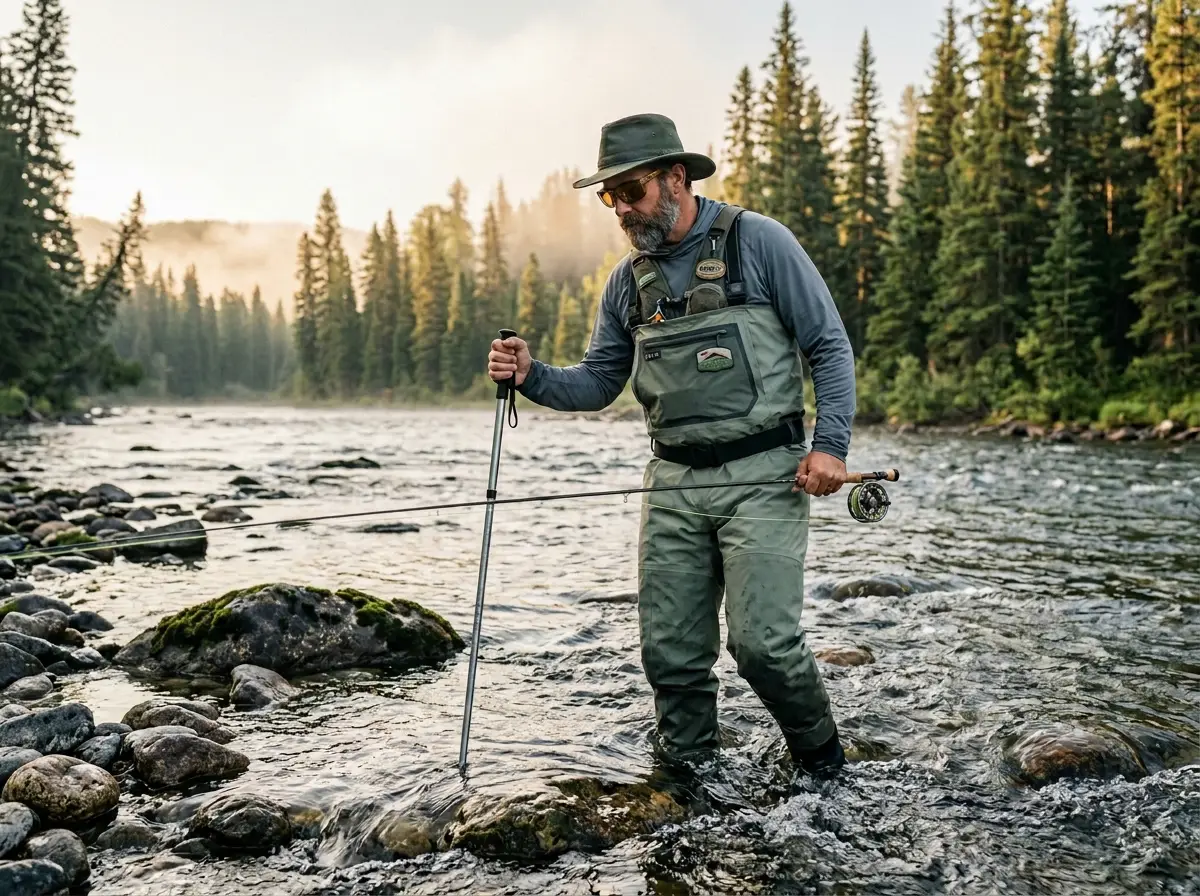
A wading staff converts your form from a bipod to a tripod — the minimum stable configuration in statics. Two fixed contact points, then move the third. Always. Staff placement goes upstream and angled into the current, never purely to the side where it provides no resistance to downstream force. Weight transfers from the staff to the leading foot to the trailing foot. When all three are moving simultaneously, you’re free-falling with extra steps.
Stance mechanics compound the benefit: wide base, flexed knees, lower center of gravity. That shifts the stabilizing moment in your favor relative to the current’s drag force. Choosing a wading staff built for technical slippery-rock wading covers the practical selection details — carbide tips, aluminum 6061 alloy shafts, telescoping length. Arm fatigue matters on a six-hour wading session. The staff you don’t want to carry gets left in the truck.
Pro tip: Check USGS gage data the evening before any wading trip. Set a personal Rule of Ten hard stop — if current conditions exceed it, fish the bank. The fish don’t care how deep you wade. They only care about presentation.
Legal Frameworks: Where Your Right to Wade Ends
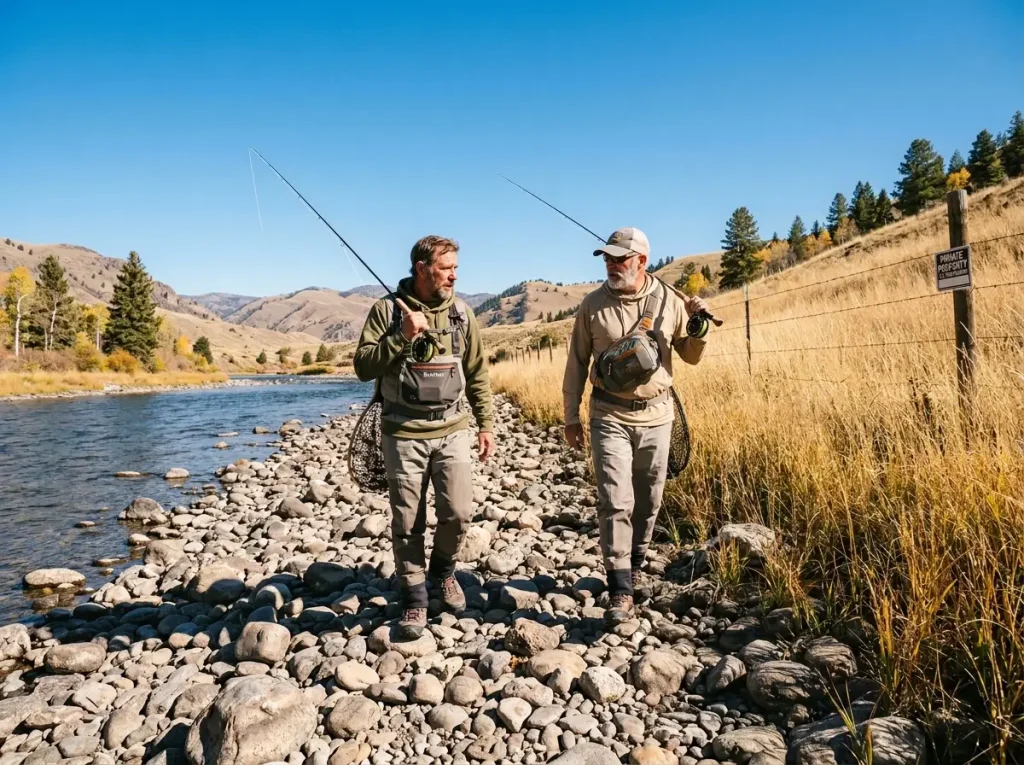
Legal access and biological suitability are not the same thing.
In Texas, navigability law grants wading rights within the gradient boundary — defined as the midpoint between the lower cutbank level and the level at which water overtops the bank. Under the 1929 Small Bill, anglers may wade the bed even where a private landowner holds a deed, provided the stream averages 30 feet wide from its mouth. The Texas Parks and Wildlife navigability law FAQ for anglers details these rights precisely. Step above the gradient boundary onto vegetated bank and it becomes criminal trespass, regardless of what’s happening in the water below you.
Montana’s 1985 Stream Access Law is the most permissive in the West: any land between the ordinary high water marks on classified streams is a public recreational corridor, provided you enter from a legal access point. Portage rights exist but come with the qualifier “least intrusive manner possible” — not however you want.
Neither of those frameworks says a word about redd sensitivity or EPT taxa. A Montana angler with full legal right to wade a Class II stream during rainbow spawn should still choose not to — because the mechanical vulnerability of the gravel they’d be walking over is a biological fact no statute addresses. Legal access is the floor. Ethics is what you build above it. The unwritten code that governs shared water — and why it matters legally covers the social layer on top.
The Low-Impact Protocol: Mastering the Stealth Entry
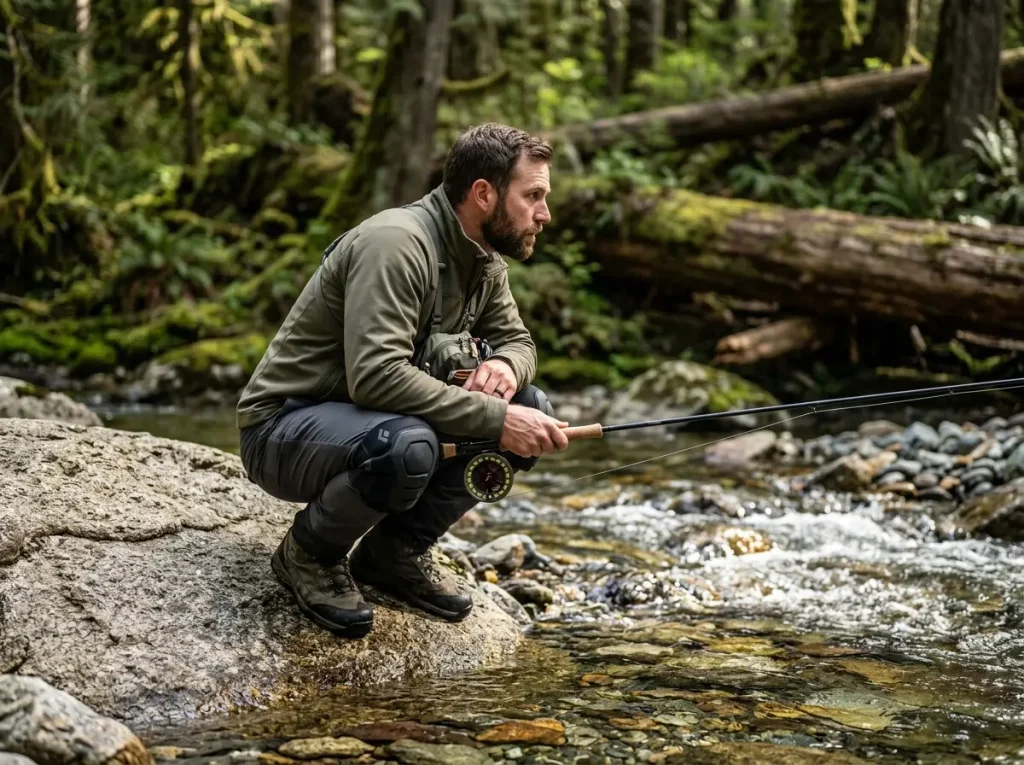
All of the preceding physics, biology, and law collapses into a single moment: you standing at the bank, deciding how and where to step in. Here’s how that decision should run.
Pre-entry assessment: pull up the USGS gage on your phone and run the Rule of Ten. Scan the entry point for substrate type — cobble and boulder are your target, silt and sand are a hard no. Visually read the substrate 10–15 feet ahead through polarized glasses for redd geometry: bright oval, pit-plus-tailspill, gravel in the 10–60mm range. Check the date against your spawning calendar and the stream temperature against CTU thresholds for the species in this system.
Substrate priority on entry: cobble and boulder fields first. Loose gravel in non-spawning reaches second. Sand only if necessary. Silt only if there’s genuinely no alternative — and if your footstep produces a visible sediment cloud on the first plant, you back out and find another approach.
Gait: shuffle-step with minimal foot lift. Transfer weight slowly onto each step — no heel strike. Staff engaged in three-point contact continuously. Wade sideways to the current to cut your frontal area. If sediment clouds follow your feet, you’re on the wrong substrate.
Minimalist wading isn’t just about not spooking fish — it’s also about metabolic efficiency. Wading waist-deep in swift current burns more than 45% of your aerobic capacity. Over-wading exhausts you faster, increases fall risk, and maximizes environmental disturbance simultaneously. Wade less. Fish more water from fewer positions. Before any wading session, ask yourself: do I actually need to cross this section to reach the fish I’m targeting? In most cases, the answer is no.
Biosecurity at exit: Check, Clean, Dry before leaving the bank — not at home, not at the truck, at the bank. For rubber soles: hot water scrub plus soap on seams, lace holes, and gravel guards, three minutes. For felt (if still using): 48-hour dry minimum, or heat treatment at 45°C for 20 minutes. This is also the inflection point for the full wading and boat safety protocol for every fishing environment — biosecurity is one piece of a larger framework, and it’s worth reading the full picture.
NOAA’s science-based guide to scaling back angler impact puts these individual decisions in context: every minimized footprint is additive across the angler population fishing a given system. One person running this protocol doesn’t save a fishery. Ten thousand people running it might.
Conclusion
Three things to take away.
Every step has a physics consequence. A 20 PSI heel strike compacts interstitial spaces, crushes nymphs, and generates sediment plume that travels downstream to spawning gravels you never saw. Knowing the substrate before you step is the foundation of ethical wading — not optional knowledge.
Identifying redds is a technical skill. Learn the pit-tailspill geometry. Know your species’ spawning seasons and CTU windows. Treat bright oval gravel in the right size range as a no-step zone from October through the following spring, regardless of whether you can directly observe eggs. The eggs are there whether or not you can see them.
Boot sole choice is a conservation decision. Felt retains 11,000 live Didymo cells per segment to rubber’s fewer than 4. If you’re wading multiple watersheds per season, switching to rubber is an obligation, not an upgrade.
Before your next session on moving water: run the Rule of Ten on your local gage reading, spend five minutes reading substrate through your polarized glasses before you enter, and pick your entry point based on what’s underfoot — not what’s easiest to reach. That’s the analytical angler’s entry protocol. Do it every time.
FAQ
Is it ethical to wade through spawning beds?
No. Wading through active spawning redds can affect up to 43% of eggs in a single event, rising to 96% with twice-daily disturbance. The ethical approach is to identify redd geometry — bright oval gravel, pit and tailspill structure, 10–60mm substrate — and treat that zone as a hard no-step area from October through the following spring.
What is the Rule of Ten in wading safety?
The Rule of Ten states that if Depth (ft) × Velocity (ft/s) reaches or exceeds 10, that reach is too hazardous to wade for a standard adult. At that stability index, the drag force of the current overtakes what most anglers can safely counterbalance — even with a wading staff in play. Check USGS gage data before you step in.
Why are felt-soled waders banned in some states?
Felt retains invasive species spores far more effectively than rubber because of its fiber matrix. After five hours of stream exposure, felt soles carry approximately 11,000 live Didymo cells per boot segment, compared to fewer than 4 for rubber. Felt’s 31.3-micrometer mean interstitial space is a near-perfect mechanical trap for Didymo and Whirling Disease myxospores; rubber’s 2.0-micrometer spacing excludes them almost entirely. Several states have responded with outright felt bans.
How does wading affect trout populations long-term?
In high-pressure tailwaters where multiple anglers wade the same gravel bars daily, cumulative redd wading harm can approach 100% for that section’s spawn cohort. In systems where natural recruitment is already limited by thermal or habitat stress, repeated wading disturbance during spawning windows compounds existing pressure over multiple seasons — contributing to localized population decline that’s difficult to attribute to any single cause.
Can you walk on a riverbed if it’s technically private property?
In Texas, yes — if the stream is legally navigable (≥30 ft average width), you have constitutional wading rights within the gradient boundary even if a private landowner holds a deed to the bed. In Montana, the 1985 Stream Access Law grants public recreational access between the ordinary high water marks on classified streams, provided entry is from a legal access point. Laws vary significantly by state. Always verify before accessing unfamiliar water, particularly where private land abuts the stream bank.
Risk Disclaimer: Fishing, boating, and all related outdoor activities involve inherent risks that
can lead to injury. The information provided on Master Fishing Mag is for educational and informational purposes
only. While we strive for accuracy, the information, techniques, and advice on gear and safety are not a substitute
for your own best judgment, local knowledge, and adherence to official regulations. Fishing regulations, including
seasons, size limits, and species restrictions, change frequently and vary by location. Always consult the latest
official regulations from your local fish and wildlife agency before heading out. Proper handling of hooks, knives,
and other sharp equipment is essential for safety. Furthermore, be aware of local fish consumption advisories. By
using this website, you agree that you are solely responsible for your own safety and for complying with all
applicable laws. Any reliance you place on our content is strictly at your own risk. Master Fishing Mag and its
authors will not be held liable for any injury, damage, or loss sustained in connection with the use of the
information herein.
Affiliate Disclosure: We are a participant in the Amazon Services LLC Associates Program, an
affiliate advertising program designed to provide a means for us to earn advertising fees by advertising and linking
to Amazon.com. As an Amazon Associate, we earn from qualifying purchases. We also participate in other affiliate
programs and may receive a commission on products purchased through our links, at no extra cost to you. Additional
terms are found in the terms of service.