In this article
The river’s bottom dropped away without warning. One second I was shuffling across familiar gravel, the next I was chest-deep in a tailwater current with forty-degree water pouring into my waders from above. My heart slammed against my ribs as the cold hit, but instead of filling instantly—instead of becoming that terrifying “sea anchor” every guide warns you about—the water stopped at my waist. My wading belt had bought me the thirty seconds I needed to kick toward shore.
After twenty years guiding on cold mountain rivers, I’ve watched too many anglers wade in with loose belts, no belts, or those stretchy neoprene strips that might as well be rubber bands. Most of them have never practiced what happens when they fall in. This guide will teach you exactly how wading belt safety works, why proper belt fitment determines whether you walk out or get dragged out, and the self-rescue techniques that turn a potentially fatal fall into a manageable inconvenience.
⚡ Quick Answer: A properly cinched wading belt slows water entry into your chest waders during a fall, giving you a 30-60 second survival window to swim to safety. Use the fist test—if you can insert your closed fist between the belt and your waders, it’s too loose. Always choose a webbing belt over neoprene, wear it on the outside of your waders at chest level, and practice your fall-and-float drill before you need it in heavy water.
The Physics of Wading Belt Safety: Why Belts Save Lives
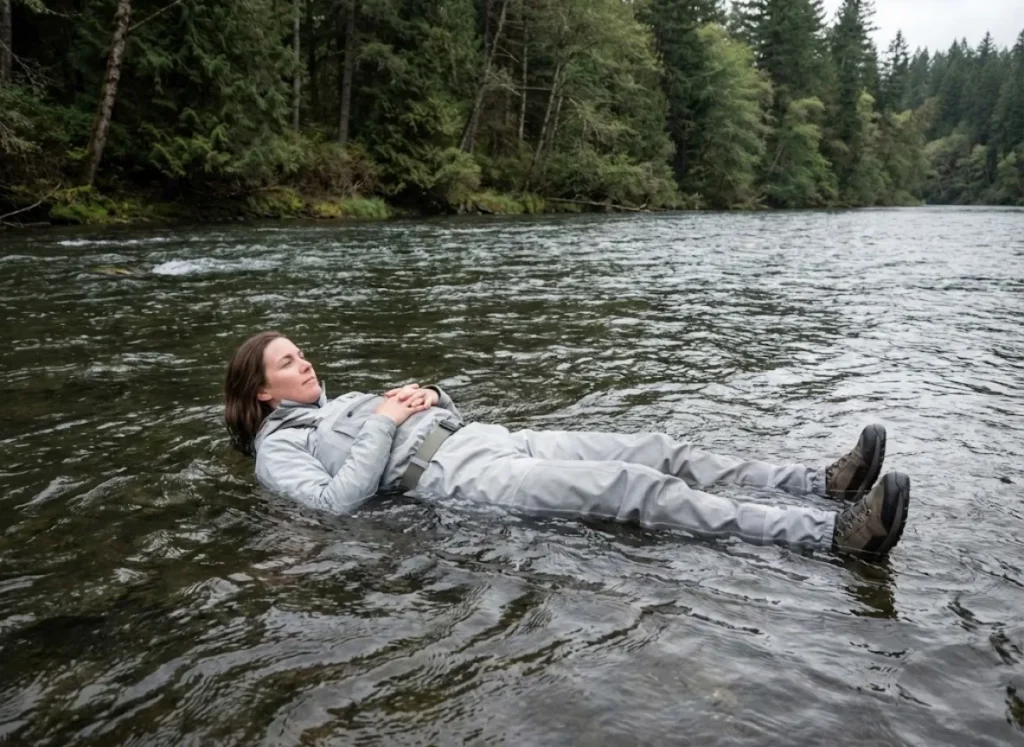
Here’s the myth that kills anglers: “If my waders fill with water, they’ll pull me under.” Wrong. Completely, dangerously wrong.
The Sea Anchor Effect: What Really Happens When You Fall
When you fall into a river, water-filled waders don’t create negative buoyancy. The water inside weighs exactly the same as the water outside—that’s how buoyancy works. Your waders won’t drag you to the bottom like an anchor tied to your ankles.
The real killer is the sea anchor effect. Think about towing a 30-gallon trash bag behind you while trying to swim. That massive hydrodynamic drag exhausts even strong swimmers within minutes. Without a belt, waders fill completely in three to five seconds when you fall in moving water. Suddenly you’re not swimming—you’re fighting a river current with the equivalent of a deployed parachute wrapped around your legs.
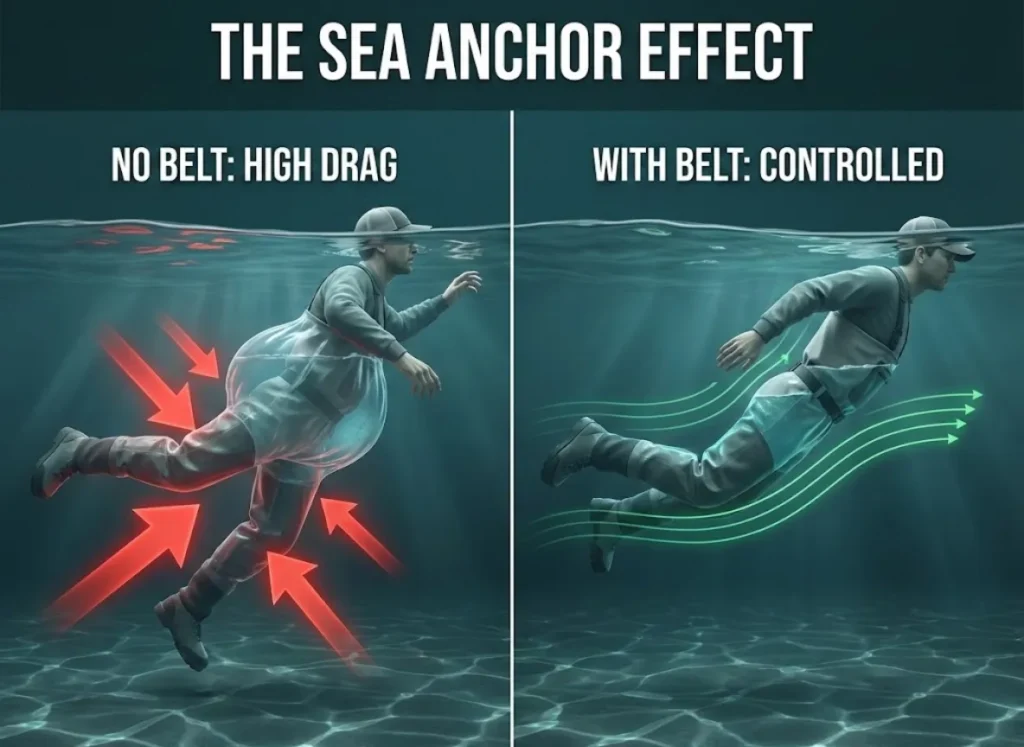
As wading safety expert Ralph Cutter puts it: “The ten-dollar belt that will save your life is the most overlooked piece of equipment in an angler’s kit.” According to comprehensive wading safety research by Tri-Valley Flyfishers, that simple webbing strap creates the time window between controlled escape and panic-driven exhaustion.
Hydrostatic Pressure: How Water Pressure Helps (Not Hurts)
Hydrostatic pressure is the pressure water exerts at any depth—and here’s the counterintuitive truth: it actually works in your favor when you’re wearing a properly belted wader.
When a belt is cinched tight, external water pressure helps seal the wader closure against water entry from below. Imagine squeezing a tube of toothpaste from the middle—pressure below the belt pushes against the constriction rather than forcing water up. This is why chest-level placement provides maximum protection: it creates the longest possible barrier to prevent water entry.
If you’re selecting quality waders that integrate properly with safety equipment, remember that the wader keeps water out from below while your belt stops it from above. They work as a system.
The 30-Second Window: Why Belt Tightness Determines Survival
A properly cinched belt doesn’t stop all water entry—it slows entry enough to create a 30-60 second survival window. That window is everything. It’s the difference between controlled defensive swimming to shore and panic-driven flailing until you’re too exhausted to move.
Water temperature matters more than most anglers realize. Below 50°F, your muscles lose function fast. Cold water wading demands extra respect for that time window. Even waist-deep water can become fatal in strong currents without a functioning tight wading belt.
Pro tip: Before entering unfamiliar water, check USGS gauge data. The USGS safe wading formula uses depth x stick drift rate to help you assess whether conditions are fishable or foolish.
The Fist Test Protocol: How to Know Your Belt Is Tight Enough
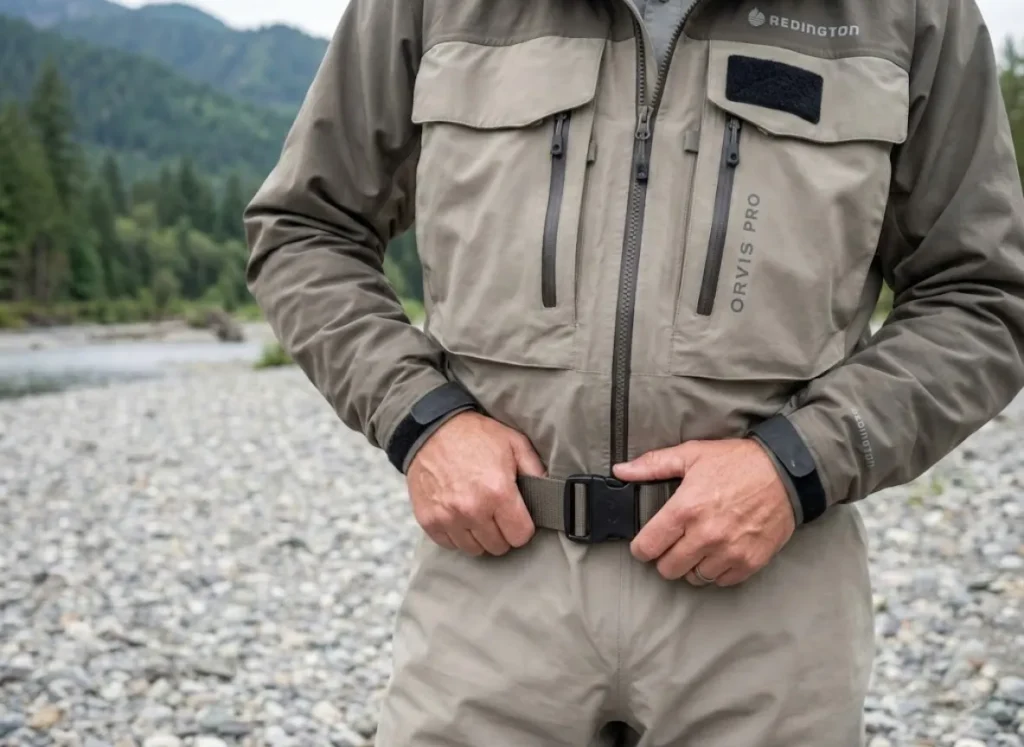
Every competitor article tells you to wear your belt “snug” or “tight.” None of them tell you what that actually means. Here’s the measurable standard that answers the question of quantitative safety thresholds.
Step 1: Position Your Belt Correctly
Your belt MUST be worn on the outside of waders—never tucked under the chest flap where it does nothing. The belt should be positioned at the natural waist, just below the ribcage. For deep water or heavy water, consider a secondary belt at waist and chest for maximum protection.
Quick-release buckles are mandatory, not optional. In an emergency where you need to shed waders fast—foot entrapment, hypothermia setting in, unable to swim—that buckle needs to pop with one hand, underwater, while you’re panicking. Buy quality, test the release mechanism on shore before you need it.
Step 2: Apply the Fist Test
With the belt cinched, attempt to insert your closed fist between the belt and your waders.
If you can insert your fist: The belt is too loose. Tighten until you cannot.
The breathing restriction threshold provides a second verification. A properly tight belt should slightly restrict deep breathing—if you can take completely unrestricted deep breaths, tighten more. You’re not trying to cut off circulation, but you should feel the belt working when you inhale deeply.
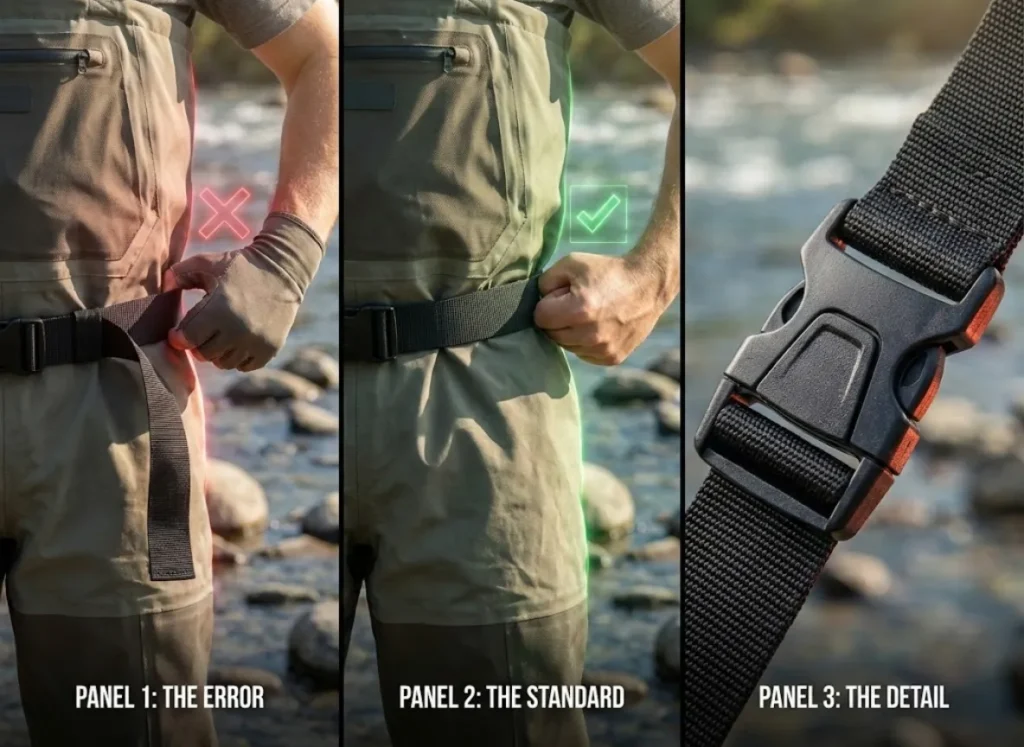
Pro tip: After cinching, try to take three deep, aggressive breaths. If there’s no resistance at all, you’re not tight enough. Recheck tightness after 20-30 minutes of wading, as movement can loosen buckles.
Step 3: The Pre-Wade Safety Check
Make this ritual as automatic as checking your fly before casting: belt check, buddy confirmation, wading staff positioned for that third point of contact. Verify the quick-release buckle functions with one hand—practice this on shore. Establish visual contact protocol with your wading partner.
If you’re reading river conditions before you wade, you already know that preparation beats reaction. Time yourself—a thorough pre-wade safety check should take under 30 seconds. Build the muscle memory so you never skip this step, even when fish are rising.
Neoprene vs. Webbing: Why Material Choice Is a Safety Decision
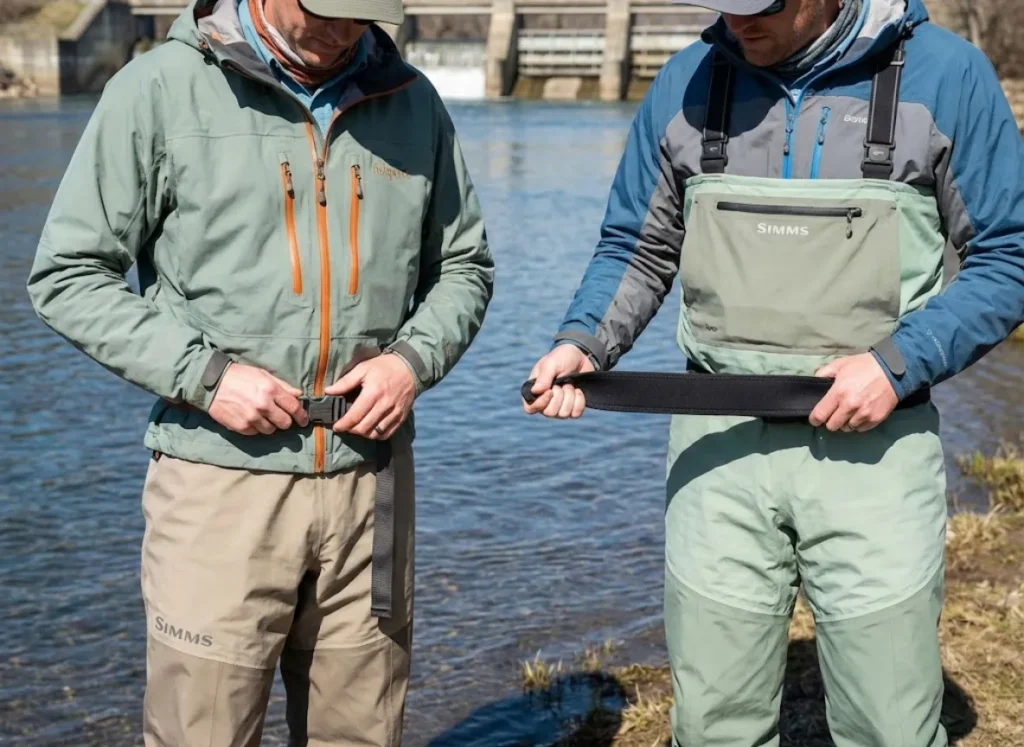
Not all belts are created equal. Some are safety equipment. Others are comfortable lies.
The Neoprene Problem: Comfort Over Safety
Neoprene belts are soft, stretchy, and feel comfortable—but they are largely ineffective for safety purposes. Neoprene’s elasticity prevents the firmly cinched belt required to slow water entry. Every time you move, it stretches. Every time you breathe, it gives.
According to GB Flycasters’ wading safety guidelines: “Neoprene wading belts are useless for safety purposes because they cannot cinch tightly enough to slow water entry.”
Here’s the problem: many breathable waders ship with neoprene belts as standard equipment. The manufacturer prioritizes comfort and cost over function. Replace that belt immediately.
Webbing Belts: The Safety Standard
Webbing belts—nylon, polypropylene, or similar materials—provide zero stretch. When you cinch a webbing belt, it stays cinched. The snug fit you need only works with non-stretch materials.
Look for belts with metal or high-quality plastic quick-release buckles. Avoid cheap friction buckles that can slip under load. Width matters: 1.5 to 2 inches distributes pressure and prevents rolling.
Brand recommendations from the research: Simms, Fishpond South Fork Wading Belt, and Patagonia all offer webbing-based safety belts designed with quick-release buckles and the rigidity needed for actual protection. Orvis also provides quality options that integrate well with their wader systems.
Belt Features: Quick-Release and Beyond
Beyond the buckle and material, look for integrated D-rings for attaching net, forceps, or tippet holders without compromising fit. Some belts offer chest-high belts or secondary straps—consider these for deep water situations where you’re regularly wading above your thighs.
Never modify a belt’s buckle mechanism. Manufacturer designs prioritize both security and emergency release. Cutting corners means cutting options when you’re underwater.
Emergency Protocols: What to Do When You Fall In
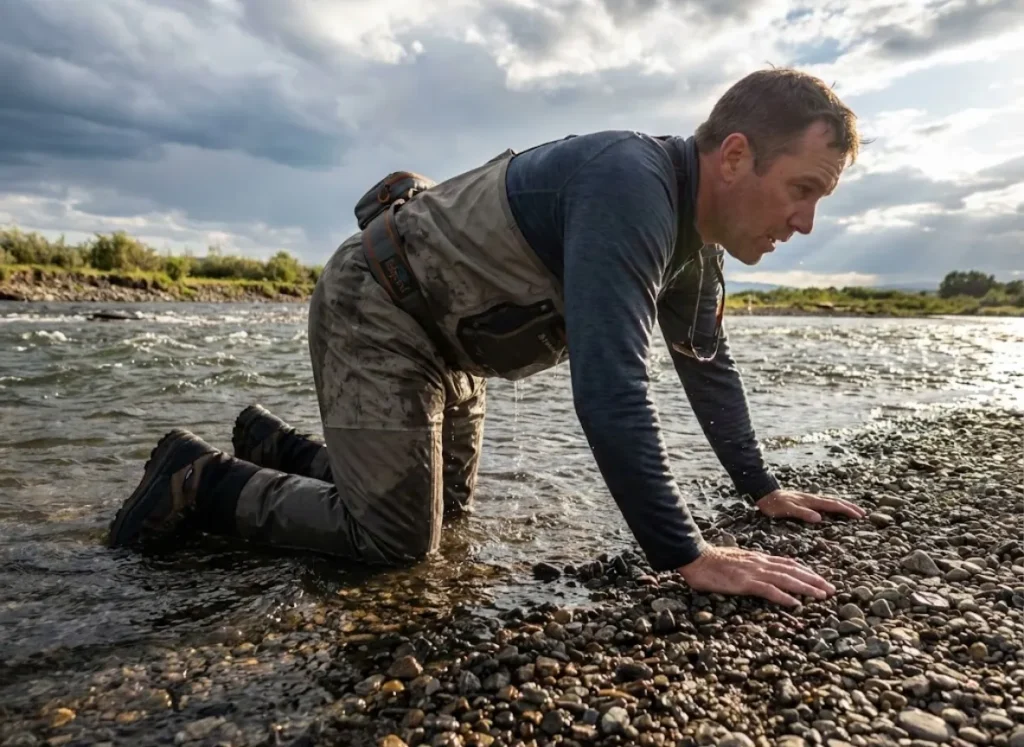
You’ve fallen in. The current has you. What now? These are your emergency response protocols.
The First Five Seconds: Don’t Fight the Current
The instinctive response—fighting against the current—is the most dangerous choice you can make. Stop. Stop struggling right now. Remember: don’t fight the current.
Immediate action: Orient feet downstream to absorb impacts from rocks using your boots, not your skull. Keep your arms at your sides initially—flailing wastes energy and can cause foot entrapment against submerged obstacles. Your belt is now working: feel for the water entry rate and assess your buoyancy.
If your head is above water and you’re floating, you have time. Don’t panic—panic kills faster than cold water.
Breathing Patterns in Current: The Survival Rhythm
Breathing patterns in currents determine whether you stay conscious or black out from hyperventilation. Exhale half lung volume before inhaling to prevent the gasping response. Inhale at wave troughs, not peaks—time your breaths between water splashes hitting your face.
Keep your head tilted back slightly to maximize airway clearance. Short, controlled breaths reduce cold water shock response better than deep gasps.
Pro tip: Practice this breathing pattern in a pool or calm water before you need it in an emergency. The muscle memory could save your life when your brain is screaming at you to gasp.
For broader preparation, understanding comprehensive water safety protocols for anglers builds the foundation that keeps you calm when everything goes wrong.
Defensive Swimming: Getting to Shore
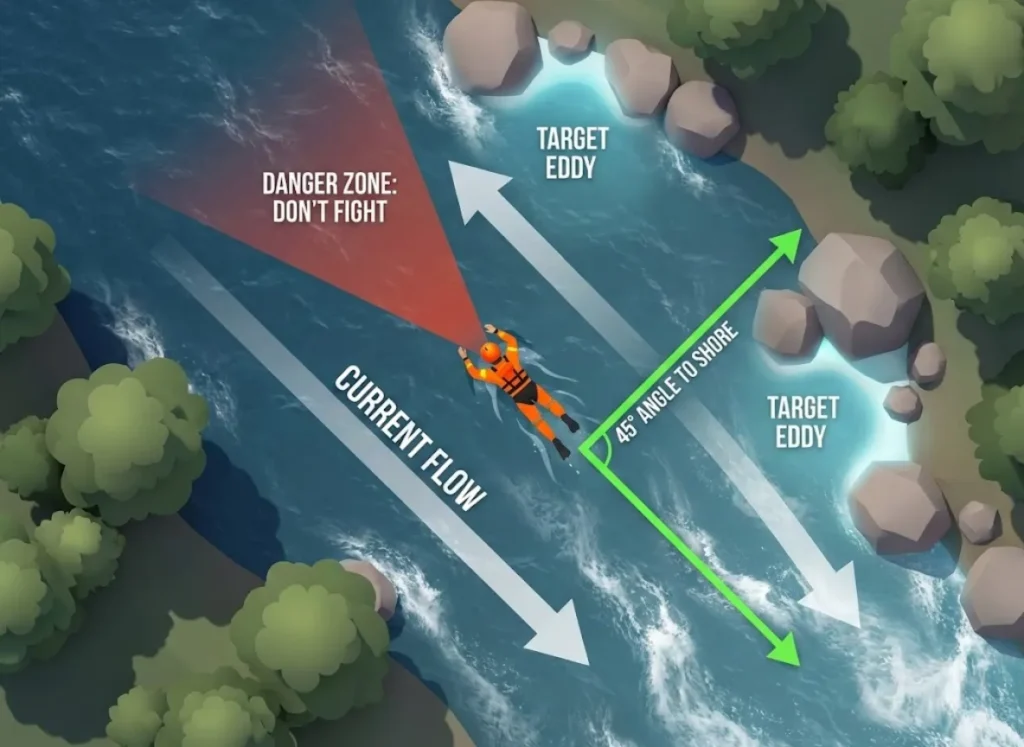
Swim at a 45-degree angle toward shore—not directly against the current. You can’t outswim the river, so don’t try. Use backstroke or sidestroke—these conserve energy better than freestyle and keep your face out of the water.
Target eddies, gravel bars, or shallow water behind obstructions. Read the river while you swim. If you cannot reach shore, stay calm and float until the current carries you to slower water. Once you reach a depth where your hands can touch bottom, crawl rather than stand. Regain footing only when you’re stable.
The Buddy System: Your Best Emergency Protocol
Never wade alone. The buddy system is cited by Take Me Fishing’s wader safety guidelines as significantly reducing wading-related fatalities.
Establish visual contact intervals before entering water—every 30 seconds minimum. Agree on emergency signals: whistle blasts, arm positions, verbal commands. A safety whistle attached to your belt or vest takes up no space and can summon help when your voice can’t carry over rushing water.
Carry a throw rope if wading challenging waters. It creates rescue options your belt cannot provide.
Wading Gear Integration: Staff, PFD, and Complete Safety Systems
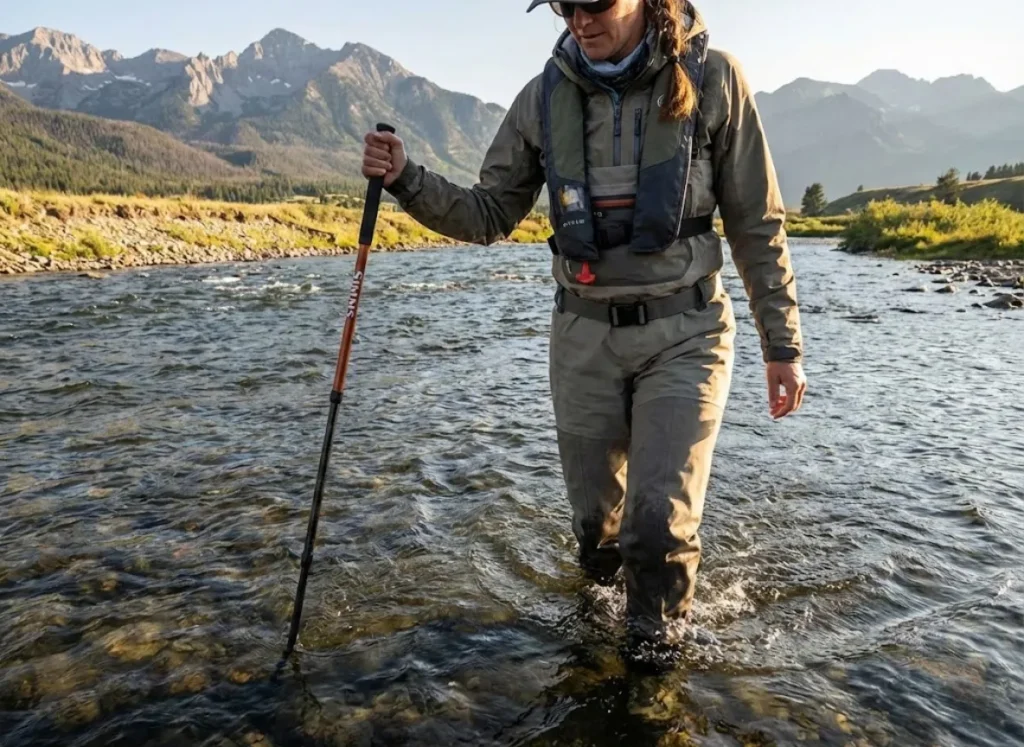
Your belt is one piece of a complete wading equipment system. Here’s how everything works together.
The Wading Staff: Your Third Point of Contact
Two points of contact—your feet—can fail simultaneously. Three points cannot. A wading staff planted on the upstream side braces against current pressure and provides stability when the bottom shifts under you.
According to Orvis guide team’s wading safety recommendations, the wading staff is “the most overlooked wading safety item.” Plant firmly before each step using the shuffle technique—shuffle, plant, shuffle—maintains stability better than lifting your feet. Keep that secure foothold before moving.
Collapsible staffs integrate with wading belts via D-ring attachment for quick deployment. When you need it, you need it now, not buried in your pack.
PFD Integration: When a Belt Isn’t Enough
A wading belt is NOT a personal flotation device—it does not provide positive buoyancy. In dangerous situations—high flows, cold water, solo wading, unfamiliar water—consider inflatable PFDs designed for anglers.
PFD integration works alongside wading belts: the belt slows water flow entry while the PFD provides flotation. Trout Unlimited recommends PFD consideration for any wading in water above knee depth with current. Modern inflatable vests are compact enough to wear without interfering with casting.
When you’re working to understand all local wading hazards, PFDs represent the final layer of protection when everything else fails.
Metal Cleats, Studs, and Footwear: The Foundation of Stability
The best belt in the world won’t save you if you slip on algae-covered rocks. Metal cleats or studs provide grip that felt soles cannot match on slippery conditions. Studs work best on hard substrates like rock and gravel bottoms; felt works better on mud bottoms and silty areas.
Replace studs before they’re completely worn—partial grip is worse than no grip because it creates false confidence on that one rock that matters. Solid fishing boots with proper traction are your foundation for safe wading.
Practice Drills: Training Your Survival Response
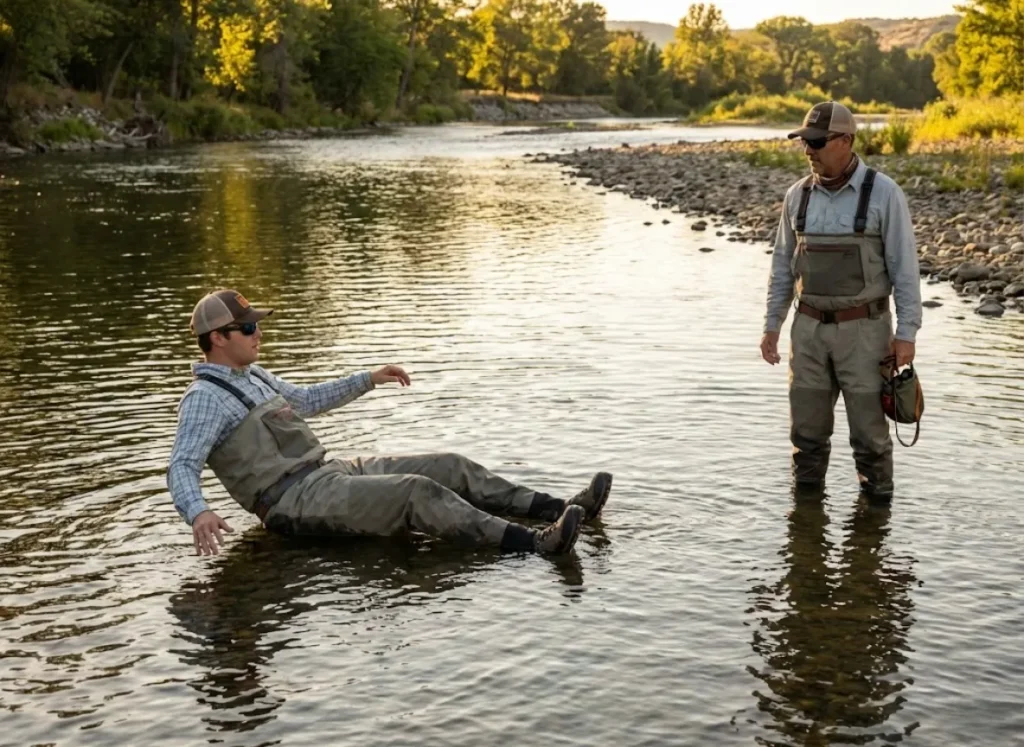
Reading about self-rescue and actually doing it under stress are different universes. Bridge that gap with practice drills.
Controlled Fall Drill: Shallow Water Practice
Find a shallow water section (waist-deep), calm pond or stream section with a safe route to exit. With a buddy watching, allow yourself to fall backward into the water. Feel the water entry rate—note how your belt restricts flow. Practice orienting to feet downstream position from various fall angles.
Repeat until the feet-downstream orientation becomes instinctive. The first time this happens for real, you won’t have time to think through the steps. These practice drills build the automatic response you need.
Breathing Practice: Pool or Calm Water
Practice the exhale-half, inhale-at-trough breathing pattern before you need it in current. Float on your back and consciously time breaths to simulated wave patterns. Practice with and without your waders to feel the difference in buoyancy.
Train in increasingly cold water if possible—acclimating to cold water shock response reduces panic when it hits for real. Consider this foot entrapment drill preparation part of your overall fishing safety education.
The Belt Tightness Check Drill
Before every wade: run the fist test, check buckle function, verify staff attachment. Time yourself—30 seconds, no excuses. Make this as automatic as stringing your rod. Build the muscle memory so you never skip this step, even when the hatch is on and fish are rising everywhere.
Good belt habits save lives. Safe wading starts before you touch the water.
Conclusion
Physics, not panic: Water-filled waders don’t pull you under—they create drag through the sea anchor effect. A properly cinched wading belt gives you the time window to escape. That’s basic hydrostatic pressure working for you, not against you.
Measurable tightness: Use the fist test. If you can insert your closed fist between belt and waders, you’re not tight enough. That breathing restriction you feel when you cinch down? That’s what safety feels like.
Material matters: Webbing belts save lives. Neoprene belts are comfortable but functionally useless for safety. Spend the extra ten dollars and get a proper wading belt that actually works.
Next time you gear up, spend an extra 30 seconds on the fist test. Practice your fall-and-float drill in calm water before the season starts. That ten-dollar belt and three minutes of preparation could be the difference between a fishing story you tell and one that gets told about you.
FAQ
Why do I need a wading belt if chest waders are designed to be waterproof?
Waders keep water out from below, but nothing stops water pouring in from above when you fall. A wading belt creates a barrier that slows water entry dramatically, preventing the sea anchor effect that exhausts swimmers and leads to drowning.
How tight should a wading belt be?
Use the fist test: cinch the belt until you cannot insert a closed fist between the belt and your waders. The belt should slightly restrict deep breathing—if you can breathe completely freely, tighten more. Snug fit means safely tight.
What happens if you fall in with waders on without a belt?
Without a belt, waders fill completely within 3-5 seconds. The water weight doesn’t pull you under—water-filled waders are neutrally buoyant—but the drag exhausts you rapidly. Most wader safety incidents result from exhaustion, not submersion.
Can waders pull you under if they fill with water?
No—this is the most dangerous myth in wading belt safety. Water inside your waders weighs the same as water outside. The real danger is hydrodynamic drag through the sea anchor effect that prevents swimming and exhausts you.
What’s the difference between neoprene and webbing wading belts?
Neoprene belts are stretchy and comfortable but cannot cinch tightly enough to slow water entry effectively. Webbing belts (nylon, polypropylene) provide zero stretch and create the firm seal required for safety. Always choose webbing for safety-critical applications.
Risk Disclaimer: Fishing, boating, and all related outdoor activities involve inherent risks that
can lead to injury. The information provided on Master Fishing Mag is for educational and informational purposes
only. While we strive for accuracy, the information, techniques, and advice on gear and safety are not a substitute
for your own best judgment, local knowledge, and adherence to official regulations. Fishing regulations, including
seasons, size limits, and species restrictions, change frequently and vary by location. Always consult the latest
official regulations from your local fish and wildlife agency before heading out. Proper handling of hooks, knives,
and other sharp equipment is essential for safety. Furthermore, be aware of local fish consumption advisories. By
using this website, you agree that you are solely responsible for your own safety and for complying with all
applicable laws. Any reliance you place on our content is strictly at your own risk. Master Fishing Mag and its
authors will not be held liable for any injury, damage, or loss sustained in connection with the use of the
information herein.
Affiliate Disclosure: We are a participant in the Amazon Services LLC Associates Program, an
affiliate advertising program designed to provide a means for us to earn advertising fees by advertising and linking
to Amazon.com. As an Amazon Associate, we earn from qualifying purchases. We also participate in other affiliate
programs and may receive a commission on products purchased through our links, at no extra cost to you. Additional
terms are found in the terms of service.