
In this article
The jig hit bottom at 22 feet and I started dragging. Ten seconds later, something loaded up the rod — but when I swept the hookset, the line went slack. I’d snatched a lightwire hook right out of a bass’s mouth. That’s the kind of mistake you make exactly once before you start paying attention.
Football jigs are one of the most effective ways to catch bass offshore, but most anglers either fish them wrong or don’t fish them at all because they look boring compared to a swimbait or a topwater frog. After years of dragging these things across ledges and humps, I’ve watched the same four mistakes cost me and my fishing partners more fish than any other lure in the box.
Here’s every technique, setup, and decision that goes into fishing a football jig right — from reading the bottom to matching your trailer to the fish’s mood.
Quick Answer: The four biggest football jig mistakes that lose deep water bass are:
- Reeling too fast and losing bottom contact
- Using the wrong jig weight for the depth you’re fishing
- Mismatching your trailer to the current bass activity level
- Snatching the hookset instead of sweeping into the fish
Why the Football Head Reads Bottom Better Than Any Other Jig
The Shape That Changed Offshore Fishing
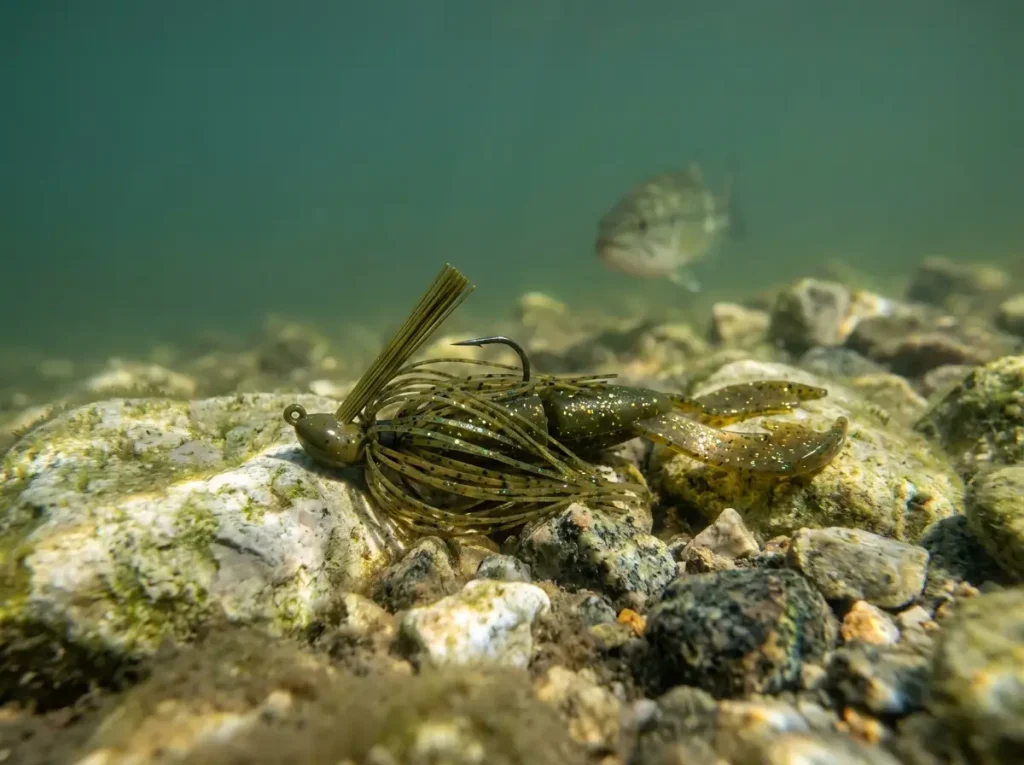
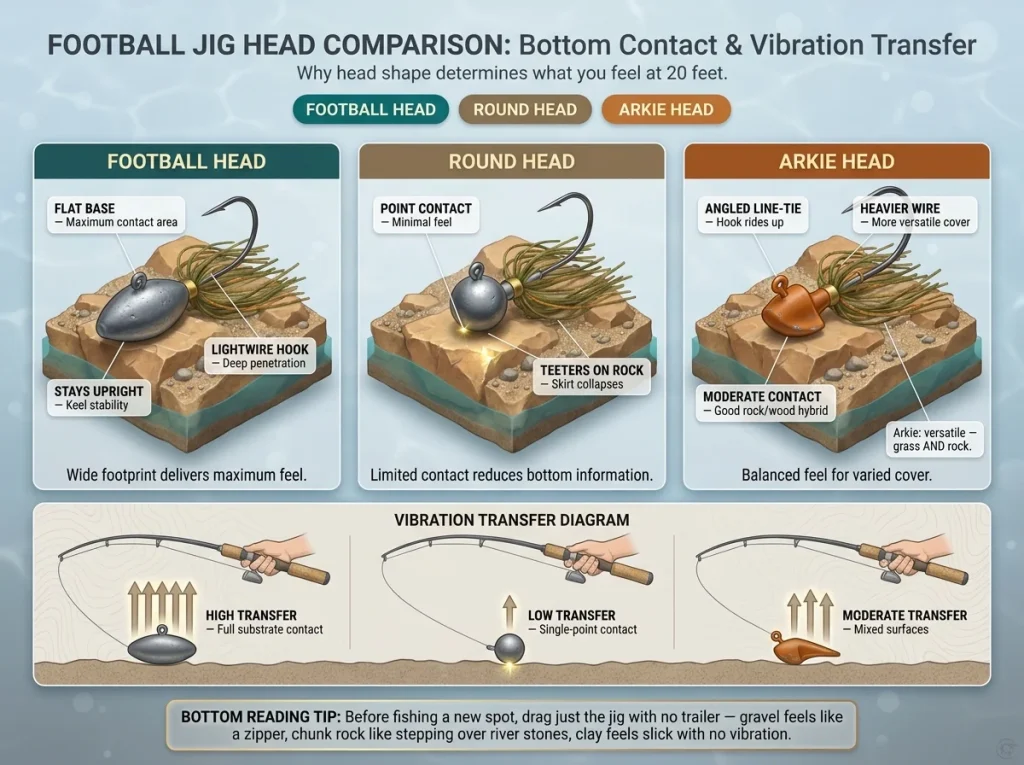
The football jig gets its name from the oblong head that sits perpendicular to the hook — shaped like a pigskin lying on its side. That shape isn’t just marketing. The wide, flat bottom creates more surface contact with the substrate than a round or Arkie-style head, and that contact translates directly into information traveling up the line and into your rod hand.
When you drag a round-head jig across chunk rock, you feel bumps. When you drag a football head across the same rock, you feel the size of the rocks, the gaps between them, and whether the bottom is transitioning from gravel to clay. That’s not poetry — it’s physics. More contact area means more vibration transfer, and vibration is how you read structure without staring at your sonar.
Why It Doesn’t Roll Over
The flat bottom of the football head acts like a keel. On irregular surfaces — chunk rock, rubble piles, gravel transitions — the jig stays upright instead of tipping on its side. That means the skirt fans out naturally and the trailer rides hook-point-up in a defensive crawfish posture.
Every other jig head fights gravity on rocky bottoms. The football head works with it.
Where the Football Head Falls Short
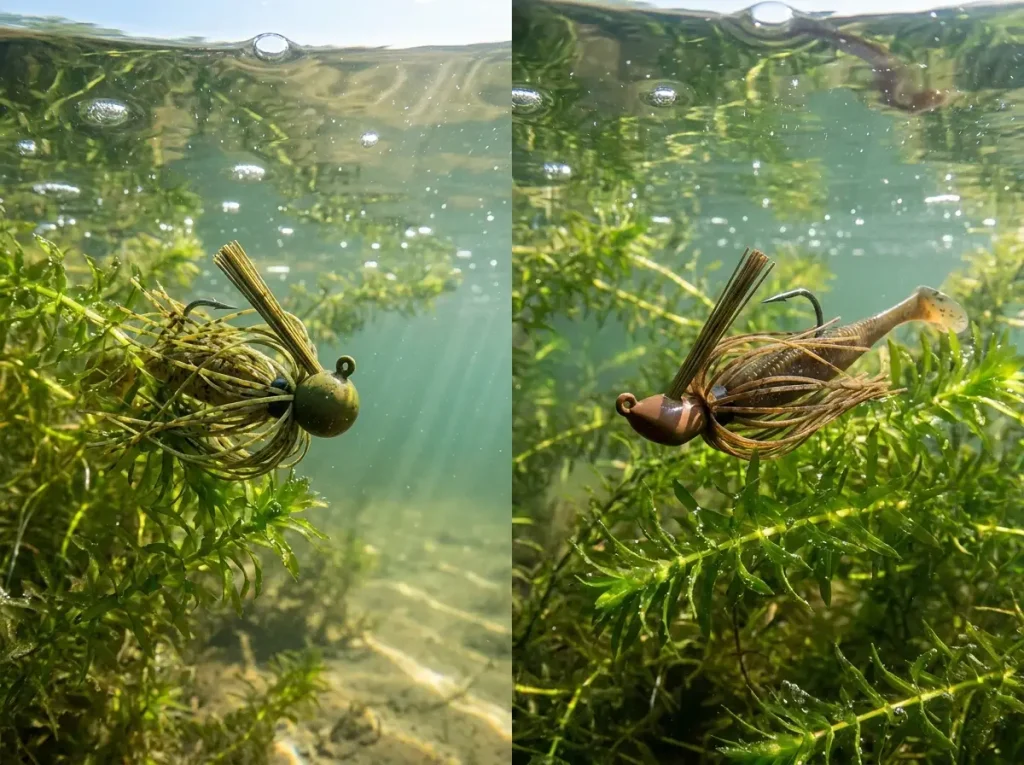
Here’s what nobody tells you upfront: this jig is terrible in vegetation. The wide head catches every strand of hydrilla, milfoil, and coontail it touches. If you’re fishing grass, put the football jig away and tie on an Arkie or a flipping jig.
The football head is a specialist — hard bottom, offshore structure, clean rock. Try to make it do everything and it’ll frustrate you into the tackle box.
Pro tip: Before you start fishing a new spot with a football jig, make a few exploratory casts with just the jig and no trailer. Drag it slowly and pay attention to what the bottom tells you — gravel feels like a zipper, chunk rock feels like stepping over river stones, clay feels slick with no vibration. That ten-second read saves you thirty minutes of fishing the wrong spot.
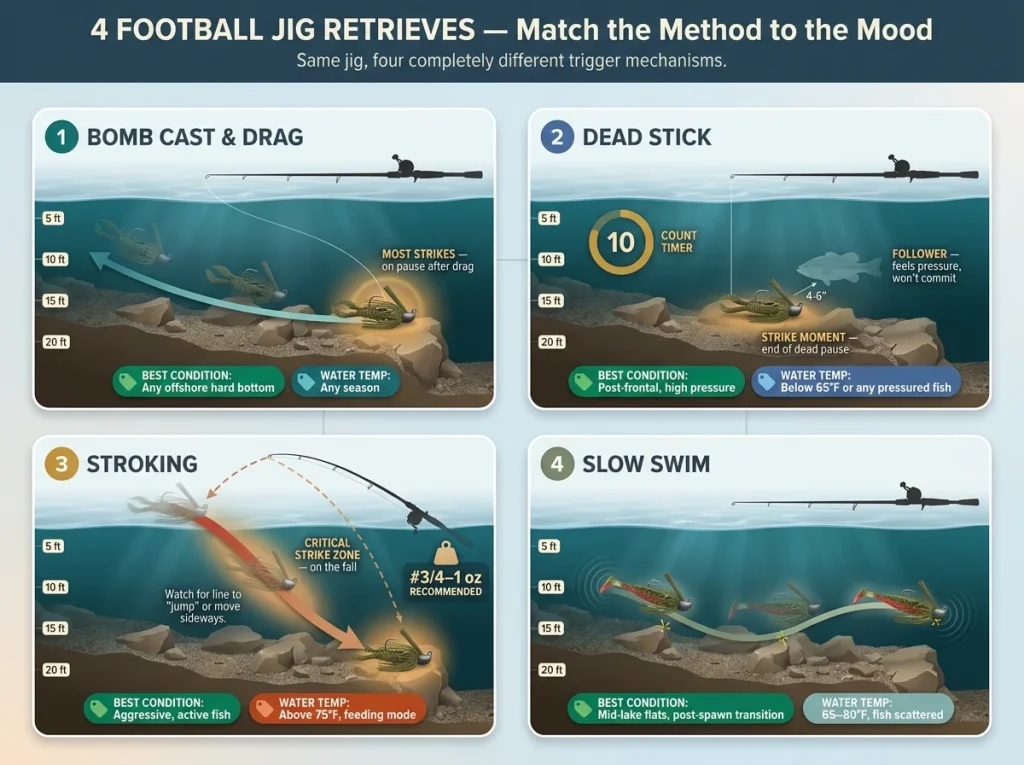
The 4 Retrieves That Cover Every Mood Bass Throw at You
The Bomb-Cast-and-Drag
This is the bread-and-butter technique and the one you should learn first. Make a long cast — as far as you can throw it — let the jig sink to the bottom on a semi-tight line, then drag it back using slow lateral sweeps of the rod. Pull the rod from 9 o’clock to about 11 o’clock, reel up the slack, let the jig sit for two to three seconds, and repeat.
The key word is “drag,” not “hop.” You want continuous or near-continuous bottom contact. The football head transmits every rock, every transition, every change in substrate. When you lose that feel, you’re reeling too fast. Slow down.
This retrieve covers 80% of what you’ll encounter on offshore structure — ledges, channel swings and humps, gravel flats, and rocky points.
The Dead Stick
When bass follow the jig but won’t commit — and you’ll feel this as a subtle pressure that appears and disappears — switch to dead-sticking. Drag the jig to your target zone, then just stop. Let it sit. Count to five. Count to ten if you have the patience.
Mike McClelland has gone as long as twelve seconds on a pause before getting bit.
Dead-sticking works because bass are ambush predators. A motionless craw on the bottom is still food. Sometimes the pause is what triggers the strike — the jig stops moving and the bass decides it’s safe to eat.
Stroking (The Reaction Trigger)
When bass are aggressive — summer months when water temps push above 75°F and the fish are active — stroking provokes reaction strikes. After the jig settles, sweep the rod hard from 6 o’clock to about 11 or 12 o’clock, ripping the jig three to eight feet off the bottom. Then stop the rod dead and let the jig free-fall on a semi-slack line.
Most strikes happen on the fall. Watch your line. If it jumps, twitches sideways, or goes slack before the jig should have hit bottom, that’s a fish. This technique works best with heavier jigs — 3/4-ounce to 1-ounce — that fall fast and create a more aggressive displacement in the water column.
Pro tip: When stroking football jigs over ledges, position your boat so you’re pulling the jig UP the ledge, not dragging it off the edge. Bass sit at the base of the break looking up — you want the jig ripping upward through their sight line, then falling back into their face.
The Slow Swim
The least-used retrieve and the one that saves tough days. Instead of dragging or hopping, reel the jig just fast enough to maintain bottom contact with a slight tick-tick-tick rhythm. The football head wobbles side to side during a slow swim, and with a paddle-tail or speed craw trailer, the jig looks like a crawfish scooting along the bottom trying to escape.
This works on flat, expansive structure where bass aren’t stacked on a specific break — think mid-lake flats between 15 and 25 feet during the post-spawn transition. The slow swim covers water faster than dragging while still keeping the jig in the strike zone.
Weight Selection by Depth: The Chart That Ends the Guessing
The Depth-to-Weight System
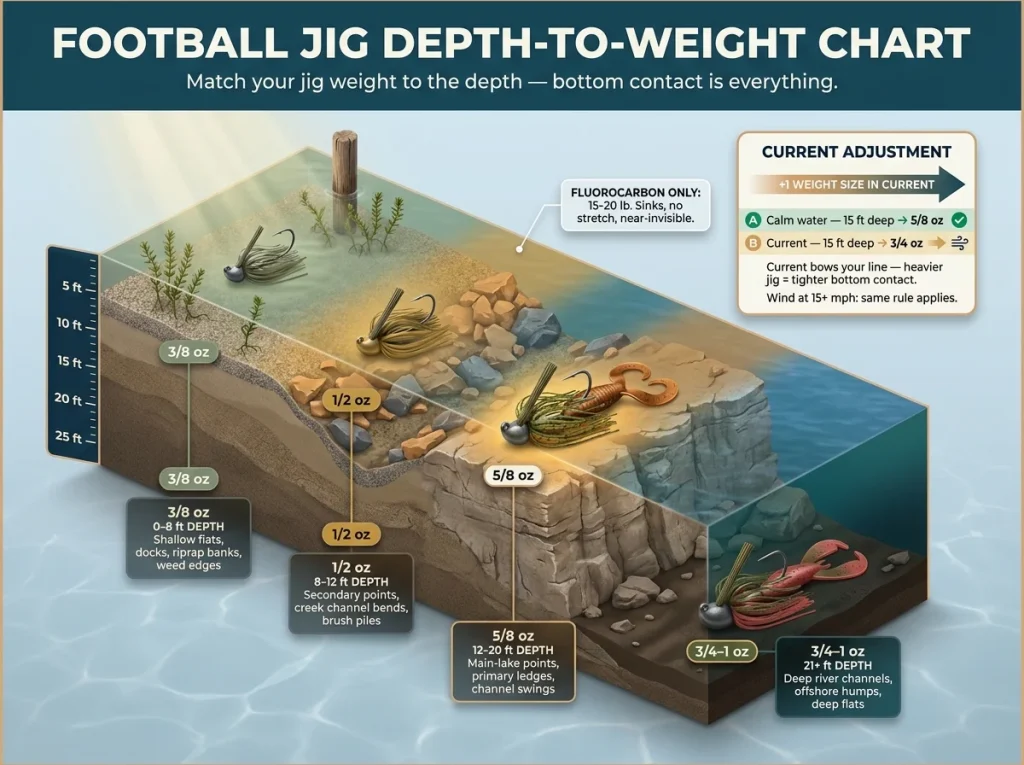
Getting the weight wrong is the second most common mistake I see. Too light and you lose bottom contact — you can’t feel anything, can’t detect bites, and the jig drifts off your target. Too heavy and the jig plows through the bottom like an anchor, killing the subtle action that triggers strikes.
Here’s the system that works across almost every reservoir and natural lake situation:
| Jig Weight by Depth — Quick Reference Chart | ||
|---|---|---|
| Depth | Jig Weight | Best Scenario |
| 8 feet or less | 3/8 oz | Shallow secondary points, post-spawn recovery areas |
| 8–12 feet | 1/2 oz | Creek channel intersections, mid-depth humps |
| 12–20 feet | 5/8 oz | Main-lake points, primary ledges, channel swings |
| 21+ feet | 3/4–1 oz | Deep ledges, river channel drops, current-swept structure |
When to Size Up Beyond the Chart
Current changes everything. If you’re fishing a reservoir with generation current — TVA lakes, Corps of Engineers impoundments, anything below a dam with scheduled releases — add one weight size to whatever the chart says. Current pushes a lighter jig off your target and ruins your bottom contact. A 3/4-ounce jig in 15 feet of current fishes cleaner than a 1/2-ounce fighting the flow.
Wind does the same thing from the surface down. A 15-mph wind creates enough bow in your fluorocarbon line to reduce sensitivity. Heavier jig, tighter line, better feel.
Why Fluorocarbon Is the Only Line Choice
Every serious football jig angler fishes fluorocarbon — typically 15- to 20-pound test. It sinks naturally, which keeps your line in contact with the jig during the fall and the retrieve. Braid floats. Monofilament has too much stretch to feel subtle bites at depth.
Fluorocarbon gives you the sink rate, the sensitivity, and the near-invisibility that pressured bass demand.
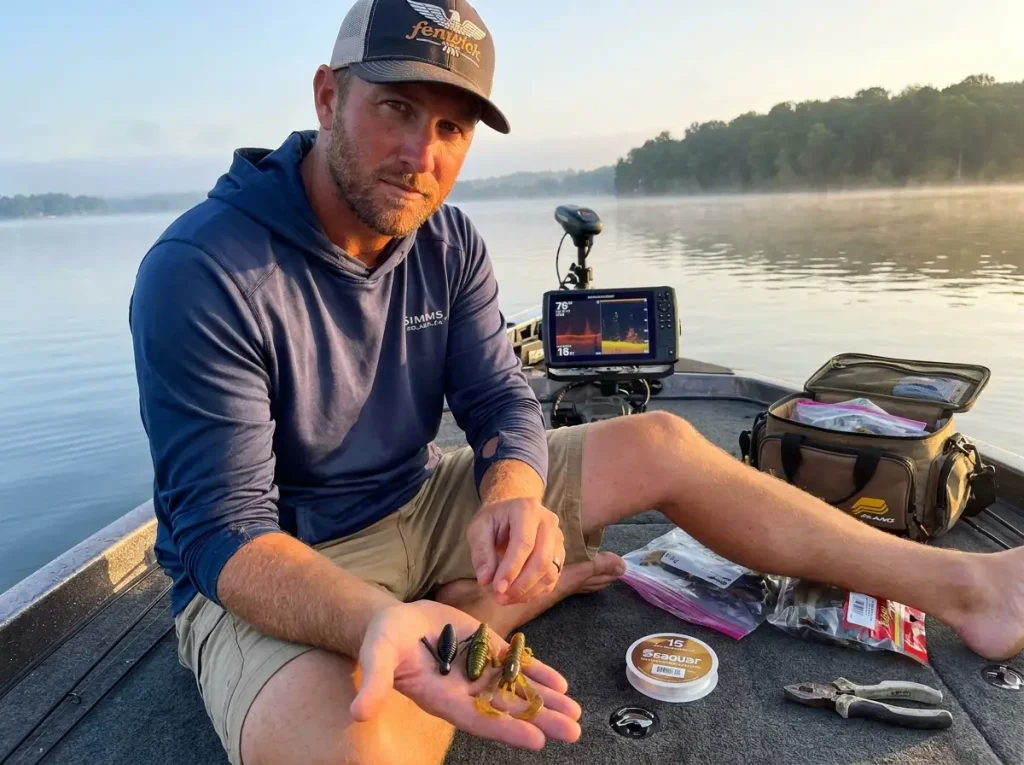
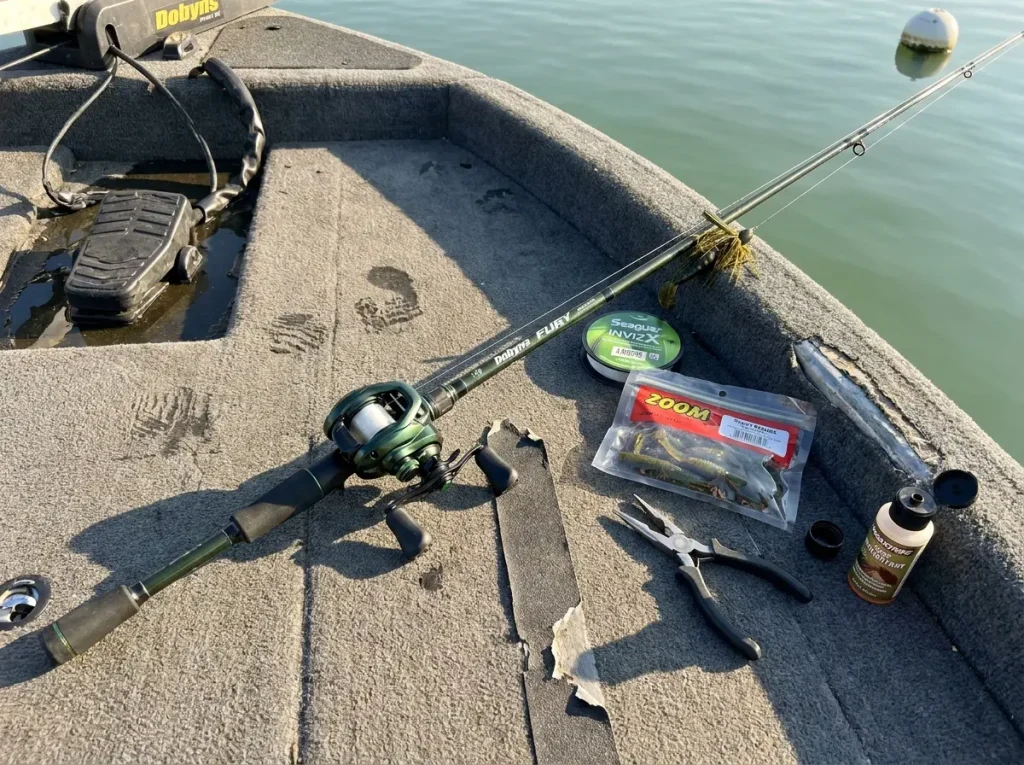
The standard range is 15-pound for open water and 20-pound when you’re fishing around heavy rock or timber where you need abrasion resistance. I fish 17-pound Seaguar InvizX as my all-around choice because it splits the difference.
Pro tip: Fluorocarbon has memory. If you notice your jig spinning on the fall or your line coiling off the spool, stretch the first 20 feet of line between your hands before your first cast of the day. Takes ten seconds and eliminates the problem.
How to Match Your Trailer to What Bass Are Doing Right Now
The Activity-Level System
Your trailer choice should change every time bass behavior changes — and it changes constantly throughout the day, the season, and with every weather shift. The skirt on a football jig provides the base profile, but the trailer determines the action, the fall rate, and the displacement.
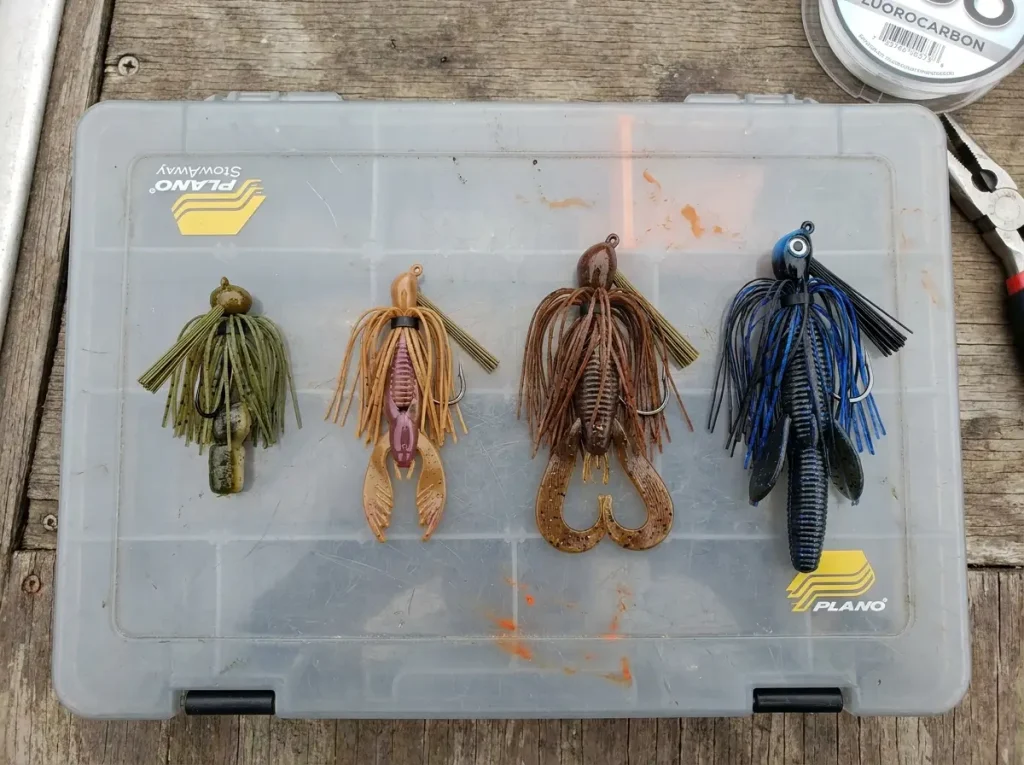
Cold or sluggish bass (water below 65°F, post-frontal, high pressure): Compact chunk-style trailers. The Zoom Super Chunk is the standard. Minimal appendage action, small profile, slow fall.
You want something that looks like a crawfish sitting still and not drawing attention to itself. Less movement triggers more confidence bites from cautious fish.
Active bass (water 65–80°F, stable or falling pressure): Medium-action craw trailers with moderate appendage movement. The Strike King Rage Craw or a standard twin-tail grub. These trailers add water displacement without overwhelming the presentation. This is your 70% of the year trailer choice.
Aggressive bass (water above 75°F, feeding competition, schooling): Maximum-action trailers with big, flapping appendages. The Zoom Ultra Vibe Speed Craw or a beaver-style bait like the Zoom Brush Hog. These trailers push water, create vibration the lateral line detects from several feet away, and trigger reaction strikes from bass that are already in a feeding mood.
The Color Rule That Nobody Explains
Most articles tell you “green pumpkin” and “black and blue” and call it a day. Here’s what actually matters: contrast relative to the bottom.
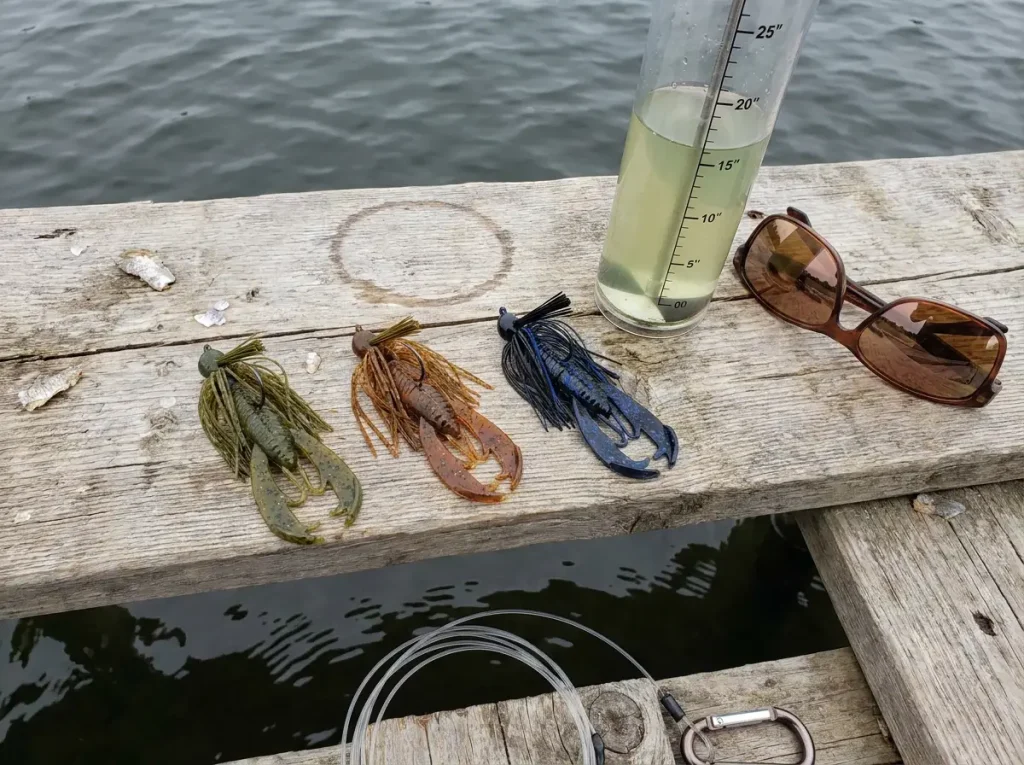
In clear water over light-colored rock or sand, natural colors work — green pumpkin, watermelon, brown-orange craw patterns. The jig should look like it belongs on the bottom. In stained water (visibility under 3 feet), increase contrast — dark skirt with a chartreuse-tipped trailer, or a bold black-and-blue combination.
The physics of color at depth matter too. Red wavelengths disappear below about 15 feet, so that “red craw” pattern you love looks gray-brown to a bass sitting at 25 feet. Below 20 feet, stick with patterns that rely on contrast and silhouette rather than color — dark versus light, not brown versus orange.
Pro tip: Try a contrasting trailer color instead of matching your skirt. Mike McClelland runs a green pumpkin skirt with a dark blue trailer in clear water — it gives the bass two different visual targets and broadens what triggers a strike.
Finding Bass Offshore: The Post-Spawn Migration Path Nobody Maps
The Seasonal Depth Progression
Bass don’t just “go deep in summer.” They follow a predictable migration route that you can track if you know where to look. After spawning in shallow flats and pockets (2–6 feet), female bass recover on the nearest available structure — usually a dock, laydown, or shallow brush pile at 6–10 feet.
Within two to three weeks of the spawn, those fish begin sliding toward deeper water along identifiable highways: secondary points first (10–15 feet), then creek channel intersections (15–20 feet), then main-lake points and primary ledges (20–30+ feet) by mid-summer. The exact depths depend on water clarity — the clearer the water, the deeper the bass push.
Structure Types That Hold Football-Jig Bass
Not all offshore structure is football jig territory. You want hard bottom — chunk rock, gravel, broken shale, clay transitions. These are the areas where crawfish populations concentrate, and crawfish are the primary forage that football jigs imitate.
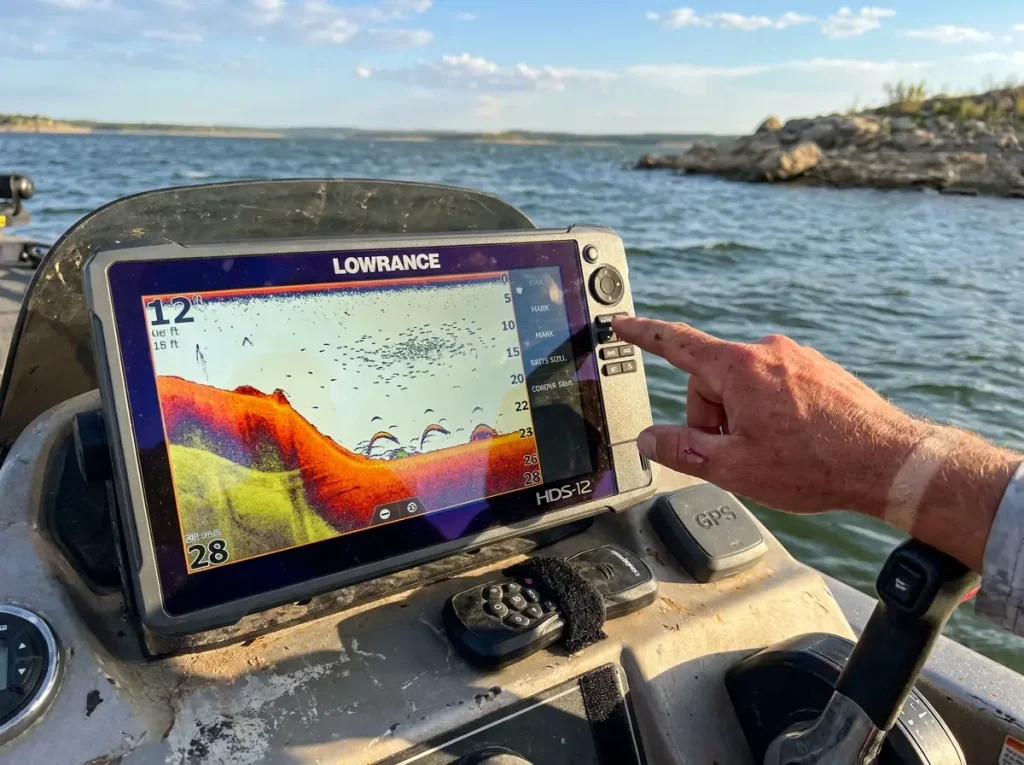
The best spots share a common feature: a depth change near hard bottom. Ledges where the bottom drops from 12 to 20 feet. Humps that rise from the channel floor to within 15 feet of the surface. Channel swings where the river bed curves and deposits rock and gravel on the inside bend. If your fish finder shows a hard bottom return at a depth transition, you’ve found football jig water.
How to Scan a Spot Before You Cast
Idle over the structure with your electronics first. Mark the depth breaks, identify the hard-bottom zones, and look for individual fish arches holding tight to the bottom between 18 and 30 feet. Those bottom-hugging marks are your targets.
Once you’ve identified the zone, position your boat so you can cast past the structure and drag the jig across it — not off the edge. You want the jig traveling along the ledge or over the hump, not falling into open water on the far side where bass aren’t holding.
Color Selection by Depth and Clarity: What Light Physics Tells You
How Light Disappears Underwater
Understanding why certain jig colors work at certain depths isn’t complicated once you know one fact: water absorbs color wavelengths at different rates. Red disappears first — by about 15 feet in clear water, anything red looks gray to a bass. Orange fades next around 25 feet. Green and blue penetrate the deepest, which is why deep-water forage species tend to be silver, green, or dark-backed.
The Three-Zone Color System
Shallow (under 12 feet) in clear water: Full-spectrum natural colors work. Green pumpkin, watermelon red flake, brown-orange craw patterns. Bass can see the full color range and they’re keying on realistic crawfish imitations.
Mid-depth (12–20 feet) in moderate clarity: Shift toward contrast patterns. Green pumpkin with a blue-flake trailer, PB&J (peanut butter and jelly), or natural brown with chartreuse tips. At this depth, the red and orange in your trailer are already fading — you need contrast between light and dark elements to maintain visibility.
Deep (20+ feet) or stained water at any depth: Silhouette is everything. Black and blue is the standard for a reason — it creates the strongest contrast against whatever light penetrates to depth. Dark jig, dark trailer, maximum silhouette. If the water is both deep and stained, add a scent trail (Megastrike or similar) because bass at these depths are relying on vibration and chemoreception as much as sight.
When to Put the Football Jig Away
Grass and Vegetation
If the structure you’re fishing has any significant vegetation — hydrilla, milfoil, coontail, lily pads — the football jig is the wrong tool. That wide head catches grass on every cast and you’ll spend more time cleaning the jig than fishing it. Switch to a flipping jig or a punching rig for heavy cover.
Vertical Timber and Laydowns
Standing timber requires a jig that falls vertically and doesn’t pendulum sideways into the wood. The football head’s wide profile makes it prone to hanging in branch forks and bark crevices. An Arkie-style jig or a finesse jig drops cleaner through timber.
Strong Current
In rivers or tailrace areas with heavy current, the football head’s flat bottom catches too much water flow and tumbles. Switch to a standup-style jig or a heavier round head that cuts through current instead of fighting it.
The Decision Framework
Ask yourself two questions before tying on a football jig: Is the bottom hard? Is it relatively clean of vegetation? If both answers are yes, the football jig is probably the best choice. If either answer is no, you’ll fish more effectively with a different jig style — and knowing when to switch is what separates anglers who catch fish from anglers who catch rocks.
The Gear Setup That Puts It All Together
Rod Selection
A 7-foot to 7-foot-4-inch medium-heavy casting rod with a fast tip covers 90% of football jig fishing. The length gives you casting distance and leverage for deep hooksets, the medium-heavy backbone drives hooks through tough bass mouths at depth, and the fast tip lets you feel subtle bites.
If you want one rod recommendation: the Dobyns Fury series or the Fenwick World Class both handle football jigs across their full weight range. The Falcon Cara T7 is what Mike McClelland fishes if you want the pro-level option.
Reel and Gear Ratio
A baitcasting reel in the 6.3:1 to 7.1:1 gear ratio range is the sweet spot. Lower ratios (6.3:1) give you more cranking power for pulling fish out of deep structure. Higher ratios (7.1:1) help you take up slack faster after a stroke retrieve. I fish a 6.6:1 as my compromise — fast enough to manage slack, slow enough that I don’t accidentally reel the jig too fast.
The Shimano Curado MGL, Daiwa Tatula SV, and Abu Garcia Revo Winch are all proven choices in the 6–7:1 range.
The Hookset That Stops Losing Fish
This is mistake number four from the title, and it’s the one that costs the most fish. A football jig uses a lightwire hook — thinner wire that penetrates easier but also pulls out easier if you jerk the rod like you’re setting a Texas rig.
The correct hookset is a sweep. When you feel the bite — a load, a tick, or your line moving sideways — reel down to the fish first, then sweep the rod in a smooth lateral motion while continuing to reel. Let the rod load. The combination of the reel tension and the rod sweep drives the hook into the roof of the bass’s mouth without the violent jerk that tears lightwire hooks free.
Think of it this way: you’re winding into the fish, not yanking its head off. The first five times you do this it’ll feel wrong. By the tenth fish, you’ll never go back.
Pro tip: Check your hook point every 15 to 20 casts, especially if you’re dragging over rock. Chunk rock dulls hooks fast, and a dull lightwire hook that barely penetrates is worse than a sharp treble on a crankbait. Carry a small hook file in your pocket and touch up the point whenever it stops grabbing your thumbnail.
Conclusion
Football jigs aren’t complicated, but they punish small mistakes harder than most lures. Match your weight to the depth, pick a trailer that reflects what the bass are doing right now, learn all four retrieves instead of just the drag, and sweep your hooksets instead of snatching.
The next time you’re over offshore structure with hard bottom showing on your finder, tie on a football jig and drag it across. Pay attention to what the bottom tells your rod hand. That’s where the fish are — and that’s where the learning starts.
Q1 What is the best way to fish a football jig for bass?
The bomb-cast-and-drag is the most effective all-around retrieve. Cast past your target, let the jig sink to the bottom, and drag it back with slow side-sweeps of the rod while maintaining constant bottom contact. Pause two to three seconds between sweeps and watch your line for subtle movement.
Q2 What depth should you fish a football jig?
Football jigs work best between 8 and 30+ feet on hard bottom structure. Use 3/8-ounce jigs in water under 8 feet and scale up to 3/4- or 1-ounce for anything deeper than 20 feet. The jig must maintain consistent bottom contact at your target depth.
Q3 What is the difference between a football jig and a regular bass jig?
The football head has an oblong shape that sits flat and rolls over rocks without snagging, while a round or Arkie-style head is more versatile in mixed cover including grass and timber. Football jigs specialize in hard-bottom offshore structure where their wider head provides superior bottom feel.
Q4 What is the best trailer for a football jig?
Match the trailer to bass activity. Compact chunk trailers like the Zoom Super Chunk work for sluggish fish, medium-action craws handle normal conditions, and aggressive speed craws with flapping appendages trigger reaction bites from feeding bass. Water temperature and pressure trends tell you which to choose.
Q5 When is the best time to throw a football jig?
Post-spawn through fall is prime football jig season, roughly May through October in most US waters. Bass move offshore to hard-bottom structure during this window, and the football jig’s bottom-reading design and crawfish imitation match exactly what those fish are eating at depth.
Risk Disclaimer: Fishing, boating, and all related outdoor activities involve inherent risks that
can lead to injury. The information provided on Master Fishing Mag is for educational and informational purposes
only. While we strive for accuracy, the information, techniques, and advice on gear and safety are not a substitute
for your own best judgment, local knowledge, and adherence to official regulations. Fishing regulations, including
seasons, size limits, and species restrictions, change frequently and vary by location. Always consult the latest
official regulations from your local fish and wildlife agency before heading out. Proper handling of hooks, knives,
and other sharp equipment is essential for safety. Furthermore, be aware of local fish consumption advisories. By
using this website, you agree that you are solely responsible for your own safety and for complying with all
applicable laws. Any reliance you place on our content is strictly at your own risk. Master Fishing Mag and its
authors will not be held liable for any injury, damage, or loss sustained in connection with the use of the
information herein.
Affiliate Disclosure: We are a participant in the Amazon Services LLC Associates Program, an
affiliate advertising program designed to provide a means for us to earn advertising fees by advertising and linking
to Amazon.com. As an Amazon Associate, we earn from qualifying purchases. We also participate in other affiliate
programs and may receive a commission on products purchased through our links, at no extra cost to you. Additional
terms are found in the terms of service.