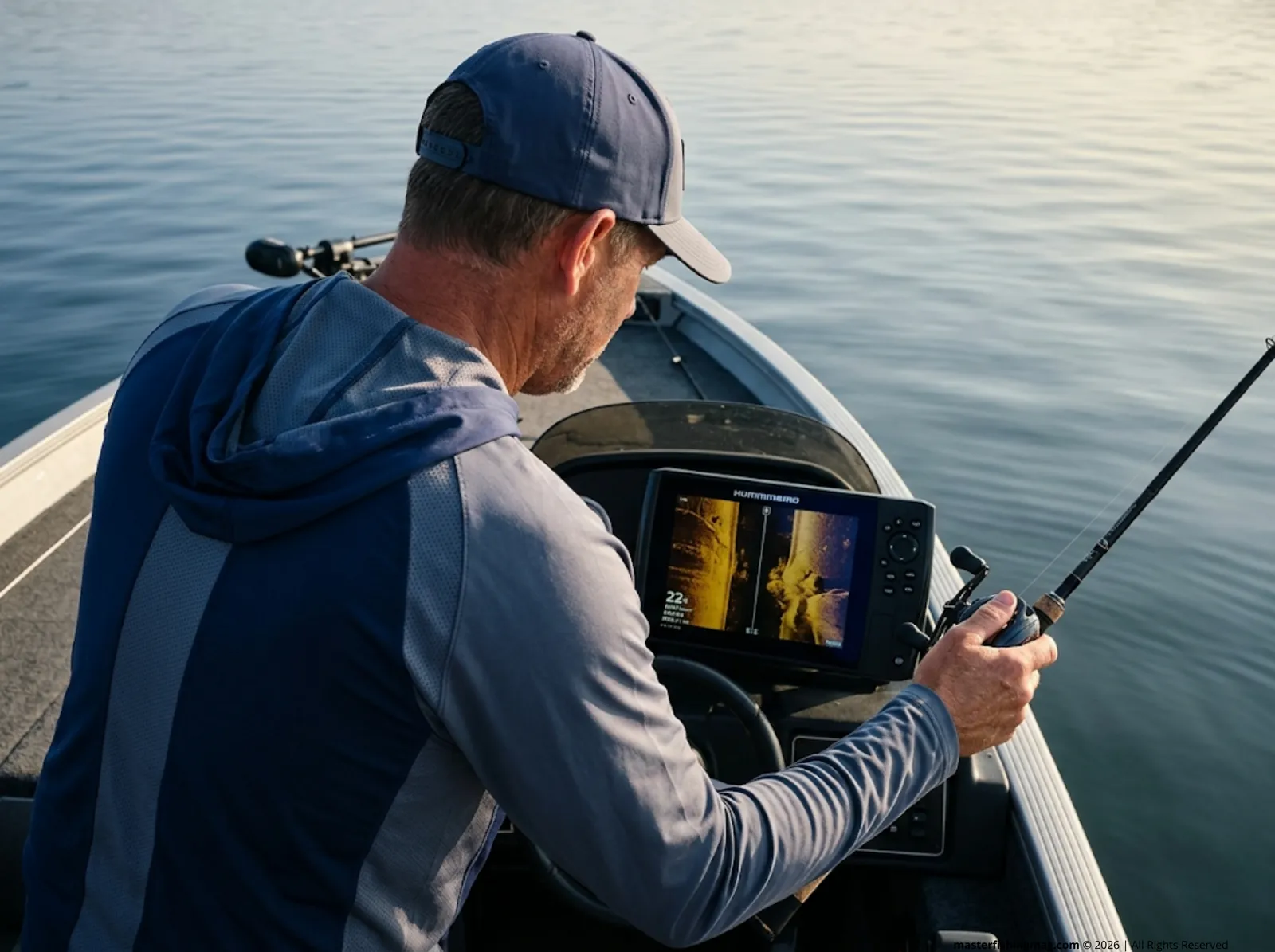
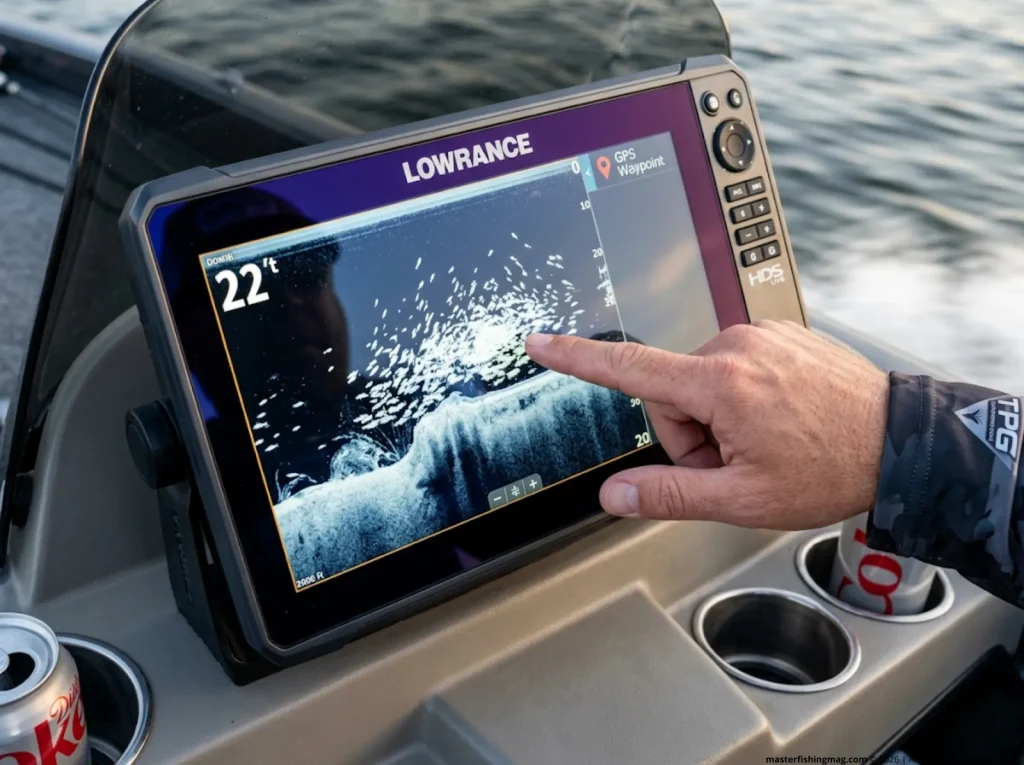
The screen lit up like a slot machine at noon. Forty feet of empty water column, then a bright horizontal shelf at twenty-two feet, and above it — dozens of white tic-tac signatures jammed so tight they looked like sonar spaghetti. I marked the waypoint, killed the outboard, and dropped the trolling motor. That school of largemouth bass had been sitting on this ledge since June, and every day I’d been fishing a bank forty yards behind them in six feet of water, wondering why the mid summer bite had dried up.
The truth is the bite never dried up. It moved. And the anglers who follow it offshore — into the deep-water structures where summer bass actually live — catch more fish between July and September than they do during the entire spring spawn.
This guide covers the science behind thermal stratification, the formula for finding the right starting depth, the crankbait physics that actually matter, and the one conservation step that most anglers skip when pulling fish from 25 feet down. If you’ve been blaming the heat for slow fishing, the problem isn’t the weather. It’s where you’re standing. Understanding why fish stop biting and how to diagnose it starts with admitting the fish moved and you didn’t follow.
⚡ Quick Answer: Bass move to offshore structures between 15 and 30 feet during mid summer, concentrating near the thermocline where dissolved oxygen stays above 5 mg/L. Find this depth using the 5x visibility rule, scan for schools on Side Imaging, approach silently on a trolling motor, and rotate from subtle finesse baits to reaction crankbaits. If pulling fish from 25+ feet, always use a descending device — it doubles survival compared to venting with a needle.
Why Bass Abandon the Banks in Mid Summer
The Thermocline — Your Lake’s Living Floor
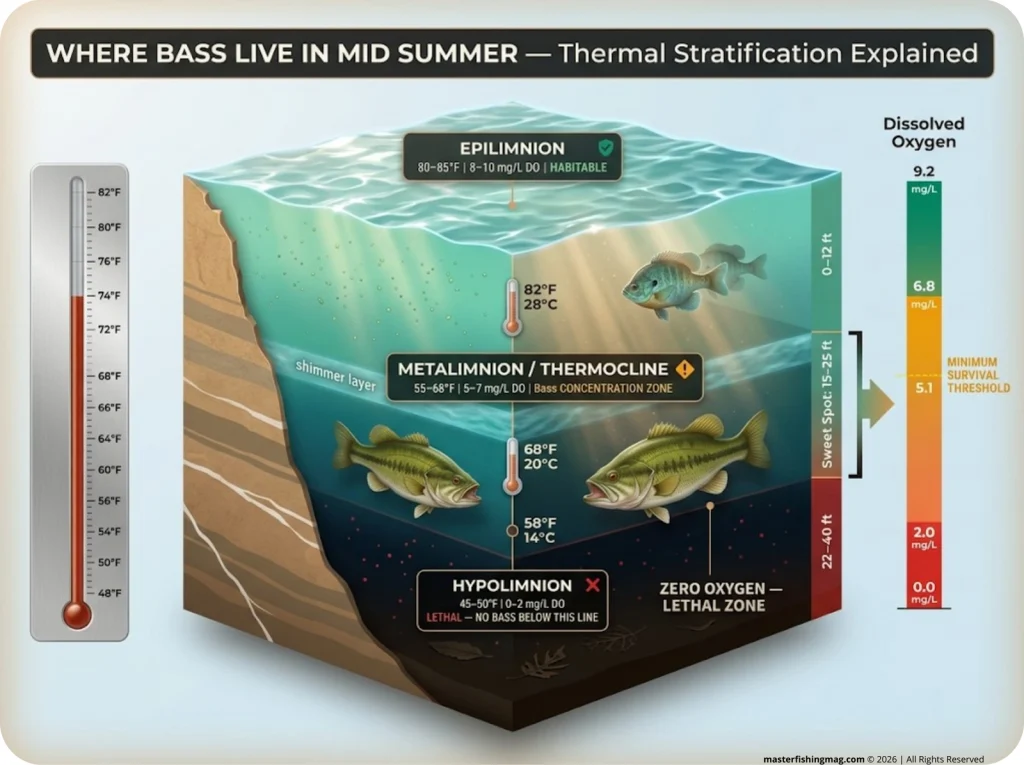
Every summer, your lake splits into three invisible layers. The warm top — the epilimnion — is the water you can feel on your hand. Below it sits the metalimnion, a transition zone where temperature drops sharply. The point of steepest drop within this zone is the thermocline. Below that, the cold, dense bottom layer — the hypolimnion — sits sealed off from atmospheric oxygen for the entire summer.
In productive lakes with heavy algae loads, bacteria feeding on decaying organic matter consume whatever oxygen remains in that bottom layer. By mid-July, the hypolimnion often becomes completely dead — zero dissolved oxygen. That creates a biological wall that bass cannot cross. The thermocline becomes the “virtual bottom” of the lake, no matter how deep the sonar says the physical bottom is.
Shallow lakes under ten or twelve feet may never stratify at all, because wind energy alone keeps the entire water column mixed. But in reservoirs with 30, 40, or 60 feet of depth, this layering is the single most important factor controlling where bass survive. Research from the Illinois EPA on lake stratification and thermal mixing confirms that this process is universal across temperate freshwater systems. Understanding why surface temperatures lie about where the fish actually are is the first step out of the mid-summer slump.
The Metabolic Squeeze — Hot Water, Low Oxygen, Hungry Fish
Bass are cold-blooded. As water temperature rises, their metabolism accelerates — they need to eat more often. But warmer water holds less oxygen. At 45°F, water carries about 11.9 mg/L of dissolved oxygen at saturation. At 90°F, that capacity drops to just 7.4 mg/L.
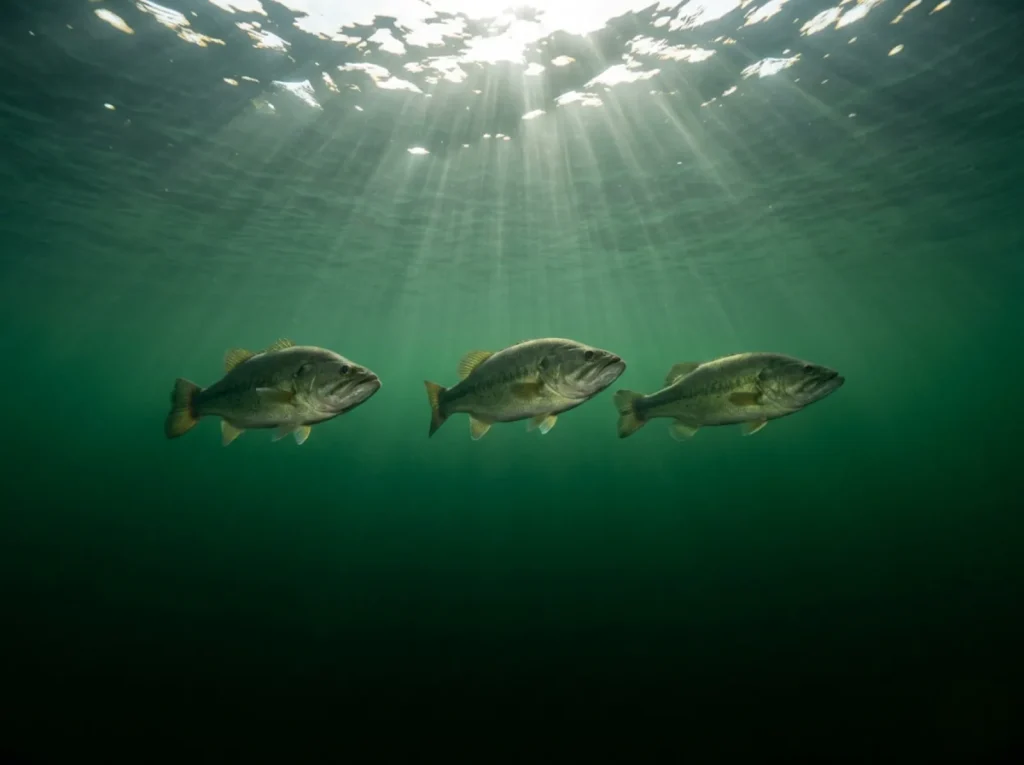
This metabolic squeeze forces bass toward the thermocline, where the water is still cool enough to carry adequate oxygen but warm enough to support active feeding. Bass need a minimum of 5.0 mg/L to function normally. Below 2.0 mg/L, they die.
That narrow band of livable water — usually between 15 and 25 feet during peak summer — is where every offshore structure decision starts. This is also why reaction strikes dominate in summer. A bass sitting in marginal oxygen doesn’t want to chase a slow plastic worm for thirty seconds. It wants a fast, aggressive bait that triggers a reflex before it can calculate the cost of the chase.
Pro tip: Drop a white jig over the side and watch it disappear. That visibility depth times five is your starting depth. If the number falls below the thermocline on your sonar, the thermocline IS your floor — ignore the math and fish the transition.
The 5x Rule and Where to Start Scanning
Edwin Evers’ 5x Visibility Rule — The Starting Depth Formula
Before you scan a single waypoint, you need a starting depth. Edwin Evers — one of the most decorated offshore anglers in Major League Fishing — uses the 5x Rule: drop a white or bright-colored lure over the side and note the exact depth where it vanishes. Multiply that number by five. Evers explains the full methodology in his column on starting depth.
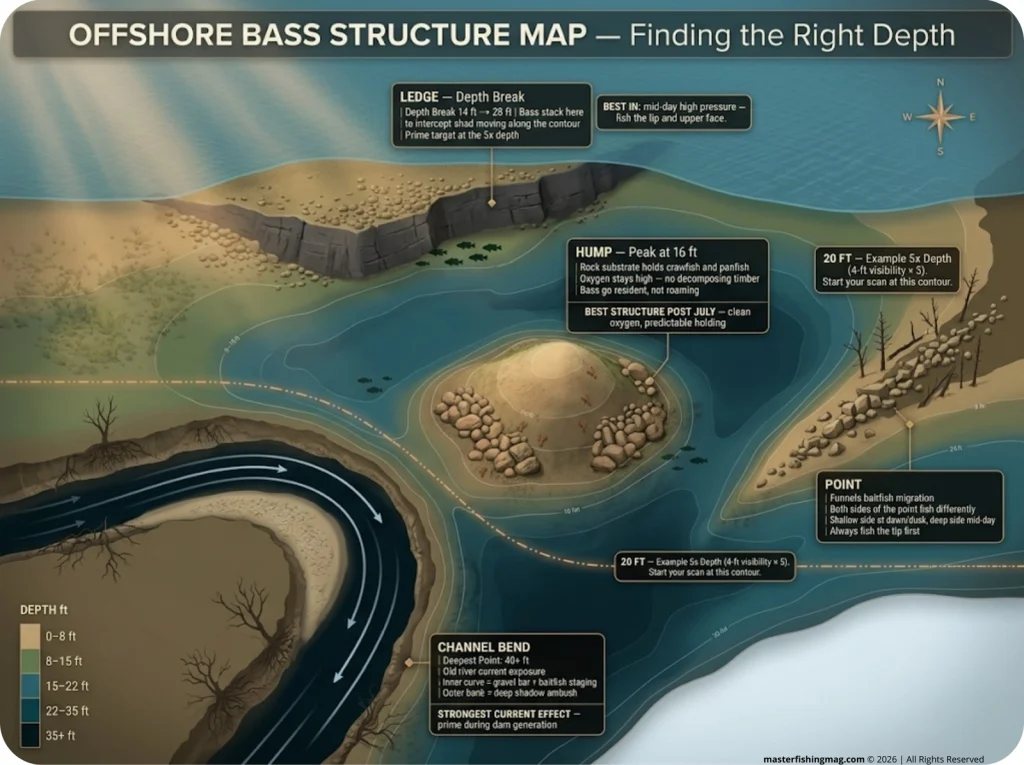
Four feet of visibility means you start at twenty feet. Three feet means fifteen. The logic tracks how light penetration governs ambush positioning — bass use darkness and contrast to hide from prey, and the 5x depth is where the light advantage shifts.
The one critical override: if the 5x number puts you below the thermocline, throw it out. The thermocline is the biological ceiling. A depth of 30 feet on paper means nothing if the oxygen at 25 feet is already below survival threshold. The 5x Rule gets you started; the thermocline mapping on your Side Imaging or forward facing sonar tells you where to stop.
Reading Structure at the Right Depth — Ledges, Humps, and Channel Bends
With your target depth set, the next question is where — and not all bottom structure is equal. Offshore ledges are sudden depth breaks where a flat shelf drops into deeper water. Bass stack on the lip and intercept shad schools moving along the contour. Humps — isolated underwater hills — concentrate crawfish and panfish, pulling bass out of roaming patterns into resident feeding. Channel bends, where the old river bed curves sharply, offer the deepest water with the strongest current exposure.
The mistake most anglers make is treating all deep structure as equal. A brush pile at 22 feet might look loaded with fish on the screen, but rotting timber drives up oxygen demand. The bacteria decomposing that wood consume oxygen faster than the surrounding water replaces it — and in mid-summer, the area around a deep brush pile can be suffocating even when the rest of the column at that depth is fine.
A clean rock hump outperforms a rotting brush pile every time after July. Rock doesn’t steal oxygen. Fish that settle on rocky substrate stay pinned to the bottom, locked onto prey. Fish over decaying vegetation suspend above the cover to breathe — and suspended fish are harder to trigger.
Deep Diving Crankbaits — The Physics Most Anglers Ignore
Strike King 6XD crankbait on heavy fluorocarbon over a deep summer ledge” class=”wp-image-11370″/>
Why Your Crankbait Never Reaches the Depth on the Box
The number printed on a deep diving crankbait‘s packaging is a best-case scenario that assumes 14 lb monofilament, a full 100-foot cast, and zero current. Most anglers achieve 60% to 70% of the advertised depth and never realize it.
Line diameter is the single biggest controllable variable. Dropping from 14 lb mono to 8 lb mono adds roughly 20% to your maximum depth. The reason is the line bow effect: as the lure dives, water pressure pushes against the submerged line, creating a curve that pulls the bait upward. Thinner line means less surface area, less drag, and a deeper dive.
Cast distance matters almost as much. A 100-foot cast gives the lure enough horizontal travel to reach its engineered maximum. A short 40-foot pitch — the kind most anglers throw — costs you 25% of your potential depth. The lure never reaches the zone.
For the Strike King 6XD, the Megabass Deep-X, and the Rapala DT series, the fix is the same: throw the longest cast you can manage on the lightest fluorocarbon you trust, and let the lip do the work.
The Kneel and Reel — Gaining a Free Foot of Depth
The kneel and reel technique is the simplest depth hack in offshore fishing. For every foot you submerge your rod tip below the surface, the lure gains approximately one foot of additional depth. Conversely, holding your rod tip three feet above the water costs you roughly a foot.
When you’re trying to reach an 18-foot ledge with a crankbait rated to 16 feet, jamming that rod tip into the water and cranking from a kneeling position closes the gap. It looks ridiculous. It works every time.
Pairing the kneel and reel with the right line diameter and a maximum-distance cast can push a 16-foot crankbait into 20 feet — a zone that normally requires specialized tackle. That extra reach is how you connect with schools sitting just off the lip of a structure, where the Carolina rig physics that bass can’t resist at depth also produce results. When cranks won’t reach, switching to a drop shot or heavy Carolina rig keeps your bait in the strike zone without the depth limitations of a diving lip.
Pro tip: Swap 14 lb monofilament for 10 lb fluorocarbon on your cranking rod. You’ll gain roughly 15% more depth AND better bite sensitivity — fluorocarbon’s near-zero stretch transmits the “tick” of the crankbait touching structure that monofilament swallows completely.
Current Seams, Dam Schedules, and When the Bite Turns On
How Current Creates a Biological Conveyor Belt
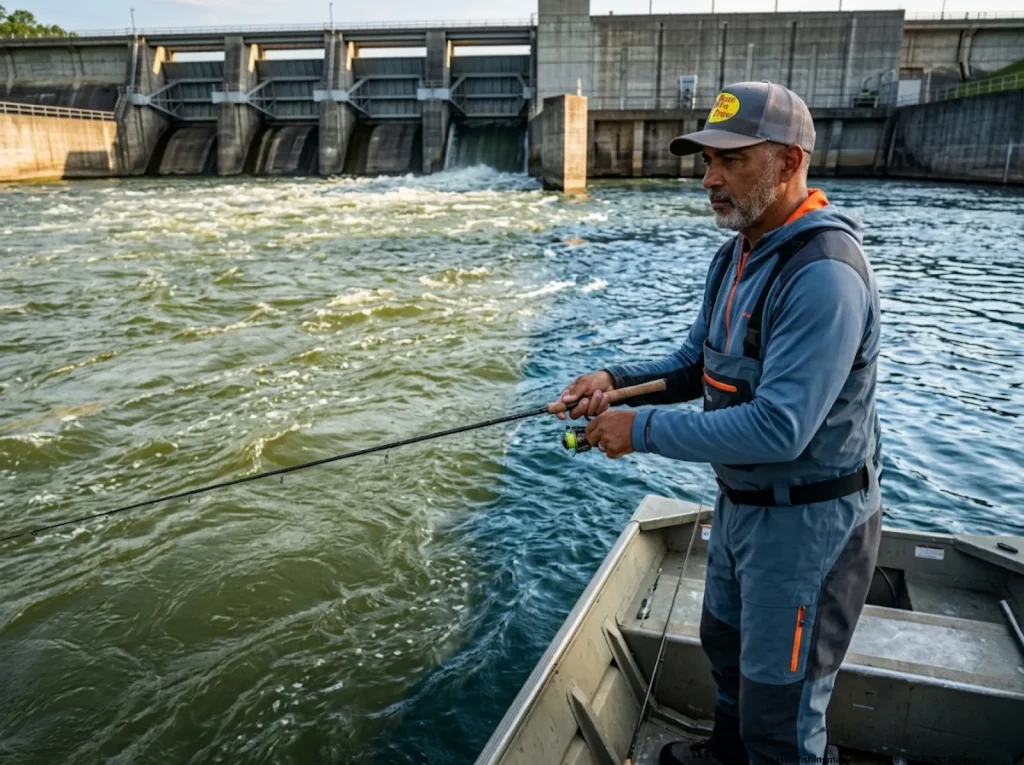
If the thermocline tells you where bass live, current tells you when they eat. In nearly every major reservoir managed by hydroelectric dams, water flow is the on/off switch for offshore feeding windows.
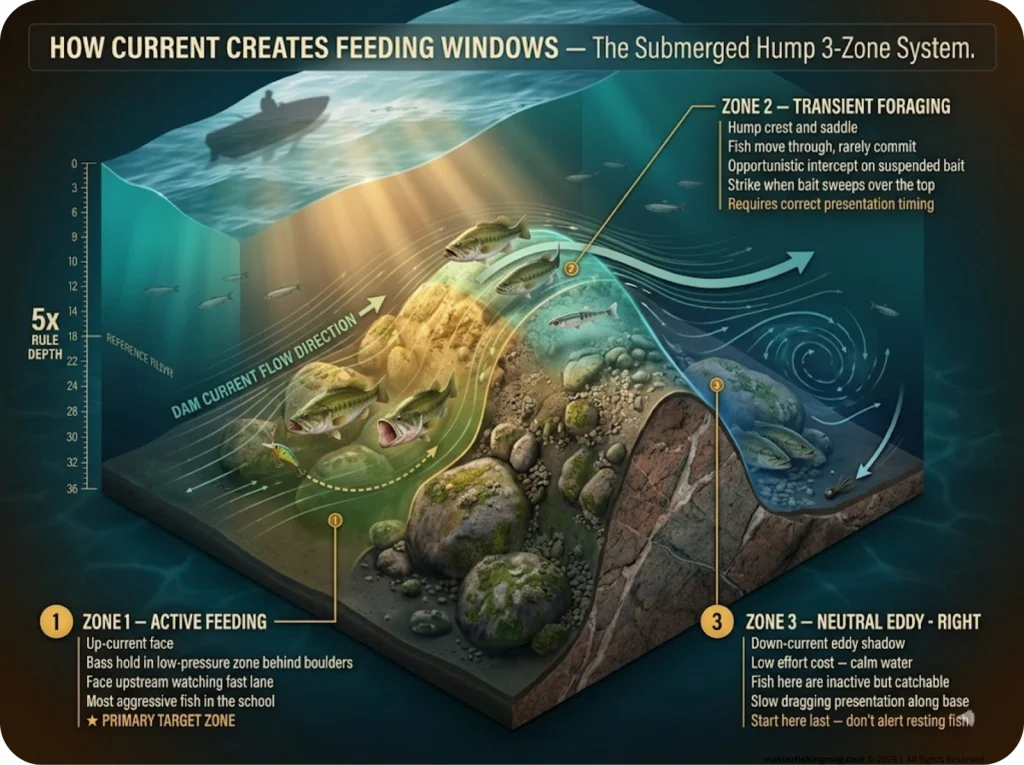
A current seam is the visible line of turbulence where fast-moving water meets a slow-moving eddy behind a structural object. Bass tuck into the calm side — the low-pressure zone — and face upstream, watching the fast lane for disoriented baitfish swept off the ledge. The fish in the seam are almost always the most aggressive in the school, because they’ve committed to feeding position.
On the up-current face of a hump, water pressure helps bass hold position with minimal effort, freeing them to concentrate on prey interception. On the down-current side, the reverse: a quiet resting zone where bass go neutral. Understanding the complete physics of current seam hydrodynamics is the difference between casting into a feeding lane and casting into a bedroom.
Reading Dam Schedules — The Switch That Turns Fish On
When the turbines go dormant and current drops to zero, deep schools scatter or suspend in a neutral state. Nobody’s home. The moment the dam release begins and current pushes through the system, fish slide to the up-current face of every structural object within range and lock into feeding mode.
The sweet spot is the first 45 minutes to two hours of active generation. After that, the strongest current overwhelms smaller forage and the feeding intensity drops. Cast up-current and let the lure drift naturally into the pressure zones — mimicking wounded shad shoved off the structure by the flow.
Checking your local dam’s generation schedule takes one phone call or one website visit. It’s the single most overlooked piece of tactical data in offshore summer bass fishing. The relationship between fish metabolism, water temperature, and lure cadence changes completely the moment that water starts moving.
Additionally, barometric pressure plays a supporting role. A falling barometer — often signaling an approaching front — pushes bass higher in the column and encourages roaming. A rising barometer drives them tight into deep shadows. When a high-pressure system parks over your lake during mid-day timing, the fish commit to the deepest available structure and respond best to slow, precise presentations dragged right across their nose.
The Stealth Rotation — Stop Firing the School Too Early
The number one mistake on a deep school is leading with a loud crankbait. That rattling lip bait sends vibration through the water column that every bass in the school detects through its lateral line — and in high-pressure fisheries, one aggressive pass can scatter the entire group before you catch a single fish.
The Lee Stealth Rotation, inspired by Jordan Lee‘s deep-water approach, works in three phases:
Phase 1 — The Probe. A big shaky head or heavy Texas rig. Drag it slowly across the bottom. No vibration, no flash. You’re testing the mood and catching the most aggressive individual without alerting the rest. A Keitech Shad Impact or Zoom Mag Finesse on a football jig is the go-to finesse bite starter.
Phase 2 — The Tease. A silent swimbait or hair jig. These provide a visual, natural profile that works on the fish watching their neighbor eat. Still quiet, still controlled.
Phase 3 — The Trigger. Once two or three fish are in the livewell and the school is competing, transition to deep-diving crankbaits or magnum spoons. Now the competitive frenzy overrides their caution and reaction strikes take over.
Boat Positioning — Why Idling Over a School Kills the Bite
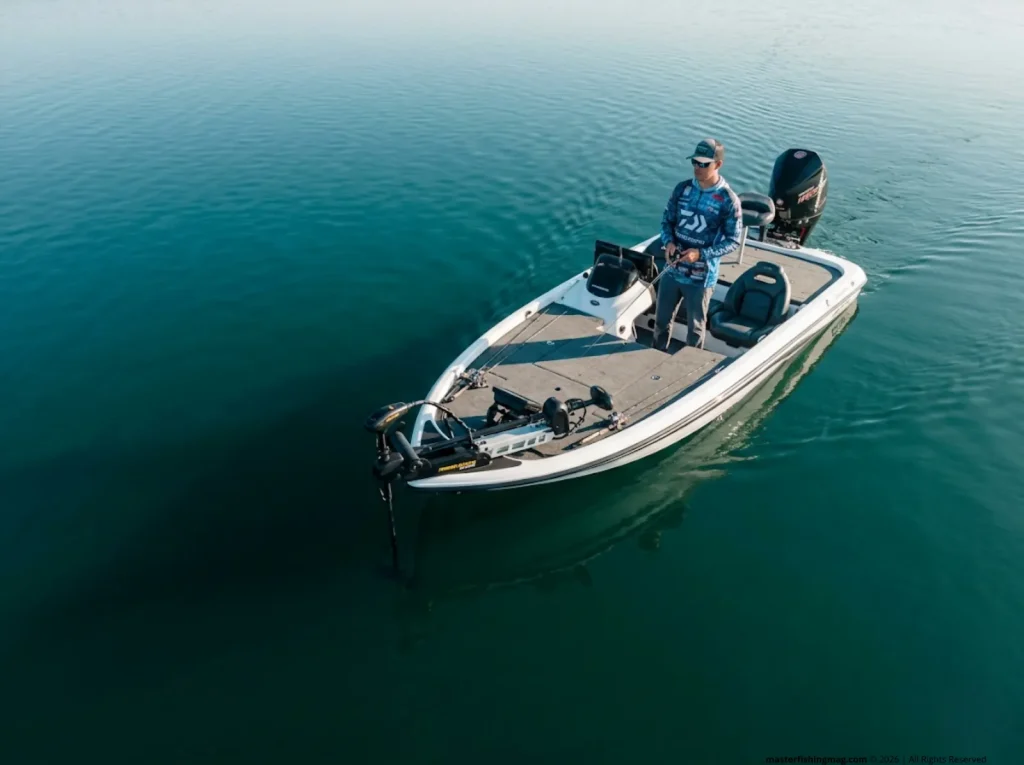
The sound of an outboard motor and the ping of multiple sonar transducers carry through water with devastating efficiency. A bass doesn’t need to see your boat — it feels the pressure wave through its lateral line from 50 feet out.
The fix is simple discipline. Idle past the target at a distance of at least 50 feet, mark the waypoint on your GPS, and use the trolling motor for the final approach. In high-pressure tournament scenarios, reduce your Garmin LiveScope or Humminbird gain, or shut off secondary transducers entirely. The fish that have survived 30 tournaments have learned to associate that sound with danger.
Pro tip: Before you throw a crankbait at a new school, make three casts with a big shaky head. If the mood is neutral, you’ll catch one or two without alerting the rest. If they’re already competitive, switch to the crankbait immediately — you’ll know within two casts.
Barotrauma — The Ethics of Catching Fish From 25+ Feet
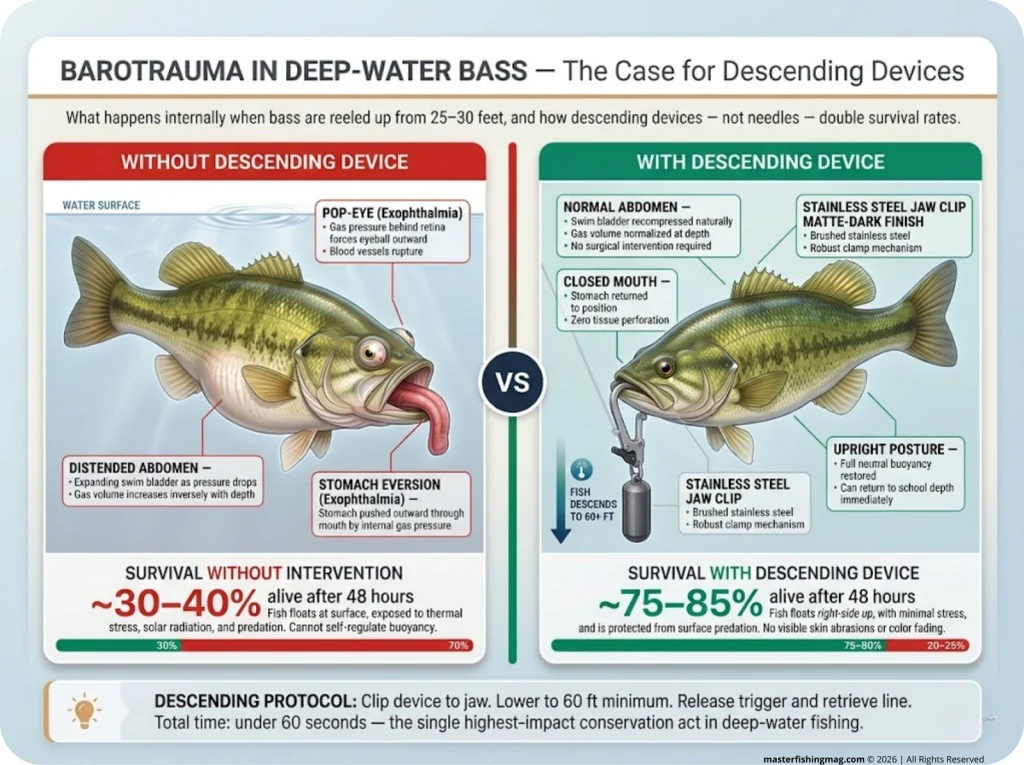
What Happens Inside a Bass When You Reel It Up From 30 Feet
Bass are physoclistous fish — meaning they have no direct connection between their swim bladder and their throat. They regulate gas volume through slow diffusion into the bloodstream, a process that cannot keep pace with a rapid angling ascent.
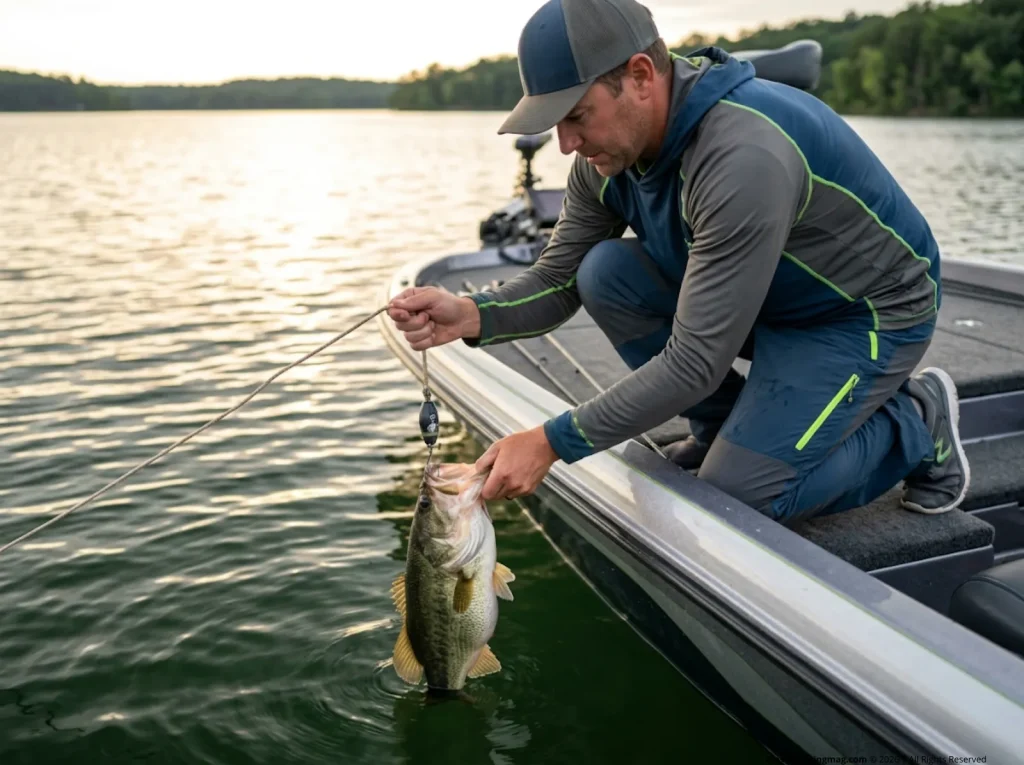
When you reel a bass up from 25 or 30 feet, the gas inside the swim bladder expands as external water pressure drops. The result is barotrauma: the abdomen balloons, the stomach pushes out through the mouth, the eyes bulge with gas pressure behind them, and blood vessels rupture internally.
A fish with these symptoms may “swim away” when you toss it back. But it can’t descend. It floats at the surface, exposed to sun, thermal shock, and predators. Delayed mortality runs high — and the fish that dies three days later never makes it into the conversation about conservation.
Fizzing vs. Descending — The Science Says One Is Twice as Effective
Venting — or “fizzing” — involves inserting a hollow needle through the fish’s side into the swim bladder. The correct entry point is three scales behind the pectoral fin tip, inserted at a 30 to 45 degree angle. It works — the fish can submerge — but it creates a wound and weakens the swim bladder’s function during healing. The Arkansas Game & Fish Commission fizzing protocol still teaches this method for anglers without a descender.
A descending device is a weighted clip that physically carries the fish back down to depth. The increasing water pressure recompresses the expanded gas naturally, without any puncture or tissue damage.
The USF College of Marine Science studied both methods head-to-head. Recompression to 60 feet or deeper produced survival rates two to 2.5 times higher than venting. The data is clear: descending is the standard for anyone serious about deep-water catch and release.
Pro tip: Clip a descending device to a D-ring on your life jacket before you launch. When a deep fish comes up belly-distended, every second counts. Fumbling through a tackle bag while the fish bakes on your deck is the fastest way to turn a legal release into delayed mortality.
Conclusion
Find the living floor first. The thermocline and the 5x Rule give you a biological starting point — everything below that line is dead water where no bass can sustain itself.
Let the current tell you when. Dam release schedules are the on/off switch for offshore feeding windows. No current, no commitment from the school. One phone call to your local dam operator puts you ahead of 90% of the boats on the water.
Release with the same precision you used to catch them. A descending device doubles survival compared to needle venting. If you’re pulling bass from 25 feet or deeper, that weighted clip is as essential as your rod.
Check your local dam’s generation schedule before your next trip. That’s the single cheapest upgrade to your deep water bass fishing game — and it doesn’t cost a penny.
FAQ
What depth are bass in mid summer?
Bass typically hold between 15 and 30 feet during mid summer, concentrating near the thermocline where dissolved oxygen stays above 5 mg/L. Use the 5x visibility rule to pinpoint the exact starting depth for your specific lake.
What is the best bait for deep water bass?
A deep-diving crankbait like the Strike King 6XD or Megabass Deep-X generates the reaction strikes that trigger feeding in pressured summer schools. Start subtle with a shaky head, then transition to the crank once the school is competing.
How do you find bass in 20 feet of water?
Use Side Imaging to scan for Tic-Tac biological signatures on ledges, humps, and channel bends at the 5x depth. Fish suspended above structure — with visible height off the bottom — are typically in an active, feeding state.
Do bass stay deep all day in summer?
Not necessarily. Bass often move shallower during low-light conditions at dawn and dusk, but deep schools on current-exposed structure feed most aggressively during the hottest part of the day, when forage is pushed to predictable ambush points by thermal pressure.
How do you release bass caught from deep water safely?
Use a descending device — not a needle. The USF College of Marine Science found that recompression doubles survival rates compared to fizzing. Descend the fish to at least 60 feet for maximum recovery.
Risk Disclaimer: Fishing, boating, and all related outdoor activities involve inherent risks that
can lead to injury. The information provided on Master Fishing Mag is for educational and informational purposes
only. While we strive for accuracy, the information, techniques, and advice on gear and safety are not a substitute
for your own best judgment, local knowledge, and adherence to official regulations. Fishing regulations, including
seasons, size limits, and species restrictions, change frequently and vary by location. Always consult the latest
official regulations from your local fish and wildlife agency before heading out. Proper handling of hooks, knives,
and other sharp equipment is essential for safety. Furthermore, be aware of local fish consumption advisories. By
using this website, you agree that you are solely responsible for your own safety and for complying with all
applicable laws. Any reliance you place on our content is strictly at your own risk. Master Fishing Mag and its
authors will not be held liable for any injury, damage, or loss sustained in connection with the use of the
information herein.
Affiliate Disclosure: We are a participant in the Amazon Services LLC Associates Program, an
affiliate advertising program designed to provide a means for us to earn advertising fees by advertising and linking
to Amazon.com. As an Amazon Associate, we earn from qualifying purchases. We also participate in other affiliate
programs and may receive a commission on products purchased through our links, at no extra cost to you. Additional
terms are found in the terms of service.


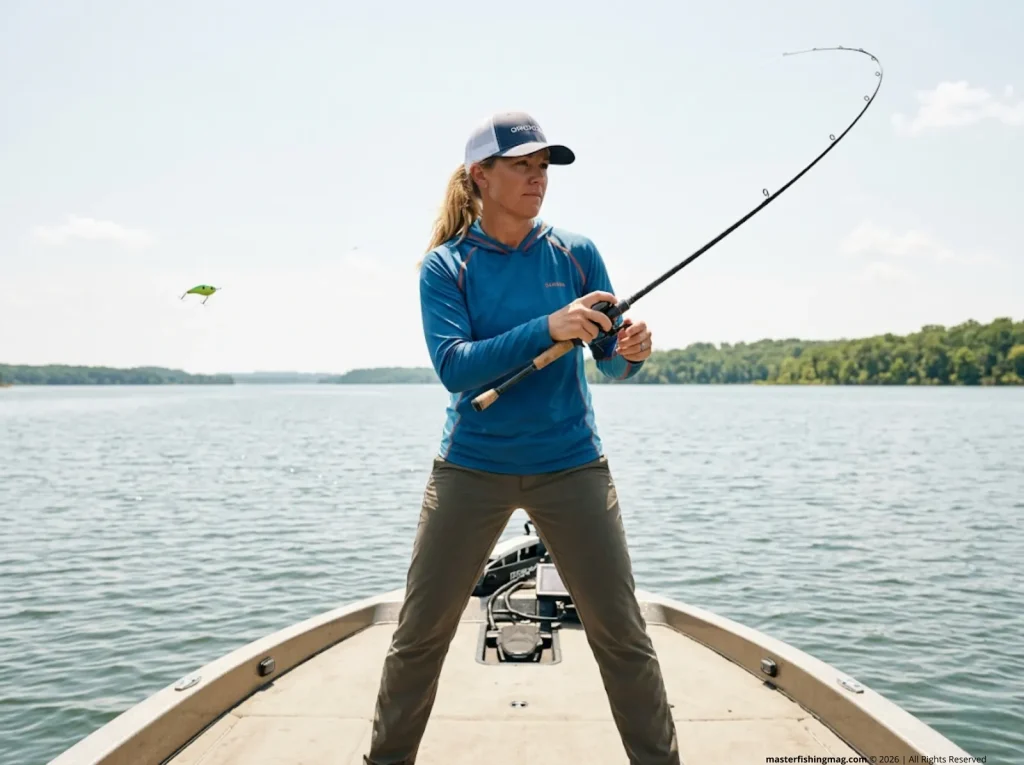 Strike King 6XD crankbait on heavy fluorocarbon over a deep summer ledge” class=”wp-image-11370″/>