
In this article
The weight hit bottom with a distinct tick-tick-tick—gravel transitioning to rock. Somewhere in the eighteen inches of slack leader behind it, my Zoom Lizard was still drifting, suspended in the strike zone like a fleeing crawfish waiting to be inhaled. That’s when the line went heavy. Not with a thump, but with the unmistakable absence of bottom contact. After twenty years of dragging carolina rigs across offshore ledges, I knew exactly what that mushy bite feel meant. The physics had done their job. The bass never felt the weight.
The Carolina rig isn’t just another bass fishing rig—it’s a controlled drift mechanism and a substrate transmission device rolled into one. While your tungsten weights map the underwater topography and broadcast crayfish-like clicks through the water column, your soft plastic bait floats freely behind, triggering predatory instincts through sound, vibration, and visual realism. This is rig physics that competitors barely scratch the surface of explaining.
Here’s what you need to know to make this versatile rig work: the hydrodynamics that create true weightless drift, the material science that separates elite bottom-readers from frustrated snagging machines, and the exact component configurations that tournament anglers guard like trade secrets.
⚡ Quick Answer: The Carolina rig works because it decouples the sinker from the lure, allowing bass to inhale the bait without feeling the weight’s mass. Use 1/2-1 oz tungsten weights, an 18-48″ leader (monofilament for floating presentations, fluorocarbon for sinking), and high-drag creature baits like brush hogs or lizards. The key is the pause—most strikes happen when the weight stops but the bait keeps drifting.
The Physics of the Sliding Weight System
The Decoupling Effect: Why Bass Don’t Spit Your Bait
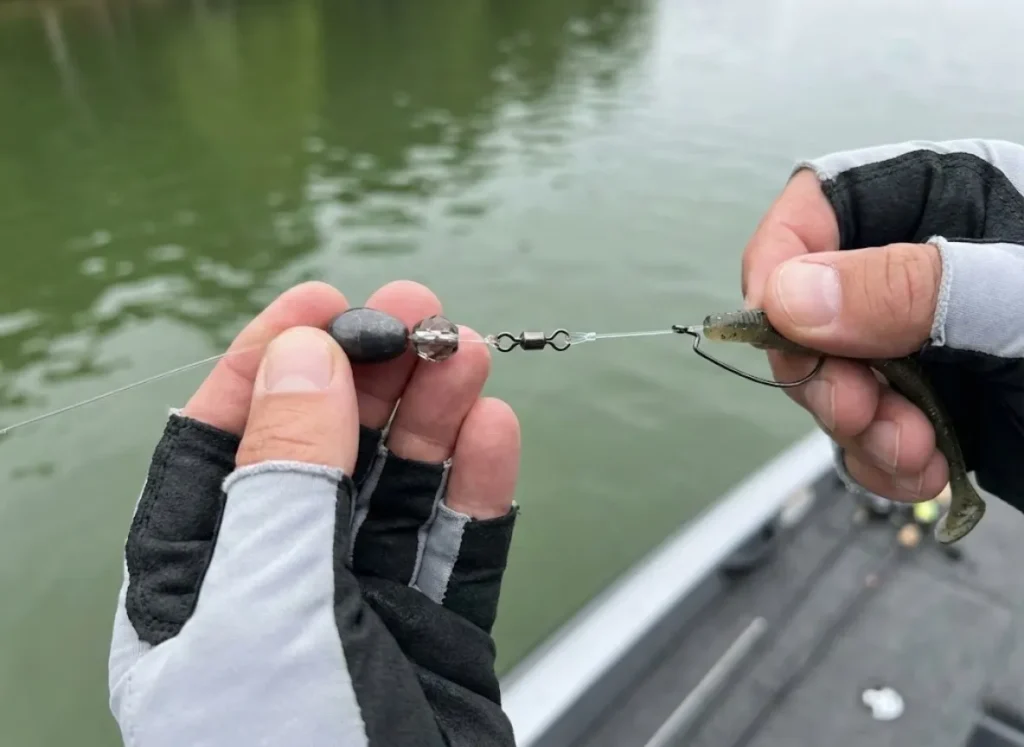
When a bass inhales a Texas rig or football jig, it encounters the combined mass of lure and sinker instantly. That immediate resistance triggers rejection in pressured fish—often before the hook point touches tissue. The Carolina rig setup eliminates this problem entirely through what serious fishermen call inertial dampening.
The sliding egg weight threads onto your main line and feeds freely through the bore when a fish strikes. Bass perceive only the negligible resistance of the plastic and line friction—not the 3/4-ounce anchor holding your rig to the bottom. This extends what pros call retention time: the duration your bait stays in the fish’s mouth. Tournament anglers estimate this rig buys you three to five times longer than fixed-weight presentations before the fish rejects.
Pro tip: The bite rarely thumps your rod tip. It feels like the rig got heavier, like dragging a wet sock. Any anomaly in bottom contact means sweep immediately—you’ve got a fish.
Leader Hydrodynamics: The Science of the Drift
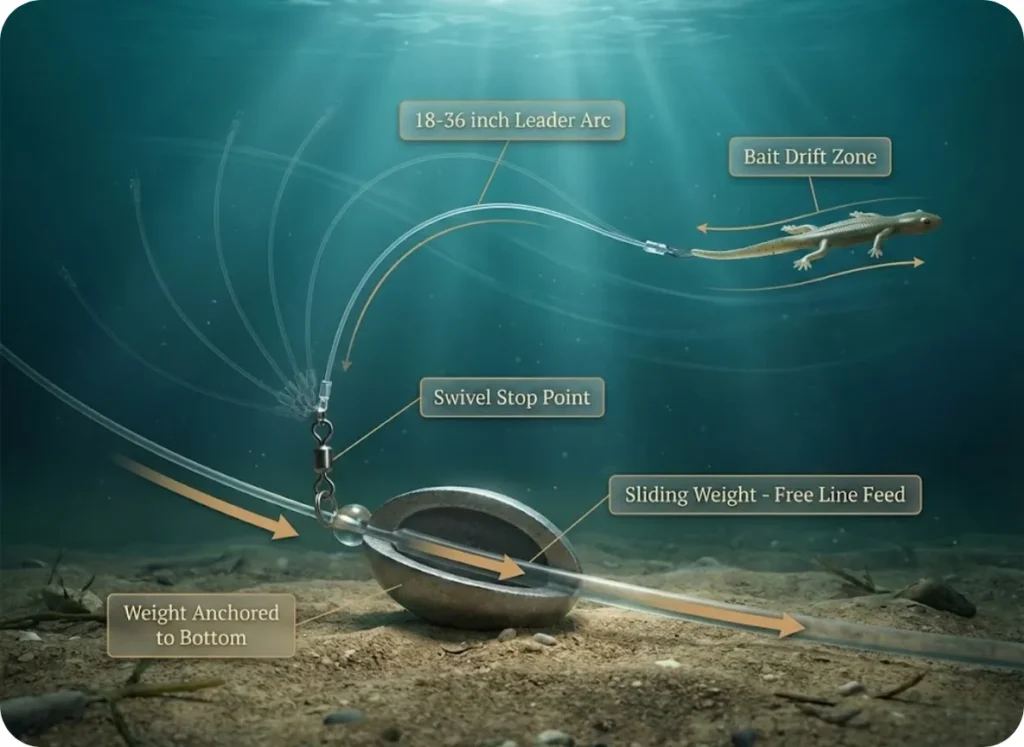
The leader—that section between the barrel swivel and your hook—is the critical variable controlling underwater behavior. Its length dictates everything about your bait presentation.
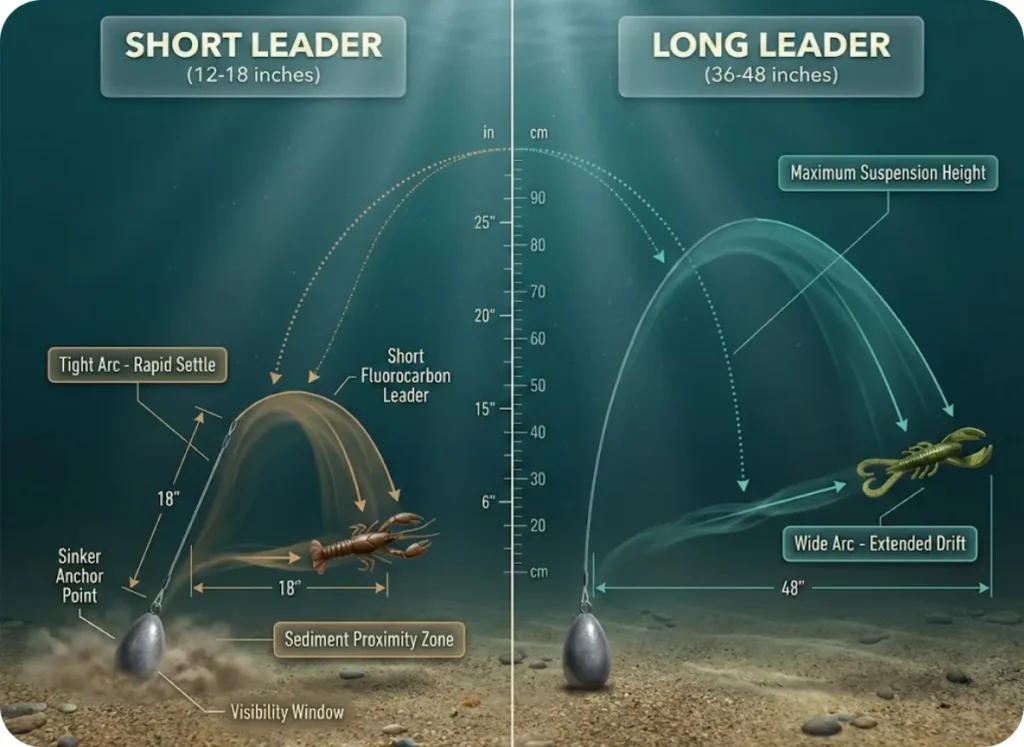
When the sinker stops, the lure continues forward on its own momentum, swinging in a pendulum arc. A long leader of 36-48 inches creates a wide, slow-swinging motion that keeps your creature bait suspended for extended visibility windows. Your target demographic—suspended fish cruising offshore structure—gets maximum look time. A shorter leader of 12-18 inches forces a tighter arc, bringing the bait to rest rapidly. Use this in stained water or heavy cover where you need the sound source and the prey item in close proximity.
The leader essentially filters your bait action. Understanding how material properties like refractive index and specific gravity affect presentation separates weekend warriors from consistent bass catcher anglers.
Buoyancy and Material Interaction: Mono vs. Fluoro Physics
Your leader material choice determines whether your bait floats, suspends, or pins to the bottom. This isn’t subtle—it fundamentally changes the presentation.
Monofilament leaders possess near-neutral buoyancy. Pair mono with a bulky soft plastic bait and you get what’s called the parachute effect: the bait slowly settles or hovers above bottom, mimicking a dying shad or crawfish rising in defensive posture. Brands like Sunline Super Natural and Berkley Big Game are go-to options for this floating bait presentation.
Fluorocarbon leaders sink aggressively—about 56% denser than monofilament. Seaguar InvizX and similar products force your bait downward, pinning it to clean substrates in current. The optical advantage of fluoro matters less here than its density characteristics. In silt or vegetation, fluorocarbon’s sinking properties can bury your bait in the cloud where bass can’t see it.
The decision matrix is simple: clear water with suspended fish equals monofilament. Current applications on rocky reservoirs equal fluorocarbon.
How Bass Detect the Carolina Rig: Sensory Biology Exploited
The Lateral Line: Dual-Signature Disturbance
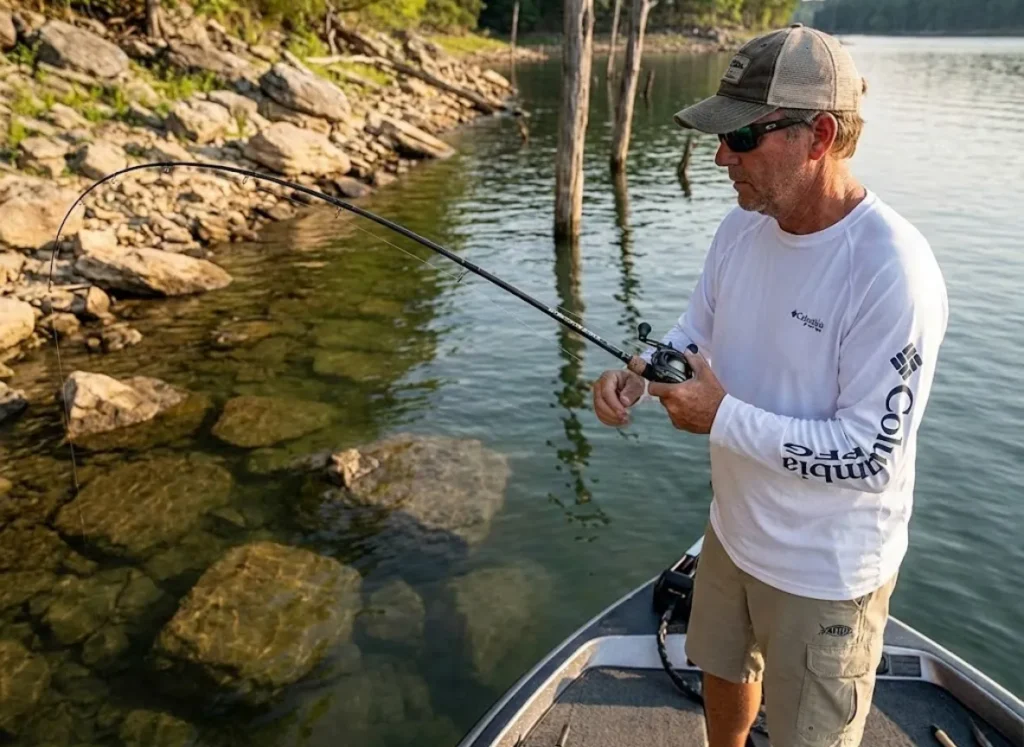
Bass possess mechanoreceptors along their lateral line system capable of detecting low-frequency vibrations and pressure gradients—a sensory capability documented in USGS species profiles. The Carolina rig presents a unique dual-signature that triggers hardwired predatory responses.
The primary disturbance comes from your heavy sinker dragging across bottom. This mimics a large organism foraging in substrate—the kind of bottom fishing activity that signals prey availability. According to the U.S. Fish & Wildlife Service, adult largemouth bass feed primarily on fish, crawfish, and frogs, making these mimicry patterns highly effective. Trailing behind this disturbance is the subtle wake of your soft plastic bait, moving with the erratic vulnerability of wounded baitfish or a fleeing crawfish.
This sequence—big disturbance plus fleeing prey—triggers what biologists call intercept behavior. The bass investigates the primary noise and encounters your vulnerable trailer drifting naturally behind the commotion. Fixed rigs lack this predator-triggering sequence because the sound source and prey item arrive as one unified package.
Auditory Triggers: Engineering Click Frequencies
Bass hearing optimizes for low frequencies between 10 and 600 Hertz, with peak sensitivity around 100 Hz—precisely the frequency range of breaking crustaceans shells. The interaction between your sinker, protective bead, and swivel generates rhythmic clicks that propagate efficiently through water, which transmits sound roughly 4.5 times faster than air.
Glass beads produce sharp, high-frequency transients that mimic crustacean shell impact. Use them in stained water or when targeting aggressive bass. Plastic beads generate muted, dampened thuds—superior in clear water or pressured fisheries where loud clicking spooks fish. Some anglers add brass clackers between sinker and bead to double the acoustic footprint for muddy water applications.
The “silent” option—no bead, tungsten directly on swivel—eliminates click entirely. This works when bass are conditioned to bead acoustics from heavy fishing pressure.
Pro tip: In heavily pressured waters where every angler throws carolina rigs, switch to plastic beads and a slower drag cadence. The subtle presentation catches fish that ignore the typical aggressive clatter.
Visual Mechanics: Leader Length as Camouflage
Vision is the primary hunting sense for bass in clear water exceeding four feet visibility. The Carolina rig exploits this by physically separating the natural-looking bait from the mechanical “machinery” of the rig—the sinker, bead, swivel, and sediment cloud.
A 36-48 inch leader in clear water on grassy flats or open reservoir structure creates the illusion of isolated, vulnerable prey. The bass sees only the drifting lure, disconnected from the noise source. In turbid water below two feet visibility, shorten the leader to 12-18 inches. Bass rely on hearing and lateral line in low-vis conditions, so keeping the bait near the auditory signal matters more than visual separation.
Material Science: Tungsten vs. Lead Decoded
Density and Sensitivity: The Hardness Advantage
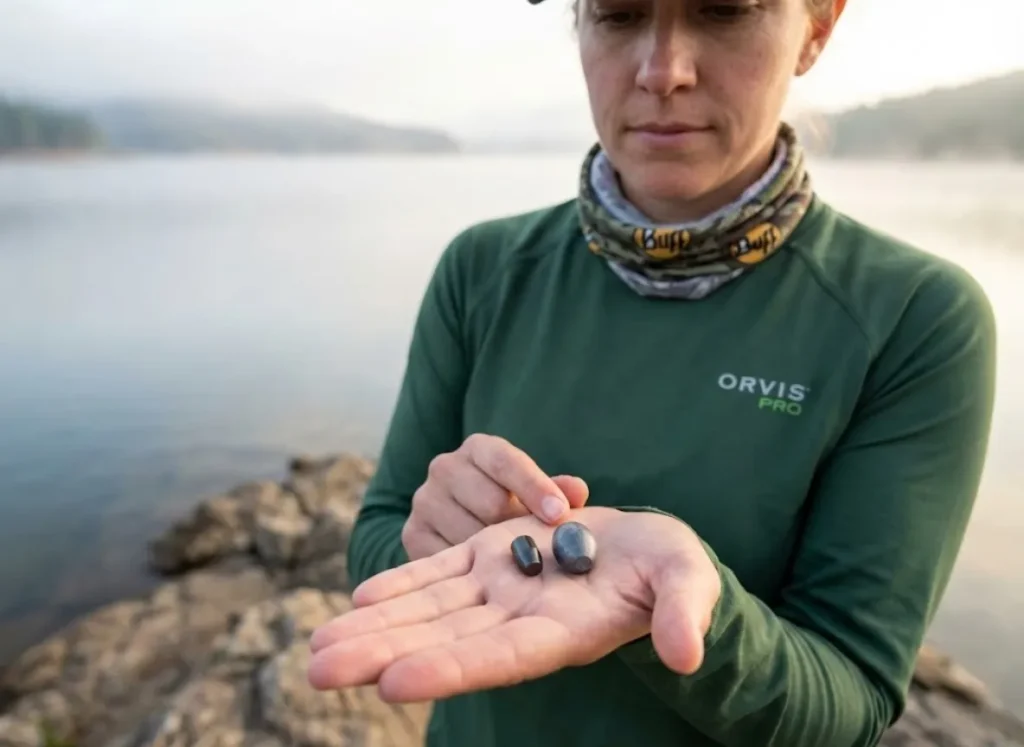
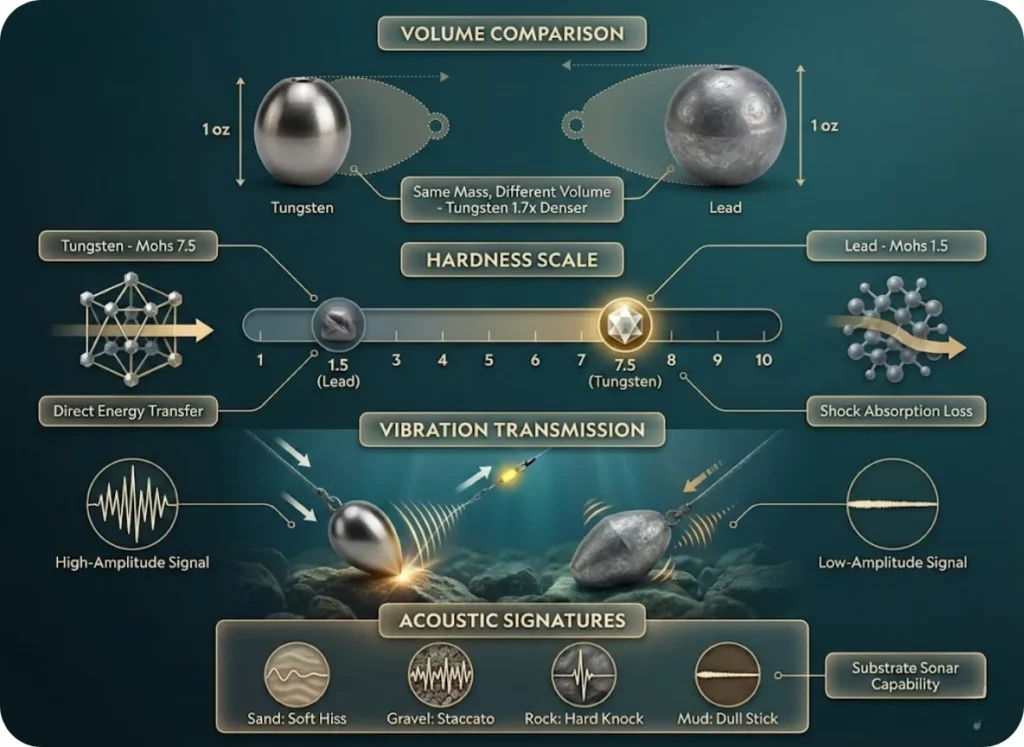
Tungsten weights are approximately 1.7 times denser than lead weights, allowing a 1-ounce tungsten sinker to occupy significantly smaller volume than equivalent lead. This compact profile reduces snag probability in rock crevices and changes the sink rate—smaller surface area means less drag and faster water column penetration.
But density is only half the story. Hardness determines what you feel through your rod.
Tungsten measures 7.5 on the Mohs hardness scale. Lead barely registers at 1.5—it deforms on impact, absorbing energy like a shock absorber. When tungsten strikes rock, the shock transmits directly to your rod tip with minimal energy loss. You can distinguish substrate composition: sand produces soft hissing, gravel generates staccato vibration, rock creates hard knocks, and mud delivers a dull sticky sensation.
This sinker-as-sonar capability allows mental mapping of underwater topography—locating the transition zones and offshore bars where big bass congregate. It’s substrate transmission that turns your carolina rig into a search fishing tool.
When Lead Still Wins: The Counter-Arguments
Despite tungsten’s superiority for sensitivity, lead retains utility. Cost is the obvious factor—tungsten runs three to five times higher than equivalent lead. In high-snag environments where you’re losing weights regularly, the economics favor disposable lead.
Lead also produces a softer “thud” that proves less likely to spook wary fish in shallow clear water. Some tournament pros deliberately fish lead on pressured waters where bass have been conditioned to tungsten’s distinctive metallic tick. The environmental consideration matters too: lead is a potent neurotoxin causing organ failure and death in waterfowl, and is banned in several states. Tungsten presents no ecological concerns.
The practical solution? Carry both. Fish tungsten until you lose three weights to the same rock pile, then switch to lead.
Building the Perfect Rig: Component-by-Component Setup
The Weight System: Matching Shape to Cover
Egg sinkers remain the traditional Carolina rig standard. The rounded profile rolls over obstructions and creates a distinct mud trail on soft bottoms—ideal for open water, sand, and gravel flats. The weakness is complex rock where egg shapes wedge in crevices.
Bullet weights, typically reserved for Texas rig applications, slip through vegetation rather than rolling over it. In heavy southern hydrilla or milfoil, the conical shape parts grass stems and penetrates the canopy without fouling. Swap to bullets when fishing submerged vegetation.
Cylinder weights (often called “Mojo” weights) excel in rocky timber. The slim profile slides through narrow gaps where round sinkers become trapped. Finesse applications use lighter cylinder weights (1/8 to 3/16 oz) for stealth presentations in shallow water.
Weight range spans 3/8 oz for shallow finesse work up to 1 oz for deep ledges and heavy current. When uncertain, go heavier. Maintaining bottom contact is non-negotiable.
The Connection System: Swivel vs. Carolina Keeper
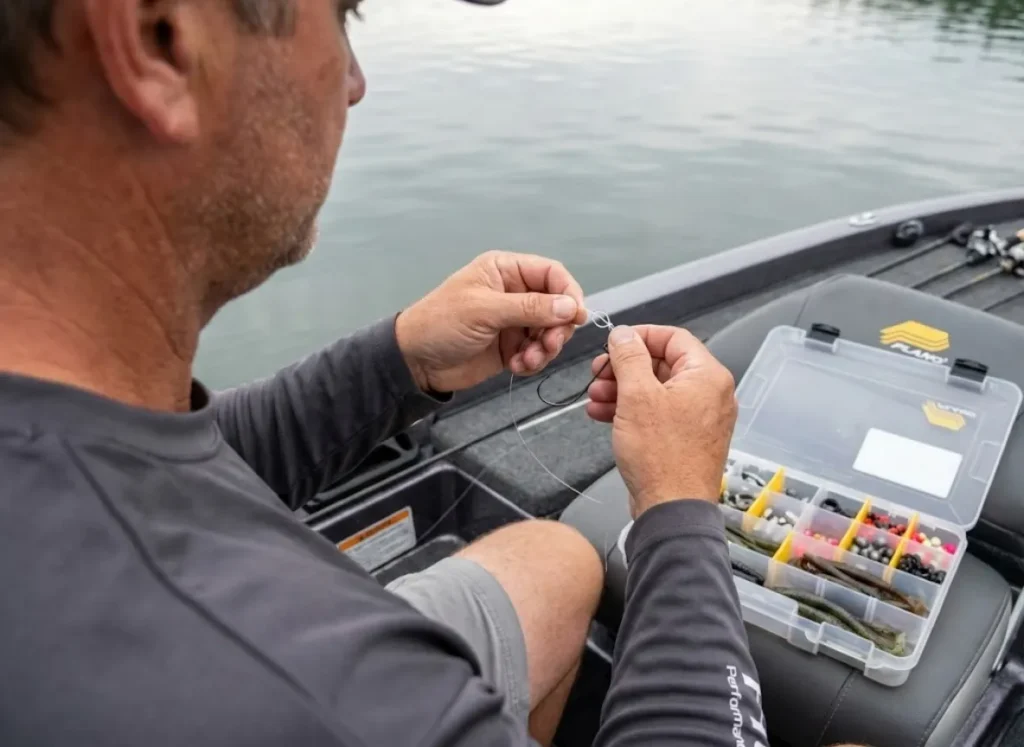
The ubiquitous #6 or #7 barrel swivel serves as the standard connection between main line and leader. It stops the sliding weight, creates the pivot point, and mitigates line twist from bait rotation. Without a swivel, dragging asymmetrical baits like lizards induces catastrophic twisting that ruins fluoro lines.
The weakness is knot vulnerability. The swivel system introduces two additional knots—mainline-to-swivel and leader-to-swivel. Each knot is a potential failure point. Learn proper knot tying techniques to maximize connection strength.
The Carolina Keeper offers an alternative: a spring-loaded plastic cylinder that clamps onto line, eliminating the swivel and both knots entirely. Squeeze with pliers to open, release to clamp. This allows instant leader length adjustment without re-tying—switching from 12 inches to 4 feet in seconds. The limitation is slippage under extreme force. Keepers work best for finesse applications with weights under 1/2 oz.
The Soft Plastic Selection: Drag Coefficients Decoded
High-drag creature baits like the Zoom Brush Hog and Zoom Lizard are archetypal carolina rig baits. Multiple appendages—curly tails, wings, legs—create significant drag in the water. When the weight stops, this drag acts as a brake, causing the bait to slow and hover rather than plummet. That prolonged gliding phase is the signature trigger of Carolina rigging.
For cold water or pressured conditions, low-drag finesse profiles like the Zoom Fluke, Centipede, or French Fry create erratic darting action followed by slow spiral falls. Floating bait formulations like Z-Man ElaZtech never touch bottom—they suspend directly above the sinker, permanently visible.
Rig baits perfectly straight on the hook. Even slight curves cause helicoptering that induces line twist.
Pro tip: Match bait size to forage. Larger 6-8 inch lizards and brush hog profiles excel during pre-spawn and post-spawn when bass target crawfish. Downsize to 4-inch profiles during cold fronts or high pressure.
Mastering the Technique: Cast, Retrieve, Hookset
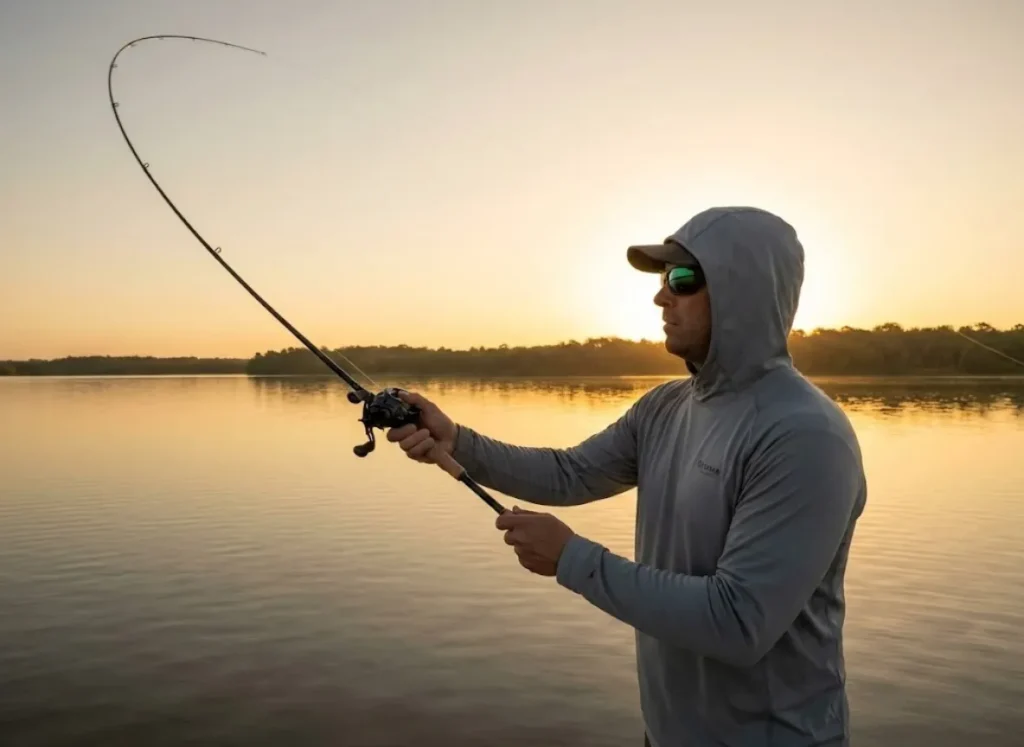
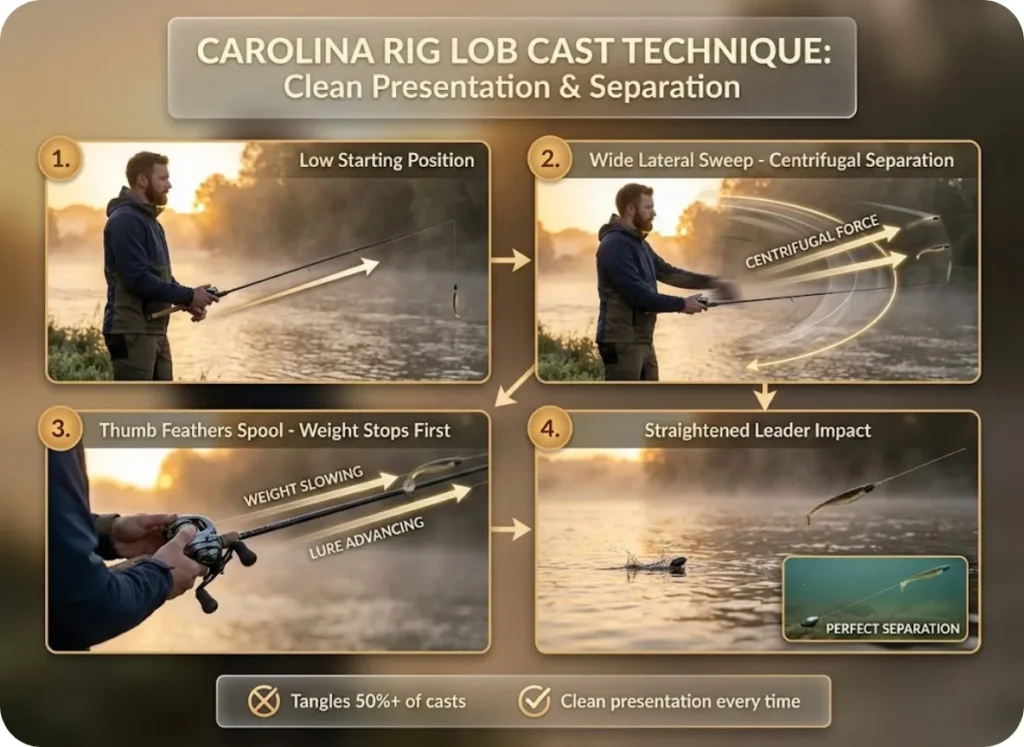
The Lob Cast: Preventing Leader Tangles
Standard overhead casts create aerodynamic instability with carolina rigs. The lighter lure overtakes the heavier weight, wrapping the leader around mainline in frustrating wind knots.
The lob cast solves this through a wide, side-arm sweeping motion. Centrifugal force keeps weight and lure separated throughout the flight. Before water entry, feather the spool lightly with your thumb. This stops the weight while the lure’s momentum carries it forward, straightening the leader before impact.
Practice the motion in open areas before fishing structure. Muscle memory is critical. With leaders exceeding 24 inches, standard overhead casting creates tangles on over half your casts.
Retrieval Cadence: The Drag-and-Pause Foundation
The primary retrieve is a side-sweeping drag. Pull the rod tip from 10 o’clock to 2 o’clock position, moving the bait 2-4 feet horizontally. Return the rod to starting position while reeling slack. This maintains constant bottom contact while your sinker maps the substrate.
The pause is everything. After the drag, stop for 5-30 seconds. The weight anchors immediately, but your bait continues drifting forward on its own momentum. Most strikes occur during this critical phase when the lure is moving independently.
Pause length should match water temperature. Cold water below 50°F demands 15-30 second pauses. Warm water above 70°F allows 5-10 seconds. Match your cadence to how water temperature dictates fish metabolism and reaction speed.
The Sweep Set: Driving the Hook Home
Vertical snap hooksets fail with carolina rigs. Too much slack line and leader length dissipate the energy before it reaches the fish.
The sweep set corrects this. When bite detection registers, reel down rapidly until the rod loads, then sweep horizontally to the side in a long powerful arc. This motion takes up slack leader, pulls the weight, and drives the hook into the fish’s jaw through continuous energy transfer.
High-speed reels with fast gear ratio ratings (7.1:1 to 8.1:1) are essential. If a bass strikes and swims toward the boat, a slow reel can’t recover line fast enough to establish hookset tension. Speed equals fish in the livewell.
Seasonal and Environmental Adaptation Matrix
Seasonal Patterns: Pre-Spawn to Winter
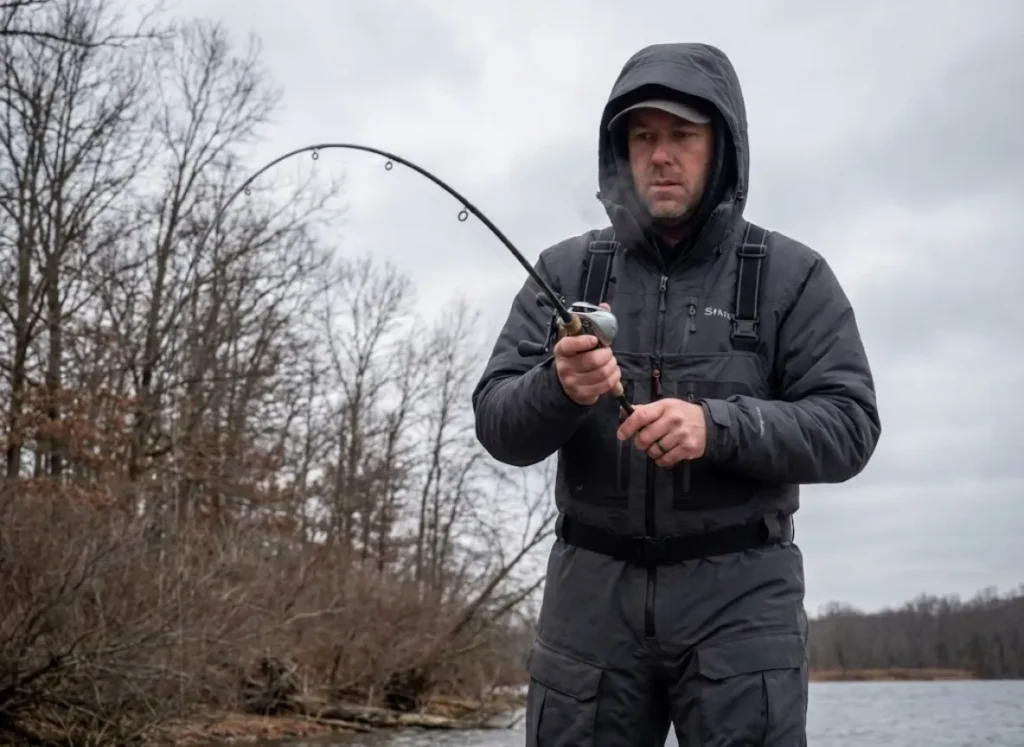
Pre-spawn timing finds bass staging on points and breaks leading to spawning flats. The c-rig covers these transition zones efficiently. Large lizard plastics trigger aggression in territorial fish holding in the 48-60°F range. Check pre-spawn bass migration routes for identifying these staging areas.
Post-spawn through summer represents peak Carolina rig fishing season. Fish move to deep offshore ledges and humps. Heavy tungsten (3/4-1 oz) probes deep shell beds and river channels where big bass suspend over structure.
Fall transition finds bass following bait fish to main lake points. Medium weight (1/2-3/4 oz) paired with shad style baits like Flukes covers water efficiently.
Winter demands finesse. Bass become lethargic and pin to bottom. A light finesse carolina rig (1/4-3/8 oz) with 48-60 inch leaders and small straight-tail worms allows “do-nothing” presentations where the bait sits nearly motionless, enticing inactive fish.
Cover-Specific Modifications
Submerged grass fouls standard egg sinkers. Swap to bullet weights or slim Mojo profiles that slip through stems. Use long monofilament leaders to float baits above the vegetation canopy.
Rock and rip-rap reward tungsten’s sensitivity for reading bottom composition. Cylinder weights reduce snag frequency. Brass clackers mimic crawfish sounds echoing off rocky structure—a deadly combination in midwest rocks environments.
Soft mud and silt bury heavy weights. Use lighter sinkers or flattened egg profiles to stay on top. Long monofilament leaders prevent baits from disappearing into the sediment cloud kicked up by the dragging weight.
Conclusion
The Carolina rig setup isn’t a beginner’s technique—and that’s precisely why it devastates in hands that understand the physics. The decoupled weight extends retention time. The leader’s hydrodynamics create weightless drift no fixed rig can replicate. The sinker functions as a sonar probe mapping bottom composition in real time.
Master the lob cast first. Then focus on reading substrate through your sinker. Finally, train yourself to recognize the mushy bite feel that signals a fish has inhaled your bait without encountering resistance.
Next time you’re working offshore bars in summer heat and struggling with conventional presentations, clip on a carolina rig and drag it across those deep ledges. You’ll understand why tournament pros have trusted this versatile bottom rig for decades. The physics doesn’t lie—and bass fishing gets easier when gravity does the work.
FAQ
How long should a Carolina rig leader be?
Leader length depends on water clarity and cover. Use 36-60 inches in clear water to separate the bait from the rig’s hardware. Shorten to 12-18 inches in stained water or heavy cover to keep the bait near the auditory signal of the clicking sinker.
What is the best bait for Carolina rig?
High-drag creature baits like Zoom Brush Hog and Zoom Lizard are the archetypes—their appendages create the hovering action on the pause. For pressured fish or cold water, downsize to finesse profiles like flukes, centipedes, or floating bait formulations.
What is the difference between Carolina rig and Texas rig?
The fundamental difference is weight position. A texas rig pegs the weight directly against the lure, creating unified mass. The carolina rig separates the weight from the lure via a leader, allowing independent, semi-buoyant drift and isolating the fish from the sinker’s inertia during the strike.
How do you detect a bite on a Carolina rig?
Bite detection rarely produces a rod-bending thump. Feel for the rig getting heavier, a loss of bottom contact, or a wet sock sensation. Any anomaly during the drag or pause phase should trigger an immediate sweep hookset.
When is the best time of year to use a Carolina rig?
Post-spawn through summer is prime time when bass hold on deep offshore structure. However, the c-rig adapts to any seasonal application timing by adjusting weight, leader length, and bait profile. Winter applications require light weight, long leaders, and minimal movement to tempt lethargic fish.
Risk Disclaimer: Fishing, boating, and all related outdoor activities involve inherent risks that
can lead to injury. The information provided on Master Fishing Mag is for educational and informational purposes
only. While we strive for accuracy, the information, techniques, and advice on gear and safety are not a substitute
for your own best judgment, local knowledge, and adherence to official regulations. Fishing regulations, including
seasons, size limits, and species restrictions, change frequently and vary by location. Always consult the latest
official regulations from your local fish and wildlife agency before heading out. Proper handling of hooks, knives,
and other sharp equipment is essential for safety. Furthermore, be aware of local fish consumption advisories. By
using this website, you agree that you are solely responsible for your own safety and for complying with all
applicable laws. Any reliance you place on our content is strictly at your own risk. Master Fishing Mag and its
authors will not be held liable for any injury, damage, or loss sustained in connection with the use of the
information herein.
Affiliate Disclosure: We are a participant in the Amazon Services LLC Associates Program, an
affiliate advertising program designed to provide a means for us to earn advertising fees by advertising and linking
to Amazon.com. As an Amazon Associate, we earn from qualifying purchases. We also participate in other affiliate
programs and may receive a commission on products purchased through our links, at no extra cost to you. Additional
terms are found in the terms of service.