In this article
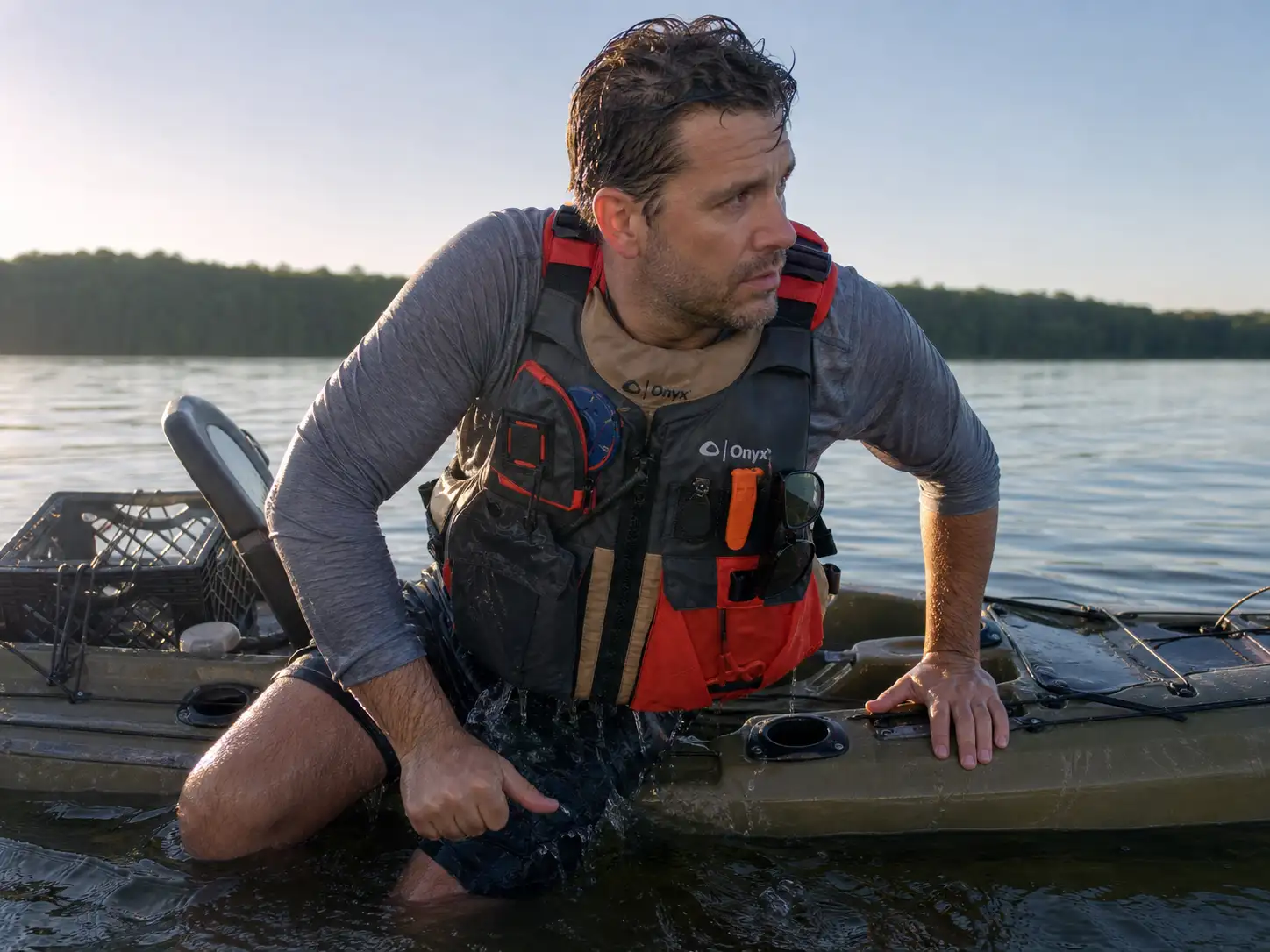
You’re in the water. The wet exit happened faster than you could react, your kayak is floating upside down an arm’s length away, and the shoreline you were casting toward twenty seconds ago is suddenly a very long way off. Deep water reentry is a four-move sequence almost anyone can learn, but the reason most first attempts fail has nothing to do with strength, and the sources teaching the technique rarely say it out loud. What follows is the sequence that actually works on a rigged fishing kayak, the five mistakes that keep anglers swimming, and an honest look at how cold water shortens your timeline.
What Actually Happens in the First Sixty Seconds
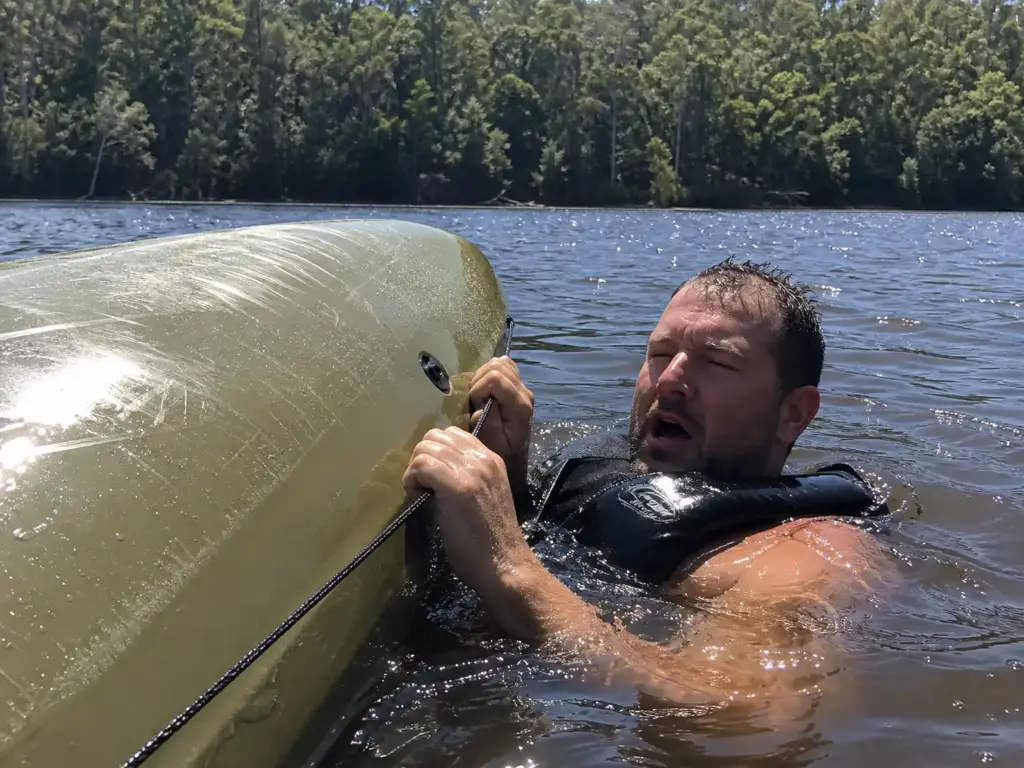
Everybody rehearses the climbing-back-on part. Nobody rehearses the part where their breathing goes sideways and their hands quietly stop working. That gap between the imagined capsize and the real one is where most bad decisions get made, and it happens before technique is even on the table.
Hit cold water suddenly and the gasp reflex fires whether you want it to or not. That first involuntary inhale, followed by a couple of minutes of hyperventilation you can’t fully control, can incapacitate a swimmer within seconds.
The first minute is a breathing problem, not a swimming problem. Float, hold the boat, and let your lungs settle before you ask yourself to do anything athletic. If you want the fuller picture of what puts anglers in the water in the first place, the risks that actually put kayak anglers in the water covers the causes rather than the recovery.
Then the second clock starts. Cold incapacitation, meaning the loss of usable grip and kick strength, sets in somewhere between roughly 2 and 30 minutes depending on water temperature. Read that range again, because it reframes the whole article: your climbing attempts run on a much shorter timer than most anglers assume. The National Center for Cold Water Safety’s breakdown of how fast cold incapacitation actually sets in is worth the five minutes it takes to read, mostly because it kills the comfortable assumption that you have all afternoon.
Good thermal gear buys time. It does not buy unlimited attempts. There’s a documented case of a swimmer wearing a snowmobile suit who was fully incapacitated after covering only 50 feet in water near 32°F. Insulation slows the bleed of heat; it does nothing about hands that have stopped closing properly.
The 1-10-1 rule gets repeated at every put-in, and the National Center for Cold Water Safety flags it as an oversimplified rule of thumb. Don’t treat ten minutes as a countdown you can spend. Treat the first attempt as the one that has to work, and plan your gear around making that attempt easy.
Which brings us to the first thing that goes wrong, and it goes wrong before anyone has touched the deck.
Mistake #1: letting go of the boat. The instinct right after a capsize is to swim for shore or lunge after the drifting paddle. Both feel productive. Both are wrong. The kayak is better flotation than your arms, and it’s the platform you’re going to climb onto, which makes it the one object in the water you can’t afford to lose. Guides watch this happen constantly: an angler releases the hull for three seconds to grab a floating rod, a gust catches the boat broadside, and now there’s fifteen feet of open water between a swimmer and their ride home. A loose kayak moves faster downwind than you can swim in a PFD. Hold the deck line. Sort out the gear later, or don’t sort it out at all.
Right the Kayak Before You Try Anything Else
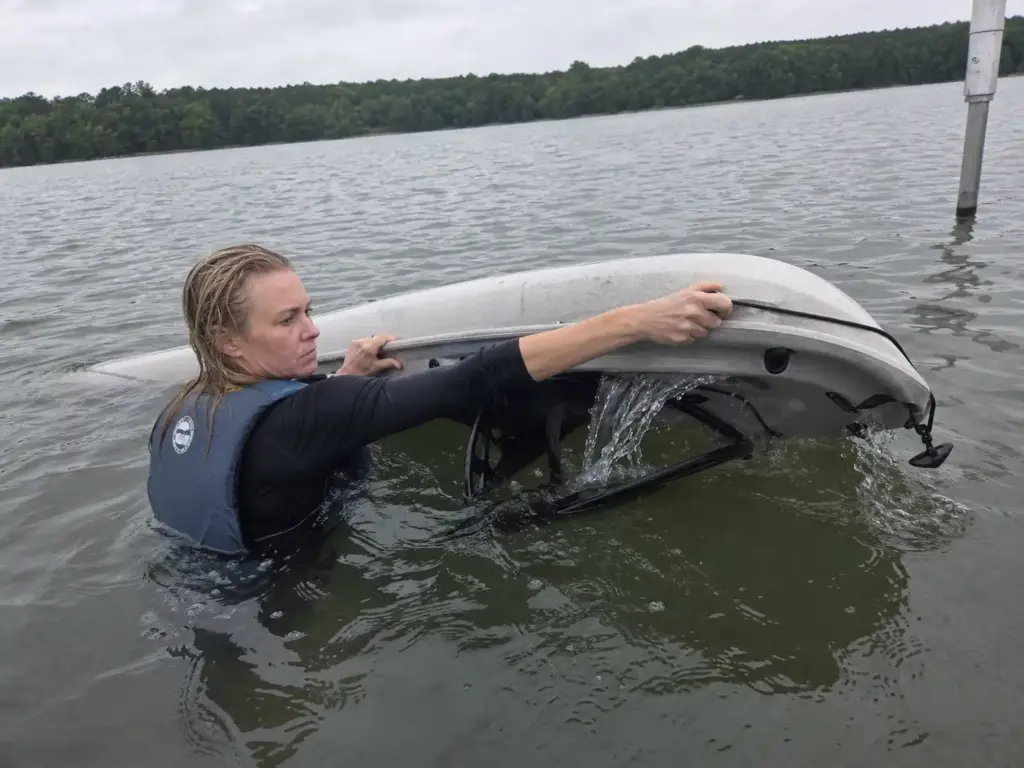
Here’s the part everyone skips in their head. You picture climbing onto a kayak that’s sitting upright, politely waiting for you. It isn’t. Righting a kayak comes first: it’s hull-up, full of your gear, and it would very much like to stay that way.
Work from the middle of the hull, never the bow or stern. Reach across the upturned bottom, get a hand on the far-side deck line or deck handle, and roll the boat toward you by leaning back and letting your weight do the work. To flip a kayak back over you’re levering, not lifting.
Anglers who try to muscle a kayak over with their arms while treading water tend to pull themselves under it instead. At the ends of the boat your leverage is worst and the hull pivots away from you like a compass needle, which is a slow, annoying way to burn through your good minutes.
Some kayaks fight you harder than others, and it’s not random. A wide, flat-bottomed hull with strong primary stability resists rolling in both directions, which is exactly the trait you wanted while standing to cast. Understanding how hull shape trades primary stability against speed explains why the boat that felt rock-solid all morning is now the one you’re wrestling.
A sit-on-top kayak rights easier than a sit-inside kayak because there’s no cockpit trapping air and water. The tradeoff is that a sit-on-top carries far more bolted-on hardware to catch on your PFD straps mid-roll. A rigged fishing kayak is heavier and slower to come over than the bare rental hulls in most tutorial videos, and the wet seat, loaded crate, and mounted electronics all add resistance nobody films.
One hand stays on the boat the entire time, through every step, including the awkward ones. It’s the single most useful habit in the whole sequence, and the one that separates paddlers who have practiced from paddlers who have only watched.
The Kick-Push-Twist Sequence That Actually Works
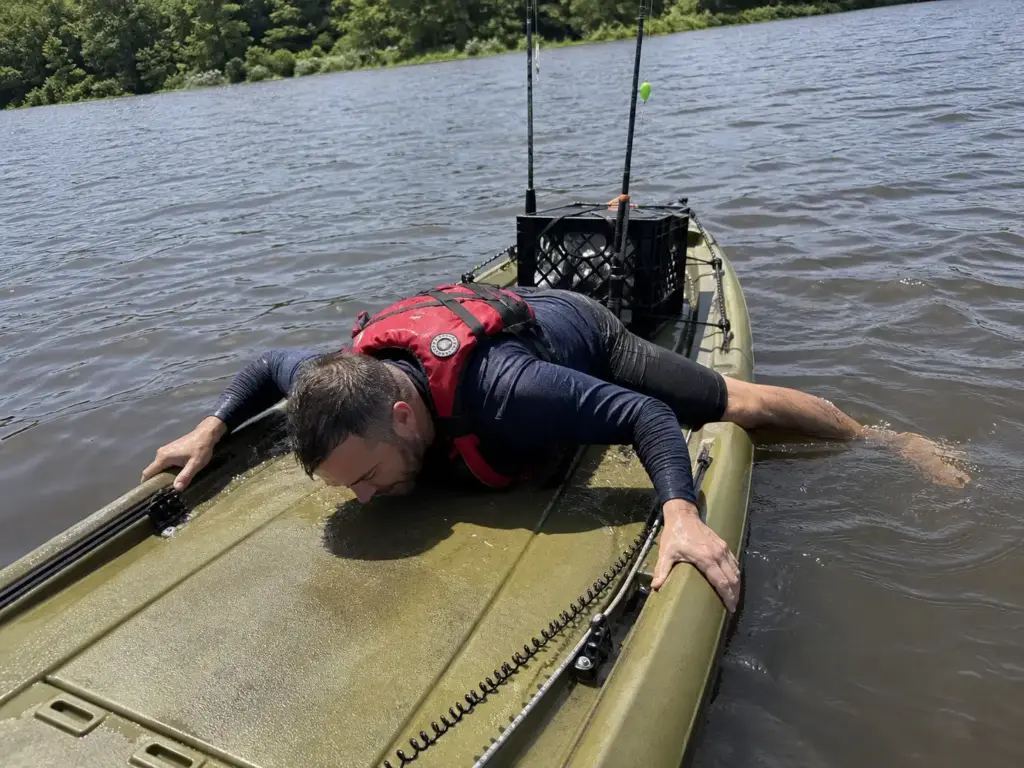
Boat’s upright. You’re beside it, breathing under control, one hand still on the deck line. This is the sequence a buddy would talk you through from the next boat over, in the order you actually have to do it.
Get Horizontal First
Kick. Hard, both legs, several strong scissor kicks before you pull with anything. The kick and push is a single linked move, and the kicking half isn’t there to lift you. It’s there to bring you up near the surface and generate forward momentum, so that when you push down on the deck you’re already moving in the direction you need to go.
The target is your chest and torso lying flat across the deck like a beached seal. Not your knees on the deck. Not your hands planted and everything below them hanging. Flat, low, and spread across the centerline.
And this is Mistake #2, the one that accounts for more failed first attempts than everything else combined: trying to climb straight up. People reenter a kayak the way they get out of a swimming pool, hands on the edge, elbows locked, heaving vertically. In a pool the edge is attached to the earth. Your kayak is not.
Vertical effort pushes the hull down and away, the boat rotates toward you, and you end up right back where you started with less energy than before. Horizontal momentum is the whole trick. Get flat, get across, then worry about being upright. Field guides note that even paddlers who practice regularly need two or three tries, so don’t read a failed attempt as a verdict on your fitness.
Twist the Hips, Then Sit
Once your torso is across the deck, rotate your hips so your backside lands in or near the seat. The rotation happens up on the deck, not down in the water. You’re pivoting on a platform your weight is already committed to, which is a completely different physical act than trying to swing a leg over from the water.
Keep your head low through the twist. Lifting your head raises your center of gravity at exactly the moment the boat is deciding whether to stay under you.
Legs Come In Last
Legs come in after your weight is centered, never before. This is the piece the fishing-kayak sources are unanimous on, and it’s the second-most-common way a reentry ends back in the water. Bringing the legs up early feels like progress because it feels like getting in the boat, but it raises your center of gravity while your weight is still hanging off the edge. The hull rolls, you slide, and you’re swimming again.
Deck height matters here more than most buying guides admit. A tall, wide kayak is a taller wall to climb, which is one of the things worth weighing in what actually matters when you’re picking a fishing kayak alongside stability and storage. For the sequenced version of this with a stabilizer added, NOLS’ technique breakdown for paddle-float-assisted self-rescue covers the same positions from the sea-kayak side.
Why Your Rigged Fishing Kayak Is Harder Than the One in the Video
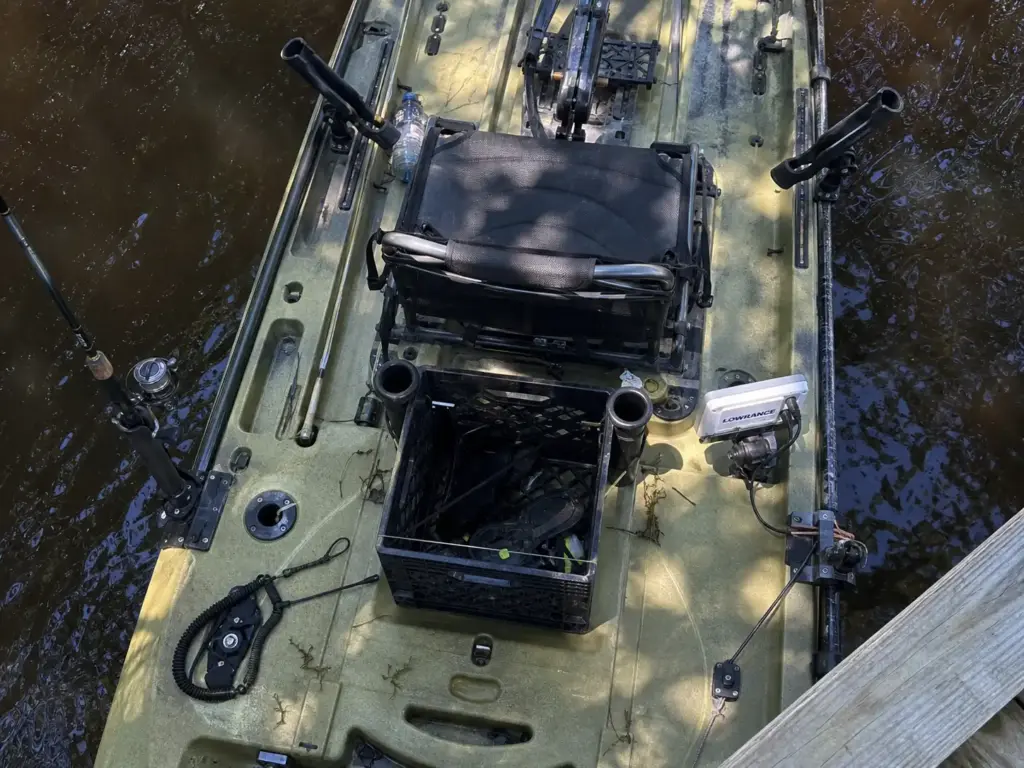
Every reentry video you’ve watched was filmed on a bare kayak in a swimming pool. Your kayak has four rod holders, a milk crate, a fish finder, and possibly a trolling motor bolted to the stern. That difference is not cosmetic, and pretending otherwise is why the technique feels different the first time you try it on your own boat.
Mounted Gear Changes the Mechanics
A kayak angler on a self-rescue thread put it about as plainly as it can be put: “massive amounts of cumbersome gear mounted all over an SOT means less room to maneuver on deck and weighty/obstructive gear.” That’s not a complaint about aesthetics. It’s a description of the exact square footage you need for your chest.
Rod holders are the worst offenders because they sit at chest height right where you’re trying to land. Track-mounted accessories stand proud of the deck and catch PFD straps, shirt hems, and knuckles. It’s one reason flush-mount rod holders sit lower than track-mounted ones matters beyond trolling performance, because a flush mount is a snag point you’ve designed out of the boat.
A mounted trolling motor and battery shift weight distribution toward the stern and make the hull noticeably slower to right, since you’re now rolling a boat with a heavy pendulum hanging off one end. Milk crate rigging does the same thing on a smaller scale, especially loaded. If you’re thinking about what lives on your deck and where, how accessory track systems change what’s bolted to your deck is worth reading with reentry in mind rather than just fishability.
Mistake #3: fighting your own rigging. Most anglers climb back in on whichever side they happened to surface on, which is a coin flip. Approach from the side with the least gear, usually the side opposite the crate and the rod holders. On a boat where the crate lives in the tank well and rods run down the starboard track, that means the port side is your reentry side, every time, and you should know that answer before you need it.
Freeboard, Beam and Honest Physical Limits
Sit-on-top fishing kayaks sit higher out of the water and run wider than sea kayaks. That extra freeboard is what lets you stand and cast, and it’s also a taller wall to climb from the water. You bought stability while fishing and paid for it in reentry difficulty. That’s a real trade, not a design flaw.
Arm and shoulder strength genuinely matters here in a way most technique guides won’t say out loud. A heavier angler on a high-freeboard fishing kayak is solving a harder physical problem than a lighter paddler on a low-deck sea kayak, and no amount of technique fully erases that gap. Anyone telling you the move works identically for everybody has never watched a mixed group try it.
The honest conclusion is uncomfortable and short: if you can’t do it in warm, calm water on your own fully rigged boat, you can’t do it in the conditions you’re training for. Cold, chop, and adrenaline only subtract. Test it, don’t assume it.
Pick your reentry side at the ramp, not in the water. Stand over your boat before you launch and ask which flank is clear of rod tips, crate corners, and the anchor trolley. Say it out loud. That’s the side you go to, and knowing it saves you the ten seconds of confusion that costs the most.
The Paddle Float Is Not Optional Gear
Most fishing kayak anglers skip the paddle float because it’s marketed to sea kayakers with spray skirts and touring hulls. Then they find out mid-climb what it was for.
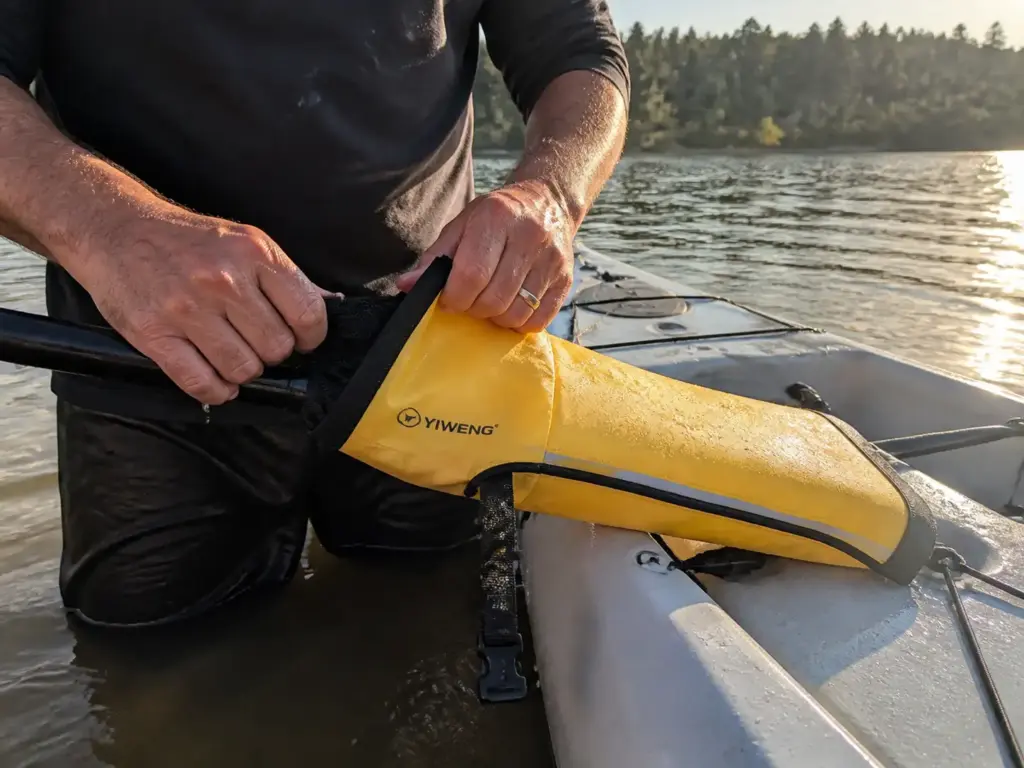
The float straps to one paddle blade and braces under a deck line, turning your paddle into an outrigger that reaches well out past the side of the boat. That’s the whole paddle float rescue in one sentence, and the mechanism is the part almost nobody explains properly: it does not lift you into the kayak. It stops the kayak from rolling back over on top of you while you climb. That distinction changes how you use it, because if you’re waiting for the float to hoist you, you’ll be disappointed.
Mistake #4: treating the float as sea-kayaker gear. Anglers leave it off the packing list, capsize once, and discover that the boat keeps rotating away from every push they make. Lateral stability isn’t a luxury on a reentry. It’s the difference between a climb and a wrestling match.
Build your stability before you start climbing, not halfway up. Most of the fight in a failed reentry is losing balance at the midpoint, not running out of strength. Get the outrigger set, get your grip planted, then commit.
Floats come in two shapes and the tradeoff is real. Inflatable models pack down into a hatch or crate and weigh almost nothing, but you have to inflate one while treading water, which costs breath and time you may not have. Read the four stages of cold water immersion, starting with cold shock and the cost of spending forty seconds blowing into a valve stops being theoretical.
Rigid foam floats are instant and never fail, and they’re bulky enough that most anglers leave them home, which makes them zero percent effective. The YIWENG Inflatable Paddle Float sits on the budget-friendly end with dual chambers and a quick-release buckle, and its real advantage is that it’s small enough you’ll actually keep it clipped in the crate instead of in the garage.
No float aboard? Lay the paddle shaft across the deck behind the seat, brace both hands on it with the blade flat on the water, and use it as a crude outrigger. Worse than a float. Considerably better than nothing.
Worth noting that a fair number of these swims never had to happen. Clipping an anchor trolley ring mid-ship is how a lot of kayaks flip in the first place, and rigging your anchor system correctly is cheaper than getting good at reentry.
When You Don’t Have a Float and the Climb Isn’t Working
Most articles treat this as a footnote. It isn’t one. If you searched for this topic, there’s a decent chance part of what’s driving that search is a quiet worry that you physically can’t do the standard move on your boat. That worry deserves an answer better than “try harder.”
The Cowboy Scramble
Straddle the kayak from the stern and slide forward into the seat, the way you’d mount a horse. The community calls it the cowboy scramble, and it works because your weight stays centered on the keel line the whole way, so the boat has no reason to roll.
It works best on sit-on-top kayaks with a clear rear tank well, which is exactly where most of us keep a loaded milk crate. That’s a real argument for a quick-release crate mount, or at least for knowing whether your crate has to come off before this option exists.
The scramble costs more energy than a side reentry, because you’re dragging yourself up the full length of the hull instead of across its width. What it demands less of is lateral balance, which is precisely the tradeoff you want if your boat keeps rolling out from under you.
A Mechanical Step
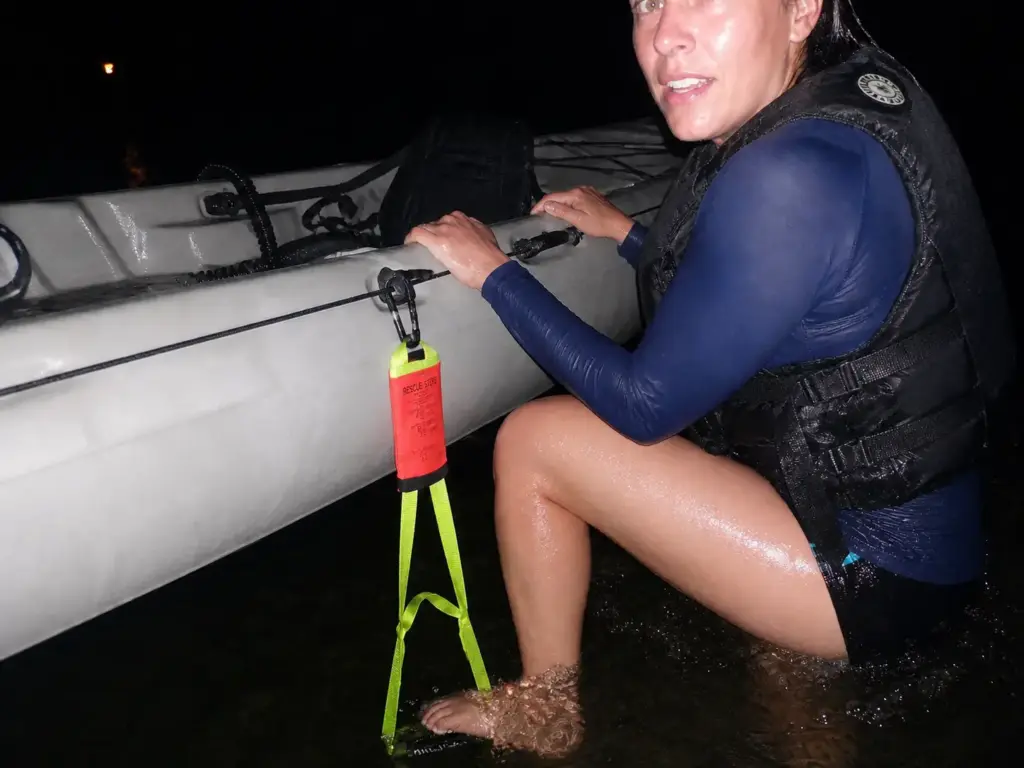
The freeboard problem from the last section has a mechanical fix that nobody talks about: a compact rope-ladder step that clips to a deck line or cleat and hangs a foothold below the waterline. The Rescue Steps for Kayaks compact boarding ladder folds into a pouch the size of a sandwich and converts the whole problem from an arm-and-shoulder pull into a leg push, which is where your strong muscles live.
That’s the honest answer to a tall deck. It lowers the effective height of the climb instead of asking you to generate more power than you have. For a lot of anglers that’s the difference between a technique that works on paper and one that works on their boat.
Which sets up Mistake #5: carrying the fallback and never rigging it. A rescue step still sealed in its pouch, zip-tied under the seat, is not a fallback. It’s ballast with good intentions. Anything meant to save you in the water has to be deployed, tested, and clipped where a cold hand can find it without looking.
Same goes for the paddle float folded in the bottom of a dry bag under three tackle trays, or a rescue strap you’ve never unclipped since the day you bought it. A paddle leash belongs in the same category: cheap, ignored, and the reason your paddle is still within reach when you surface.
Assisted Reentry With a Partner
Assisted rescue methods like the T-rescue and the scoop both work, and both need a second boat within sight, which is an argument for the buddy system rather than an excuse to skip the solo skill. Solo is the situation you’re actually training for, because a buddy rescue is only available on the days you brought a buddy.
When someone is available, a partner stabilizes the far gunwale while you climb. That single point of contact does most of what a paddle float does and does it better, because it’s attached to a human who can adjust. If you paddle with a regular buddy, spend twenty minutes practicing this together once. It takes longer to explain than to do.
The underlying principle travels beyond kayaks, too. The same self-rescue logic applies when you’re wading: the gear only works if you set it up before the water gets involved.
Clearing the Water and Getting Underway Again
You’re back on the boat. The article doesn’t end here, because you’re now sitting on a swamped kayak, cold, with your gear scattered across fifty feet of water, and the next ten minutes still matter.
Sit-on-tops handle this themselves. The self-bailing scupper holes drain the tank well and footwell as you move, so get seated, get the paddle in hand, and let the hull do its job. Bailing a self-draining kayak is a way to spend energy you need for paddling. The one thing worth checking at the ramp is your drain plug, because a missing stern plug turns a self-bailing hull into a bathtub.
Sit-insides are a different story. A swamped cockpit makes the boat top-heavy and eager to flip again, and paddling on before you clear it is how anglers end up doing this twice.
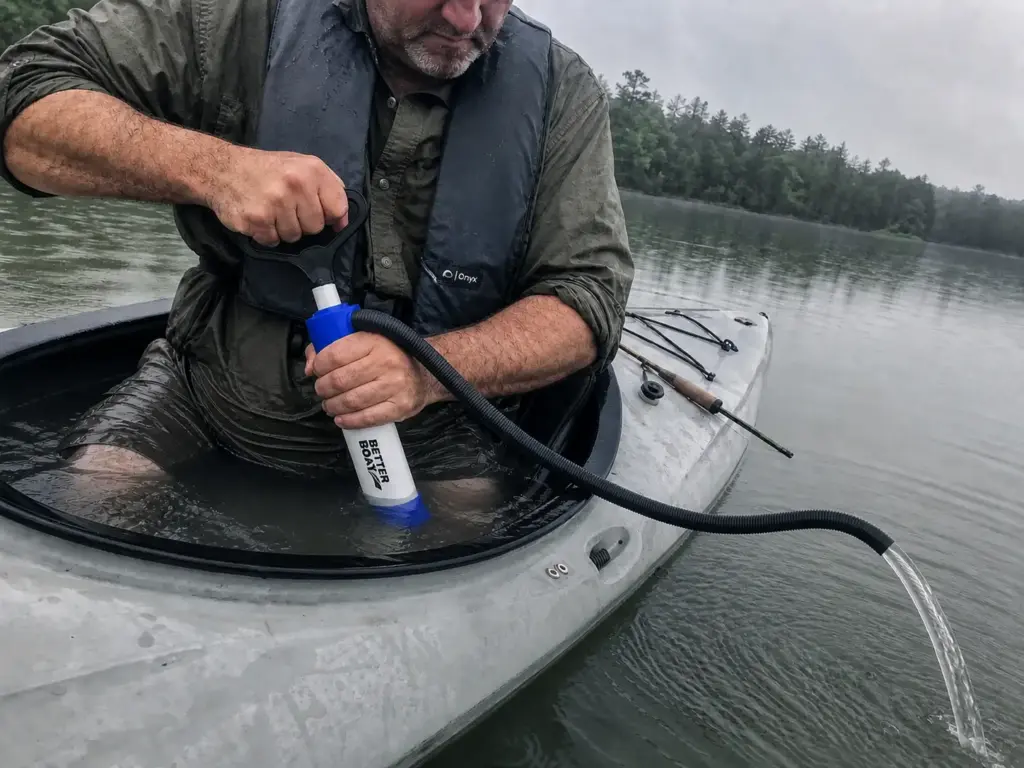
A bilge pump is the tool for it, and hose length is the spec that decides whether it works from a stable seated position. The Better Boat Manual Bilge Pump runs a 39-inch hose, which reaches deep into a cockpit or across into a tank well without you leaning over the side at exactly the wrong moment. Short-hose pumps make you lean. Leaning is what got you here.
Then gear triage, in this order: paddle first, then the boat’s stability, then whatever floated away. Rods on leashes are recoverable. Rods not on leashes usually aren’t, which is the cheapest lesson in this article and the one most of us pay for once.
Head for the nearest safe shore, not the one you launched from. You’re colder than you feel, the cold incapacitation clock from the first section is still running, and pride is a poor navigational aid. Once you’re on the bank, dry layers matter more than anything else, and a waterproof first aid kit that survives the swim is worth more than the one that took on water in the hatch.
The PFD Is the Whole Argument
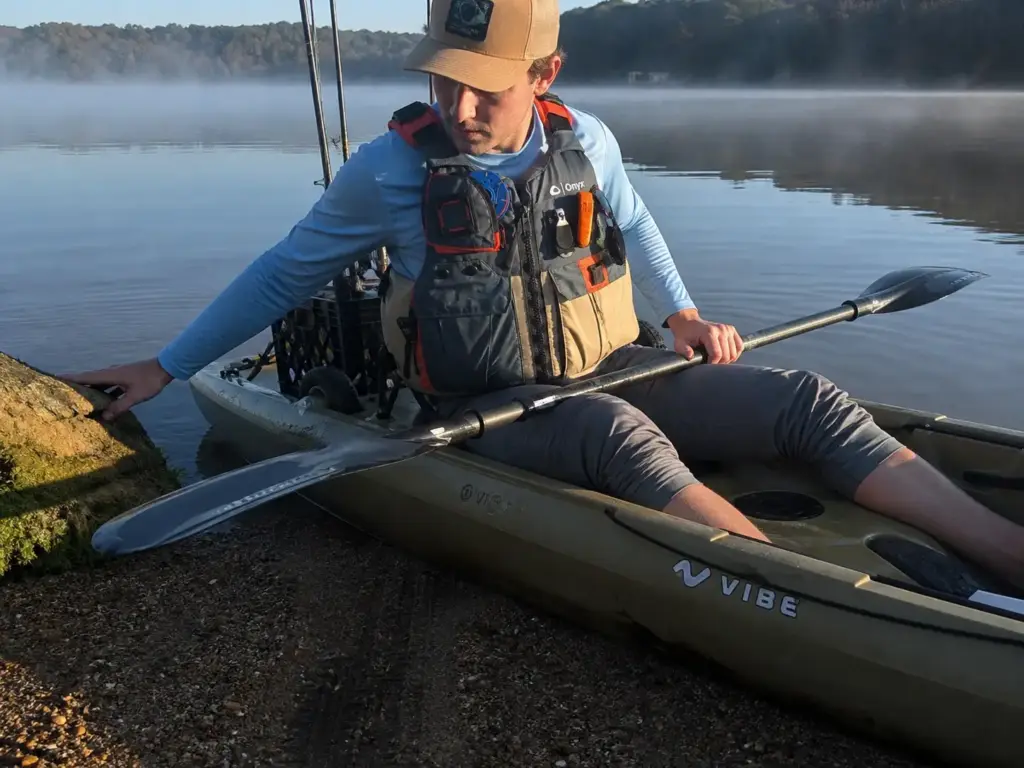
Here’s the number that ends the conversation. USCG recreational boating data shows 76% of fatal boating-incident victims drowned, and 87% of those were not wearing a life jacket.
But the statistic that matters most for this specific article is quieter than that. Everything in the previous seven sections assumes you’re floating calmly while you work the problem. Reading the hull, timing your kick, choosing the clear side, deciding whether to inflate the float. All of it assumes your head is above water and your hands are free.
Without a PFD you’re swimming and problem-solving at the same time, during the exact minute cold shock is disrupting your breathing. The technique doesn’t fail. It never gets attempted.
Worn, not stored. A personal flotation device in the hatch is a flotation device for the hatch.
Kayak-fishing-cut PFDs exist for a reason and they solve the actual complaint. High backs clear the seat instead of shoving you forward all day, and front pockets keep pliers and a whistle where a wet hand can find them. The Onyx Kayak Fishing Life Jacket is cut for exactly that, with a high back designed to sit above a raised kayak seat. Once a vest actually fits the boat, the comfort argument for leaving it off evaporates, and comfort is the only reason anyone ever gives.
Inflatable versus foam is a genuine decision with a genuine tradeoff, not a formality. A manual inflatable does nothing at all during the seconds cold shock has your hands and your breathing, because it requires a deliberate pull at the worst possible moment. The difference between auto and manual inflatable life jackets is the detail to sort out before you buy, not after.
Practice It Before You Need It
The most common mistake in this whole subject isn’t a technique error. It’s attempting the technique for the first time during an actual capsize, when the motion is unfamiliar, your hands don’t work right, and the panic is doing the thinking. That’s the worst classroom ever built.
Calm water practice looks like this: warm water shallow enough to stand in, your own fully rigged kayak, a partner on the bank, and enough repetitions that you learn how many attempts it genuinely takes you. Not how many it should take. How many it does.
Count honestly. If it takes you five tries in a swimming pool, you don’t have a working reentry, you have a technique you’ve read about. Two or three attempts is normal even for practiced paddlers, so that’s your benchmark. Consistently worse than that means you need a stabilizing aid, not more willpower.
Re-test after any significant rigging change. Bolting on a trolling motor, adding a loaded crate, or swapping to a taller seat can quietly turn a reliable reentry into a marginal one, and you won’t find out at the ramp. If your honest verdict is that your current boat is a bad match for your reentry ability, that’s useful information, and kayaks under a thousand that are worth rigging up is a reasonable place to start looking at lower-deck options.
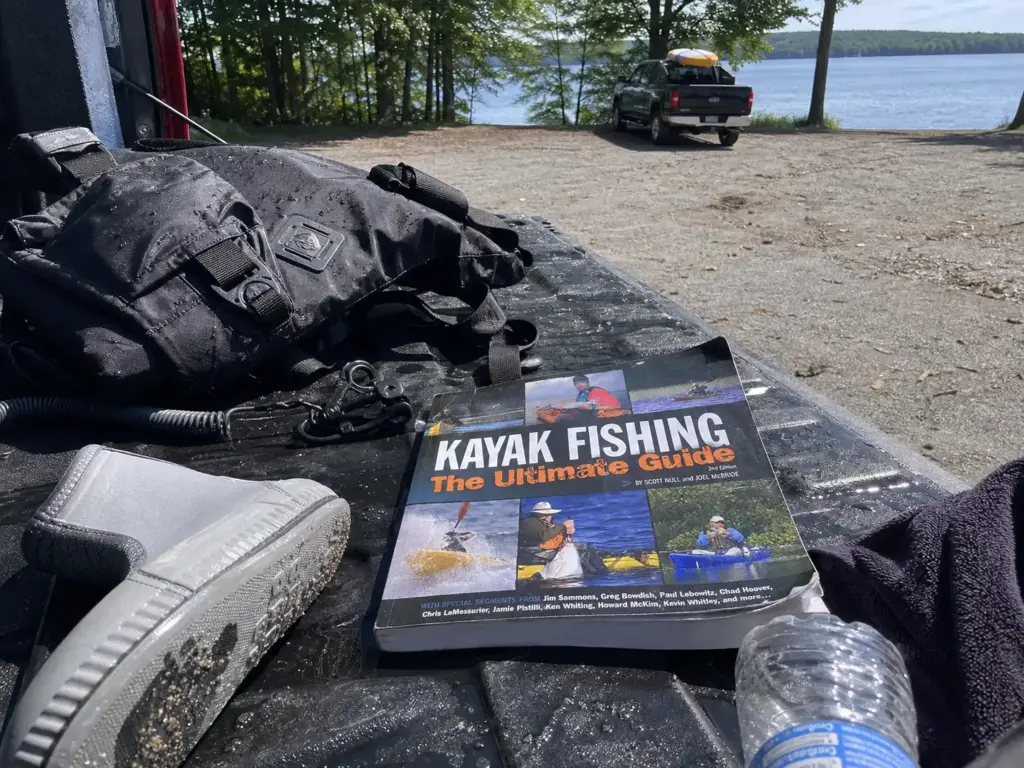
For anglers who want the deeper technique library beyond one article, Kayak Fishing: The Ultimate Guide by Capt. Scott Null and Joel McBride covers self-rescue alongside the rest of the sport, and it’s the kind of reference that earns its shelf space over a season rather than an afternoon.
Conclusion
Hold onto the boat and get horizontal. The vertical lunge is what puts most anglers back in the water, and it’s the easiest habit to fix.
Your rigged fishing kayak is a different problem than the stripped hull in the video. Know which side is clear before you need to know.
The cold sets the clock. The PFD buys you the time to use it.
Take your own kayak to a warm, shallow lake this month and find out how many tries it takes you. That number is the only honest measure of whether any of this works for you.
Frequently Asked Questions
01How do you re-enter a kayak in deep water?
Hold the kayak, right it by pulling the far deck line toward you, then kick hard and push your chest flat across the deck. Twist your hips into the seat and pull your legs in last. The most common failure is climbing straight up instead of getting horizontal first.
02What is the 120 rule in kayaking?
It’s the rule of thumb that air temperature plus water temperature reaching 120°F means thermal protection isn’t needed. Paddling educators increasingly call it misleading: an 80°F day over 40°F spring-fed water hits 120 on paper while that water still incapacitates fast. Dress for the water temperature.
03What is the leading cause of fatalities among kayakers?
Water-related emergencies, overwhelmingly among paddlers not wearing a life jacket. USCG recreational boating data shows 76% of fatal boating-incident victims drowned, and 87% of those were not wearing a PFD at the time.
04Is there supposed to be water inside my kayak?
A small amount in a sit-on-top’s footwell or tank well is normal, since scupper holes drain it out as you paddle. Water inside a sit-inside cockpit is not normal and needs pumping out, because a swamped cockpit makes the boat top-heavy and much easier to flip.
05How many tries does it take to get back on a kayak in deep water?
Two or three attempts is normal even for paddlers who practice, according to field technique guides. If it consistently takes you more than that in calm warm water, the fix is a stabilizing aid like a paddle float or a rope-ladder step rather than more effort.
Risk Disclaimer: Fishing, boating, and all related outdoor activities involve inherent risks that
can lead to injury. The information provided on Master Fishing Mag is for educational and informational purposes
only. While we strive for accuracy, the information, techniques, and advice on gear and safety are not a substitute
for your own best judgment, local knowledge, and adherence to official regulations. Fishing regulations, including
seasons, size limits, and species restrictions, change frequently and vary by location. Always consult the latest
official regulations from your local fish and wildlife agency before heading out. Proper handling of hooks, knives,
and other sharp equipment is essential for safety. Furthermore, be aware of local fish consumption advisories. By
using this website, you agree that you are solely responsible for your own safety and for complying with all
applicable laws. Any reliance you place on our content is strictly at your own risk. Master Fishing Mag and its
authors will not be held liable for any injury, damage, or loss sustained in connection with the use of the
information herein.
Affiliate Disclosure: We are a participant in the Amazon Services LLC Associates Program, an
affiliate advertising program designed to provide a means for us to earn advertising fees by advertising and linking
to Amazon.com. As an Amazon Associate, we earn from qualifying purchases. We also participate in other affiliate
programs and may receive a commission on products purchased through our links, at no extra cost to you. Additional
terms are found in the terms of service.