
In this article
Three hours into a redfish trip, your lower back starts screaming. By hour five, you’re shifting every thirty seconds trying to find a position that doesn’t hurt. By hour seven, you’re paddling back to the ramp early — not because the bite died, but because the stock seat turned your spine into a pretzel. I’ve cut more fishing days short because of a bad kayak seat than because of bad weather, and it took me way too long to fix it.
This guide covers the seat upgrades that actually solve the problem — from drop-in replacements to DIY foam builds — so you can fish a full day without your back making the decision to leave. Every recommendation here comes from long days on the water, not a product spec sheet.
Here’s how the top options compare:
| Kayak Seats Comparison | ||||
|---|---|---|---|---|
| Seat | Best For | Padding | Back Height | Price |
| Skwoosh Expedition | Overall comfort (sit-on-top) | Liquid gel + lumbar roll | 20″ high-back | ~$136 |
| KERCO Angler-X | Long fishing trips | Thermal-molded foam | High contoured | ~$60 |
| WOOWAVE Kayak Seat | Best value | EVA foam | High-back | ~$40 |
| Kayak Kushion | Raised frame seats | Breathable foam pad | Cushion only (2″) | ~$70 |
| Cascade Creek Yakpads | Sit-inside kayaks | Silicone gel | Cushion only | ~$48 |
| DIY closed-cell foam | Custom fit | Cross-linked PE foam | You decide | ~$25 |
Why Stock Kayak Seats Fail Fishing Anglers
Most kayak manufacturers treat the seat as an afterthought. Touring and recreational kayaks are designed for paddlers who move their core constantly — the seat doesn’t need to support a static sitting position for hours. Fishing is different. You sit in one spot, cast, wait, reel, repeat. Your back takes the load that paddling normally distributes across your core.
The Static Sitting Problem
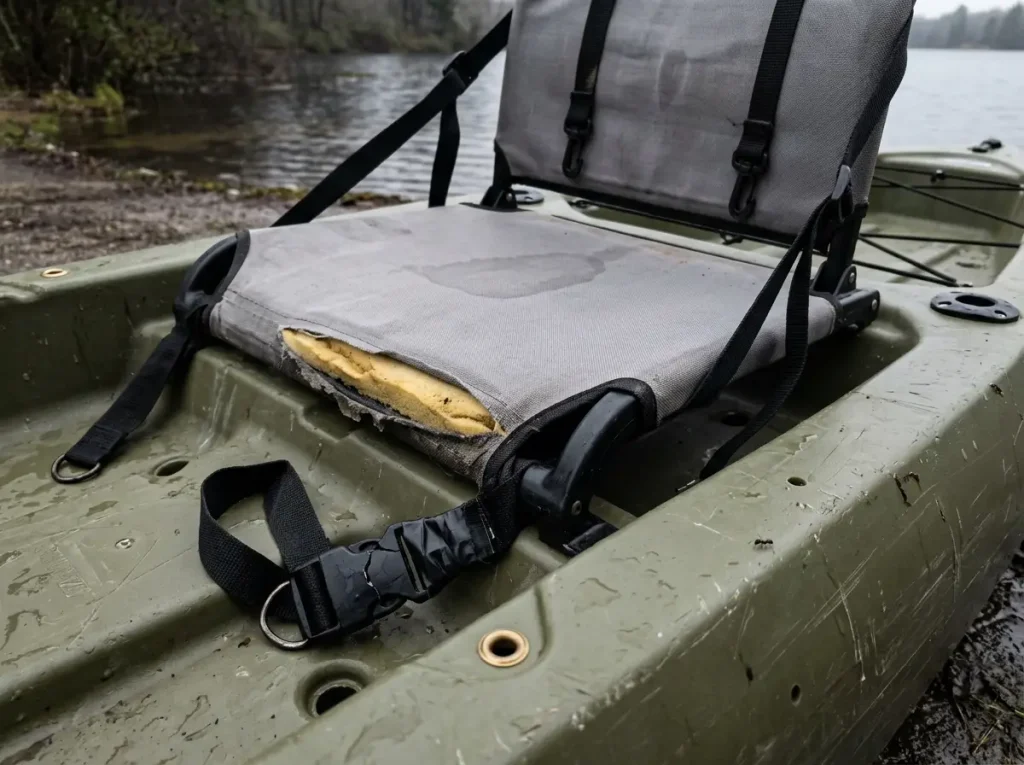
Paddling engages your core muscles and shifts your weight with every stroke. Fishing from a kayak is mostly static — you’re sitting still, leaning forward to cast, twisting to fight a fish, and then sitting still again. Stock seats weren’t built for this. The thin fabric-over-frame design provides almost zero lumbar support, and the foam compresses permanently after a few trips. What started as a half-inch of padding becomes a quarter-inch of nothing.
What Actually Causes the Back Pain
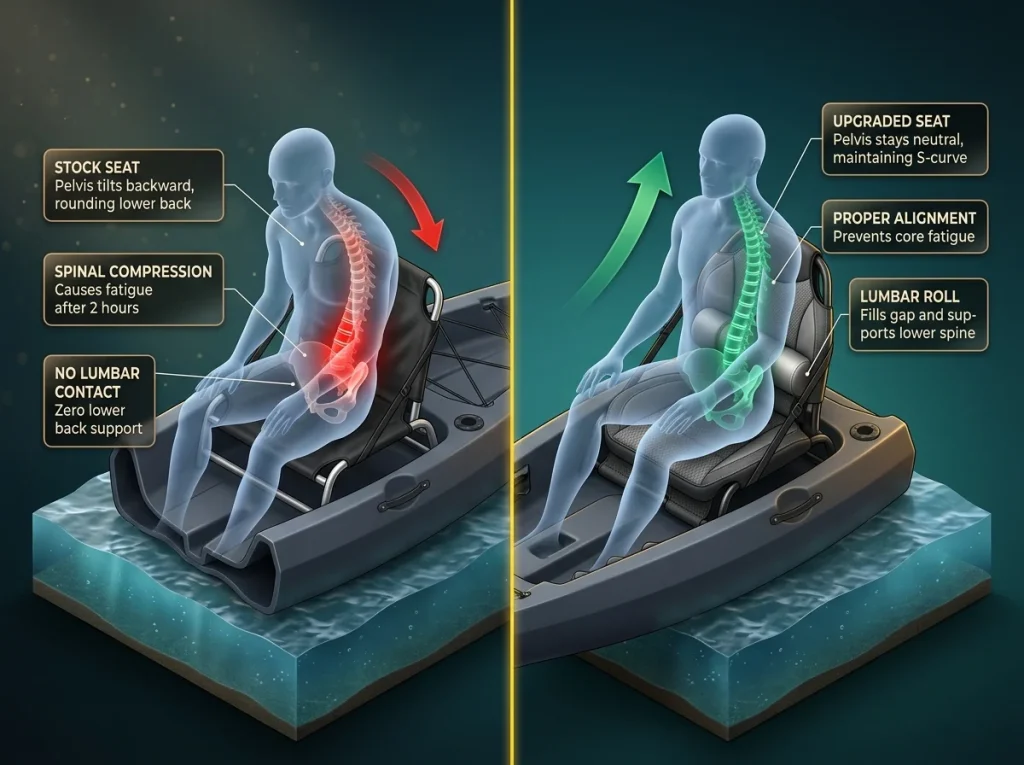
The pain usually starts in the lower back because the stock seat allows your pelvis to tilt backward. Without lumbar support pushing your lower spine into its natural curve, your entire back rounds forward. That slouched position compresses your spinal discs and fatigues the muscles that are trying to hold you upright. After four or five hours, even a strong core gives out. The same rod and reel balance principles that prevent arm fatigue apply here — get the ergonomics right and the hours disappear.
Why Fishing Demands More From a Seat
Casting adds rotational force through your hips. Fighting a fish loads your lower back asymmetrically. And you’re doing all of this while trying to maintain balance in a platform that moves on water. A seat upgrade isn’t about luxury — it’s about having a base that supports the movements fishing actually requires. Think of it as the same upgrade logic behind choosing the right kayak hull — the right foundation changes everything.
Pro tip: If your back hurts after two hours in your kayak, the seat is the first thing to fix — not your fitness, not your posture habits. A $40 seat upgrade often solves what people think is a $500 kayak problem.
Padding Types: EVA Foam vs Gel vs Memory Foam
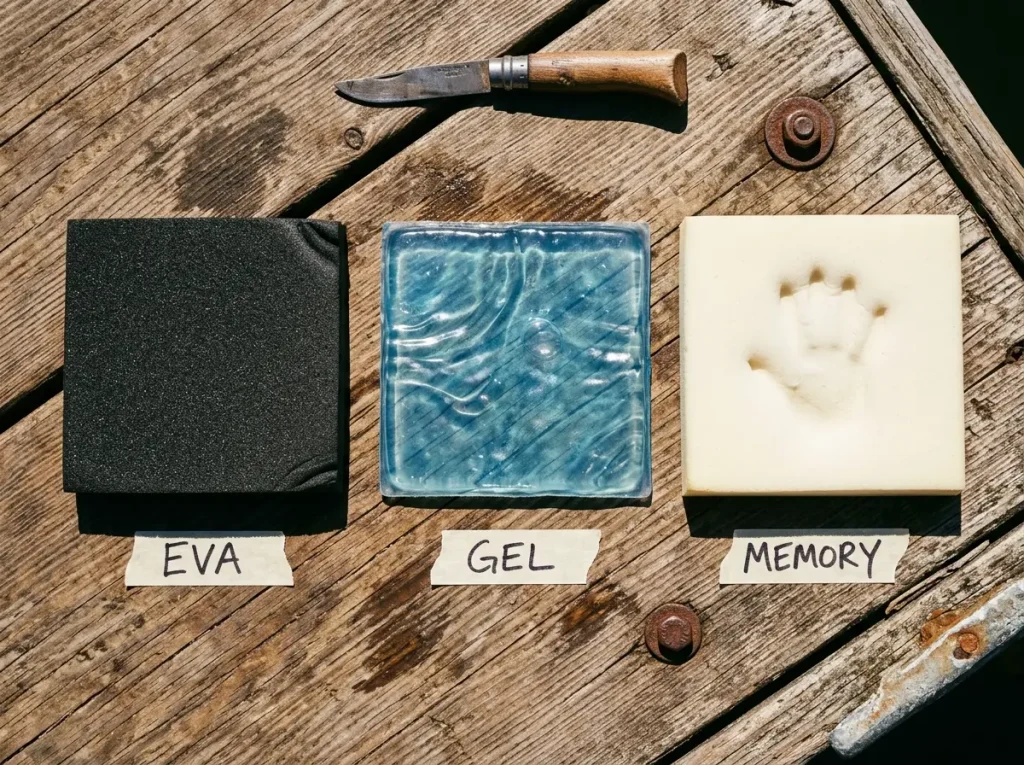
The padding material determines how the seat feels on hour one versus hour six. Each type has real tradeoffs, and the best choice depends on how long you fish and where you carry weight.
EVA Foam: The Workhorse
EVA foam (ethylene-vinyl acetate) is the most common padding in aftermarket kayak seats. It’s closed-cell, which means it doesn’t absorb water — a non-negotiable feature for anything sitting in a kayak cockpit. EVA is firm, supportive, and durable. The WOOWAVE and KERCO Angler-X seats both use EVA or thermal-molded foam variants.
The downside: EVA compresses over time. After fifty or sixty trips, the foam develops a permanent compression indent that reduces its support. It doesn’t bounce back the way it did new. Budget around 18-24 months before you’ll want to replace a heavily-used EVA pad.
Gel: The Pressure Distributor
Gel padding, like the silicone elastomer in the Skwoosh Expedition and Cascade Creek Yakpads, doesn’t compress the same way foam does. Gel flows under your weight, distributing pressure across a wider area instead of creating hot spots. For anglers who sit on bony pressure points (and most of us do), gel eliminates that specific pain.
Gel pads are thinner than foam pads — usually one inch versus two or three. This is actually an advantage because it doesn’t raise your center of gravity as much, which matters for stability on narrower kayaks. The tradeoff: gel is heavier than foam and costs more per square inch.
Memory Foam: The Comfort King (With a Catch)
Memory foam conforms to your shape over time, creating a personalized seat surface. It feels great in the garage. On the water, it has a problem: memory foam is open-cell, which means it absorbs water like a sponge. Unless the foam is sealed inside a fully waterproof cover, it’ll soak up bilge water and spray, adding weight and creating a soggy sitting experience by mid-morning.
If you go memory foam, make sure the cover is heat-sealed or welded — not just stitched. Stitched seams wick water directly into the foam core.
Pro tip: The tissue test works for seat cushions too. Press a piece of tissue against the seam of any foam seat cover, then submerge the cushion for ten minutes. If the tissue wicks moisture, that cover will leak on the water.
The Best Kayak Seat Upgrades for Fishing (Reviewed)
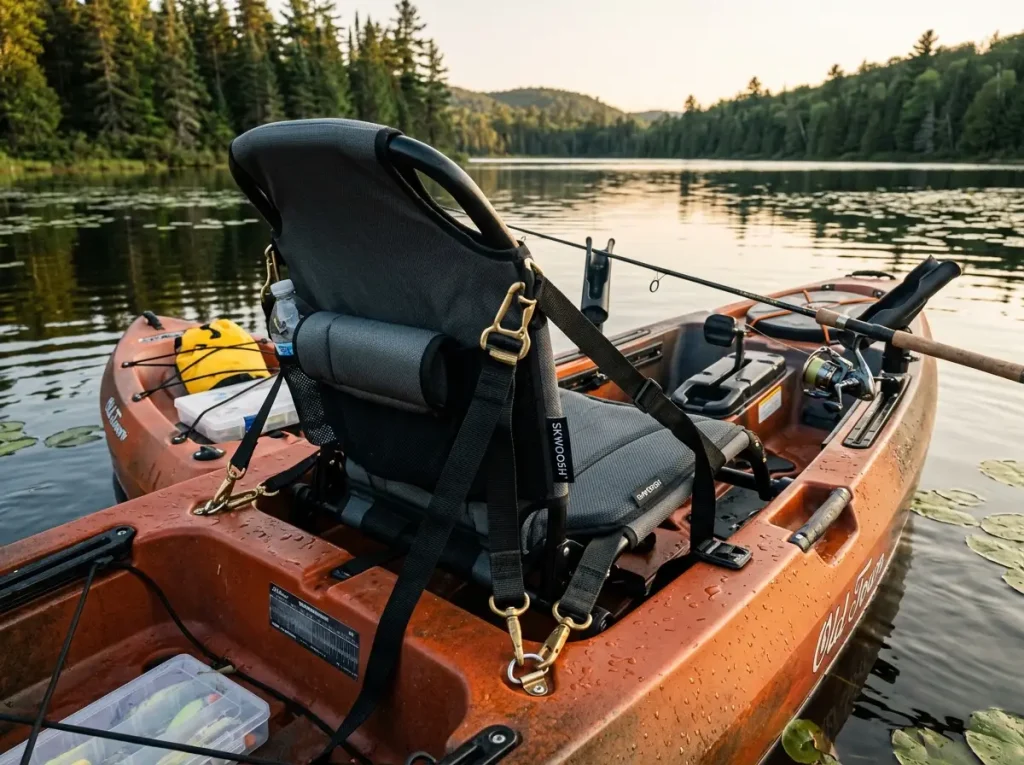
These are the seats that earned their spot after real use, not just spec comparisons. Every recommendation considers fishing-specific demands: static sitting, casting rotation, and full-day durability.
Best Overall: Skwoosh Expedition Seat (~$136)
The Skwoosh Expedition is the closest thing to a recliner you’ll find in a kayak cockpit. Liquid gel padding under the seat base eliminates pressure points. The 20-inch high-back provides full lumbar-to-shoulder support, and the adjustable lumbar roll lets you dial in the exact amount of lower back pressure. Fiberglass rods embedded in the backrest give it structure without adding bulk.
It also includes mesh water bottle holders and a bungee storage pocket on the back — small details that matter when everything you need has to be within arm’s reach. At ~$136, it’s the most expensive seat on this list, but it’s also the one that lets you fish from dawn to dusk without thinking about your back.
Compatible with most sit-on-top kayaks that have four D-ring eyelets. Not for sit-inside cockpits.
Best for Long Days: KERCO Angler-X (~$60)
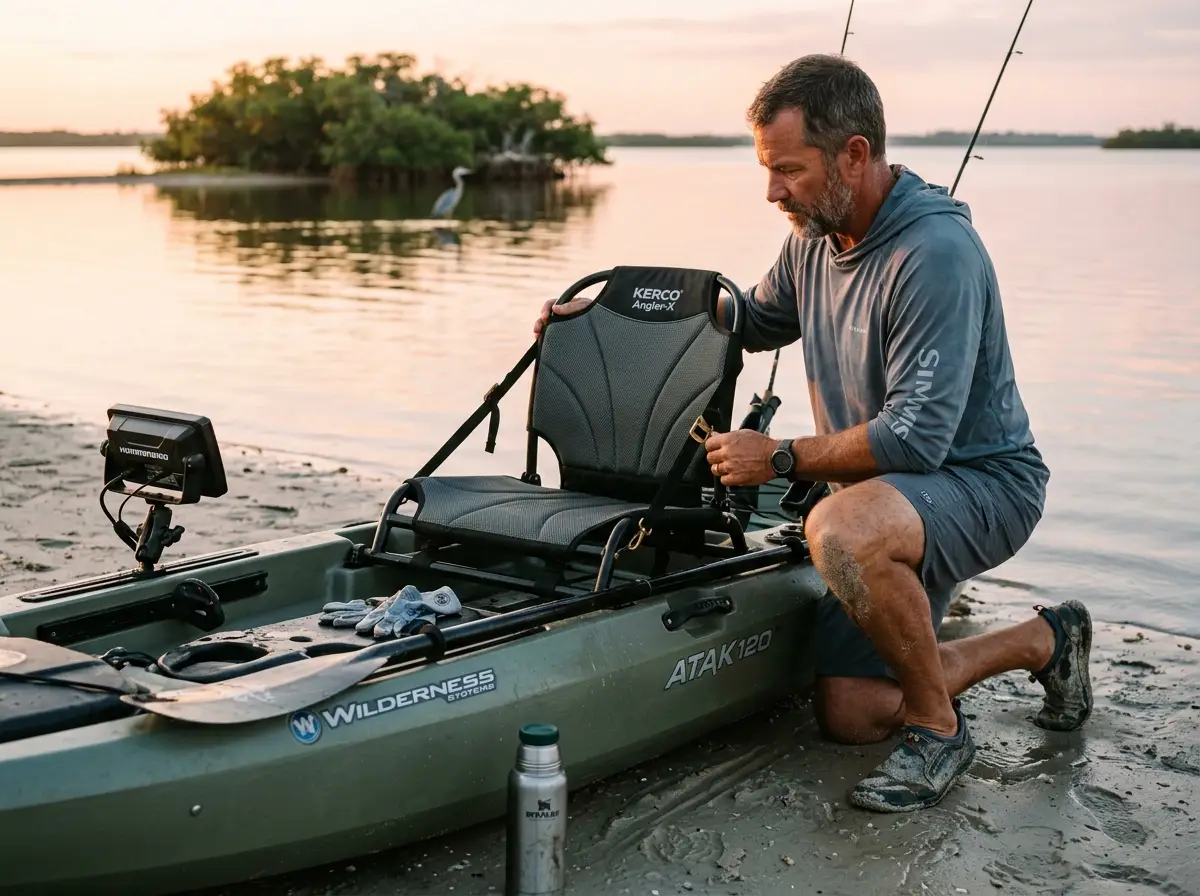
The KERCO Angler-X uses extra-thick thermal-molded foam that holds its shape better than standard EVA over a full season. The contoured backrest wraps slightly around your sides, which helps when you’re twisting to cast or leaning to net a fish. A detachable backpack provides storage without rigging extra crates.
At $60, it hits the sweet spot between the budget seats and the premium Skwoosh. If you fish two to three times a week and need something that won’t compress flat by September, the KERCO holds up.
Best Value: WOOWAVE Kayak Seat (~$40)
The WOOWAVE does everything a kayak seat needs to do at a price that doesn’t sting. EVA foam interior, high-back design with adjustable straps, corrosion-resistant brass clips, and a detachable storage bag. The anti-slip seat base stays put on the hull without sliding around during casts.
It won’t last as many seasons as the Skwoosh, and the lumbar support is less adjustable than the KERCO. But for anglers who fish once or twice a month, the WOOWAVE delivers honest comfort without overthinking it.
Best for Raised Frame Seats: Kayak Kushion (~$70)
If your fishing kayak already has a raised aluminum-frame seat (Hobie, Jackson, Wilderness Systems), you don’t need a full replacement — you need a cushion that adds padding to the existing frame. The Kayak Kushion provides two inches of breathable foam that straps directly to your frame seat with tactical cam buckles.
The removable washable cover is a real feature, not a gimmick. After a week of saltwater trips, the ability to throw the cover in the wash makes a noticeable difference. The Kushion is stitched for durability and won’t compress the way cheaper pads do. The best kayak rod holder flush-mount systems pair well with frame-seat kayaks — same rigging philosophy.
Best for Sit-Inside Kayaks: Cascade Creek Yakpads Paddle Saddle (~$48)
Sit-inside kayaks are harder to upgrade because the cockpit limits seat dimensions. The Cascade Creek Yakpads Paddle Saddle is a silicone gel pad that fits most sit-inside bucket seats. No back support — it’s a bottom-only cushion — but the gel eliminates the hard-plastic contact that makes sit-inside fishing miserable after an hour.
Non-skid bottom and attachment loops keep it in place. If your sit-inside has a molded-in seat with no backrest provision, this is your best option without going custom.
Seat Height and Sight Fishing: The Tradeoff Nobody Explains
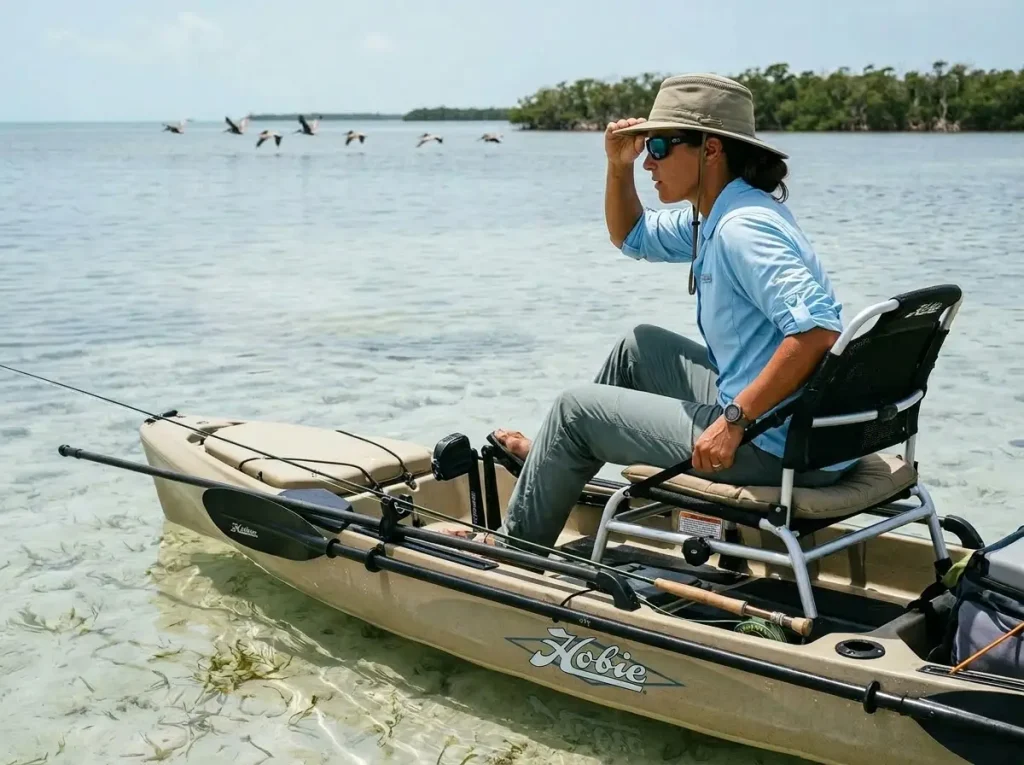
Every inch of seat height you add gives you a wider view of the water. For sight fishing — spotting tailing redfish on a flat, watching bass push baitfish in the shallows — that extra visibility is a real advantage. Some fishing kayaks like the Hobie Pro Angler offer seats that sit six inches or more above the standard cockpit level.
How Height Improves Your Fishing
The Surf to Summit seat raises you three inches above a standard sit-on-top position. Even that small change opens up your sightline significantly. You can see further into the water column, spot structure and shadows earlier, and react to surface activity sooner. Casting mechanics improve too — a higher seated position gives your rod arm more clearance for sidearm casts and overhead throws.
For anglers on Texas coast kayak fishing spots chasing reds on the flats, seat height directly translates to more fish spotted.
The Stability Cost of Sitting Higher
Every inch you rise above the hull raises your center of gravity. A higher center of gravity means less primary stability — the kayak feels tippier, especially on initial lean. On wide, stable fishing kayaks (33″+ beam), this tradeoff is minor. On narrower touring-style kayaks or budget sit-on-tops under 30″ wide, adding four or five inches of seat height can make the kayak genuinely uncomfortable in chop.
Before upgrading to a tall seat, test it on flat water first. If you feel unstable during a hard lean, lower the seat position or switch to a lower-profile cushion. Stability always wins over visibility — you can’t sight-fish from the water. The American Canoe Association’s paddling safety program covers kayak stability fundamentals worth reviewing if you’re new to modifying your setup.
Finding Your Personal Height Sweet Spot
Start low and add height in one-inch increments using foam pads. Fish a full trip at each height. You’ll find the point where visibility improves without stability suffering. For most anglers on standard fishing kayaks, two to three inches above stock is the sweet spot. The same physics-first approach behind understanding kayak stability applies — know your hull’s limits before modifying the load.
Pro tip: Stand up in your kayak on flat water before upgrading the seat height. If you can’t stand comfortably, your kayak probably can’t handle a significantly elevated seat either. Same hull, same physics.
DIY Kayak Seat Upgrades That Actually Work
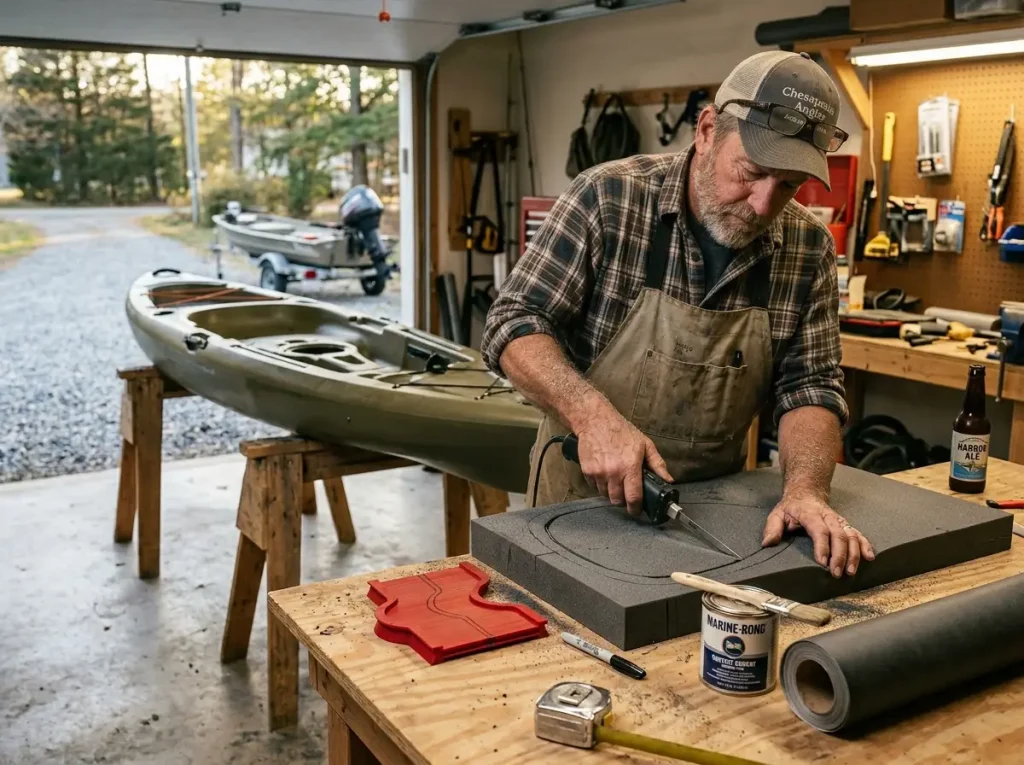
Not every upgrade requires a credit card. Some of the most comfortable kayak seats I’ve sat in were built in a garage with forty dollars worth of materials and a Saturday afternoon.
The Closed-Cell Foam Custom Build
Buy a block of cross-linked polyethylene foam — 3 inches thick, 2lb density. Trace your kayak cockpit profile with a contour gauge, transfer it to the foam, and cut with an electric carving knife. Carve a slight concave depression where your sit bones land. Glue marine-grade contact cement to bond the foam, and wrap it in marine vinyl sealed with heat or adhesive.
Total cost: roughly $25 for foam plus $10-15 for vinyl and cement. Total time: two to three hours. The result: a custom seat shaped exactly to your cockpit and your frame, made from material that won’t absorb water and won’t compress for years.
The Stadium Seat Quick Fix (~$15)
A folding stadium seat from Walmart or any sporting goods store provides instant back support and a padded base. Most clip right onto the kayak cockpit rim or sit on the molded seat area with enough friction to stay put. They cost between $10 and $18 and provide adjustable back angles.
The downside: stadium seats aren’t marine-grade. The fabric soaks up water, the hardware corrodes in salt, and the padding compresses fast. But for freshwater anglers who fish a dozen times a season, this $15 fix buys you time to decide if a premium seat is worth the investment.
Foam Pad Layering for Frame Seats
If your fishing kayak has a frame seat (Hobie Vantage, Jackson Elite), you can add comfort without replacing the whole seat. Layer a 1-inch closed-cell EVA pad cut to size on the seat base, secured with adhesive Velcro strips. Add a small lumbar roll — a pool noodle cut to 12 inches and duct-taped to the seat frame works in a pinch.
The pool noodle trick sounds janky. It works. Guides have been doing it for years because it costs nothing and provides adjustable lumbar support you can reposition on the water. The same resourceful rigging mindset behind kayak accessory track systems applies here — simple solutions that solve real problems.
Pro tip: Spray marine-grade contact adhesive on the bottom of any DIY foam pad and let it tack up for two minutes before pressing it onto the hull. This prevents the pad from sliding forward when you lean back — the number one complaint with loose cushions.
How to Install and Adjust Your New Kayak Seat
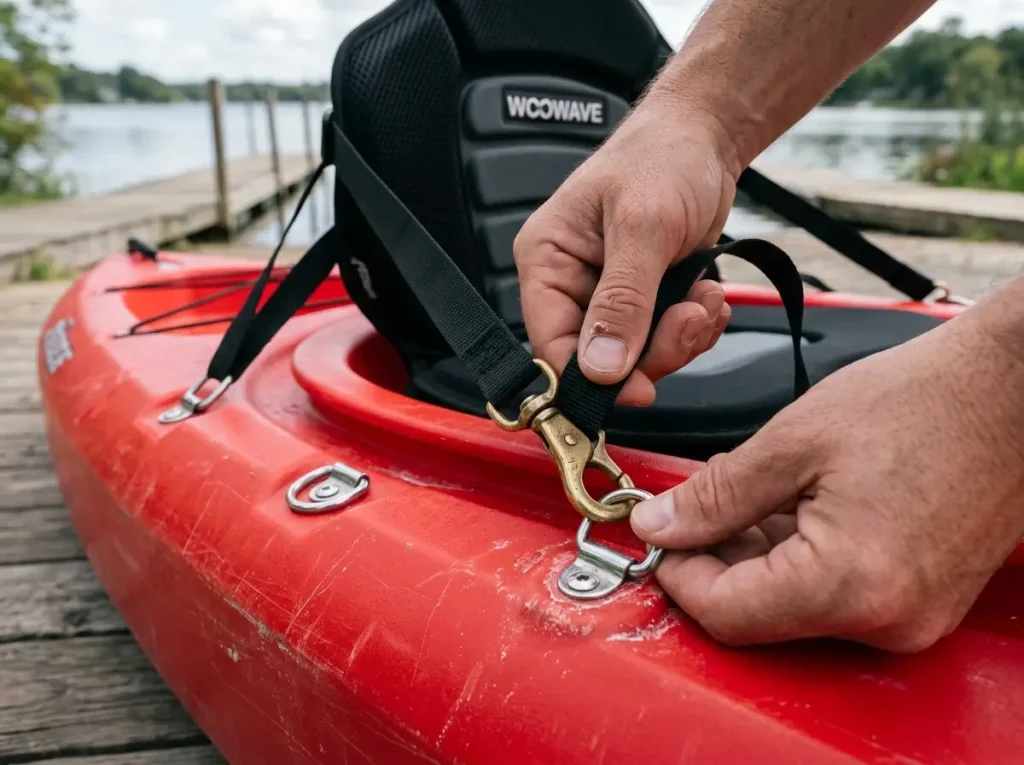
A great seat installed wrong is still uncomfortable. Most aftermarket seats take ten minutes to install, but the adjustment phase takes a full fishing trip to dial in.
Strap Tension and D-Ring Placement
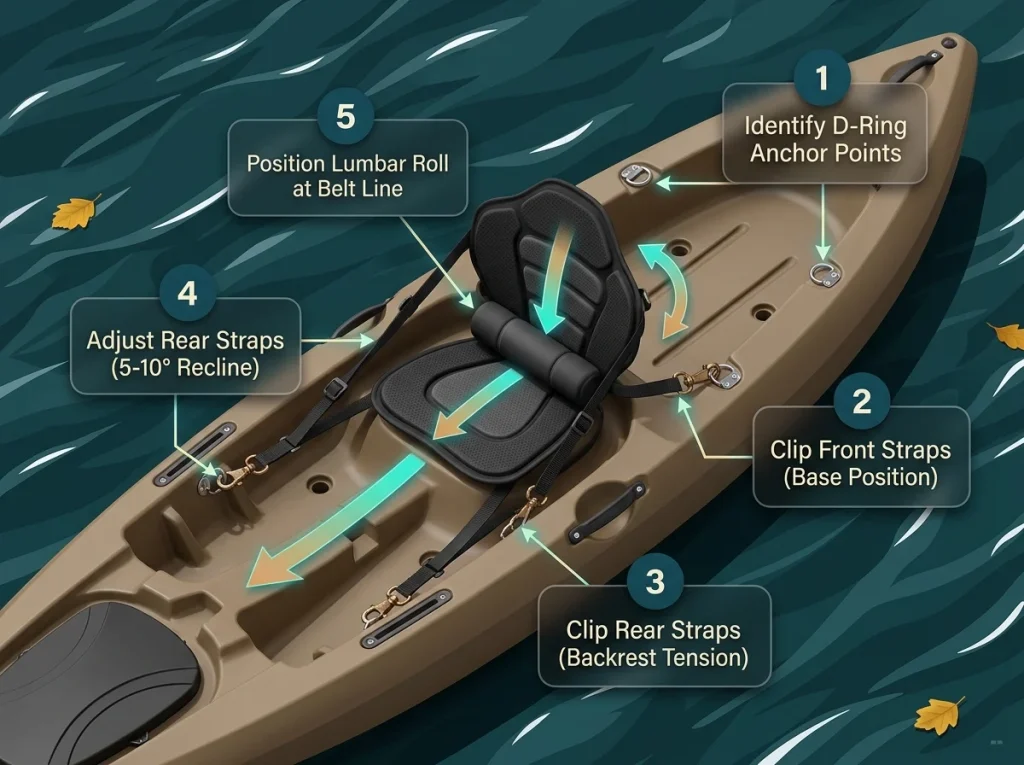
Most sit-on-top kayak seats attach with four straps and brass clips to D-ring eyelets molded into the hull. Front straps control how far forward the seat base sits. Rear straps control the backrest recline angle. Start with all four straps snug but not cranked tight — you’ll adjust once you’re on the water.
The most common mistake: over-tightening the rear straps. This pulls the backrest too far forward, forcing you into an upright position that feels rigid and uncomfortable after an hour. Loosen the rear straps until the backrest reclines about 5-10 degrees past vertical. That slight lean lets your spine settle into its natural curve instead of fighting the seat.
Lumbar Roll Positioning
If your seat has an adjustable lumbar roll (Skwoosh Expedition, some KERCO models), position it at the belt line — right where your lower back curves inward. Too high and it pushes your shoulders forward. Too low and it does nothing. You’ll know it’s right when you sit back and feel the roll pressing into the small of your back without you having to think about it.
For seats without a built-in lumbar feature, a rolled-up microfiber towel wedged behind your lower back serves the same purpose. It’s not elegant, but it stops the pain.
On-Water Fine-Tuning
Install the seat at home. Adjust it on the water. Your weight distribution changes when you’re floating versus sitting on land, and the hull flex of a loaded kayak slightly alters how the seat sits. Bring a multi-tool on your first trip with the new seat — you’ll want to adjust strap tension at least twice before you find your setting.
Once you’ve dialed it in, mark your strap positions with a Sharpie so you can reinstall to the same setting after removing the seat for transport. The same approach to kayak fish finder mounting works here — get it roughly right on land, fine-tune on the water.
If your kayak has safety protocols for paddling that include a properly fitted PFD, make sure the seat adjustment accounts for the PFD bulk at your back — adjust with it on, not off.
Conclusion
Three things will save your fishing days. First, the stock seat is almost never good enough for all-day fishing — replacing it is the single highest-value upgrade you can make on any kayak. Second, gel beats foam for pressure distribution and foam beats gel for structural support, so pick based on whether you feel sore spots or overall fatigue first. Third, seat height helps sight fishing but costs stability — test before committing, and start lower than you think.
Upgrade the seat. Adjust it on the water. Fish longer.
Q1 What is the most comfortable kayak seat for fishing?
The Skwoosh Expedition is the most comfortable aftermarket seat for sit-on-top fishing kayaks, with liquid gel padding and an adjustable lumbar roll that supports full-day trips. For budget-conscious anglers, the WOOWAVE at roughly $40 provides solid EVA foam comfort that handles weekend fishing without issues.
Q2 How do I make my kayak seat more comfortable?
Add a closed-cell foam pad or gel cushion to the seat base, and position a lumbar roll at belt height behind your lower back. Even a rolled microfiber towel provides meaningful lumbar support. Adjust rear straps so the backrest reclines 5-10 degrees past vertical for a natural spinal curve.
Q3 Is a gel or foam kayak seat better?
Gel distributes pressure across a wider area and works best for anglers with pressure-point pain. Foam provides firmer structural support and works better for maintaining posture over long sessions. Gel is thinner and heavier; foam is thicker and lighter. Most anglers benefit from gel on the seat base with foam in the backrest.
Q4 Does kayak seat height affect stability?
Yes. Every inch of added seat height raises your center of gravity, which reduces primary stability. On wide fishing kayaks over 33 inches, two to three inches of height gain is manageable. On narrower kayaks, even small increases can make the platform feel unstable in waves or wind.
Q5 Can you add lumbar support to a kayak seat?
Most aftermarket seats include adjustable lumbar rolls or pads. For stock seats or budget upgrades, attach a 12-inch section of pool noodle to the seat frame with zip ties or duct tape at belt height. It costs nothing and provides adjustable support that you can reposition while fishing.
Risk Disclaimer: Fishing, boating, and all related outdoor activities involve inherent risks that
can lead to injury. The information provided on Master Fishing Mag is for educational and informational purposes
only. While we strive for accuracy, the information, techniques, and advice on gear and safety are not a substitute
for your own best judgment, local knowledge, and adherence to official regulations. Fishing regulations, including
seasons, size limits, and species restrictions, change frequently and vary by location. Always consult the latest
official regulations from your local fish and wildlife agency before heading out. Proper handling of hooks, knives,
and other sharp equipment is essential for safety. Furthermore, be aware of local fish consumption advisories. By
using this website, you agree that you are solely responsible for your own safety and for complying with all
applicable laws. Any reliance you place on our content is strictly at your own risk. Master Fishing Mag and its
authors will not be held liable for any injury, damage, or loss sustained in connection with the use of the
information herein.
Affiliate Disclosure: We are a participant in the Amazon Services LLC Associates Program, an
affiliate advertising program designed to provide a means for us to earn advertising fees by advertising and linking
to Amazon.com. As an Amazon Associate, we earn from qualifying purchases. We also participate in other affiliate
programs and may receive a commission on products purchased through our links, at no extra cost to you. Additional
terms are found in the terms of service.