


In this article
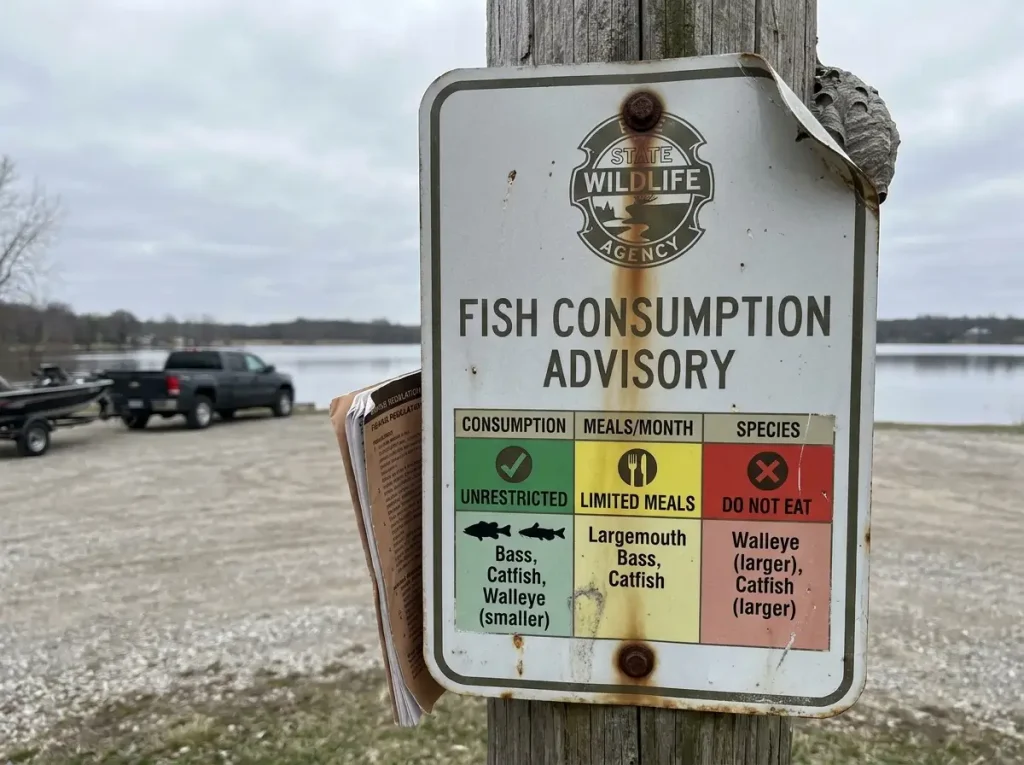
I watched a guy at my local boat ramp glance at the fish consumption advisory sign, shrug, and toss five keeper bass into his cooler without a second thought. The next week, a different angler told me he’d stopped eating anything he caught because “mercury is in everything now.” Both of them were wrong — and both of them missed the point entirely. Fish advisories aren’t telling you to stop eating fish. They’re telling you how to eat fish smarter.
After two decades of harvesting fish from waters all over the country, I’ve learned that understanding these advisories takes about ten minutes — and those ten minutes protect your family without ruining your fishing.
Quick Answer: Fish consumption advisories are government-issued guidelines that tell you how many meals per month of specific species from specific waters are safe to eat based on mercury and other contaminant levels. They don’t ban eating fish — they provide species-specific, water-specific meal frequency limits so you can enjoy your catch without accumulating harmful mercury levels over time. The system is simpler than most anglers realize.
What Fish Consumption Advisories Actually Are (And Aren’t)
The Basic Structure Every Advisory Follows
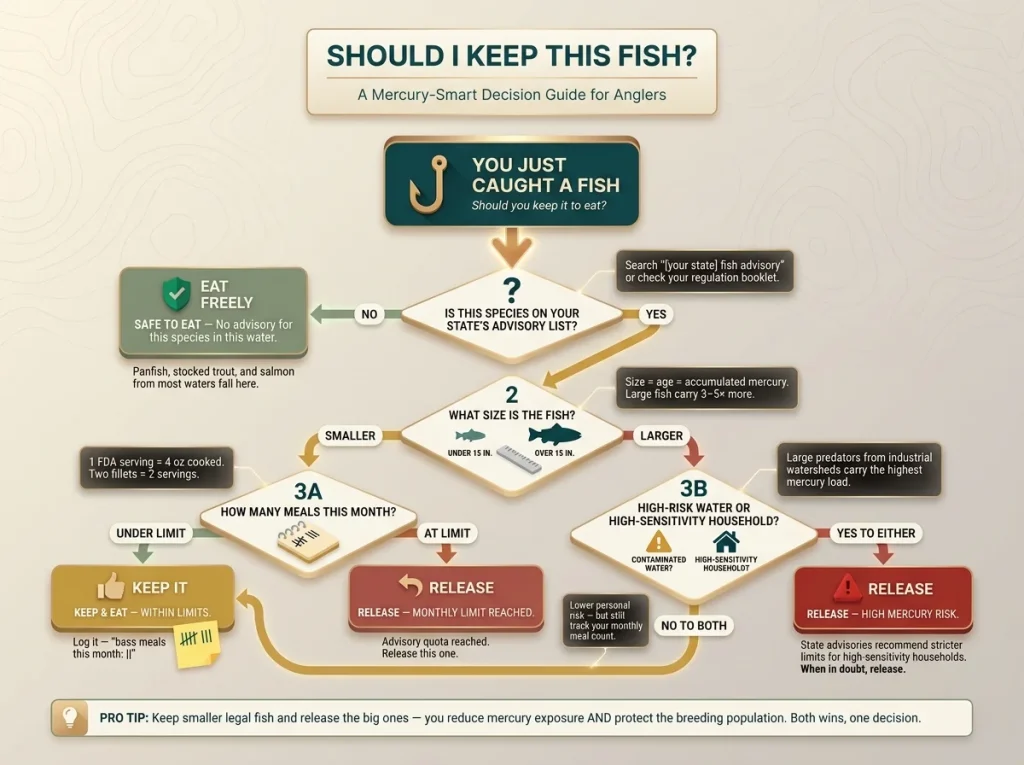
Every fish consumption advisory in the United States follows the same basic logic: a specific waterbody + a specific fish species + a recommended number of meals per time period. That’s it. “Lake X, largemouth bass over 15 inches, no more than one meal per month for adults” is a typical advisory statement.
The key word most anglers miss is specific. An advisory for walleye in one reservoir doesn’t apply to walleye in the river twenty miles away. An advisory for largemouth bass doesn’t automatically include the bluegill from the same lake. Each species accumulates contaminants differently, and each body of water has different contamination levels based on its watershed, industrial history, and geology.
Who Issues Them and Why
State health departments and environmental agencies issue advisories based on tissue sampling — they actually catch fish, fillet them the same way you would, and send the muscle tissue to a lab for analysis. When mercury levels in a fish species from a specific water exceed thresholds set by the EPA, the state issues consumption guidance.
The federal government — specifically the EPA and FDA jointly — issues broader national guidance for commercial seafood. But for fish you catch yourself, your state’s advisory is the one that matters because it reflects actual testing of your local waters.
What They Are NOT
Advisories are not fishing bans. They don’t tell you to stop fishing, stop catching, or stop releasing. They don’t mean the fish are “toxic” or that one meal will harm you. They’re conservative guidelines designed to protect the most vulnerable people — pregnant women, nursing mothers, and young children — at chronic exposure levels over months and years.
Pro tip: Think of fish advisories the same way you think of speed limits — they exist for a reason, they protect the most vulnerable, and exceeding them occasionally isn’t catastrophic. But consistently ignoring them over years creates cumulative risk that catches up.
How Mercury Gets Into the Fish You Catch
From Smokestacks to Your Fillet
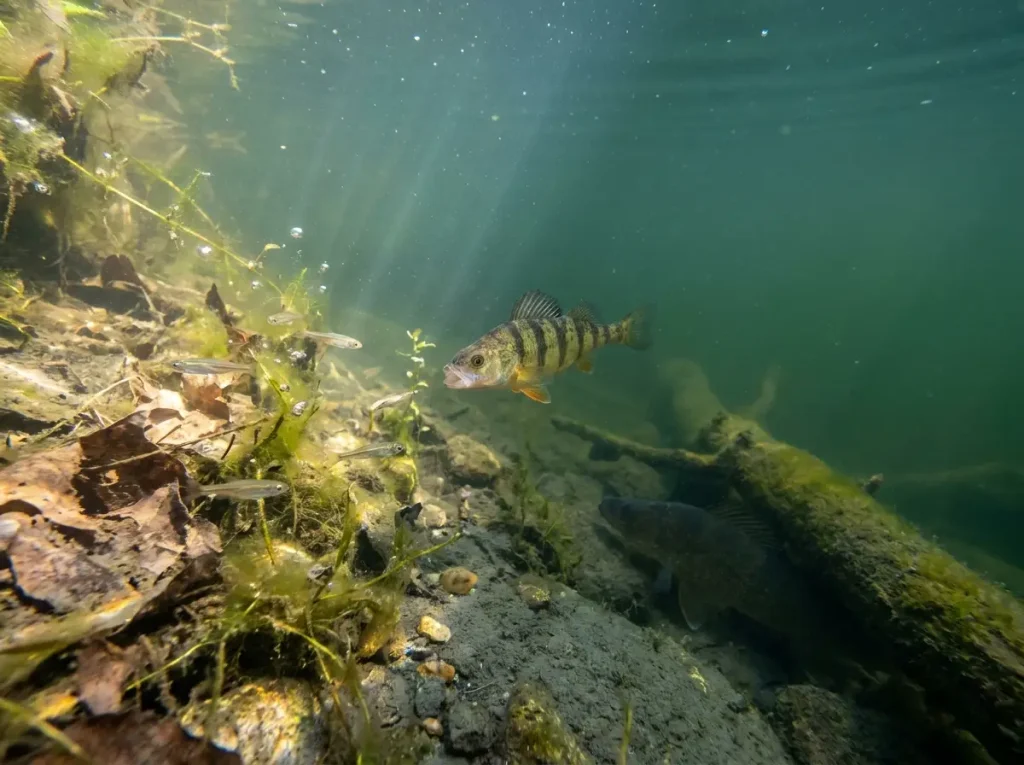
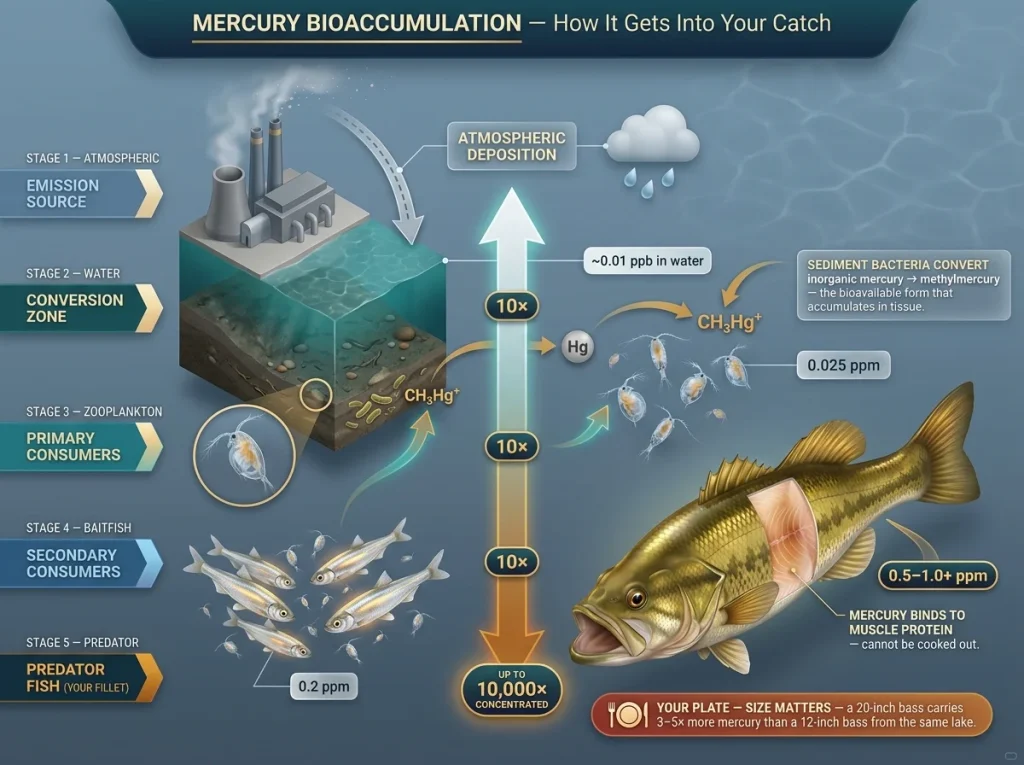
Mercury enters waterways primarily through atmospheric deposition — coal-burning power plants and industrial processes release mercury into the air, it falls with rain into lakes and rivers, and bacteria in bottom sediments convert it into methylmercury. That methylmercury is the form that accumulates in living tissue and moves up the food chain.
The process called bioaccumulation means each organism retains methylmercury rather than excreting it. A tiny zooplankton absorbs a trace amount. A minnow eats thousands of zooplankton and accumulates all their mercury. A bass eats hundreds of minnows over its lifetime and concentrates their combined mercury load into its muscle tissue. By the time you’re looking at a 5-pound bass, you’re looking at the accumulated mercury of an entire food web below it.
Why Bigger, Older Predators Carry More
This biomagnification across trophic levels explains why the FDA’s “avoid” list includes the largest predatory fish — shark, swordfish, king mackerel, tilefish, marlin, orange roughy, and bigeye tuna. They sit at the top of marine food chains and live for decades, accumulating mercury with every meal for their entire lives.
The same principle applies to freshwater fish you catch locally. A 20-inch largemouth bass that’s 8 years old carries significantly more mercury than a 12-inch bass that’s 3 years old from the same lake — even though they’re the same species in the same water. Size and age are the two strongest predictors of mercury concentration in any individual fish.
Why You Can’t Cook It Out
Unlike some contaminants (PCBs concentrate in fat and skin, which you can trim), mercury binds to muscle protein. You cannot reduce mercury by skinning, trimming, filleting thinner, or cooking at high temperatures. The mercury in that fillet goes directly into whoever eats it. This is why advisories focus on meal frequency rather than preparation methods — the only lever you control is how often you eat which species.
Pro tip: The exception is PCBs and dioxins, which DO concentrate in fat. For those contaminants (listed on some advisories separately from mercury), trimming belly fat, removing skin, and grilling on a rack so fat drips away genuinely reduces exposure. But this does nothing for mercury specifically.
The FDA/EPA Three-Tier System (Translated for Anglers)
Best Choices, Good Choices, and Fish to Avoid
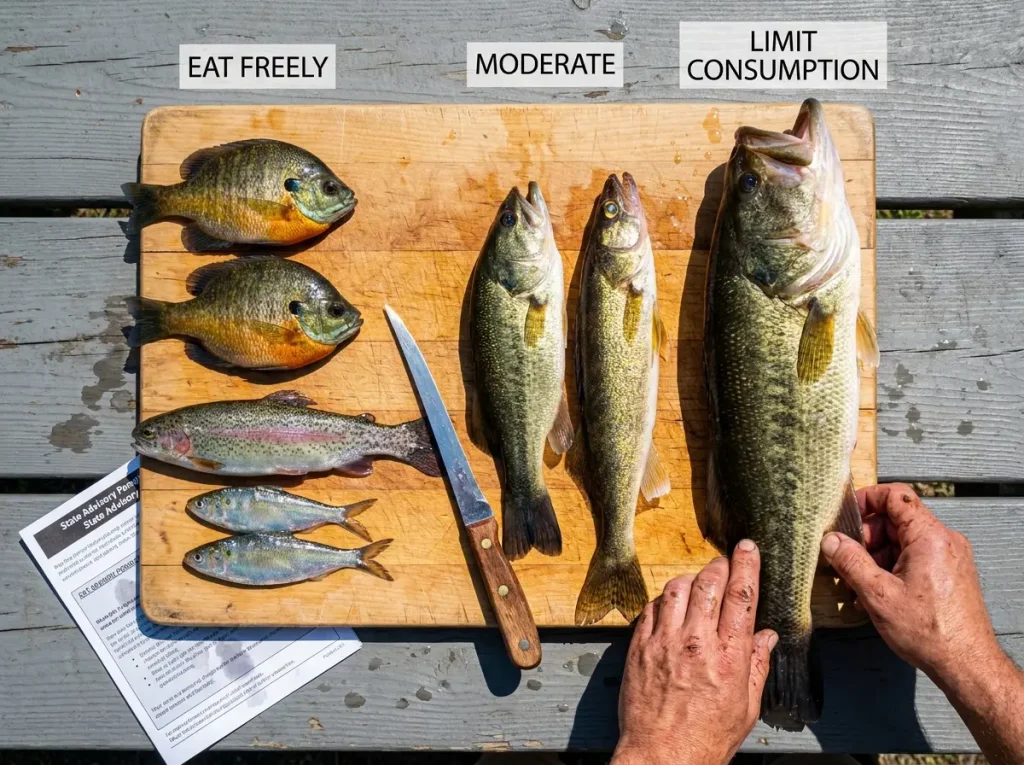
The FDA and EPA sort commercial seafood into three categories based on mercury levels measured in parts per million (ppm). While this system was designed for grocery store and restaurant fish, the same logic applies to your local catch — the species categories translate directly:
Best Choices (lowest mercury — eat 2-3 servings per week): panfish (bluegill, crappie, perch), catfish under 20 inches, trout, salmon, shrimp, pollock, sardines, and most small-bodied species. These are your “eat freely” fish from a mercury perspective.
Good Choices (moderate mercury — eat 1 serving per week): largemouth bass, walleye, striped bass, carp, white bass, and most mid-sized predators. These are fine to eat regularly but not daily.
Choices to Avoid (highest mercury): shark, swordfish, king mackerel, bigeye tuna, marlin, orange roughy, and tilefish (Gulf of Mexico). Most anglers will never encounter these unless they fish offshore.
How This Translates to What You Actually Catch
If you’re a freshwater angler — which most people reading this probably are — the practical translation is simple: panfish and stocked trout are essentially unlimited from a mercury standpoint. Bass and walleye in the 12-16 inch range are perfectly safe at one or two meals a week for most adults. The risk escalates with older, larger predator fish from waters with known contamination.
Your state advisory overrides this general guidance because it reflects actual testing of your specific waters. A walleye from Lake Erie might have different mercury levels than a walleye from a Minnesota boundary lake, even at the same size — because the watershed contamination differs.
The “Serving Size” Most Anglers Get Wrong
One serving in FDA/EPA language is 4 ounces of cooked fish — roughly the size of your palm. Most anglers eating their catch consume 8-12 ounces at a meal, which counts as 2-3 servings. This means the “one serving per week” advisory for walleye actually means one typical fish dinner every two to three weeks for most people — not one meal per week as most anglers interpret it.
What Anglers Can Actually Do to Reduce Mercury Exposure
Eat Down the Food Chain
The single most effective strategy for anglers who harvest fish regularly: shift your meals toward smaller, shorter-lived species. Those panfish you catch in an hour at the local pond — bluegill, crappie, perch — are consistently among the lowest-mercury freshwater fish anywhere in the country because they’re small, short-lived, and eat invertebrates rather than other fish.
This doesn’t mean you can’t keep a bass or walleye. It means making panfish your default harvest fish and treating larger predators as occasional meals rather than every-trip keepers.
Keep Smaller Fish, Release the Trophies
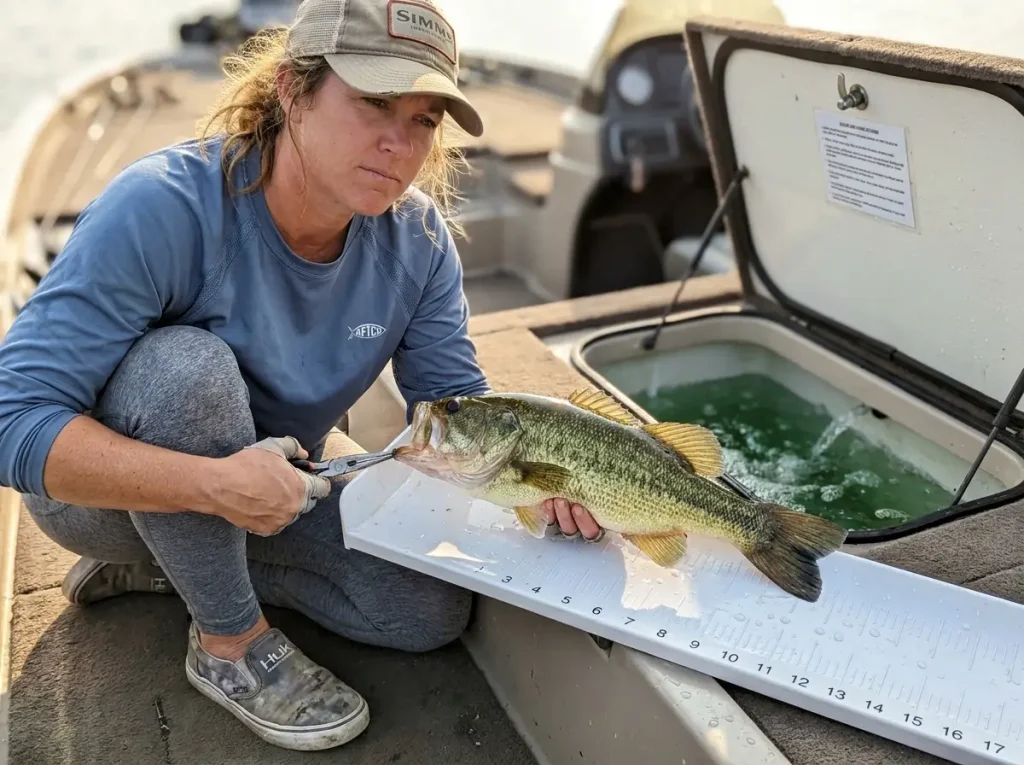
Mercury correlates directly with size and age. A 13-inch bass carries substantially less mercury than a 20-inch bass from the same water. If you’re eating fish regularly, keeping the smaller legal fish and releasing the big ones isn’t just good conservation — it’s a direct mercury reduction strategy for your family.
This aligns with fisheries management goals too. Large breeding females produce exponentially more eggs than young fish. Releasing mature fish benefits both the fishery and your mercury exposure simultaneously.
Diversify Waters and Species
If you fish one lake exclusively and eat the same species from it every week, any contamination in that water concentrates in your diet. Rotating between different waters and different species spreads your risk the same way diversifying investments spreads financial risk. One walleye dinner from Lake A this month, panfish from River B next week, trout from Creek C the week after — that rotation prevents chronic accumulation from any single contaminated source.
Track Your Meals (It Takes 10 Seconds)
The advisory system works on monthly meal counts. A simple note on your fridge — “bass meals this month: ||” — takes the guesswork out of compliance. You don’t need an app. You don’t need to weigh every fillet. Just count the meals of each advisory-listed species per month and stay within your state’s recommendations.
Pro tip: Freeze your catch in individual 4-ounce portions (roughly palm-sized fillets). When you pull one bag out for dinner, that’s one FDA serving. Two bags for a big appetite? That’s two servings counted against your monthly advisory for that species. Simple tracking built into your fish storage routine.
How to Find Advisories for Your Local Waters

The Federal Starting Point
The EPA maintains a National Listing of Fish Advisories searchable by state — start there if you don’t know where your state publishes its specific guidance. Every state in the country has active fish consumption advisories, but they vary enormously in how accessible and updated they are.
Your State’s Specific Tool
Most state health departments or DNR agencies maintain searchable databases where you enter a lake or river name and get species-specific consumption guidance. States like Minnesota, Wisconsin, and Massachusetts have particularly user-friendly lookup tools. Others publish PDF documents organized by county or watershed.
Search “[your state] fish consumption advisory” and you’ll find the relevant agency within the first three results. Many states also print advisory information directly in their annual fishing regulation booklets — the same booklet you get with your license.
What to Do When No Advisory Exists for Your Water
Not every lake and river has been tested. If no advisory exists for a specific waterbody, the state’s general statewide advisory applies as a default. Most states issue blanket statewide guidance like “limit large predator fish to one meal per week” that covers untested waters conservatively.
When in doubt, the general principle holds: smaller, shorter-lived fish are safer regardless of specific testing data. A panfish from an untested farm pond carries negligible mercury risk compared to a large bass from the same water.
Pro tip: Check advisories BEFORE you fish a new water — not after you’ve already filled a cooler. Most state advisory databases work on mobile phones and take 30 seconds to search by lake name.
The “All or Nothing” Trap (And the Smarter Middle Ground)

Why Some Anglers Ignore Advisories Completely
The psychology makes sense: advisories feel like government overreach telling you not to eat what you caught with your own hands. The sign uses scary language. The serving sizes feel impossibly small. And your grandfather ate fish from that same lake for 50 years and lived to 85. So you ignore it.
The problem is that mercury accumulation is invisible and cumulative. Unlike food poisoning that hits within hours, mercury builds over months and years with no symptoms until levels reach a threshold — primarily affecting neurological development in children and fetuses. For adult men with no plans for pregnancy, the personal risk is genuinely lower. But if children or women of childbearing age eat from your cooler, the advisories exist specifically for them.
Why Some Anglers Panic and Stop Eating Fish Entirely
The opposite extreme — refusing to eat any self-caught fish — ignores the documented health benefits of fish consumption. Fish remain one of the leanest protein sources available, rich in omega-3 fatty acids that reduce cardiovascular risk. The science consistently shows that moderate fish consumption following advisory guidance produces net health benefits compared to eating no fish at all.
The FDA’s guidance isn’t “don’t eat fish.” It’s “eat 2-3 servings per week from the lower-mercury options.” That guidance applies to everyone, including people who catch their own.
The Rational Middle Ground
The smarter approach combines awareness with proportion: know your state’s advisories for the waters you fish, favor smaller species and younger fish for regular meals, treat large predators as occasional rather than weekly harvests, and track roughly how many servings of advisory-listed species your household eats per month.
This isn’t complicated. It’s not fearful. It’s the same common-sense approach experienced anglers apply to everything else — reading conditions before fishing, matching tackle to the situation, and making informed decisions rather than reactive ones.
Conclusion
Fish consumption advisories aren’t a reason to stop eating what you catch — they’re a tool for eating it smarter. The system is straightforward once you spend ten minutes understanding it: check your state’s advisory for your specific water and species, favor smaller panfish for regular meals, keep larger predators as occasional treats, and track your monthly servings loosely.
Mercury accumulates invisibly, but the fix is proportional — not absolute. You don’t need to give up walleye dinners. You need to know which waters, which sizes, and how often. That knowledge turns a confusing yellow sign into a useful decision-making tool.
Go catch fish. Eat some. Release some. Just know which is which before you fire up the grill.
Q1 Can you remove mercury from fish by cooking?
No. Mercury binds to muscle protein and cannot be reduced by any cooking method, trimming, or preparation technique. The only way to reduce mercury intake is eating fewer servings of high-mercury species or choosing lower-mercury fish instead.
Q2 Which fish have the most mercury?
The highest-mercury species are large, long-lived predators: shark, swordfish, king mackerel, bigeye tuna, marlin, orange roughy, and tilefish. In freshwater, older largemouth bass and walleye over 20 inches accumulate significantly more than smaller specimens.
Q3 How often can you safely eat fish with mercury?
The FDA recommends 2-3 servings weekly from low-mercury species (panfish, trout, salmon) or 1 serving weekly from moderate-mercury species (bass, walleye). One FDA serving equals 4 cooked ounces — roughly palm-sized.
Q4 What level of mercury in fish is unsafe?
The FDA action level is 1.0 ppm methylmercury, though advisories typically trigger well below that. Most state advisories begin issuing consumption limits when tissue samples exceed 0.3-0.5 ppm — a conservative threshold protecting sensitive populations.
Q5 How do I find fish advisories for my area?
Search [your state] fish consumption advisory online, or check the EPA’s National Listing of Fish Advisories at epa.gov. Most states also print advisory summaries in their annual fishing regulation booklets distributed with licenses.
Risk Disclaimer: Fishing, boating, and all related outdoor activities involve inherent risks that
can lead to injury. The information provided on Master Fishing Mag is for educational and informational purposes
only. While we strive for accuracy, the information, techniques, and advice on gear and safety are not a substitute
for your own best judgment, local knowledge, and adherence to official regulations. Fishing regulations, including
seasons, size limits, and species restrictions, change frequently and vary by location. Always consult the latest
official regulations from your local fish and wildlife agency before heading out. Proper handling of hooks, knives,
and other sharp equipment is essential for safety. Furthermore, be aware of local fish consumption advisories. By
using this website, you agree that you are solely responsible for your own safety and for complying with all
applicable laws. Any reliance you place on our content is strictly at your own risk. Master Fishing Mag and its
authors will not be held liable for any injury, damage, or loss sustained in connection with the use of the
information herein.
Affiliate Disclosure: We are a participant in the Amazon Services LLC Associates Program, an
affiliate advertising program designed to provide a means for us to earn advertising fees by advertising and linking
to Amazon.com. As an Amazon Associate, we earn from qualifying purchases. We also participate in other affiliate
programs and may receive a commission on products purchased through our links, at no extra cost to you. Additional
terms are found in the terms of service.