

In this article
The water on the shallow water flats is a deceptive mirror. One moment it looks completely empty. The next, a massive redfish explodes off the bottom, spooked by a shadow you didn’t know you cast or a vibration you didn’t feel yourself make.
Sight fishing is a high-stakes hunt. Whether you are a fisherman chasing largemouth bass on a lake or tracking tarpon across estuaries, the game is the same. You are trying to spot a predatory fish that is evolved to hide, and you have to do it through a surface that plays tricks on your eyes.
Success here isn’t about luck. It’s about understanding the visual physics of how light works in water, the stealth mechanics of how sound travels through a boat, and how a fish’s eye detects movement. Spotting fish isn’t magic. It is a skill every angler can learn.
This pro-level mastery guide breaks down the optical hierarchy that hides the fish, the engineering needed to keep your vessel quiet, and the biological cues that give a target away long before you see its body.
Why is the “Window” the Most Critical Concept in Sight Fishing?
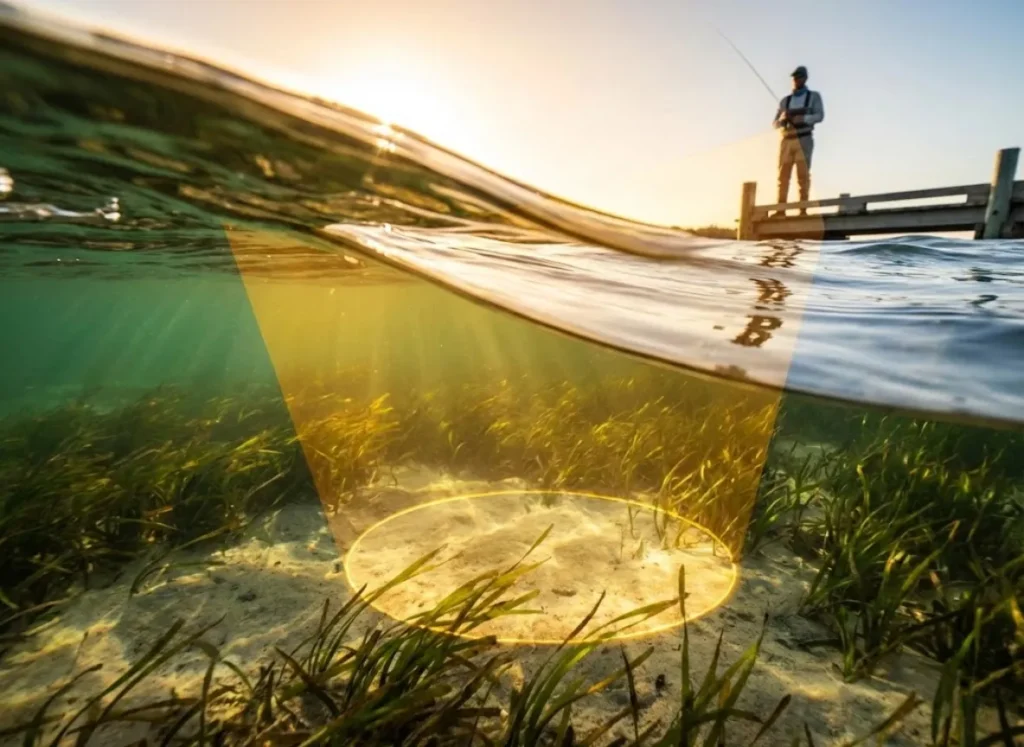
This section breaks down the rules of the environment. These are the physical laws that decide where a fish can see you and where you can hide from them.
What is Snell’s Window and how does it hide the fish?
A fish looking up does not see the sky from horizon to horizon. Because of how light bends when it hits water, their entire view of the world above the surface is squeezed into a circle. This circle is roughly 97 degrees wide. This is the optical phenomenon known as Snell’s Window.
At the edge of this circle, vision stops. Outside of that width, light from the air cannot get down to the fish. Instead, the surface acts like a perfect mirror, reflecting the bottom of the freshwater lake or saltwater flat.
This creates a massive blind spot for the fish. We call this the “Zone of Invisibility.” If you stay in this zone, you are optically invisible to the fish.
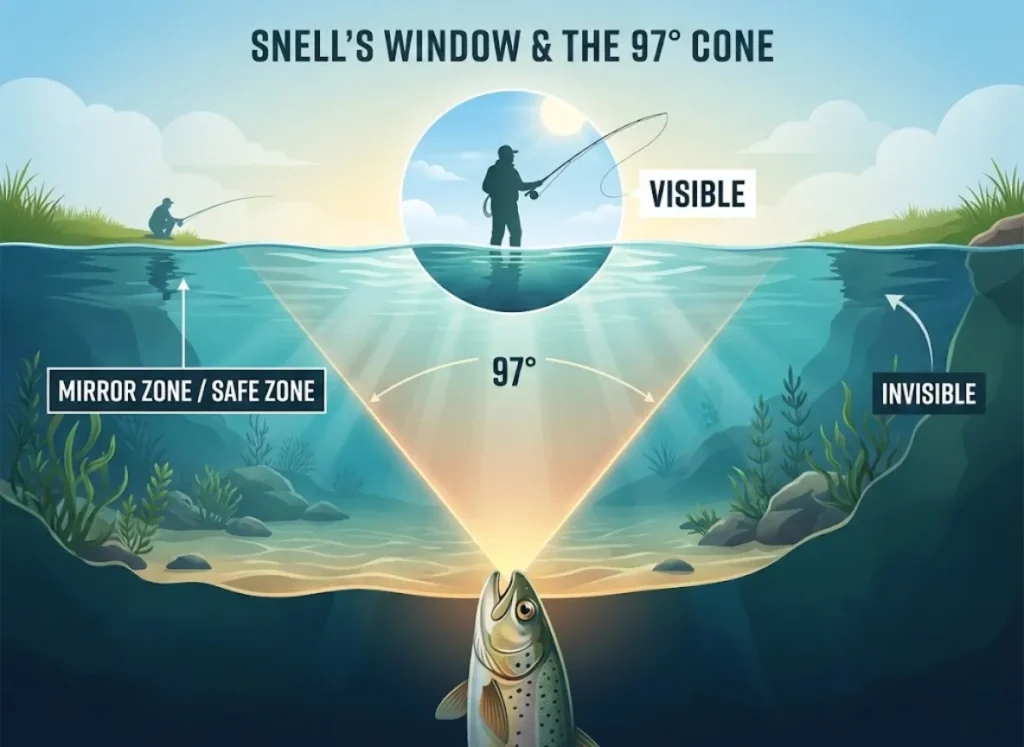
To use this to your advantage, you have to stay low. If you stand tall on a high poling platform when you are close to the fish, you poke up into the edge of their window. You become a silhouette against the bright sky. Staying low keeps you in the mirror zone.
Lead distance and positioning help, too. The further away you are, the lower your angle is relative to the fish. This keeps you safely outside their view. This is also why your clothing materials should match the sky (light blues and greys) rather than the land. To the bonefish or snook, you are always seen against the bright light of the window, not the mangroves behind you. This matches the science of fish vision, which uses contrast to spot danger.
Why do fish appear shallower than they actually are?
Once you know where the fish can see you, you need to figure out where the fish actually is. Light rays bend as they pass from the air into the water. This bending creates an illusion that every sight casting angler has to deal with.
Objects underwater look about 25% shallower and a little further away than they really are. If you cast exactly at the fish you see, your lure will likely fly right over its head.
Pro-Tip: Adopt the “Aim Low” rule. Visualize the fish’s belly as your target rather than its back. This compensates for the light bending and puts your lure right in the feeding zone.
This illusion gets worse the deeper the water is. The deeper the fish, the bigger the difference between what you see and reality. Snell’s Law dictates the angle of refraction, which means the effect is strongest when you make long casts at a low angle.
Many anglers make the mistake of aiming for the “nose” of the fish they see. Because of the depth distortion, this often results in the monofilament line or fluorocarbon leader landing across the fish’s back or tail, which scares it off immediately. Understanding how light refraction affects topwater strikes and subsurface placement is the difference between a missed opportunity and a hookup.
How Do You Optimize Your Vision to Penetrate the Surface?
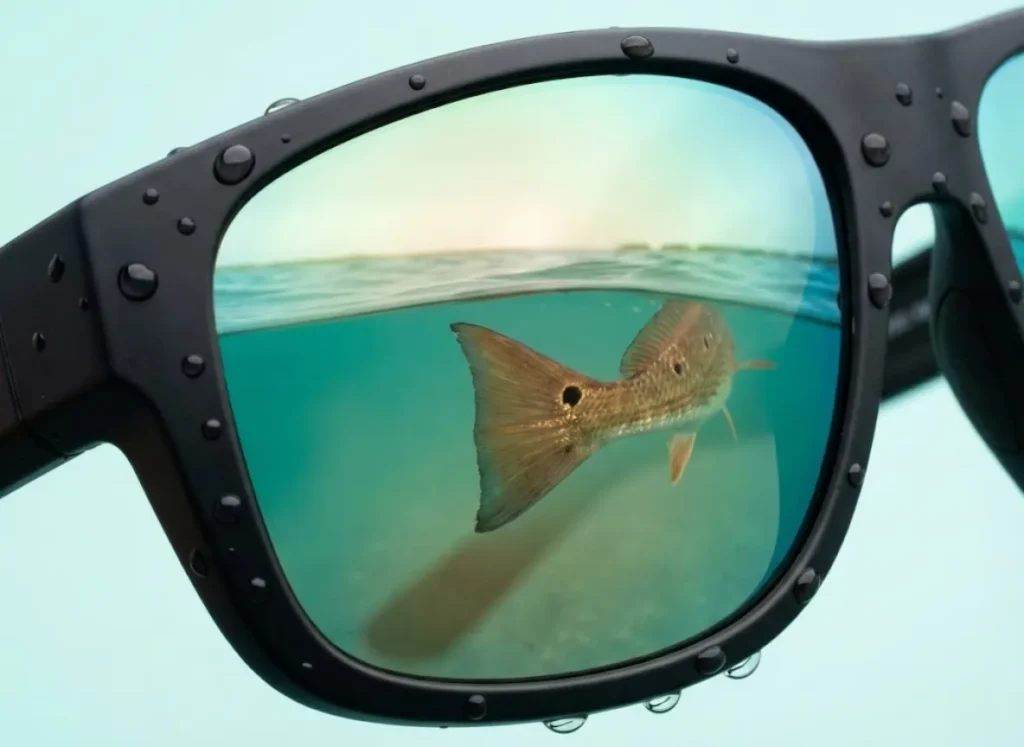
Correcting your aim helps you hit the target. But first, you have to see the target through the surface glare. This requires the right eyewear and an understanding of water clarity and light transmission.
How does lens color impact contrast in shallow water?
Not all polarized sunglasses are the same. The key number to look for is Visible Light Transmission (VLT). This measures how much light gets through the lens. For sight fishing in grass flats or creeks, you generally want a range of 12-18%. Darker lenses meant for deep sea or nearshore fishing often block too much light for shallow water.
The main problem in shallow water is “scattering.” This is blue light noise that makes it hard to see contrast. To cut through this, you need lenses that block that blue haze. This is why amber lenses, copper lenses, and yellow lenses are scientifically better for inshore fishing. They make red and brown objects (like redfish or trout) pop against green or brown backgrounds.
| Optimal Lens Base Colors by Water Environment | ||
|---|---|---|
| Water Type | Optimal Base Color | Science |
| Blue Water (Deep Ocean, Full Sun) | Grey | Neutral contrast reduction of overall brightness; allows for natural color perception in intense sunlight/glare environments. |
| Green Inshore (Flats, Murky Water) | Copper / Bronze | Selectively absorbs High-Energy Visible (HEV) blue light to maximize contrast; significantly enhances separation between red, green, and brown wavelengths to distinguish fish from grass or mud. |
| Low Light (Dawn, Dusk, Heavy Overcast) | Yellow / Sunrise / Violet | High Visible Light Transmission (VLT of 20-25%) maximizes light gathering; maintains visual acuity and contrast when photons are scarce. |
There is one exception: the “Golden Hour.” At dawn and dusk, there isn’t much light, but active fish are often feeding. During these times, you need brighter lenses (Yellow or Sunrise colors) to help you see. While visual acuity correlates with light environment, having a lens that is too dark can leave you blind during the best fishing trip of your life.
Mirrored lenses also do a job. A Green Mirror is tuned to reflect the extra green light found in estuaries and shallow water structure. Blue Mirror is better for the deep ocean. Grey lenses are soothing to the eye, but they are “neutral.” They darken the view without helping you separate the bedding bass from the bottom. For more help on gear, check our guide on selecting the best polarized sunglasses for specific waters.
When does polarization fail and how do you fix it?
Polarized lenses work by blocking horizontal glare. However, how well they work depends on where the sun is. There is a specific angle, called Brewster’s Angle, where glare is blocked perfectly.
This means polarization works best in mid-morning and mid-afternoon. At high noon, with the sun position at its zenith, or at sunrise with the sun on the horizon, your glasses won’t work as well. You can’t move the sun, but you can change what you wear. Wide-brimmed hats and side shields are necessary to block light from leaking in behind your glasses and blinding you.
Pro-Tip: If you are struggling to see through ripples, tilt your head slightly side-to-side. This manually adjusts the angle of your glasses relative to the waves, often letting you see what is hiding beneath.
Where you stand matters, too. Ideally, keep the sun at your back. Looking “down-sun” lets your vision penetrate deep into the water. Looking “up-sun” guarantees glare. Understanding the physics of polarization and Brewster’s angle helps you position the boat so you can actually see. For a deeper look, you can read about the physics of glare.
How Can You Move Without Triggering the Fish’s Alarm System?
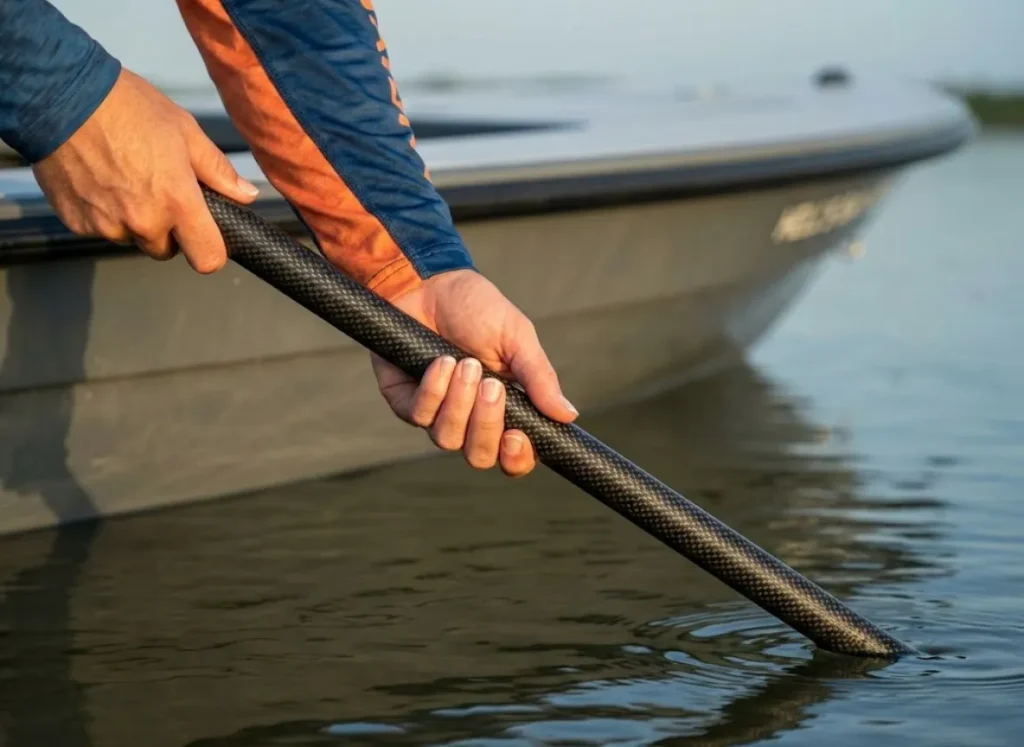
Seeing the fish is useless if the fish feels you coming before you spot them. We need to look at stealth mechanics and how boat noise travels through water.
What is a “pressure wave” and why does it spook fish?
Fish have a sensory system called the lateral line. It acts like a long-distance touch system that detects movement and vibration. When a boat hull moves through shallow water, the water has nowhere to go. It gets pushed outward and forward, creating a “pressure wave.”
This wave travels much faster and further than the visible wake you see on the surface. It is a giant signal that warns fish hundreds of feet ahead of you. This is why successful charter captains move very slowly. Speeding up quickly sends a shockwave through the water.
Hydroacoustic effects of underwater sound are louder in shallow water flats. Even stopping makes noise. Jamming an anchor pin into the bottom sends a tremor through the mud that fish can feel. By using the lateral line system, fish can pinpoint exactly where you are instantly.
What causes “hull slap” and how do you engineer silence?
Pressure waves are felt, but “hull slap” is heard. This happens when small waves hit the hard edges of your boat, like the chines or the bow. In the quiet of the mangroves or cypress knees, this tapping sound shoots right into the water.
The shape of the boat matters. Sharp edges are great for driving fast, but they are noisy. This applies to skiffs, kayaks, and canoes alike. Matching hull design to your fishing is important. Technical poling skiffs often have rounded edges designed to stay underwater and silent when the boat is stopped.
You can also fix noise with soft materials. Foam matting (like SeaDek) stops vibrations from dropped pliers or heavy footsteps from ringing through the hull like a drum. Stiffness also helps silence. Carbon fiber push poles are better than fiberglass because they don’t bend and wobble as much, which means less vibration goes into the water. Even trolling motors can be too loud; silent propulsion via a pole is the gold standard.
Understanding shallow water acoustics and sound transmission teaches us that acoustic stealth takes work. Do a “Quiet Boat Audit.” Tape down metal latches, wear soft shoes, and lift your pole straight up without sucking mud.
What Biological Cues Reveal a Fish That You Can’t Clearly See?
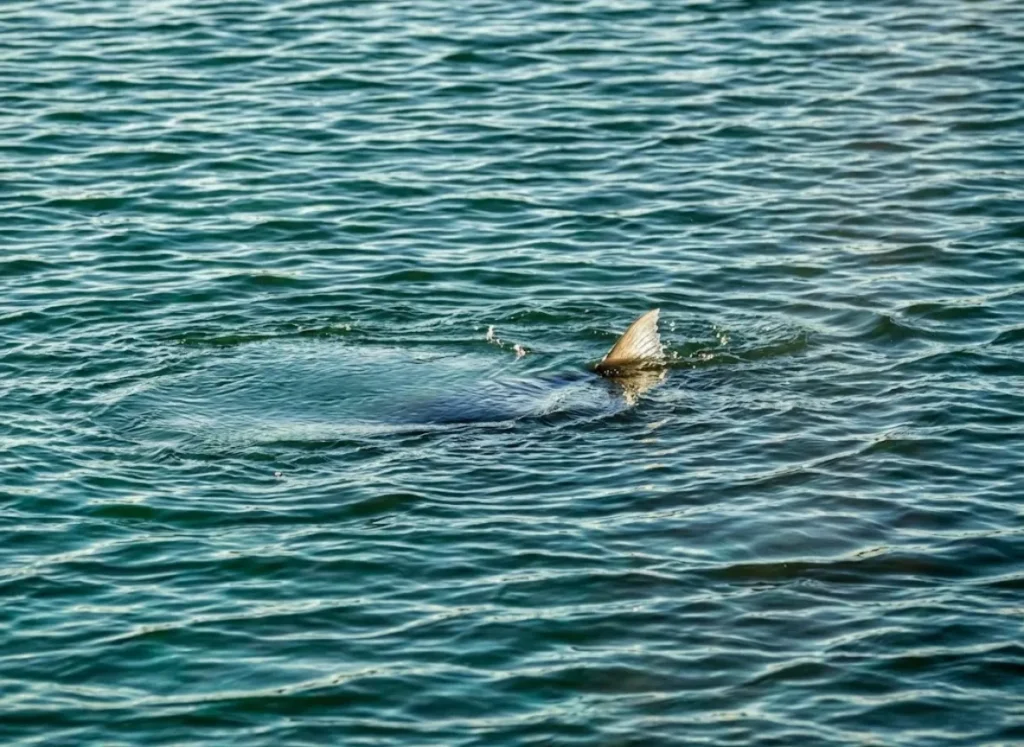
With the boat silent and your glasses ready, the last piece is understanding the fish itself. You need to learn “pattern recognition.” You aren’t looking for a whole fish; you are looking for small clues like tail movement or fin movement.
How do you distinguish “nervous water” from wind ripples?
“Nervous water” is a subtle change on the surface caused by a school of fish moving just underneath. While wind ripples are steady and even, nervous water looks like a “slick” patch in chop or a “shivering” spot on calm water.
The key is direction. Look for ripples moving against or across the wind direction. Retinal structure for motion detection in predatory fish dictates how they move, and this creates specific wakes. A large predator like a tarpon pushes a V-shape wake. A school of mullet makes a messy, chaotic disturbance.
If you see a patch of water that looks odd, pause and stare. Wind patterns drift with the wind. Nervous water often stays in place or moves on its own. Mastering this skill is a huge part of reading saltwater flats ecosystems.
What is the difference between a “feeding tail” and a “cruising wake”?
While nervous water shows movement, a “tail” shows focus. When a fish “tails,” it tips its head down to eat crabs or shrimp on the bottom. This forces its tail fin out of the water. This is common with redfish, bonefish, and even carp and black drum.
Visually, a tail looks different than debris. It is wet, shiny, and it flickers. A floating leaf just bobs up and down. A tailing fish is a great target because it is distracted by food. On the other hand, a “wake” means the fish is traveling. A wake moves steadily and pushes water; a tail stays in a tight area.
Understanding tarpon and bonefish life cycle behaviors helps you guess what they are doing. If you see a tail, your cast must be close and soft—perhaps using light spinning rods or flies. If you see a wake, you have to cast far ahead of the fish using paddletails or jerk shads. Be careful: if a tail disappears and the fish doesn’t move, it has likely lifted its head to look around. If you cast while its head is up, you will spook it. This decision-making is key to improving casting accuracy.
How Should Anglers Communicate and Execute the Shot?
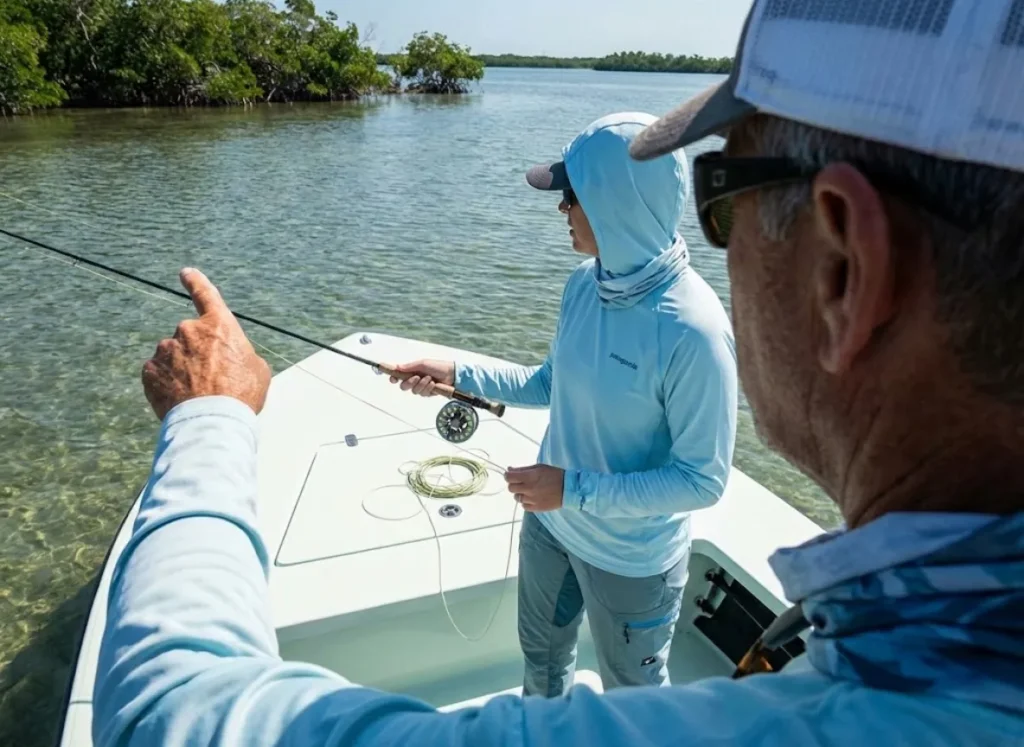
Finding the target is only half the battle. You have to tell the person with the rod and reel exactly where to look.
How does the “Clock System” prevent missed opportunities?
On a boat, “over there” doesn’t help anyone. We use the Clock System to be precise. 12 o’clock is always the front (bow) of the boat, no matter which way the boat is facing. 9 is Left, 3 is Right.
A good command has three parts: Direction, Distance, and Movement. For example: “11 o’clock, 40 feet, moving left to right.”
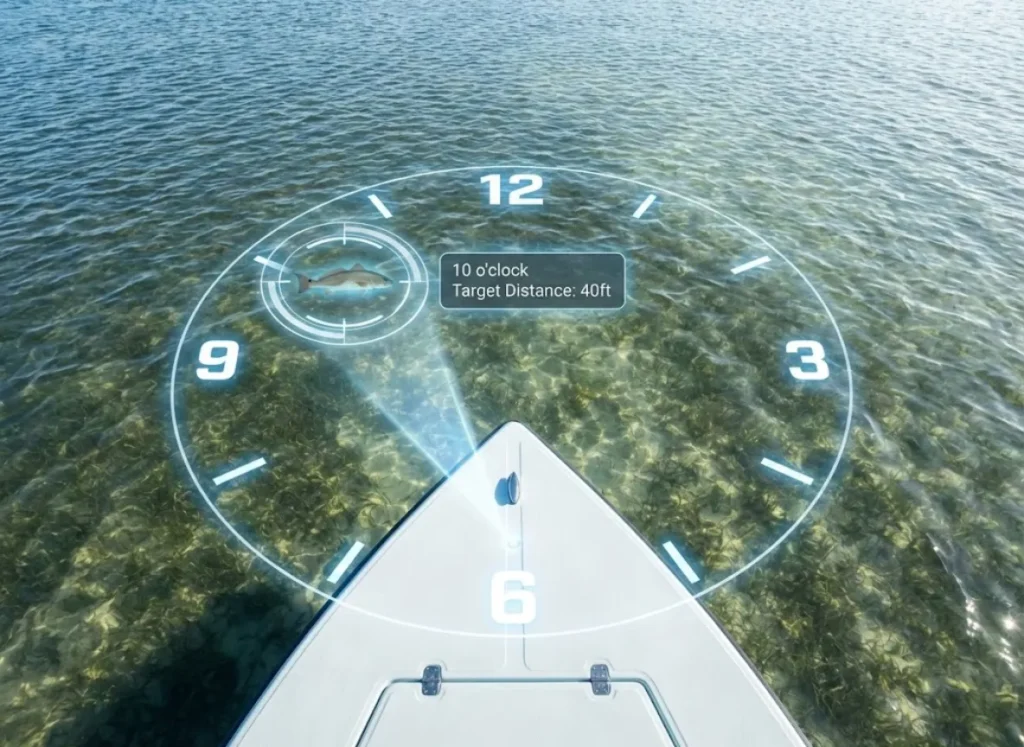
The trick is that the clock spins with the boat. If the guide turns the boat to give you a better shot, your 12 o’clock moves. You have to adjust instantly in your head. Guessing distance over water is hard, so practice is needed to hit the target every time you cast.
Why is “Soft Focus” superior to hard scanning?
Staring hard at one spot makes your eyes tired and gives you tunnel vision. Instead, use “Soft Focus,” sometimes called lifeguard scanning techniques. This uses visual tracking and peripheral awareness.
Your eye’s center is built for detail, but the edges of your vision are better at spotting moving objects and shadow creep. By relaxing your eyes and scanning patterns over wide areas, any movement—a flash or a wake—will trigger your side vision. Once you see the movement, you can lock on with your center vision.
Scan in layers: look close (20ft), then mid-range (40ft), then far (60ft). Remember to blink and look at the horizon now and then. Staring at blue water can numb your eyes to color; looking at the grey horizon resets them. This vision training is vital given the challenges of aquatic optics and keeps your eyes fresh. Studies on predator-prey visual integrity suggest that this wide-scanning method is exactly how natural predators hunt.
Putting It All Together
Sight fishing is not a game of chance. It is a mix of skills coming together.
- Physics Wins: You cannot beat the laws of light. You have to position yourself correctly to see through Snell’s Window.
- Stealth is Engineering: Silence comes from good hull design and smart materials, not just hoping to be quiet.
- Biology is the Code: Success comes from reading the nervous water and tailing patterns that show you where the fish are.
- Vision is a Skill: Soft Focus and the best lens color for sight fishing turn the confusing surface into a readable map.
Next time you are on the water, spend the first ten minutes without a rod in your hand. Practice the “Soft Focus” drill, read the surface for nervous water, and listen to the silence of your boat. When you finally pick up the rod, you won’t just be fishing; you’ll be hunting.
FAQ – Frequently Asked Questions about Sight Fishing
What is the best lens color for sight fishing in shallow water?
Amber lenses, copper lenses, or bronze base lenses are scientifically better for inshore flats. They filter out blue light haze. This increases the contrast between a brown or red fish and a green or muddy bottom.
How far should I lead a fish when sight casting?
A general rule of thumb is 3 to 6 feet for a cruising fish. You have to adjust for how fast the fish is moving and how deep it is. You must cast to where the fish will be, not where it is. Remember, the water makes the fish look further back than it really is.
Can you sight fish in murky or cloudy water?
Yes, but you have to change your strategy. Instead of looking for the fish, look for surface cues. Focus on nervous water, wakes, and tailing. Also, switch to a brighter lens (Yellow or Sunrise color) to let more light in.
What is hull slap and how do I stop it?
Hull slap is the noise of waves hitting the edges or bow of the boat. To stop it, shift weight in the boat to keep the edges underwater. You can also use a boat with a spray rail design or stick sound-dampening mats (like SeaDek) to the noisy parts of the hull.
Risk Disclaimer: Fishing, boating, and all related outdoor activities involve inherent risks that
can lead to injury. The information provided on Master Fishing Mag is for educational and informational purposes
only. While we strive for accuracy, the information, techniques, and advice on gear and safety are not a substitute
for your own best judgment, local knowledge, and adherence to official regulations. Fishing regulations, including
seasons, size limits, and species restrictions, change frequently and vary by location. Always consult the latest
official regulations from your local fish and wildlife agency before heading out. Proper handling of hooks, knives,
and other sharp equipment is essential for safety. Furthermore, be aware of local fish consumption advisories. By
using this website, you agree that you are solely responsible for your own safety and for complying with all
applicable laws. Any reliance you place on our content is strictly at your own risk. Master Fishing Mag and its
authors will not be held liable for any injury, damage, or loss sustained in connection with the use of the
information herein.
Affiliate Disclosure: We are a participant in the Amazon Services LLC Associates Program, an
affiliate advertising program designed to provide a means for us to earn advertising fees by advertising and linking
to Amazon.com. As an Amazon Associate, we earn from qualifying purchases. We also participate in other affiliate
programs and may receive a commission on products purchased through our links, at no extra cost to you. Additional
terms are found in the terms of service.