In this article
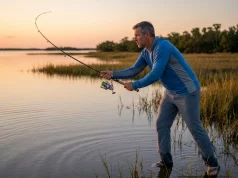
The shade beneath a floating dock is a fortress. In the middle of a hot day, this is where the big bass hide. They sit there to stay safe from birds and to get out of the boiling sun. Most fishermen just cast near the edge and hope a fish swims out.
But a pro like Andy Montgomery or Gerald Swindle doesn’t just hope. They break into the fortress. By skipping a lure deep into the darkest corners—a technique made famous on Lake of the Ozarks—you trigger a reaction from a bass that thinks it is totally safe.
This technique isn’t magic. It’s just using speed and angles correctly. This guide will take you from being nervous about backlashes to confidently sliding skipping jigs right where the fish live.
Why Does a Lure Skip Instead of Sink?
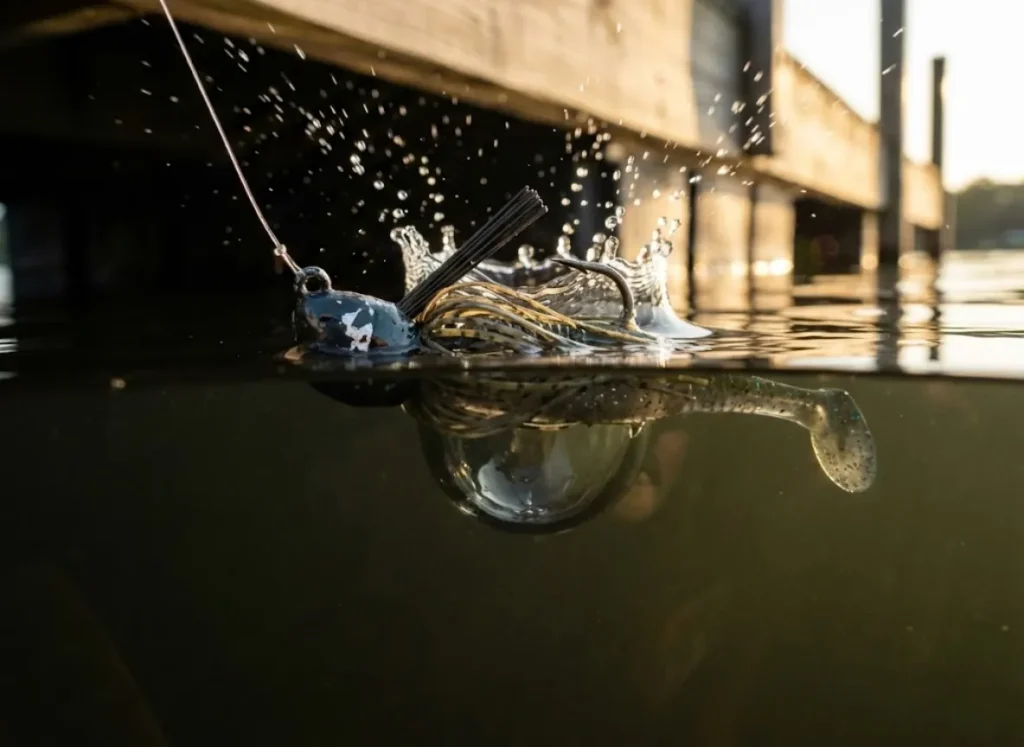
To get a bait twenty feet under a dock, we need to understand how a heavy piece of lead can slide across the water without sinking. This is the physics of the skip.
What Is the “Magic Angle” of Incidence?
Skipping is basically a crash between your lure and the water. Whether it works or fails depends entirely on the angle of incidence.
Research on the physics of water-skipping interaction shows there is a “magic angle” of about 20 degrees. To hit this angle with a fishing rod, your release point has to be very low. You often need to be within 6 to 12 inches of the water to make the bait skip like a stone.
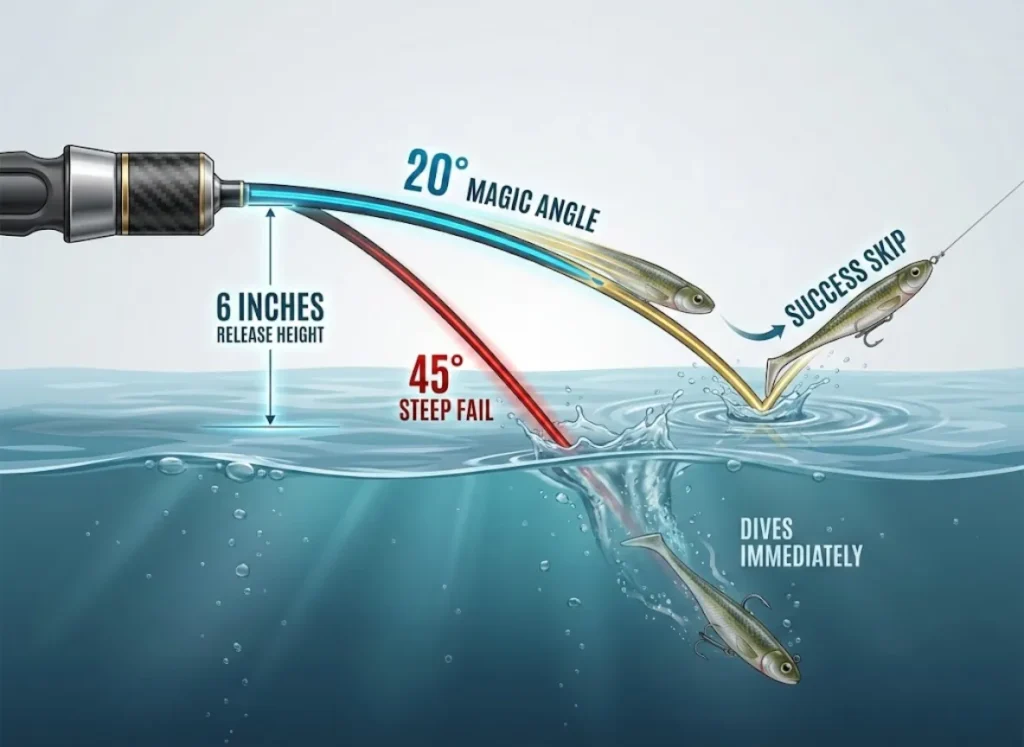
If your angle is steeper than 45 degrees, the lure hits too hard. It breaks the surface tension and dives immediately. To stop this, your rod tip needs to move in a flat line parallel to the water.
This low trajectory cast lets the lure skim instead of digging in. To do this, you have to physically get lower. Bend your knees so your rod tip is level with that 20-degree path. This flat path is the same method used to improve casting accuracy in open water, but here, the margin for error is non-existent.
Why Is a Heavier Jig Actually Better?
It seems like a lighter lure would skip better, like a flat, light stone. In fishing, that isn’t true. A 1/2 oz Greenfish Craw Jig is usually the best choice, and it often works better than lighter 1/4 oz or 3/8 oz jigs.
The reason is simple: heavy things carry more speed. When a heavy lure hits the water, the water tries to slow it down. The extra weight helps the jig “punch” through that resistance. This is why lure density matters so much.
Pro-Tip: Pay attention to the “Salt Paradox.” Soft plastics filled with salt impregnation, like a Yamamoto Senko, are heavier and often skip further than floating plastics, even though they sink faster when they stop moving.
Lighter jigs don’t have enough weight to fight the friction of the water. They often stop after the first or second skip. This “heavy advantage” means you need to understand the impact of object density on water entry to pick the right trailer.
You want a flat-bottomed lure or a compact lure with an appendage-less design to reduce drag. A Zoom Z-Hog or a Keitech trailer is perfect for this. While floating materials look good underwater, they are too light to generate good skipping speed. If you prefer the physics of fishing lure buoyancy found in stretchy Z-Man plastics, you often have to use an even heavier jig head to make up for the light plastic.
What Equipment Is Required to Master the Skip?
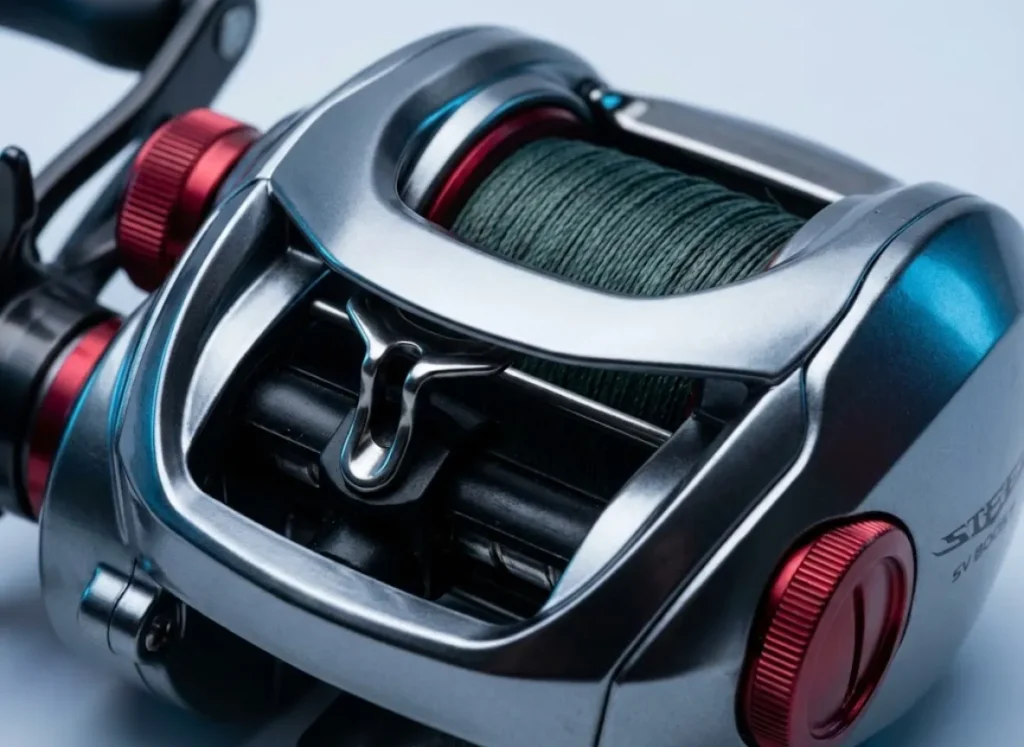
You can’t force this technique with regular rods and reels. You need specific tools to make it work.
Which Reel Technologies Prevent Backlashes?
The baitcasting reel is usually where things go wrong. Standard reels hold a lot of line, which makes the spool heavy. When a skipping lure hits the water, it slows down instantly. A heavy spool keeps spinning fast, dumping line everywhere and causing a giant tangle.
Modern skipping uses SV spools (found on Daiwa reels) or shallow spools. These are lighter and easier to stop. Shallow spools hold only about 40 yards of line. Because they hold less line, they have less weight to start spinning and, more importantly, less weight to stop.
| Standard Deep Spool vs. Shallow/SV Spool Comparison | ||
|---|---|---|
| Feature | Standard Deep Spool | Shallow/SV Spool |
| Weight | Heavy / High Mass. Deep designs and heavy frames contribute to significant rotating mass, which increases momentum. | Ultra-lightweight. Often made of magnesium or aluminum with porting (drilled holes) to drastically reduce rotating mass. |
| Line Capacity | High. Designed to hold a large volume of line, which adds significant weight to the spool when filled. | Low. Intentionally restricted (e.g., ~40 yards on Lew’s Pro SP) to minimize the total weight of the line and spool. |
| Startup Inertia | High. The heavy spool retains high angular momentum, continuing to spin fast even when the lure decelerates, leading to backlashes. | Minimized. The low mass allows the spool to accelerate instantly and stop nearly instantly when the lure hits the water, preventing overruns. |
A reel gear ratio of 7.5:1 or higher is a must. These high-speed reels let you pick up slack fast once the lure finishes skipping, so you can set the hook before the fish wraps you around a piling.
Some reels use computers to control the spin, but many pros prefer mechanical brakes on shallow spools, like those on a Curado 70. They use the principles of angular momentum conservation to provide smooth braking without needing batteries. For a closer look at specific models, check our guide on the best baitcasting reels for bass that have these braking systems.
How Does Rod Handle Length Impact Mechanics?
Skipping involves moving the rod in tight circles close to your body. Standard heavy rods usually have long handles for leverage, but those are bad for skipping.
A long handle gets in the way. It will snag on your ribs, rain gear, or life jacket when you try to roll your wrist. The best rod for dock skipping has a shorter rear grip, usually around 13 or 14 inches, so it clears your arm and body.
The rod needs to be strong enough to pull fish out, but the tip must be flexible. A rod power Medium-Heavy with a rod action Fast is ideal. A rod length 6’6″ to 7’3″—like a Dobyns Fury or Shimano Zodias—gives you the right balance of control and clearance.
A fast tip lets the rod load up with just a quick wrist snap. This creates the rod tip speed you need without a big arm swing. Understanding the biomechanics of upper limb movement shows why a short snap is better than a full arm swing here. It is important to know the difference between rod power vs action before you buy a blank.
How Do You Execute the Perfect Skip Cast?
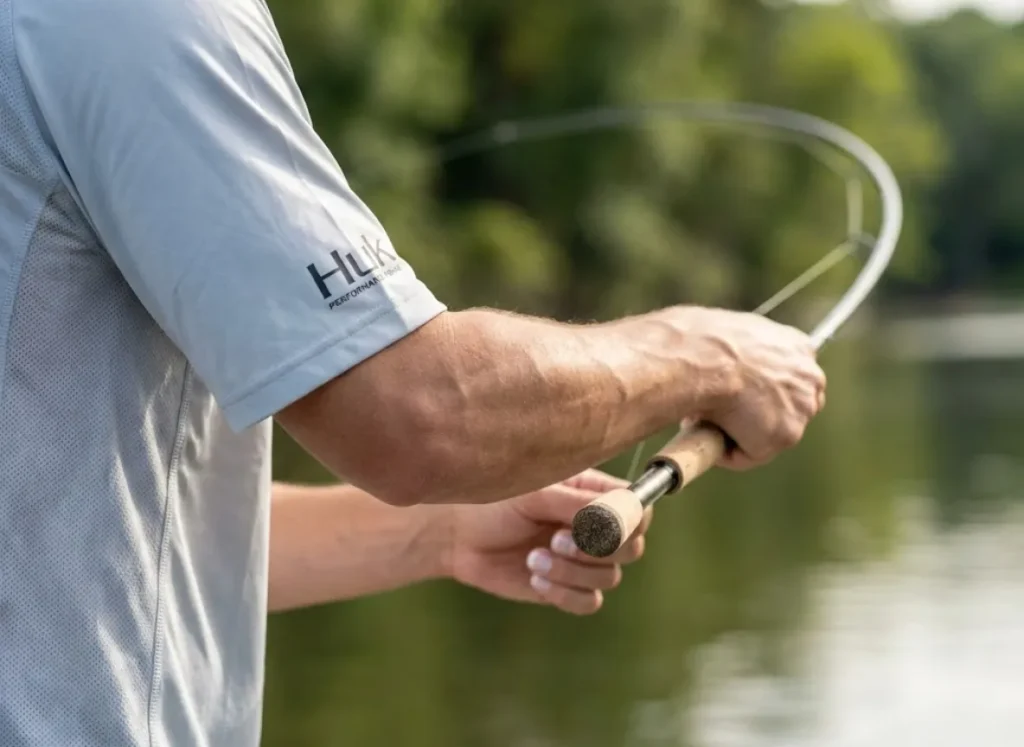
Once your gear is ready, you need to focus on how you move. We need to look at the backhand skip, which is different from a normal overhead cast.
How Do You Master the Backhand Skip?
The backhand skip is the sign of a skilled angler. It lets you reach the hard-to-hit side of the dock. Unlike a normal cast, the backhand uses a circular backhand slide cast motion.
Think of it like a tennis backhand or throwing a frisbee. The power comes from turning your body, not just your arm. You need to turn your shoulders so your back is slightly facing the target. This clears a path for your arm to swing across your chest using a sidearm skipping technique.
Keep your wrist loose. If you lock your wrist, you will chop down and drive the lure into the water too hard. The rod tip should make a “U” shape or a circle. It loads up at the bottom and releases as it comes up to that flat, level path.
You actually need to aim slightly to the left of your target (for right-handers). The spin on the lure makes it curve. To hit the gap, use “Visual Locking.” This means staring at a tiny target, like a specific nail, rather than looking at the whole empty space.
This focus uses visual gaze behavior in aiming tasks to help you aim better and stop you from getting nervous. Of course, this assumes you already know how to cast a baitcaster and control the spool with your thumb.
Pro-Tip: Tuck in your shirt. Loose clothing will catch the handle of your rod and ruin your cast. Tuck in your shirt and rain gear before you get close to the docks.
Where Should You Skip and How Do You Manage Access?
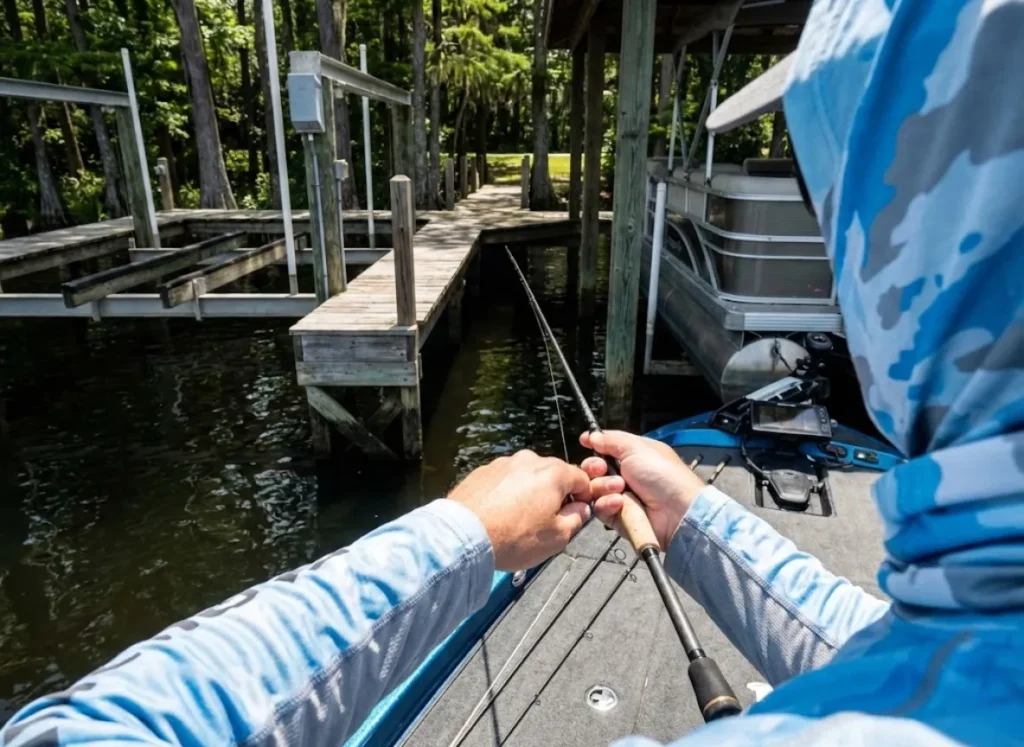
Picking the right target and following the rules is just as important as the cast itself. You are fishing on public water, but you are casting near private property.
What Are the Rules of Homeowner Etiquette?
The water around a dock is usually public, but the dock itself is private property. The rule is simple: don’t touch it. Never let your skipping lures, braided fishing line, or boat hit the dock or the boats parked there.
Be extra careful around boat covers. If you snag a canvas cover, you can rip it, and that costs money. If you do snag a piling dock, break your line. Do not climb onto the dock to get your lure back.
Climbing onto the dock is trespassing. We must respect the intersection of public and private property rights so we don’t lose our right to fish there.
If people are swimming or sitting on the dock, skip it and move to the next one. You don’t want to hurt anyone. If a homeowner yells at you, don’t argue. Just apologize and leave.
Look for older wooden docks or docks with fewer slats. These usually hold more active fish and suggest the spot has been there a long time. This is part of a smart approach to fishing heavy cover, making sure you spend time on the best targets.
Conclusion
Precision fishing is about controlling your mechanics. By sticking to the 20-degree angle and using the speed of heavy jigs, you take luck out of the picture.
Remember that your gear matters. Shallow spools and short rod handles are necessary tools, not just fancy add-ons. Practice that power skip, but always respect the water and the dock owners. Good aim prevents damage, and good manners keep the water open for everyone.
Before you head to the lake, take your setup to a local pond or open water. Practice that low angle cast without the risk of hitting a dock post. Share your progress or your favorite skipping jig setup in the comments below.
FAQ – Frequently Asked Questions
What is the best lure weight for skipping docks?
A 1/2 oz jig is usually the best weight. The heavier weight gives it the speed to punch through the water’s surface friction. Lighter lures tend to stop and sink too early.
How do I stop my reel from backlashing when I skip?
Use a reel with a shallow spool and keep your thumb on the spool during the cast. Your thumb acts as the brake. As soon as the lure hits the water, press down with your thumb to stop the spool from spinning.
Can I use a spinning reel to skip lures?
Yes, spinning reels are easier for beginners because they don’t backlash. However, they aren’t as accurate or strong as baitcasters for pulling big fish out of heavy cover. Spinning gear is better for light baits like floating worms or tubes.
Is it legal to cast under a private dock?
In most places, the water under a dock is public, so casting is legal as long as you don’t touch the dock or the land. However, rules change depending on where you are. Never climb onto a dock to get a lure back, as that is trespassing.
Risk Disclaimer: Fishing, boating, and all related outdoor activities involve inherent risks that
can lead to injury. The information provided on Master Fishing Mag is for educational and informational purposes
only. While we strive for accuracy, the information, techniques, and advice on gear and safety are not a substitute
for your own best judgment, local knowledge, and adherence to official regulations. Fishing regulations, including
seasons, size limits, and species restrictions, change frequently and vary by location. Always consult the latest
official regulations from your local fish and wildlife agency before heading out. Proper handling of hooks, knives,
and other sharp equipment is essential for safety. Furthermore, be aware of local fish consumption advisories. By
using this website, you agree that you are solely responsible for your own safety and for complying with all
applicable laws. Any reliance you place on our content is strictly at your own risk. Master Fishing Mag and its
authors will not be held liable for any injury, damage, or loss sustained in connection with the use of the
information herein.
Affiliate Disclosure: We are a participant in the Amazon Services LLC Associates Program, an
affiliate advertising program designed to provide a means for us to earn advertising fees by advertising and linking
to Amazon.com. As an Amazon Associate, we earn from qualifying purchases. We also participate in other affiliate
programs and may receive a commission on products purchased through our links, at no extra cost to you. Additional
terms are found in the terms of service.