

In this article
The completion of the Pinopolis Dam in 1941 did more than generate power for South Carolina; it accidentally trapped a population of Morone saxatilis—ocean predators known as Atlantic striped bass—in a freshwater jail. Biologists expected these fish to wither and die without access to the salt. Instead, they thrived, exploding in population and changing freshwater striped bass fishing in North America forever.
This unintended event created a unique target for anglers. These landlocked striped bass retain the hunting instincts of pelagic wolf packs while living in the backyard of the American interior. Catching them requires respecting this duality—they are marine fish living in a freshwater world.
To catch freshwater stripers consistently, you have to evolve from a shoreline caster into a student of the lake. You must understand that temperature and oxygen—not just lure selection—dictate the bite. We will move from the biology of the “thermal squeeze” to the tactics required to pull these predators from the depths.
How did a saltwater predator adapt to freshwater reservoirs?
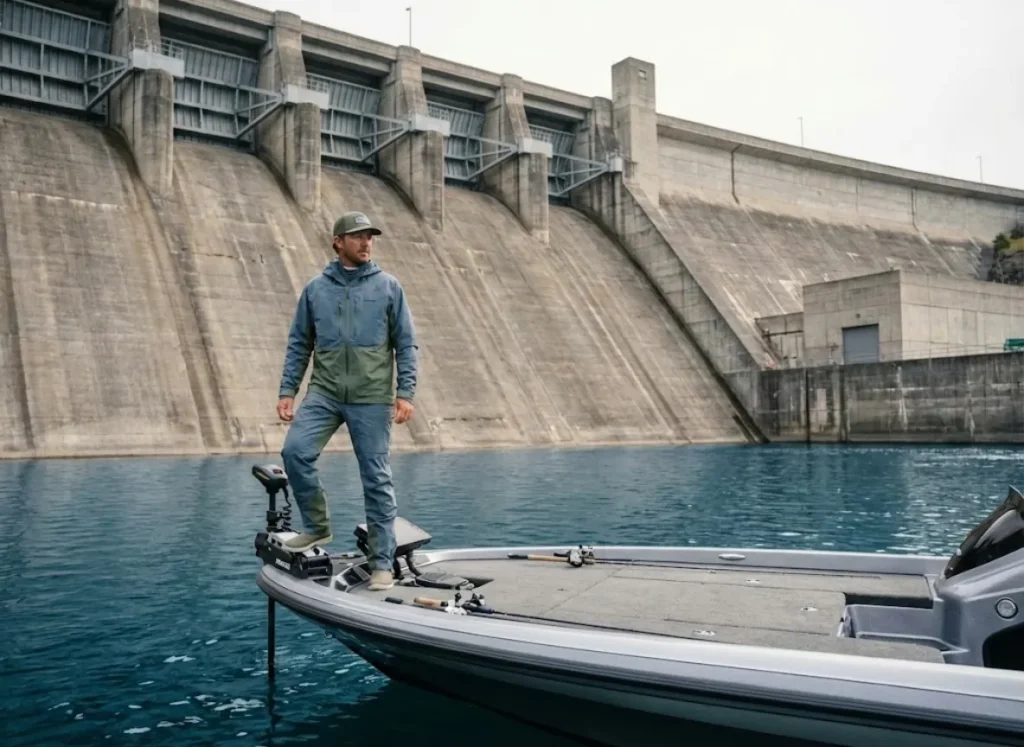
Through unexpected physical adaptability, striped bass proved they could live their entire lives in fresh water. However, most modern populations rely on national fish hatchery stocking trucks because they lack the specific river conditions needed to reproduce naturally.
What was the accidental beginning of the landlocked striper fishery?
The striped bass fishery began with the closure of the Santee-Cooper lakes (Lake Marion and Lake Moultrie) in South Carolina during the early 1940s. Before this, striped bass lived in the Atlantic and only entered rivers like the Hudson River or Chesapeake Bay to spawn. The entrapment proved that the species could adapt, living entirely in fresh water if the current flow was just right for their eggs. You can read more about the seasonal movements of adult striped bass in the Santee-Cooper to understand the behavior of this original population.
Unlike most freshwater fish, striped bass eggs are semi-buoyant. They need nearly 50 miles of moving river water to stay suspended—a process called egg tumbling—until they hatch. Because most reservoirs don’t have this specific length of flowing water, the majority of modern fisheries (like Smith Mountain Lake, Leesville Lake, or Raystown Lake) are “put-and-grow” systems. They depend on stocking to maintain striped bass stocks. Exceptions exist, such as Lake Texoma, where the Red River provides enough flow and salt for natural hatching. It is also important to learn the visual cues for distinguishing pure strains from hybrids like the Wiper. These hybrid striped bass (also known as wipers, sunshine bass, palmetto bass, or cherokee bass) are often stocked in similar waters but grow differently.
Pro-Tip: If you are fishing a reservoir with a major river inlet, check historical flow charts. Years with high water levels in the spring often help eggs survive, leading to better fishing a few years later.
Why does the “temperature-oxygen squeeze” dictate survival?
Striped bass have a “fundamental thermal niche.” Simply put, they prefer water temperatures below 77°F with plenty of oxygen. According to USGS research on the fundamental thermal niche of adult landlocked striped bass, warm water limits where they can live. In summer, reservoirs form layers: surface water becomes too hot, while deep bottom water often runs out of oxygen.
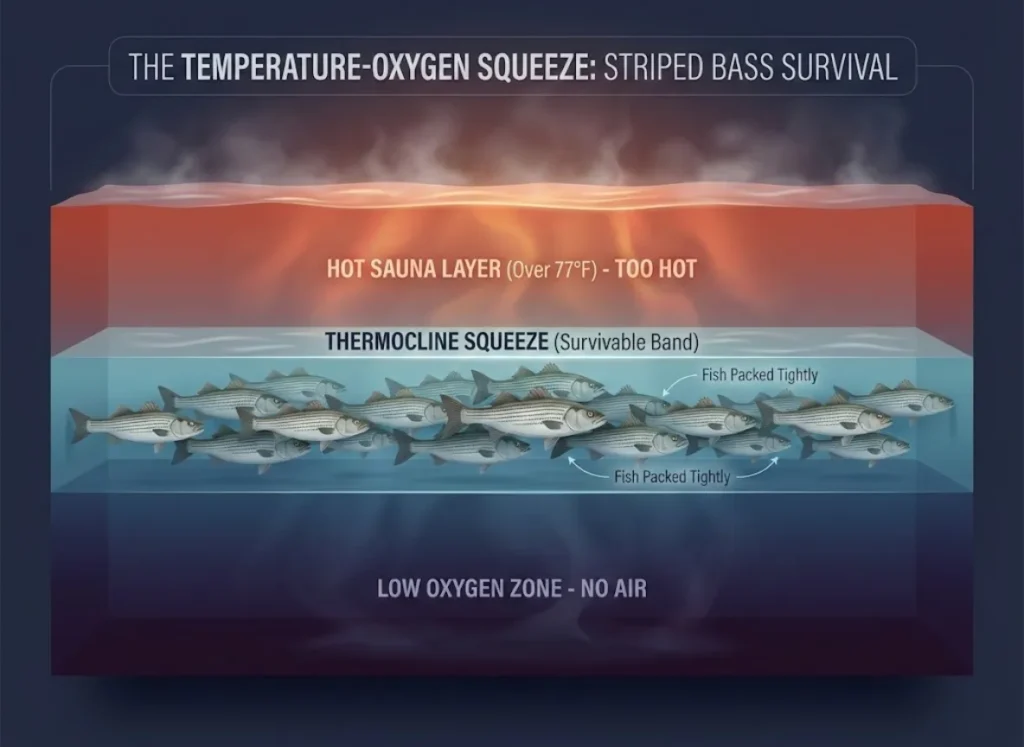
This forces the fish into a narrow band of water—the thermocline—where conditions are just barely survivable. You must become proficient at identifying the thermocline layer on your sonar to find this specific depth range. This “squeeze” packs the fish into a tight area, making them easier to find with a fishfinder but also very stressed. In some lakes, the squeeze can eliminate all safe water, leading to summer die-offs that usually kill the biggest trophy fish first.
How does the food source dictate predator behavior?
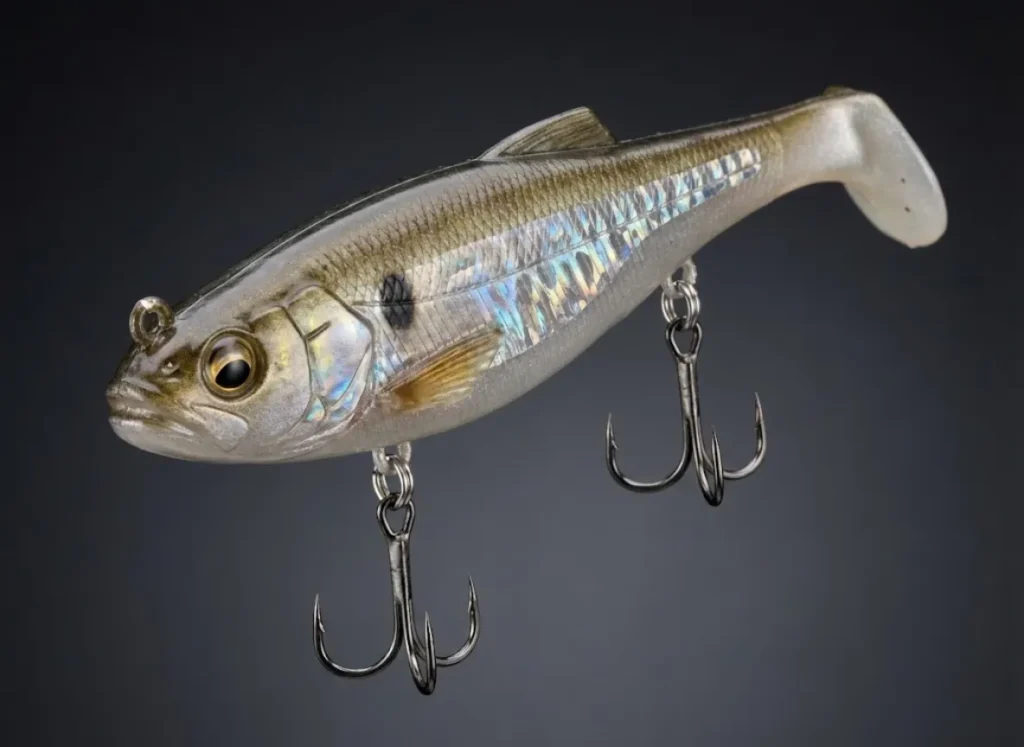
Where the predator swims depends entirely on the baitfish. Understanding the difference between shallow-schooling shad, deep-dwelling herring, or river-running skipjack is the main key to finding stripers.
What is the difference between Gizzard Shad and Threadfin Shad?
Gizzard Shad are the “trophy” meal. They grow fast, reaching sizes of 12-18 inches, which only big striped bass can eat. You can view the full Gizzard Shad Species Profile to understand their rapid growth. Threadfin Shad, on the other hand, are smaller (3-6 inches) and sensitive to cold. They stay small enough for all stripers to eat. Threadfin tend to school near the surface, causing a topwater blitz, while Gizzard shad often graze on the bottom.
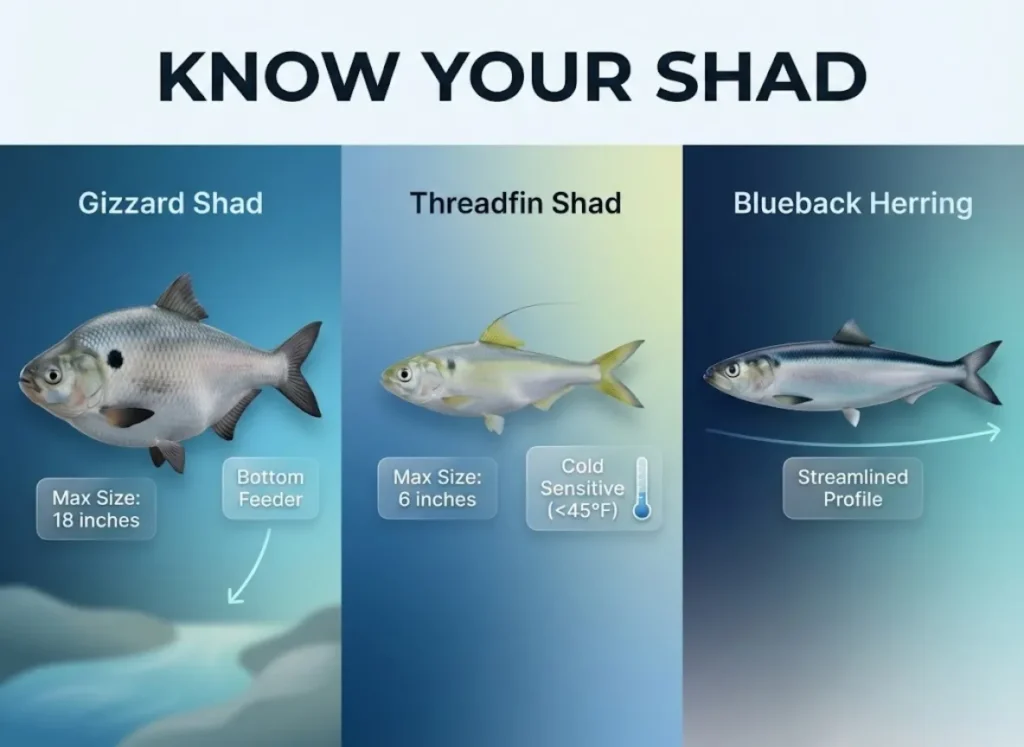
“Matching the hatch” is critical here. Throwing a small 3-inch lure into a school of large Gizzard shad will usually get ignored. Threadfin populations can die off in winter if water temps drop below 45°F, creating massive feeding events known as the “shad kill.” Gizzard shad can grow too big for most fish to eat, filling the lake with food the predators can’t touch. Timing is everything, especially when timing the chaotic shad spawn events that occur in the shallows during late spring.
How do Blueback Herring change the hunting strategy?
Blueback Herring and alewives prefer deeper, cooler water than shad. They often stick tight to the thermocline or deep standing timber. In Southern reservoirs like Lake Lanier (GA), Lake Murray (SC), and Lake Norman (NC), their presence forces stripers to leave the shorelines and hunt in deep, open water. The Ohio DNR offers excellent Fishing Tips by Species that cover the open water habits of stripers chasing these different baits.
Fishing with live bait for herring-eaters requires downlining. This means dropping weighted lines straight down to the exact depth you see on sonar. Because herring swim constantly, you must keep them in round tanks with plenty of oxygen and current. If you don’t, they get “red nose” and die. Mastering the art of learning how to keep bait alive in specialized tanks is necessary for this style of fishing. The “freeline” bite happens when stripers push these deep herring schools to the surface, creating short but explosive topwater activity.
Where can anglers locate stripers throughout the four seasons?
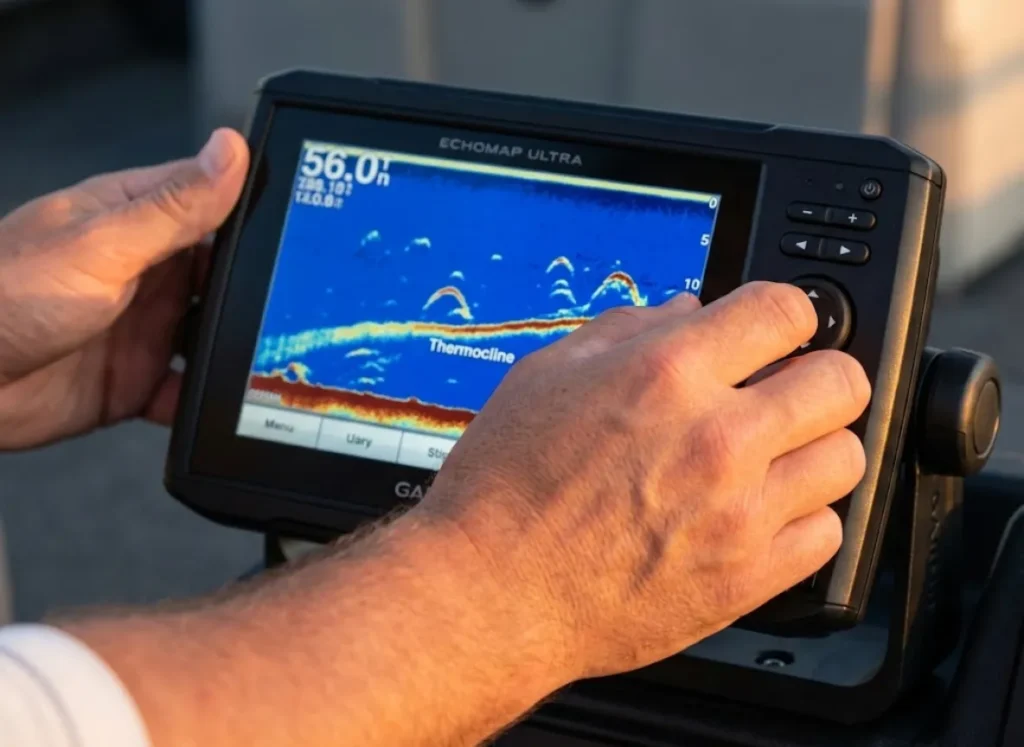
Seasonal location follows a predictable path: river runs in spring, deep main-lake hiding spots in summer, and creek arm feeding frenzies in the fall. This applies whether you are fishing Lake Cumberland in Kentucky, Lake Ouachita in Arkansas, or western waters like Lake Mead, Lake Powell, and Lake Havasu.
Why do stripers make a “false spawning run” in the spring?
When the water warms up to the preferred spawning temperature of 55-68°F, landlocked stripers swim up major rivers. They are copying their ancestors’ return to fresh water to spawn. They gather below dams, shoals, or rock gardens at the top of the reservoir. This is common in systems like Watts Bar Lake or the Santee-Cooper. The Striped Bass profile by the Virginia Department of Wildlife Resources explains these migration patterns in detail.
In most reservoirs, this is a “false run.” The eggs will sink to the bottom and die before hatching because the river isn’t long enough to support egg suspension. Even though they won’t reproduce, the fish are aggressive and hungry. This is especially true at night or in low light periods near moving water. Anglers should target current edges using large swimbaits or drifting live shad, which requires mastering techniques for fishing in current.
How does summer heat force fish into deep water?
By mid-summer, surface temperatures go over 80°F. This forces stripers to retreat to the main lake basin near the dam where the water is deepest. Fish suspend at the depth of the thermocline (often 20–60 feet). They avoid the hot surface and the oxygen-depleted bottom. This pattern holds true in clear waters like Lewis Smith Lake, Lake Norfork, and Beaver Lake. Texas Parks and Wildlife has published Guidelines for Culture of Striped and Palmetto Bass which highlight the specific oxygen needs during these hot months.
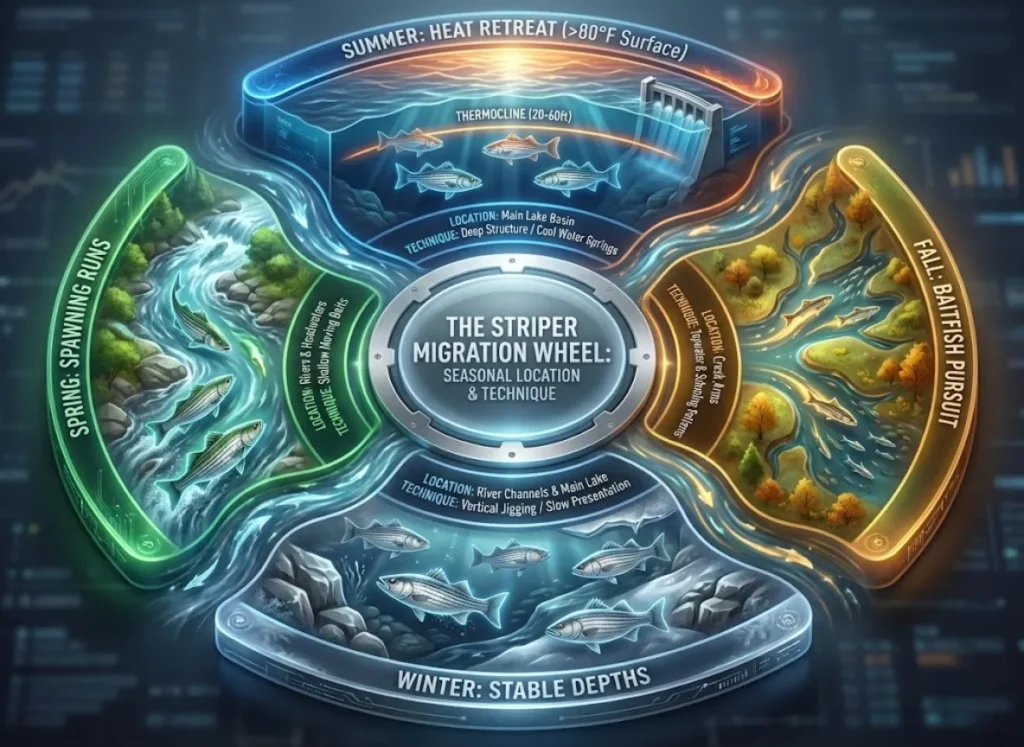
In reservoirs that generate power, the moving water can mix the layers, triggering bite windows. Anglers must watch for monitoring dissolved oxygen levels for metabolic strikes. Fish will cluster tightly around underwater springs or cold streams flowing into the lake. These cool spots attract huge numbers of fish, sometimes visible as “blackouts” on your sonar screen.
What triggers the autumn “blitz” and surface feeding?
As surface water cools down to the 60s and 70s, the lake “turns over.” This mixes the water layers and lets stripers leave the deep water. At the same time, baitfish schools move into the creek arms and shallow flats for winter, with stripers chasing them. This creates “schooling” or “blitz” conditions where packs of stripers push bait to the surface. You can review regional reports like Striped Bass – NORTH – NC Wildlife to track these fall movements into creeks.
Topwater poppers and shallow crankbaits become very effective because the fish are looking up. Success requires understanding how lake turnover physics resets the system. The fish might scatter at first, but they will group up to feed. Look for “bent rods”—other boats hooking up—or diving blue herons and seagulls to find these moving schools.
What specific tactics and gear catch the most fish?
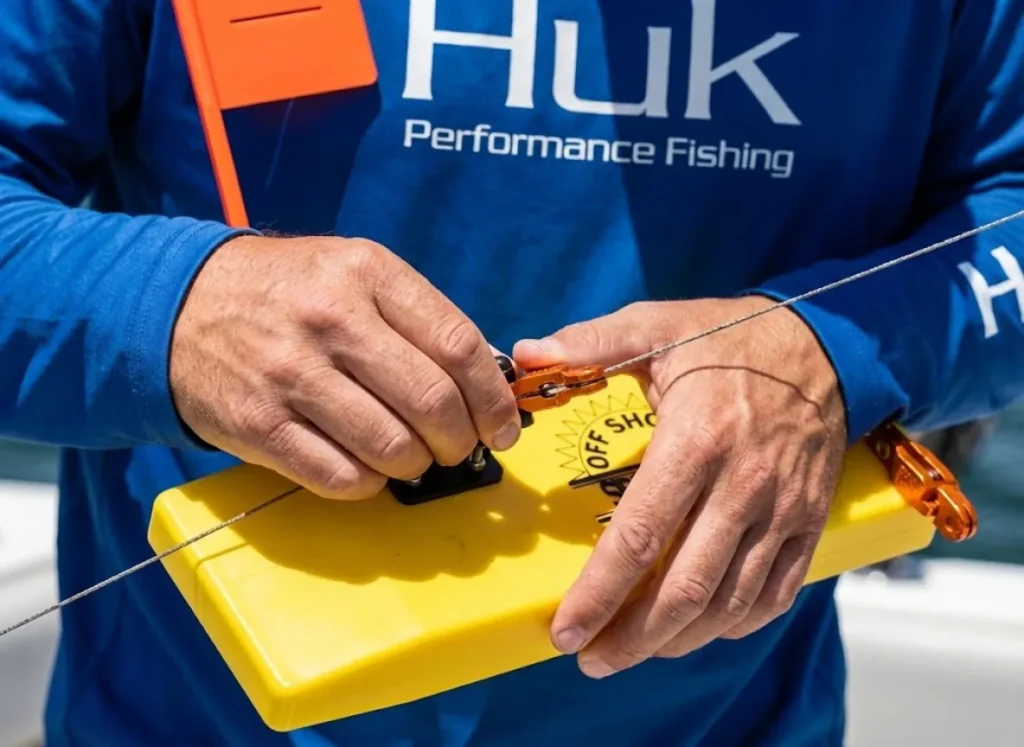
You need heavy tackle capable of trolling big rigs or precise live bait strategies to target specific depths. Whether you are on Lake Buchanan, Lake Tawkoni, or Possum Kingdom Lake, the gear remains similar.
When is live bait the best method?
Slow trolling live baits is the most popular tactic for landlocked striped bass. Live bait (shad, herring, or trout) is the most consistent way to catch big striped bass, especially when fish aren’t aggressive. Planer Boards are essential for shallow water in spring and fall. They move the bait away from the boat’s noise and shadow. You can learn how this works in the guide to Planer Board Trolling for Striped Bass on Lake Anna.
The bait must be lively. A bait that struggles sends out vibrations that stripers can feel. If the bait is tired, they ignore it. Circle hooks (size 1/0 to 5/0) are mandatory if you plan to release the fish, as stripers tend to swallow live bait deep. Anglers need reels with a “baitrunner” feature or need to be precise when calibrating how to set your fishing drag for sudden runs. This lets the fish take the bait without feeling resistance.
How does precision trolling target suspended fish?
Trolling lets you search huge open-water areas for schools that aren’t near the bottom. Lead Core Line is a heavy, color-coded line that sinks the lure without extra weights. It sinks about 5 feet per color, allowing you to follow the river channel precisely. A technical breakdown can be found in the 2021 Lake Powell Fisheries Technical Report, which discusses trolling tactics in deep reservoirs.
Umbrella Rigs (Alabama Rigs) look like a whole school of baitfish. This triggers a feeding response even in fish that aren’t hungry. Spoons and minnow plugs are also staples. Speed control is critical; typical trolling speeds are 2.0 to 3.0 mph. For a broader overview, consider implementing the definitive guide to trolling for freshwater fish. You need heavy rods and large reels loaded with 20-50lb braided line to handle the drag of these big rigs. Fly fishing guides, like those inspired by Blane Chocklett, often use 8-10wt fly rods, sinking lines, and Scientific Anglers lines to reach these fish.
Pro-Tip: Use thin braided line with deep-diving crankbaits. The thin line cuts through the water better than thick plastic line, letting your lure dive up to 30% deeper.
How should anglers manage catch-and-release?
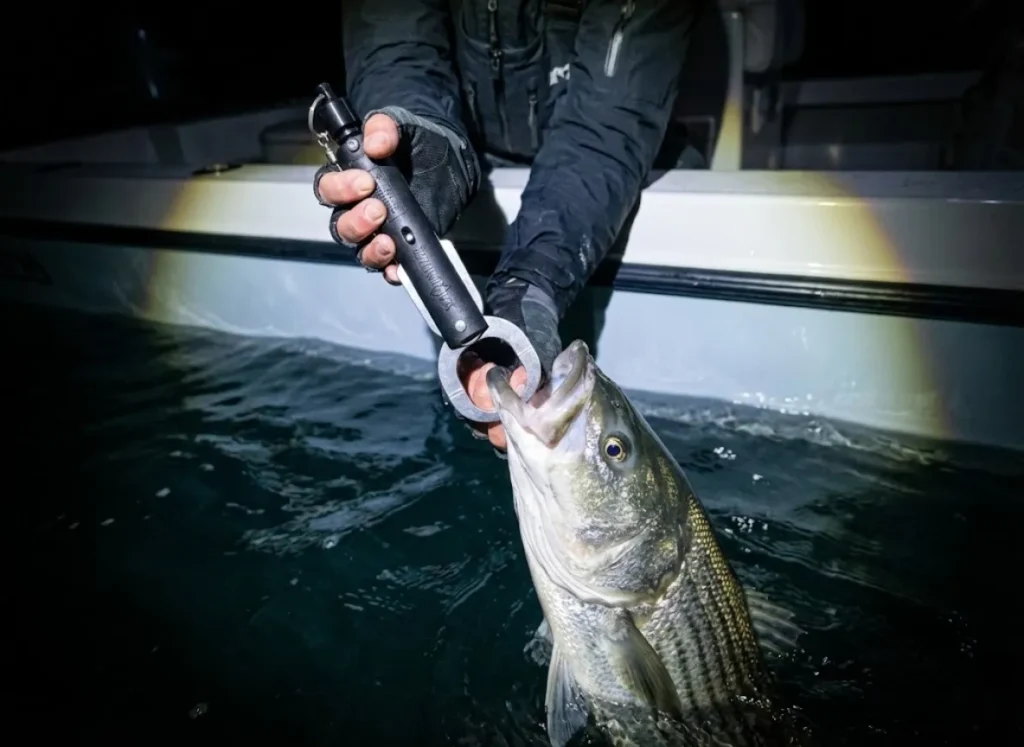
Anglers must handle fish quickly and use tools to help them survive deep-water changes. This is vital for sustainable catch & release of striped bass stocks.
What is barotrauma and how does it kill stripers?
Barotrauma is like “the bends” for fish. It happens when you reel a fish up too fast from deep water (usually deeper than 30 feet). The gases in the swim bladder expand. Signs include a bloated belly, bulging eyes, and the stomach sticking out of the mouth. The Florida Fish and Wildlife Conservation Commission provides clear descriptions of this condition.
If you release the fish like this, it floats. It can’t swim down, so it dies from heat or gets eaten by birds. It is crucial to be capable of identifying signs of barotrauma in fish immediately upon landing. Hot surface water in summer makes this worse. Sometimes a fish swims away but dies hours later due to stress.
Why are descending devices better than “fizzing”?
Descending Devices (like the SeaQualizer) clamp to the fish’s jaw. They use a heavy weight to lower the fish back to the depth where you caught it. Once deep, the pressure naturally shrinks the gas in the swim bladder, and the device lets go. The Arkansas Game & Fish Commission details this in Deep trouble: Protecting your catch from barotrauma.
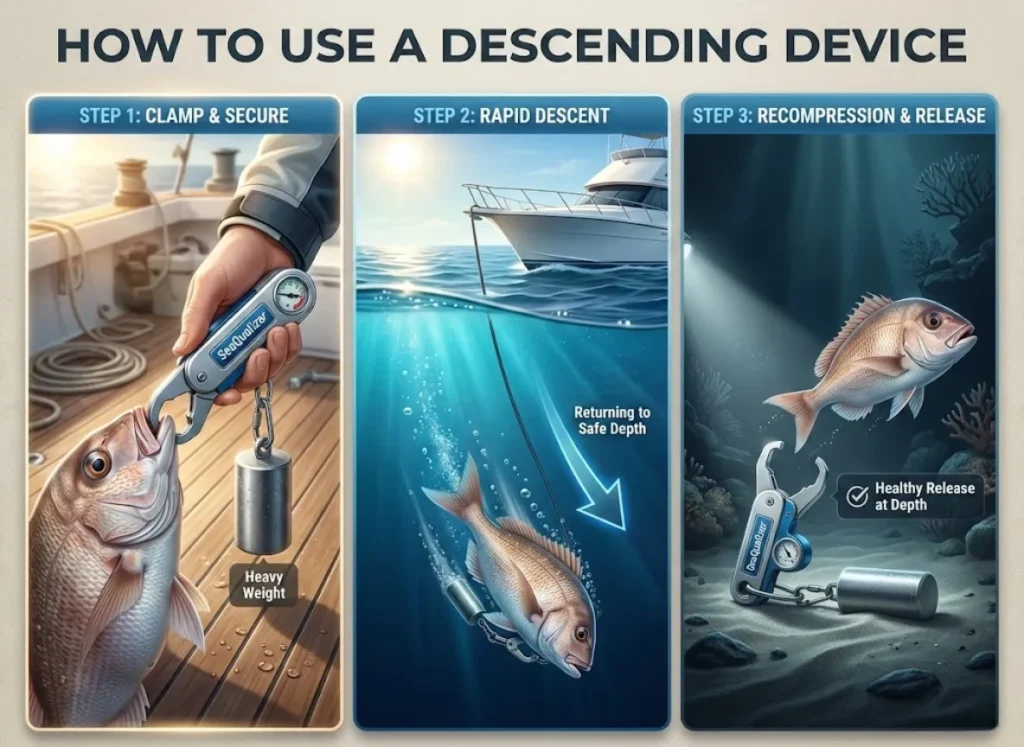
Deep-water fizzing involves poking the fish with a needle to let the gas out. While experts can do this, it is risky. You can easily poke an organ and kill the fish. Conservation agencies now recommend descending devices as the standard for ethical fishing. This aligns with broader efforts in applying data-backed catch and release techniques to keep our fisheries healthy.
Final Thoughts
Landlocked stripers are a unique resource in most lakes. They depend on stocking and are limited by the hot summer water. Success requires changing your approach with the seasons: river runs in spring, deep trolling in summer, and creek arm fishing in the fall.
The food source decides the location. Figuring out if they are eating Gizzard Shad, Threadfin Shad, or Herring is the first step. Responsible fishing is non-negotiable. Learning to use descending devices prevents the waste of the very trophy fish we all want to catch.
Ready to test your skills against the freshwater wolf pack? Check out our state-by-state guide to the top striper reservoirs near you—from Lake George to Silverwood Lake—and start planning your next trip.
FAQ – Frequently Asked Questions
Can striped bass reproduce in freshwater lakes?
Generally, no. Striped bass eggs need long stretches of fast river water to stay floating. In most reservoirs, the eggs sink and die. A few exceptions exist, like Lake Texoma (OK or TX), where the river conditions are just right.
What is the best time of year to catch landlocked stripers?
Spring and Fall are the easiest times. The fish move into shallow water and creeks to feed. Summer and Winter can be good, but you need special deep-water gear and must handle the fish carefully.
Do I need heavy saltwater tackle for freshwater stripers?
You don’t need giant ocean gear, but you do need strong conventional gear. Medium-heavy to Heavy rods with 20-50lb braided line are standard. You need this power to handle the fish and the heavy weights used for trolling.
What happens if I catch a striper in deep water and its stomach is coming out of its mouth?
This is a sign of pressure shock (barotrauma). Do not poke the stomach. Immediately use a descending device to lower the fish back to deep water. The pressure down there will fix the gas issue and the stomach will go back to normal.
Risk Disclaimer: Fishing, boating, and all related outdoor activities involve inherent risks that
can lead to injury. The information provided on Master Fishing Mag is for educational and informational purposes
only. While we strive for accuracy, the information, techniques, and advice on gear and safety are not a substitute
for your own best judgment, local knowledge, and adherence to official regulations. Fishing regulations, including
seasons, size limits, and species restrictions, change frequently and vary by location. Always consult the latest
official regulations from your local fish and wildlife agency before heading out. Proper handling of hooks, knives,
and other sharp equipment is essential for safety. Furthermore, be aware of local fish consumption advisories. By
using this website, you agree that you are solely responsible for your own safety and for complying with all
applicable laws. Any reliance you place on our content is strictly at your own risk. Master Fishing Mag and its
authors will not be held liable for any injury, damage, or loss sustained in connection with the use of the
information herein.
Affiliate Disclosure: We are a participant in the Amazon Services LLC Associates Program, an
affiliate advertising program designed to provide a means for us to earn advertising fees by advertising and linking
to Amazon.com. As an Amazon Associate, we earn from qualifying purchases. We also participate in other affiliate
programs and may receive a commission on products purchased through our links, at no extra cost to you. Additional
terms are found in the terms of service.