In this article
The silence of the Harney River broke just before dawn — not with a splash, but with a single vacuum pop, a sound like a cork being pulled from a bottle, as a Snook yanked a finger mullet clean out of a mangrove root system fifteen feet from my skiff. I had been sitting there for forty minutes, running through the water temperature math in my head, calculating whether the tide had moved far enough inland to trigger a feed. The bite window was exactly eighteen minutes. I know because I timed it.
After two decades running the Everglades National Park backcountry — the Harney River, Whitewater Bay, the Shark River labyrinth — I can tell you that most of what gets written about fishing the Glades is surface-level stuff. Guides will tell you to fish the tides. They won’t tell you which tide, at which station, corrected for a 4-hour lag that most anglers never calculate. They’ll tell you to cast to the mangroves. They won’t tell you why 47% root porosity is the number that matters, or why a violent 15-minute feed window is driven by the same physics as water draining from a bathtub.
This is that guide. It covers the hydraulics, the biology, the gear physics, the regulations, and the mercury data that the Glades keeps hidden in plain sight.
⚡ Quick Answer: Everglades backcountry fishing rewards anglers who understand two things above all: tidal lag and feeding windows. The tide at the Flamingo station can run 4+ hours ahead of what’s actually happening at inland creeks. The single most productive moment is the 15–25 minute window when a pond empties into a creek, concentrating baitfish at creek mouths where Snook, Redfish, and Tarpon are already staged. Use fluorocarbon leader (25–40 lb Seaguar AbrazX), set drag before you cast, carry both a saltwater and freshwater license if you’re crossing Nine Mile Pond, and practice 100% catch-and-release for bass and seatrout — the mercury levels in apex predators here are documented to exceed Florida’s 0.5 ppm advisory threshold.
| Everglades Fishing Logistics & Regulations | |
|---|---|
| Category | Data |
| Primary Species | Snook, Redfish, Tarpon, Spotted Seatrout, Largemouth Bass |
| Best Tides | 2 hours before peak outgoing |
| Tidal Lag | ~4 hours (Flamingo to Harney River) |
| Recommended Leader | 25–40 lb fluorocarbon, Seaguar AbrazX |
| Required License | Saltwater south of Nine Mile Pond / Freshwater north |
| Permit Fee (Overnight) | $21 non-refundable + $2/person/night |
| Insect Repellent | Picaridin 20% only — no DEET near tackle |
| Water per Person | 1 gallon minimum per day |
The Hydraulics of the “River of Grass” — Where Fish Actually Hold
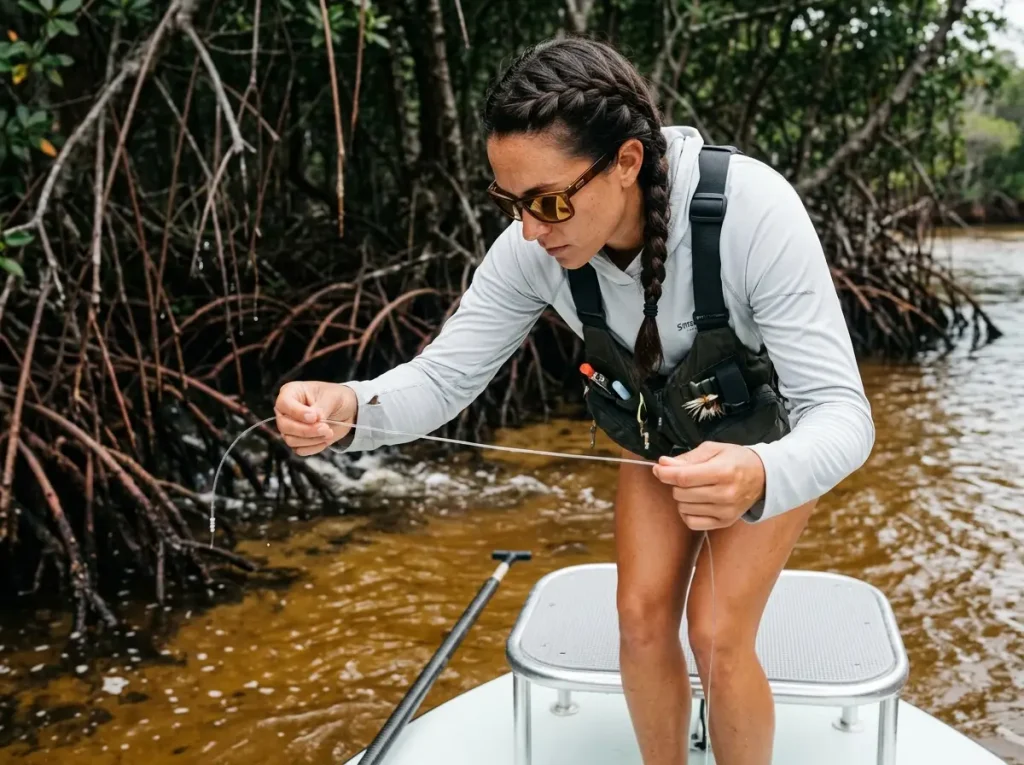
Most anglers who fish the Glades for the first time make the same mistake: they cast to open water in front of the mangroves. Every fish in that creek is already somewhere else.
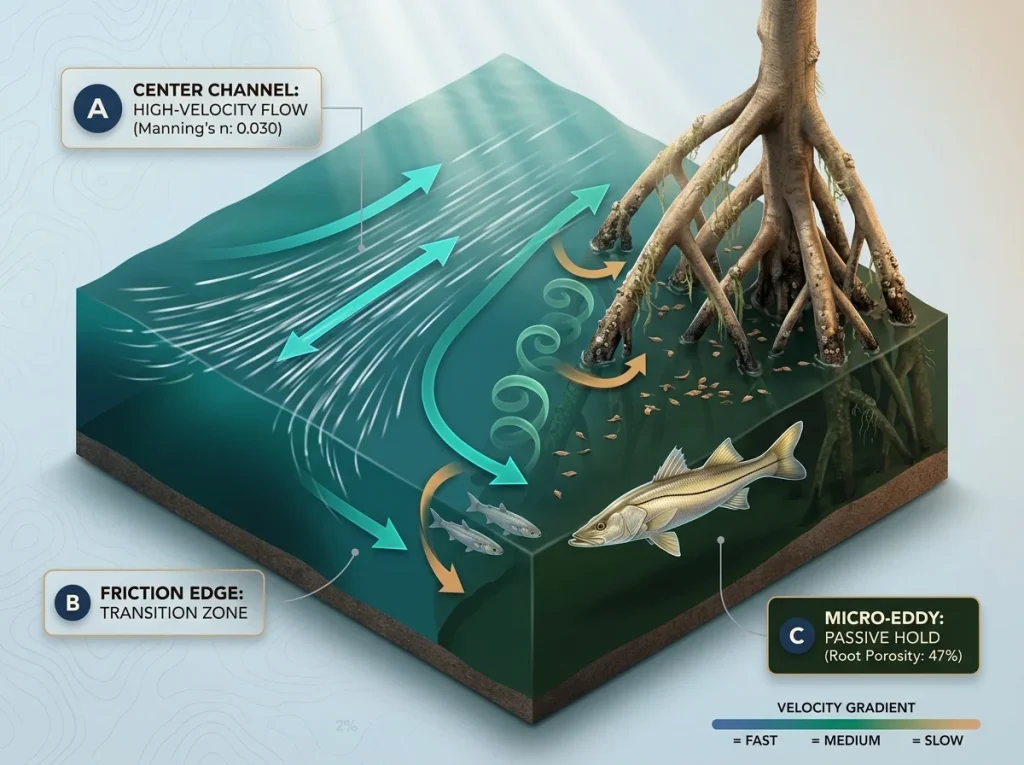
The Everglades backcountry is a high-friction environment. The Manning’s n bottom friction coefficient for southwest Florida mangrove systems is dramatically higher than any trout stream or open estuary. That friction isn’t uniform either. Mangrove prop roots have a Young’s modulus of approximately 15 GPa — think of it as concrete stiffness with a biological surface. They are hydraulically rigid obstacles. They do not flex. When a fish wraps your line around them, the root wins every time.
What those rigid roots create is vortex shedding — micro-eddies on the downstream side of root clusters where the water slows from fast to nearly still. Snook sit in those zones, expending almost no energy while the current delivers prey directly to them. They’re not in the fast water. They’re at the exact edge where fast water meets the root-retarded shadow.
Florida Atlantic University’s engineering research on mangrove hydrodynamics identified a root porosity of 47% as the sweet spot. Dense enough to create a current break. Open enough that prey can drift through without escaping into the root structure entirely. Visually, you’re looking for root clusters where you can see daylight through roughly half the structure — not impenetrable walls, not sparse skeleton roots.
Understanding this dynamic starts with reading tidal velocity over height — because what triggers the feed isn’t the direction of the tide, it’s the speed.
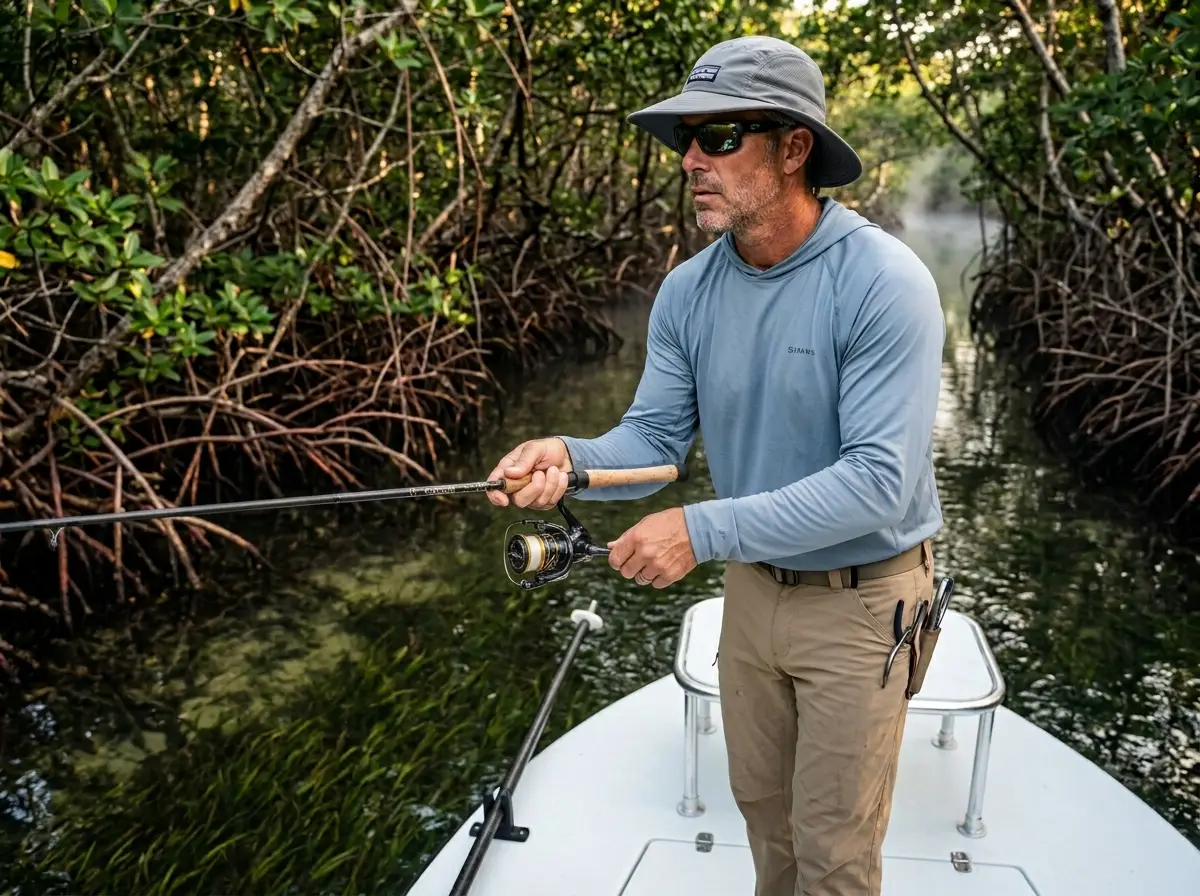
Pro tip: Target the downstream side of mangrove points where root porosity creates a localized current break. Cast to the shadow line inside the roots, not the open water in front of them. The fish are facing into the current — your lure needs to enter their visual field, not pass across it.
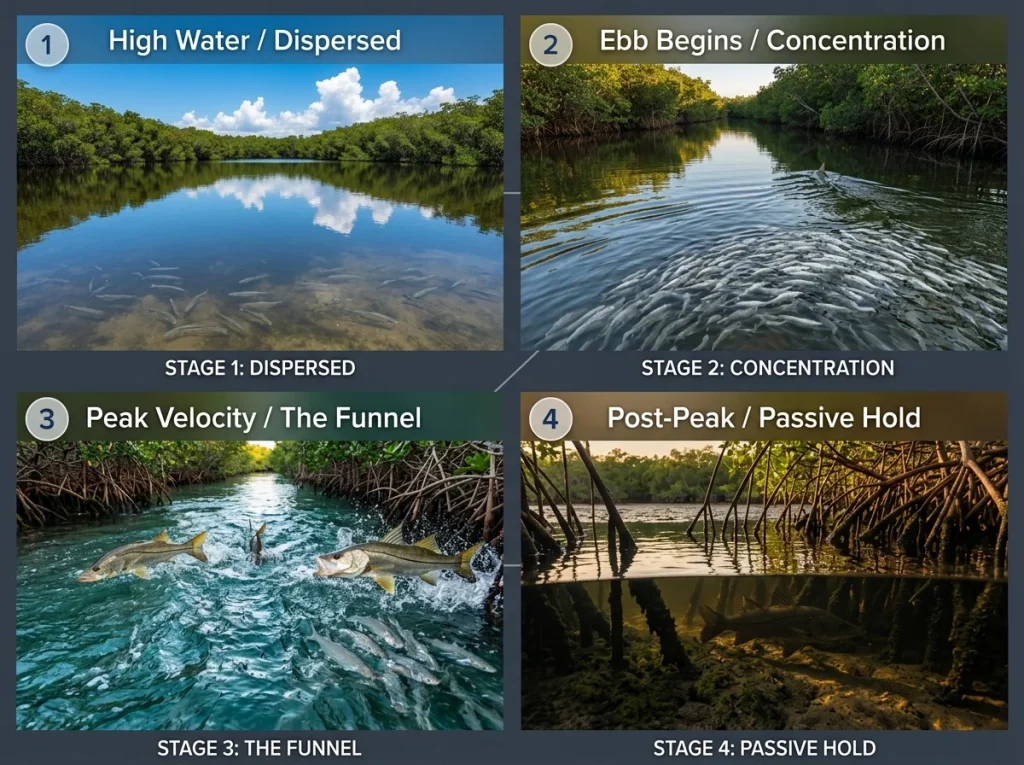
Here’s the operational detail that earns its keep, especially as a pond empties into a narrow creek: a 2-foot tidal drop in a 10-foot-wide channel creates what I call the vacuum effect — a concentrated biomass funnel where baitfish get compressed into a strike zone the size of a car. This window runs 15–25 minutes. Missing the first 10 minutes means fishing after the prey have dispersed and the predators have returned to passive hold. Use NOAA Flamingo tide predictions to pinpoint when outgoing flow peaks, then position at creek mouths 30 minutes before that point.
When scouting a new system, kayak it on a full outgoing tide. Photograph the root clusters. What you map at low water is your strike-zone blueprint for every future trip.
Decoding the Tidal Lag — The 4-Hour Calculation Guides Don’t Teach
 MirrOlure Catch 2000 in Whitewater Bay” class=”wp-image-12177″/>
Here is where most backcountry trips fail before they start.
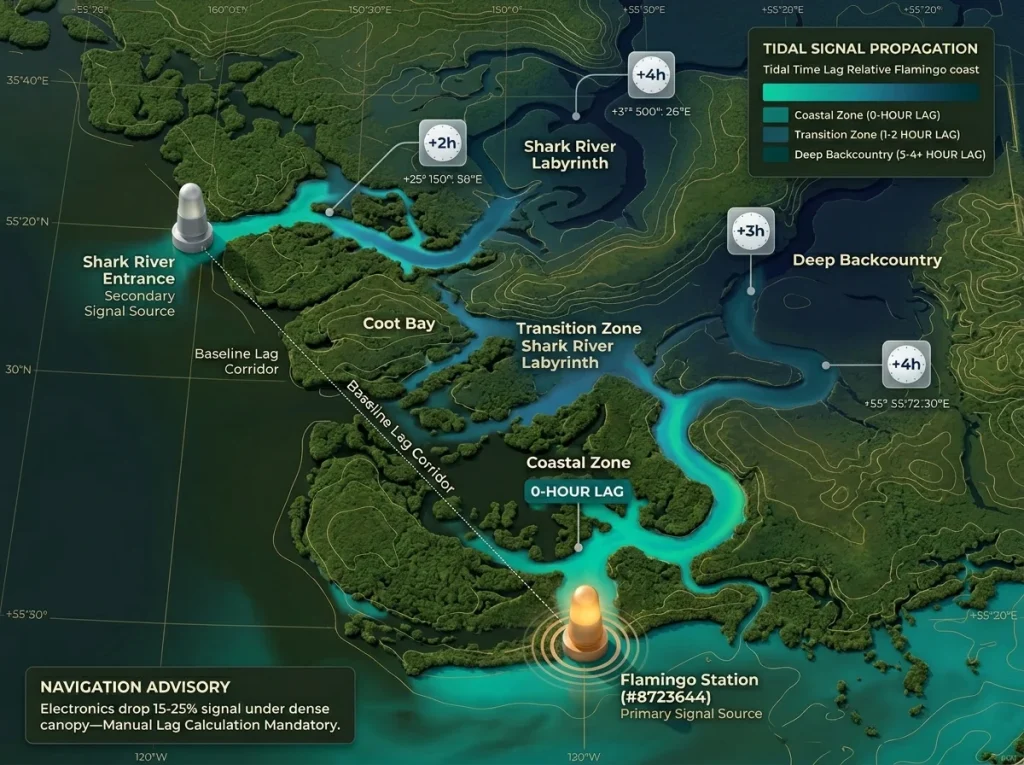
The tide chart on your phone shows Flamingo. If high tide at Flamingo is noon, guides will tell you to be upstream at noon. The problem: the water pushing inland toward the Harney River may not arrive there until 4 PM. You just spent the most productive window of the day fishing a slack, draining system.
The tidal time lag between Flamingo and the backcountry interior is driven by Manning’s n — the same friction that creates those current breaks behind the roots also slows the propagation of tidal energy inland. More friction, slower signal. Add 2–4 hours for inland targets beyond the coast, and add another half-hour for every 5–8 miles of creek penetration past that.
Two stations give you the full picture. The Flamingo station (#8723644) covers the southern ENP coast. The Shark River Entrance station on US Harbors covers the northwest gulf side. The difference in their predicted high-tide times reveals the baseline lag for that corridor. After heavy rain, freshwater discharge from the Shark River Slough compresses or eliminates tidal intrusion in some creek systems — check USGS discharge data before any post-storm trip.
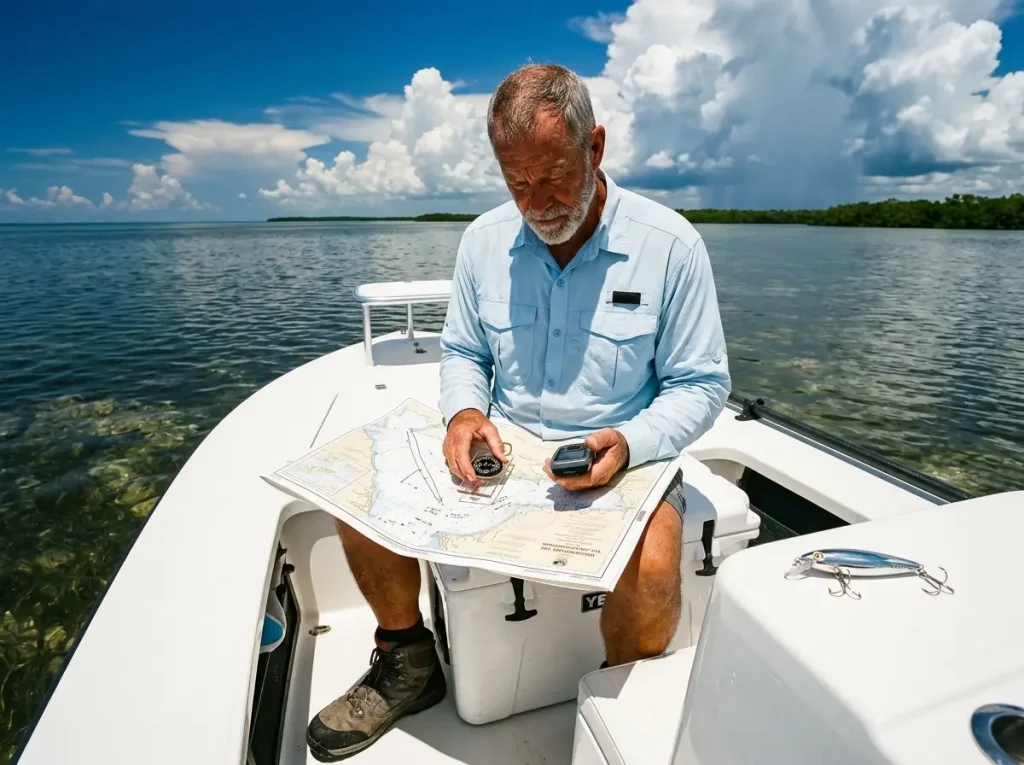
Pro tip: Write your tide lag calculations on waterproof paper before you leave the launch. Electronics fail in the backcountry at exactly the wrong time, usually inside “The Nightmare” where you have no cellular signal and GPS satellite acquisition drops by 15–25% under dense canopy.
The strongest feeding windows happen when peak tidal current velocity aligns with a major solunar period. On spring tides — new and full moon — the vacuum effect in backcountry ponds is more dramatic. The tidal amplitude is larger, the funnel is tighter, and the feed window is more defined. Plan multi-day trips around moon phases if you want the most concentrated action.
The navigation consequence of miscalculating lag: you enter a shallow creek on a falling tide and you’re grounded on an oyster bar for the next 6 hours. Minimum depth for skiff operation in most ENP backcountry channels is 18–24 inches at low tide. Always enter on a rising tide. Plan your exit on the outgoing. Never the reverse.
Species-Specific Biology — Why Each Fish Behaves Differently Here
The bite doesn’t just turn on and off. It follows rules — and the rules are different for every species.
Snook (Centropomus undecimalis) are euryhaline. They can tolerate salinities from near-fresh to hypersaline. But that tolerance has a metabolic cost. When a heavy tropical rainfall drops salinity gradients from 15+ ppt to near-fresh in hours, Snook have to work hard at the gill level to prevent cellular swelling — a process that burns through energy reserves. That process ties up the fish. As long as it’s running, the fish will not chase a lure across the creek. Per research on Snook movement and trophic dynamics in south Florida estuaries, this osmoregulatory load is tied directly to salinity shift magnitude. The bite returns 6–12 hours after salinity stabilizes. Watch the baitfish: when they resume normal schooling patterns, the predators are recovering.
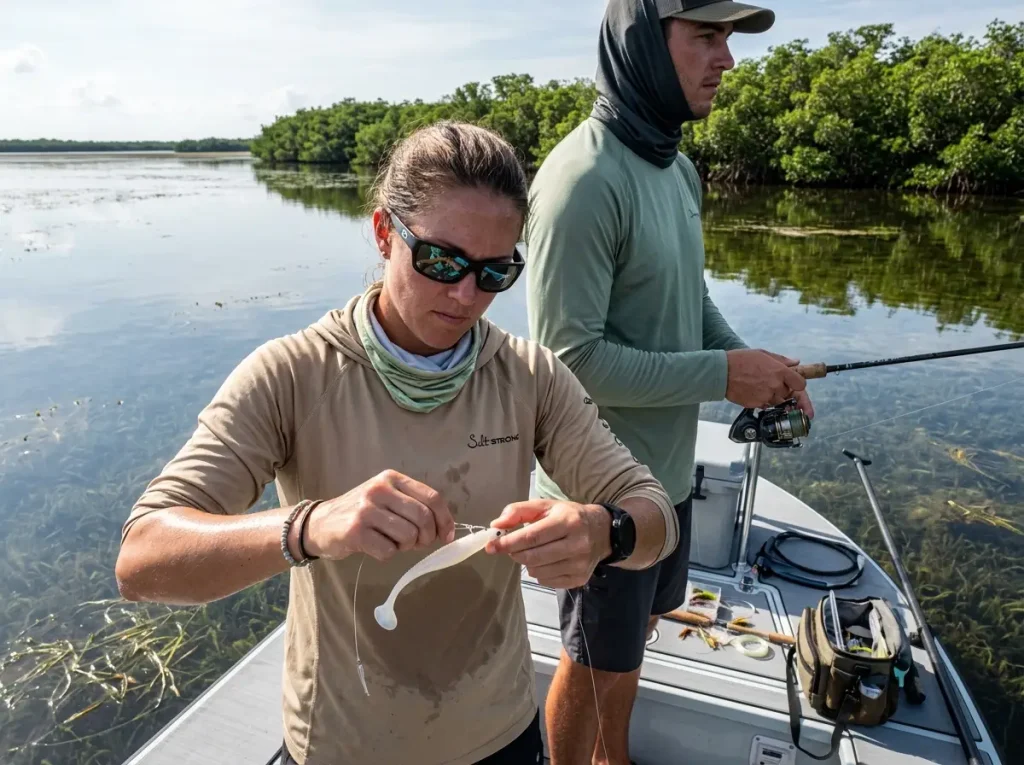
The thermal ceiling matters too. At 85°F water temperature, the caloric ROI of chasing a fast-moving mullet can fall below zero for a 30-inch Snook. Research on Shark River fish shows that at these temperatures, a fish may need 5–7 invertebrates to match the energy yield of one fish prey. When invertebrates dominate the menu, Snook enter compensatory foraging — eating more frequently from closer range. A fast lure gets ignored. A small, slow, erratic profile — a Salt Strong Slam Shady or MirrOlure Catch 2000 stopped dead in the root shadow — gets eaten. Understanding Snook’s seasonal migration patterns and temperature triggers explains why backcountry fish behave differently from their open-estuary counterparts.
Per FWC Snook harvest regulations and seasonal closures, Snook in most backcountry zones are subject to seasonal closed seasons — check current status before any trip.
Redfish are less temperature-sensitive than Snook and stay active through summer heat. A gold spoon retrieved slowly through shallow turtle grass over the mangrove fringe is the single most reliable Redfish presentation in the backcountry — it mimics an escaping mullet and covers water efficiently in low-visibility conditions.
Tarpon in the backcountry are mostly juveniles in summer, 5–30 lb fish transiting through deeper creek systems. Surface-rolling tarpon are exchanging oxygen in low-oxygen pockets — they are not actively feeding. Bypass them. Find stationary tarpon holding at creek bends on a falling tide. A chrome MirrOlure Catch 2000 worked on a slack line through a falling-tide creek bend at dawn is as close to a guaranteed strike as the backcountry offers.
Largemouth Bass deserve a separate conversation, and not because of the fishing. Bass in ENP carry methylmercury contamination well above Florida’s 0.5 ppm advisory threshold. The USGS mercury bioaccumulation studies in the Florida Everglades document this consistently. The largest fish — the ones most worth catching — have had the most time to bioaccumulate. Catch and release is not a suggestion here.
Pro tip: If water temps exceed 85°F, slow your retrieve by 50% and drop to a smaller profile lure. The Snook won’t travel for it, but it’ll eat if you put it in exactly the right spot. The stop-and-go is the trigger — not the movement.
Gear Engineering for the Backcountry — What Survives the Roots
Gear failure in the backcountry has one primary cause, and it is not the fish.
It is the roots.
Mangrove prop roots have a stiffness comparable to dense hardwood — they don’t compress or give under load. When a fish wraps your leader around one of those roots, the leader doesn’t wear through gradually — it fails immediately at the contact point. The question becomes: which material gives you enough time to turn the fish before it reaches the root?
The answer is fluorocarbon leader, and not for the reason most people think. Yes, the refractive index of fluorocarbon leader (approximately 1.42) is closer to water (1.33) than monofilament (1.49), making it functionally near-invisible in the gin-clear southern flats. In 6-foot-visibility water, Snook will refuse a presentation if they can see the leader. But the more important advantage is abrasion resistance: high-quality fluorocarbon (Seaguar AbrazX, 25–40 lb) maintains 90% of its rated strength after moderate oyster bar abrasion. Monofilament drops to 60% or less under the same conditions. That 30% difference is the fish.
Match leader weight to water clarity. Lighter in the clear southern flats. Heavier in stained northern creek systems where visibility won’t penalize you. Practical rule: leader diameter shouldn’t exceed 30% of the lure body diameter in clear conditions.
Every trip into the backcountry requires a full post-salt protocol. How saltwater gear corrosion accelerates in estuarine environments explains what’s happening invisibly inside your reel bearings on every cast in this water.
On the reel side: drag matters more in the backcountry than anywhere else. A 30-inch Snook hooked at a mangrove root system will reach its refuge in 1.5–3 seconds if drag pressure is inadequate. Set drag to 30–35% of leader breaking strength before the first cast. The Shimano Sustain FK 4000’s Duracross orthogonal fiber drag washers provide 10x abrasion resistance over conventional carbon washers, maintaining pressure through repeated runs without heat fade. Wide-spool reels retrieve line faster under load — giving you fractions of a second more to turn the fish before it finds the root. Those fractions matter.
Line: 20–30 lb braid main line on a 3000–4000 series spinning reel. Braid transmits root contact instantly through tactile feel — you can sense when the line is grazing a root and redirect before the leader takes the damage. Rod: medium-heavy action, 7’–7’6″ spinning. Enough backbone to apply side pressure on a run; enough length to clear low-hanging branches on the backcast.
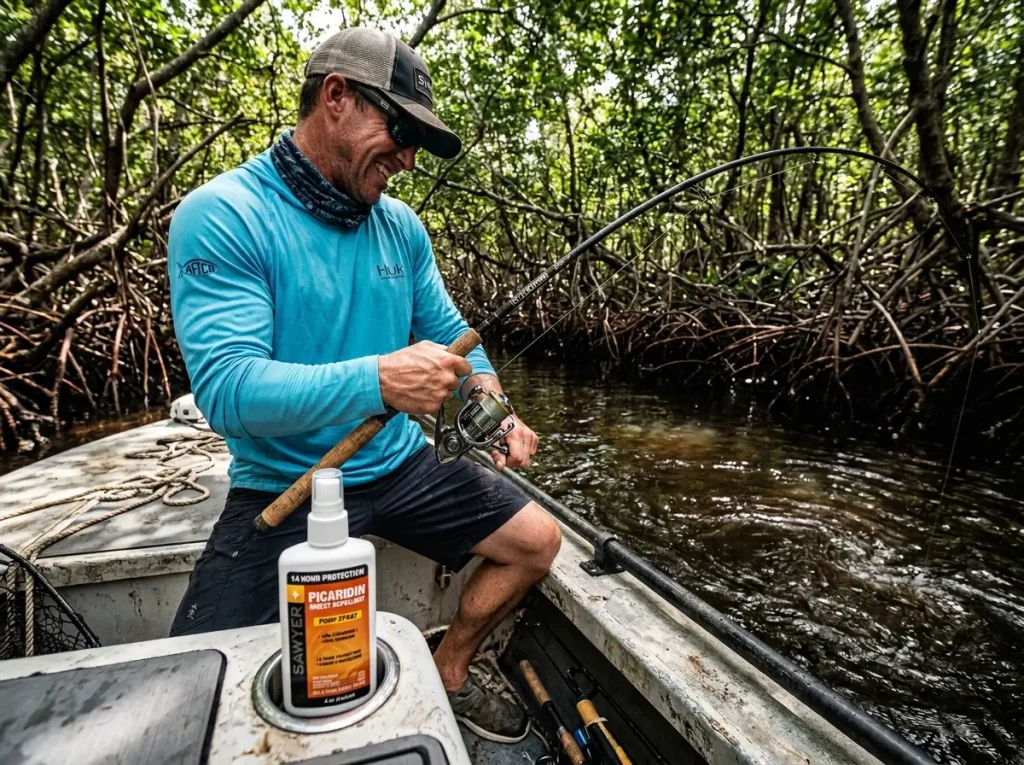
One more thing: do not use DEET as insect repellent in the backcountry. DEET is an organic solvent. It dissolves the rubber seals on saltwater spinning reels, degrades EVA foam rod handles, and attacks the UV coating on fluorocarbon. Picaridin at 20% concentration provides equivalent protection — up to 12 hours against mosquitoes and no-see-ums — and is chemically inert regarding synthetic fishing gear. Apply to skin only. Let it dry before touching tackle. Never spray near open reel frames.
The no-see-ums (Ceratopogonidae) are the primary insect threat in summer. Standard mesh headnets don’t stop them. Use fine-mesh 18-strand nets specifically rated for Ceratopogonidae.
The Regulatory Labyrinth — NPS Rules That Trip Up Experienced Anglers
The regulatory framework for ENP backcountry fishing has one wrinkle that catches experienced anglers off guard at the worst possible time.
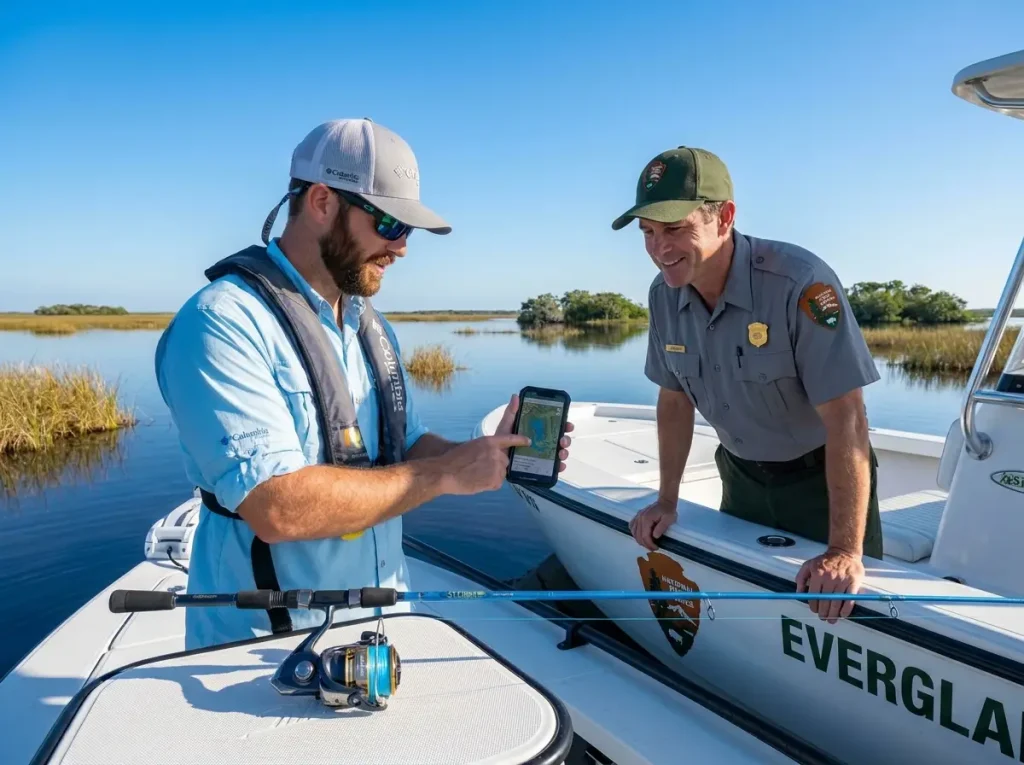
Nine Mile Pond is a regulatory boundary line. North of it, you need a Florida Freshwater fishing license. South of it, you need a Florida Saltwater license. Multi-day backcountry trips frequently cross this line in both directions. Many anglers arrive with only one. If you’re unfamiliar with Florida’s dual-license system for freshwater and saltwater, this boundary is worth understanding before you launch.
NPS rangers patrol this boundary. They know where it is on the water better than you do. Carry the current ENP official map layer in Gaia GPS or onX Offroad, but purchase both licenses before you ever reach the ramp.
According to NPS Everglades fishing regulations and closed zones, possession limits in ENP are 20 fish total per person, with no more than 10 of any single species — more restrictive than Florida state limits in some cases. This applies to all recreational anglers regardless of state residency.
Three areas are permanently and completely closed to all recreational fishing: Eco Pond, Mrazek Pond, and Coot Bay Ponds. Eco Pond protects a freshwater bird rookery. Mrazek Pond is a critical winter manatee thermal refuge — water temperature in enclosed ponds stays warmer than open-bay water, and manatees depend on that. NPS rangers monitor these areas on foot and by boat. Violations are federal offenses, with fines and potential license revocation.
For overnight trips: wilderness permits run $21 non-refundable plus $2 per person per night, reserved through Recreation.gov. Peak-season permits (November–March) sell out 60–90 days in advance. If you wait until three weeks out, you’re sleeping somewhere else. Chickee platforms are the only permitted overnight structures along the coastal wilderness route — ground camping is not allowed at most coastal sites. The platforms provide zero ground anchoring, so secure all gear overnight with cordage tied to the platform structure.
There is no potable water anywhere on the coastal wilderness route. Minimum 1 gallon per person per day. Raccoons will find your food overnight. Hard-sided containers for storage.
Pro tip: Book your peak-season permit the same day you book your flights. They’re gone that fast. A non-refundable $21 fee is a lot less painful before the trip than being forced out to a gravel campsite at Marco Island.
Mercury, Safety, and the Survival Calculation — What Guides Rarely Tell You
The Everglades looks pristine. It is not a safe place to eat what you catch.
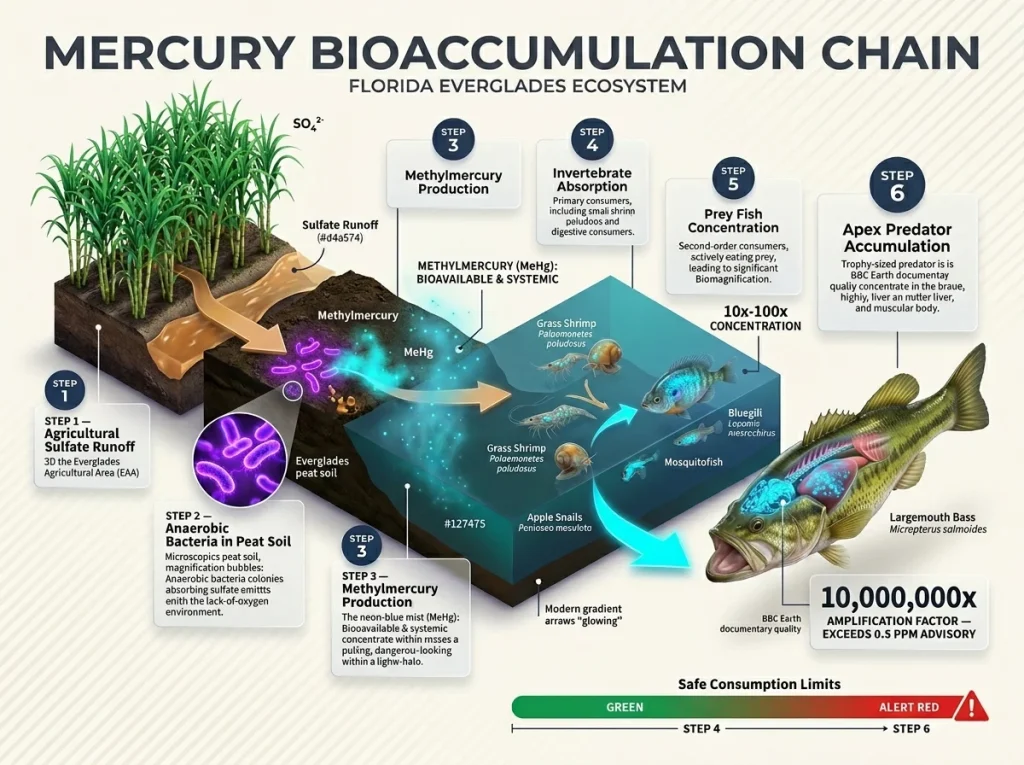
Methylmercury contamination in ENP game fish is chronic, systemic, and well-documented. The mechanism: agricultural sulfate runoff from sugarcane operations in the Everglades Agricultural Area north of the park reaches the peat soil. Anaerobic bacteria convert that sulfate into byproducts that transform inorganic mercury — atmospheric deposition that lands in the watershed — into methylmercury. According to UC Davis research by Dr. Brett Poulin, this sulfur runoff can amplify mercury levels in fish tissue by up to 10 million times the ambient water concentration.
Methylmercury crosses the blood-brain barrier. It crosses the placental barrier. It accumulates in muscle tissue and does not cook out. The USGS mercury bioaccumulation studies in the Florida Everglades consistently document ENP game fish exceeding Florida’s 0.5 ppm advisory threshold.
The high-risk species: Largemouth Bass have the highest bioaccumulation because they live longest and sit at the top of the marine and estuarine ecology food chain. Spotted Seatrout from Florida Bay populations are also elevated. The trophy fish you remember catching — the animals that have had the most time to grow — are precisely the ones with the highest tissue concentrations.
MasterFishingMag’s position: 100% catch-and-release for all backcountry apex predators. Releasing fish in 85°F water requires discipline. Follow warm-water release protocols that protect fish survival — a Snook released improperly in the backcountry heat is a Snook that dies 200 meters from the net.
Navigation in the backcountry demands redundancy, not confidence. The stretch known locally as “The Nightmare” — the dense, forking creek system in the Harney River/Shark River labyrinth — has left experienced guides turned around for 5-hour detours. GPS is mandatory but not enough alone. Required stack: offline Gaia GPS with pre-downloaded satellite imagery downloaded at home the night before, a waterproof NOAA nautical chart, and a compass. Mark waypoints at every major creek junction on both a primary and backup device. Do it before entering the canopy, where offline satellite caching is essential because you have no cellular signal inside.
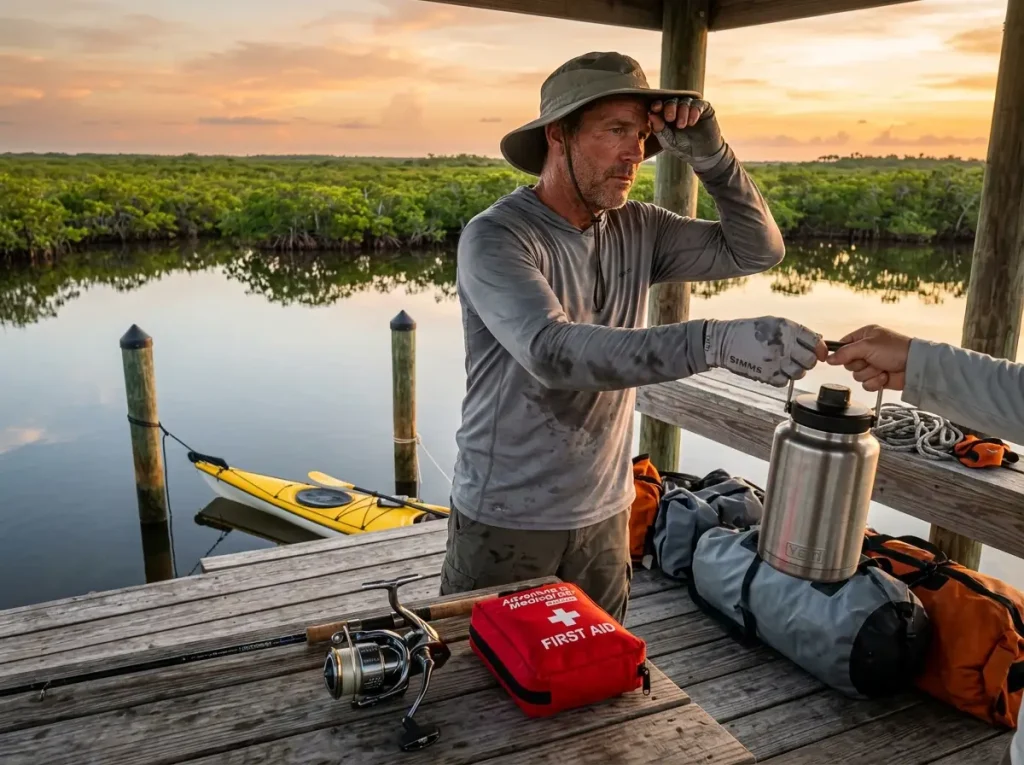
Heat is the quiet hazard. Radiant heat from open water doubles the effective thermal load of ENP summer conditions. Skin surface temperatures on open flats can run 10–15°F above ambient. Heat exhaustion onset occurs in 45–90 minutes of unshaded, active exertion at summer temperatures. The early warning sign to watch for: headache and confusion. Confusion in a navigation situation in the backcountry is a critical safety failure — it’s how people get into serious trouble here.
Plan demanding paddling for the first two hours after sunrise and the last 90 minutes before sunset. Shade breaks every 20–30 minutes during peak sun. UPF 50+ sun shirts cut UV-B exposure by 98% — that is not comfort gear, it is medical protection. Electrolyte replacement every 60–90 minutes matters more than total fluid volume.
Conclusion
Three things separate anglers who consistently produce fish in the Everglades backcountry from the ones who blame the tide.
First: the Glades is an energy equation. Every productive fish is positioned exactly where the friction physics of Manning’s n and 47% root porosity create the maximum caloric return per unit of effort. Find the friction edge. Find the fish.
Second: your tide chart is wrong until you add 4 hours. The Flamingo station tells you when the water is moving at the coast. It does not tell you when the Harney River is pushing. Calculate the lag before you leave the dock, write it on waterproof paper, and fish accordingly — or spend all day on water that produced 4 hours ago.
Third: catch-and-release here is not optional sentiment. The methylmercury contamination in ENP apex predators is real, documented, and severe. Keep your fluorocarbon sharp, your drag preset, and your release fast.
On your next ENP trip, launch one hour earlier than you think you need to. Use that hour to paddle one creek system on a falling tide and do nothing but watch — where the water accelerates, where it calms, where the root clusters create shadow seams. That one hour of observing will produce more fish on the next tide than any gear upgrade you could make.
FAQ
Do you need a permit to fish the Everglades?
A Florida state fishing license is required — saltwater for locations south of Nine Mile Pond, freshwater for those north of it. Day fishing does not require a backcountry permit. Overnight wilderness trips require a separate NPS permit ($21 non-refundable + $2 per person per night) booked through Recreation.gov. Peak-season dates sell out 60–90 days out.
What is the best month to fish the Everglades backcountry?
November through March gives you the best combination of temperature, insect pressure, and fish concentration. December and January are peak Snook months as fish stage in creek mouths ahead of cold fronts. March produces transitional Tarpon in the 10–30 lb range. Summer is productive, particularly for Redfish, but physically demanding — disciplined heat management is not optional.
Can you keep fish caught in Everglades National Park?
Yes, within specific limits: 20 fish total per person, no more than 10 of any single species. That said, documented methylmercury contamination above Florida’s 0.5 ppm advisory threshold in apex predators — Largemouth Bass especially — makes catch-and-release the only rational choice for those species. Keep your Sheepshead. Release your Bass.
What are the permanent no-fishing zones in ENP?
Eco Pond, Mrazek Pond, and Coot Bay Ponds are permanently closed to all recreational fishing. These closures protect avian rookeries and manatee thermal refuges. NPS rangers patrol them actively. Federal violations carry substantial fines and can result in license revocation.
Why do Snook stop biting after heavy rain in the Everglades?
Heavy rain rapidly drops salinity gradients in the backcountry — sometimes from 15+ ppt to near-fresh in hours. This forces Snook to redirect significant metabolic energy toward gill regulation to prevent cellular swelling — the same osmoregulatory response explained in research on Snook movement and trophic dynamics in south Florida estuaries. The fish isn’t gone — it’s physiologically occupied. The bite returns 6–12 hours after salinity stabilizes. Watch the baitfish: when they resume normal schooling, the predators are recovering.
Risk Disclaimer: Fishing, boating, and all related outdoor activities involve inherent risks that
can lead to injury. The information provided on Master Fishing Mag is for educational and informational purposes
only. While we strive for accuracy, the information, techniques, and advice on gear and safety are not a substitute
for your own best judgment, local knowledge, and adherence to official regulations. Fishing regulations, including
seasons, size limits, and species restrictions, change frequently and vary by location. Always consult the latest
official regulations from your local fish and wildlife agency before heading out. Proper handling of hooks, knives,
and other sharp equipment is essential for safety. Furthermore, be aware of local fish consumption advisories. By
using this website, you agree that you are solely responsible for your own safety and for complying with all
applicable laws. Any reliance you place on our content is strictly at your own risk. Master Fishing Mag and its
authors will not be held liable for any injury, damage, or loss sustained in connection with the use of the
information herein.
Affiliate Disclosure: We are a participant in the Amazon Services LLC Associates Program, an
affiliate advertising program designed to provide a means for us to earn advertising fees by advertising and linking
to Amazon.com. As an Amazon Associate, we earn from qualifying purchases. We also participate in other affiliate
programs and may receive a commission on products purchased through our links, at no extra cost to you. Additional
terms are found in the terms of service.