
In this article
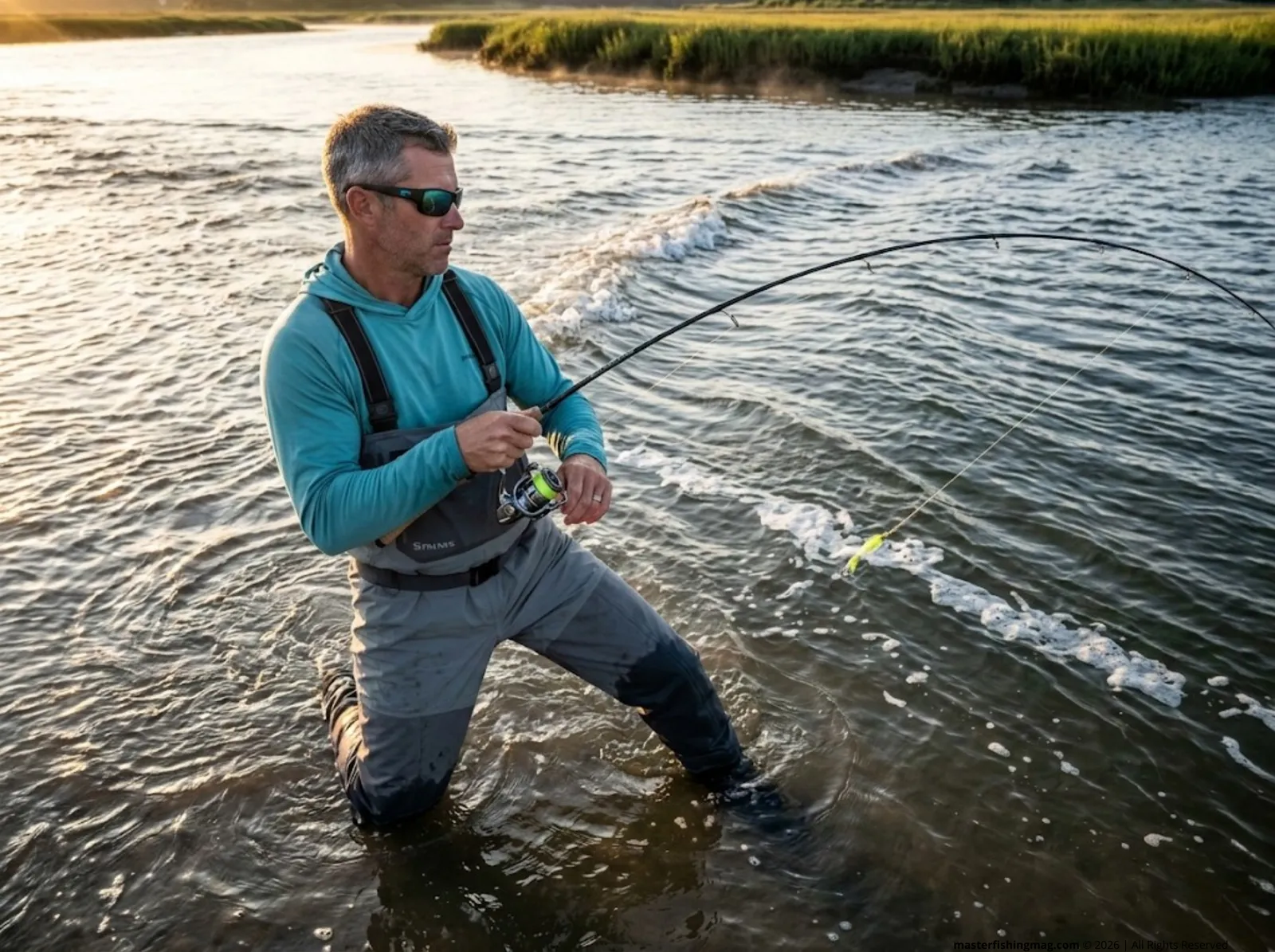
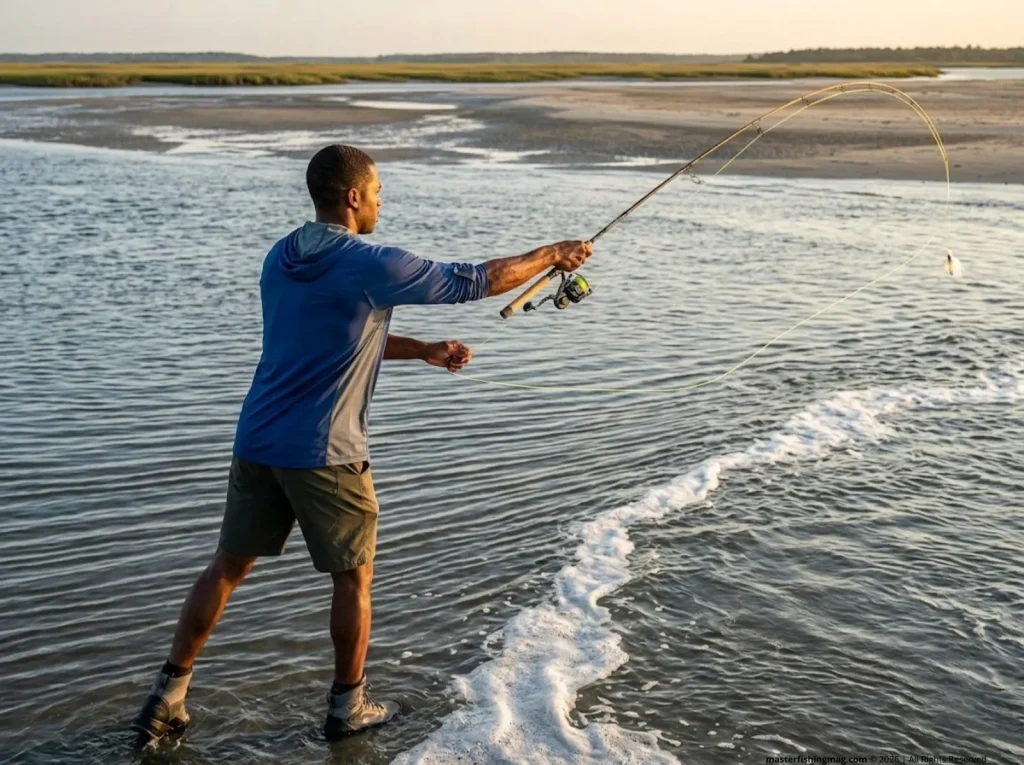
The tide chart said “High Tide: 11:47 AM.” I was standing knee-deep on a Cape Cod sandbar at 11:50. The water hadn’t moved an inch vertically, but the current ripping past my ankles was pulling my 3/4-oz bucktail sideways like a kite. Ten minutes later, a 28-inch striper slammed it mid-swing. That fish didn’t care about the height on my app. It cared about the tidal velocity pushing shad past its face.
After fifteen years of chasing stripers in tidal inlets, redfish on Gulf flats, and flounder in back-bay channels, I’ve learned the same lesson the hard way every time: fish don’t respond to water level. They respond to water movement. The vertical number on your tide chart tells you where the waterline sits. The horizontal speed of the current tells you where the food conveyor belt is running, and that’s where the fish will be.
This guide will teach you to stop reading tides like a bathtub and start reading them like an energy equation, where current velocity, not height, determines when fish feed, where they stage, and what tackle you need to reach them.
⚡ Quick Answer: The best time to fish a tide is during the 2-hour window when current velocity peaks, not at the moment your app says “High” or “Low.” The Rule of Twelfths shows that 50% of all water volume moves during hours 3 and 4 of a 6-hour tidal cycle. Use the 30-60-90 rule: 30 minutes before the tide change, fish position; 60 minutes during peak flow, strikes peak; 90 minutes after, activity tapers. Track current speed, not water level.
The Hydrostatic Fallacy — Why Tide Charts Lie to You
Most anglers treat the ocean like a static tank where water rises and falls, what I call the “Hydrostatic Fallacy.” Tide charts from NOAA predict vertical displacement. Your phone shows you a smooth curve climbing to “6.2 feet” and dropping back down. Clean, simple, and misleading.
Fish don’t have depth gauges. They have lateral lines tuned to water movement. A tide can read “6.2 feet” at two different inlets, but the current strength at each can differ by three knots or more depending on the geography between them. Height tells you where the waterline is. Velocity tells you where fish are eating. Once you understand how tidal currents position predators along structure, you’ll stop planning trips around the wrong axis.
Standing Waves vs. Progressive Waves — The 1-Hour Error
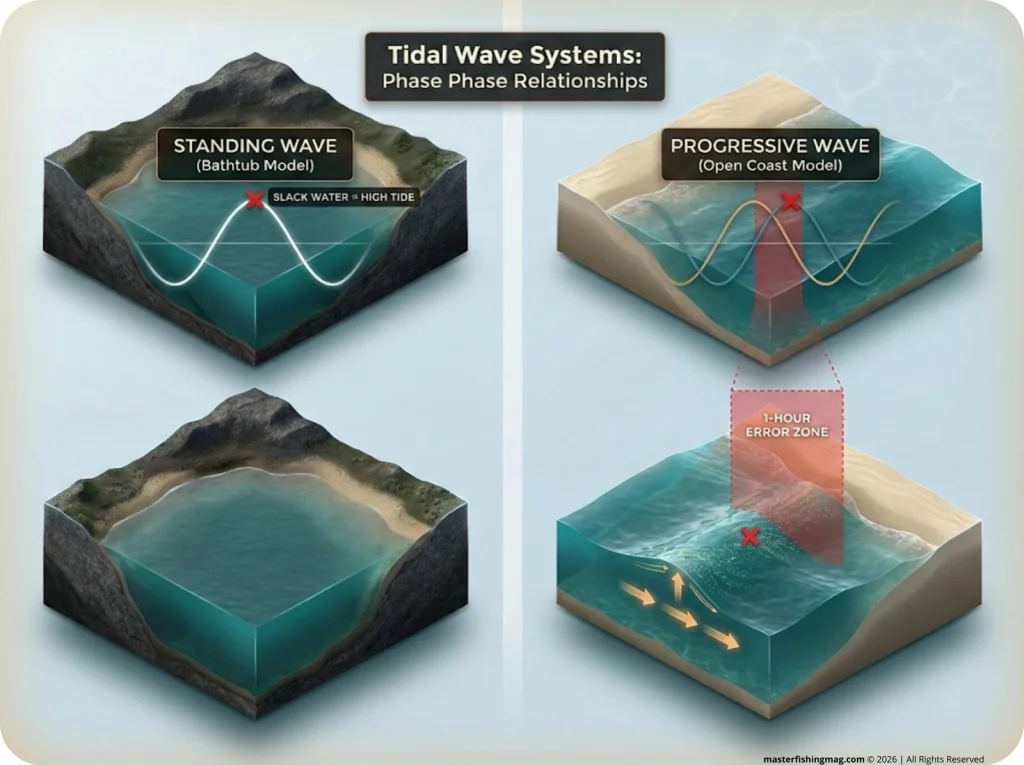
Here’s where most tide advice falls apart. There are two types of tidal systems, and they behave differently.
In a standing wave system, think deep, enclosed bays, the water sloshes back and forth like a bathtub. Slack water really does coincide with high tide and low tide. The classic “fish the tide change” advice works here because the physics support it.
But on open coasts and large oceanic inlets, you’re dealing with a progressive wave. The tidal energy moves forward like a swell. In these systems, peak velocity can occur AT high tide, not between tides. That creates a full 1-hour timing error for anglers who assume slack always equals high tide. Even NOAA’s own FAQ on understanding standing versus progressive tidal waves states it plainly: “The assumed ‘rule of thumb’ that slack water is at the same time as high and low tides does not hold for most locations.”
Hydraulic Head — The Hidden Current Driver
Then there’s a third system most people never consider. In canals and narrow passes like the Cape Cod Canal or the East River, current isn’t driven by the height curve on your app at all. It’s driven by hydraulic head, the difference in water elevation between the two connected ends.
Even when both ends show “High Tide,” a 1-foot elevation difference between them can drive a 4-knot current. I’ve stood at the canal watching my bucktail get ripped downstream while my app cheerfully displayed “slack water.” The height doesn’t lie, exactly. It just isn’t telling you the part that matters.
Pro tip: If you fish canals, straits, or narrow tidal rivers, ignore the height curve entirely. Find the NOAA current prediction for your station and fish the velocity peak. That’s your strike window, not the height peak.
The Rule of Twelfths — Your Velocity Speedometer
You don’t need a current meter or a fancy electronics package to read velocity. You just need the Rule of Twelfths, a simple pattern that has been used by sailors for centuries and works just as well for anglers who understand what it actually describes.
The 1:2:3:3:2:1 Acceleration Curve
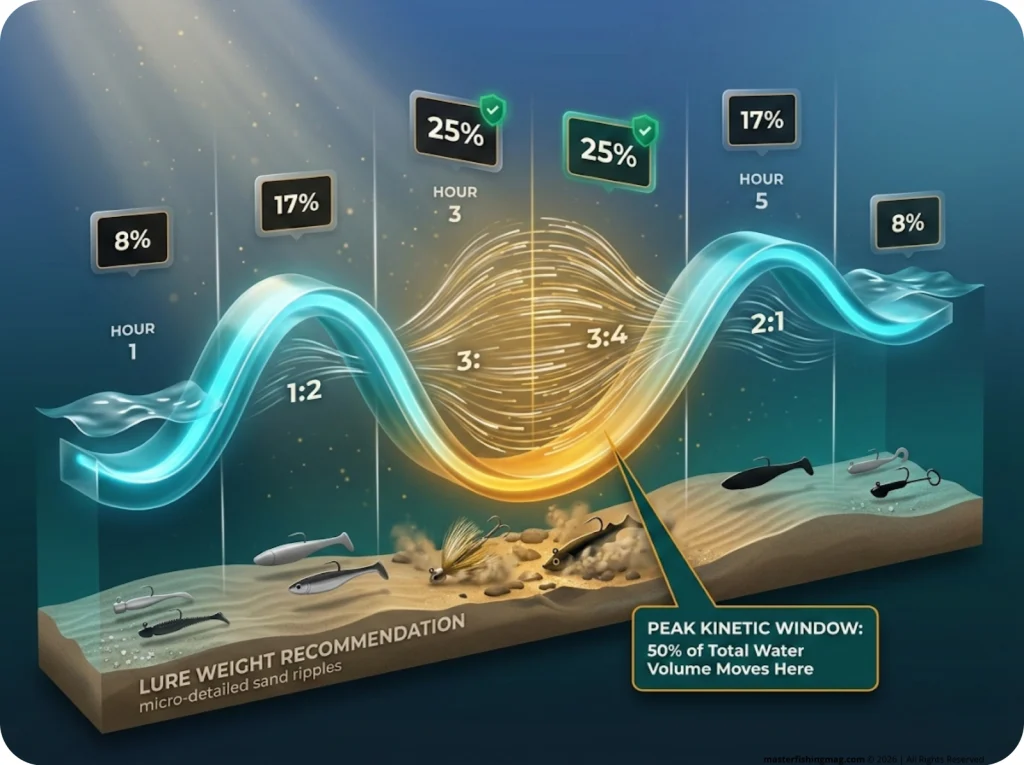
The Rule approximates a sine curve where water moves in a 1:2:3:3:2:1 ratio over a six-hour tidal stage. That ratio describes both height AND velocity, because the rate of height change IS the current speed.
In practical terms: during Hour 1, only 1/12 of the total water volume moves. Fish are repositioning, not feeding hard. During Hour 2, that doubles to 2/12, moderate tidal flow with fish moving toward ambush stations. But Hours 3 and 4 are where it gets serious: 3/12 each, which means 50% of the total water volume moves in just two hours. That’s the peak tidal flow window, the period when baitfish get displaced, current seams form, and predators go into full ambush mode.
Hours 5 and 6 mirror the slowdown. Current decelerates, and the urgency fades.
The 30-60-90 Rule — Minute-by-Minute Timing
The Rule of Twelfths tells you which hours matter. The 30-60-90 rule tells you what to do within them.
Thirty minutes before the tide change, fish sense “The Push”, the first acceleration of water, and begin positioning at the physics of current seams where fast water meets slow water. This is when you want to be rigged, positioned, and making your first casts.
Sixty minutes during peak flow: maximum baitfish movement, predators locked into ambush stations, your highest-percentage strike window. This is the golden window. Spend it casting, not re-rigging.
Ninety minutes after: current decelerates. Fish shift to opportunistic feeding, then retreat deeper. Active Angling NZ confirms it: “The maximum tidal flow occurs in a two hour band… there is no margin for error with the incoming tide.”
Pro tip: I adjust jig heads from 1/4 oz in Hour 1 to 1 oz in Hour 3. If you’re using the same weight all day, you’re fighting the physics half the time.
When the Rule Breaks — Irregular Tide Curves
The Rule of Twelfths is a heuristic, not a law. It assumes a clean sine curve.
It fails in areas with double high waters like The Solent in the UK. It fails where extreme diurnal inequality gives you one strong tide and one weak one per day. And it fails in shallow marsh systems where tidal truncation clips the range, a sill at the marsh entrance holds water in like a dam, keeping height static for hours inside even while velocity at the entrance stays fierce. Always compare the Rule’s prediction against NWLON station data for your water.
Circatidal Clocks — Why Fish Don’t Need Your App
Sometimes you do everything right, perfect tide, perfect conditions, perfect positioning, and nothing happens. The water is ripping, the baitfish are moving, and the predators just aren’t there. That disconnect has a biological explanation.
The 12.4-Hour Internal Oscillator
Marine organisms possess circatidal clocks, internal biological timers that cycle every 12.4 hours, matching the lunar tidal period. Not the 12-hour solar clock. Not your watch. Their own rhythm, synchronized to the moon.
These clocks allow fish to anticipate tidal changes even without any water flow cues. Peer-reviewed research on biological rhythms synchronized to the 12.4-hour tidal period has documented this in lab conditions: remove every external signal, and intertidal species still cycle their activity every 12.4 hours. The practical implication for you is uncomfortable but valuable: fish are already pre-positioned BEFORE the tide turns. If you arrive at the turn, you might already be late.
The “Skipped Bout” Problem — Circalunidian Dual Clocks
Research on Horseshoe Crabs and teleost fish reveals something stranger. These animals may possess two separate 24.8-hour clocks working in tandem to produce the 12.4-hour tidal rhythm. That dual-clock system explains something every serious tide angler has experienced: the fish feed aggressively on the morning flood tide but completely skip the evening flood, even when conditions are identical.
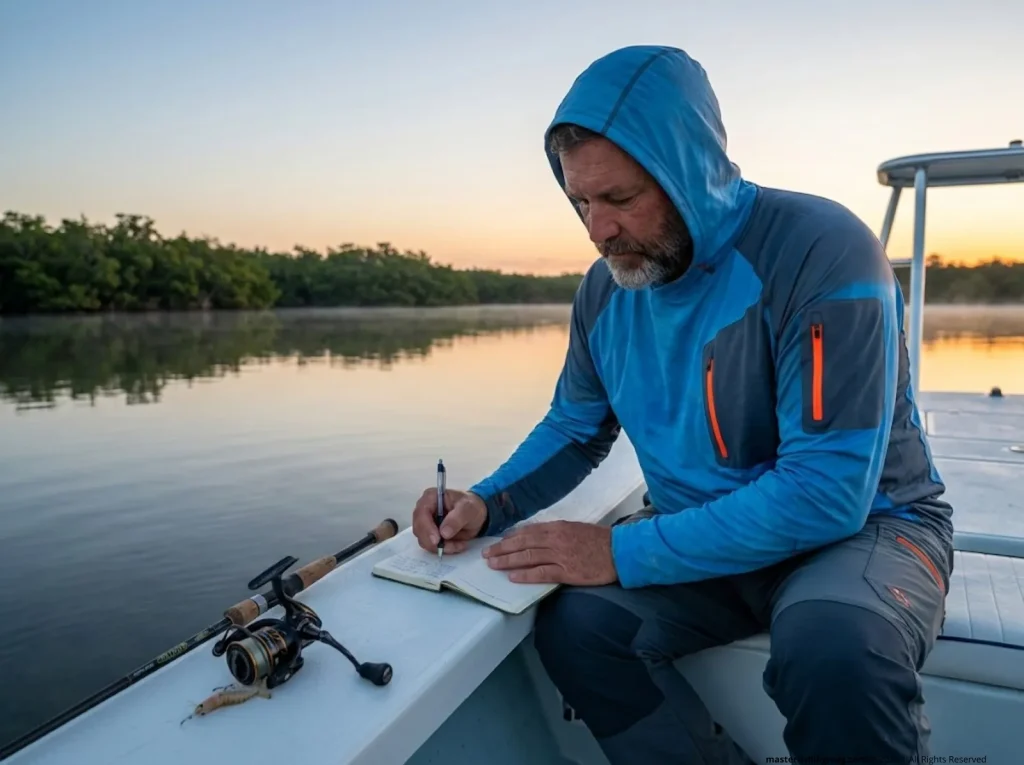
The angler who keeps a logbook noting which daily tide produced strikes, AM versus PM, will discover a local pattern that competitors miss entirely.
Metabolic Cost — When Velocity Becomes the Enemy
Here’s the biological flip side of velocity. Holding position in current costs energy. Every fish has a baseline resting metabolic rate and a maximum rate it can sustain. The gap between those two numbers, the aerobic scope, is its energy budget.
As water temperature climbs, that baseline rate increases while the ceiling stays the same. On an 85°F summer day, a redfish fighting a 3-knot current burns through its energy reserves fast. If it can’t find a velocity refuge behind an oyster bar or bridge piling, it has to abandon the current entirely. Active metabolic rate in fish can spike to 10 or 12 times the resting rate at top swimming effort. That’s why fish hold tight behind structure in warm water that narrows a fish’s metabolic scope, not for “shelter,” but for survival.
Wind, Structure, and Local Anomalies — When the Chart Is Wrong
Your tide app runs on math. The ocean runs on physics, wind, and bottom contour. The gap between those two realities is where most anglers get burned.
Wind-Tide Stacking (Tidal Compression)
A strong onshore wind blowing into a bay “stacks” water against the land. That wind-tide interaction causes higher-than-predicted high tides and delays the ebb tide by 30 minutes or more. The stacked water also increases turbidity as heightened friction stirs bottom sediment, directly changing your lure visibility and selection.
The opposite scenario works too: an offshore wind accelerates the ebb and drops the water below predicted low, exposing structure that normally stays submerged. Both situations make your chart wrong, sometimes by a full hour.
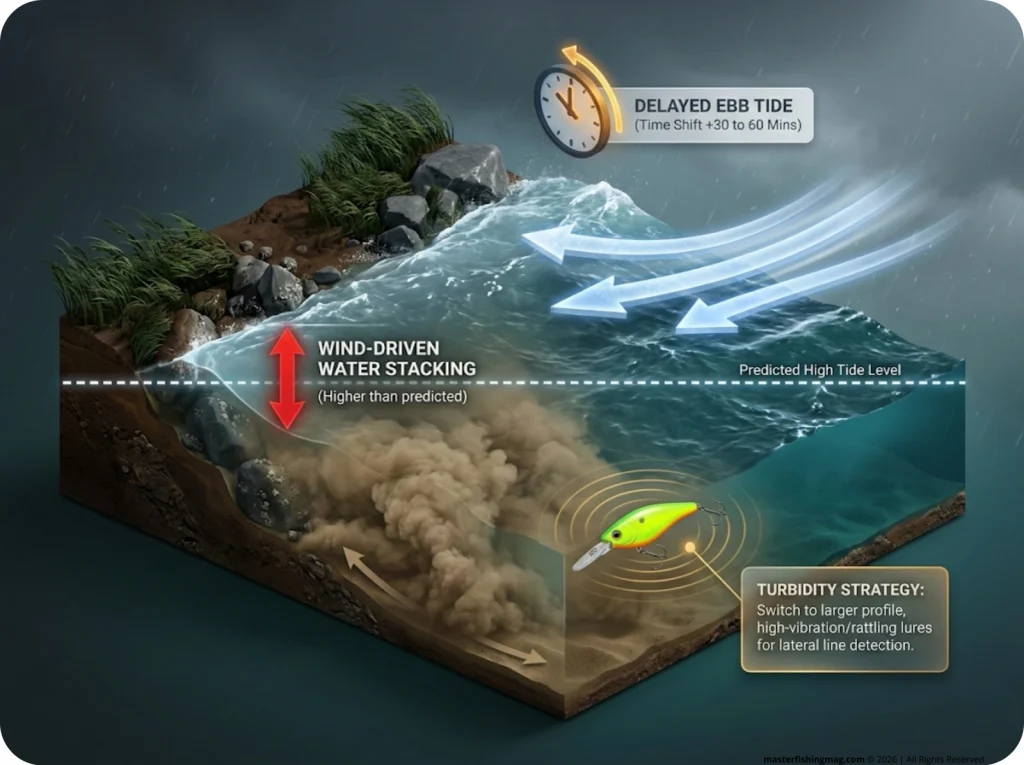
Pro tip: If the wind is blowing against the tide, expect a delayed turn and much rougher surface conditions. I switch to larger, louder lures, rattling plugs and heavy spoons, when compression turbidity kicks in.
The Pothole Strategy — Reading Receding Water
Most guides say “fish move to deep water on the ebb.” That’s half the story.
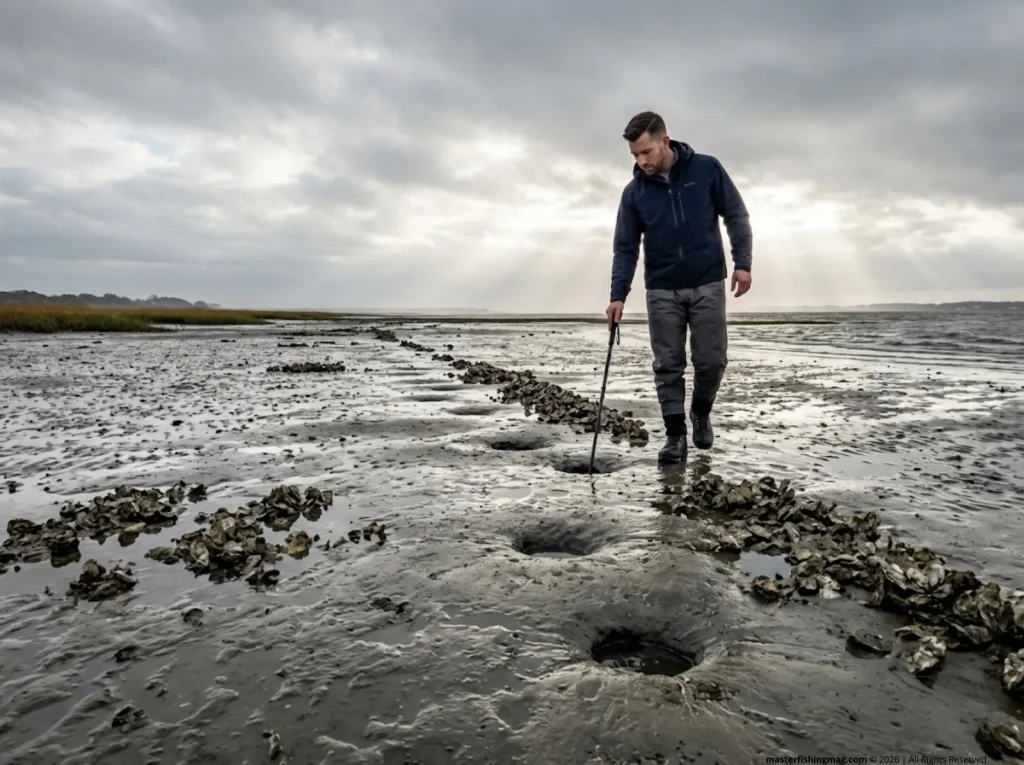
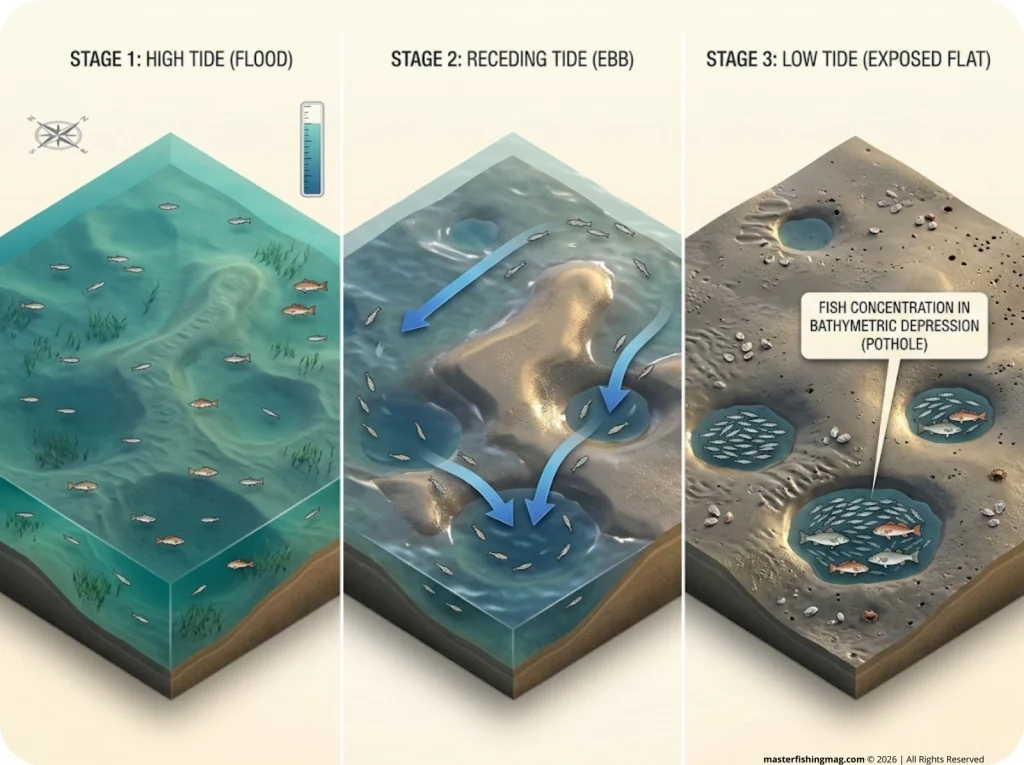
As the water recedes, current forces baitfish into bathymetric depressions, or “potholes,” where depth holds even as surrounding flats drain. These become high-density feeding zones because the energy cost of leaving outweighs the risk of staying shallow. You can find them at dead low on foot: dark spots in sand or mud, 6 to 18 inches deeper than the surrounding tidal flow that shapes saltwater flat ecosystems, often near oyster clusters. On the next flood tide, fish will stage at these same depressions first, making them reliable ambush points trip after trip.
Manning’s Coefficient — Why Bottom Type Changes Everything
Two spots 50 yards apart with identical tidal exposure can fish completely differently. The reason is bottom friction.
A sand or mud bottom creates low friction and high velocity, water blows through fast and fish get pushed out. But oyster bars, rock structure, and heavy bottom relief create turbulence, eddies, and those velocity refuges predators need. This is the practical version of what hydrologists call the Manning coefficient, a measure of how “rough” the seabed is. The rougher the bottom, the more holding spots for fish, and the more productive your cast will be.
Tackle Adjustments by Velocity Phase — The Lure Selection Matrix
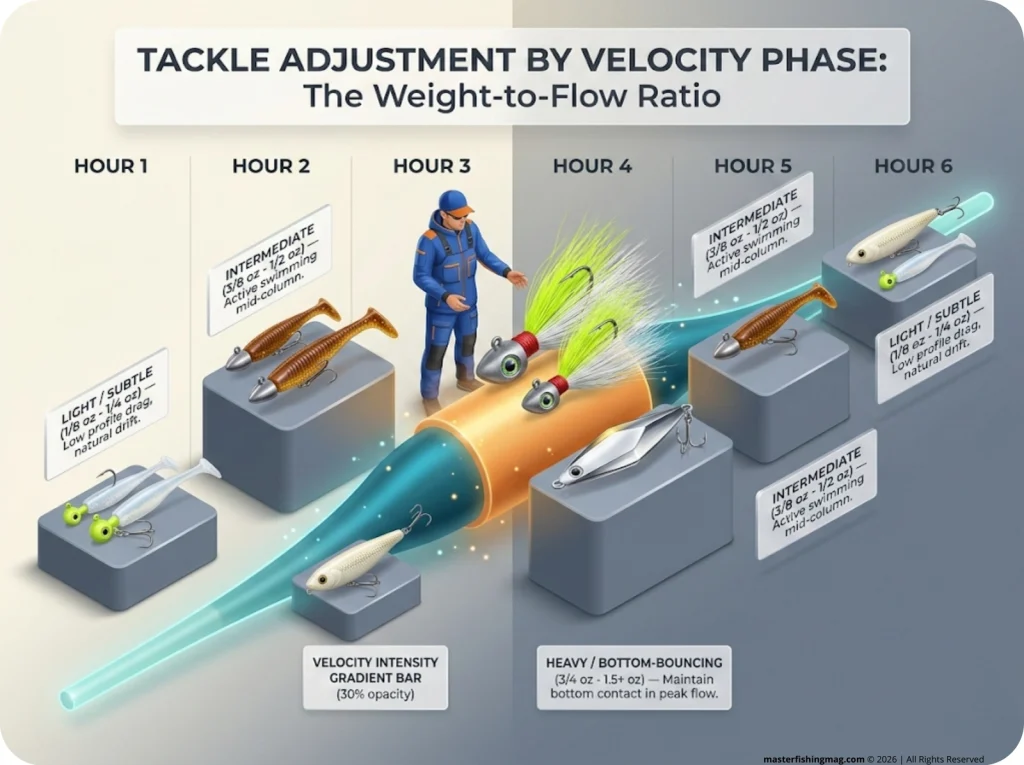
If velocity changes throughout the tide, your tackle needs to change with it. A 1/4-oz jig head that was perfect in Hour 1 becomes useless in Hour 3 because the current just sweeps it off the bottom.
The Weight-to-Flow Ratio
A lure in current is subject to profile drag. Thicker line, say 30-lb braid, creates more drag surface than 10-lb braid, pushing your presentation up and away from the strike zone. To maintain bottom contact in those peak-flow Hours 3 and 4, you either increase weight or decrease line diameter. That’s the tradeoff.
The 50/50 trolling rule applies too: when trolling against current, 50% of your effective depth is lost to line drag alone. If your lure runs at 15 feet in still water, expect 7 or 8 feet in a 2-knot current. Adjust accordingly, or match weight geometry to current conditions before you lose your best jig to the bottom.
Lure Weight Selection Matrix by Tidal Hour
Here’s how I break it down across the six-hour cycle:
Hours 1 and 6 (Low Flow): 1/8 oz to 1/4 oz jig heads. Slow, subtle presentation. Topwater is viable. Soft plastics on light heads can drift naturally without getting swept.
Hours 2 and 5 (Moderate Flow): 3/8 oz to 1/2 oz. Active swimming lures. Paddletails and swimbaits in the mid-column work well as fish start positioning at ambush stations.
Hours 3 and 4 (Peak Flow): 3/4 oz to 1.5 oz. Heavy bottom-bouncing. Bucktails, heavy jigs, cut bait on fishfinder rigs. This is where you earn it or go home skunked.
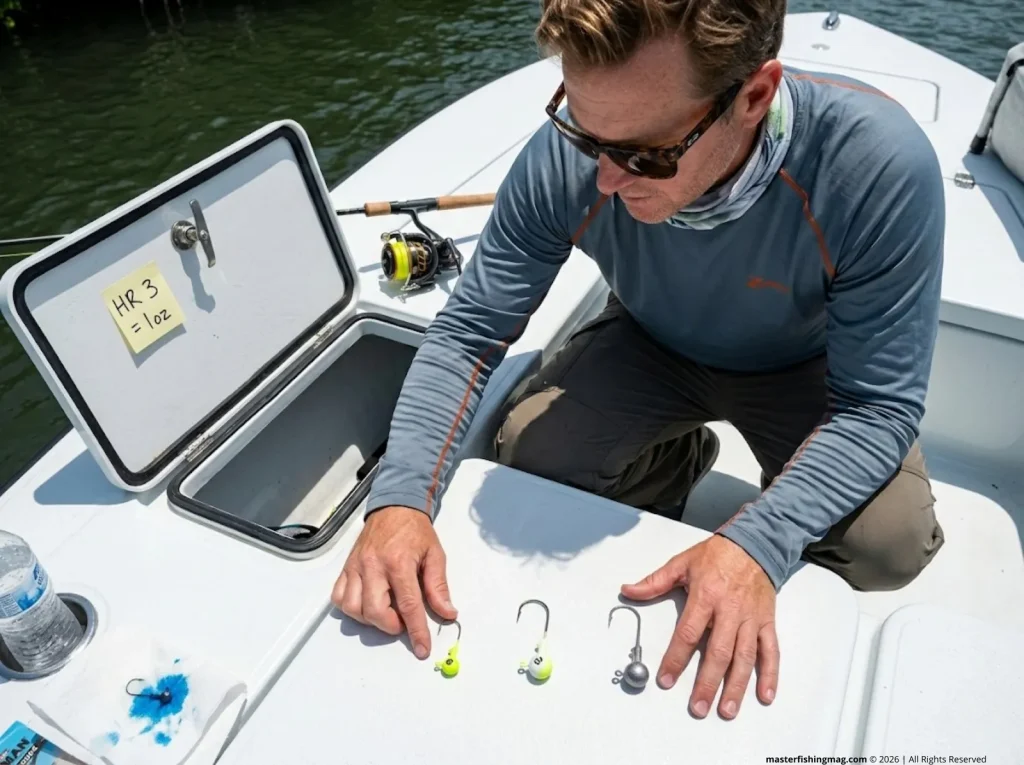
Pro tip: I carry three sizes of the same jig head: 1/4, 1/2, and 1 oz. I switch purely based on what hour of the tide I’m fishing. If my lure isn’t ticking bottom, I go heavier. No exceptions.
Species-Specific Tide Preferences
Not every species feeds on the same phase.
Flounder feed most aggressively on the ebb tide. They lie flat in potholes and ambush anything funneling out. Redfish prefer the flood, because incoming tide pushes shrimp and crabs onto flats where they tail in shallow water. Striped bass are current seam specialists: they hold in eddies behind structure and strike anything swept past by Hours 3-4 velocity. Snook stack against bridge pilings and seawall corners during strong flow, using structure as a velocity refuge.
Once you learn a species’ preferred tide phase, you stop wasting casts during the wrong window.
Tools and Apps — Reading Velocity, Not Just Height
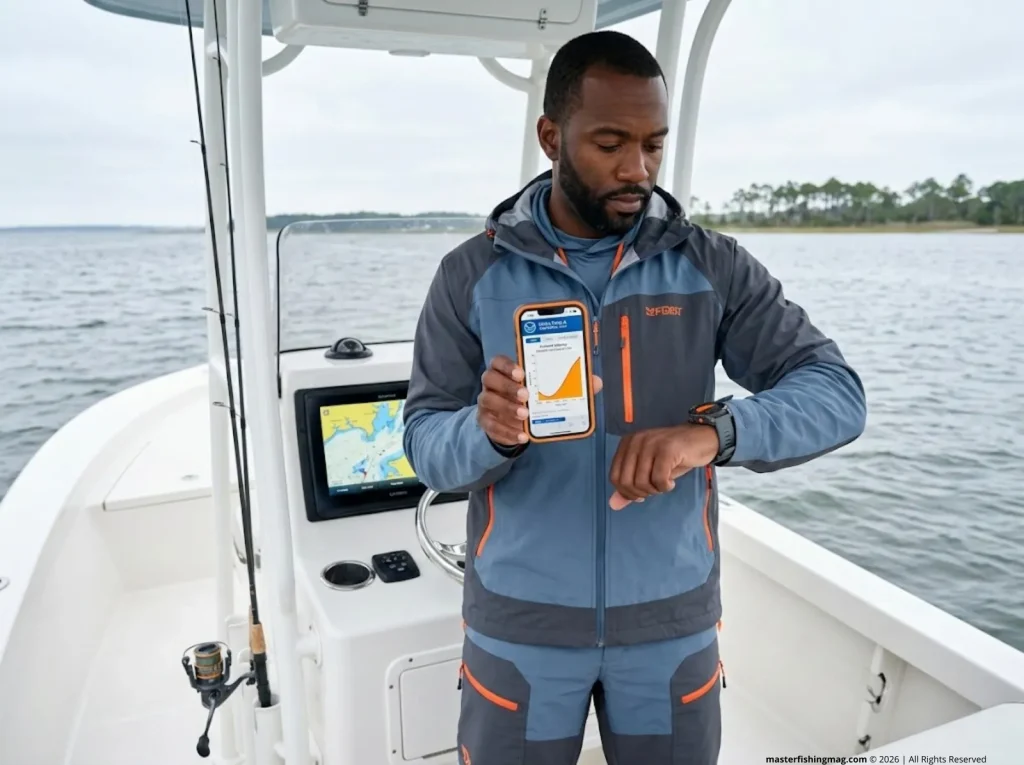
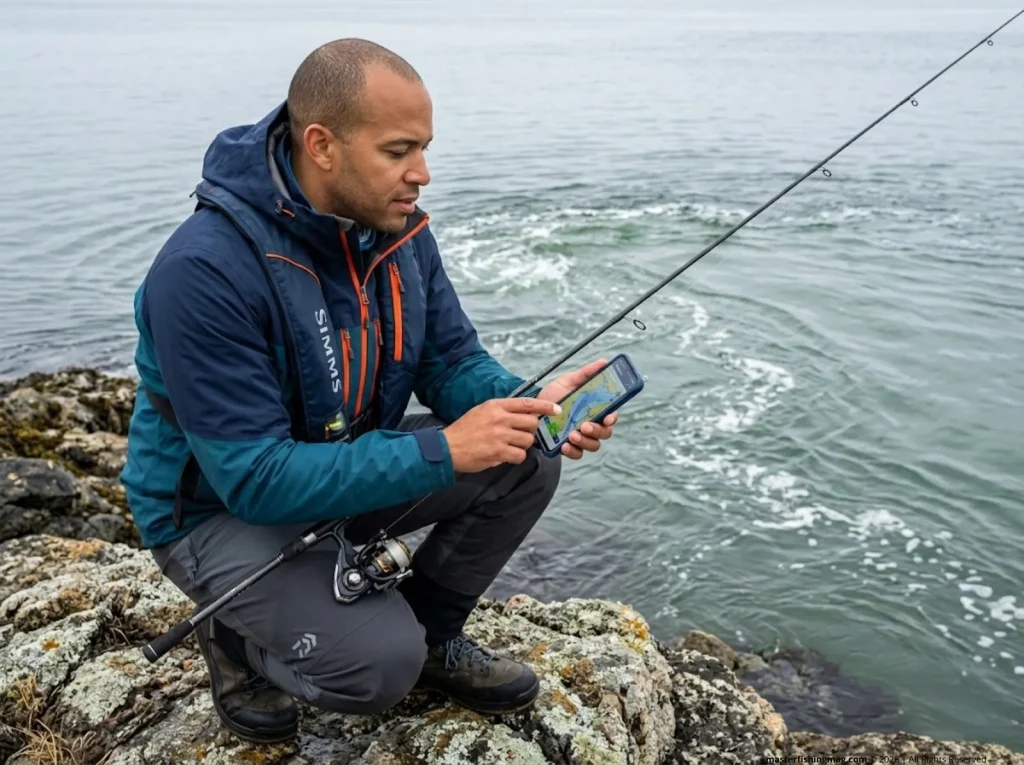
Most fishing apps like Tide Alert and Tides Near Me only display predicted height from harmonic analysis. They show you the bathtub model. That’s useful for knowing whether your sandbar will be walkable, but useless for predicting when fish will feed.
NOAA vs. Consumer Tide Apps
NOAA Tides and Currents provides Nowcast data from 210 long-term NWLON monitoring stations, including current velocity predictions at subordinate stations. The difference between a “harmonic” station and a “subordinate” station can shift predicted slack water by 30 minutes or more, enough to miss your entire golden window.
Tides4Fishing gives you tidal coefficients on a 0-120 scale, a single number telling you the “horsepower” of a given tide. Navionics overlays bathymetry so you can identify potholes and velocity refuges before you arrive. For a deeper comparison, here’s our full breakdown of the best fishing apps for tide and GPS data.
Building Your “Local Corrections” Log
No app is perfect for your specific spot. Structure, wind, and geography create local anomalies that only you can track.
After each trip, log three things: predicted tide time versus actual current turn, wind direction and speed, and which hour of the Rule of Twelfths produced your bites. After 10 trips to the same spot, you’ll have a custom local corrections table that outperforms any consumer app at your home water. I keep a simple spreadsheet: Date, Predicted Turn, Actual Turn, Wind, and whether bites came in Hours 2-3 or 4-5. After a season, I can predict my spot’s behavior within 15 minutes.
Tidal Coefficients and Moon Phases — Predicting Energy Before You Leave the Dock
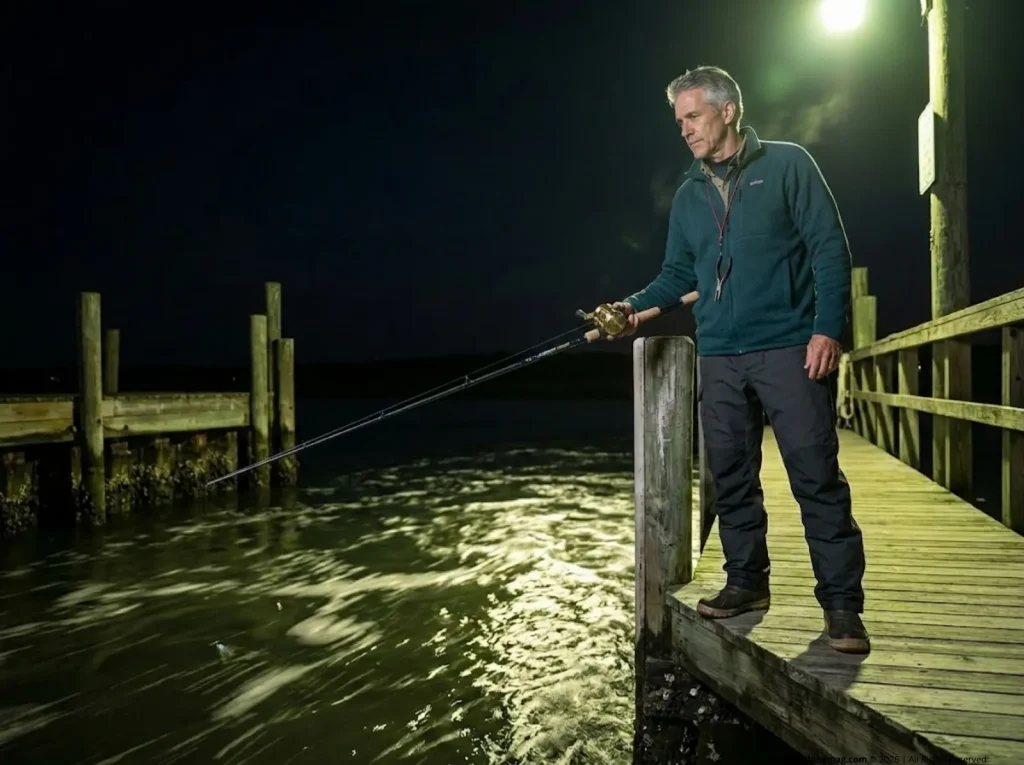
Not all tides are created equal. Some days, the water barely moves. Other days, the rip is so strong it pulls your anchor. The difference comes down to the moon phases and how they translate into tidal energy.
Tidal Coefficients — The 0-120 Energy Scale
Tidal coefficients quantify the “energy” of a specific tide. A coefficient of 95 or above means massive water movement and aggressive feeding. Below 40, the current barely whispers. Fish scatter rather than funnel, and finding them becomes a puzzle.
Spring tides happen every 14.5 days when the sun, moon, and earth align during the new moon and full moon phases. These produce the highest coefficients and the fastest currents. Neap tides during quarter moons produce the lowest. Plan your premier trips around coefficients above 80, and save the low-energy days for scouting structure at dead low.
Moon Phase Fishing — Beyond Solunar Theory
The lunar day lasts 24.8 hours, which is why tides shift by roughly 50 minutes each calendar day. Full moon periods produce the strongest tides but also the brightest nights, which shifts much of the feeding to after dark.
New moon periods produce equally strong spring tides with dark nights, and that combination often concentrates feeding into daytime windows. For day anglers, the new moon is typically the highest-value planning target. My best big-fish days are always within two days of a new moon. The tides are ripping, but the fish haven’t been feeding all night under moonlight, so they’re hungry and aggressive during the day. For the full science behind solunar theory and lunar feeding periods, that breakdown covers the rest.
Conclusion
Three things will change how you fish tides starting on your next trip.
First: stop reading height, start reading velocity. The Rule of Twelfths tells you that 50% of water volume moves in just 2 hours. That’s your strike window, not the moment your app says “High Tide.”
Second: your spot has a personality. Standing waves, progressive waves, wind stacking, and bottom friction all create local anomalies that can make your tide chart wrong by 30 to 60 minutes. Build a corrections log and let the data accumulate.
Third: match your tackle to the hour, not the day. A 1/4-oz jig that worked in Hour 1 is useless in Hour 3. Carry a weight progression and swap as the velocity climbs.
On your next trip, pick one thing: time your bites against the Rule of Twelfths and log which hour produced. Do that for five trips. You’ll stop chasing height numbers and start reading the water the way the fish do, by feel, by flow, and by physics.
FAQ
What is the best tide to fish — incoming or outgoing?
Incoming (flood) tide is generally the most productive because it pushes baitfish into shallow areas where predators stage. However, species like flounder feed more aggressively on the outgoing (ebb) tide as bait funnels out of marsh drains and potholes. The real answer: the 2-hour window around any tide change, when velocity peaks, matters more than direction.
Is it better to fish at high tide or low tide?
Neither. Fish respond to current velocity, not water level. The best fishing occurs during Hours 3 and 4 of the Rule of Twelfths, when 50% of the tidal volume is moving, regardless of whether your chart reads high or low.
How do you read a tide chart for fishing?
Look beyond the simple height curve. Identify your local wave type (standing or progressive), calculate which hours fall into the Rule of Twelfths peak velocity window, and cross-reference with tidal coefficients to assess energy. Use NOAA’s current predictions, not just height predictions, for your nearest subordinate station.
Do fish bite more during a full moon?
Full moons produce the strongest tides (spring tides), which creates excellent velocity for feeding. But bright nighttime light shifts most of the feeding to after dark. New moons produce equally strong spring tides with dark nights, which often concentrates daytime feeding, making them the more productive pick for daylight anglers.
What are the best apps for reading fishing tides?
For velocity analysis, start with NOAA Tides and Currents for current predictions. Tides4Fishing provides tidal coefficients on a 0-120 scale. Navionics overlays bathymetric data to identify potholes and velocity refuges. Consumer apps like Tide Alert and Tides Near Me handle quick height checks but don’t provide current velocity data.
Risk Disclaimer: Fishing, boating, and all related outdoor activities involve inherent risks that
can lead to injury. The information provided on Master Fishing Mag is for educational and informational purposes
only. While we strive for accuracy, the information, techniques, and advice on gear and safety are not a substitute
for your own best judgment, local knowledge, and adherence to official regulations. Fishing regulations, including
seasons, size limits, and species restrictions, change frequently and vary by location. Always consult the latest
official regulations from your local fish and wildlife agency before heading out. Proper handling of hooks, knives,
and other sharp equipment is essential for safety. Furthermore, be aware of local fish consumption advisories. By
using this website, you agree that you are solely responsible for your own safety and for complying with all
applicable laws. Any reliance you place on our content is strictly at your own risk. Master Fishing Mag and its
authors will not be held liable for any injury, damage, or loss sustained in connection with the use of the
information herein.
Affiliate Disclosure: We are a participant in the Amazon Services LLC Associates Program, an
affiliate advertising program designed to provide a means for us to earn advertising fees by advertising and linking
to Amazon.com. As an Amazon Associate, we earn from qualifying purchases. We also participate in other affiliate
programs and may receive a commission on products purchased through our links, at no extra cost to you. Additional
terms are found in the terms of service.