


In this article
A 60-pound yellowfin had been peeling drag for four solid minutes when the angler’s $280 low-profile baitcaster made a sound no reel should ever make — a grinding crunch as the pinion yoke deformed under sustained torque. The line went slack. Not because the fish escaped. Because a tool engineered for 3/8oz jigs had just been asked to do the work of a winch. The fish won by engineering default.
The difference between a baitcasting reel and a round conventional reel is not brand loyalty, price, or fishing experience — it’s physics. Spool mass, frame metallurgy, drag architecture, and level-wind synchronization are the actual variables. Get them wrong and you’re not just fishing with the wrong tool. You’re fighting against the gear itself.
⚡ Quick Answer: A baitcaster’s low-mass spool lets it cast light lures efficiently — below 1/4oz with a standard model, down to 1/16oz with a Bait Finesse System (BFS) reel. A round conventional has a heavier spool that creates a flywheel effect with heavy sinkers and live bait (2oz+), and its robust frame and drag stack handle sustained big-game fights that would collapse a standard baitcaster. Choose by lure weight, target species, and fight style — not by brand or habit.
The Spool as a Rotating Mass — Why Startup Inertia Is Everything
Here’s where most guides get it wrong. They tell you baitcasters are for freshwater and conventionals are for saltwater. That’s a geography rule, not a physics rule. The real question is always the same: does your lure carry enough energy to set this spool spinning?
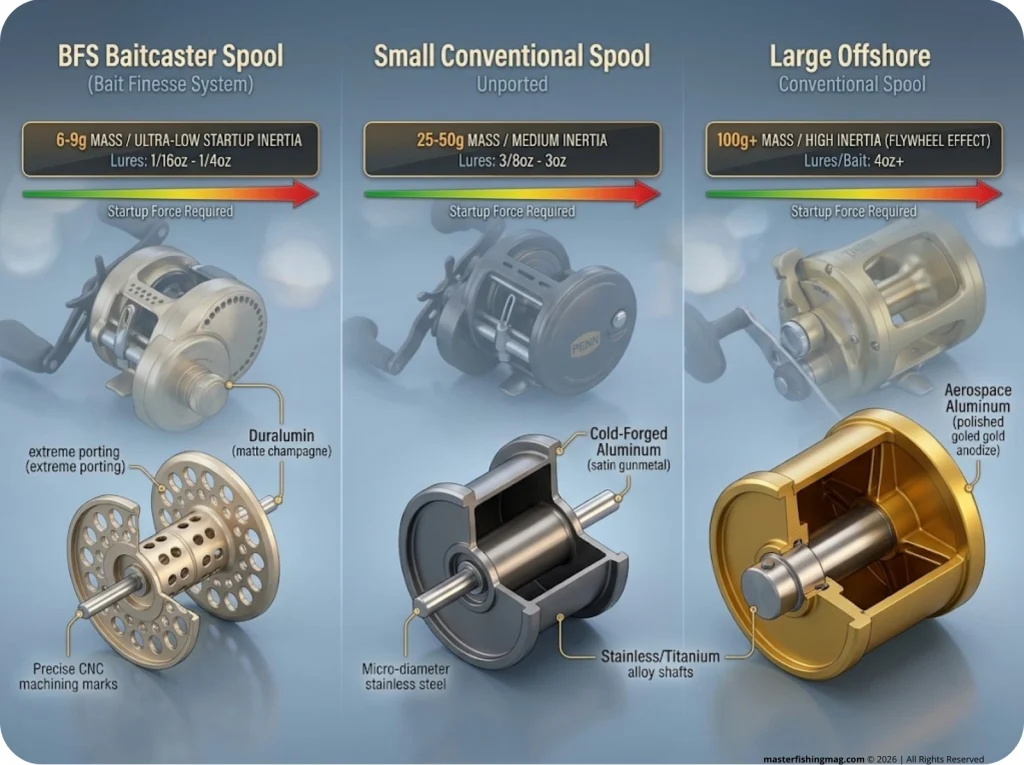
The quantity that governs this is startup inertia — a spool’s resistance to changing its rotation rate from a dead stop. It scales with mass and how that mass distributes relative to the rotation axis. More mass further from the center means higher inertia and a heavier lure required to get the spool moving. That threshold is the master variable behind every casting limitation you’ve ever experienced. The relationship between angular momentum principles in rotating systems and reel behavior is exact — physics, not folklore.
A BFS reel (Shimano MGL Spool III, Okuma Flite Spool) carries rotational mass of 6–9 grams. A standard baitcaster sits at 11–18g — efficient from about 1/4oz up. A small conventional starts at 25–50g. A large offshore conventional exceeds 100g. These numbers reflect the application each reel was engineered to solve. After understanding startup inertia, proper spool tension adjustment becomes logical — you’re calibrating the spool to launch within its designed inertia window.
Light Lures and the Finesse Threshold — Where Baitcasters Win
Below 1/4oz on a standard baitcaster, you’re not dealing with a technique problem — you’re dealing with a physics failure. The lure doesn’t carry enough energy to overcome the spool’s startup inertia. It stalls. The cast lands at your feet. No brake adjustment fixes this; the problem is spool mass.
Here’s something experienced finesse anglers know that doesn’t make it into gear guides: spool fill level changes effective inertia. A half-loaded spool has less mass and lower inertia than a full one. Some anglers intentionally fish spools at 60–70% capacity when throwing ultralight jigs — not for line economy, but to drop the inertia threshold. That’s the kind of thing you learn after the 40th session of wondering why your BFS setup still stalls.
BFS reels — designs like the Shimano Curado BFS or niche JDM-market setups — take this further. They’re purpose-engineered around low spool mass as the primary specification. The spool is the spec. Everything else follows.
Pro Tip: When a standard baitcaster keeps stalling on light lures, don’t add brake. Brake adjustments solve overrun problems, not startup failures. The only real fix is a lighter spool or a lighter lure.
Heavy Loads and the Flywheel Effect — Where Conventionals Win
Put a heavy conventional spool in motion with a 4-ounce sinker and something changes. The spool doesn’t just keep up — it helps. The rotational momentum of a 50–100g+ spool, once established, smooths out the payout of heavy monofilament and keeps line from digging into underlying layers under load. Offshore anglers feel this as the reel pulling line out during a pelagic run rather than fighting against inertia. That’s the flywheel effect, and it explains why conventional reels carry high line capacity on wide, deep spools specifically suited for heavy mono.
Put that same large conventional spool on a 1/4oz jig and you’ll watch the cast die ten feet in front of you. The lure exhausts its energy before the spool finishes accelerating. This is not operator error. This is energy conservation.
The Backlash Equation — Newton’s Second Law Applied to Your Thumb
Backlash happens when the lure slows faster than the spool does. Air resistance drops lure speed mid-flight, but the spool — all that rotating mass — keeps spinning. The excess line has nowhere to go. You know what happens next.
Here’s what nobody explains: the thumb pressure required to prevent overrun scales directly with spool mass. A heavy conventional spool requires significantly more thumb force than a low-profile baitcaster to stop at the same rate. This is why conventional reels are harder to thumb — it’s not a skill gap, it’s a physics gap. The angler’s thumb is the entire braking system on a conventional with no mechanical assist.
Wind creates sudden, unpredictable lure deceleration — that’s when thumb control on a conventional becomes most demanding and when a baitcaster’s automatic brakes earn their keep. The physics here don’t negotiate. More spool mass means more restraining force required, every cast.
Frame Metallurgy — Torsional Rigidity Under Load
Your reel’s drag rating is printed on paper. Whether it delivers that number depends on frame metallurgy.
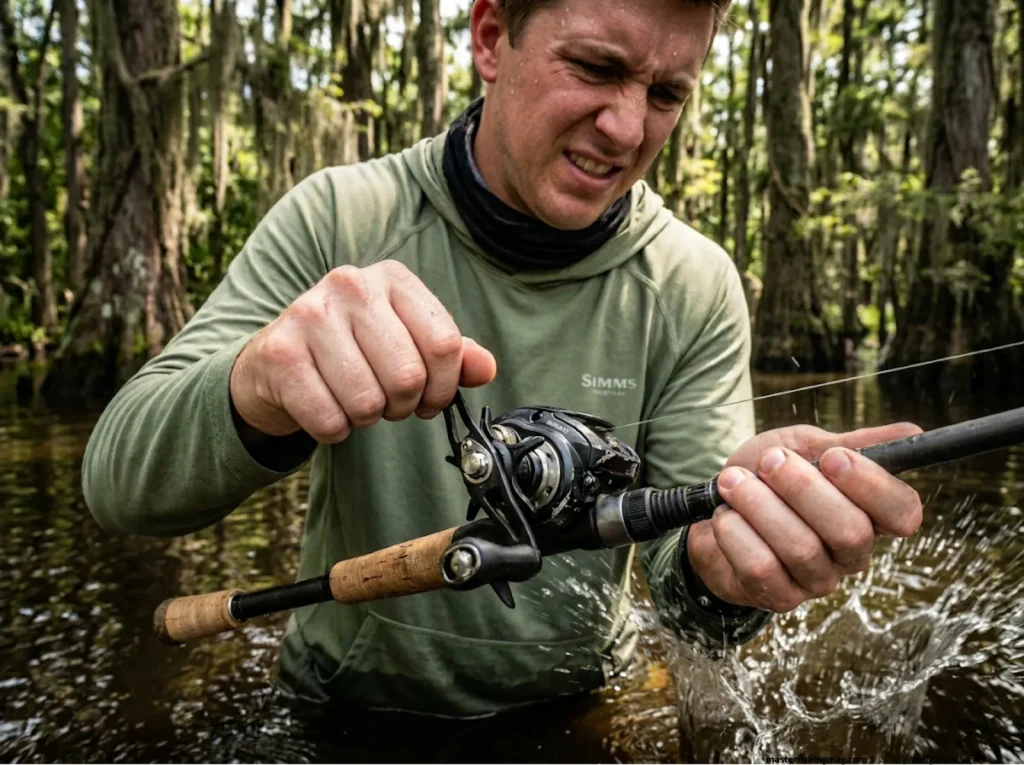
The frame’s job during a fight is to hold gear mesh in precise alignment while torque transfers from the fish through the line, through the spool, into the gears. When the frame flexes, that alignment shifts. Gear contact moves from face to edge. That grinding sound is what frame failure feels like before it becomes complete failure. The baitcasting reel mechanical engineering analysis from MIT DSpace identifies frame torsional flex as the primary structural failure mode under sustained load.
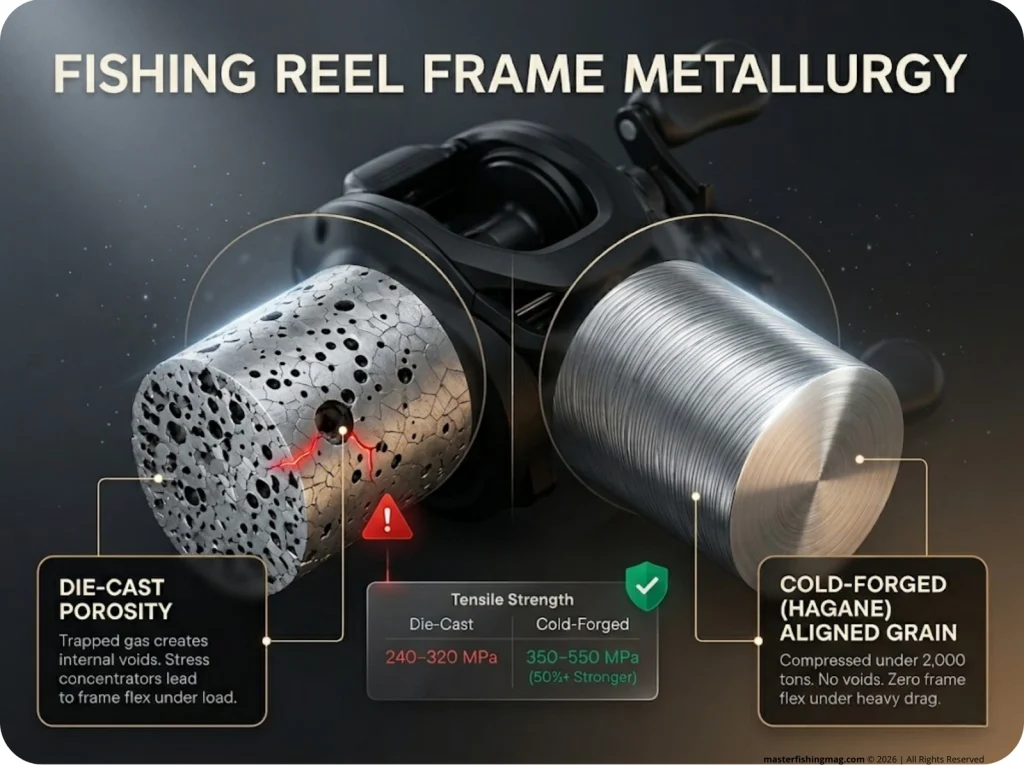
Die-cast aluminum traps gas during molding, creating internal porosity. Those voids are stress concentrators — under cyclic load, the frame cracks or warps at those points. Cold forging compresses solid aluminum under up to 2,000 tons of force, aligning and refining the crystalline grain structure and eliminating porosity entirely. Die-cast tensile strength: 240–320 MPa. Cold-forged: 350–550 MPa — up to 50% stronger. Shimano’s Hagane and Daiwa’s Hyper Armed Body are marketing names for what is mechanically a cold-forged and CNC-machined frame system. “Full metal body” on a spec sheet does not guarantee cold forging — confirm the process in the manufacturer’s tech pages, not the box.
Pro Tip: Grip the reel body firmly on both sides and squeeze like you’re simulating a load. A die-cast frame flexes perceptibly. A cold-forged frame does not. If you feel flex in your hand, you’ll feel it against a serious fish — except it won’t feel like flex. It’ll feel like grinding.
A standard $150–200 low-profile baitcaster uses a die-cast frame with thin walls to stay light — correct for 50 casts per session with 3/8oz lures, wrong for 15–20 pounds of sustained drag against a large saltwater species. The frame flexes, the pinion yoke deforms, the gears grind. That $280 reel in the opening story failed because its frame was never rated for what it was asked to do. When reviewing frame-rated baitcasting reels for bass, this distinction is what separates usable drag specs from marketing numbers.
Round conventionals incorporate two-speed gearing — a 6:1 high ratio for taking up slack and a 2.5:1 “granny gear” for winching. Halving the gear ratio doubles the torque at the handle. That torque multiplication is why deep-water vertical jigging is sustainable for hours with the right reel and a back-destroying grind with the wrong one. Baitcasters skip two-speed gearing because casting frequency applications prioritize retrieve speed, not winching power.
Braking Systems — Engineering the Counter-Torque

Every braking system applies counter-torque to the spool to prevent it outrunning the lure. Where they differ is when and how hard they brake. For the practical tuning side, dialing in your baitcaster’s braking system is where this physics becomes hands-on decisions.

Digital Control (DC) — Shimano DC200 series — samples spool speed 1,000 times per second and applies electromagnetic braking pulses to create an asymmetric curve no mechanical system can achieve: maximum braking at launch, minimal braking mid-trajectory, late spike as the lure settles. DC is the engineering answer to baitcaster design’s core contradiction. For variable-wind fishing or distance casting it’s justifiable. For general use, magnetic is sufficient.
Pro Tip: If you’re fishing into a headwind with medium-weight lures, magnetic brakes win over centrifugal. The lure decelerates early in headwind, and mag brakes stay active at low RPM where centrifugal systems have already gone quiet. Set your mag dial two clicks higher than you think you need and adjust from there.
Drag Mechanics — Side-Load Vectors and Heat Dissipation
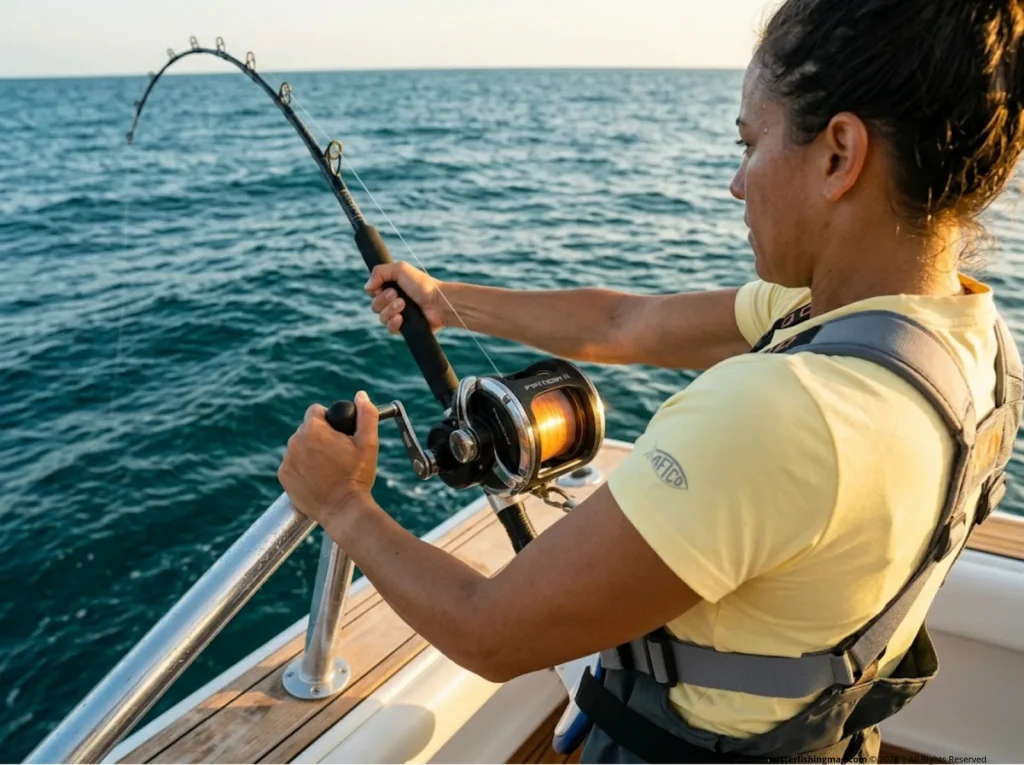
Star drags sit on the drive shaft and apply pressure to a washer stack inside the main gear. The spool bearings experience only their designed radial loads — the reel stays smooth at any drag setting. Adjustment is blind: you dial by feel, not visual reference. Correct for inshore and casting applications.
Lever drags push the entire spool against a single large-diameter drag washer via a cam — precise visual positioning, high surface area, higher stopping power. The cost: a massive axial force vector goes through the spool bearings. Standard ball bearings are not built for thrust loads. Under high drag the balls press against raceways at an angle, causing handle binding. Professional lever drags — Shimano Ocea Jigger LD, Okuma Makaira — solve this with thrust bearings or twin-drag architectures that sandwich the spool and balance the axial load.
During a sustained run from a large pelagic, kinetic energy converts to thermal energy at the drag washers interface. If lubricant heats past its viscosity threshold, drag output surges unpredictably — what offshore anglers call the drag “exploding.” That surge will cost you a fish if you haven’t accounted for it. Carbon fiber drag washers (Carbontex) maintain consistent friction at temperatures that destroy synthetic felt or nylon components. Metal frames — aluminum and magnesium — conduct heat away from the gearbox significantly faster than graphite. For a full treatment of drag heat physics and material failure, the material science matters as much as the mechanical design.
The carbon fiber drag washer thermal performance data from AvCarb Material Solutions confirms what offshore anglers learn the hard way: graphite frames are not substitutes for metal when a pelagic fish is running. The frame is doing thermal work. That work requires metal.
Level-Wind Mechanics — Friction You Can’t See Costing You Distance
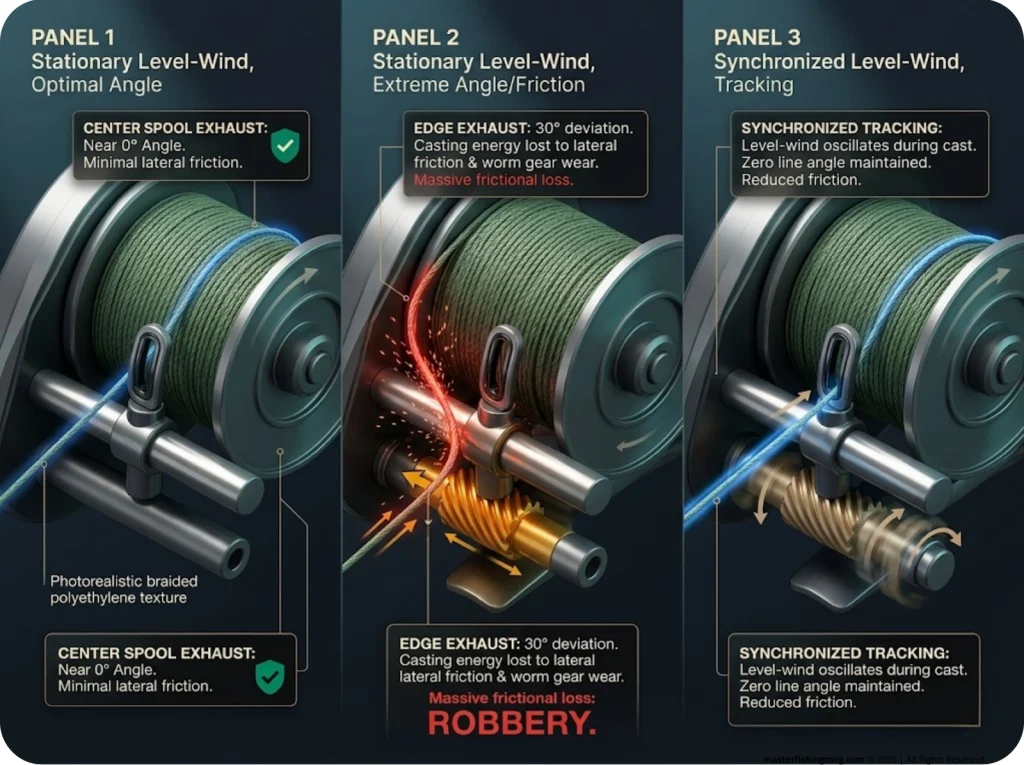
Understanding how level-wind timing affects lure retrieve speed starts with the two architectures: stationary during cast, and synchronized.
On a standard baitcaster, the level-wind stays stationary during the cast. As line peels from spool edges, it bends at an angle to enter the narrow worm-gear guide — at 30 degrees of deviation, up to 25% of line tension transfers as lateral force into the guide and worm gear, robbing that energy from the cast. This also concentrates wear on the worm gear pawl, the smallest and most failure-prone component in the reel. Line dig-in under heavy tension happens when line buries into underlying layers; stationary level-winds amplify that risk.
Synchronized level-winds — Abu Garcia Ambassadeur series, select Shimano Calcuttas — oscillate during the cast, tracking spool position and maintaining near-zero line angle throughout. Drastically reduced friction, eliminated dig-in, more uniform line lay. The tradeoff: synchronization gears add mass and startup inertia, pushing the effective minimum lure weight up. Correct for heavy conventional applications. Counterproductive for finesse baitcasting.
Some high-end round conventionals disengage the level-wind entirely during the cast, letting line flow freely, then re-engage it only during retrieve. This eliminates all casting friction from the level-wind but requires the angler to guide line manually onto the spool to prevent uneven lay. Experienced surf and offshore anglers do this instinctively. It’s not a technique — it’s what happens after enough casts.
The Decision Matrix — Which Reel Solves Your Energy Equation

Every reel choice is an optimization problem. Lure weight, target species torque, fight duration, casting frequency — these are the variables. Getting them wrong doesn’t create incremental inefficiency. It creates categorical failure.
Use a baitcaster when: casting 50+ times per session with lures from 1/4oz to 1.5oz, targeting species that need quick torque bursts from cover (bass, snook, corvina), or palming the reel during the fight. Line limits: fluorocarbon or mono under 20lb, braid under 40lb PE. Below 1/4oz with a standard baitcaster, below 1/16oz with a BFS reel — you’ll get stalled casts. For selecting the right baitcaster for your bass technique, the lure weight range is the first filter.
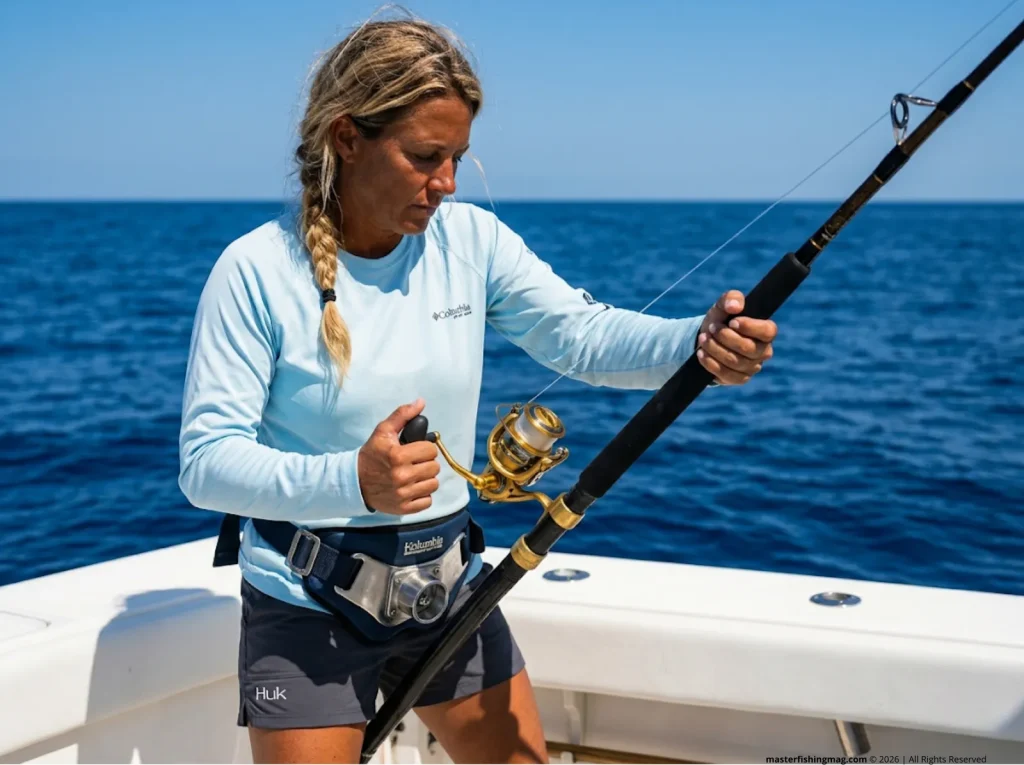
Use a conventional when: sinker weight reaches 2oz or more for surf, live or cut bait over 4oz, deep-water vertical jigging at 150ft+, or trolling sustained loads for hours. Pelagic species — tuna, wahoo, amberjack — that run fast and long require the thermal management that only a conventional’s drag stack and metal frame can provide. The ergonomic tell: if you’re pumping and reeling in a two-handed grip with the reel braced against your body, you’re in a conventional application.
The gray zone: casting conventionals like the Penn Fathom Low Profile or Penn Squall handle lures from 3/4oz to 3oz and occasional heavy-drag encounters that would deform a standard baitcaster frame. The Penn Squall handles a 1oz surf plug with a 30-yard cast AND 15 pounds of drag — that dual capability is the engineering value proposition. Startup inertia is still higher than a finesse baitcaster, so the effective floor is around 3/8oz.
Pro Tip: If your inshore sessions mix medium plug casting with hard-running fish — slot redfish, big snook, stripers — a casting conventional is often the right call. You don’t have to choose between casting range and drag capacity. The Penn Squall and Shimano Tranx sit in this window on purpose.
Get the Physics Right
Three things, locked in.
Spool mass is the master variable. Minimum lure weight is set by your reel’s inertia, not your casting skill. Those numbers are not opinions.
Frame metallurgy sets your real drag ceiling. The spec sheet number means nothing if the frame flexes at half that load. Cold-forged aluminum holds gear alignment where die-cast does not.
Braking and drag are two separate systems. The braking system manages the spool during the cast. The drag system manages heat during the fight. A centrifugal brake won’t save a melted drag washer. A Carbontex drag stack won’t prevent a backlash.
Pull the spool mass, frame material, and drag washer spec on whatever reel you’re running. Cross-reference against what you actually fish. You’ll find the mismatch. Fix the physics and the sessions that consistently underperform will start making sense.
FAQ
Is a baitcaster the same as a conventional reel?
No. A baitcaster is a low-profile casting reel with a level-wind, optimized for lures from 1/4oz to about 1.5oz. A conventional reel is typically a round-body reel built for heavier loads, higher line capacity, and sustained drag under pelagic species. They share the same side-reel orientation and thumb-braking principle but differ fundamentally in spool mass, frame architecture, and drag system design.
Can you cast a conventional reel?
Yes — casting conventionals like the Penn Fathom, Shimano Tranx, and Avet MX are designed for overhead casting in the 1/2oz–4oz range. Higher spool mass than a true baitcaster limits casting efficiency below 3/8oz, but within their designed window they handle both casting range and heavy-drag capacity in the same session.
Why do offshore conventional reels not have level-winds?
Because a level-wind adds friction, dig-in risk, and a mechanical failure point — all costly on a 200-yard marlin run. Without a level-wind, offshore anglers thumb line manually during retrieval. Experienced hands do this instinctively. The absence of a level-wind is an engineering choice, not an omission.
What is the difference between star drag and lever drag?
Star drags apply pressure via a washer stack on the drive shaft, keeping spool bearings in radial load mode — the reel stays smooth to crank at any drag setting. Lever drags push the spool axially against a single large washer, giving precise visual positioning and high drag surface area, but generating severe axial side-load stress on spool bearings that causes handle binding at high drag. Professional lever drags resolve this with thrust bearings or twin-drag architectures.
How do I know if my baitcaster frame is strong enough for saltwater?
Squeeze the reel body firmly on both sides and apply lateral pressure. A die-cast frame flexes. A cold-forged or CNC-machined frame does not. Check the manufacturer’s tech specs — Shimano Hagane, Daiwa Hyper Armed Body, or explicit cold forged language confirm real construction. If the spec sheet only says aluminum body, assume die-cast.
What is structural integrity in fishing reels and why does it matter?
Structural integrity refers to the frame’s ability to maintain gear alignment under torsional stress. A frame that lacks it will flex during a hard fight, shifting gear contact from face to edge — that’s the grinding you hear before complete failure. Cold-forged frames maintain alignment at loads that permanently warp die-cast alternatives. It’s the difference between a reel that performs at its rated drag and one that fails at half that number.
Risk Disclaimer: Fishing, boating, and all related outdoor activities involve inherent risks that
can lead to injury. The information provided on Master Fishing Mag is for educational and informational purposes
only. While we strive for accuracy, the information, techniques, and advice on gear and safety are not a substitute
for your own best judgment, local knowledge, and adherence to official regulations. Fishing regulations, including
seasons, size limits, and species restrictions, change frequently and vary by location. Always consult the latest
official regulations from your local fish and wildlife agency before heading out. Proper handling of hooks, knives,
and other sharp equipment is essential for safety. Furthermore, be aware of local fish consumption advisories. By
using this website, you agree that you are solely responsible for your own safety and for complying with all
applicable laws. Any reliance you place on our content is strictly at your own risk. Master Fishing Mag and its
authors will not be held liable for any injury, damage, or loss sustained in connection with the use of the
information herein.
Affiliate Disclosure: We are a participant in the Amazon Services LLC Associates Program, an
affiliate advertising program designed to provide a means for us to earn advertising fees by advertising and linking
to Amazon.com. As an Amazon Associate, we earn from qualifying purchases. We also participate in other affiliate
programs and may receive a commission on products purchased through our links, at no extra cost to you. Additional
terms are found in the terms of service.




