In this article
Three casts into a Saturday morning on my local reservoir, I coughed. Not even a real cough — more like a throat-clearing reflex. But my thumb lifted off the spool for maybe half a second, and the bird’s nest that erupted from my KastKing MegaJaws looked like someone had stuffed a cotton ball into the reel. I spent the next eight minutes unpicking tangled fluorocarbon while the angler in the next boat hooked two keeper bass.
Here’s the thing: my spool tension knob was cranked tight. Tight enough that I thought backlashes were impossible. And I still got one, because I didn’t understand what that little knob actually controls — and more importantly, what it doesn’t.
After fifteen years of tuning baitcasting reels across brands from Daiwa to Lew’s to Shimano, I’ve watched hundreds of anglers make the same mistake. They treat the tension knob like a backlash prevention switch instead of what it really is: a precision friction adjuster that only controls one phase of your cast. This guide walks you through two proven methods for setting it correctly — the classic lure-drop test and the lesser-known clack test — and maps a clear progression from beginner-tight to expert-loose so you stop fighting your rod and reel and start casting with them.
⚡ Quick Answer: The spool tension knob sits on the handle side of your baitcasting reel, under the star drag. Set it by running the lure-drop test: reel your lure to the rod tip, press the thumb bar, and loosen the knob until the lure falls in a controlled slow descent and the spool stops spinning the instant it hits the ground — zero overrun. Readjust every time you change lures or conditions shift.
What the Spool Tension Knob Actually Does (And What It Doesn’t)

Where to Find It and How It Works
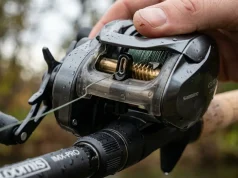
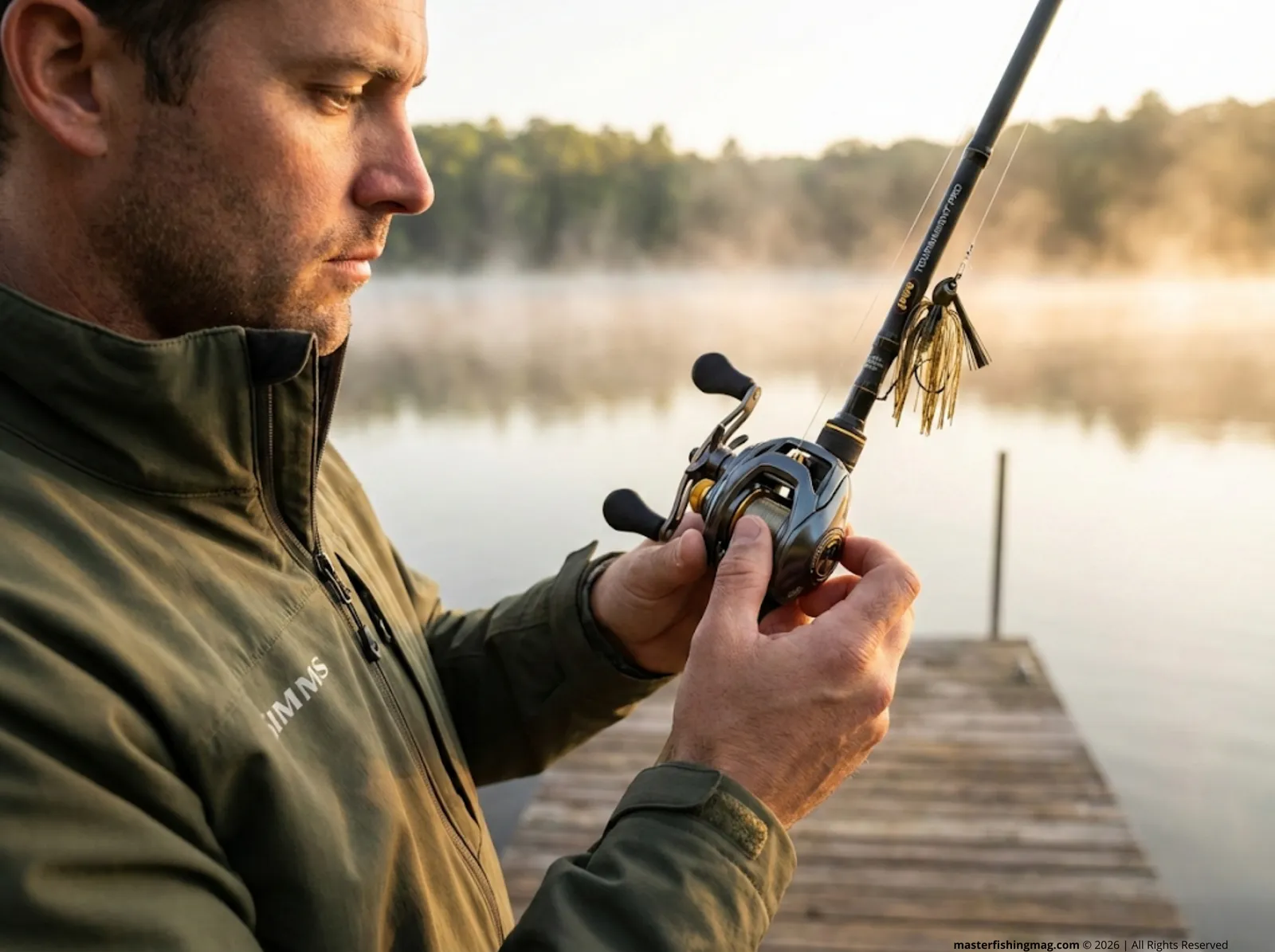
That dime-sized knob on the handle side of your reel, tucked right under the star drag, is technically called the cast control knob. Most anglers just call it the tension knob, and it does one thing: applies axial pressure on the spool axle to control how freely the spool spins at the instant you release the thumb bar.
That’s it. It’s a friction adjustment for the initial burst of spool energy when you start a cast. It is not a brake. It is not a drag. The drag fights the fish — set it at roughly a quarter to a third of your line’s test strength, and forget about it when you’re tuning your cast. The tension knob has nothing to do with that system, according to the Recreational Boating & Fishing Foundation’s baitcaster casting guide.
Pro tip: If you’ve been adjusting your drag knob thinking it controls backlashes, you’ve been fighting the wrong dial entirely. The tension knob is the small one you can turn with your thumb — not the star-shaped one near the cranking handle.
Tension vs. Brakes vs. Thumb — The Three-Layer System
Here’s where most anglers get confused, and where nearly every how-to article falls short. Your baitcasting reel has three separate systems controlling spool speed, each handling a different phase of the cast.
The spool tension knob controls the initial burst — that first spin the moment you release the thumb bar. Magnetic brakes or centrifugal brakes handle mid-to-end cast deceleration. They slow the spool down as the lure loses momentum and air resistance takes over. Your thumb is the ultimate override — feathering the spool through the entire flight path.
When you crank the tension knob tight to “prevent backlashes,” you’re actually only addressing the start of the cast. The end-cast deceleration — where most backlashes happen for intermediate anglers — is entirely controlled by your braking system. Dr. Paul Gaskell from Fishing Discoveries puts it directly: “You shouldn’t be using your spool tension to brake your spool. That’s what your brakes are for.”
Understanding this three-layer system is the difference between an angler who fights their equipment and one who casts with it. If you’re already understanding your baitcaster’s gear ratio, adding tension fundamentals gives you a complete picture of how your reels work.
The Lure Drop Test — Step by Step
Setting Up the Test
Reel your lure to within six to twelve inches of the rod tip. Hold the rod at horizontal or roughly 45 degrees — the two o’clock position. Both work, but pick one and stay consistent so your results are repeatable. Now depress the thumb bar to disengage the spool, but keep your thumb firmly on the spool. Don’t release it yet.
Dialing the Knob
Start with the tension knob tightened enough that the lure doesn’t fall at all when you lift your thumb. Now, slowly loosen it — counterclockwise — until the lure begins to descend under its own weight.
What you’re looking for is a visible, controlled slow descent. Not freefall. Not stuck. The lure falls under its own weight at a pace you can watch. With a half-ounce lure, expect roughly two to three seconds from rod tip to ground. Lighter lures take longer; heavier ones fall faster.
The critical checkpoint: the spool stops spinning when the lure hits the ground. Zero overrun. No loops of line forming around the spool. If the spool keeps spinning after impact, tighten back a quarter turn and test again.
Reading the Results
A perfect setting looks like this: the lure descends smoothly, hits the ground, and the spool is dead still. No lingering rotation, no line loops. If you pick up the reel and look at the spool, every wrap of line is clean and flat.
Too tight? The lure barely moves or doesn’t fall at all. You’ll lose thirty percent or more of your casting distance, and here’s where it gets worse. Shane Beilue from Game & Fish nails it: “If the tension knob is too tight, you lose considerable casting distance and will likely try to compensate by casting harder, thereby making matters worse.”
Too loose? The spool overruns the instant the lure hits ground, producing small loops that turn into full bird’s nests on your next cast.
The Clack Test — The Expert Method Nobody Covers
Why This Method Exists
The lure-drop test works. It’s reliable and repeatable and has been the standard for decades. But it tends to leave your tension settings slightly over-tightened — good for beginners avoiding frustration, but costing experienced anglers distance on every cast.
The clack test sets tension at the absolute minimum needed for smooth spool rotation. Reel techs and competitive bass fishing anglers use it when every yard of distance matters. Instead of treating the tension knob as a brake, this method treats it as a bearing preload — just enough pressure for clean spin, nothing more.
How to Run the Clack Test
With the thumb bar depressed and no lure attached, push the spool left and right with your thumb. Listen. Feel. You’re checking for side-to-side spool play — a subtle click or clack as the spool shifts on its axis.
Tighten the knob just until that play disappears. The spool should feel snug but spin freely when you flick it — a true free spool feel. Then back off one click — or about a quarter turn on reels without audible clicks. That’s your baseline.
Dr. Paul Gaskell describes it as setting tension so it “just stops any side-to-side play” — nothing more. This gives you the lightest possible friction, which means the freest possible spool, which means maximum casting distance.
If you’re running this test and notice persistent play even after tightening, you might be dealing with worn bearings rather than a tension issue. Consider diagnosing worn reel bearings before blaming the knob.
Pro tip: The clack test works best on modern low-profile reel designs with tight tolerances. On older or budget reels with naturally loose bearing fits, stick with the lure-drop test as your primary method.
Daily Tweaks — When and Why to Readjust
Lure Weight Changes
Every time you switch lures, the drop test needs to run again. A half-ounce crankbait and a quarter-ounce jig need completely different tension settings. Heavier lures overcome spool friction more easily, so they need less tension. Lighter lures need slightly more.
Failing to readjust after a lure change is the number one cause of mid-day backlashes among experienced anglers. You tie on a lighter buzzbait, make your first cast with yesterday’s tension setting, and suddenly you’re picking out another tangle.
Pro tip: Mark your tension knob position with a small piece of tape for your most-used lure weight. Return to that baseline in seconds instead of running the full drop test every time.
Wind and Conditions
Headwind is the enemy of spool management. Wind slows the lure but the spool keeps spinning at the same rate — and that mismatch creates overrun. Add one click of tension when casting into wind. On calm days, loosen for maximum distance.
Crosswind on your casting-arm side is the worst-case scenario for backlashes. In those conditions, add tension and increase brake pressure through the brake adjustment dial. Temperature matters too — cold weather stiffens monofilament and fluorocarbon, which changes how line peels off the spool. If you’ve been mastering casting tactics in heavy wind, adding spool tension adjustment awareness completes your windy-day toolkit.
Pro tip: In wind, add a click of tension and bump your brakes up one notch. On calm days, loosen both for maximum distance. Think of it as two dials that move together with conditions.
What Overtightening Actually Costs You
Performance Loss You Can Measure
Here’s the paradox most anglers never figure out: the tighter you set the spool tension knob, the harder you have to cast to get any distance. Harder casts generate more spool energy at release. And that excess energy, combined with compromised friction from the overtightened knob, actually produces worse bird’s nests than a properly loosened setting would.
Overtightened tension can cut your casting distance by a third or more. You’re working harder for worse results — and most anglers never connect the two.
Mechanical Damage You Can’t See
This is the part nobody talks about. Mike Cork, a reel service expert on UltimateBass, breaks it down: “Over tightening of the spool tension knob causes the spool shaft ends to wear cups into these plates… the angler who continues to tighten the spool tension knob is also damaging the shaft ends and the phenolic or brass plate.”
That wear is permanent. Once you’ve cupped out the end plates, your reel has increased friction even at the correct tension setting. Over time, you’ll notice your casts getting shorter and you’ll have no idea why. The fix is a bearing and plate replacement — a thirty to sixty dollar reel servicing job that could’ve been avoided by not treating the tension knob like a backlash prevention crutch.
If you’re already caring for your equipment with our reel greasing and maintenance guide, adding proper tension habits protects everything that lubrication maintains. For a deeper look at how fishing reels are built, the mechanical principles of fishing reel construction explains the axle and plate system that overtightening degrades.
The Tension Mastery Progression — Beginner to Expert
Phase 1 — Safety Net (First Month)
Start with the lure-drop test set slightly tight — aim for a four-plus second descent. Set your magnetic brakes or centrifugal brakes at maximum. Practice short twenty to thirty foot casts to build thumb pressure memory. Distance will be limited, and that’s fine. This phase is about avoiding frustration and building confidence with baitcasting fundamentals. Even new anglers who have never touched a baitcast reel can build muscle memory in these first few weeks.
Phase 2 — Loosening Up (Months 2–3)
Reduce brake pressure by one setting per session. Retake the drop test and target a two to three second descent — the sweet spot for most lure weights. Start practicing longer casts in the forty to sixty foot range. This is where thumb feathering begins — light contact during mid-cast to feel the spool speed. Lew’s pro staff member Mark Rose recommends starting the magnetic brake at five and working down as control improves.
Phase 3 — Thumb Mastery (Months 4+)
Advanced anglers run near-minimal tension — clack test baseline or one click past it. Brakes at two or three out of ten. Your thumb does eighty percent of the work, feathering the spool through the entire cast.
The difference is real. Same reel, same lure, same spot: an experienced angler with loose tension and trained thumb control casts nearly twice as far as a beginner with tight tension and no thumb skills. Less friction means more free spool energy transferred to the lure, and your thumb handles the rest.
The Daiwa Zero Adjuster concept takes this to its logical endpoint: some modern Daiwa reels ship with factory-preset spool tension, acknowledging that minimal tension is optimal and removing the guesswork entirely. Whether your preferred reel has that feature or not, the progression path is the same — loosen gradually as your thumb catches up.
If you’re working on your casting fundamentals alongside tension mastery, improving your casting accuracy with proper mechanics rounds out the skill set.
Conclusion
Three things worth remembering every time you pick up a baitcaster. First, the spool tension knob controls the initial burst of spool energy — it is not a brake, and treating it like one kills your distance and wears out your reel. Second, the lure-drop test gives you a solid baseline, but the clack test gives you an expert baseline — learn both methods and you’ll always know your knob is dialed in. Third, tension is a living adjustment. Every lure swap, every wind shift, every skill milestone means reaching for that knob again.
Next time you’re on the water, run the drop test with your go-to lure and time the descent. Then try the clack test on the same setup and compare your casting distance. The yards you gain will do more convincing than anything I can write.
FAQ
How tight should spool tension be on a baitcaster?
Tight enough that the lure descends in a controlled slow descent when you release the thumb bar, and the spool stops spinning the instant the lure hits the ground. If it’s so tight the lure won’t fall, you’re losing casting distance and potentially damaging the reel’s internal plates over time.
What’s the difference between spool tension and brakes on a baitcaster?
Spool tension controls the initial burst of spool rotation at cast release. Brakes — magnetic or centrifugal — control spool deceleration during the mid-to-end portion of the cast. They address different phases of the same cast and should be tuned independently, not used as substitutes for each other.
Why is my baitcaster still backlashing after I adjusted the tension?
The tension knob only prevents initial overrun. If backlashes happen mid-cast or at the end, your braking system needs adjusting — not more tension. Also, switching lures without readjusting tension is the single most common cause of unexpected bird’s nests among experienced anglers.
Do I need to readjust spool tension every time I change lures?
Yes. A half-ounce crankbait and a quarter-ounce jig require completely different tension settings because their weight changes how the spool behaves at cast release. Failing to readjust is the number one cause of mid-day backlashes.
Can too much spool tension damage my reel?
Yes. Chronic overtightening compresses the spool shaft ends and wears cups into the phenolic or brass end plates. Over time, this creates permanent friction increases that shorten your reel’s lifespan and reduce casting performance — even when the knob is set correctly.
Risk Disclaimer: Fishing, boating, and all related outdoor activities involve inherent risks that
can lead to injury. The information provided on Master Fishing Mag is for educational and informational purposes
only. While we strive for accuracy, the information, techniques, and advice on gear and safety are not a substitute
for your own best judgment, local knowledge, and adherence to official regulations. Fishing regulations, including
seasons, size limits, and species restrictions, change frequently and vary by location. Always consult the latest
official regulations from your local fish and wildlife agency before heading out. Proper handling of hooks, knives,
and other sharp equipment is essential for safety. Furthermore, be aware of local fish consumption advisories. By
using this website, you agree that you are solely responsible for your own safety and for complying with all
applicable laws. Any reliance you place on our content is strictly at your own risk. Master Fishing Mag and its
authors will not be held liable for any injury, damage, or loss sustained in connection with the use of the
information herein.
Affiliate Disclosure: We are a participant in the Amazon Services LLC Associates Program, an
affiliate advertising program designed to provide a means for us to earn advertising fees by advertising and linking
to Amazon.com. As an Amazon Associate, we earn from qualifying purchases. We also participate in other affiliate
programs and may receive a commission on products purchased through our links, at no extra cost to you. Additional
terms are found in the terms of service.