

In this article
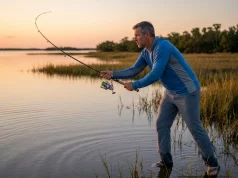
A lure stuck in a willow tree doesn’t catch fish. It’s frustrating, but it’s also a sign that something went wrong with your casting mechanics.
In sport fishing, precision is the difference between hoping for a bite and making it happen. I have spent years guiding clients who blame the wind or their reel for a bad shot. But when you ignore the marketing hype of high-end gear, casting accuracy boils down to physics.
It’s about how you handle the lever in your hand and how you control the spinning spool. By understanding the “Unified Casting Logic,” you stop gambling on where your lure lands. This isn’t about buying a more expensive graphite rod; it is about mastering the machine you already hold to achieve true technical proficiency.
What is the “Unified Casting Logic” for accuracy?
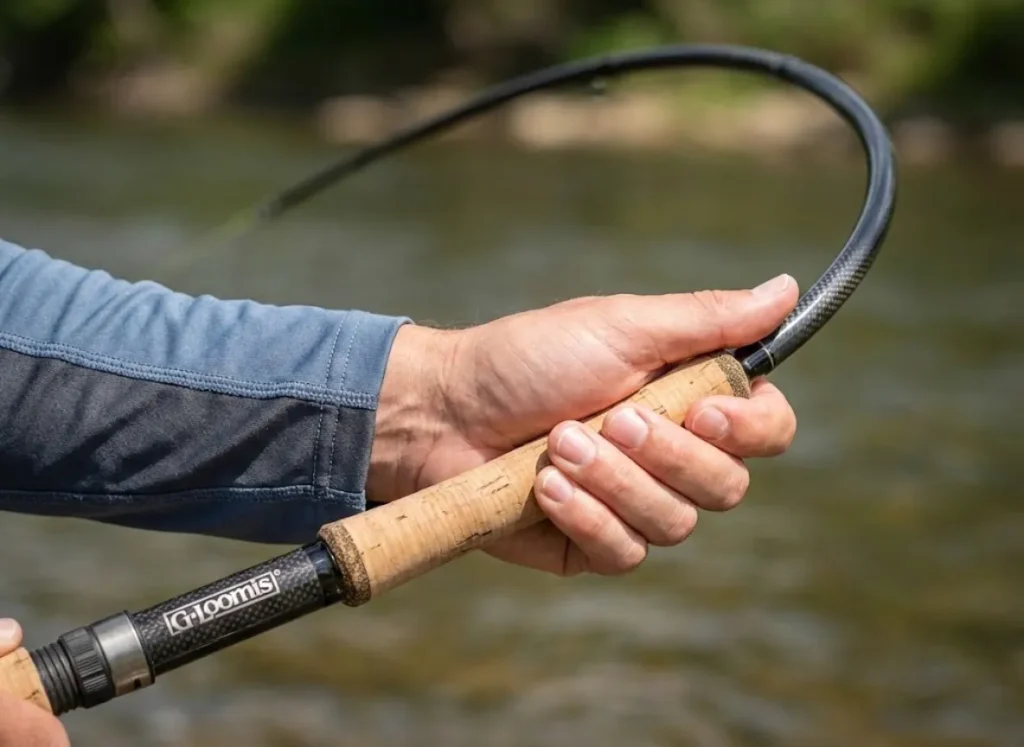
This logic covers the basic laws that apply to all fishing, whether you use a fly rod, spinning reel, or a baitcast reel. If your mechanical layer is solid, the lure has no choice but to go where you aim.
How does the rod work as a lever?
Most anglers think of a fishing rod as a spring that stores energy. While it does bend, it actually works more like a rod-as-lever. In this system, your elbow or hand is the pivot point. Your forearm provides the effort, and the lure weight at the rod tip is the load.
This lever setup doesn’t make the load feel lighter. Instead, its job is to speed things up. It turns small arm movements into massive velocity at the tip.
To be precise, you need to load the rod smoothly. This keeps the force steady. If you rush and “shock” the rod with jerky motions, you create wiggles in the line that kill your accuracy. About 80% of your casting power comes from this leverage, while only 20% comes from the rod snapping back straight.
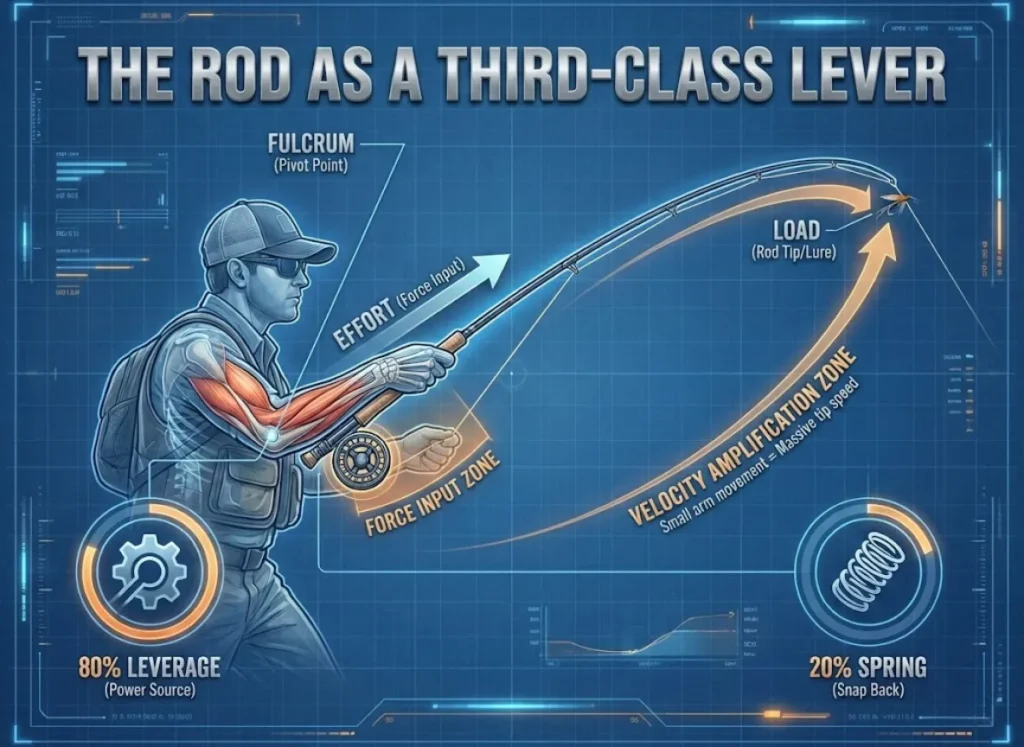
Because leverage is so important, the path your rod tip travels is more critical than the loading capability of the material. Research into the physics of the overhead fly cast confirms that the rod acts as a lever system, not just a simple spring.
Once you accept the rod as a machine for speed, you can see how a detailed breakdown of fishing rod levers and fulcrums explains why shifting your grip changes how the rod performs during momentum transfer.
Why is the “Straight-Line Path” essential?
The Straight-Line Path rule is simple: if you want a projectile to fly straight to a target, you must pull it in a straight line toward that target.
If your rod tip moves in a curved arc (like a rainbow) or swings out to the side, you are pulling the lure off course. The goal is to make the rod tip travel in a straight, flat line within the vertical plane.
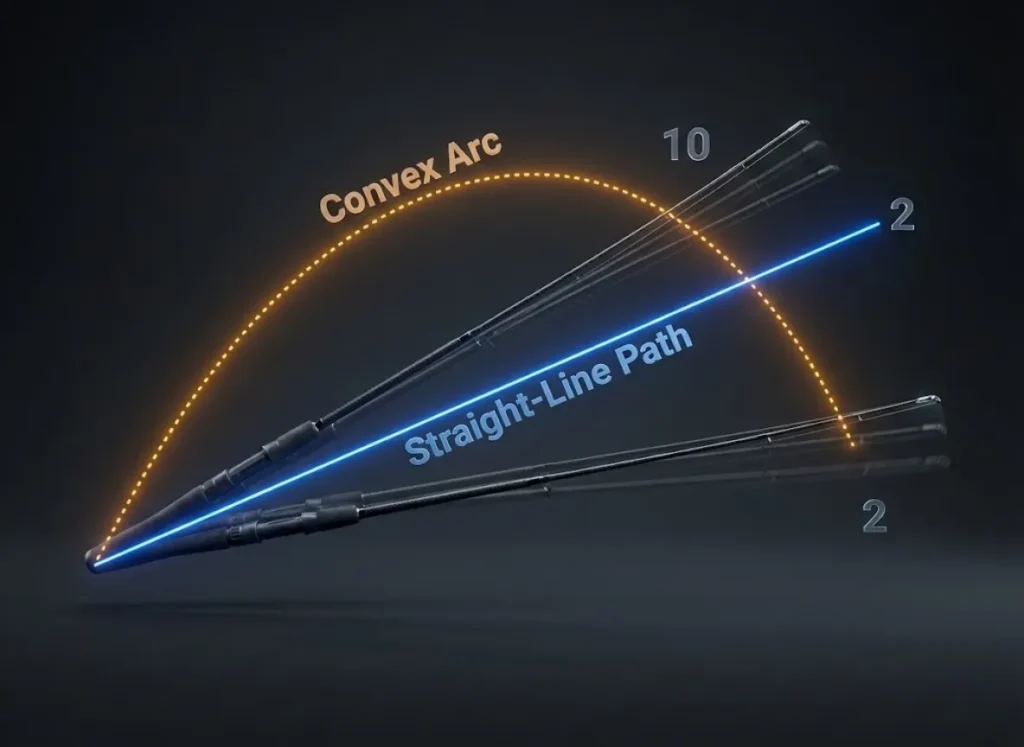
If you swing in a high arc, you get wide, sloppy loops in fly casting or high lobs in baitcasting that the wind can easily blow away. If you swing wide to the side during a sidearm cast, the reel tilts, and the lure curves like a sliced golf shot. Academic texts on projectile motion principles define the laws that make this happen.
To fix this, think about the 10-to-2 clock positions. This helps flatten your swing into a straight line. Understanding the relationship between rod action vs power is key here, as stiffer rods require faster timing to keep that casting plane straight.
How can biomechanics improve your aim?

The rod handles the physics, but your body is the engine. The order in which you move your muscles and how your eyes lock onto the target dictate where the lure lands.
What is the correct body sequence?
Efficient casting moves from the ground up, starting with your stance alignment. The movement begins in your stable core and shoulder. It then travels to your elbow and finishes with your wrist.
This adds up the power, just like a baseball pitch. The big muscles do the heavy lifting, and the small muscles handle the release. Beginners often mess this up by using their wrist snap too early or trying to throw with just their shoulder.
Studies show that the wrist’s main job is the final tiny adjustment of the release angle. It also provides the “hard stop” that sends energy into the line. In fly fishing specialization, this is the “squeeze” at the end of the stroke. Keeping your elbow tucked in helps your arm move in a straight vertical line.
This matches studies on the kinematics of fly-casting that analyze how the arm should move for best results. It is a fundamental principle when learning to balance a beginner fly rod and reel, where that specific sequence prevents tangles.
Pro-Tip: If you are struggling with a “wandering” rod tip, try casting with a small towel tucked under your casting arm’s armpit. If the towel falls during the cast, your elbow is flaring out. This breaks your form and ruins your accuracy.
How does the “Quiet Eye” technique help?
“Quiet Eye” means staring at a specific spot before you start moving. The saying “Aim small, miss small” is true in targeting psychology.
If you look at the whole dock, you might miss the dock. If you look at a single nail on the dock, you might miss the nail, but you will still hit the dock. Focusing on a tiny point helps your brain calculate exactly how much force you need for casting distance.
Water makes judging distance hard because there are no markers on the ground. This leads to anglers consistently casting too short or too long. Staring at the target helps your brain figure out how much the line drag will slow the lure down. Resources on the properties of nylon fishing line explain the stretch and feedback variables your brain has to account for.
Good fly anglers keep their line of sight locked on the target while the lure is in the air. This is why picking the best polarized sunglasses for fishing is a mechanical necessity. They cut the glare so you can keep that eye-target alignment on targets under the water.
Which gear features help you cast better?
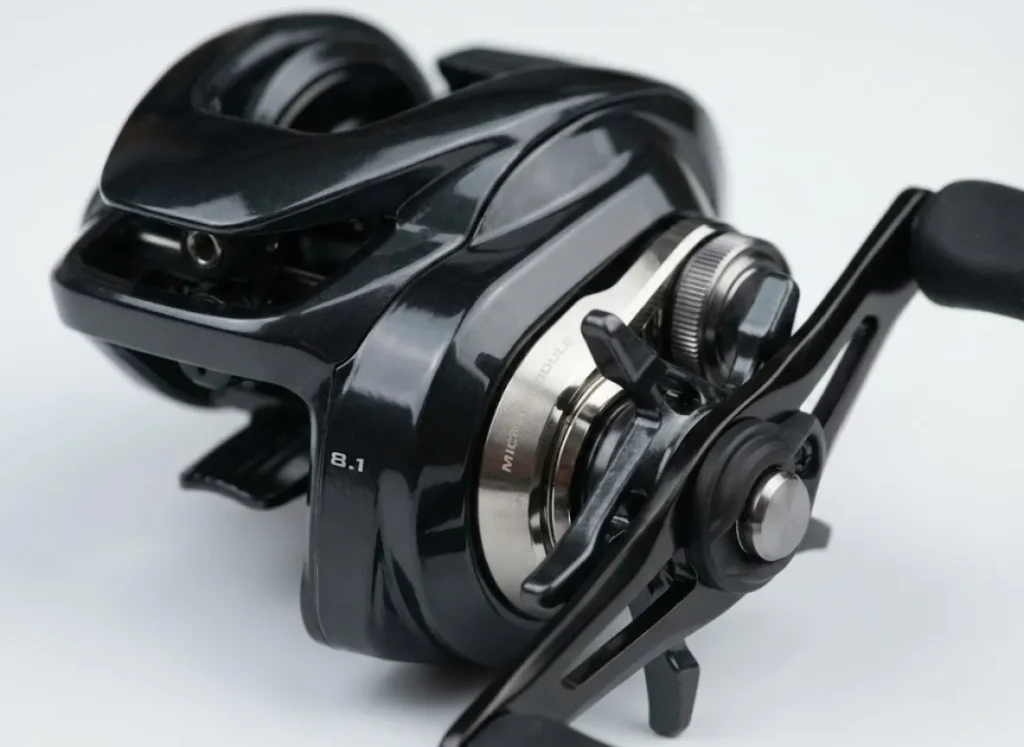
Even with perfect form, friction and wind can ruin a cast. Modern technology in reels and rods helps fix human errors and environmental problems. This is the equipment layer of accuracy.
How do reel brakes manage spin?
In baitcasting, accuracy suffers if the spool spins faster than the lure flies. If that happens, the line bunches up into a “bird’s nest” or backlash.
The “Educated Thumb” is the old-school fix. You use thumb pressure to feel the line and slow the spool down. Modern braking systems help do this for you.
Magnetic Brakes use magnets to provide steady, consistent braking. This is great for casting into the wind. Centrifugal Brakes use small weights that rub against a ring. They brake hard at high speeds and back off as the lure slows down. Digital Control (DC) systems are like a computer for your reel. They monitor speed 1,000 times per second and apply tiny brakes only when needed.
Research on the mechanics of the flyline explains the drag forces that these brakes fight against. Technologies found in the best baitcasting reels for bass, such as DC chips, specifically target this problem.
How does line stretch affect feel?
The line connects your rod tip to the lure. Braided line has almost zero stretch. It feels like a direct drive, transferring 100% of your rod’s movement to the lure. This improves accuracy but feels jerkier.
Monofilament stretches a lot. It acts like a shock absorber. However, it has “memory,” meaning it likes to stay coiled. These coils act like little springs that absorb your casting energy and make the lure fly off-center.
Fluorocarbon is heavy, so it sinks. This helps stabilize the line in the wind. Line diameter matters, too. Thinner lines cut through the wind better, keeping your cast straight. The centrifugal brake mechanism patent shows the drag principles, but a full comparison of braid vs fluorocarbon vs monofilament reveals how stretch directly changes your aim.
What drills will fix your aim?
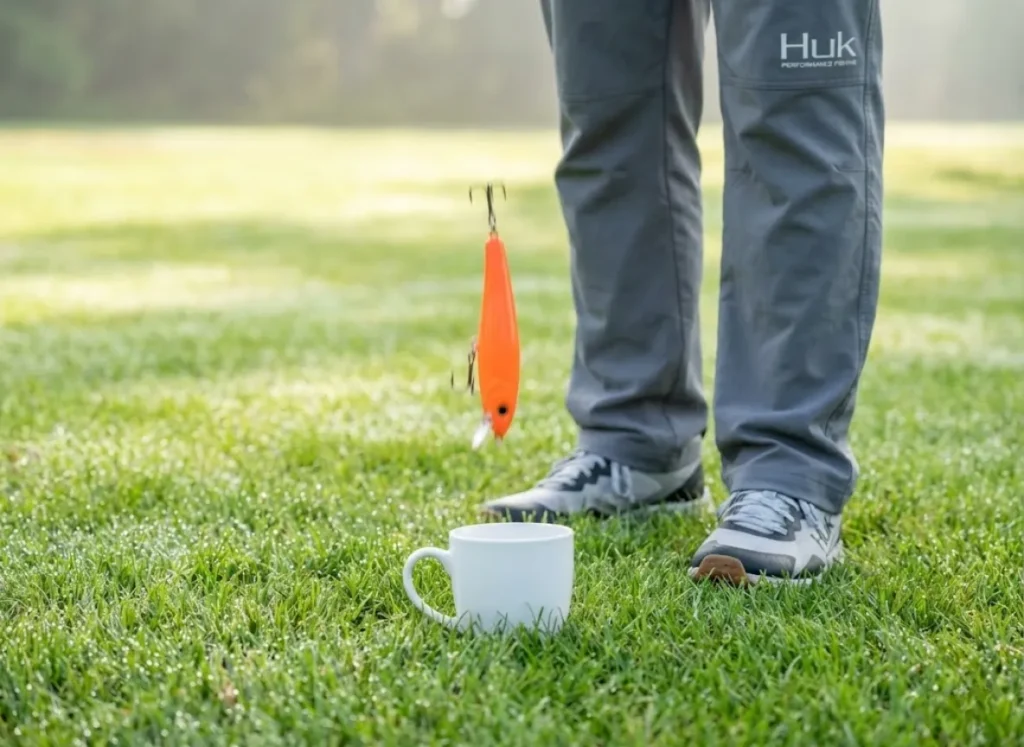
Technology helps, but it doesn’t replace practice. To get better, you need a drill protocol to build muscle memory. This isn’t for trick-casting shows; it’s for catching fish.
The “Tea Cup” Drill
This drill fixes your release timing. Place a standard coffee cup, tea cup target, or hula hoop 20 to 30 feet away on the grass. At this short distance, the lure flies flat, so you can focus purely on when you let go of the line. This mimics pitching and flipping into heavy cover.
Try to hit the target 10 times in a row. If you miss high, you let go too late. If you miss low, you let go too early.
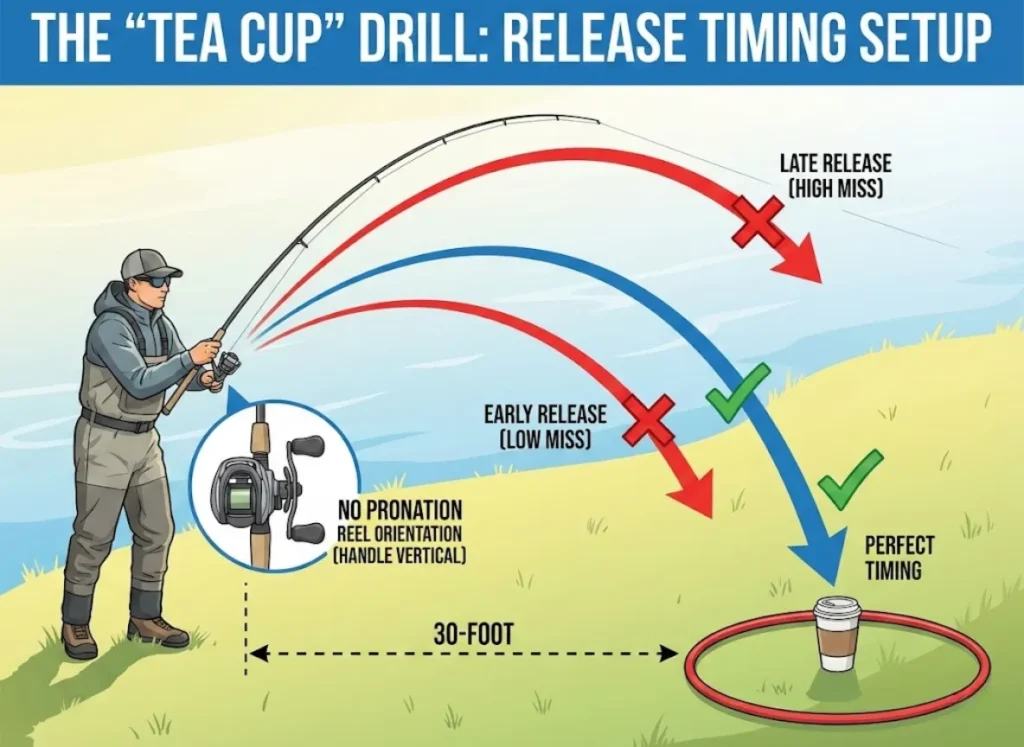
This quick feedback trains your thumb to time the release perfectly. Keep your reel handle vertical to stop the rod from swinging side-to-side. This skill is mandatory when fishing heavy cover, where missing a small pocket by inches means snagging a weed mat instead of catching a bass.
The “Distance Sticks” Drill
Distance Sticks help you learn exactly how hard to throw. Place two sticks exactly 12 feet apart. Wrap your line around them in a figure-eight pattern to measure a precise distance (for example, 10 wraps equals 40 yards).
Clip the line on your reel at this exact distance. Now, you can cast with 100% force. The line clip will stop the lure exactly over the target zone.
By fixing the distance mechanically, your brain can focus entirely on aiming left and right. This removes the guesswork from casting precision. However, this precision is impossible if your line is coiled, so removing line memory coils is a necessary first step.
Wrapping Up
Your rod is a lever, not just a stick. Accurate casting requires a smooth motion to build up speed. The Straight-Line Path rule says that if your rod tip wiggles, your lure will wander.
While fancy brakes and expensive rods help, they cannot replace a trained thumb and a focused eye. Take the “Tea Cup” challenge this weekend. Measure your accuracy, fix your form, and see the difference in your fishing.
FAQ – Frequently Asked Questions
What is the biggest cause of bad casts?
The main cause is the rod tip not moving in a straight line. This usually happens because you are swinging too hard (shocking the rod) or twisting your wrist during the forward cast, which sends the lure off to the side.
How does rod action change accuracy?
Fast action rods are stiff with a flexible tip. They are generally more accurate because they stop wobbling quickly after you cast. However, they are harder to time correctly than softer, moderate action rods.
Does braided line help accuracy?
Yes. No-stretch braid ensures the energy transfer is instant. It is also thinner, so the wind doesn’t push it around as much. Plus, it doesn’t coil up like monofilament, which helps the lure fly straighter.
Pro-Tip: If using braid, add a fluorocarbon leader using a strong leader knot. This gives you the casting distance and accuracy of braid, but the fish won’t see the line near the hook.
Why do I always miss to the left or right?
If you miss sideways consistently, it’s a tracking issue. This means your reel handles aren’t staying vertical. If you are right-handed and miss left, you are likely closing your wrist too early (hooking it). If you miss right, you are releasing too late (slicing it).
Risk Disclaimer: Fishing, boating, and all related outdoor activities involve inherent risks that
can lead to injury. The information provided on Master Fishing Mag is for educational and informational purposes
only. While we strive for accuracy, the information, techniques, and advice on gear and safety are not a substitute
for your own best judgment, local knowledge, and adherence to official regulations. Fishing regulations, including
seasons, size limits, and species restrictions, change frequently and vary by location. Always consult the latest
official regulations from your local fish and wildlife agency before heading out. Proper handling of hooks, knives,
and other sharp equipment is essential for safety. Furthermore, be aware of local fish consumption advisories. By
using this website, you agree that you are solely responsible for your own safety and for complying with all
applicable laws. Any reliance you place on our content is strictly at your own risk. Master Fishing Mag and its
authors will not be held liable for any injury, damage, or loss sustained in connection with the use of the
information herein.
Affiliate Disclosure: We are a participant in the Amazon Services LLC Associates Program, an
affiliate advertising program designed to provide a means for us to earn advertising fees by advertising and linking
to Amazon.com. As an Amazon Associate, we earn from qualifying purchases. We also participate in other affiliate
programs and may receive a commission on products purchased through our links, at no extra cost to you. Additional
terms are found in the terms of service.