
In this article
The sonar lit up with arcs stacked along the breakline. Perfect. I anchored the boat, cast a jig straight to the tip of the point, and waited. Nothing. Five more casts, same spot, same angle—nothing. I moved one boat length to the left, let the jig fall along the side slope instead, and the rod doubled over before it hit bottom.
After two decades of chasing bass, walleye, and stripers across reservoirs from Lake Champlain to Lake Norman—even tournament fishing on Lake Toho—I’ve watched this same scene play out hundreds of times. The fish are there. The electronics prove it. But anglers keep blanking because they treat every structure point like a bullseye—cast to the tip, hope for the best, move on. That approach misses 70-80% of the productive water on any given point.
Here’s what this article gives you: a breakdown of why fish use points and humps the way they do, how to read them with your electronics before making a single cast, and the exact adjustments that turn a dead point into a loading dock.
⚡ Quick Answer: Most anglers miss fish on structure because they cast to the obvious tip from one angle and never move. Fish position on the sides and downcurrent end of points, not the tip. Fan cast from 3-4 boat positions to cover the full structure, use your electronics to identify the breakline and suspended fish before casting, and match your rig to the depth fish actually hold—which is often 4-8 feet off bottom, not glued to it.
Structure vs. Cover — The Distinction That Changes Everything
Why Most Anglers Confuse These Two Concepts
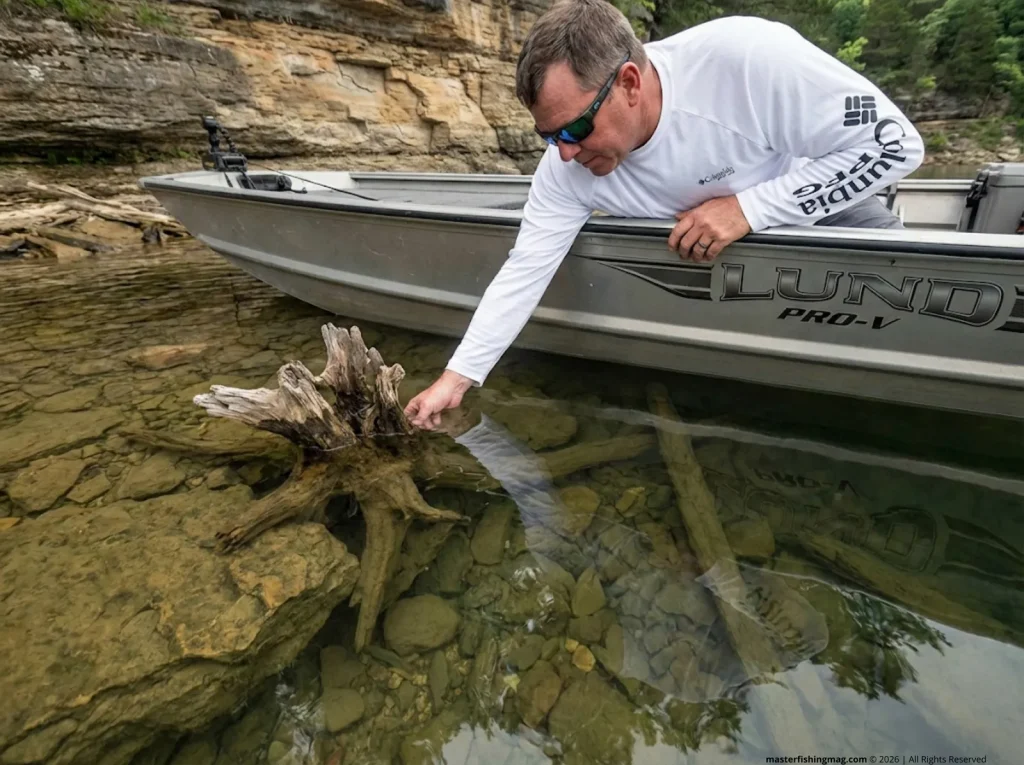
This is where most anglers get it wrong before they even make a cast. Structure is the bottom contour itself—points, humps, ledges, creek channels, roadbeds, and drop-offs. It doesn’t move. Think of it as the highway system under the water.
Cover is what sits ON that highway—stumps, weeds, rocks, laydowns. These are the rest stops along the route. A stump on a flat mud bottom holds some fish. That same stump sitting on a breakline where the bottom drops from 8 to 15 feet? That’s where things get interesting.
Missouri Department of Conservation studies at Long Branch Lake found that anglers caught twice as many bass and crappie per hour near cover than in open water. But here’s the part most people miss: that cover was productive because it sat on structure.
Joe Thomas, a 4-time Bassmaster Classic qualifier, puts it bluntly: “A structure containing a small to moderate amount of cover can be much more productive than one with a tremendous amount of cover, because bass are concentrated in predictable sweet spots.” Too much cover actually disperses fish and makes them harder to pattern.
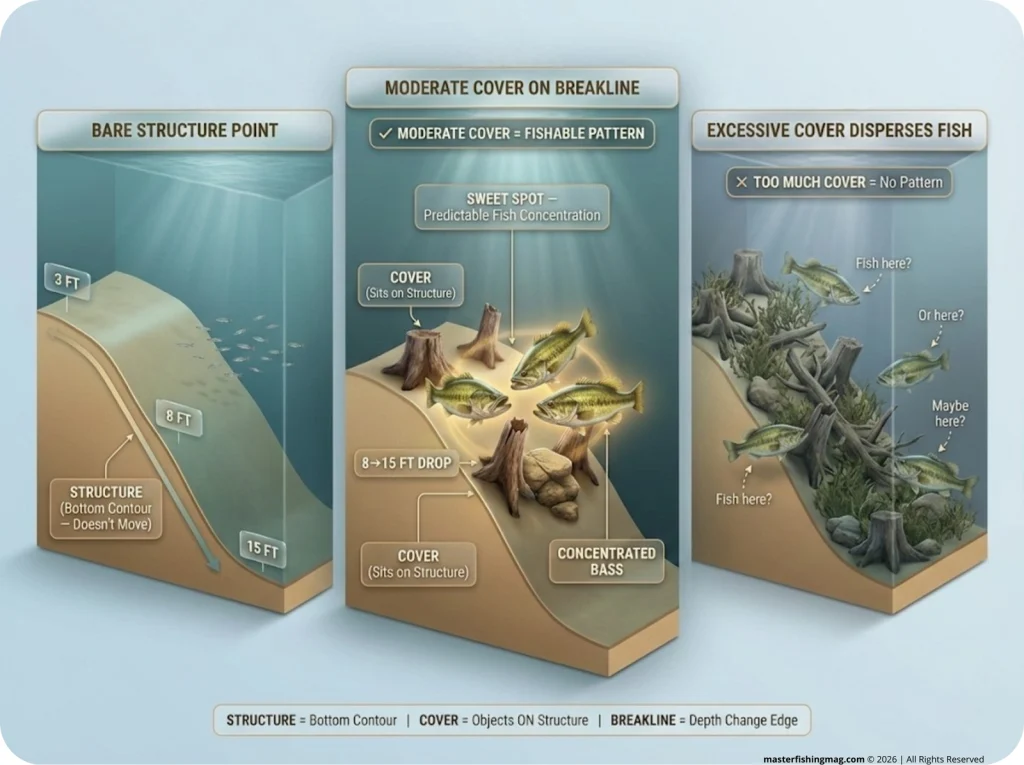
Pro tip: If a point is loaded with cover and you can’t buy a bite, look for the one nearby with just a few stumps or a single rock pile on the breakline. Fish concentrate where cover is moderate, not where it’s everywhere.
How Fish Use Structure as a Highway System
Structure points function as submerged highways between deep water sanctuary (30+ feet) and shallow feeding zones (under 10 feet). Fish don’t wander randomly. They follow predictable depth contours along what Buck Perry—the father of offshore structure fishing—called the path of least resistance.
A primary point that juts into the main lake basin acts like a highway on-ramp. Fish cruise along these migration routes daily, moving shallow to feed and returning to deep water when conditions change. The key insight is that fish don’t live on the point. They use it for transit and feeding, then retreat along the shallows-to-deep connection.
The spot where structure, cover, and current intersect is your contact point—or what experienced anglers call the sweet spot. That intersection is roughly 10% of any given point, but it holds 90% of the fish. If you understand reading lake contour maps to identify structure, you can narrow down that sweet spot before you ever launch the boat.
Reading Points and Humps With Your Electronics
The Idle-and-Graph Pass
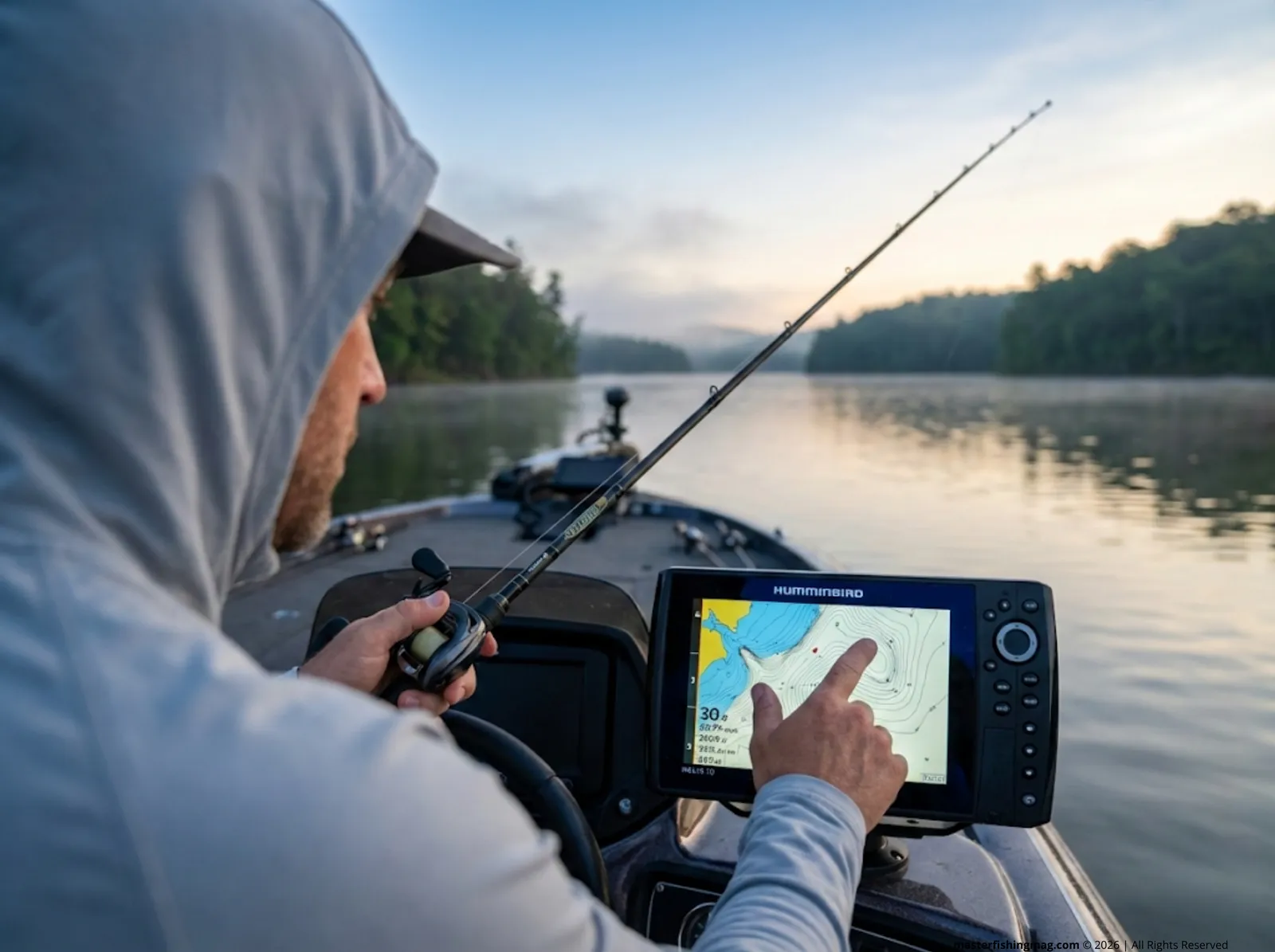
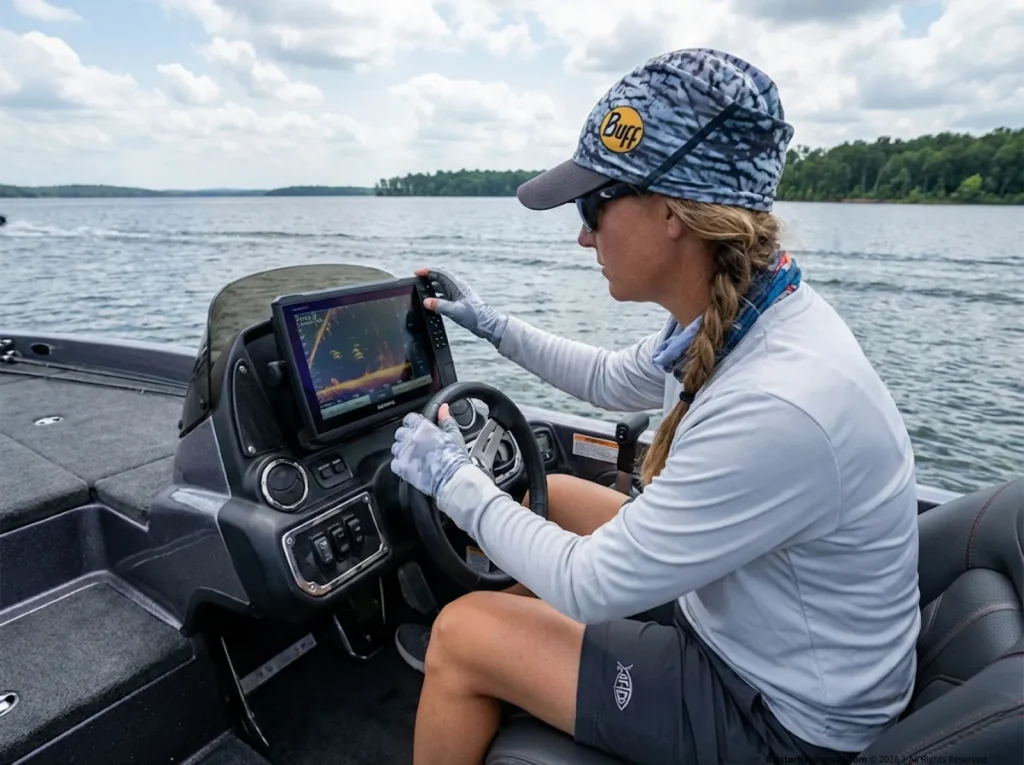
Before you make a single cast, idle over the point slowly and let your electronics map everything. I run my Lowrance Hook Reveal on 2D CHIRP for this first pass because it excels at showing bottom contour changes and suspended fish arcs simultaneously.
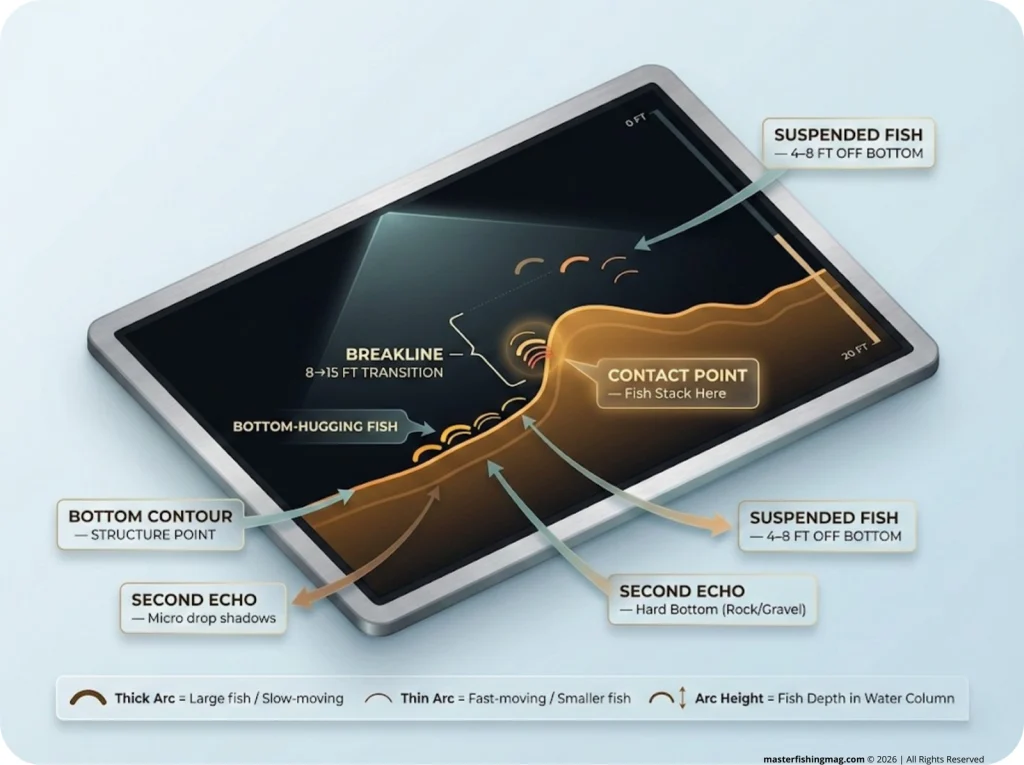
What you’re looking for: where the bottom drops suddenly (that’s the breakline), any irregularities like a rock pile or stump on that break (that’s the contact point), and fish arcs that may or may not be touching the bottom line. Fish holding 4-8 feet off the bottom are suspending, and they won’t show up on your screen the same way bottom-huggers do.
Drop a marker buoy at the first spot where you see fish arcs clustered. Experienced anglers call this a “kick-in buoy” because it marks the zone you’ll work on subsequent passes. Idle over the point from multiple directions—a single pass only shows you one cross-section.
Some pros use a zig-zag electronics search pattern on larger humps and submerged islands, crisscrossing the feature at different angles to build a complete picture. This works especially well when you’re fishing a new lake and don’t have waypoints dialed in yet.
Identifying the Breakline and Contact Points on Screen
The breakline shows as a sudden depth change on side-imaging or 2D sonar—where the bottom drops from 8 feet to 15 feet in a short horizontal distance. Look for hardness returns (the second echo on 2D sonar) that tell you substrate composition. Fish prefer hard-to-soft transitions where rock or gravel meets mud.
If you’re running a Lowrance Elite-12 Ti2 or similar unit with C-MAP Genesis mapping, you can build custom contour maps of your favorite points over time. This is especially valuable on humps and submerged islands that have deep water on all four sides, because their shape is impossible to judge from the surface.
For a deeper understanding of what your sonar actually shows and misses, check out our breakdown on mastering side imaging vs. down imaging.
Pro tip: When the graph shows fish arcs but nothing bites, change your approach angle first, then adjust depth, then change lure speed. In that order. Direction is the most common problem, not bait selection.
When the Graph Shows Fish But They Won’t Bite
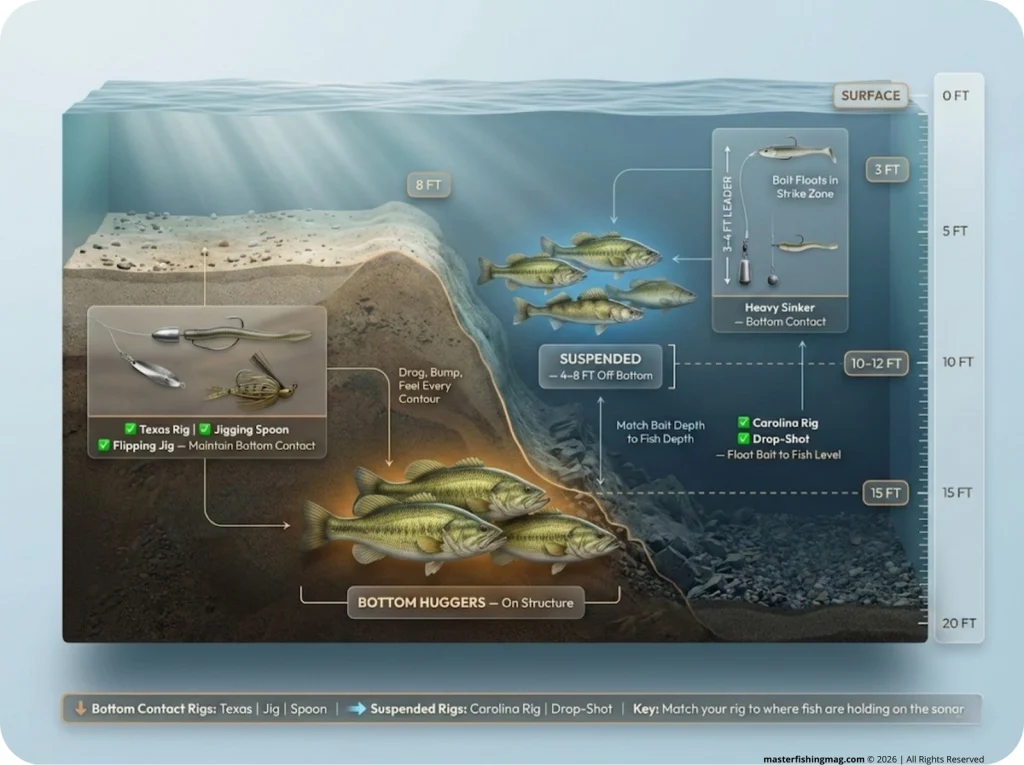
Suspended fish (4-8 feet off bottom) are the hardest fish on structure to catch. Most anglers only fish the bottom and miss them entirely. Your electronics show the arcs, but your bait is dragging 6 feet below where those fish are feeding.
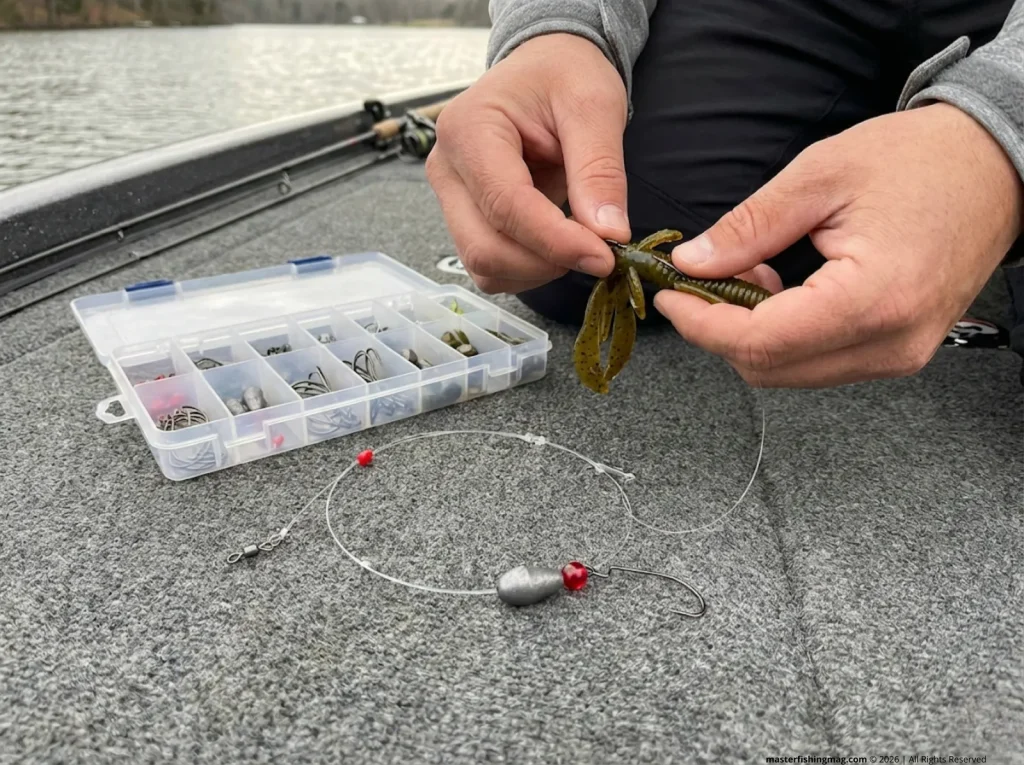
A Carolina rig with a 3-4 foot leader is the answer here. The heavy sinker maintains bottom contact while the leader floats your bait above—right in the zone where those suspended bass, walleye, or stripers are holding.
Seasonal Positioning — Right Point, Wrong Time of Year
Main-Lake Points vs. Secondary Points
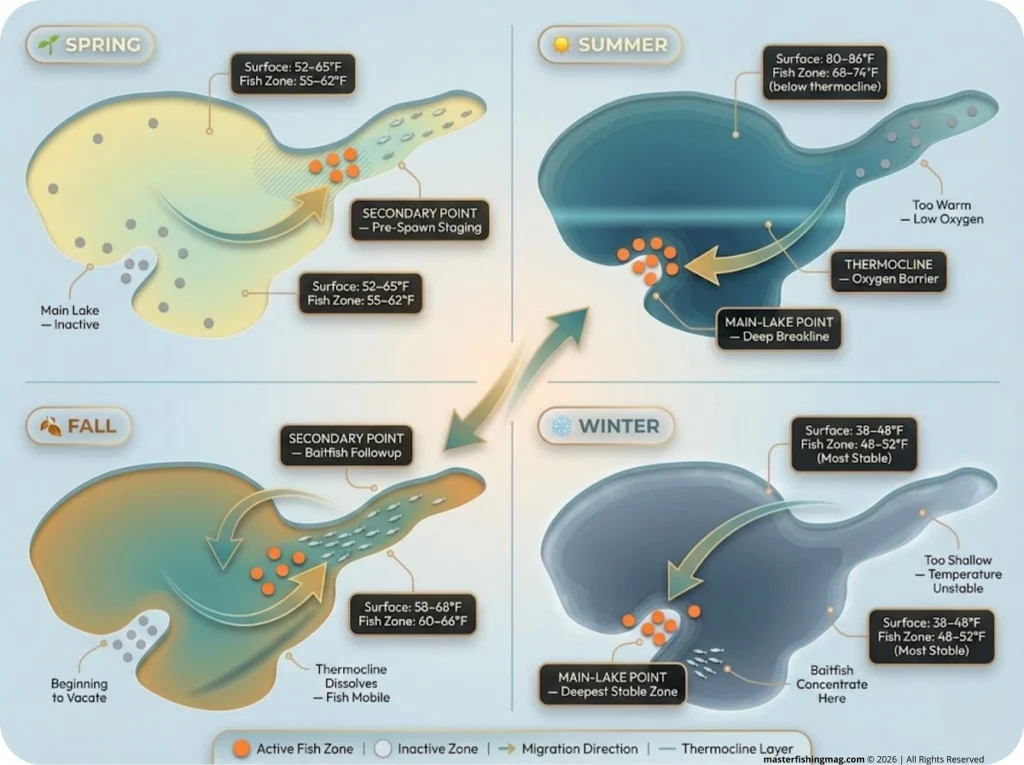
This is why the same spot that loaded fish last month is dead today. Primary points—the ones that jut into the main body of the lake—hold fish best in summer and winter when bass and walleye seek deep, stable water nearby.
Secondary points, the ones that jut into creek channels and coves, hold fish best in spring and fall when fish are transitioning between shallow and mid-depth zones. If you’re pounding main lake points in March and wondering why they’re empty, the fish haven’t arrived yet. They’re staging on secondary points, moving along the spine of the creek arm toward eventual spawning zones.
Don Dickson, a veteran tournament angler, hammers this principle: fish follow the path of least energy cost. The points closest to the depth they prefer at any given water temperature get the most traffic. As water temperatures shift through the seasons, the migration routes shift with them.
For a detailed look at how bass manage these transitions, our article on fall bass transition routes between shallow and deep structure breaks it down by the numbers.
Temperature and Depth — The Two Variables That Move Fish
Fish position on structure is driven primarily by water temperature and the presence of a thermocline. In stratified lakes during summer, the thermocline acts as a ceiling. Fish on structure will rarely go above it because dissolved oxygen drops off sharply.
Here’s the trick most people miss: surface temperature lies. You might read 82°F at the surface while fish are sitting in 72°F water at the breakline. Use your sonar’s temp reading at depth or check out why surface temps lie when you fish deeper water for a full breakdown.
In winter, look for points near the deepest breakline where water temperature is most stable. Baitfish concentrate in these zones because they’re the warmest, most oxygen-rich spots in the lake, and the predators follow.
Directional Presentation — The Angle Nobody Talks About
Why the Same Spot Catches From One Angle and Not Another
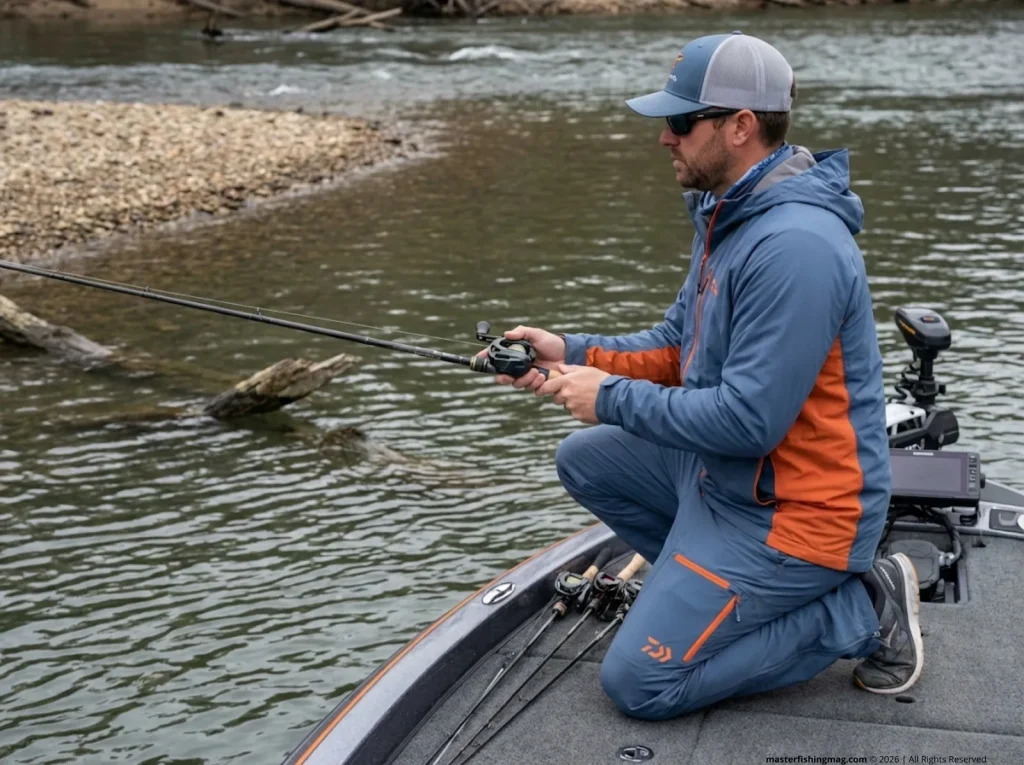
Joe Thomas again: “I’ve seen countless times where my lure had to hit the structure from a certain direction, or the bass simply wouldn’t strike it.” Fish position facing current or toward the direction they expect food to approach. If your lure comes from behind them, they either spook or ignore it.
The downcurrent end of the point is almost always more productive than an upcurrent cast. Fish face INTO the current, and your lure approaching from downstream mimics natural bait concentration movement. In lakes without obvious current, wind creates it. Cast into flow when possible and retrieve so your bait moves naturally with the wind-generated current toward the structure. Retrieving downstream is one of the simplest adjustments you can make—and one of the most effective.
This is where NOAA’s research on essential fish habitat reinforces what field experience teaches: fish position relative to energy-conserving features. Points and humps create eddies on their downcurrent end, and fish park in those ambush spots because it costs them nothing to wait there.
Fan Casting — The System That Covers 100% of the Point
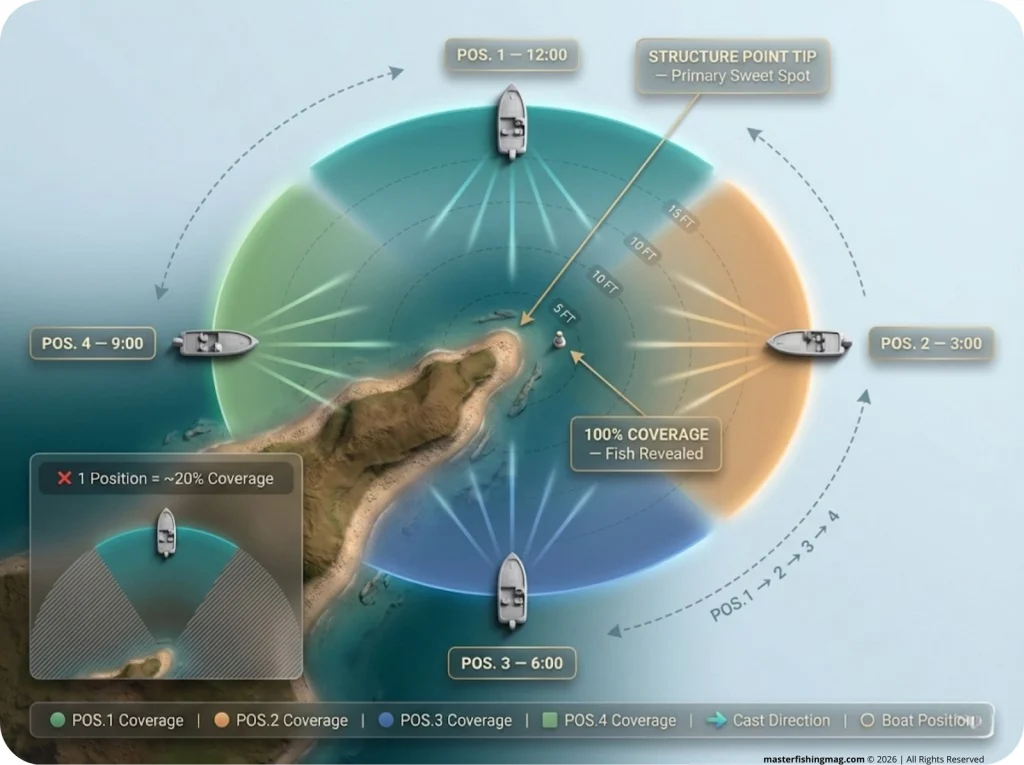
Single-angle casts miss 70-80% of productive water. Here’s the system that fixes it: fan casting all around the point from multiple boat positions.
Position your boat at 12 o’clock relative to the point tip. Cast from 9 o’clock to 3 o’clock in a fan pattern. Move the boat to 3 o’clock. Fan cast again. Then 6 o’clock. Then 9 o’clock. Each position reveals fish that were invisible from the previous angle.
If you only cast straight to the tip from your first position, you’ve covered roughly 20% of the productive water. That’s why you blank on a point that clearly holds fish—you’re casting to the wrong 20%.
Pro tip: Mark your first bite with a marker buoy and revisit that angle repeatedly. The sweet spot where you got bit first is usually the productive zone for the rest of the day.
Boat Positioning Without Spooking Fish
Boat positioning spooks shallow-holding fish on points. Use the trolling motor on low, approach from deep water, and stop short. On clear-water lakes, stay 40-60 feet from the shallowest part. In stained water, you can close to 20-30 feet.
Avoid idling directly over the point. Engine noise and your boat’s shadow push fish off temporarily. Approach from the side and idle past the deeper end. If wind is a factor, learn how controlling your boat position in heavy wind works with structure fishing, not against it.
The Milk-Run System — Covering More Structure in Less Time
Why Sitting on One Point All Day Fails
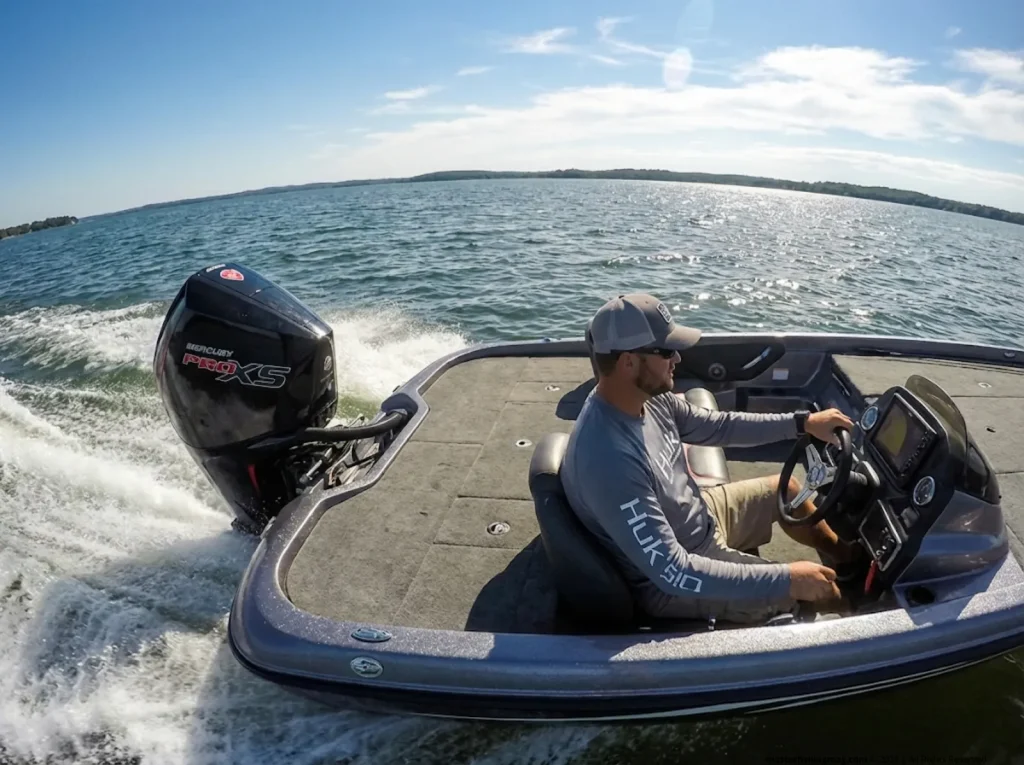
Fish move ON and OFF points throughout the day. A point dead at 8 AM may be loaded by 10. Joe Thomas runs a rotation: graph a point, fish it for 15-20 minutes, move to the next. Return to the best ones later.
This “structure fishing milk run” works because it matches how fish actually behave. They don’t camp on one piece of structure from dawn to dark. They cruise migration routes, stop to feed when conditions line up, then slide back to deeper water. The angler who covers 4-6 points in rotation contacts more actively feeding fish than the one who parks on a single spot and waits.
Building Your Rotation With Electronics
During your first pass of the day, boundary an area before casting by idling over every point and marking fish presence. Use live sonar or traditional 2D to rank them: points with fish arcs on the breakline get priority. Points with only bait and no predator arcs go to the bottom of the list.
As the day warms, revisit points that had no fish earlier—they may have moved up from deep water along the spine of the point. Use waypoints to mark each contact point. After a few trips, you’ll have a reliable rotation that puts you on fish consistently. Understanding your sonar’s coverage area matters here—check out transducer cone geometry to avoid dead zones so you know what your screen is actually showing you.
Rigs and Presentations That Solve Structure Failures
Bottom Huggers vs. Suspended Fish — Different Rigs for Each
Bottom-hugging fish want a jig, Texas rig, or jigging spoon that maintains constant contact with the structure. Feel every rock, stump, and contour change. These fish are aggressive enough to grab something that bumps into their holding zone.
Suspended fish need a completely different approach. A Carolina rig with a 3-4 foot leader lets the heavy sinker maintain bottom contact while the bait floats above at the depth where those fish are feeding. A drop-shot rig does the same thing vertically. Mike Iaconelli has spoken repeatedly about spot-on-the-spot probing—putting the bait exactly where the fish are, not 3 feet below where they’re ignoring it.
For a deep look at why the Carolina rig is the structure angler’s best friend, read the physics behind why bass can’t resist the Carolina rig.
Matching Retrieve Speed to Fish Activity Level
Active fish respond to reaction baits: crankbaits deflecting off the breakline (a Lucky Craft Fat CBDR crankbait is deadly for this), heavy spinnerbaits rolled along the slope, or lipless crankbaits ripped through cover.
Neutral fish need slow presentations: dragging a creature bait on a Carolina rig with flow retrievals that let the current do the work, dead-sticking a drop-shot, or hovering a jig just above bottom. Water temperature tells you which approach to use—below 55°F, slow everything down. Above 65°F, reaction speed usually wins.
Reading the Bite to Adjust in Real Time
Short strikes—fish bumping but not committing—mean wrong angle or too-fast retrieve. Slow down and change your casting direction. Fish caught deep in the throat? Right speed, right depth. Keep doing what you’re doing.
Fish hooked on the outside of the mouth? They swiped from the side, meaning your bait was slightly off their depth plane. Adjust up or down 1-2 feet.
Pro tip: If you lose a fish on the hookset, switch to a smooth sweep set instead of a hard snap. Structure fish often have marginal hook holds, and a slow, firm pressure set buries the hook better than a violent snap that rips the bait free.
Practice catch-and-release on structure-caught fish by using barbless or circle hooks where legal, keeping fish in the water during unhooking, and minimizing air exposure—especially in warm water. These habitats concentrate fish, and protecting them protects your future fishing.
Conclusion
Three things need to change if you want to stop blanking on structure.
First, understand that structure is the highway and cover is the rest stop. Fish the intersection of both, and remember that moderate cover outproduces heavy cover every time.
Second, your approach angle matters more than your lure choice. Fan cast from multiple boat positions. The fish that ignored your jig from the north side may crush it from the east.
Third, run a milk-run rotation across 4-6 points. Fish move on and off structure throughout the day, and the angler who covers more water contacts more actively feeding fish.
Pick three points on your home lake this week. Graph each one before casting. Fish completely around the hump or point from at least three boat positions. Note where you get bit—not just which point, but which angle and depth. After two trips, you’ll have a structure map that puts you on fish consistently instead of guessing.
FAQ
What’s the difference between a point and a hump in fishing?
A point extends outward from shore with a gradual depth increase on both sides. A hump is an isolated rise in the lake bottom—a submerged island with deep water on all four sides. Both concentrate fish at their breaklines, but humps tend to hold fish tighter because there’s only one route on and off—straight down. A saddle between two humps is especially productive because it funnels migration between the features.
How do I find structure points without a fish finder?
Locate via topo maps—most state wildlife agencies publish free lake contour maps. Match contour lines to visible shoreline features. If the bank juts outward above the surface, the contour usually continues underwater. You can also use a weighted Texas rig as a depth probe, counting seconds on the fall to map the bottom manually.
Do fish stay on structure all day?
Rarely. Fish use structure as a migration route, visiting specific points for 20-60 minutes during feeding windows, then retreating to deeper water. This is why the milk-run rotation outperforms parking on one spot. Capt. Craig Price teaches a similar concept for inshore structure—pattern the timing, not just the location.
What rod and reel setup is best for structure fishing?
A medium-heavy baitcasting rod (7’0-7’3) with a moderate-fast action handles most presentations from jigs to Carolina rigs. Pair it with a reel in the 6.3:1 to 7.1:1 range. Use fluorocarbon line (12-15 lb) for bottom contact sensitivity and abrasion resistance around rocks and wood.
When should I fish the tip of a point versus the sides?
Fish the sides first. The tip is the most obvious target, but fish stage on the side slopes where breaklines create depth transitions. The downcurrent end concentrates bait and predators. Only fish the tip if the sides are unproductive or if fish are chasing bait at the surface.
Risk Disclaimer: Fishing, boating, and all related outdoor activities involve inherent risks that
can lead to injury. The information provided on Master Fishing Mag is for educational and informational purposes
only. While we strive for accuracy, the information, techniques, and advice on gear and safety are not a substitute
for your own best judgment, local knowledge, and adherence to official regulations. Fishing regulations, including
seasons, size limits, and species restrictions, change frequently and vary by location. Always consult the latest
official regulations from your local fish and wildlife agency before heading out. Proper handling of hooks, knives,
and other sharp equipment is essential for safety. Furthermore, be aware of local fish consumption advisories. By
using this website, you agree that you are solely responsible for your own safety and for complying with all
applicable laws. Any reliance you place on our content is strictly at your own risk. Master Fishing Mag and its
authors will not be held liable for any injury, damage, or loss sustained in connection with the use of the
information herein.
Affiliate Disclosure: We are a participant in the Amazon Services LLC Associates Program, an
affiliate advertising program designed to provide a means for us to earn advertising fees by advertising and linking
to Amazon.com. As an Amazon Associate, we earn from qualifying purchases. We also participate in other affiliate
programs and may receive a commission on products purchased through our links, at no extra cost to you. Additional
terms are found in the terms of service.