

In this article
The wind on the main lake hits 25mph, and suddenly your boat feels less like a stable platform and more like a leaf on the water. In these treacherous main lake conditions, hope isn’t enough. You have to understand how the water and wind work together, or the weather will decide where your boat moves.
If you don’t take control, the wind will pull your lure right out of the strike zone, likely ending your fishing trip early. I’ve seen too many anglers pack up the moment whitecaps appear, missing out on the best high percentage fishing opportunities for walleye or bass.
After decades on the water, I’ve learned that handling heavy wind isn’t about fighting nature. It’s about being smart with your boat control. In this guide, we are going to fix the anxiety that comes with rough water. We’ll look at why boats drift the way they do, why your battery setup matters, and how to use a gas and electric combo to stay right on your spot.
Why Boats Lose Control
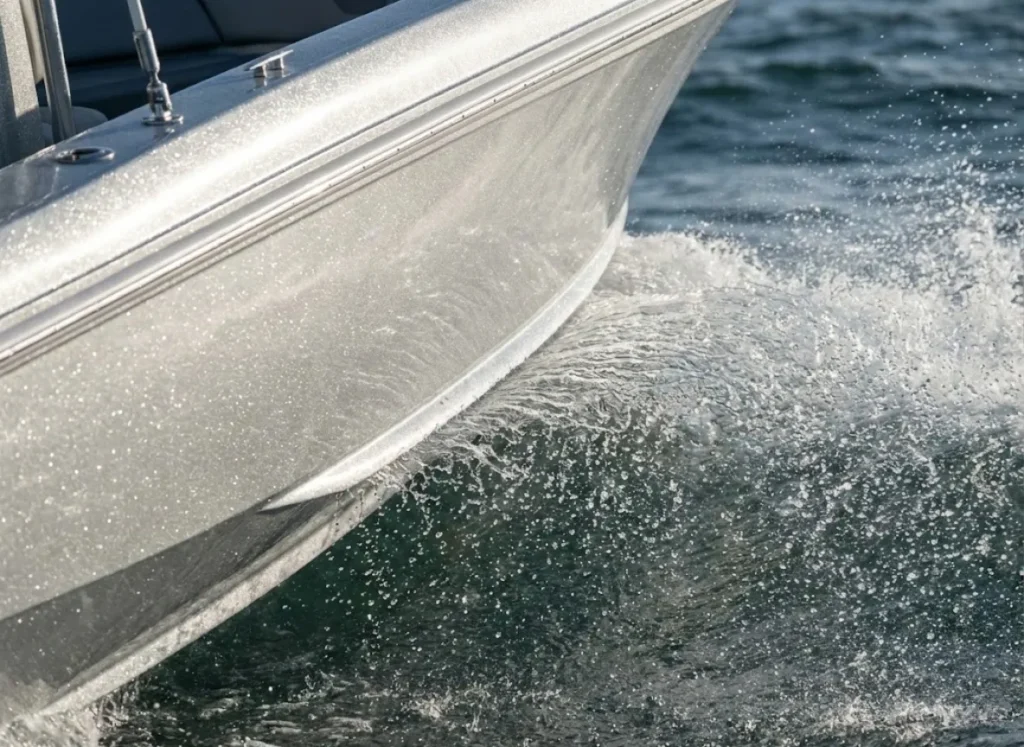
To beat the wind, you first have to understand why it’s winning. Most anglers treat winds as just a nuisance, but it acts like a giant hand pushing against anything above the water.
How wind actually affects your boat
The force of wind gets stronger much faster than you might think. A 25mph wind speed is actually more than twice as strong as a 16mph wind speed. That big jump in power is why your standard trolling motors suddenly feel useless when the breeze picks up just a little bit. We often call these wind speed thresholds the point of no return for lesser equipment.
We call the surface area of your vessel above the water “windage.” This includes the sides of the hull, the windshields, and even you standing on the deck. All of this acts like a sail, catching the wind and pushing you off course. This is exactly what makes sailboats so effective, but for powerboats, it causes unwanted drift.
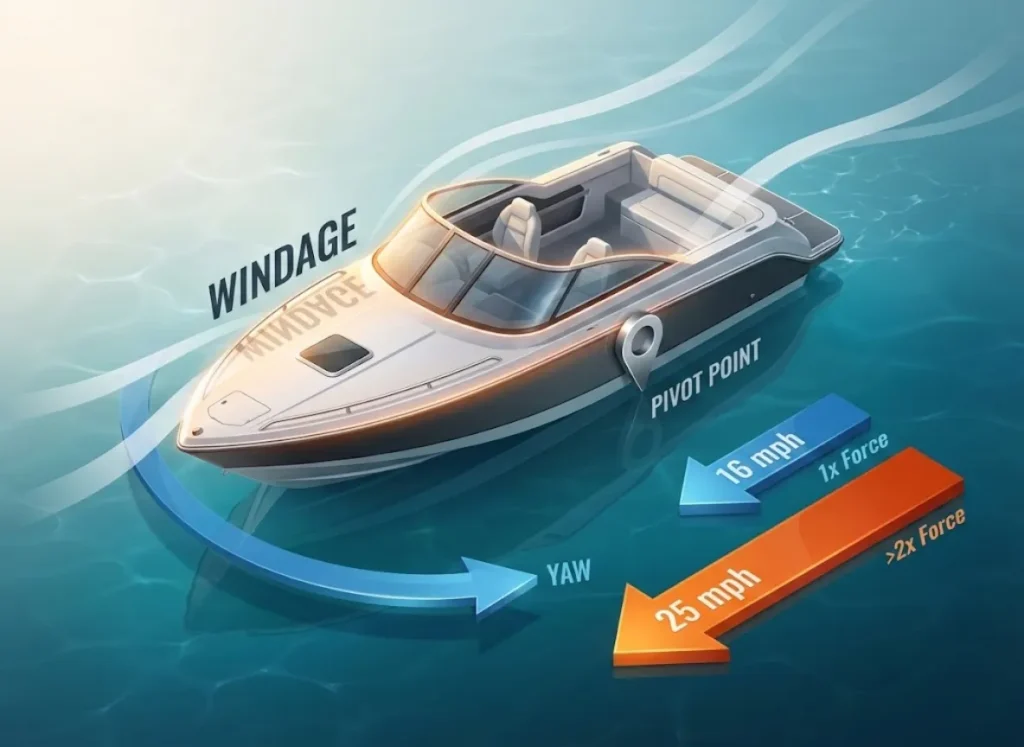
Usually, the wind pushes the front of the boat harder than the water holds the back. Because the pivot point is often further back, the wind grabs the bow and swings it downwind. This causes the boat to spin, a phenomenon known as yaw.
This is why how hull design impacts boat control is so important. Deep-V hull designs, common on multi-species boats, have higher windage and spin easier than low-profile bass boats. You can’t stop control your drift until you stop that spinning motion.
According to the National Weather Service definitions of wind force on marine vessels, these conditions create real hazards for small vessels. Understanding where your boat pivots, especially with a north wind or east wind blowing, is a matter of safety, not just catching fish. Savvy boaters prioritize this knowledge.
The Electric Motor: Power and Batteries
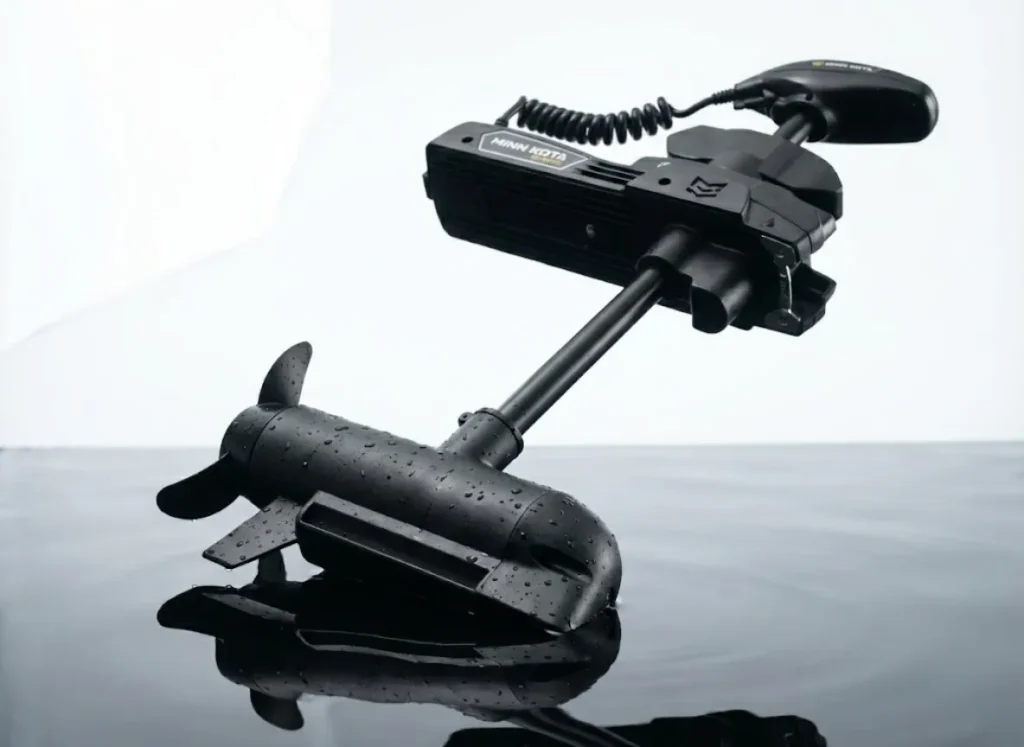
Once you understand the invisible forces pushing against the hull, you can pick the right tools to push back. This starts at the front of the boat.
Is my trolling motor strong enough?
The standard rule suggests you need 2lbs of thrust for every 100lbs of boat weight. That works fine in calm weather. But in heavy wind, you need a ratio closer to 3.5 to 5 lbs of thrust per 100lbs.
If you are running an 18-20 foot boat, a standard 24-volt system often isn’t strong enough to correct your course when a gusty wind hits. In real windy conditions, a 36-volt system (112lb+ thrust) is what you really need for maximum boat control. Modern brushless trolling motors, like the Minn Kota Quest, provide instant power and high torque at lower motor rpm. You need that snap to keep your bow pointed into the wind.
Pro-Tip: Don’t rely on your Spot-Lock mode blindly. Watch your bow. If the trolling motor is spinning in circles trying to find the spot, you are asking it to do too much. You need to help it with the main engine or lower your profile to maintain directional control.
However, power means nothing if your lithium batteries die. In 20mph wind, a trolling motor might run at nearly full power the whole time. This creates a severe lithium battery drain scenario, which quickly depletes standard lead-acid batteries.
When standard batteries work that hard, their voltage drops, meaning they lose power just when you need it most. This is why ranking top trolling motor batteries almost always puts Lithium (LiFePO4) at the top. Looking at the principles of battery discharge rates and capacity, we can see that Lithium batteries stay strong until they are almost completely empty. In heavy wind, lithium batteries are almost a requirement to keep your power consistent.
The Hybrid System: “The 60/40 Split”
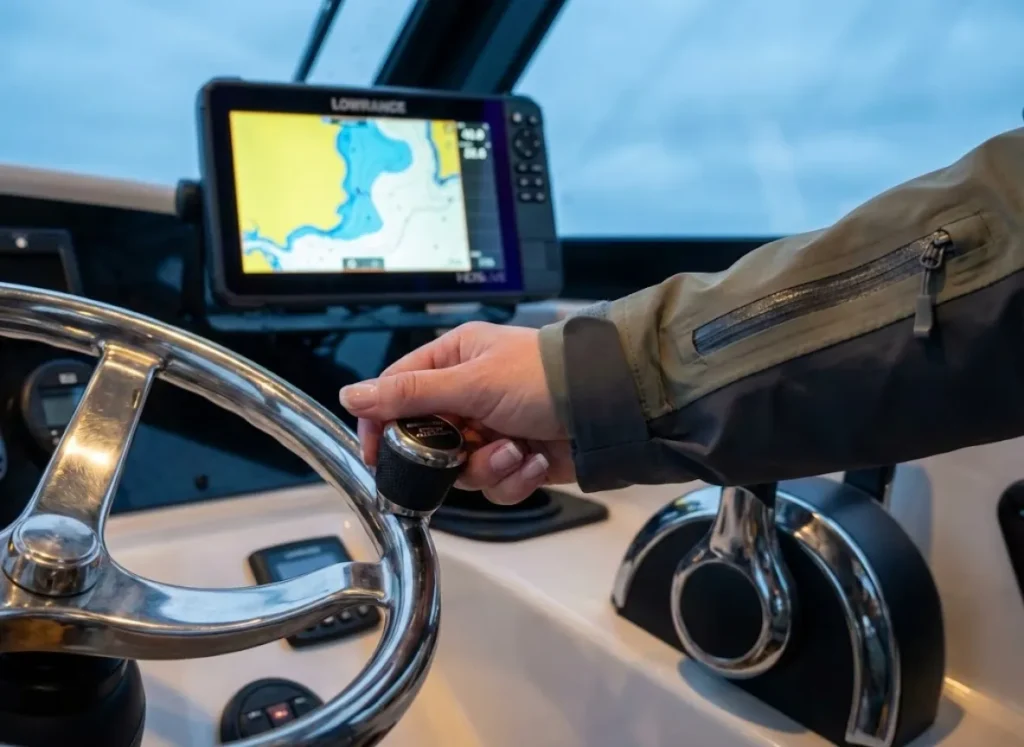
Even the strongest electric trolling motor has limits. When the wind is too strong for just the electric trolling motor, we have to use the gas engine, too. This is a trick the pros use for advanced boat maneuvering.
How the Kicker-Electric combo works
We call this the “60/40 Split”. It involves using your kicker motor (on the back of the boat) to do about 60-70% of the work. You lock the kicker motor pointing straight forward, set the throttle to match the wind speed, and leave it alone. It provides the “Push” or thrust.
At the same time, you use the bow-mount motor at the front to do the remaining work and all of the steering. This lets you steer from the front, which is much more precise than steering from the back when the wind is blowing sideways. This kicker-to-trolling motor ratio gives you great boat control.
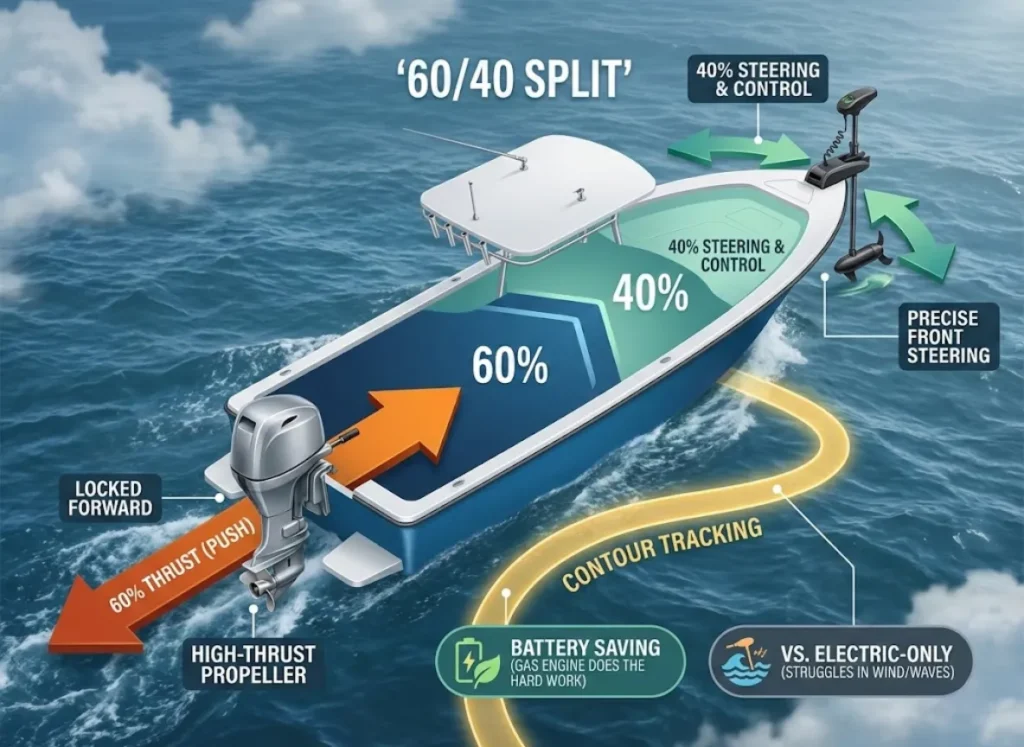
This setup saves your lithium batteries because the gas engine is doing the hard work. It also allows for precise contour tracking. While how Spot-Lock systems manage boat position is great for sitting still, the 60/40 Split is better for moving along a ledge in big waves where an electric trolling motor alone would struggle to keep boat steady. Modern GPS-anchoring systems like i-Pilot are made even better by this technique.
To make this work well, you need a high-thrust propeller on your kicker motor. This keeps the prop grabbing the water even when the boat bounces in waves. The US Coast Guard analysis of vessel maneuvering in wind confirms that steering from the back is hard in the wind, which is why this front-steering method provides superior directional control.
Using Drag to Your Advantage

Sometimes the smartest move isn’t to fight the wind, but to use drag to slow down your drift speed. This is where drift socks come in.
How to use drift socks properly
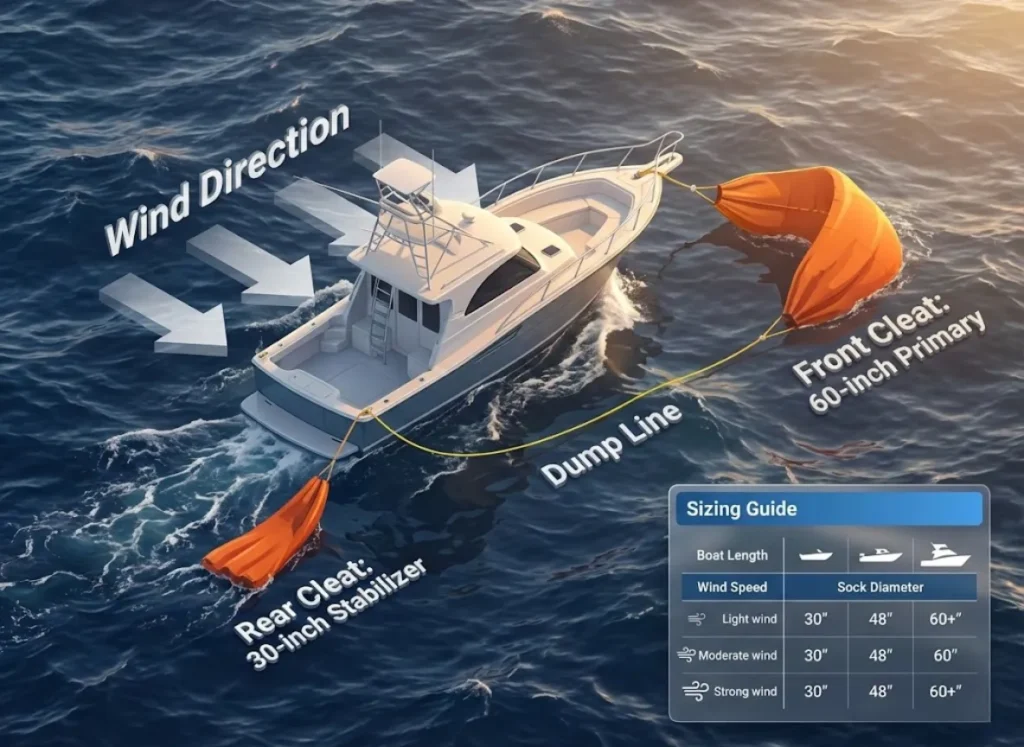
Drift socks function as hydrodynamic brakes. The drag they create is proportional to their size. A 60-inch drift sock offers roughly 4x the resistance of a 30-inch drift sock. Size matters a lot here.
If you want to drift sideways—which is great for letting multiple people fish at once with fan casting for bass or walleye—you should use two drift socks. Put a larger one on the front cleat and a smaller one on the back cleat. This asymmetrical drag stops the front of the boat from blowing downwind, keeping you in parallel positioning to the waves, perfect for working windblown points.
You can also use Power-Pole Drift Paddles, which attach to shallow water anchors. They act like stabilizers, significantly reducing how much the boat rocks in the waves. These paddles act like deep keels for added stability.
Pro-Tip: Always attach a “dump line” to the back of the drift sock. This lets you collapse the sock easily when you want to pull it in. Trying to pull a water-filled 60-inch drift sock against the current is dangerous and nearly impossible during drift sock rigging.
Make sure the rope is the right length. The sock needs to be far enough away to be in “clean water” (away from the boat’s hull turbulence) but close enough to handle.
Academic research on drift characteristics and leeway of small vessels backs up the physics of wind and drag, but safety is the priority. Be sure to review critical fishing safety gear and protocols before dealing with ropes and rigging in rough waters or angry water. Always have a float plan when facing strong wind conditions.
Wrapping Up
Mastering heavy wind isn’t about muscle; it’s about smart thinking and the right gear. Boat control comes from combining 36V Lithium Propulsion (Active) with Drift Drag (Passive).
The “60/40 Split” remains the professional standard for managing energy and precision in gale conditions. Remember that battery chemistry matters; Lithium is necessary to keep your power up when the bow-mount motor is working hard.
Finally, never rely only on electronics. Always have a real anchor ready to drop if your systems fail in a Small Craft Advisory. This is a key safety point for all boaters.
Share your own “heavy wind” setup or questions about rigging kicker motors in the comments below, and help build our community’s knowledge base.
FAQ – Frequently Asked Questions about Boat Control in Wind
What size drift sock do I need for a 20-foot boat?
For heavy wind (20+ mph), a 50 to 60-inch drift sock is best to slow your drift speed. If the windsock is too small, you will drift too fast (over 1.5 mph), making it hard to make accurate casts with crankbaits or spinnerbaits.
Does Spot-Lock work in 30 mph wind?
Yes, if you have a 36-volt system with 112lbs of thrust (like a Minn Kota Terrova or Ulterra), but it will drain your lithium batteries fast. Adjusting the Boat Scale or Heading Sensor settings can help the motor run smoother in gusty wind, reducing the overshoot often experienced.
Is it better to troll with the wind or against it?
Trolling with the wind allows for better boat control and battery conservation, using the wind to push you along windblown points. However, trolling against the wind offers slower, more precise speeds for vertical jigging if you have a kicker motor to help provide thrust. Sometimes, you need to trim the motor down to get better bite from the propeller.
Why does my boat spin in circles when Spot-Locked?
This is usually caused by a lack of a calibrated Heading Sensor (puck), preventing the motor from knowing the hull’s boat orientation. Without heading data, the motor only knows where it is located via GPS, so it spins around trying to stay on the dot. A common issue is wind bow in line where the line is getting wrapped.
Risk Disclaimer: Fishing, boating, and all related outdoor activities involve inherent risks that
can lead to injury. The information provided on Master Fishing Mag is for educational and informational purposes
only. While we strive for accuracy, the information, techniques, and advice on gear and safety are not a substitute
for your own best judgment, local knowledge, and adherence to official regulations. Fishing regulations, including
seasons, size limits, and species restrictions, change frequently and vary by location. Always consult the latest
official regulations from your local fish and wildlife agency before heading out. Proper handling of hooks, knives,
and other sharp equipment is essential for safety. Furthermore, be aware of local fish consumption advisories. By
using this website, you agree that you are solely responsible for your own safety and for complying with all
applicable laws. Any reliance you place on our content is strictly at your own risk. Master Fishing Mag and its
authors will not be held liable for any injury, damage, or loss sustained in connection with the use of the
information herein.
Affiliate Disclosure: We are a participant in the Amazon Services LLC Associates Program, an
affiliate advertising program designed to provide a means for us to earn advertising fees by advertising and linking
to Amazon.com. As an Amazon Associate, we earn from qualifying purchases. We also participate in other affiliate
programs and may receive a commission on products purchased through our links, at no extra cost to you. Additional
terms are found in the terms of service.