
In this article
The truck was still rolling when the trailer disappeared. One forgotten transom strap — still clipped to the hull — went taut as the boat floated free, yanked the rear axle up off the ramp, and dragged the whole rig into eight feet of water. The crowd on the dock didn’t say anything. They didn’t have to.
I’ve been guiding on these lakes for over two decades. That scene? I’ve watched it three times — twice from the dock, once in my own mirror, a long time ago. The boat ramp loading scene is the great equalizer. Doctors, engineers, weekend warriors, seasoned anglers — none of it matters. Without a methodical understanding of what’s physically happening under that trailer, launching is always one skipped step away from a very expensive afternoon.
This guide breaks down the mechanics: angular velocity of the trailer hitch, hydrostatic float-off depth, surface roughness of ramps, winch safe working load, and hub thermal physics. When you understand the why behind every step, the checklist stops feeling like bureaucracy. It becomes physics.
⚡ Quick Answer: Back a bunk trailer until the bunks are at or below the waterline — typically 37+ inches of transom depth on a 10° ramp — and let buoyancy do the lifting before the winch does the pulling. A roller trailer can recover at 12–18 inches shallower but introduces rollback risk if the strap disconnects early. Always stage the rig in the parking area first: drain plug in, transom straps off, bow safety chain last. Let your hubs cool at least 5 minutes before submersion, and never exceed 75% of your winch’s rated Safe Working Load.
The Physics of Backing a Trailer — Angular Velocity and the Offset Law
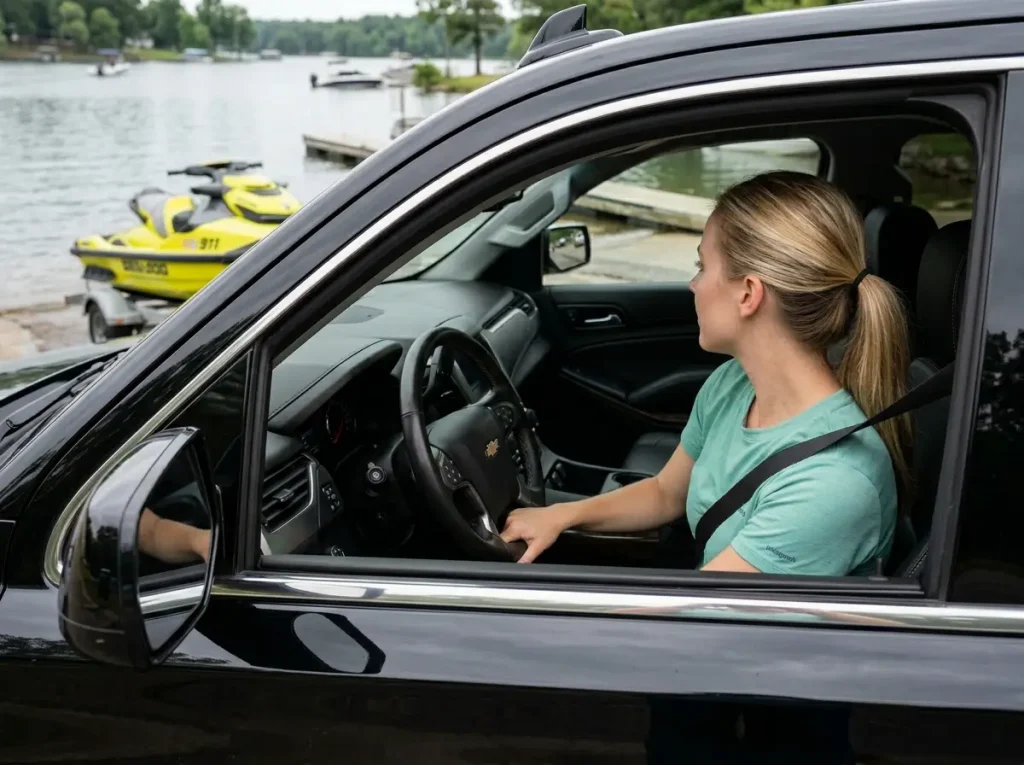
Here’s where every beginner gets humbled. You steer left and the trailer goes right. You overcorrect. It jackknifes. Someone on the dock pulls out their phone. You’ve seen this movie.
The reason it happens isn’t driver error — at least, not the kind you can fix by trying harder. It’s geometry.
Why the Trailer Swings: The Offset Law Explained
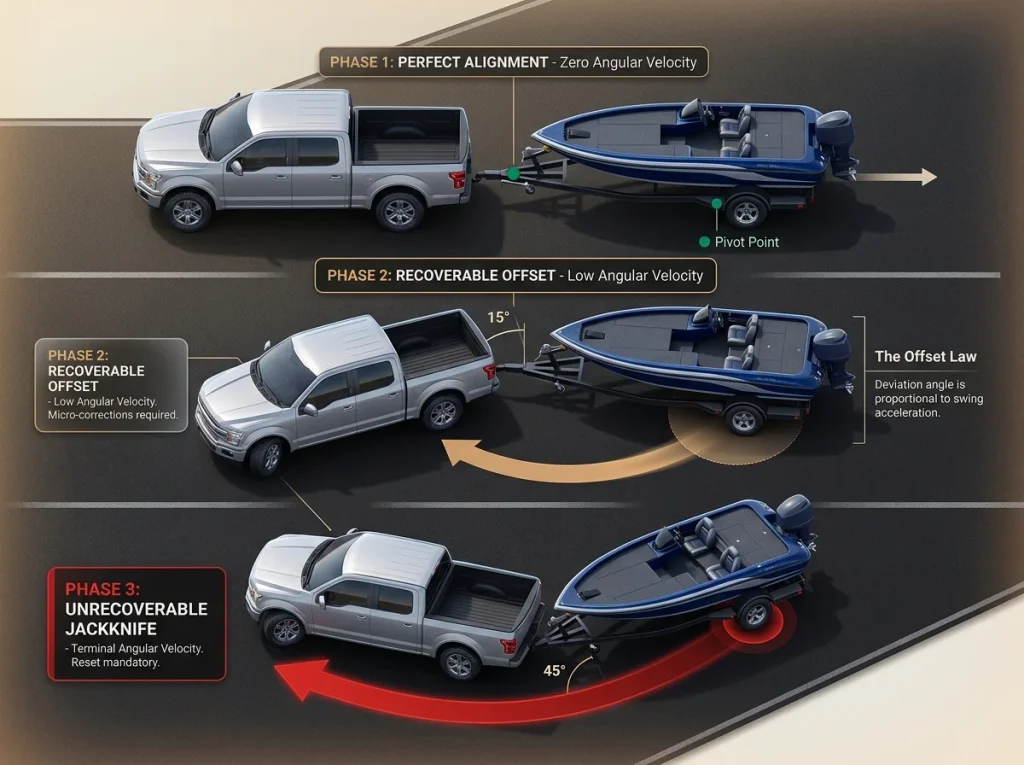
A trailer in reverse behaves like a pendulum. Its angular velocity — the rate at which it swings off your centerline — is inversely proportional to wheelbase length. Short trailer, faster swing. That’s why a jet ski trailer can jackknife within a single full steering input while a 25-foot center console barely moves. The math is fixed. You can’t negotiate with it.
What makes it worse is the Offset Law: the further the trailer deviates from center, the faster it continues to deviate. Correction must come early, not reactively. By the time you see a problem in the mirror, you’re already behind the physics. This is the same spatial awareness that helps you control a drifting boat in wind — reading vector forces before they become problems, not after.
And then there’s the lever arm effect. The distance from your rear axle to the hitch ball amplifies every steering input. Large SUV with long rear overhang? Your hitch ball covers twice the lateral distance per degree of steer. Light inputs. Always light inputs.
Pro tip: Lower your truck’s tailgate or open the hatchback before you back. You’ll see the pivot point at the trailer axle much earlier in the sequence. Process the deviation before the trailer swings, not after.
The Hand-at-the-Bottom Steering Method
Rest your steering hand at the six o’clock position on the wheel. When you move your hand left, the trailer goes left. Direct, intuitive, no cognitive reversal. This eliminates the “turn opposite to go right” confusion that stacks up beginners at the ramp.
Micro-corrections. Not full rotations. The trailer responds in degrees. Speed is also your enemy — slower reverse velocity extends your feedback window. A rig crawling backward at two miles per hour can be corrected. One moving at five cannot. The first twenty times you back a short-wheelbase trailer, you’re just burning in the muscle memory. After that, it becomes feel. Until then, go slow and commit to small inputs.
Staging Area Protocol — Preparation Before the Lane
Every ramp screw-up starts before the ramp. The staging area — any parking zone away from the active launch lanes — is where all pre-launch preparation happens. Drain plug insertion. Transom strap removal. Electronics staged and powered up. Safety equipment accessible.
The “Gawker Effect” is real. Social pressure from other boaters watching your reverse sequence increases error rates — rushed backing, skipped checklist items, forgotten plugs. Staging removes that pressure entirely. You’re not performing for an audience in the parking lot. You’re operational there.
Assign a spotter before any reverse maneuver. Position them at the rear trailer corner — never directly behind it. Hand signals or radio. Clear line of communication. Non-negotiable.
Launching the Boat — Hydrostatics, Ramp Slope, and the Float-Off
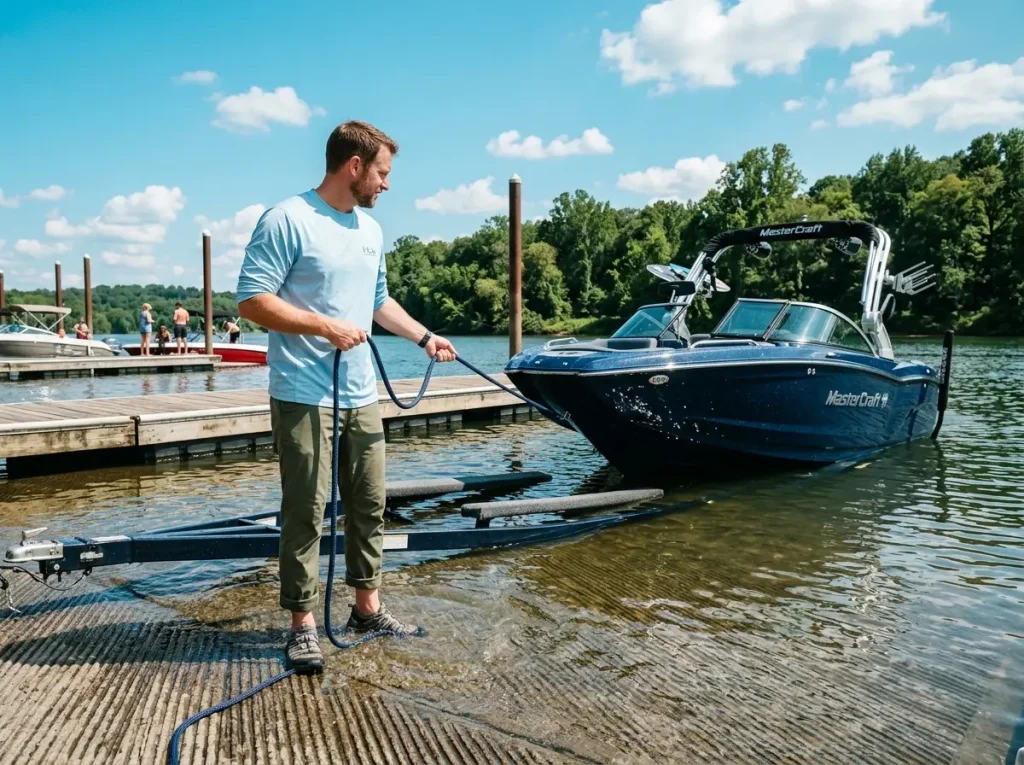
Most ramp arguments I’ve witnessed boil down to one thing: a bunk-trailer owner who backed in two feet and can’t figure out why the boat won’t float. They needed four feet. The physics were never on their side.
The Launch Triangle — Calculating the Float-Off Depth
The same Archimedes principle that governs lure suspension also determines when your boat leaves the trailer. Buoyancy force must equal or exceed the boat’s weight before the hull will float free. What determines when that happens? Ramp slope and bunk trailer submersion depth.
Think of it geometrically. The ramp angle, the transom height, and the required water depth form a right triangle. On a 10° slope with a transom 25 inches above ground, you need approximately 37 inches of water depth at the transom to achieve initial buoyancy. Back in two feet, and you’re asking the winch to pull against the hull’s full weight plus the friction between wet marine carpet and gelcoat. That load can exceed the winch’s rated capacity. According to hydraulic resistance factors documented for sloped surface environments, the relationship between slope angle and submersion depth follows consistent geometric principles that recreational boaters rarely account for.
Bunk trailers require approximately 80% buoyancy compensation before the winch can safely recover. Roller trailers run shallower — sometimes 12 to 18 inches less — because rolling resistance is orders of magnitude below bunk friction. The tradeoff is rollback risk: roller trailers can and do float the boat off prematurely if the winch strap goes slack before you’re ready.

Pro tip: Tie a length of colored tape at the trailer bunk at the depth mark for your ramp’s average slope. Visual depth reference beats guessing every time, especially when the water is murky and the dock light is bad.
Bunk Trailers vs. Roller Trailers — Friction and Recovery Depth
Understanding how trailer type intersects with hull geometry and total ownership cost starts at the ramp. Bunk trailers are forgiving in alignment — the carpeted surface cradles the hull and keeps it centered through current and wind pressure. But they demand depth. The hull has to be buoyant enough to slide off without the winch bearing the full dead load.
Roller trailers solve the depth problem but introduce an alignment problem. Current or wind applies hydrodynamic drag laterally on the hull during retrieval, pushing the boat off-center. The bunk guides — the “goal posts” at the rear of the trailer — are the physical constraint that prevents this. Keep the engine in gear at idle RPM during winching: the prop wash acts as a counter-force that steers the stern back onto the centerline even while the rig is stationary.
The Steeper Ramp Problem — Momentum Management on Descent
At 15° incline, gravity pulls on the loaded trailer with over 700 lbs of force at the hitch. When you’re descending a steep ramp, momentum — mass times velocity — builds fast. If your braking system can’t overcome that combined momentum, the boat can continue sliding into the water after the trailer stops. This is not the ramp’s fault. It’s physics.
Steeper ramps get you to float-off depth faster, but they stress everything harder: hitch assembly, braking, transmission under heavy load on extraction. Always set the emergency brake before the transmission during steep ramp recovery. The parking pawl in an automatic transmission is not rated for sustained slope loading. Set the brake.
Manning’s n and the Ramp Surface — Traction You Can Actually Measure
Nobody talks about this. Every online guide says “watch for algae.” None of them tell you why algae makes traction functionally zero — and why the specific finish of the concrete matters before any growth appears.
Surface Roughness as a Traction Metric
Manning’s n is an engineering surface roughness coefficient. For boat ramps, it’s the difference between your tow vehicle climbing out under load and spinning helplessly. Trowel-finished smooth concrete (n ≈ 0.011) is poor when wet — high slip risk. Broom-finished concrete (n ≈ 0.016) provides significantly more grip because the texture gives tires something to engage. The difference is tactile. You can feel it when you walk on it wet.
Ramp weathering progressively erodes that broom texture. An eight-year-old ramp that was safe on day one may have already dropped from 0.016 to near 0.011 as the finish wears smooth. You won’t see this from your cab. You’ll feel it when the rear tires start spinning at 40% throttle. Per surface roughness coefficients for concrete structures, the margin between passable and hazardous can be surprisingly thin. The same physics that govern safe ice load-bearing ratios at the coefficient-of-friction level apply here — surface condition determines everything.
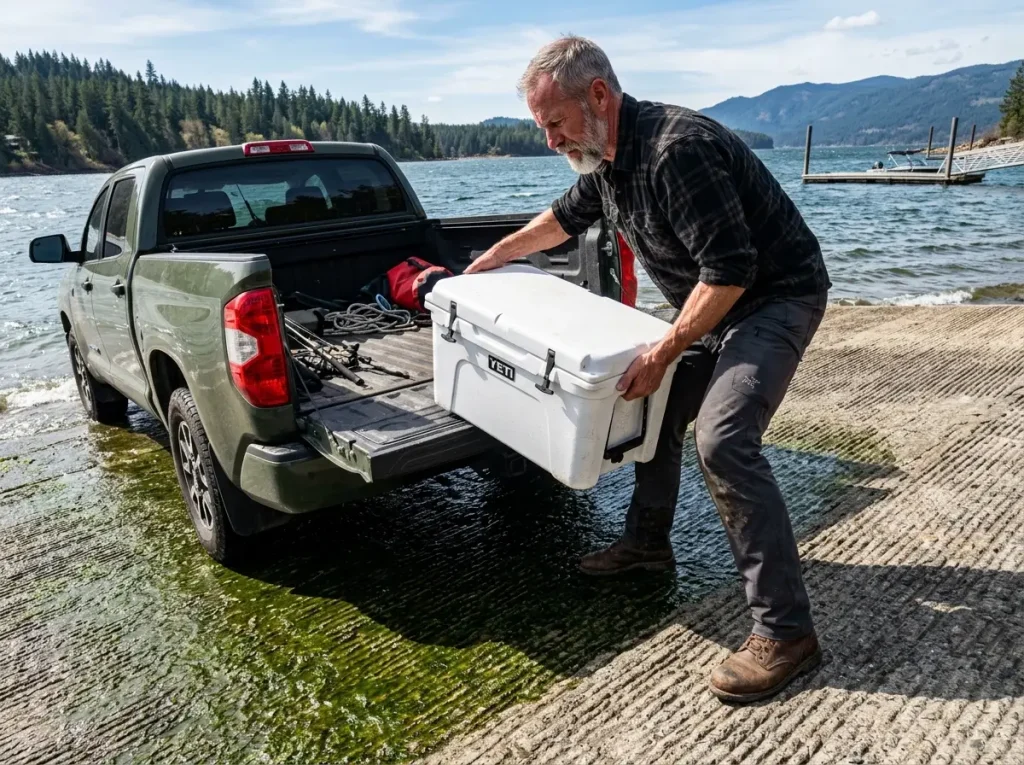
Algae-covered concrete is a different problem entirely. The effective friction drops to near that of black ice. Double-footing — riding brake and throttle simultaneously — is the field technique for managing torque on slippery inclines without losing momentum or stalling completely. And here’s the other trick: moving a 100-pound cooler to the rear of the truck increases the normal force over the rear axle by 40 to 60 pounds. On a marginal traction ramp, that’s often the critical margin between exit and failure.
The gravel and riprap edges along many ramps serve a real structural function: lateral drift protection. When cross-current or wind pushes the trailer sideways during recovery, those rough edges arrest the slide before it becomes a loss of lane. Don’t back over them — back next to them.
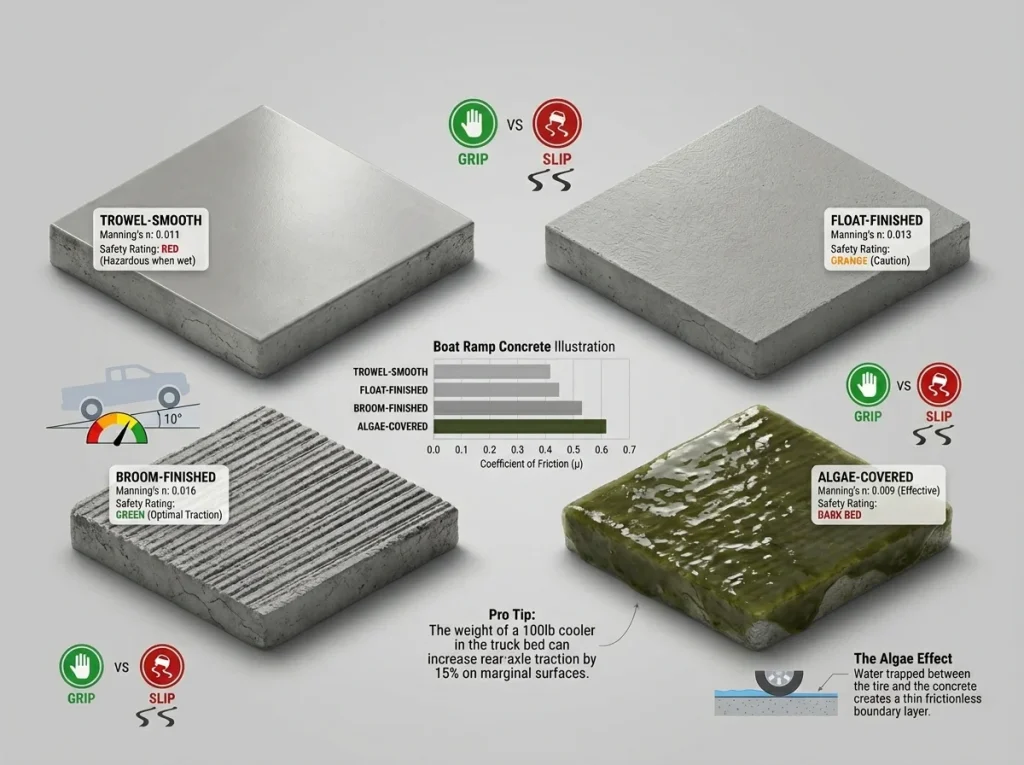
Pro tip: Before you back, walk the ramp. If it’s slick underfoot — especially past the waterline — treat it like a wet boat deck. What slips a 200-pound person will spin a two-ton drive axle.
The Prop Wash Scour Pit — Why Power Loading Is a Structural Hazard
Power loading — using the boat’s engine to drive it onto the trailer bunks — is a ramp throughput trick that destroys the ramp it uses. The high-velocity propeller jet erodes sediment at the ramp terminus, creating a scour pit that deepens over time. When that pit is large enough and a trailer’s rear wheels drop into it on extraction, the required torque to lift the tires over the concrete edge can exceed the transmission’s capacity. That’s the “transmission burnout” story you’ve heard at the marina — not bad luck, straight physics. Technical analysis of propeller-induced seabed erosion documents exactly how propeller jets create and deepen these structural traps.
Before backing down, check the ramp terminus visually. A concrete lip, an edge discontinuity, or a visible depression is a scour pit warning. If the ramp bans power loading, that ban exists because it’s already structurally compromised.
Winch Selection and SWL — The Mechanical Advantage You’re Probably Ignoring
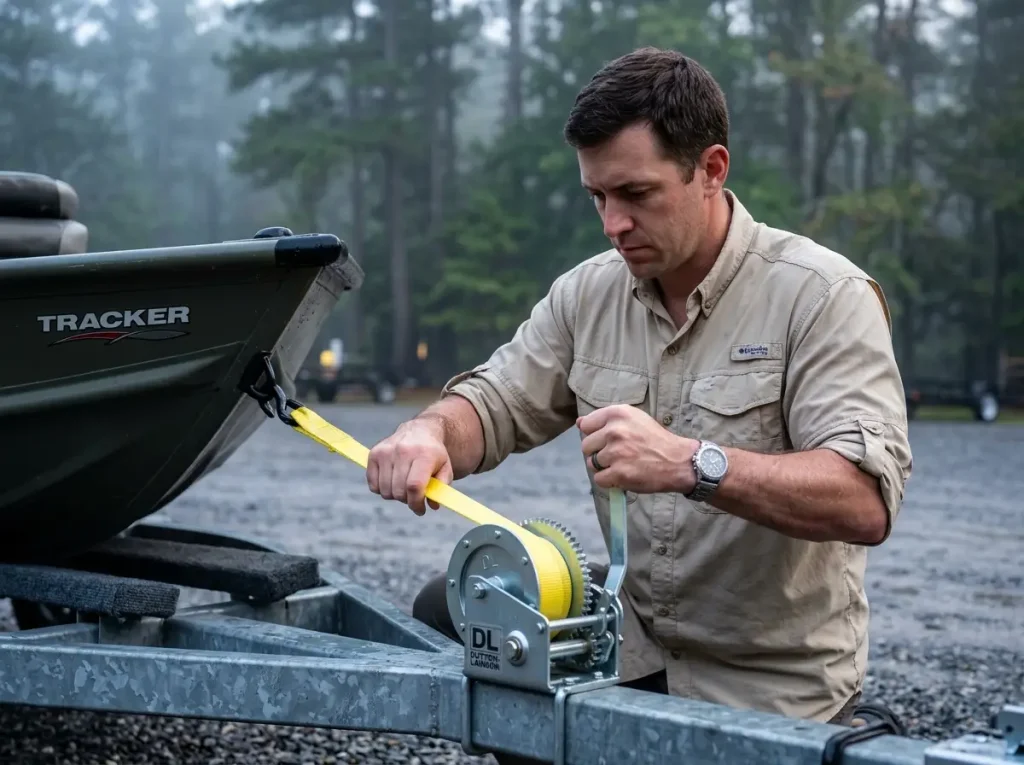
The $12 strap from the big box store is not rated for dynamic marine loads. It’s rated for static tie-down. Different test, very different failure point. Buy the wrong winch or use a degraded strap, and the only thing standing between your boat and the bottom of the launch lane is physics you didn’t stack in your favor.
Gear Ratios Decoded — Matching Winch to Vessel Weight
Winch gear ratio determines how much mechanical advantage you have against hull friction plus gravity. Here’s where the numbers actually sit:
- 1:1 — takes up slack only, no load capacity
- 3:1 or 4:1 — aluminum boats and tinnies up to 1,200 lbs
- 5:1 — mid-sized fiberglass on bunk trailers, 1,500–2,000 lbs
- 10:1 to 15:1 — heavy vessels or shallow-ramp recovery over 2,500 lbs
- 16.2:1 — large offshore vessels, high-load low-speed recovery
If you’re pulling a properly loaded winch and the handle force exceeds 55 pounds, the winch is overloaded. That’s the diagnostic — not noise, not handle flex. Sustained effort over 55 lbs means the rig is overtaxed. The 75% SWL rule applies here: never winch a vessel whose weight exceeds 75% of the winch’s rated Safe Working Load. That 25% buffer is your margin against dynamic load spikes — waves, current surges, hull misalignment.
This same principle — the mechanical limits of load-bearing systems under sustained tension — governs reel drag systems too. The physics of overloading a gear system don’t change based on what the gear is doing.
Winch Strap vs. Winch Cable — Failure Modes and Load Behavior
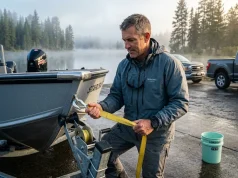
Polyester straps lose up to 15–20% of their rated capacity when wet. UV exposure degrades them further each season. Inspect the first 24 inches of strap before every launch — this is the highest-stress zone, where every loading cycle adds cumulative fatigue. Check the webbing for fraying, discoloration, or stiffness. Any of those signs mean replacement, not another season.
Steel cable fails differently: fatigue fractures at kink points. A kinked cable should be replaced, not straightened. And understand this clearly — a winch strap failure under load is not a quiet event. Stored elastic energy releases the strap as a whip. Stand to the side of the winch. Never inline with the strap under tension.
The Recovery Sequence — Winching Technique for Alignment and Safety
Cleat the bow line first. This holds the bow against current while you move from helm to winch. Keep the engine in gear at idle RPM through the winching sequence — prop wash centers the stern on the bunks better than any amount of winch tension adjustment. Attach the winch strap to the bow eye before hull contact on roller trailers, and never let it go slack once the hull touches the first roller. Slack mid-retrieval on rollers allows the hull to roll back freely.
Pro tip: A short snubber or elastic shock absorber between the winch strap and bow eye dampens dynamic load spikes, particularly on rough-water launches where wave action creates sudden slack-and-jerk cycles on the strap.
Hub Thermal Physics — Why the 5-Minute Rule Saves Your Bearings
Everyone tells you to let the hubs cool. Nobody explains why the physics make it mandatory, not optional.
What’s Actually Happening Inside Your Hub
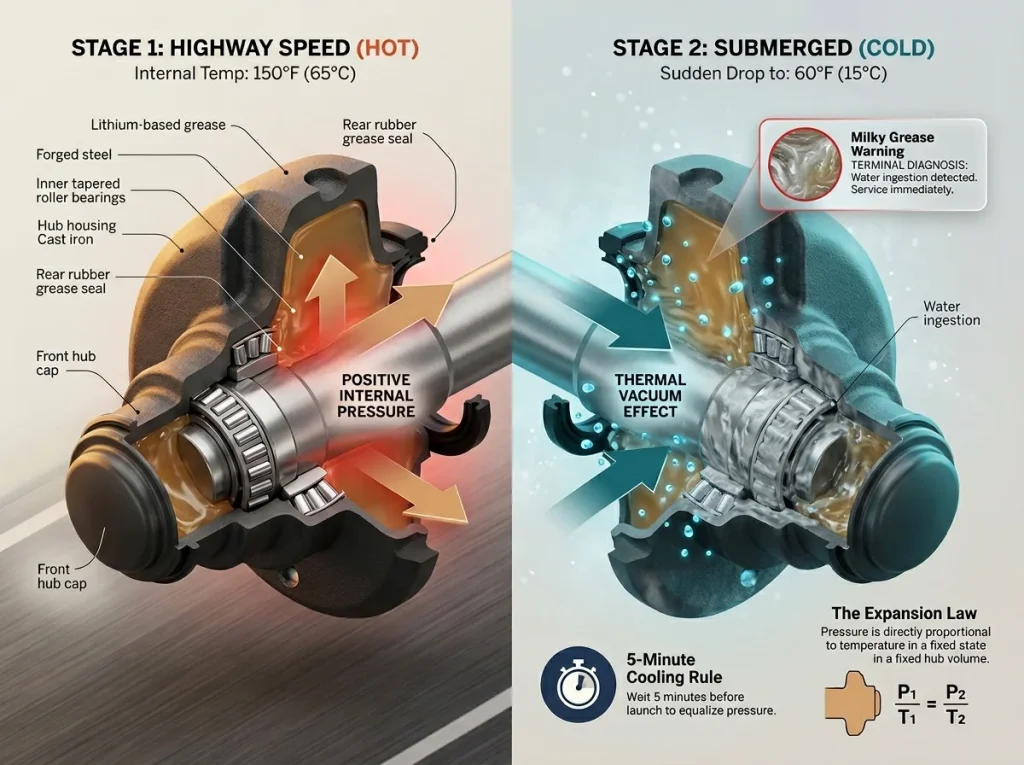
Your trailer hubs running at highway speed accumulate heat through kinetic friction — typically 140°F to 160°F at the bearing race. When that hub enters 60°F lake water, the temperature drop is near-instantaneous. As the air and grease inside the fixed hub volume cool, internal pressure drops proportionally. The outside atmospheric pressure — now higher than the hub interior — physically forces water and suspended silt past the rubber seals and into the bearing.
That water contacts your steel bearings. Oxidation starts. Pitting begins. Given time and repeated cycles, the bearing race degrades to the point of seizure. I’ve seen hubs fail on the highway exit ramp, with the wheel passing the truck at 65 mph. This is not a fringe scenario. It’s a predictable failure mode with a simple fix: wait five minutes.
The 5-minute rule: engine off, truck stationary, approximately five minutes before submersion. Hub temperature drops to a safe submersion range in that window. The same electrochemical corrosion mechanisms that destroy reel components also attack trailer bearings soaked in brine — and saltwater environments demand both lithium-based waterproof grease and longer cool-down intervals than freshwater.
Bearing Buddy Systems — Pressurized Hubs and Their Failure Modes
A Bearing Buddy device uses a spring-loaded piston to maintain approximately 3 PSI of positive internal pressure in the hub. This prevents water ingestion even during thermal contraction — as long as you don’t defeat it. Over-greasing causes rear seal blowout, creating a leak path that eliminates the positive pressure system entirely. The visual diagnostic is milky grease — gray or white color at the hub cap means water emulsification is already happening. That’s not a warning sign. That’s a terminal diagnosis for that bearing if you don’t service it immediately.
Replace grease annually for freshwater use. Every six months for saltwater. No exceptions — the bearing doesn’t care how new the trailer is.
Hub Temperature Monitoring — A Non-Contact Thermometer Is Gear, Not a Gadget
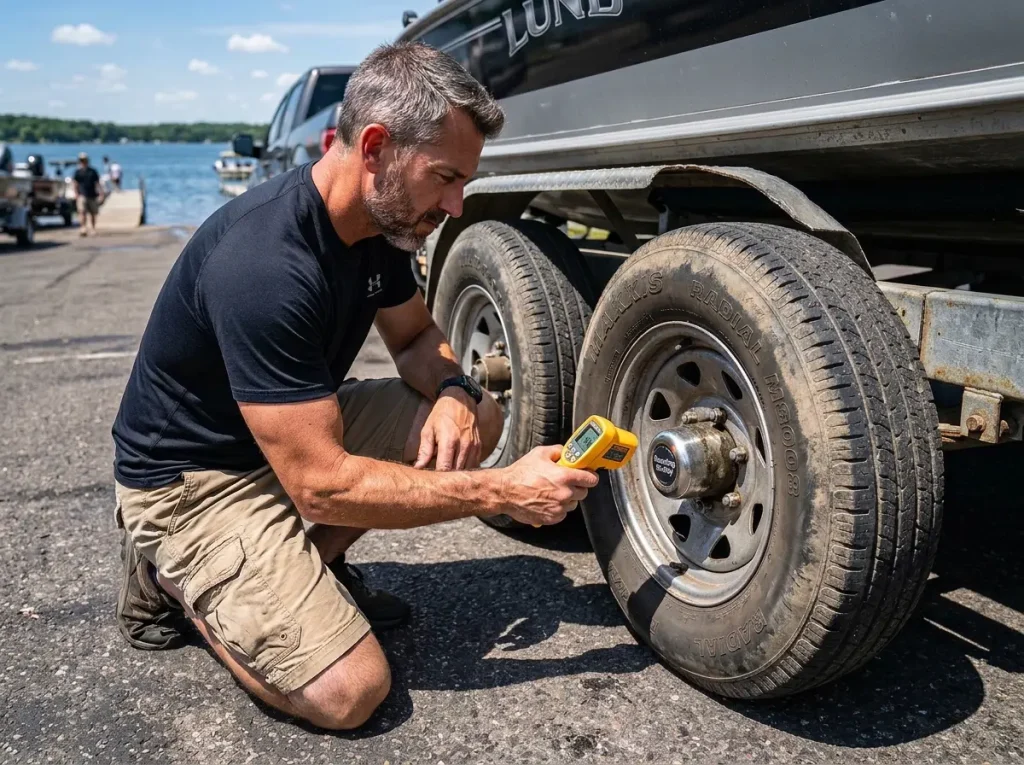
Infrared thermometers — non-contact, under $30 — let you read hub temperature before the wheels stop spinning. Normal operation: 120°F to 140°F. Warning threshold: 160°F+. Critical failure imminent: 200°F+. A hub running measurably hotter than its axle partner indicates brake drag or lubricant failure. That’s a service call, not a “let’s see what happens on the drive home” situation.
Check hub temperatures as you pull off the highway, before entering the staging area. You want to know about problems before the water — not while you’re backing down.
Pre-Launch Checklist Execution — The Mandatory Protocol
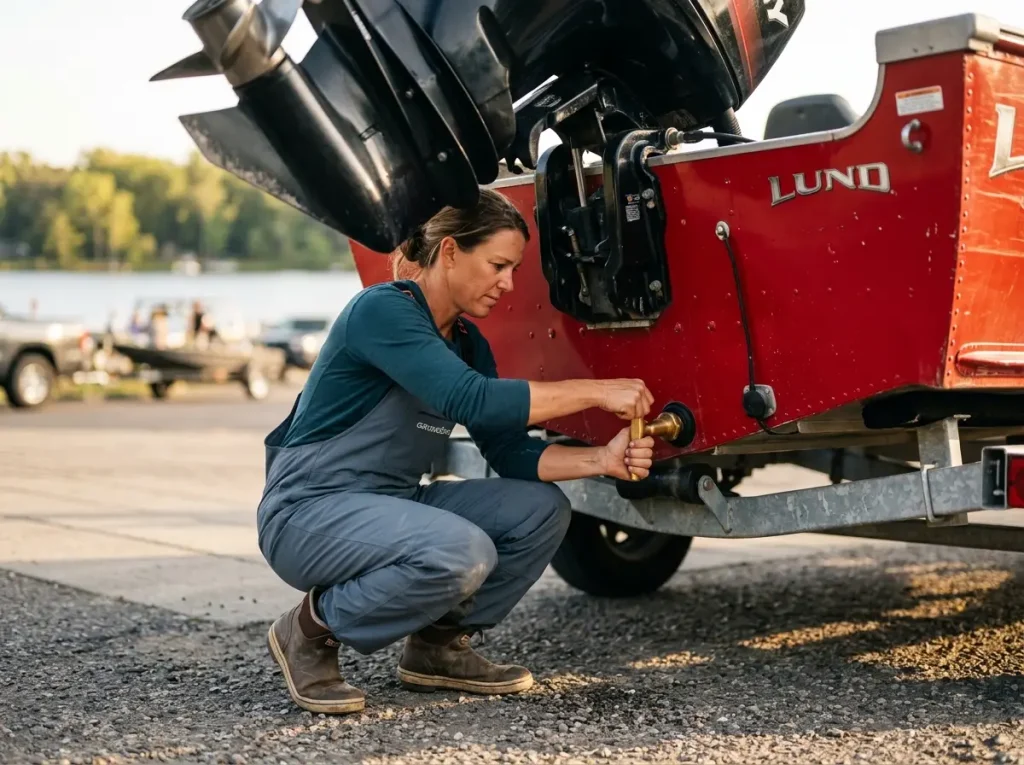
The checklist isn’t for beginners. It’s for experts who know which three seconds of inattention costs them a truck.
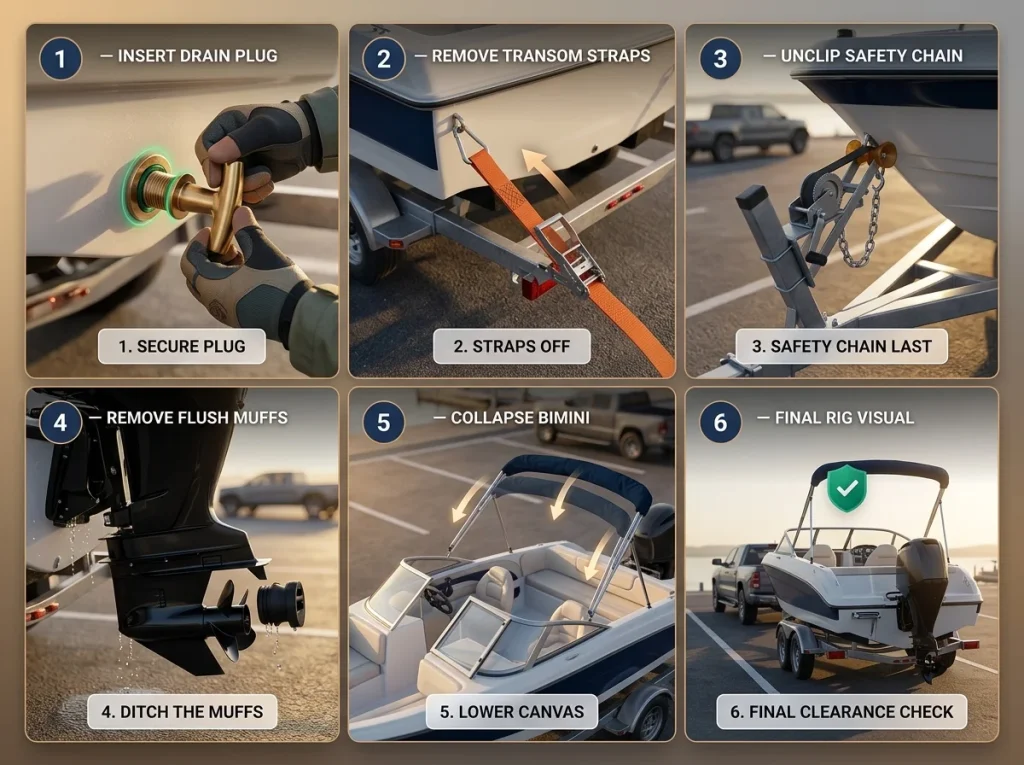
The Five Items That Sink Trucks and Boats
These five items, skipped or checked incorrectly, account for the overwhelming majority of ramp catastrophes:
- Drain plug — Insert and verify before backing. A spring-loaded plug that won’t seat properly is a no-launch condition, full stop.
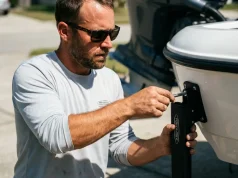
- Transom straps — Remove these in the staging area. Not at the ramp edge. Not once you’re partially backed in. Remove them before you ever touch the lane.
- Bow safety chain — Last item removed, first item attached on recovery. It’s the last physical barrier between a separated hull and a floating hazard.
- Engine flush muffs — Remove before launch. Flush muffs left on the raw water intake block cooling water flow. The engine runs hot, then fails.
- Bimini and canvas — Collapse in any significant wind. Biminis add windage that pushes a light hull off centerline during launch, often enough to clear the bunk guides entirely.
These aren’t hypothetical failure modes. They’re direct from the broader safety protocols that start before your hull ever touches the water. Each item on this list has a documented history of ramp incidents.
The Clean, Drain, Dry Protocol — Invasive Species and Legal Exposure
Aquatic invasive species decontamination is mandatory in most states — not a suggestion, not a courtesy. Zebra mussel veligers and hydrilla fragments can survive in bilge water and live-well residuals for 48 hours or more after leaving the water. By the time you’ve driven to the next lake, you’ve become the vector.
The Clean, Drain, Dry protocol is exactly what it sounds like: remove all visible plant material from hull and trailer, drain every water-holding system (live wells, bilge, baitwells, engine cooling), and allow the rig to dry before the next launch. Thermal treatment — 140°F for five minutes — eliminates all known AIS life stages. Many ramp stations now have hot wash facilities specifically for this purpose. Using them is faster than paying the fine and replacing your registration.
Per the full decontamination protocol for AIS prevention, the compliance burden is real: fines up to $1,000 in many jurisdictions, and in repeat-offense states, trailer confiscation. The extra four minutes at the decontamination station is never the long choice.
Pro tip: Every extra minute at the decontamination station is time you’re not driving home with a $500 fine and an AIS flag on your state registration.
Ramp Etiquette as Throughput Engineering
A properly prepared launch runs under 10 minutes. An unprepared one can block a lane for 30 minutes or more. Think of the boat ramp as a constrained throughput system: one disorganized rig flattens the capacity of a three-lane facility to zero.
The staging area protocol covered earlier is the primary solution. If you need a second attempt at your backing angle, wave off other rigs and reset — it takes 90 seconds and costs nothing. A jackknife recovery takes significantly longer. In multi-lane ramps, don’t use your maneuvering room as everyone else’s obstacle. The marina community operates on shared good faith, and your efficiency is everyone’s problem.
Conclusion
Three things to carry away from this:
Master the geometry first. The Offset Law is not a suggestion — it’s a physical law. Control your trailer’s angular velocity with micro-corrections at slow speed, not reactive corrections at speed. Practice in an empty parking lot before you touch the ramp. An hour in an empty lot saves a hundred hours of humiliation.
Physics over luck. Float-off depth, winch SWL, hub cooling intervals, and ramp surface traction are calculable variables. The analytical angler who understands them makes launches look effortless because they’re engineered, not improvised. The numbers are not complicated. The discipline to use them is.
The checklist exists because experts forget. The drain plug has sunk more boats than storms have. The transom strap has pulled more trucks than ramp slopes. Run the checklist in the staging area, every single time, without exception — because the one time you skip it is the time the dock is full and the tide’s going out.
Next time you pull into the ramp, check your hub temperatures before backing. Count how many other rigs do the same. The ones who do don’t have roadside breakdown stories.
FAQ
How far do you back a boat trailer into the water?
Far enough that buoyancy does most of the work — not the winch. On a bunk trailer with a 10° ramp, you typically need the bunks at or slightly below the waterline to achieve 80% buoyancy compensation; on a roller trailer, 12 to 18 inches shallower usually works. Backing too shallow forces the winch to pull against the full friction load of bunks on hull, which can exceed the rated SWL.
Should you unhook the boat before backing into the water?
Remove the winch strap from the bow eye only when the boat is ready to float — not before. The bow safety chain stays attached until a spotter holds a bow line. Never disconnect both the winch strap and the safety chain simultaneously. That’s the setup for a runaway hull. Transom straps must be removed in staging, not at the ramp edge.
How do you load a boat on a trailer by yourself?
Solo loading requires three things running in sequence: a low-RPM engine approach to align the bow with the trailer centerline, the winch strap attached to the bow eye before hull contact, and a cleat or dock fitting to hold the stern against current while you move from helm to winch. Keep idle throttle in gear during winching — prop wash centers the stern on the bunks automatically.
Is it better to drive a boat on (power loading) or winch it on?
Winching. Full stop. Power loading exceeds the erosion threshold for sediment entrainment at most ramp terminuses, creating scour pits that become transmission traps. Many public marinas ban it because the structural damage is cumulative and invisible until a trailer wheel drops in. Power-on is appropriate only on private ramps with grouted, armored terminations — and even then, tilt the motor immediately after hull-to-guide contact.
How do I stop my trailer bearings from failing prematurely?
Three disciplines: let hubs cool at least 5 minutes before submersion — the thermal vacuum effect is real and the physics don’t care how rushed you are. Inspect grease color every trip — milky grease means water is already inside the bearing. Repack annually for freshwater use, every six months for saltwater. A Bearing Buddy pressurized cap adds a positive-pressure buffer but is not a substitute for regular repacking — over-greasing it blows the rear seal and defeats the system entirely.
Risk Disclaimer: Fishing, boating, and all related outdoor activities involve inherent risks that
can lead to injury. The information provided on Master Fishing Mag is for educational and informational purposes
only. While we strive for accuracy, the information, techniques, and advice on gear and safety are not a substitute
for your own best judgment, local knowledge, and adherence to official regulations. Fishing regulations, including
seasons, size limits, and species restrictions, change frequently and vary by location. Always consult the latest
official regulations from your local fish and wildlife agency before heading out. Proper handling of hooks, knives,
and other sharp equipment is essential for safety. Furthermore, be aware of local fish consumption advisories. By
using this website, you agree that you are solely responsible for your own safety and for complying with all
applicable laws. Any reliance you place on our content is strictly at your own risk. Master Fishing Mag and its
authors will not be held liable for any injury, damage, or loss sustained in connection with the use of the
information herein.
Affiliate Disclosure: We are a participant in the Amazon Services LLC Associates Program, an
affiliate advertising program designed to provide a means for us to earn advertising fees by advertising and linking
to Amazon.com. As an Amazon Associate, we earn from qualifying purchases. We also participate in other affiliate
programs and may receive a commission on products purchased through our links, at no extra cost to you. Additional
terms are found in the terms of service.