In this article
You feel the rod load up. Heavy, dead, no pulse. Not a snag — you’ve felt snags. This is different. Something large was 120 feet down and is now swimming toward the boat to equalize pressure. The line goes slack. You reel like mad thinking you’ve lost it.
Then it loads back up.
That fish hit clean. You lost it at one variable: monofilament. The rubber-band effect absorbed your hook-set before it ever reached bone. I’ve watched it happen to too many anglers on Superior, on Great Bear, on every deep oligotrophic lake where trophy macks live. It’s not bad luck. It’s physics you haven’t corrected yet.
This guide treats the water column as a set of decisions — not guesses. Thermal stratification, line drag, hook-set force, barotrauma management: these aren’t abstract concepts. They’re the variables that decide whether you land that fish or watch a telltale arc disappear back into the dark. We’ll break each one down so you can stop guessing and start solving.
⚡ Quick Answer: Lake trout hold in water between 8°C and 12°C, typically from 40 to 150+ feet during summer stratification — wherever ciscoes and smelt school at the thermocline. Use 30–50 lb braided mainline with a 3–6 ft fluorocarbon leader to eliminate line stretch and reduce drag at depth. Jig with slow, controlled 6–12 inch lifts and watch your sonar for telltale arcs rising toward your lure. For trolling, fish a Sutton Silver Spoon #44 on a 3-way swivel rig at 0.8–1.2 mph just above the thermocline. Any laker caught from 80+ feet needs a descending device — post-release rates without one run as high as 41%.
The Biology of a Deep-Water Predator
Most guides tell you “lake trout like cold water.” That’s true the same way “cars need fuel” is true — technically accurate, completely useless.
Salvelinus namaycush doesn’t just prefer cold water. It runs an energetic calculation every hour of every day. If a laker burns more calories chasing a cisco than it gains from eating it, it stops chasing. The aerobic scope model describes this precisely: the gap between a fish’s maximum metabolic rate and its resting rate is the energy budget available for activity. At 12°C (53.6°F) — the documented optimal feeding temperature — that budget is wide open. The fish can sprint, corral baitfish, and crush a lure.
Above 15°C, that budget closes. The metabolic cost of maintenance increases, but the fish’s top-end capacity doesn’t follow. Warm water doesn’t make lakers sluggish in some vague, comfortable sense — it makes hunting unprofitable. They stop. They park in the thermal layer and wait.
For you, that means locating the thermocline isn’t about finding where trout are comfortable. It’s about finding where they can afford to feed. Below the thermocline, in the cold hypolimnion, they’re lethargic and hard to trigger. Above 15°C, they shut down. The strike zone is the narrow band between — 8°C to 12°C — and staying in it is the whole game.
There’s one more layer here that nobody talks about. Research on cellular stress response in lake trout after angling documents that heat shock protein 70 (hsp70) mRNA levels spike more than five-fold within two hours of a catch. That’s a measurable genomic stress signal from the NIH/PMC database. The fish is already working hard just surviving at depth; your presentation timing and retrieve speed either help or hurt that calculus.
Understanding how water temperature controls lure cadence explains why slow presentations beat fast ones when lakers are metabolically pinched in warm mid-summer conditions.
The Thermocline: Finding the Cisco Layer
The thermocline isn’t a fixed number. It shifts with the lake, the season, and the last frontal system that blew through. In deep oligotrophic systems, you might find it at 60 feet in July and 80 feet by September. In shallower mesotrophic lakes, compressed oxygen zones can push it so shallow that lakers hold much higher than you’d expect.
Find the thermocline on 2D sonar: it appears as a soft, diffuse horizontal band — not a hard line. Fish the upper edge of that band. The Ciscoe Layer — where pelagic forage like ciscoes, smelt, and alewives concentrate — sits right at that thermal boundary, and lakers use canyon pinch points and gullies to trap them there. A 78°F surface and a 48°F hypolimnion can coexist on the same lake. Those are two completely different fishing environments separated by a few dozen feet of water.
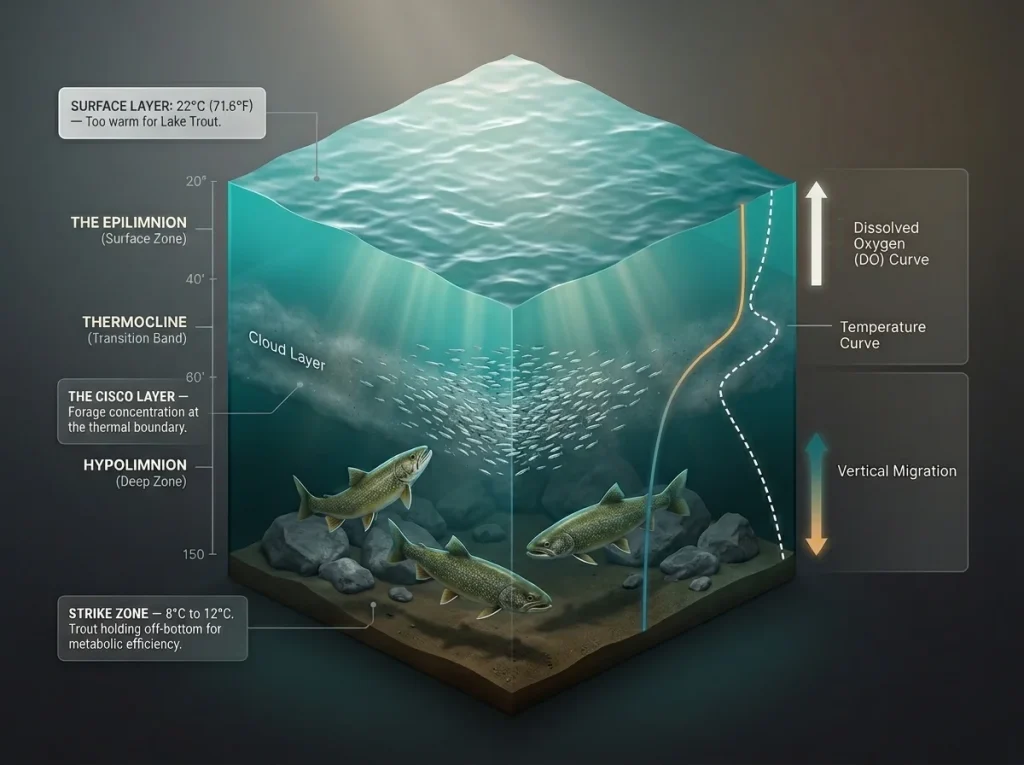
Pro tip: Drop a jig 5–10 feet above where you mark the thermocline on sonar. Let it settle. Watch for a slow upward arc on the screen. If you see a laker rise to investigate without committing, the fish is neutral — slow your cadence and let the lure hang. The strike usually happens on the pause.
Aerobic Scope and the Feeding Window
Here’s the practical takeaway from all the biology: in summer, fast presentations near the thermocline are usually wrong. Below 12°C, a laker can sprint. At 14°C, it’s calculating whether the effort is worth it. At 15°C-plus, it’s done. Slow, deliberate cadences that put the lure in the right thermal zone — the benthic thermal layering where aerobic scope is highest — will consistently outperform aggressive ripping on a warm August afternoon. This is the metabolic cost reality that most guides skip entirely.
The Physics of Verticality: Why Braid Is the Only Answer
I’ve watched anglers spool fresh monofilament onto a big jigging reel, drop to 100 feet, and wonder why they can’t feel bites. The answer is sitting in their hands.
At 100 feet, 20 lb monofilament (diameter ≈ 0.40mm) creates a bow in the line from the water resistance pushing against all that exposed surface. The lure doesn’t ride at 100 feet. It rides at 75 feet. The angler is fishing the wrong depth entirely and doesn’t know it. Meanwhile, 20 lb braided line (UHMWPE, diameter ≈ 0.23mm) — same breaking strength, less than half the cross-sectional area — cuts through the water column with almost no drag vector. The lure goes where you put it.
This isn’t preference. Smaller line diameter means less surface area exposed to current and dramatically less drag resistance. The drag coefficient difference isn’t close, and it doesn’t close as depth increases — it gets worse for mono. Every foot of water you add makes the problem bigger.
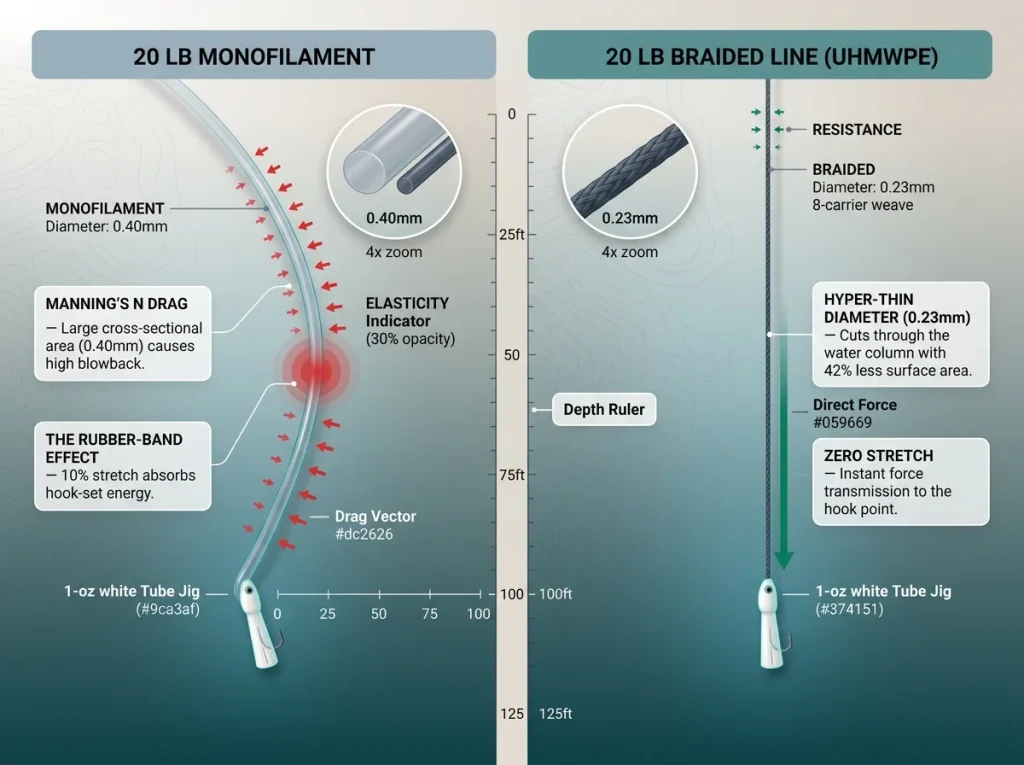
There’s a second problem with mono that ruins your hook-set before you even move the rod: elasticity. Monofilament stretches significantly — at 100 feet of depth, a 10% stretch means you’re taking up roughly 10 feet of slack before any force reaches the fish. You rip the rod and absorb all that energy in the line. The fish feels almost nothing. That’s the rubber-band effect, and it’s why the trophy you felt load up on the drop never showed up in the net.
For the full engineering decision matrix for braid vs. fluorocarbon vs. mono, the site’s line comparison guide breaks down every variable worth knowing before you spool up for a deep-water trip.
Manning’s n and Line Drag
The dominant variable here is cross-sectional area, not surface texture. A 12-carrier braid with a textured weave still produces far less total drag than smooth-surfaced mono at the same strength rating, simply because its line diameter is so much smaller. The Manning’s n roughness principle for fluid resistance confirms what you can see without a formula: thinner diameter, smaller water-contact surface, less resistance. At equivalent terminal strength, braid wins on drag physics every time. There’s no counterargument.
Pro tip: Spool braid as your main line, then attach a 3–6 foot fluorocarbon leader. You get braid’s near-zero stretch and thin line diameter for 95% of the depth, plus fluoro’s abrasion resistance and lower light distortion at the business end. Use a PR or FG knot at the connection — it eliminates the weak point that a poorly tied connection creates under shock loads.
The Fluorocarbon Leader: Optics, Not Magic
Fluorocarbon (PVDF) has a refractive index of 1.42. Water sits at 1.33. Monofilament nylon runs 1.52–1.63. So fluoro is closer to water’s light-bending properties — but it’s not equal to water. It’s not invisible. The marketing claim is real in direction and wrong in degree.
What fluoro actually gives you at depth: reduced light distortion, not zero light distortion. Below 40 feet in stained water, ambient light is already severely lowered, so the refraction difference becomes less meaningful anyway. The more practical advantage is material stability. Fluorocarbon absorbs less than 0.04% water by weight. Its properties don’t change after a long soak. Monofilament loses roughly 15–20% of its breaking strength after an hour of submersion. When you’re fighting a big laker, that degradation cost is real.
Read the actual optics behind fluorocarbon visibility at depth if you want the full breakdown of what the refractive index of PVDF means in practice versus what tackle companies want you to think it means.
Acoustic Visualization: Reading Sonar for Deep Jigging
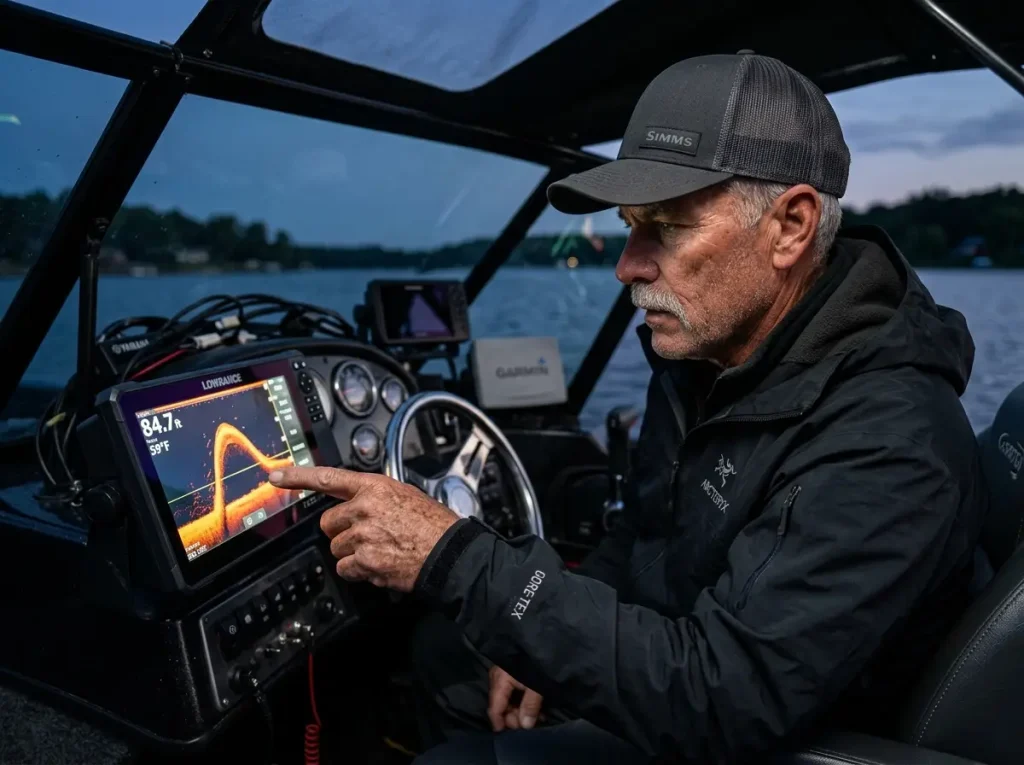
Vertical jigging without understanding your sonar is just dropping a lure in the dark and hoping. Most people do it this way. Guides do not.
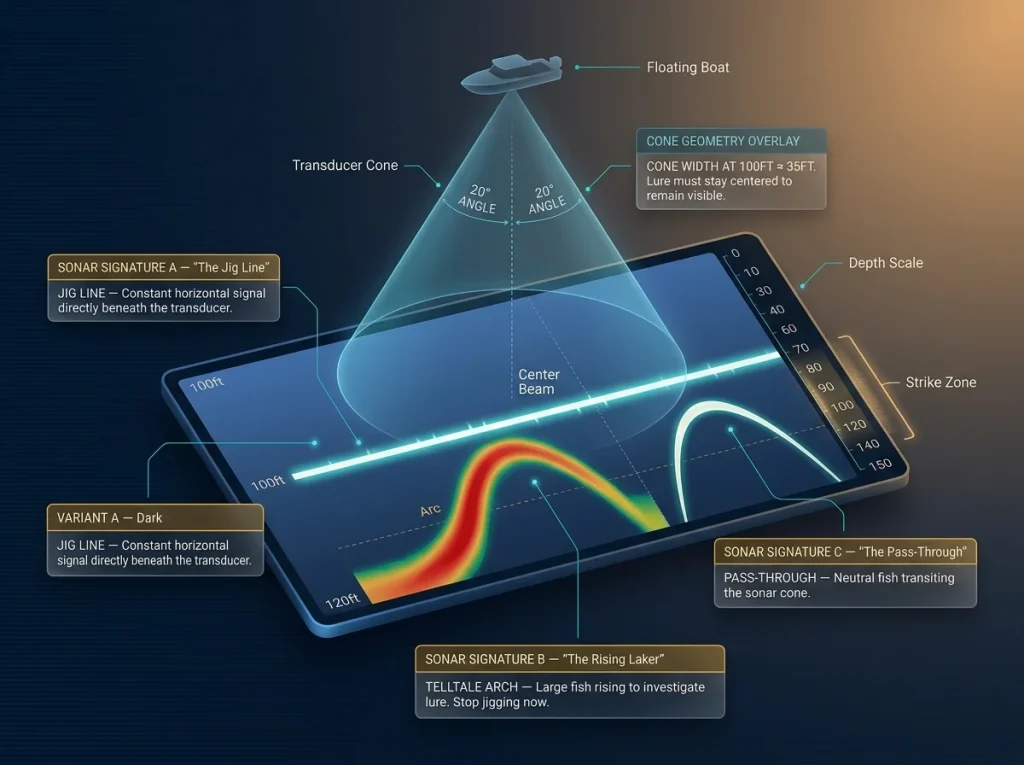
A 20-degree sonar cone covers roughly 35 feet of diameter at 100 feet of depth. That’s your entire fishable window for vertical jigging — everything outside it is invisible. And here’s where most anglers lose fish without realizing it: pendulum error. When your boat drifts, wind pushes, or you lift the jig too fast, the lure swings laterally and exits the cone. At 100 feet, a lure angled just 18 feet off-center disappears from the screen. You’re jigging blind. You have no idea if a fish is below you, above you, or if the lure is even at the right depth.
How transducer cone geometry creates dead zones at depth explains how beam width, depth, and lure angle interact in ways that surprise most anglers when they see it mapped out.
Lines vs. Arches: Interpreting the Screen
A stationary jig directly beneath the transducer shows up as a continuous horizontal line. Consistent, unwavering. A fish swimming through the cone produces an arch — entry curve, peak, exit curve. Larger arch, larger fish. Partial arch means the fish entered but didn’t cross the full cone.
The moment you train yourself to watch for is this: a lake trout’s arch rising toward your jig’s line, slowly, then stopping. That slow upward swoop is the fish coming up to inspect. When you see it, stop jigging. Let the lure hang completely still. The strike usually happens on a stationary bait, not a moving one. Most first-timers miss this because they keep popping the rod, which is exactly the wrong move. The lure chasing behavior is visible on screen — use it as a cue, not background noise.
Here’s a video resource that makes this clearer than any diagram:
Correcting Pendulum Error in Real Time
The fix for pendulum error is boat position, not rod work. Position the boat so drift moves into the current, reducing lateral swing beneath the transducer. Spot-lock with a GPS trolling motor in winds below 15 mph and the problem mostly disappears. When you’re drifting without spot-lock, over-drop your jig 10–15% past target depth — the pendulum angle automatically puts you shallower, so you compensate by starting deeper.
Slow, controlled lifts of 6–12 inches keep the lure inside the cone. Ripping the jig upward fast swings it out immediately. Lose the sonar contact, and you’re guessing.
Pro tip: Calibrate your sonar sensitivity until you can track a 1-oz jig at 100+ feet. If you can’t see your lure on screen, you can’t read what the fish are doing relative to it. Every session should start with this check before you drop down to fish.
The Hook-Set Equation: Penetrating Calcified Bone at Depth
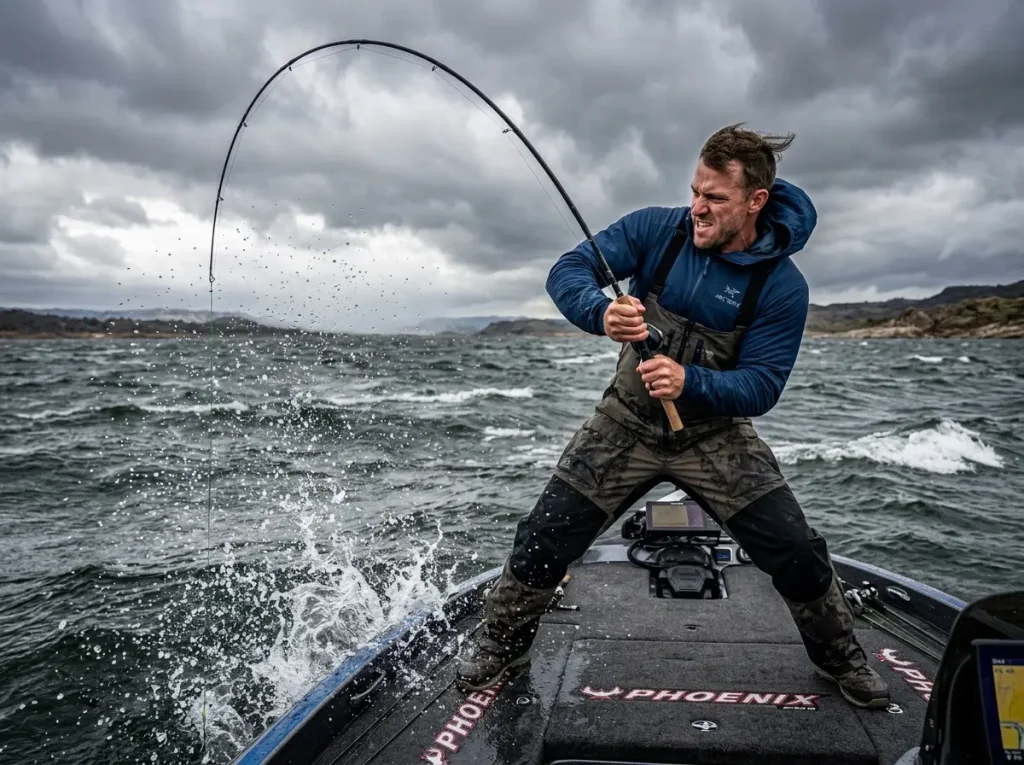
Lake trout aren’t soft-mouthed. That’s the thing nobody tells you when you’re coming from bass or walleye. The mandibular bone in a mature laker contains what researchers call hypermineralized zones — elevated concentrations of calcium and phosphorus that make the jaw significantly harder than most species anglers are used to.
Getting a hook through that calcified bone at 100+ feet means every link in your system has to work. The line can’t absorb the strike — you’re running braid, you’ve solved that. The rod has to transmit the energy rather than dampen it. And the hook geometry has to let the point do the work. When everything is aligned, the penetration happens cleanly. When any piece is wrong, you get a hard bump and a gone fish.
Read the full physics of hook sets — timing, line stretch, and rod angle before your next deep-water trip. The difference between a hook that buries and one that deflects is usually in the details most anglers skip.
Rod Selection: The Broomstick Explained
Fast-action graphite rods — high-modulus graphite, 40–60 ton — concentrate the bend in the upper one-third of the blank. The butt section stays stiff. When you sweep the rod, that muscular butt section drives force directly toward the hook point through the braid, through the leader, into the fish’s jaw. A medium-heavy parabolic rod absorbs all of that into the blank. It’s a great rod for fighting fish. It’s a bad rod for hook-sets at depth.
Some Great Lakes specialists cut down longer musky or streamer rods to 6–6.5 feet for boat-side work, especially on big lakers that peel drag violently near the surface. The math works: shorter lever arm, more control when the fish is 10 feet under the boat going sideways.
Hook geometry matters too. A thinner-gauge octopus or treble point requires less force to penetrate hypermineralized mandibular bone than a heavy-wire worm hook. Think of it as pressure per contact area — the thinner gauge concentrates the driving force into a smaller point.
Jig Weight and Terminal Velocity
The terminal velocity of lure descent is the speed at which drag forces balance the jig’s weight in the water column. Heavier jigs fall faster. In significant current or with heavy drag coefficient from line blow, a light jig pendulums out of the cone before reaching depth.
Rule of thumb: 1 oz per 30–40 feet of target depth as a baseline, adjusted for current. White or chartreuse tube jigs are the production choice — they flutter on the fall, which is when most deep-water strikes happen, not on the lift. Meat-tipping with a strip of sucker belly adds scent and slows the fall rate slightly, giving lakers a little more time to commit. The weight-to-depth ratio isn’t set in stone, but it’s the right starting point every time.
Trolling the 3-Way Rig: The Kinetic Equation
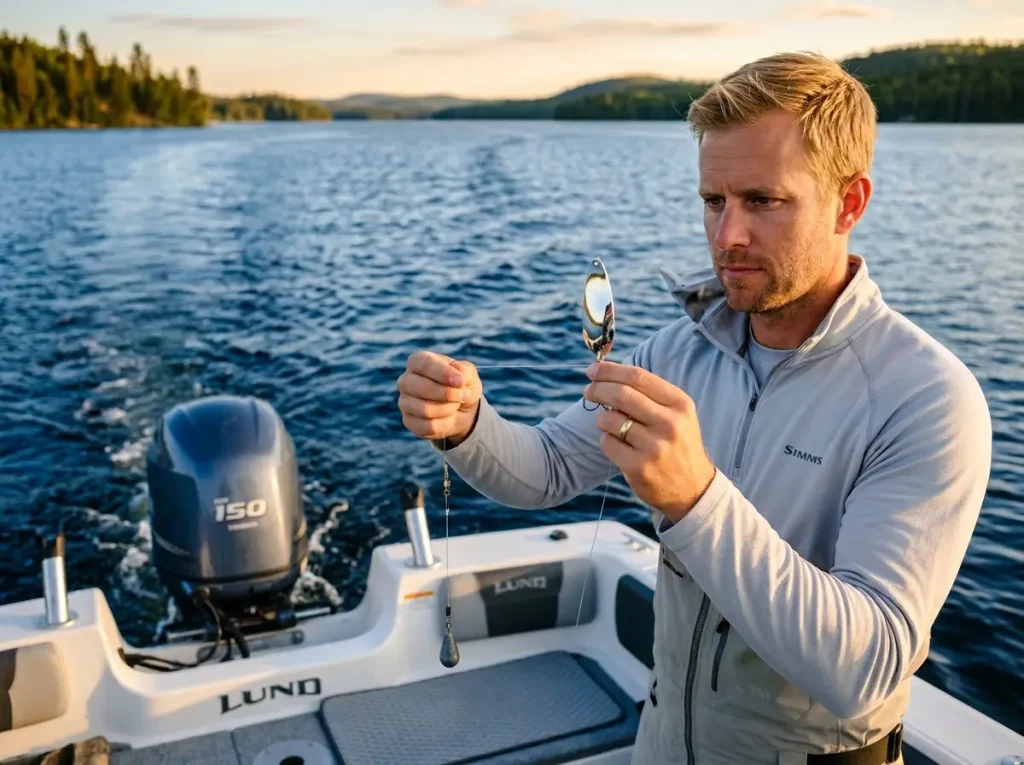
If you don’t have a downrigger, the 3-way swivel rig is how you control depth precisely without cable and winch. The setup is straightforward: main line to swivel, 12–24 inch dropper line to 3–8 oz lead weight, and a 3–6 foot fluorocarbon leader to a light spoon. The weight maintains contact with (or proximity to) the bottom. The spoon flutters above it.
The physics that control this rig are hydrodynamic blowback — at trolling speed, water resistance pushes the weight and spoon forward and upward. Heavier weights resist; longer leaders worsen it. Speed changes this entire equation. Above 1.5 mph, blowback lifts the rig so high it loses the bottom. Below 0.5 mph, the Sutton spoon loses its action entirely.
How downrigger systems control depth and manage cable blowback shows you the full hardware solution if you eventually want to graduate beyond the 3-way — but for most Ontario or Great Lakes trolling situations, the 3-way rig is all you need.
Sutton Spoon Physics and Lure Action
The Sutton Silver Spoon #44 is not a mystery. It’s a physics exercise. Invented in the 1860s by a jeweler in Naples, NY, this spoon weighs 0.16 oz with a profile of 0.010 inches. Paper thin. Because it has almost no mass relative to its surface area, it doesn’t dig into the current at trolling speed — it oscillates in a tight, high-frequency shimmy that closely mirrors the dying flutter of a cisco. That’s not marketing. That’s what 0.010 inches of silver does in moving water.
The white and silver finish reflects whatever light reaches the 40-foot-plus zone — contrast matters more than color accuracy in deep stained water. Meat-tipping the Sutton with a strip of cisco or sucker belly adds lateral scent dispersion, pulling lakers from greater distances through the water column.
Pro tip: Troll directly over the thermocline. The heavy dropper weight should sit at or just below the thermocline; the spoon should work in the Ciscoe Layer just above it. This positions the lure where the laker’s aerobic scope is highest and forage density is maximum. You’re not guessing at depth — you’re using the biology.
Back-Trolling and Speed Control
Back-trolling — operating the motor in reverse — achieves speeds between 0.5 and 1.0 mph that are physically impossible to hold while moving forward without losing steerage. At those speeds, the 3-way rig maintains bottom contact while the spoon works just above the substrate, which is exactly where benthic lakers hold in summer: 10–15 feet off the bottom.
In high-wind conditions, back-trolling lets the motor work against the wind, giving you real speed control instead of chasing a drift. Monitor speed with GPS, not feel — a quarter-throttle variation at these slow speeds is the difference between the spoon working and just dragging.
The Open-Close Rhythm is the technique that separates trollers who produce from those who just cover water: hold the main line loosely in your palm and release it 1–2 feet at a time to feel bottom contact through the weight. This keeps you dialed into depth changes and isolates actual strikes from bumps on structure.
Conservation Science: Boyle’s Law and Barotrauma Management
This section isn’t optional reading for catch-and-release anglers. It’s physics, and the physics don’t care about your intentions.
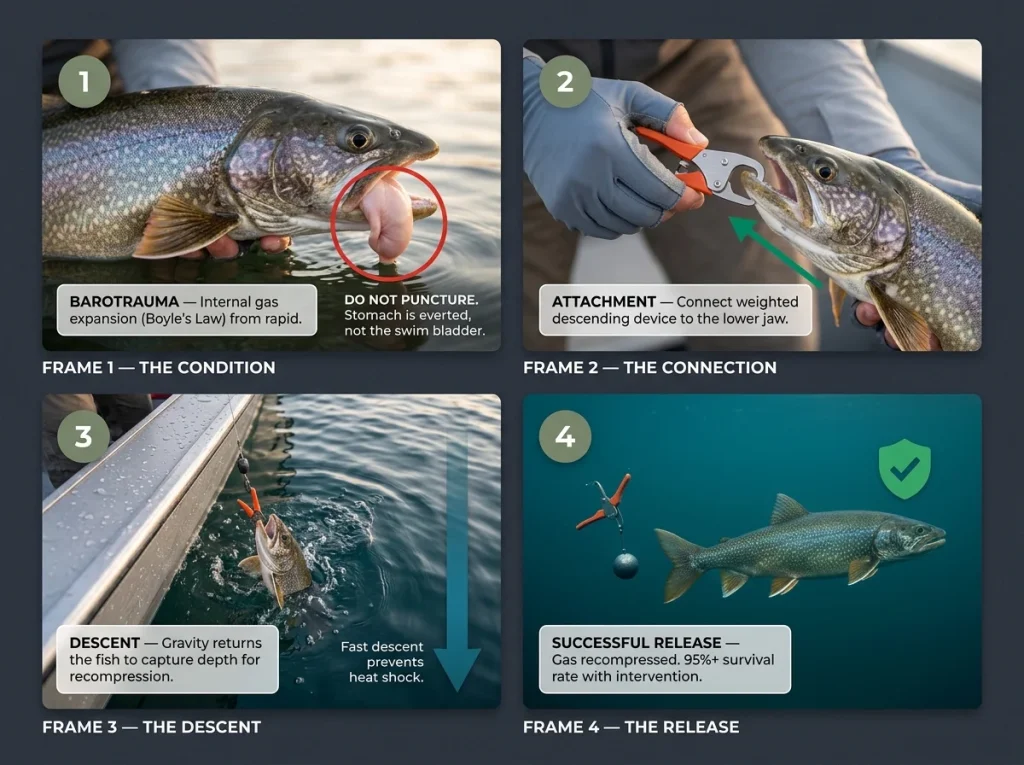
Water pressure increases one atmosphere (14.7 psi) every 33 feet. A lake trout pulled from 132 feet to the surface experiences a 300% reduction in external pressure. Internal gases expand proportionally — that’s Boyle’s Law applied to a living fish, and it causes what we call barotrauma: stomach eversion out of the mouth (anglers who mistake this for the swim bladder and try to puncture it cause irreversible fatal damage), exophthalmia (bulging eyes), and loss of orientation.
According to post-release mortality of lake trout caught at depth, survival rates without intervention run as low as 59% — a 41% mortality figure from USGS data. That’s not anecdotal. That’s peer-reviewed fisheries science from studies conducted at Priest Lake, Idaho. Additional NOAA guidance on barotrauma in deep-water fish confirms the same conclusions — slow ascent and descending devices are not optional for serious conservation-minded anglers.
Lake trout are physostomous — their swim bladder connects to the esophagus via a pneumatic duct, which means they can voluntarily expel gas. The problem is ascent speed. Rapid reeling doesn’t give the fish time to regulate. Slow your retrieve to roughly 1 foot per 2–3 seconds from 80+ feet, and you’ll often hear or see laker burps — audible release of air bubbles as the fish actively works the pneumatic duct on the way up. That’s the fish managing its own barotrauma. Help it by slowing down.
The complete science of fish barotrauma and recompression covers the underlying physiology in more depth, including why thermal shock at the surface is a separate mortality risk in water above 77°F.
Descending Devices: Protocol and Selection
The DESCEND Act (2022) requires federally permitted for-hire vessels in certain fisheries to carry descending devices. For-hire captains know this. Recreational anglers on public water still largely don’t. You should.
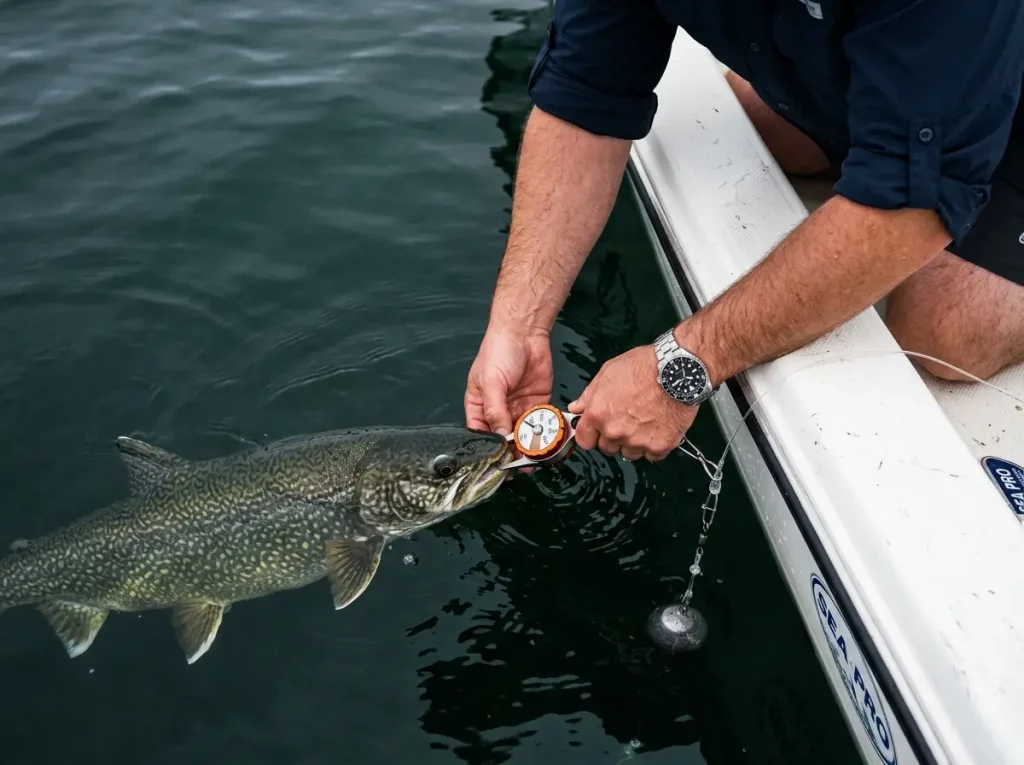
A SeaQualizer or similar weighted clip device returns the fish to depth under the weight of the sinker. At that pressure, internal gases recompress and the fish can recover and self-release. Depth-triggered devices open automatically at a preset pressure; manual devices require you to retrieve after a set time. Either works. The rule of thumb: return the fish to at least 50% of its capture depth — a fish from 100 feet gets a minimum 50-foot descent.
Never attempt to “fizz” a lake trout. Fizzing — puncturing the swim bladder to release gas — is sometimes used on physoclistous fish (closed-bladder species like bass, walleye) that cannot self-regulate. Lake trout are physostomous. They can self-regulate. Puncturing them risks terminal infection even if the fish descends and appears to recover. Don’t do it.
Time on the surface is your other enemy. Every second at surface pressure allows gases to expand further. Move fast: hook out, descending device clipped, fish over the side. That sequence should take under 90 seconds if you’ve practiced it.
Lift Time and Ascent Speed Management
USGS data shows mortality decreases measurably with longer lift times. Target 1 foot per 2–3 seconds from 80+ feet. A fish from 120 feet should take at least four to six minutes to reach the surface if you’re doing it right. That feels painfully slow when you’ve got an eight-pound laker on and adrenaline running. Do it anyway.
Lower your drag settings for fish from depth. Let the laker run a little. Fighting a deep fish to the net in 45 seconds on locked drag is a mortality sentence dressed up as skill.
One last thing on the ghost hookset: that laker that swims toward the boat after the strike, going slack, then loading up again — it’s still on. It swam toward you to equalize pressure. Retrieve slowly, stay tight, and wait for it to change direction. Those are often the biggest fish of the day.
Conclusion
Three things actually move the needle on deep-water lake trout:
Find the thermal address first. The 8°C–12°C band at the thermocline is where aerobic scope and baitfish concentration overlap. Get your lure in that layer and stay there. Everything else is guessing.
Run braid or keep missing fish. Line diameter and elasticity both point the same direction — thin-diameter, low-stretch braid is the only line that keeps you at depth, in the cone, with enough force transfer to penetrate hardened jaw bone. There’s no workaround made of monofilament.
The fish earned the release. A 41% post-release mortality rate without intervention isn’t a sad statistic to read and move on from. Slow your retrieve. Use a descending device. Know the difference between fizzing a physostomous fish and a physoclistous one, because that difference is between a live trout and a dead one.
On your next trip, set up braid-to-fluoro and time your drop to the bottom. Find the Ciscoe Layer on sonar. Then try back-trolling a Sutton #44 at 0.8 mph on a 3-way rig and see what the difference between depth guessing and depth knowing actually feels like.
FAQ
How deep do lake trout go in summer?
During thermal stratification, lake trout typically hold between 40 and 150+ feet, positioned within or just below the thermocline where temperatures stay between 8°C and 12°C. In deep oligotrophic lakes, this pushes fish to 120 feet or more depending on where pelagic forage like ciscoes and smelt school up.
What is the best lure for deep jigging lake trout?
White or chartreuse tube jigs (1–3 oz depending on depth and current) are the most consistently productive for vertical jigging, while the Sutton Silver Spoon #44 is the benchmark for trolling. Both mimic dying cisco, which is the dominant forage in most lake trout systems. Meat-tipping either presentation with sucker belly adds a scent dimension that can trigger neutral fish holding in the Ciscoe Layer.
How do you jig for lake trout in 100 feet of water?
Use 30–50 lb braided main line with a 3–6 foot fluorocarbon leader. Select a jig weight of 1.5–3 oz to maintain lure verticality. Lower to depth, let the jig contact bottom, then lift 6–12 inches with a slow, controlled pop — never a rip. Watch sonar for telltale arcs rising toward your jig’s line. The majority of deep-water strikes happen on the pause or flutter-fall, not the lift.
Trolling vs. jigging — which catches more lake trout?
Both work. Trolling with a 3-way rig or downrigger covers water and is better for locating scattered fish early in the day or after a front moves through. Vertical jigging excels when fish are marked on sonar in a specific depth band — it lets you hold position over them with precision and watch the lure chasing behavior on screen in real time. Expert lake trout anglers use both and switch based on what the sonar tells them, not what they feel like doing.
How do you handle a lake trout from depth to prevent barotrauma?
Slow the retrieve to one foot per 2–3 seconds from 80+ feet — this gives the physostomous system time to self-regulate via the pneumatic duct. At the surface, move fast: remove the hook and clip a descending device immediately. Return the fish to at least 50% of its capture depth. Do not attempt to fizz lake trout — their open-bladder physiology lets them self-regulate, and puncturing risks fatal infection.
Risk Disclaimer: Fishing, boating, and all related outdoor activities involve inherent risks that
can lead to injury. The information provided on Master Fishing Mag is for educational and informational purposes
only. While we strive for accuracy, the information, techniques, and advice on gear and safety are not a substitute
for your own best judgment, local knowledge, and adherence to official regulations. Fishing regulations, including
seasons, size limits, and species restrictions, change frequently and vary by location. Always consult the latest
official regulations from your local fish and wildlife agency before heading out. Proper handling of hooks, knives,
and other sharp equipment is essential for safety. Furthermore, be aware of local fish consumption advisories. By
using this website, you agree that you are solely responsible for your own safety and for complying with all
applicable laws. Any reliance you place on our content is strictly at your own risk. Master Fishing Mag and its
authors will not be held liable for any injury, damage, or loss sustained in connection with the use of the
information herein.
Affiliate Disclosure: We are a participant in the Amazon Services LLC Associates Program, an
affiliate advertising program designed to provide a means for us to earn advertising fees by advertising and linking
to Amazon.com. As an Amazon Associate, we earn from qualifying purchases. We also participate in other affiliate
programs and may receive a commission on products purchased through our links, at no extra cost to you. Additional
terms are found in the terms of service.