
In this article
You’ve probably walked past a hundred brook trout streams without knowing it. Those thin blue lines on the topo map — the ones too small to have names — hold some of the prettiest and most willing fish in freshwater. I’ve spent years bushwhacking into these little creeks, getting skunked on some, catching the best fish of my life on others. Here’s how to find those streams, gear up without overthinking it, and actually put brook trout in your hands.
Quick Answer: Here are seven tricks that consistently produce brook trout on small streams:
- Blue-line unnamed headwater streams on topo maps for unpressured fish
- Read water for plunge pools, current breaks, and pocket water
- Downsize your gear — short rods, light line, small lures
- Match your fly or spinner to stream size, not fish size
- Stay low, stay back, and make your first cast count
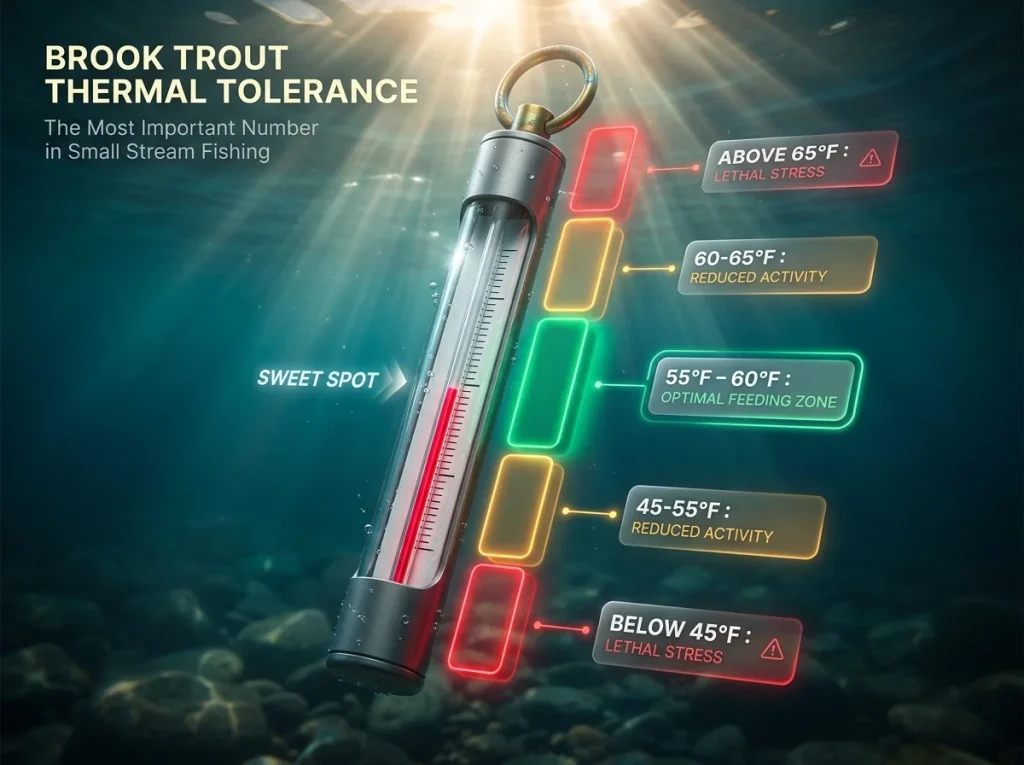
- Fish dawn, dusk, and overcast days in the 55–60°F water temp sweet spot
- Keep moving upstream — spend minutes per pool, not hours
How to Find Brook Trout Streams Worth Fishing
Blue-Lining: Reading Topo Maps for Unnamed Streams
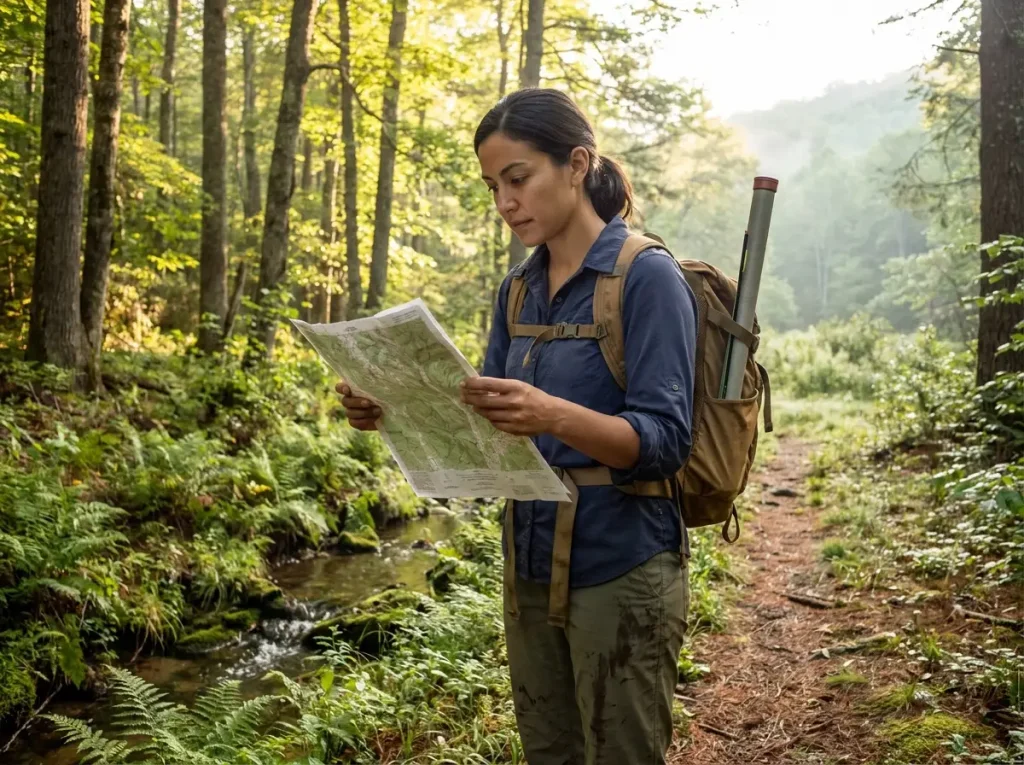
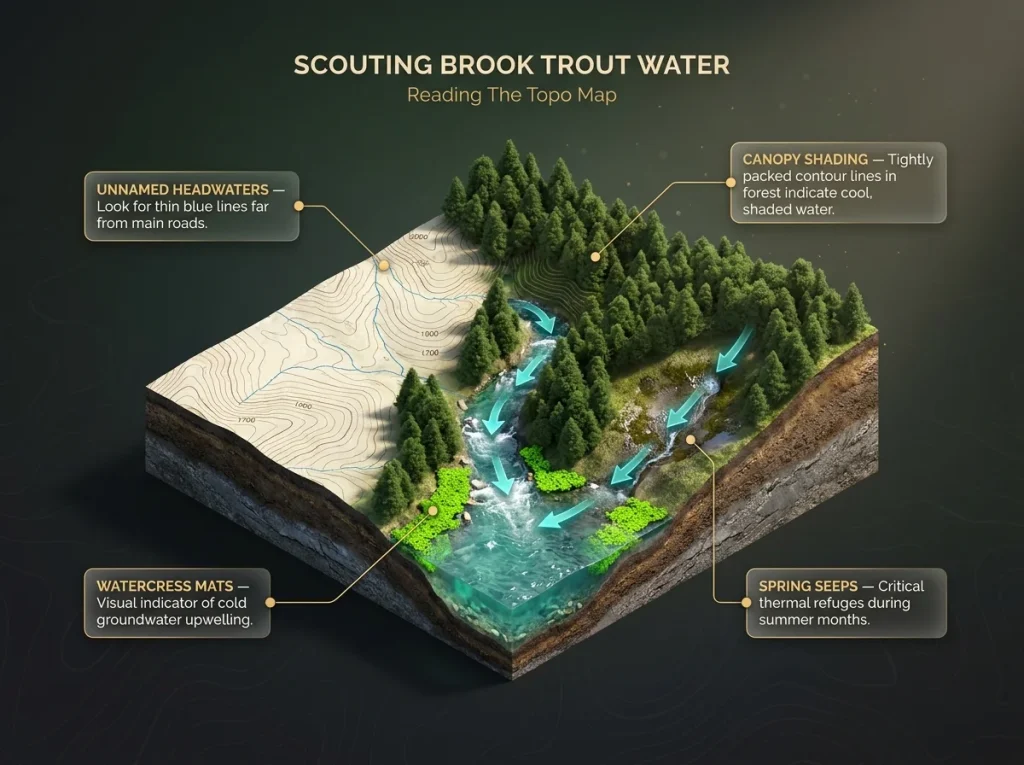
The best brook trout fishing happens on streams most anglers don’t know exist. The community calls it blue-lining — pulling up a USGS topo map, finding those hairline blue threads in the high country, and hiking in to see what lives there. The unnamed tributaries, the ones that don’t show up on fishing reports, are where wild brook trout hold in water that hasn’t seen a fly or spinner in months.
Start with your state fish and wildlife website. Most publish stocking lists and stream surveys that tell you which waters hold native trout versus stocked fish. Cross-reference those with topo maps — the streams marked as wild-trout-only and too small for stocking trucks to reach are your targets. The Eastern Brook Trout Joint Venture’s habitat maps show where native populations still exist across the eastern range, which narrows your search fast.
Pro tip: Use Google Earth to scout access before you drive. Look for old logging roads, power line cuts, or hiking trails that cross or parallel your target stream. Some of the best spots are a two-mile walk from a pulloff nobody uses. If you want to get serious about finding remote fishing spots with satellite imagery, the time you spend on your screen saves hours in the field.
What Cold Water Looks Like From the Bank
Brook trout need cold water — they feed best between 55°F and 60°F and start stressing above 65°F. But you don’t always need a thermometer to find productive water. Look for streams where the surrounding forest provides shade for most of the day. If sunlight never hits the water directly, that’s a good sign.
Watercress growing along the banks is one of the best visual indicators of spring-fed cold water. Those thick green mats mean groundwater is seeping into the stream, keeping temperatures down even in midsummer. Spring seeps — spots where you can see clear water bubbling up through gravel or trickling from the hillside — create micro cold zones where brookies stack up during warm weather.
Why the Hardest Streams to Reach Fish the Best
This isn’t a theory. Every small-stream angler figures it out eventually: the further upstream you hike, the less pressure the fish have faced, and the more willing they are to eat. The first pool off the road might hold fish, but they’ve seen every lure in the tackle shop. Hike past the easy water. Get into the stuff where you’re stepping over blowdowns and ducking under rhododendron. That’s where the magic is.
Brook trout populations in these headwater streams are often the last wild natives in a drainage. According to conservation data, brook trout have been lost from 28% of their native subwatersheds, with populations cut by more than half in another 35%. The fish you find three miles up an unnamed creek might represent a lineage that’s been there since the last ice age. Handle them with that in mind.
Reading Water on a Brook Trout Stream
Pools, Plunge Pools, and Pocket Water
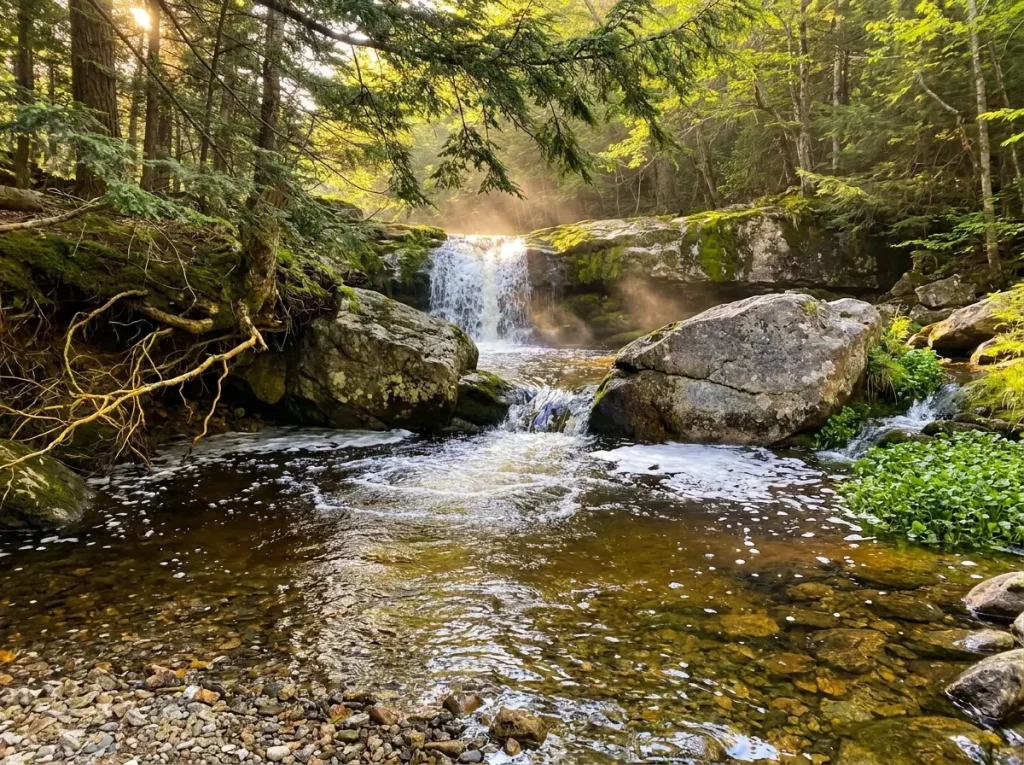
Small streams compress all the structure of a big river into miniature. A plunge pool below a two-foot waterfall might only be three feet deep, but to a brook trout, that’s a penthouse apartment — deep water for safety, aerated water for oxygen, and a conveyor belt of insects washing over the lip. These are almost always your highest-percentage spots.
Pocket water — the broken, choppy stuff between boulders — holds more fish than most anglers realize. Brook trout tuck behind rocks where the current slows just enough to hold position without burning energy. They dart out to grab food drifting past, then slide back behind cover. Cast just upstream of the boulder and let your offering drift into that calm pocket. If you want to take your water-reading further, reading nervous water and spotting fish before you cast changes how you approach every pool.
Current Breaks and Structure That Hold Fish
Anything that redirects the current creates a feeding lane. Downed trees, exposed root wads, large rocks — they all do the same thing. They break the flow and create a calm spot where a fish can hold with minimal effort while food funnels past.
Look for V-shapes on the surface. That V points downstream from a submerged object, and the calm water behind it is where a brookie sits. Undercut banks deserve special attention. Where the current has carved under a root system or dirt bank, brook trout hide in shadow during bright conditions. Some of the biggest fish in a small stream live under banks you’d walk right past.
Don’t Skip the Skinny Water
I used to walk past every shallow riffle on my way to the next deep pool. Then I watched a 10-inch brookie explode on a Stimulator in water barely covering my boot sole. That changed everything.
Brook trout in skinny water — riffles six inches deep, thin runs between pools — are often the most aggressive fish in the stream. They’re actively feeding in the current, not hiding. They see your fly or spinner first, and they don’t have time to think about it. A lot of anglers skip this water because it doesn’t look “fishy.” That’s exactly why the fish there are so willing.
The Right Gear Without Overthinking It
Fly Rod Setup for Tight Quarters
A 7-foot 3-weight fly rod is the small-stream workhorse. It’s short enough for bow-and-arrow casts under canopy, light enough to feel a six-inch brookie take a dry fly, and has enough backbone to roll cast into a headwind. If you’re fishing truly tiny water — streams you can step across — a 2-weight at 6 feet gives you even more precision.
Pair it with a simple click-and-pawl reel. You’re not fighting tarpon. A 7.5-foot tapered leader ending in 4X or 5X tippet covers most situations. Go to 6X if the water is glass-clear and the fish are spooky. If you’re picking a beginner fly rod that grows with you, a 3-weight is the right call for small water.
Ultralight Spinning Gear That Actually Casts
For spin anglers, a 5.5 to 6-foot ultralight spinning rod paired with a 1000-size reel is the setup. Shorter rods let you work under branches with sidearm flips and keep you accurate in tight corridors where a seven-footer would constantly hit trees.
Spool it with 2 to 4-pound fluorocarbon line. Fluoro is less visible than mono in clear water and sinks slightly, which helps small spinners get into the strike zone faster. A quality limp line makes a huge difference when you’re casting 1/16-ounce spinners — stiff line kills your distance and accuracy. Our field test of nine ultralight spinning combos breaks down which setups handle light lures best.
Pro tip: Don’t bring your whole tackle bag. A small sling pack with a fly box, three spinners, a spool of tippet, nippers, and a stream thermometer is all you need. Every extra ounce matters when you’re hiking two miles up a mountain.
Line, Leader, and Tippet — Keep It Simple
If you’re fly fishing, your leader does most of the work. A 7.5-foot tapered leader to 4X handles 90% of small-stream situations. Add 18 inches of tippet when the fish get picky or when you’re switching flies frequently and the leader gets short.
For spin, fluorocarbon outperforms mono in every small-stream scenario — it’s less visible, more abrasion-resistant against rocks, and has a bit of stretch to absorb the headshakes of a hot brookie. If you’re fishing heavier cover with lots of snags, bump up to 4-pound test. In open pocket water, 2-pound gives you better feel. If you’re curious about how different lines perform in cold water conditions, temperature affects stiffness more than most anglers realize.
Flies and Lures Brook Trout Can’t Resist
Top Flies for Small Stream Brookies
Brookies aren’t picky. That’s the good news. They eat what’s in the water and they eat it aggressively. Your dry fly box for small streams needs four patterns:
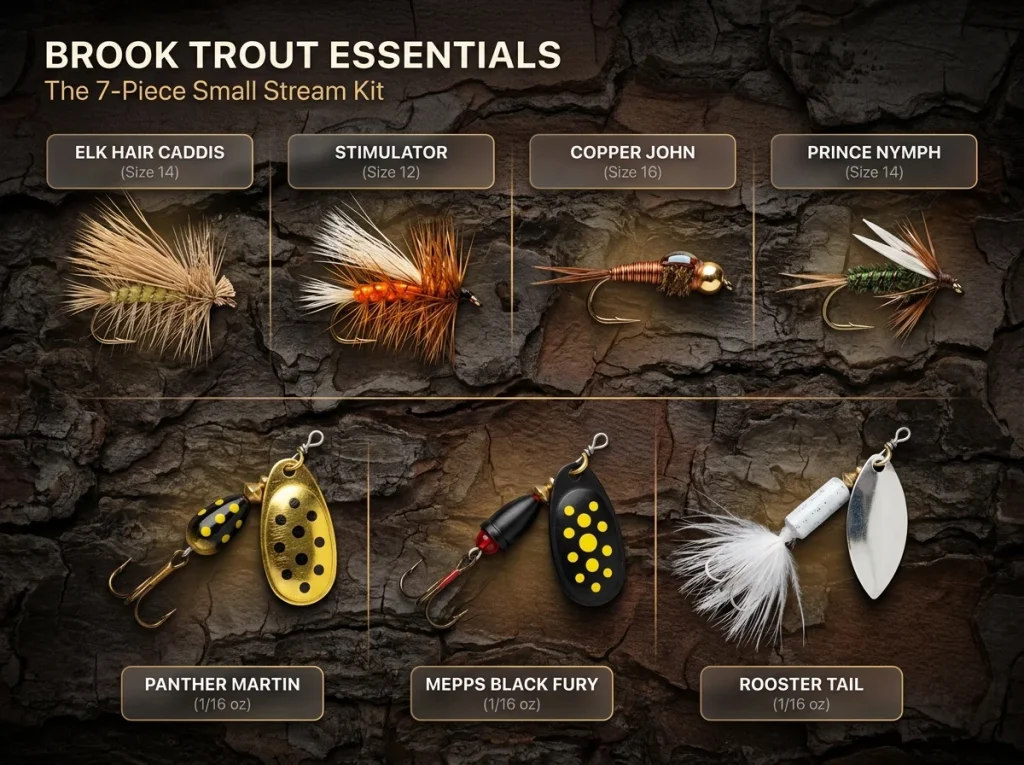
The Elk Hair Caddis in sizes 12–16 is the single most reliable small-stream dry fly. It floats well, it’s visible in broken water, and caddis are present on virtually every brook trout stream. Carry it in tan and olive.
A Stimulator in yellow or orange works as an attractor pattern when nothing specific is hatching. It suggests a stonefly, a hopper, a caddis — brook trout don’t analyze it, they just eat it. The Parachute Adams is your all-purpose mayfly imitation, and a Royal Wulff in size 14 is the brookie fly — something about that red band drives them crazy.
For subsurface, a Copper John and a Prince Nymph in sizes 14–16 cover your nymphing needs. Add a bead-head Pheasant Tail if you want a third option. If you want to understand what’s actually swimming under the surface on your stream, matching the local insects pays off once you know what to look for.
Pro tip: Size matters more than pattern on pressured streams. If you’re not getting takes on a size 12, go to a 16 before you change the fly. On truly tiny creeks, a size 18 Adams pulled more fish for me than anything else in the box.
Best Spinners and Spoons for Ultralight
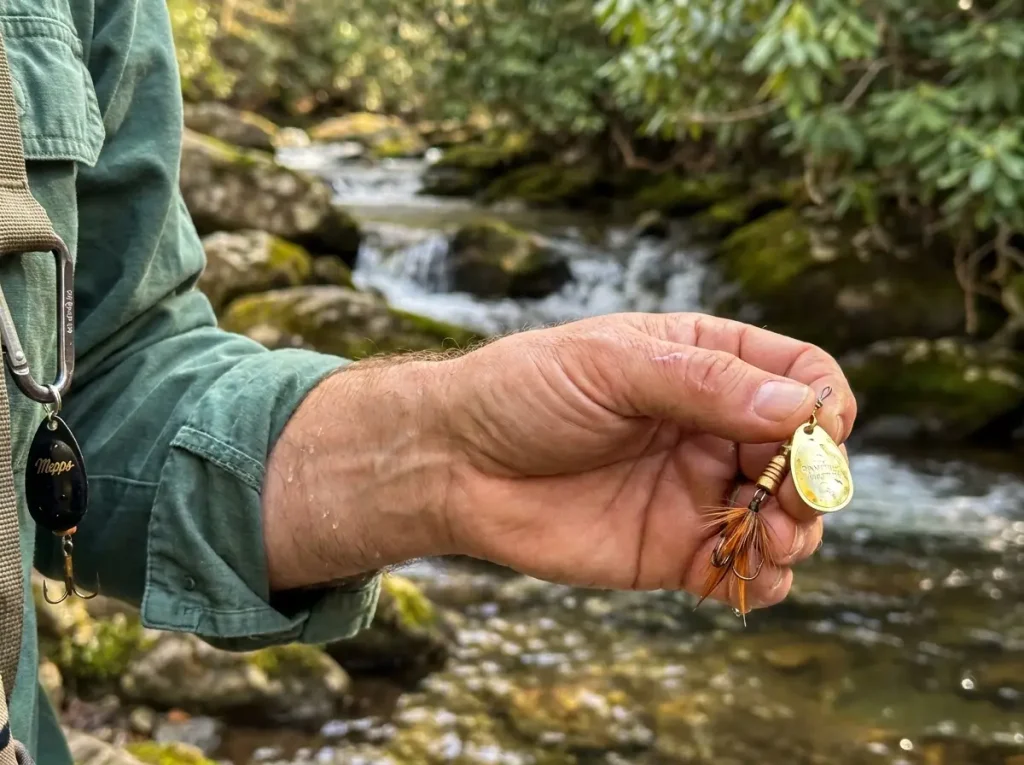
A 1/16-ounce Panther Martin with a gold blade is probably the single most effective brook trout lure ever made for small water. Cast it upstream past a pool, let the current carry it down while you reel just fast enough to keep the blade turning. That fluttering descent through a plunge pool is irresistible.
The Mepps Black Fury with a black blade outperforms everything on overcast mornings and in slightly murky water after rain. Low light, dark blade — it’s a combination that works when gold and silver don’t. The Rooster Tail in white or brown is another proven producer, especially in faster current where its dressed treble adds movement.
For deeper pools, a small Kastmaster spoon in gold or silver flutters on the drop like a wounded baitfish. Let it sink to the bottom of the pool, then jig it up and let it fall again. Brookies hit it on the drop. If you’re wondering whether to use a snap swivel or direct tie for inline spinners, the answer on small streams is almost always a direct tie — less hardware, more natural action.
When Nothing Works — Go Live
Some days, nothing artificial gets a look. It happens. When it does, a live worm on a #8 hook with a single split shot, drifted through a pool on light line, catches brook trout when everything else fails.
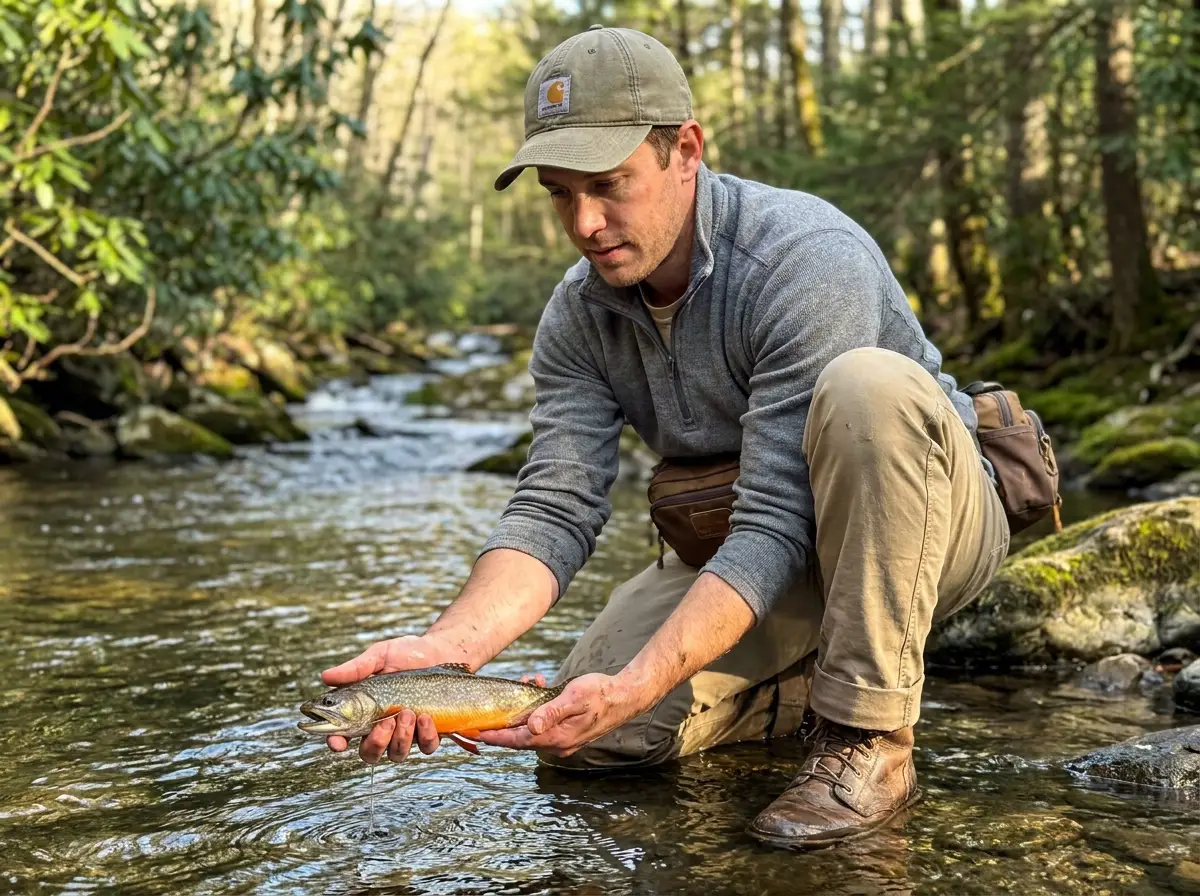
This isn’t glamorous. Purists will object. But if you’ve hiked two hours into a headwater stream and the fish are refusing everything in your box, a garden worm drifted through a deep plunge pool will remind you why you came. Use barbless hooks and handle the fish gently — catch-and-release practices matter even more with wild native populations.
Stealth and Approach — Why Brookies Disappear Before You Cast
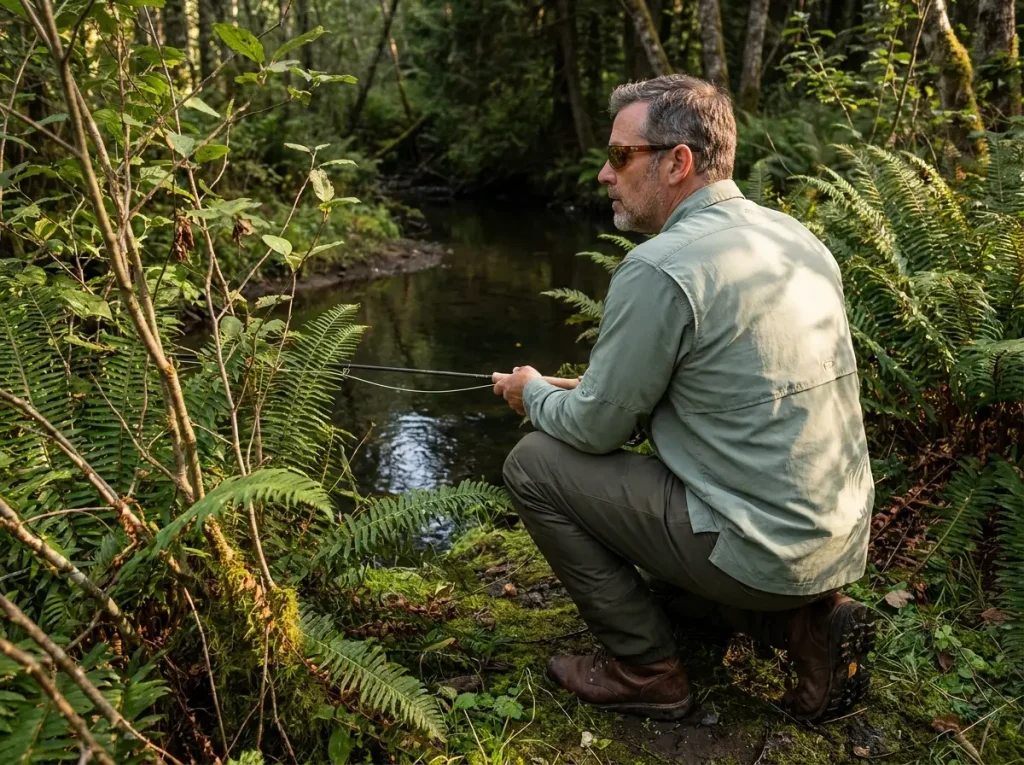
Stay Low, Stay Back, Stay Out of the Water
Brook trout in small streams live their entire lives in a space the size of a bathtub. They know every shadow, every ripple, every rock. The second something changes — a new shadow, a vibration through the substrate, a flash of color — they’re gone. Not spooked-and-they’ll-come-back-in-five-minutes gone. Gone for the session.
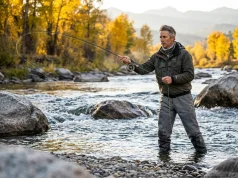
Stay on the bank as long as physically possible. Your footsteps in shallow water send pressure waves that brookies detect through their lateral line long before you see the pool. When you have to wade, move slowly and place your feet on sand or gravel, not loose rocks that shift and clunk. Keep your rod tip low — a fly rod waving overhead looks like a heron’s wing to a six-inch fish looking up through the surface.
Pro tip: Wear earth tones. A bright yellow rain jacket stands out like a flare against a green streambank. Olive, brown, gray — anything that blends with the forest. And keep your movements slow. Quick arm motions spook fish at surprising distances.
Upstream vs Downstream — Which Way to Fish
Fish upstream. Always. On small streams, this is non-negotiable. Brook trout face into the current, which means their blind spot is directly behind them — exactly where you’re standing when you approach from downstream. Your wading disturbance, dislodged sediment, and scent all flow away from the fish you’re targeting.
There are days when a downstream approach works on larger water, but on a creek you can step across, the upstream method is the only one that consistently produces. Every pool you fish, you leave behind — and the fish above never knew you were there. If you’ve fished pressured water where standard approaches fail, you already know that adjusting your angle of approach is often the fix, not changing your fly.
Your First Cast Is Your Best Cast
This is the single most important habit for small-stream brook trout fishing: your first cast to any spot is the one most likely to catch a fish. Every subsequent cast reduces your odds.
False casting over a pool — letting line fly back and forth in the air — puts your rod and line in the fish’s window of visibility. They see it. They know something’s wrong. If you’re fly fishing, load your cast to one side and deliver it to the target on the first forward stroke. If you’re spinning, make your first flip accurate. One cast, one chance. Miss it, move on.
When to Go — Timing Your Trip for Brook Trout
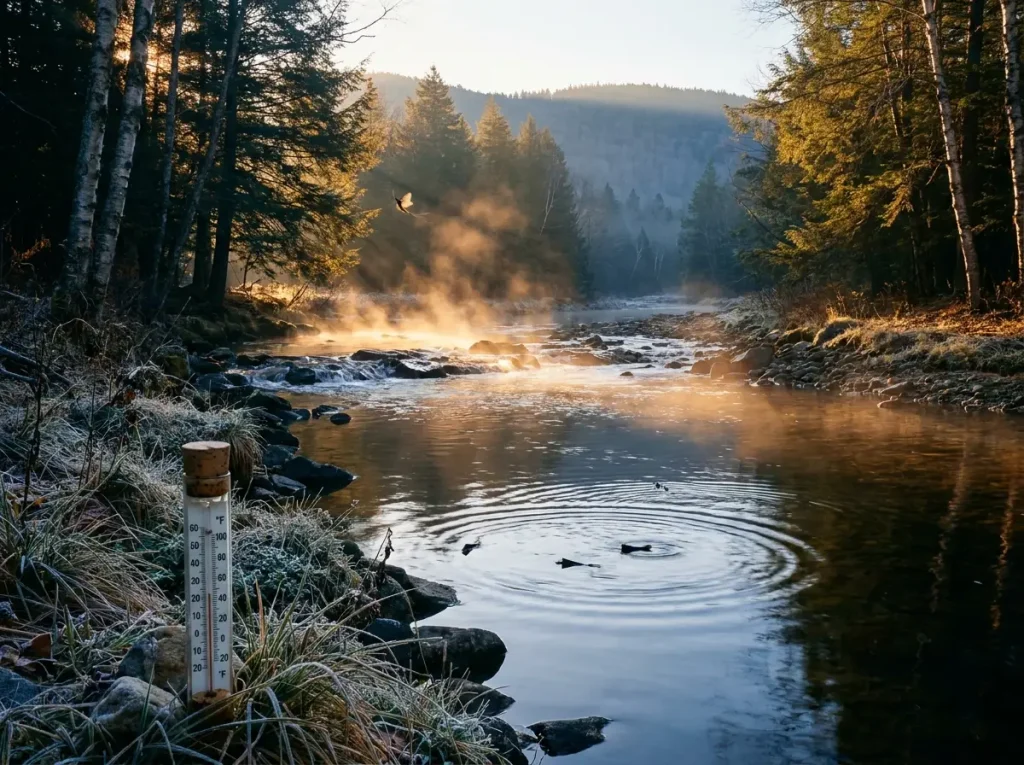
Water Temperature — The Number That Matters Most
Every trick in this article becomes more or less effective depending on one number: water temperature. Brook trout feed most actively between 55°F and 60°F. Below 45°F, their metabolism slows and they won’t chase much. Above 65°F, they start stressing. Above 75°F, sustained exposure is lethal — Shenandoah National Park’s brook trout monitoring data confirms how narrow their thermal tolerance really is.
Carry a stream thermometer. Not a $50 digital unit — a $10 thermometer with a six-inch probe works fine. Dip it in the water at the start of your session and check again if conditions change. If you’re reading 58°F, you’re in the zone. If you’re reading 66°F at midmorning in July, the fishing window has already closed for the day.
Seasonal Patterns: Spring, Summer, Fall
Spring is recovery season. As water temps climb through the 40s into the low 50s, brook trout shake off winter lethargy and feed aggressively. Late spring — May and early June in most of the native range — is prime time. Insect hatches ramp up, and fish that haven’t eaten well in months are looking for calories.
Summer gets tricky. Midday water temperatures on lower-elevation streams can push into the stress zone. Fish early morning — arrive before sunrise — and target the highest-elevation streams you can find. Spring-fed tributaries stay cooler when everything else warms up. If the water feels warm on your hand, the brookies feel it too.
Fall is the best season for brook trout fishing, period. Cooling water reignites feeding, and the pre-spawn aggression makes fish hit harder and chase further than any other time of year. But fall is also spawning season — typically September through November depending on latitude. Many states close specific streams during spawn. Check your regulations. And if you see fish paired up on gravel beds with cleaned depressions, walk away. Those are active redds. To understand why this matters, how brook trout lost most of their native habitat puts the conservation stakes into perspective.
Dawn, Dusk, and Overcast — The Feeding Windows
Brook trout are most active at dawn and dusk. These are the feeding windows, and they’re not optional — they’re the difference between a great day and a blank one. In summer, the first hour after sunrise produces more fish than the next three hours combined.
Overcast days are the exception. When cloud cover keeps light levels low and water temperatures stable, brook trout feed throughout the day. A gray, drizzly morning on a small stream is brook trout heaven. The fish come out of cover, they move into open water, and they eat with less caution.
Barometric pressure plays a role too. A falling barometer before a weather front pushes fish to feed actively — they sense the pressure change coming. The best small-stream sessions I’ve had were the two hours before a storm rolled in. High-pressure bluebird days with bright sun are the toughest. The fish are there, but they’re hunkered down and reluctant.
Pro tip: Check the weather forecast the night before. If tomorrow is overcast with a chance of afternoon rain, that’s your day. Cancel everything and go fishing.
Conclusion
Three things put brook trout in your hands on small streams. First, find the water nobody else fishes — blue-line your topo maps, hike past the easy access, and target the unnamed headwater streams where wild fish haven’t seen pressure. Second, gear down harder than feels comfortable — a short rod, light line, and three lures are enough. Third, time it right — 55 to 60°F water, dawn or dusk, and overcast skies stack the odds in your favor.
Pick a thin blue line on the map this weekend. Hike in before sunrise with a sling pack and a short rod. The fish that live in those tiny creeks have been there a lot longer than any of us, and they’re worth the walk.
Q1 What is the best bait for brook trout in small streams?
A 1/16-ounce Panther Martin spinner with a gold blade is the most consistent producer for spin anglers. For fly fishing, an Elk Hair Caddis in size 14 covers most situations. When nothing artificial works, a live worm drifted on a light split-shot rig catches brookies that refuse everything else.
Q2 What time of day are brook trout most active?
Dawn and dusk are the primary feeding windows, with the first hour after sunrise being the most productive. Overcast days extend feeding activity throughout the day. In summer, avoid midday — water temperatures rise into the stress zone and fish go inactive.
Q3 What size hook for brook trout?
Sizes 8 to 16 cover most brook trout fishing. For live bait, a #8 to #10 hook is standard. For dry flies on small streams, sizes 12 to 16 work best, with size 18 for heavily pressured fish. Match the hook to the stream — smaller water and pickier fish call for smaller hooks.
Q4 Are brook trout hard to catch?
Brook trout are among the most willing freshwater fish once you find them. They’re aggressive feeders that strike a wide variety of flies, lures, and bait. The challenge isn’t getting them to bite — it’s reaching the cold, remote small streams where healthy wild populations live without spooking them on the approach.
Q5 What is the best month to catch brook trout?
Late May through June offers strong spring fishing as water temps enter the optimal 55–60°F range. September and October are the peak months — cooling water and pre-spawn aggression make fall the best season overall. Avoid mid-July through August unless you’re fishing high-elevation spring-fed streams where water stays cold.
Risk Disclaimer: Fishing, boating, and all related outdoor activities involve inherent risks that
can lead to injury. The information provided on Master Fishing Mag is for educational and informational purposes
only. While we strive for accuracy, the information, techniques, and advice on gear and safety are not a substitute
for your own best judgment, local knowledge, and adherence to official regulations. Fishing regulations, including
seasons, size limits, and species restrictions, change frequently and vary by location. Always consult the latest
official regulations from your local fish and wildlife agency before heading out. Proper handling of hooks, knives,
and other sharp equipment is essential for safety. Furthermore, be aware of local fish consumption advisories. By
using this website, you agree that you are solely responsible for your own safety and for complying with all
applicable laws. Any reliance you place on our content is strictly at your own risk. Master Fishing Mag and its
authors will not be held liable for any injury, damage, or loss sustained in connection with the use of the
information herein.
Affiliate Disclosure: We are a participant in the Amazon Services LLC Associates Program, an
affiliate advertising program designed to provide a means for us to earn advertising fees by advertising and linking
to Amazon.com. As an Amazon Associate, we earn from qualifying purchases. We also participate in other affiliate
programs and may receive a commission on products purchased through our links, at no extra cost to you. Additional
terms are found in the terms of service.