In this article
The spoon fluttered down through twelve feet of green water, wobbling side to side like a wounded shad — and then it stopped. Dead. No flutter, no flash, just a brass pendulum hanging limp below a chunky snap swivel that had no business being there. Three more casts. Three more lifeless drops. I cut it off, tied a Rapala knot to a slim round snap, and the next cast produced the wide, rolling wobble that spoon was designed to deliver. Two fish followed on back-to-back retrieves.
That afternoon changed how I think about every line-to-lure connection I make. After twenty years of guiding clients who clip on the same hardware for everything from crankbaits to finesse jigs, I’ve watched the same mistake play out thousands of times: anglers rigging for convenience instead of rigging for the lure.
Here’s the truth nobody prints on the packaging. The snap swivel vs direct tie knot debate isn’t binary. It’s a lure-by-lure decision governed by weight, water clarity, and what your bait is supposed to do underwater. This guide breaks it down so you stop guessing and start matching the connection to the job.
⚡ Quick Answer: Use a direct tie (Palomar or loop knot) for jigs, soft plastics, jerkbaits, and topwaters — any lure where added weight, fouling, or dampened action hurts performance. Use a ball bearing snap swivel only for inline spinners that generate rotational torque. Use a rounded snap (no swivel) for crankbaits and spoons where quick changes and wider wobble matter. The connection method should match the lure’s physics, not your personal preference.
Why the Connection Point Changes Everything
The Pivot Point Problem
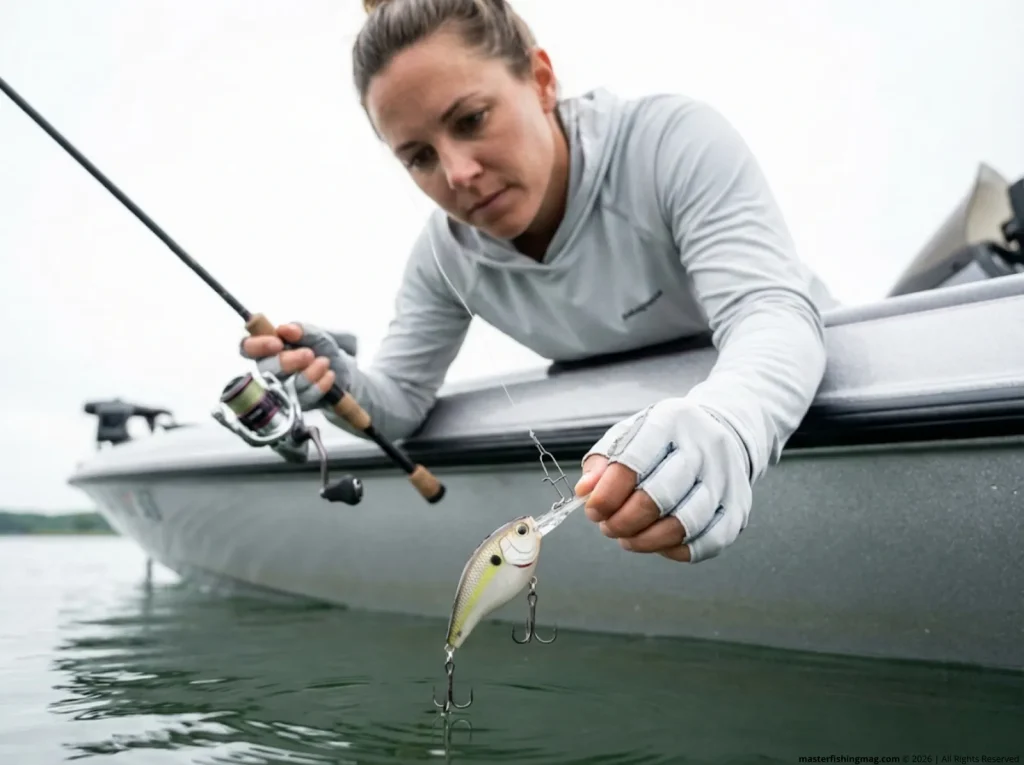
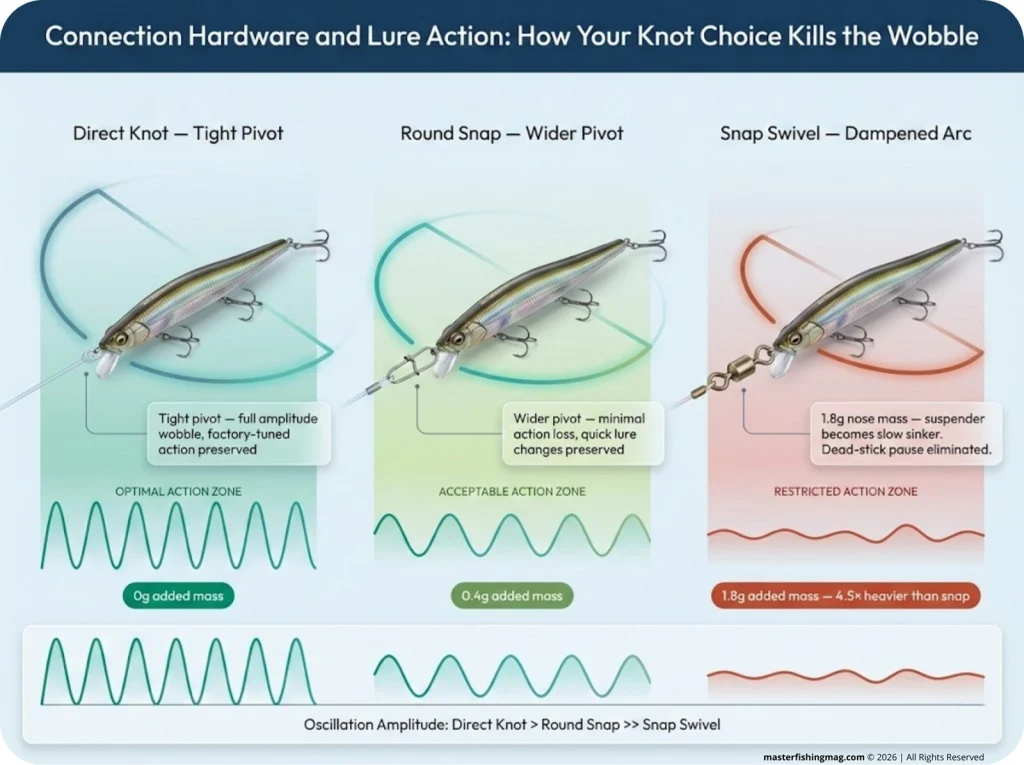
Every lure leaving the factory is tuned to wobble at a specific speed and width. The spot where your line meets the lure’s eyelet is the pivot point — and the geometry of that connection controls everything about how the bait moves.
A rounded snap like the VMC Crankbait Snap gives the lure room to swing through a wide arc. That matters for baits designed with a hunting wobble — crankbaits that need to kick left and right, spoons that need to flutter and dart. A tight, cinched-down knot does the opposite. It pins the nose and chokes the lateral range, producing a stiff action that looks mechanical instead of alive.
Think of it this way. A door on a well-oiled hinge swings freely. A door nailed shut doesn’t move at all. Your lure attachment works the same way — the pivot radius controls how much freedom the bait has to do its job.
Pro tip: Before your first cast with any new lure, run it at boat side and watch the wobble. If the action looks wrong — too tight, too stiff, no hunting — your connection is the first thing to change.
Mass at the Nose and What It Kills
Here’s where most anglers don’t think it through. A cheap barrel snap swivel weighs around 1.8 grams. A SPRO Prime Snap in Size 2 weighs 0.4 grams. That sounds trivial until you realize it’s more than four times the dead weight hanging off the front of your lure.
That extra weight shifts the bait’s balance point forward. For bigger lures — 8-inch swimbaits like the Huddleston or MagDraft, magnum cranks — it barely matters because the hardware is a tiny fraction of the total mass. But for a suspending jerkbait like a Megabass Vision 110 that’s been factory-tuned to hang horizontally at specific water temperatures, even half a gram turns a suspender into a slow sinker. And that ruins the dead-stick pause that triggers cold-water strikes.
Surface Area, Drag, and Vibration Dampening
A snap swivel doesn’t just add weight. It adds frontal surface area right at the lure’s leading edge. That creates turbulence where you want smooth flow, and the turbulence dampens the vibration pattern the bait is supposed to throw.
That dampened vibration shrinks the detection radius — the distance at which a fish’s lateral line detects vibration and picks up the bait. For finesse lures under three inches, the snap swivel’s profile can represent 15-20% of the total frontal area. That’s a huge visibility and drag penalty in stained or dark water where vibration is the primary detection channel.
When Snap Swivels Earn Their Spot
Inline Spinners and the Torque Mandate
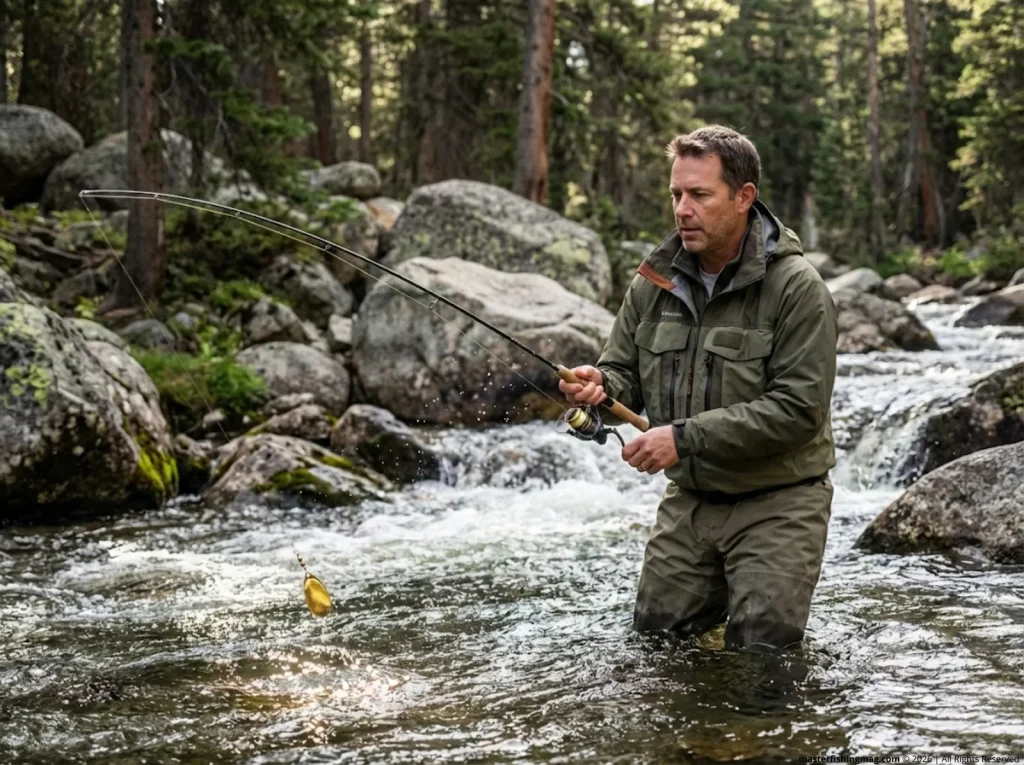
This is the one category where a swivel is mechanically necessary — period. Inline spinners like the Mepps Aglia and Rooster Tail generate rotational torque around a central shaft. Without something to decouple that spin, the torque transfers straight into your line and creates line twist that can trash a spool in a single afternoon of casting.
But here’s the detail most rigs get wrong: a standard barrel swivel locks up under fighting tension. The metal-on-metal friction increases with load, and by the time you’re cranking down on a decent fish, that barrel swivel has stopped rotating entirely. It’s a decoupling device that fails at the moment you need it most.
The fix is a ball bearing swivel matched to your line class — not oversized, not undersized. The stainless balls inside keep the opening and closing smooth even under a hard fight. Size it to the line’s rated strength and use the smallest one that fits. Anything bigger adds visual contrast in clear water that you don’t need. If you’re struggling to manage line twist at the source, this is the most effective hardware solution available.
Spoons and the Line-Pinch Trap
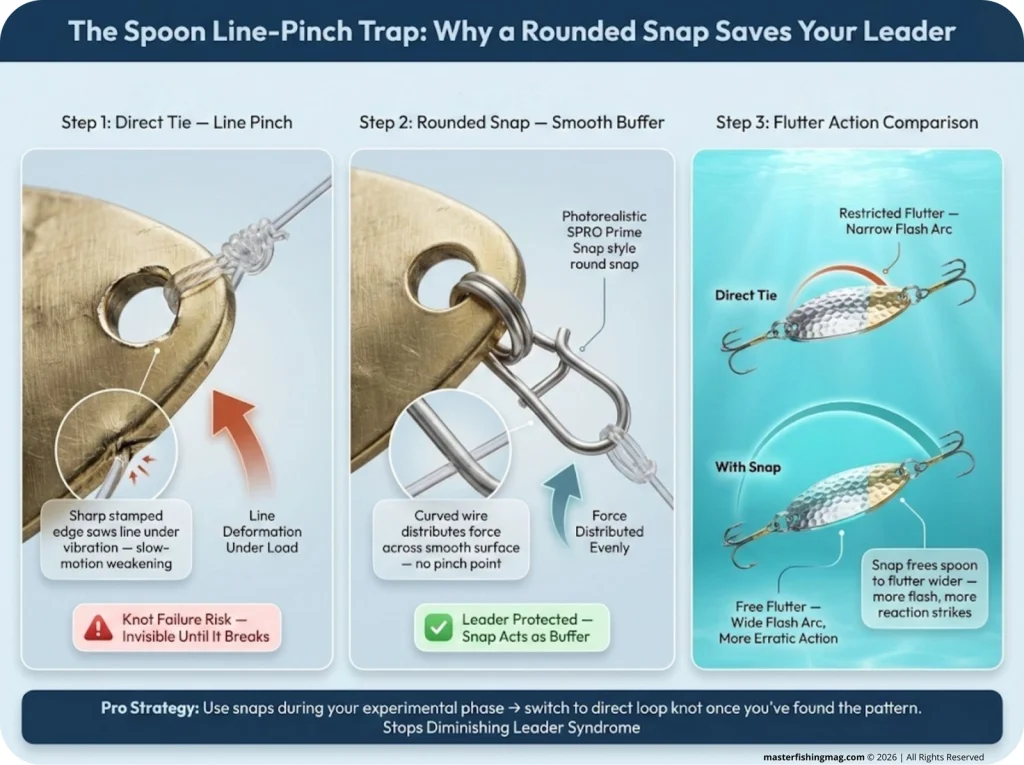
Spoon fishing creates a unique problem that doesn’t get enough attention. Most spoons are stamped from sheet metal, and the attachment eyelet can have surprisingly sharp edges. When you tie directly to that eyelet with fluorocarbon or mono, the vibration of the retrieve saws the line against that metal edge — a slow-motion “line pinch” that weakens the knot before you ever feel it.
A rounded snap acts as a buffer. The curved wire distributes force across a smooth surface instead of concentrating it on a sharp edge. It also frees the spoon to flutter with a wider arc, which means more flash and more erratic action — exactly what triggers reaction strikes.
If line twists from a spinning spoon are a concern, don’t clamp a snap swivel at the lure. Instead, place a barrel swivel 18 to 24 inches up the line between your main line and leader. This decouples the twist without dampening the spoon’s flutter at the business end. The research confirms this works — peer-reviewed lure rig testing on pike showed that hardware placement directly affects both landing rates and lure action quality.
Pro tip: Once you’ve found the pattern for the day — the right spoon, the right retrieve speed — commit to a direct tie with a loop knot. Use snaps during your experimental phase, then strip them off when you know what’s working. This kills the “Diminishing Leader Syndrome” where every lure change eats 4-6 inches of your leader until the braid-to-leader knot is jammed inside your rod guides.
Quick-Change Scenarios That Justify Snaps
There’s a legitimate speed argument for snaps during the first hour of a session. If you’re testing 8-12 lures to find a pattern, re-tying costs real leader material. Over a full day with 12 changes, that’s roughly 6 feet of leader consumed — which is why guides carry micro-snaps like the Decoy Egg Snap (under 0.3g in Size 1) for the testing phase and then switch to a direct line tie once the pattern locks in. The ease of swapping lures without cutting line is real, but it’s a temporary convenience — not a permanent rigging strategy.
Where Direct Tie Wins Every Time
Jigs and Soft Plastics — The Posture Problem
Jigs are designed to hang horizontally. A snap swivel creates an unstable pivot that tilts the jig tail-heavy, making it look unnatural to any bottom-oriented predator watching it fall. For bass fishing with football jigs, swim jigs, and finesse presentations, posture is everything — and the clip kills it.
Beyond posture, snaps collect filamentous algae and debris. That fouling prevents the jig from penetrating brush, laydowns, and grass — exactly the heavy cover where flipping jigs into heavy cover is the most productive technique. A Palomar knot or Uni knot tied directly to the jig eyelet gives you a rigid, low-profile connection that maintains the hook’s designed entry angle and slides through cover clean.
For soft plastics on a Texas rig, wacky rig, or drop shot, the same logic applies. The direct tie preserves the natural presentation these finesse baits depend on. On a Ned rig or micro jig under 1/8 oz, even a small swivel weighs more than 10% of the total lure — a proportional penalty that no finesse angler should accept.
Topwaters — The Fouling Problem
Topwater lures ride the surface tension. A dangling snap or swivel below the nose creates a pendulum that catches treble hooks during the cast, causing fouling — the single most frustrating topwater problem that exists. The fix is a Rapala knot or non-slip loop knot tied directly to the eyelet. It gives the bait freedom to walk side to side without adding mass or creating a hook-catching snag point below the nose.
The weight issue compounds the problem. A snap swivel pulls the nose of a popper below the surface plane, killing the chugging action that triggers reaction strikes. If your walking bait fouls on more than one in ten casts, your connection hardware is too heavy. Cut it off and tie direct.
Suspending Jerkbaits — The Weight Sensitivity Crisis
Jerkbaits are the most weight-sensitive lures you own. High-end Japanese models are calibrated at the factory to suspend neutrally at specific water temperatures. Adding a snap swivel — even a lightweight one at 1.0 gram — converts a suspending bait into a slow-sinking bait, which eliminates the horizontal dead-stick pause that’s the entire point of cold-water jerkbait fishing.
Understanding how mass shifts affect lure suspension makes this clear. In water below 45°F, where maximum pause time matters most, even a 0.3g snap can wreck the suspension. Go direct tie with a loop knot to preserve natural action without adding a single tenth of a gram.
The Stealth Factor Most Anglers Underestimate
What Fish Actually See at the Nose
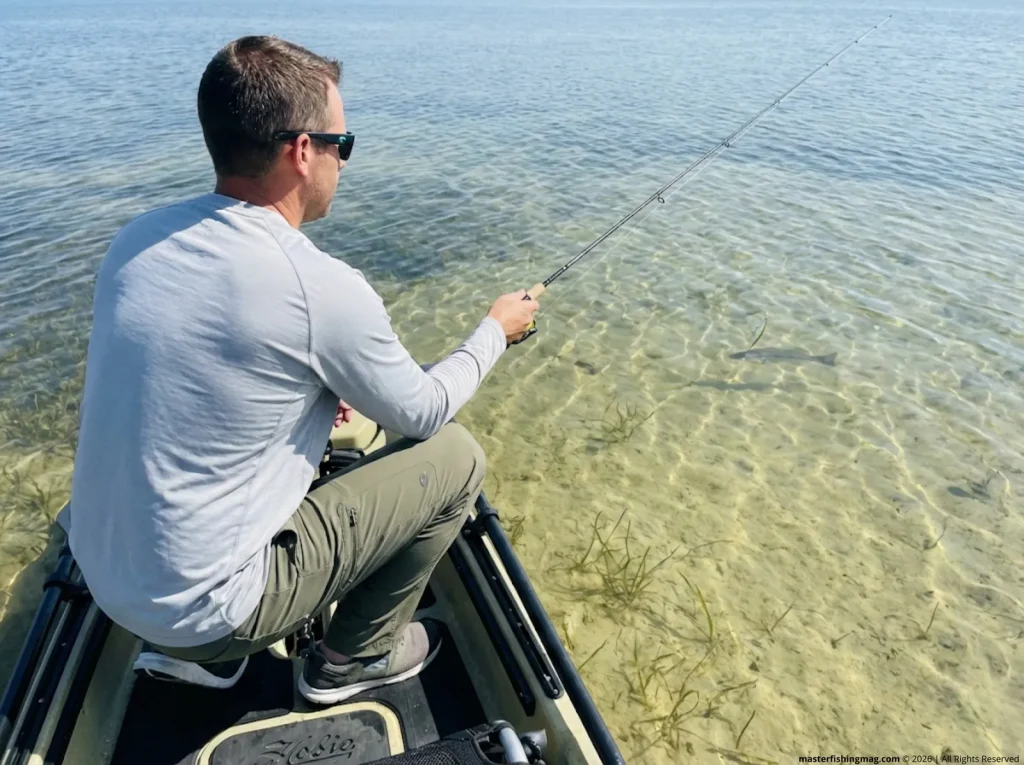
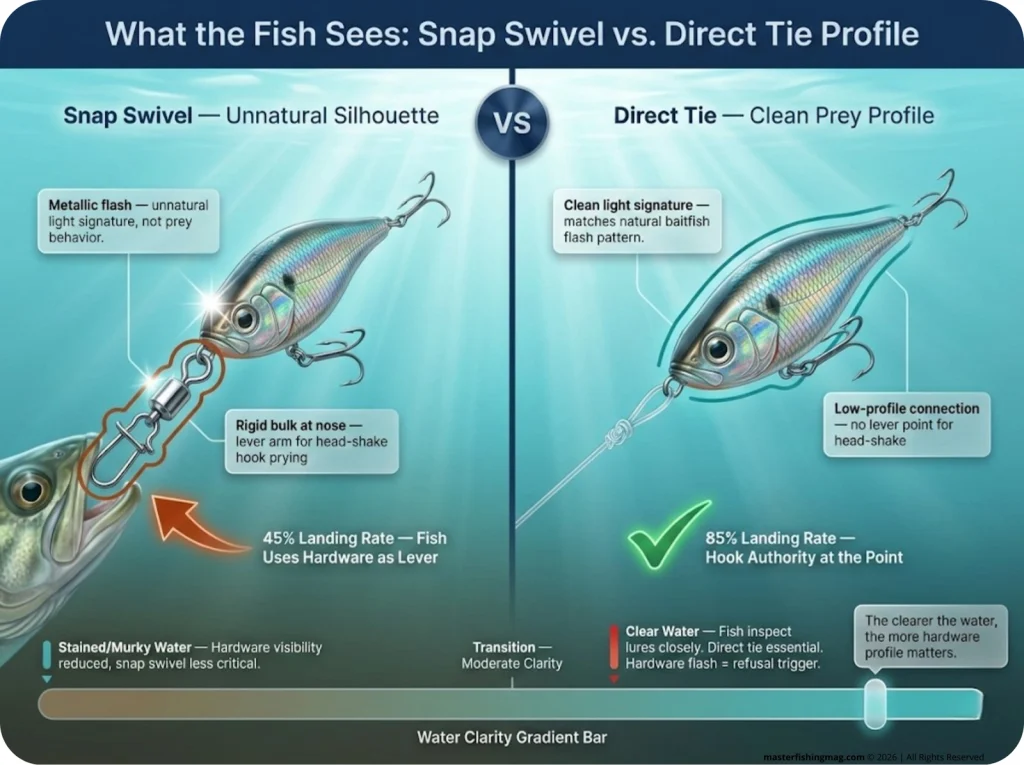
Fish can detect metallic flash and unnatural contrast at distances over five feet in clear water. Species like tarpon, snook, and heavily pressured largemouth are notorious for refusing lures with visible hardware at the nose. The flash of a chrome snap swivel doesn’t match anything in the natural prey profile — it’s a warning flag, not an attractor. A stealthier presentation starts at the nose of the bait.
Here’s a simple water clarity protocol that works across species. In visibility over five feet, use a direct tie or matte black nickel micro-snaps only. In one to five feet of visibility, dark-finished hardware is acceptable. Below one foot, hardware color is irrelevant — vibration and size drive the bite, not visuals.
The dividing line between “hardware matters” and “hardware doesn’t matter” often comes down to retrieve speed. On a fast-burned chatterbait or ripped spoon, fish get a fraction of a second to react — no time for inspection. On a paused jerkbait or a slow-crawled finesse jig, every detail at the nose gets examined. The connection between visible hardware and why fluorocarbon isn’t actually invisible to fish is worth understanding if you chase pressured fish in clear water — it all ties into the same stealth equation.
The Lever-Arm Problem Nobody Talks About
Here’s a finding from fisheries research that should make every angler rethink their hardware. A study on Baltic pike found that standard rigs — where the lure body stays attached rigidly to the hooks — produced only a 45% landing rate. Fish used the lure body as a lever to pry hooks loose during head-shakes. When researchers switched to “release rigs” that let the lure slide away from the hook connection, landing rates jumped to 85% — nearly doubling success.
A long, rigid snap swivel amplifies this lever effect. If the snap gets wedged against the fish’s jawbone during a thrashing fight, the fish gains enough leverage to straighten the snap wire or tear the hook free. Short, low-profile connections — direct tie or micro-snap — keep hookset authority at the hook point where it belongs.
The Lure-by-Lure Rigging Matrix
Building Your Personal Rigging Rules
Here’s the table that belongs on every tackle box lid. Match the lure to the connection, and you’ll never default to a snap swivel out of habit again.
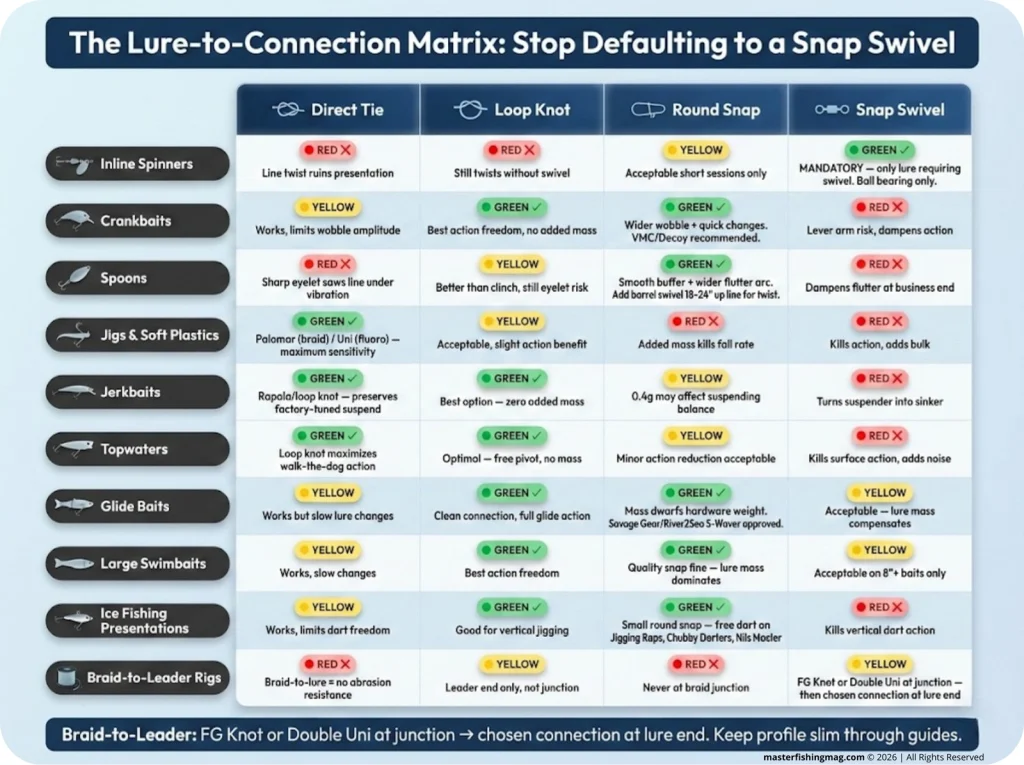
Inline spinners get a ball bearing snap swivel — the only lure category where a swivel is mandatory for line-twist prevention. Crankbaits get a rounded snap (VMC or Decoy) for wider wobble amplitude and quick-change convenience — never a snap swivel. Spoons get a snap at the lure with a barrel swivel 18-24 inches up the line to handle twist without dampening flutter. Jigs and soft plastics get a direct tie — Palomar knot for braid, Uni knot for fluorocarbon. Jerkbaits and topwaters get a direct-tie with a Rapala knot or loop knot to preserve action freedom without adding mass. Glide baits like the Savage Gear Shine Glide and River2Sea S-Waver, plus large swimbaits, can handle a quality snap because their mass dwarfs the hardware weight. Ice fishing presentations like Jigging Raps, Chubby Darters, and Nils Master spoons respond best to a small round snap that lets them dart freely on vertical presentations.
When you’re running braid to a fluorocarbon leader, the connection sequence matters. An FG knot or Double Uni knot at the braid-to-leader junction keeps the profile slim enough to pass through guides cleanly, then your chosen connection — direct tie or snap — goes at the lure end.
The Five Knots You Actually Need
The Palomar knot is your default direct tie — double loop through the eye, nearly 100% rated strength when you remember to wet the line before cinching. The Rapala knot gives you a non-choking loop when you need pivot freedom without hardware — ideal for jerkbaits and topwaters on fluorocarbon. The FG knot is the slimmest braid-to-leader junction that actually holds under load. The Uni knot is the all-purpose backup for fast re-tying knots when the pattern is hot. And the San Diego Jam handles heavy fluorocarbon (20lb+) without the friction-burn that weaker knots suffer during cinching. The science behind why knots fail under load comes down to heat and friction at the cinch point — and wet line solves most of it.
Pro tip: Carry two pre-tied leaders in a Ziploc for every trip. When your leader gets short from re-tying, swap the whole thing instead of burning precious fishing time rebuilding on the water. Label each bag with the line weight and leader length.
Matching Hardware to Species and Conditions
Clear water and pressured bass fishing: matte black Decoy Snap in Size 1 (30lb rated, under 0.2g). Zero visible flash, minimal hardware, wide enough pivot for cranks and swimbaits.
Stained water and aggressive species: SPRO Prime Snaps in Size 2 (50lb rated). The 90-degree weedless end resists accidental opening from jaw pressure, and it’s heavy enough for hard hooksets into thick cover.
Inshore saltwater fishing for snook, redfish, and sea trout: stainless VMC Crankbait Snap for corrosion resistance and wide pivot radius. Switch to direct tie for any sight-fishing situation where the fish has time to inspect.
Ice fishing: small round snap for vertical presentations. Avoid crosslock snaps — they restrict the lateral dart movement that triggers neutral-buoyancy strikes from walleye and panfish. Norman Quick Clips and standard Fas-Snaps are better choices for hard-water anglers who need fast lure attachment without killing the bait’s glide.
Hardware Maintenance and the Failures Nobody Checks
The 3-Fish Inspection Rule
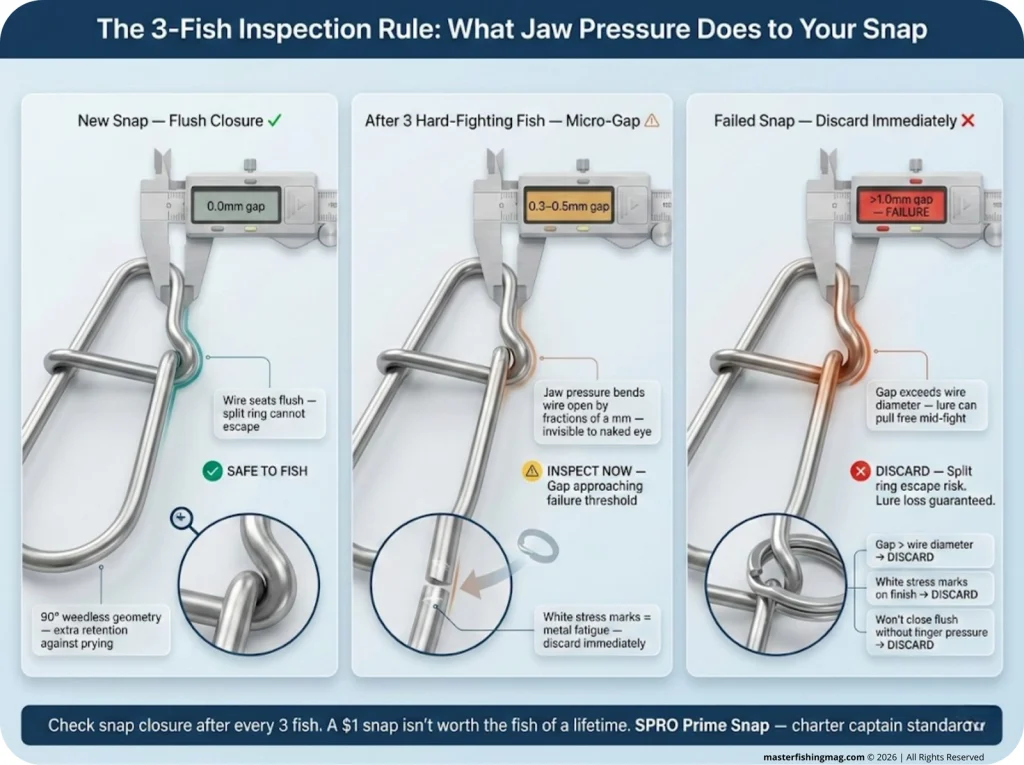
After every three fish, check your snap’s closure. Jaw pressure during fights can bend the wire open by fractions of a millimeter — invisible to the naked eye but enough for a split ring or lure eyelet to slip through mid-fight. The SPRO Prime Snap’s 90-degree weedless end provides an extra retention geometry that resists prying, which is one reason charter captains prefer it.
Discard any snap immediately if the closing gap exceeds the wire diameter, if you see white stress marks on the finish, or if the snap won’t close flush without finger pressure. A dollar snap isn’t worth the fish of a lifetime.
Corrosion, Metallurgy, and When to Upgrade
Most premium freshwater snaps use a grade of stainless steel that handles lakes and rivers just fine. But sustained saltwater exposure will eat through standard stainless over time. If you fish salt more than three times a season, look for marine-grade stainless hardware on the packaging — the kind with extra alloy protection against salt damage. Don’t just assume “stainless” means “saltwater-proof.” It doesn’t.
There’s a wire gauge trade-off here that matters. Thicker wire means a stronger snap but heavier and stiffer — which can dampen the subtle action of finesse lures. Finer-gauge Japanese snaps like the Decoy Egg Snap use higher-grade steel to stay strong while staying light enough to let the lure hunt freely. For a deeper look at keeping all your terminal tackle safe from saltwater corrosion, the maintenance protocol is simple: dry everything after every trip and hit swivel bearings with a drop of lightweight reel oil.
Pro tip: Bronze barrel swivels are single-use items in saltwater. The corrosion starts inside the housing where you can’t see it. Stainless ball bearing swivels cost more up front but last far longer — worth the upgrade for anyone who fishes salt regularly.
Conclusion
Three things to carry home from this. First, the right connection is lure-specific, not preference-specific. The lure decides whether you snap, tie, or swivel — not habit. Second, terminal tackle rigging with hardware is justified in exactly two scenarios: rotational torque on inline spinners and line-pinch protection on metal spoons. Everything else is a penalty you’re choosing to pay because it’s faster. Third, the five-knot toolkit — Palomar, Rapala Loop, FG, Uni, and San Diego Jam — eliminates every excuse for defaulting to a snap swivel out of laziness.
Next time you’re on the water, run a side-by-side test. Tie the same lure two ways and watch the action at boat side. The difference in wobble amplitude will tell you more than any article can. Once you see it, you can’t unsee it — and your terminal tackle rigging will stop being an afterthought.
FAQ
Do snap swivels scare fish away?
In clear water with visibility over five feet, yes — the metallic flash and unnatural silhouette trigger refusals from pressured bass, trout, and inshore species. In stained or muddy water, visual deterrence drops significantly and vibration becomes the primary detection channel, so hardware matters far less.
What is the best knot to tie directly to a lure?
The Palomar knot is the strongest general-purpose direct tie at nearly 100% line strength when cinched wet. For lures needing a free pivot — jerkbaits, topwaters, crankbaits — the Rapala Loop Knot provides an open-loop connection that mimics a snap’s action benefit without adding mass, though it trades down to about 85% strength.
Are snap swivels bad for fishing lures?
They’re bad for specific categories — jigs, soft plastics, jerkbaits, and topwaters — where added weight, fouling risk, or dampened action directly reduces strikes. They’re beneficial for inline spinners and useful as line-pinch protection on metal spoons.
Should I use a snap on crankbaits?
Yes — a rounded snap (not a snap swivel) is ideal for crankbaits. The wide pivot radius enhances wobble amplitude, and quick-change convenience lets you swap depths and colors fast. Choose an egg-style or round snap like the VMC Crankbait Snap or Decoy Snap over narrower crosslock designs to maximize wobble and preserve natural action.
How do I prevent line twist without a snap swivel at the lure?
Place a quality barrel or ball bearing swivel 18-24 inches above the lure — between your main line and leader — instead of at the lure. This decouples rotational energy without dampening the lure’s designed action. For non-spinning lures, periodic line management — releasing slack, towing the line behind the boat — prevents line twists buildup without any hardware at all.
Risk Disclaimer: Fishing, boating, and all related outdoor activities involve inherent risks that
can lead to injury. The information provided on Master Fishing Mag is for educational and informational purposes
only. While we strive for accuracy, the information, techniques, and advice on gear and safety are not a substitute
for your own best judgment, local knowledge, and adherence to official regulations. Fishing regulations, including
seasons, size limits, and species restrictions, change frequently and vary by location. Always consult the latest
official regulations from your local fish and wildlife agency before heading out. Proper handling of hooks, knives,
and other sharp equipment is essential for safety. Furthermore, be aware of local fish consumption advisories. By
using this website, you agree that you are solely responsible for your own safety and for complying with all
applicable laws. Any reliance you place on our content is strictly at your own risk. Master Fishing Mag and its
authors will not be held liable for any injury, damage, or loss sustained in connection with the use of the
information herein.
Affiliate Disclosure: We are a participant in the Amazon Services LLC Associates Program, an
affiliate advertising program designed to provide a means for us to earn advertising fees by advertising and linking
to Amazon.com. As an Amazon Associate, we earn from qualifying purchases. We also participate in other affiliate
programs and may receive a commission on products purchased through our links, at no extra cost to you. Additional
terms are found in the terms of service.