
In this article
You tied on fluorocarbon because the package promised a line the fish would never see. Then you watched an underwater clip of the stuff and there it was, plain as day, drifting next to the mono like it never got the memo. Here’s the flat truth a lot of tackle marketing would rather you not hear: “invisible” is a sales word, not a physics one. The anglers who actually filmed both lines underwater keep landing on the same verdict, and the optics back them up. This is what the science really buys you in clear water, and exactly where the label oversells.
Is Fluorocarbon Actually Invisible Underwater?
The Short Answer (Less Visible, Not Invisible)
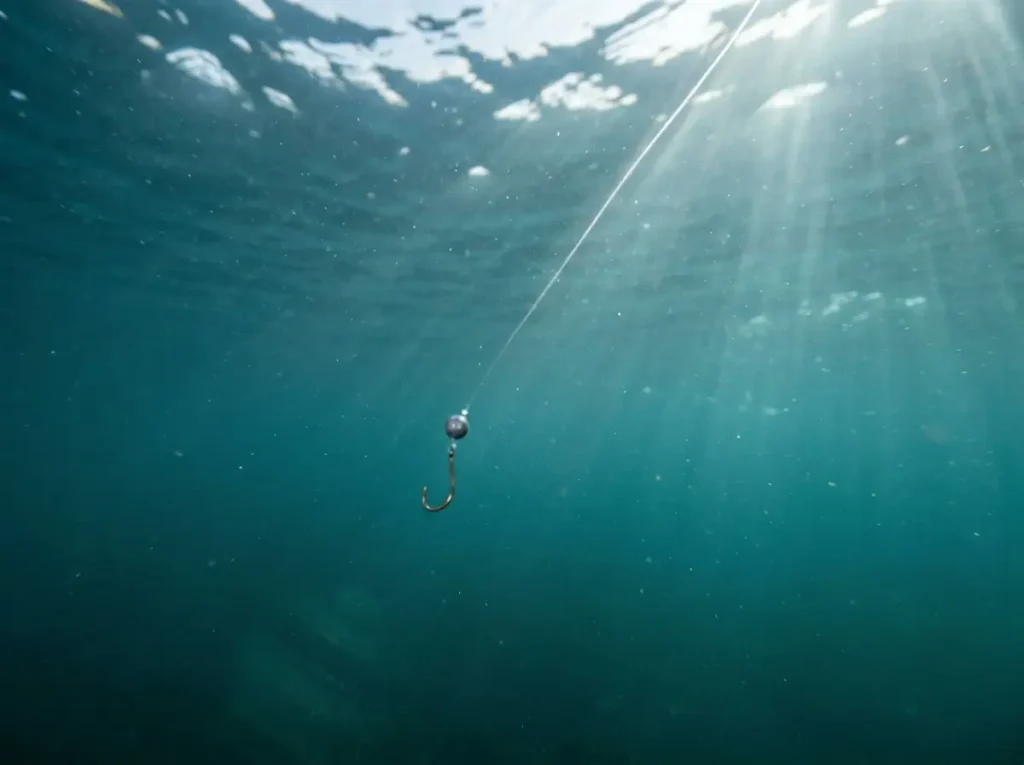
No line you spool disappears. Fluorocarbon is the least visible of the mainstream choices, and in the right water that edge is real, but “gone” was never on the table. Think of it as the quietest line in the room, not a line that left the room. Once you stop expecting a true cloak of invisibility, you start using fluoro where its actual strengths pay off, which is the whole point of understanding the bigger picture of how every fishing line behaves before you spend a dime on a spool.
What Refractive Index Actually Means
Every material bends and bounces light by a set amount, and that amount has a number: the refractive index. The refractive index of water sits around 1.33. A fishing line in that water shows itself whenever its own index differs from the water around it, because the mismatch makes light bend (refraction) and bounce (reflection) at the boundary. The closer a line’s index is to water, the less it disturbs the light passing through, and the fainter it looks. That single idea is the entire scientific case for fluoro, and it’s genuinely true as far as it goes.
Where the “Invisible” Marketing Came From
Tackle copy has leaned on phrases like virtually invisible, “no shadow,” and “no distortion” for decades because they sell spools. The phrases aren’t pulled from nowhere, fluoro’s index really is closer to water than nylon’s, but that’s marketing hype rounding a small advantage up to a magic trick. Ask the skeptics who dropped a camera in a pool and filmed mono against fluoro side by side: the fluoro was fainter and still obviously there. “So much for invisible” is the line that keeps showing up in those threads, and your own eyes will agree the first time you watch the footage.
Refractive Index Fluoro vs Mono vs Braid vs Water
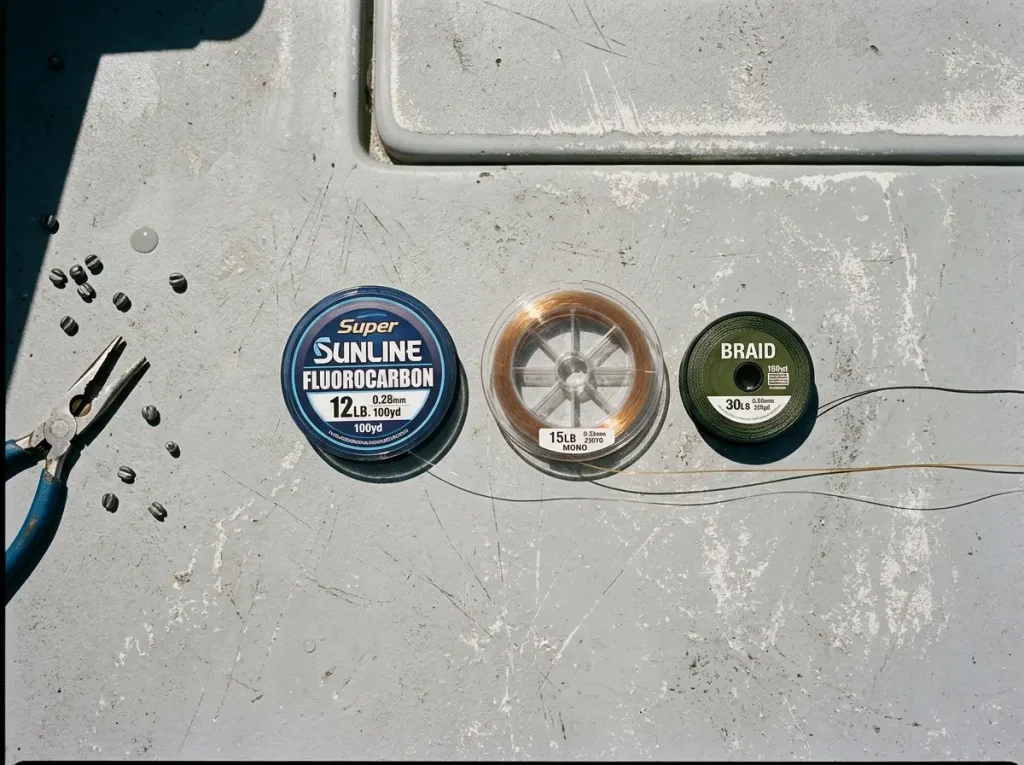
The whole argument lives in a few numbers, and once you see them laid out, the marketing and the reality separate cleanly.
The Numbers That Matter (Index Comparison)
Here’s the comparison that gets screenshotted on every fishing forum. Fresh water reads about 1.33 (salt water nudges up to roughly 1.35). Fluorocarbon comes in near 1.42. Monofilament runs 1.52 and higher depending on the formula.
Air, for scale, is basically 1.0, which is why a line is wildly obvious above the surface and much harder to spot below it.
| Line Type | Refractive Index | Delta From Water | What the Fish Sees |
|---|---|---|---|
| Fresh Water | ~1.33 | 0.00 (the target) | Nothing, this is the baseline |
| Fluorocarbon | ~1.42 | ~0.07–0.09 | The faintest strand of the three |
| Monofilament | ~1.52 | ~0.20–0.22 | A brighter, more distorting line |
| Braided Line | Opaque (n/a) | n/a | The most visible, solid and dark |
Reading the Delta From Water
The number that matters isn’t the index, it’s the delta, the gap between the line and the water. Fluoro misses water by about 0.07 to 0.09. Mono misses it by about 0.20 to 0.22, give or take the blend. So fluoro’s mismatch is roughly a third of mono’s, which is a real, measurable reason it looks fainter.
But notice the honest part: the only delta that means invisible underwater is zero, and nothing on the shelf reads zero. Fluoro is closer to the target. It does not hit it.
Why Braid Plays by Different Rules
Braided line skips the index conversation entirely because it isn’t translucent. It’s a solid, opaque weave, so it’s the most visible line in clear water by a wide margin. That’s exactly why so many anglers run braid on the spool and tie on a clear leader at the business end. If you want the full rundown on how braided, fluoro, and mono really stack up side by side, that comparison goes deeper on strength and stretch too, but for visibility alone the order rarely changes: braid first, mono second, fluoro last.
Why a Closer Index Makes Fluorocarbon Harder to See
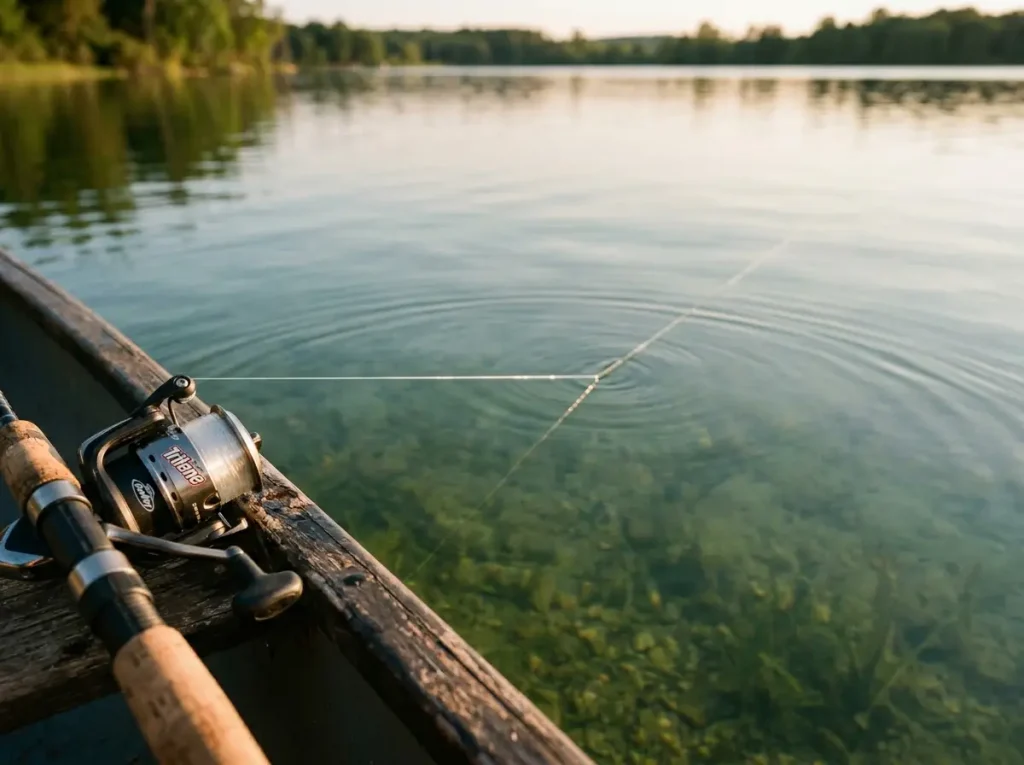
Numbers are fine, but the reason they matter is what light actually does when it hits your line, and that’s easier to feel than to calculate.
How Light Behaves at the Line’s Edge
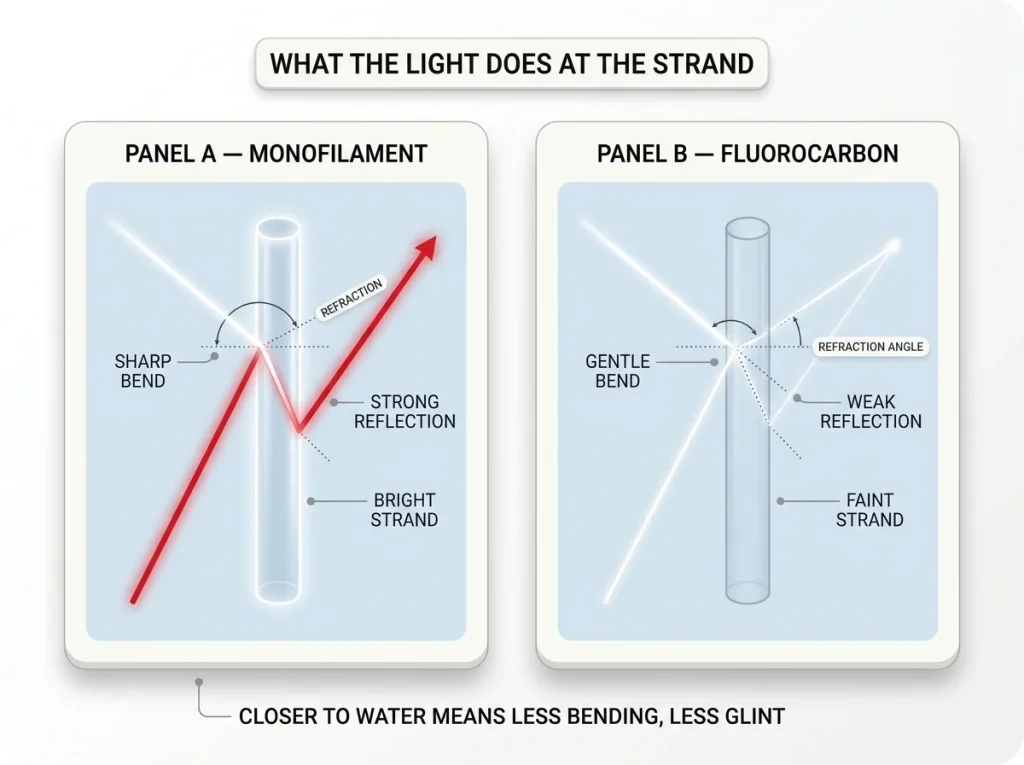
Drop a straw in a glass of water and it looks broken at the surface. That kink is refraction, light changing speed and direction as it crosses from one material into another. Your line does the same thing underwater every time light passes from water into the strand and back out.
At that same boundary, some light also bounces straight off, which is reflection. Both effects are what hand a fish a visible strand to notice.
Less Bending, Less Reflection, Fainter Line
Here’s where the index finally earns its keep. Because fluorocarbon sits closer to water than nylon monofilament does, light crossing into it bends less and bounces less.
Less light bending means less distortion behind the line. Less reflection means less of that bright glint running down the strand. The fish still gets a line, just a quieter one, and in gin-clear water with calm light that’s enough to matter.
The Clear-Water Payoff (and Its Limit)
On a flat, sunny morning over clear shallows, a mono strand can throw a glint that pressured fish learn to associate with trouble. Fluoro softens that glint, and that’s where its clear-water reputation is honestly earned.
But “softer” isn’t “absent.” The boundary between line and water never goes away, so the bending and bouncing only shrink, they never reach zero. Sell yourself on “fainter” and you’ll be right. Sell yourself on “gone” and the fish will correct you.
In stained or muddy water, don’t pay the fluorocarbon premium. Turbidity hides every line you own, so the index advantage you bought is doing nothing down there. Save the good fluoro for the gin-clear days when visibility is actually the thing standing between you and a bite.
Why It’s Still Not Invisible — Lens, Polarization, and the Off-Bottom Flip
Even if a line perfectly matched water, it would still give itself away, and this is the part the brand pages skip. Three things keep fluoro visible no matter how good the index gets, plus one situation that flips the whole invisibility story on its head.
The Cylindrical Lens Effect (Why Shape Beats Index)
Your line isn’t a flat pane of glass. It’s a round cylinder, and a round transparent cylinder is a lens. It acts like a convex cylindrical lens that focuses light into a bright band, called a caustic, on whatever sits behind it, with darker edges flanking that band.
So even a line whose index matched water exactly would still concentrate light into a bright band with high-contrast edges, and fish retinas are wired to catch exactly that kind of contrast. The index controls what happens at the boundary; the cylindrical lens geometry creates the bright line no matter what the index does. Matching the water gets you a fainter caustic, not no caustic.
Polarization, the Channel the Index Match Misses
Here’s the one almost nobody mentions. Light underwater is partly polarized, and many daytime fish see color at least as well as we do, and some can even detect polarized light. A shiny round strand reflects light with a polarization signature that differs from the scattered background, and a fish tuned to read that polarization vector can pick the line out of the scene even when its brightness blends in.
The refractive index match does nothing for polarization. It’s a separate optical channel that fish vision exploits, and the sales pitch only ever addresses refraction. Once you know how fish see, the “matches the water” claim starts to feel like it’s answering half the question.
The Off-Bottom Flip (When Fluoro Lights Up)
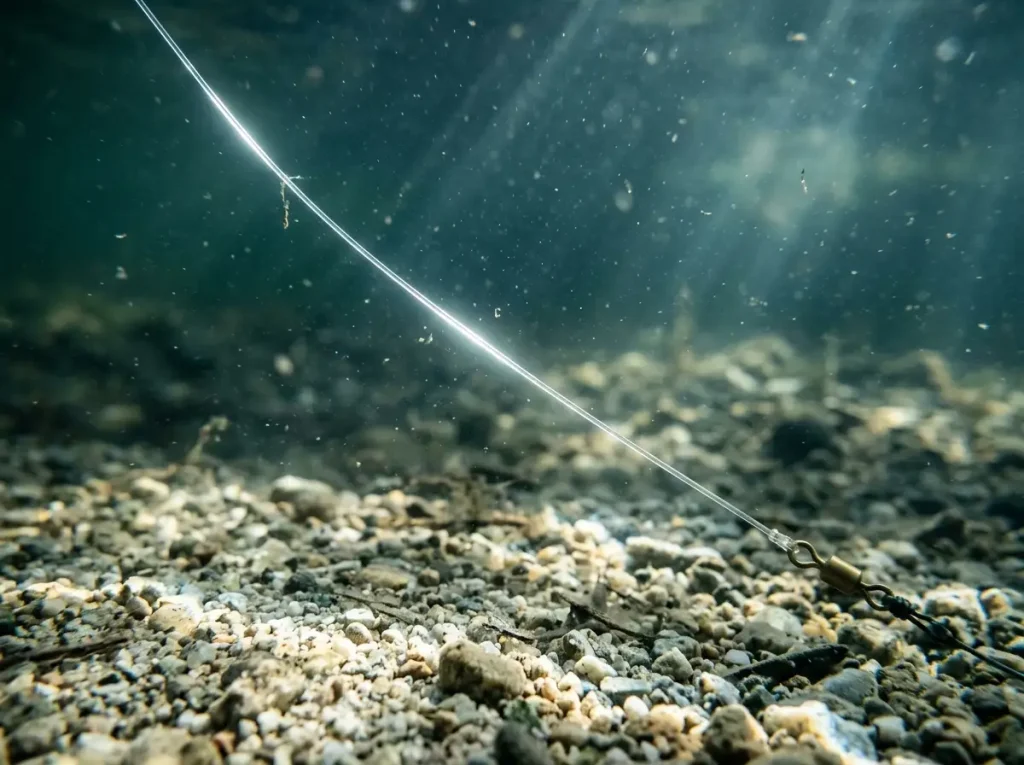
This is the counterintuitive one, and it catches a lot of anglers off guard. Lying still over gravel, fluoro is about as close to invisible as line gets, because the light passes through and the stationary strand all but vanishes into the substrate. Lift that same line off the bottom into the water column, though, and light enters one end and travels down its length, so the strand can glow brighter than nylon would.
The carp crowd noticed this first, watching an “invisible” hooklink light up like fiber-optic cable the second it rose off the gravel. It’s the same reason the carp anglers who obsess over what a hooklink looks like off the bottom often work hard to pin it back down.
Fluoro’s density is the hidden link here. The material is roughly three times denser than water, so it sinks faster than mono, and that fast sink rate is exactly what keeps it pinned in the low-visibility zone against the bottom.
That same trait creates a second problem: fluoro is a dust magnet. Over a session it collects suspended particles, algae, and silt, so an all-day leader gets dirtier and more visible than a fresh one. If you’re chasing finicky fish, that’s a strong reason to swap a tired leader for a fresh one more often than you think.
Diameter Beats Index — What to Actually Run
If you remember one thing from all this physics, make it this: the diameter of your line matters more for visibility than its refractive index ever will. This is the takeaway that actually puts more fish in the net, and it’s the one the spec sheets bury.
The Diameter Chart Nobody Reads
Pull up a line diameter chart and the “thinner” marketing falls apart fast. At 4 lb test, mono runs about 0.008 inches and fluoro about 0.007, basically a rounding error. At 6 lb they’re both near 0.009. Down where line-shy fish actually live, in the light tests, fluoro and mono are nearly the same thickness.
Climb to 50 lb or 60 lb and it flips the wrong way: fluoro is thicker than mono of the same pound test, which is why what pound test really tells you about a line’s diameter matters more than the material printed on the box. A 20 lb fluoro leader is a fatter, more visible strand than a 15 lb mono, the better index notwithstanding.
The One Rule for Line-Shy Fish
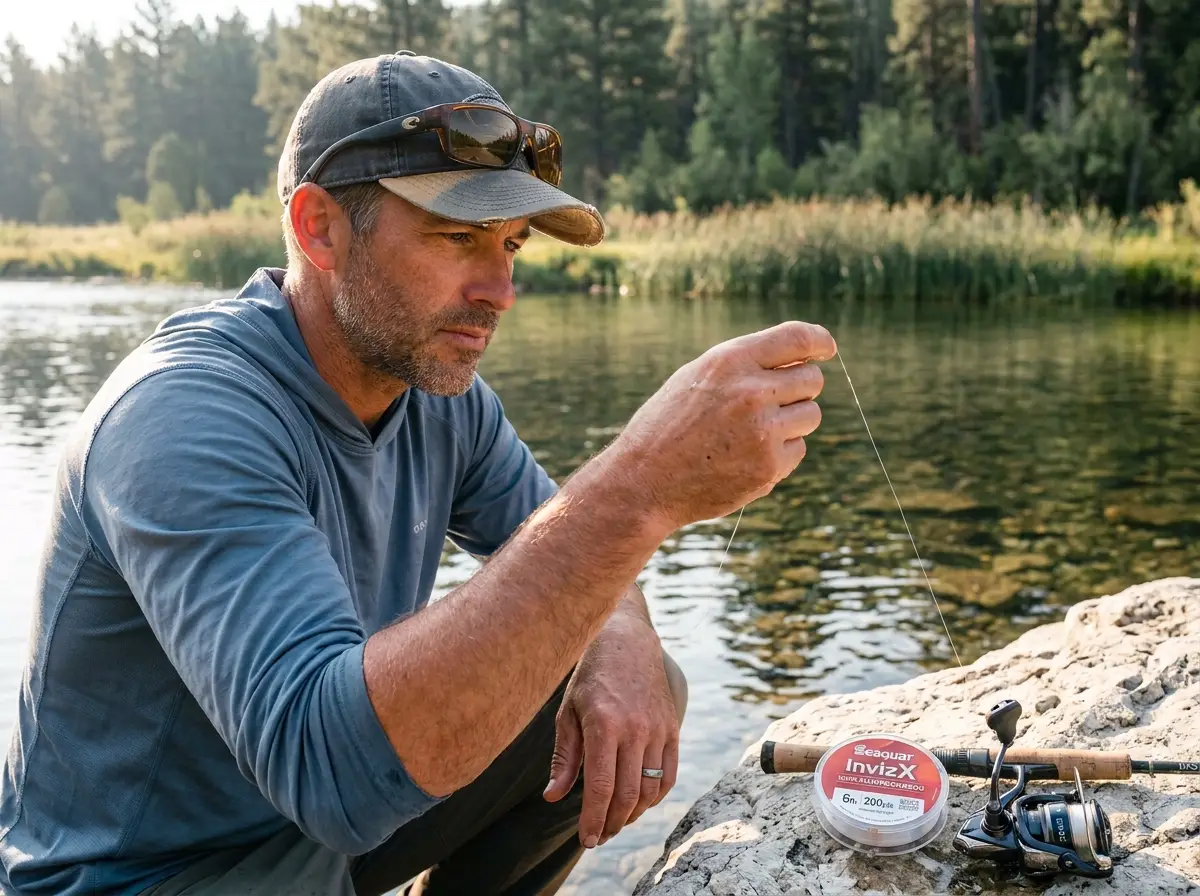
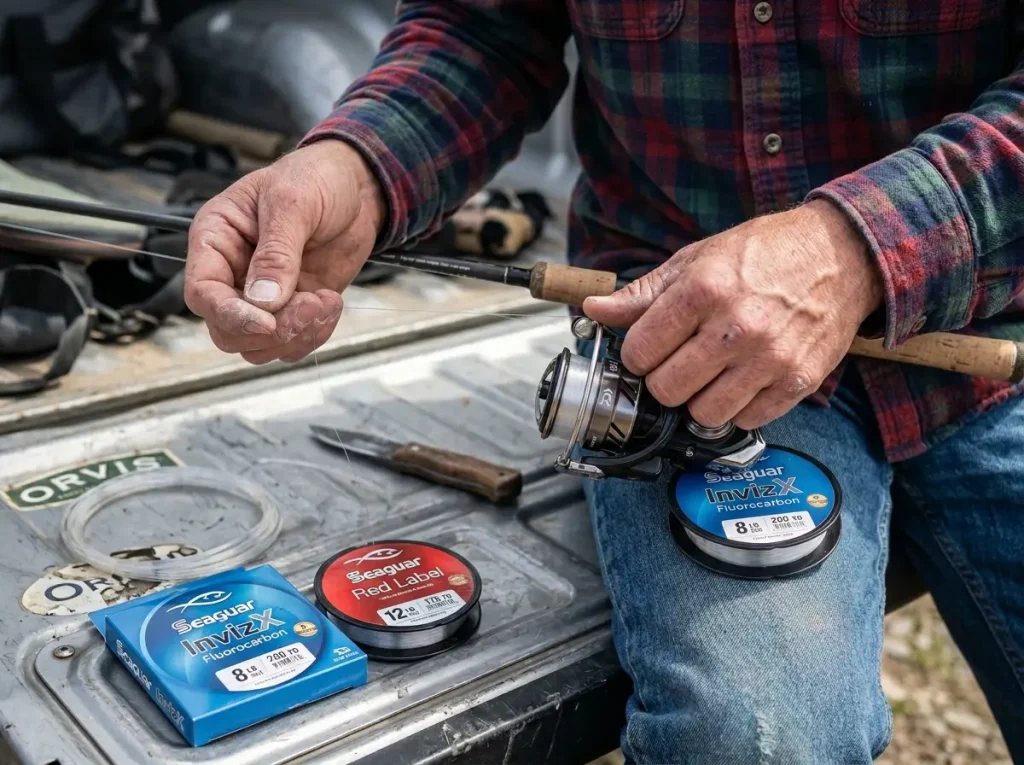
So here’s the rule that beats every label: run the thinner diameter you can get away with, and never upsize just because the spool says fluoro. Diameter is the tell, not the material. The bass anglers who drop from 17 lb down to 10 lb fluoro and suddenly start getting bit in clear water didn’t find a more invisible material, they found a thinner strand. When you want a supple, thin-for-its-test fluoro to fish that edge, the Seaguar InvizX 100% Fluorocarbon is an easy “run it thin” pick, manageable enough to use as a clear-water leader or a finesse main line without fighting line memory all day.
Before you blame your lure on a slow clear-water day, drop two pound tests of leader. Going from 15 lb to 10 lb shrinks the strand a fish sees more than switching brands ever will. Thinnest you can get away with beats fanciest label, every single time.
Why a Cheaper Spool Sees the Same
Now the part the premium pricing won’t advertise: refractive index is a property of the material, PVDF (polyvinylidene fluoride), not of the price. A budget 100% fluoro and a premium 100% fluoro bend light the same way, because they’re the same polymer.
You’re paying up for handling, consistency, abrasion resistance, and UV resistance, not for a lower index. If you just want to spool plenty of honest fluoro without the premium, the Seaguar Red Label 100% Fluorocarbon is optically the same line as its pricier cousin. Spend the difference on more line, not on a number that doesn’t change.
When Fluorocarbon’s Low Visibility Actually Matters
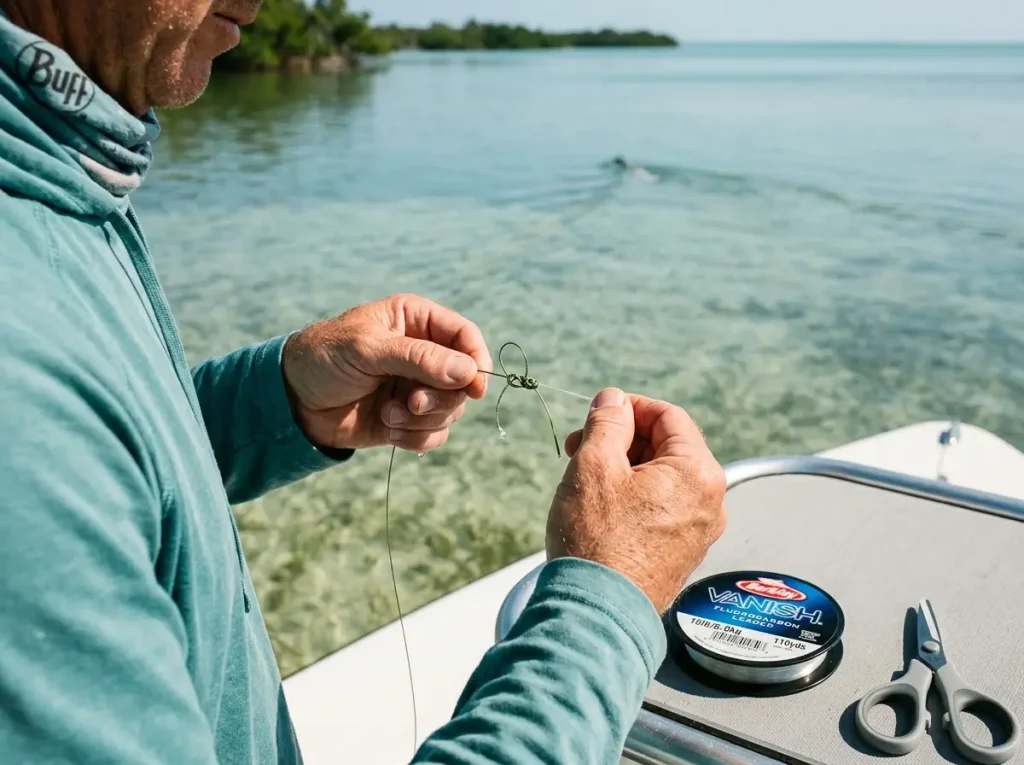
All this optics boils down to one decision at the ramp: is the water clear enough and the fish spooky enough to bother with fluoro at all? Most days, the honest answer points to a leader, not a full spool.
Match the Line to the Water, Not the Label
Fluoro’s fainter strand only buys you something when water clarity is high enough for a fish to see line in the first place. In gin-clear shallows with calm light, that edge is real. In murky water or stained runoff, turbidity hides every line you own, and the index advantage you paid for does nothing.
Depth stacks on top of that, because light penetration falls off and water itself filters and scatters light with depth, so the deeper and dirtier it gets, the more fluoro’s edge shrinks. Clear and shallow is fluoro country. Muddy and deep is a wash.
The Fish That Actually Notice
Not every fish cares. A schooling, aggressive feeder in stained water won’t inspect your line.
But trout in a clear stream, carp over a clean gravel bed, bonefish on a flat, and pressured largemouth bass in heavily fished clear water are the spooky fish that refuse on a line they can see. Those are the fish worth a fluorocarbon leader. Match the effort to the fish: the spookier and clearer the situation, the more the optics earn their keep.
Run It as a Leader, Not a Whole Spool
Here’s how most experienced anglers actually deploy fluoro. Braid goes on the spool for sensitivity and casting distance, and a short fluorocarbon leader gets tied on at the business end where the fish is looking.
You get the low stretch and feel of braid plus the faint, abrasion-tough leader exactly where it counts. A spool of Berkley Vanish fluorocarbon leader material is a cheap, widely stocked way to rig that braid-to-leader connection, joined with a Double-Uni knot or an Alberto knot. If you’re building that setup from scratch, it’s worth pairing that leader with the right braided main line so the whole rig balances out.
Fluoro where it counts, braid everywhere else. A full spool of fluoro costs more, sinks your whole presentation, and buries the sensitivity you’d rather keep. A two-foot leader puts the invisible-ish line right in front of the fish and leaves the rest of the job to braid that does it better.
The Honest Take on Fluorocarbon Visibility
Strip away the marketing and three things hold up. Fluorocarbon is fainter than mono, not invisible, because its index sits closer to water but never matches it. Diameter beats the label, so the thinnest line you can get away with hides better than the fanciest spool you can upsize into. And the whole advantage only cashes in when the water is clear and the fish are spooky, which is why a leader does the job more often than a full spool.
None of that makes fluoro a bad buy. It makes it a tool with a real, narrow edge, worth running where clarity and pressure demand it and worth skipping where they don’t. Next clear-water trip, downsize your leader a couple of pound tests before you blame the lure, and see if the bites come back. That one change will teach you more about line visibility than any label ever printed.
Frequently Asked Questions
01Is fluorocarbon line really invisible underwater?
No. Fluorocarbon is the least visible mainstream line, but it never truly disappears. Its refractive index near 1.42 sits closer to water at 1.33 than monofilament does, so it bends and reflects less light, yet the match is not exact and the strand stays faintly visible.
02Can fish see fluorocarbon fishing line?
Yes, especially off the bottom, in a glint, or through polarized light the index match does not hide. Clear water and a thin diameter make it harder for them, but no fluorocarbon line is genuinely invisible to a fish that is looking for it.
03Does fluorocarbon line diameter affect how visible it is?
Yes, more than the refractive index does. A thick fluoro leader is more visible than a thinner mono despite fluoro’s better index. At light pound tests the two are nearly the same thickness, so run the thinnest diameter you can get away with.
04Is fluorocarbon or monofilament harder for fish to see?
Fluorocarbon, in clear water, because its refractive index sits closer to water than mono’s. The gap shrinks at equal diameter and disappears in murky water, where turbidity hides both lines about the same. In gin-clear conditions, fluoro keeps a real edge.
05Should I use fluorocarbon as a leader or a full spool?
A leader handles most situations. Run braid or mono on the spool for cost, sensitivity, and distance, then tie on a short fluorocarbon leader where the fish is looking. You get fluoro’s faint, abrasion-tough edge exactly where it counts without spooling the whole reel.
Risk Disclaimer: Fishing, boating, and all related outdoor activities involve inherent risks that
can lead to injury. The information provided on Master Fishing Mag is for educational and informational purposes
only. While we strive for accuracy, the information, techniques, and advice on gear and safety are not a substitute
for your own best judgment, local knowledge, and adherence to official regulations. Fishing regulations, including
seasons, size limits, and species restrictions, change frequently and vary by location. Always consult the latest
official regulations from your local fish and wildlife agency before heading out. Proper handling of hooks, knives,
and other sharp equipment is essential for safety. Furthermore, be aware of local fish consumption advisories. By
using this website, you agree that you are solely responsible for your own safety and for complying with all
applicable laws. Any reliance you place on our content is strictly at your own risk. Master Fishing Mag and its
authors will not be held liable for any injury, damage, or loss sustained in connection with the use of the
information herein.
Affiliate Disclosure: We are a participant in the Amazon Services LLC Associates Program, an
affiliate advertising program designed to provide a means for us to earn advertising fees by advertising and linking
to Amazon.com. As an Amazon Associate, we earn from qualifying purchases. We also participate in other affiliate
programs and may receive a commission on products purchased through our links, at no extra cost to you. Additional
terms are found in the terms of service.