
In this article
Mid-October on a Great Lakes tributary, fighting a 4-mph headwind with the Minn Kota pinned at full thrust. By 2 PM, the lead-acid battery bank was dead. Half a tournament day, gone. My partner, running a LiFePO4 setup on the same boat model, still had 60% charge and towed me back to the ramp without breaking a sweat. That afternoon was the last time I ever plugged in a lead-acid trolling motor battery.
Here’s what most lithium vs lead acid trolling motor battery guides won’t tell you: lithium wins on virtually every metric that matters on the water. Weight, runtime, voltage stability, long-term cost. But if you skip the fine print on charger compatibility, cold-weather performance, and motor-specific heat risks, that $800 battery can become an expensive paperweight faster than you’d think. This article covers where lithium batteries actually earn their price and where the traps hide.
| LiFePO4 vs. Lead-Acid (AGM) Comparison | ||
|---|---|---|
| Spec | LiFePO4 | Lead-Acid (AGM) |
| Usable Capacity | 80–100% | 50% |
| Weight (100Ah) | ~25 lbs | ~70 lbs |
| Cycle Life | 3,000–5,000 | 300–500 |
| Charge Time | 2–4 hrs | 8–12 hrs |
| Voltage Curve | Flat | Sagging |
| 10-Year TCO Savings | 64–75% less | Baseline |
⚡ Quick Answer: LiFePO4 trolling motor batteries deliver double the usable capacity of same-rated AGM batteries at roughly one-third the weight, with a flat discharge curve that provides consistent thrust from dawn to dusk. They cost more upfront but save 64–75% over 10 years by eliminating serial replacements and battery maintenance. The catch: you need a compatible charger, you must respect the 85% throttle rule on brushed motors, and you cannot charge below freezing without risking permanent cell damage.
Why Rated Amp-Hours Lie on Lead-Acid Labels
How Peukert’s Law Steals Your Runtime
That 100Ah number stamped on your AGM battery is technically accurate under one very specific condition. The 20-hour rate assumes a 5-amp draw, sustained for 20 hours straight. Nobody runs a trolling motor at 5 amps.
Crank that Minn Kota to full thrust and you’re pulling 50 amps or more. At those draw rates, Peukert’s Law kicks in hard. Internal resistance heats up the lead plates, and the battery power you thought you had evaporates. A lead-acid battery with a Peukert exponent of 1.2 at a 50-amp draw drops from 100Ah to roughly 60Ah effective. Combine that with the 50% depth of discharge limit that protects the plates from permanent sulfation, and your “100Ah” AGM battery delivers maybe 30–40 usable amp-hours on a hard fishing day.
LiFePO4 chemistry doesn’t have this problem. The Peukert exponent sits near 1.01, which means a 100Ah lithium battery at 50 amps still delivers around 98 usable amp-hours. You get what the label promises, regardless of how hard you push it.
Pro tip: If your lead-acid meter shows 50%, you’re closer to dead than you think. Peukert losses accelerate below half charge, and the last 25% of rated capacity drains faster than the first 75%.
The 50Ah Lithium = 100Ah AGM Equivalence
This is the math that changes the conversation. A 50Ah LiFePO4 at 100% depth of discharge gives you 50 usable amp-hours. A 100Ah AGM at 50% depth of discharge gives you the same 50 usable amp-hours. Identical runtime on the water.
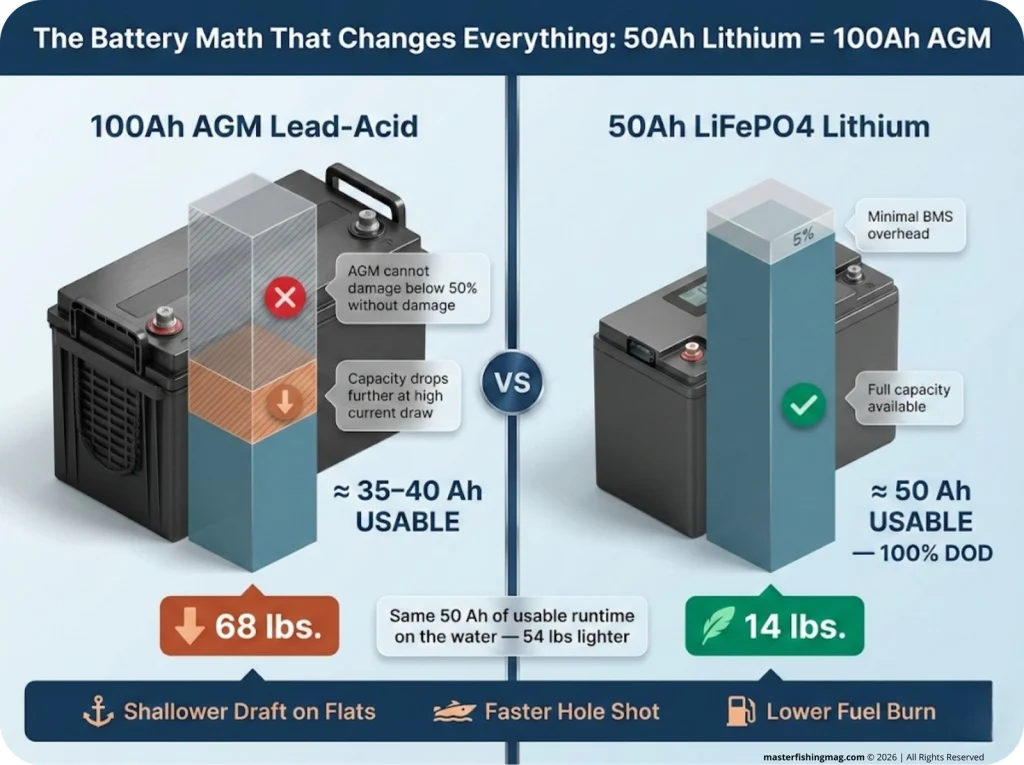
The difference is sitting in the weight column. That 50Ah lithium battery weighs around 14 lbs. The 100Ah AGM it replaces weighs 68 lbs. That 54-lb weight reduction per battery has real consequences on a fishing boat — shallower draft on flats boats, faster hole shot out of the marina, and lower fuel burn on the big motor when you’re running between spots.
The Voltage Curve That Changes Everything on the Water
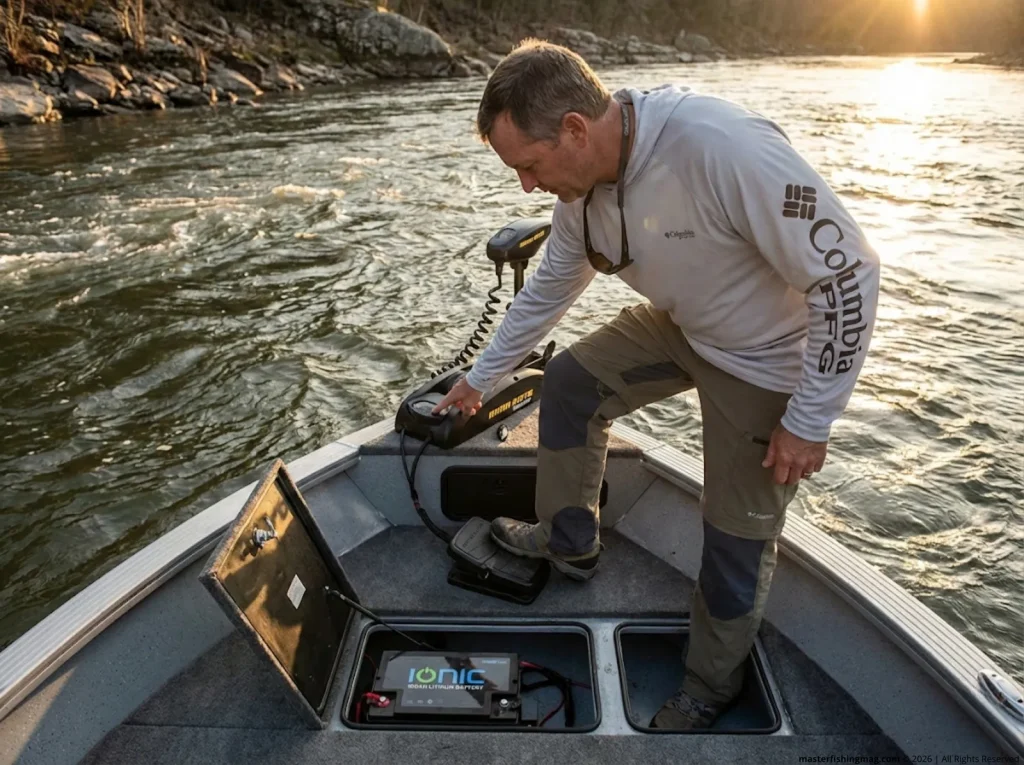
Lead-Acid Voltage Sag and the Afternoon Slow-Down
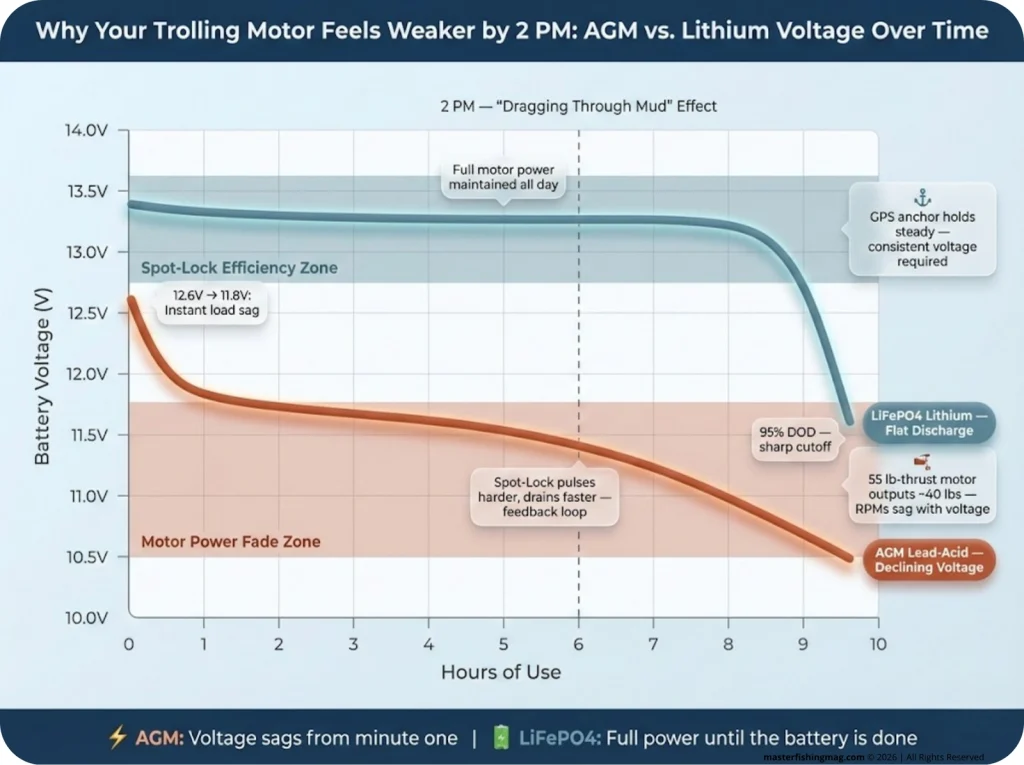
Here’s what happens to every lead-acid trolling battery as the day wears on. The moment you apply load, the voltage drops from 12.6V to around 11.8V. Then it keeps sliding. By mid-afternoon, your 55 lb-thrust motor is effectively putting out 40 lbs of thrust because the RPMs have sagged proportionally with the voltage.
Spot-Lock makes this worse. Your GPS anchoring system compensates for the fading power by pulsing harder and more frequently, and each pulse drains the weakening battery faster. It’s a feedback loop that chews through your remaining amp-hour rating at an accelerating rate. You’ve probably felt it: by 2 PM, pushing against any kind of current feels like dragging your boat through mud.
LiFePO4’s Flat Line from Dawn to Dusk
LiFePO4 technology holds voltage between 13.2V and 13.6V from a full charge down to about 5% remaining. That flat discharge curve means your motor delivers full-rated thrust literally until the battery is nearly empty. For Spot-Lock users, this translates to consistent GPS anchoring current and predictable trolling motor runtime all day.
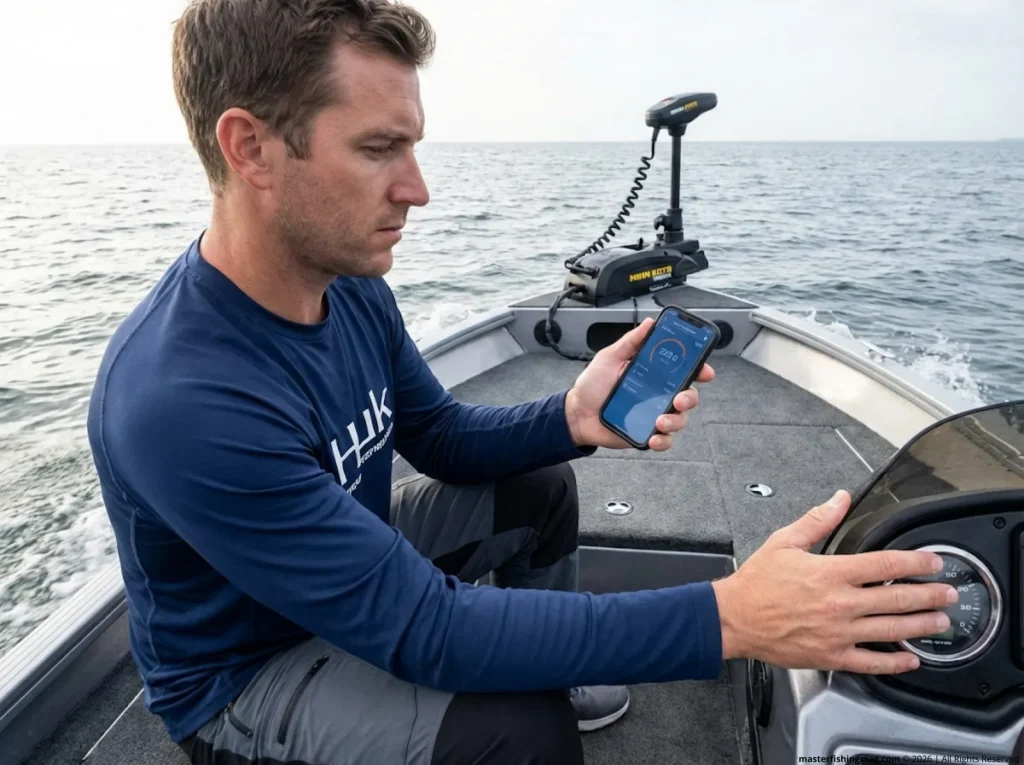
There’s one catch that trips up new lithium owners. Because the voltage stays flat, your standard battery gauge is useless for state of charge (SOC) monitoring. The meter reads “full” right up until the battery drops off a cliff. You need a coulomb counter — something like a Victron Energy SmartShunt — that tracks amps in and amps out rather than relying on voltage readings.
Pro tip: Install a Victron SmartShunt or buy a battery with Bluetooth monitoring built in. Lithium voltage tells you nothing about remaining capacity until it’s too late.
The 85% Throttle Rule and Other Compatibility Traps
Why Brushed Motors Overheat on Lithium Power
Older trolling motors — the Minn Kota Endura, pre-2020 Terrova, and similar brushed motor designs — were engineered for lead-acid voltage sag. They expect the battery to drop from 12.6V to 11.8V under load. That’s the thermal envelope the brushes and commutator were designed to handle.
Feed those same brushes a sustained 13.6V from a lithium battery, and the math changes fast. That 1.4V difference increases RPM and current through the commutator by roughly 15–20%. Run at full throttle for an extended stretch, and the extra heat can melt brush housings and damage internal components. This is why Minn Kota’s own engineering support recommends limiting brushed motors to 85% throttle when running lithium power.
Brushless motors like the Minn Kota Quest or Garmin Force/Kraken don’t have this limitation. Their electronic speed controllers handle the full lithium voltage range without generating excess heat. If you’re planning a lithium upgrade and you’re still running a brushed motor, factor in the 85% throttle ceiling or budget for a brushless motor swap.
Your Charger Might Be the Problem
Your old lead-acid charger uses a 3-stage profile: bulk charge, absorption, then a float stage that holds voltage indefinitely. That float stage will slowly cook lithium-ion batteries over time. LiFePO4 cells need a CC/CV (constant current, constant voltage) profile with a 14.4V–14.6V cutoff and absolutely no float.
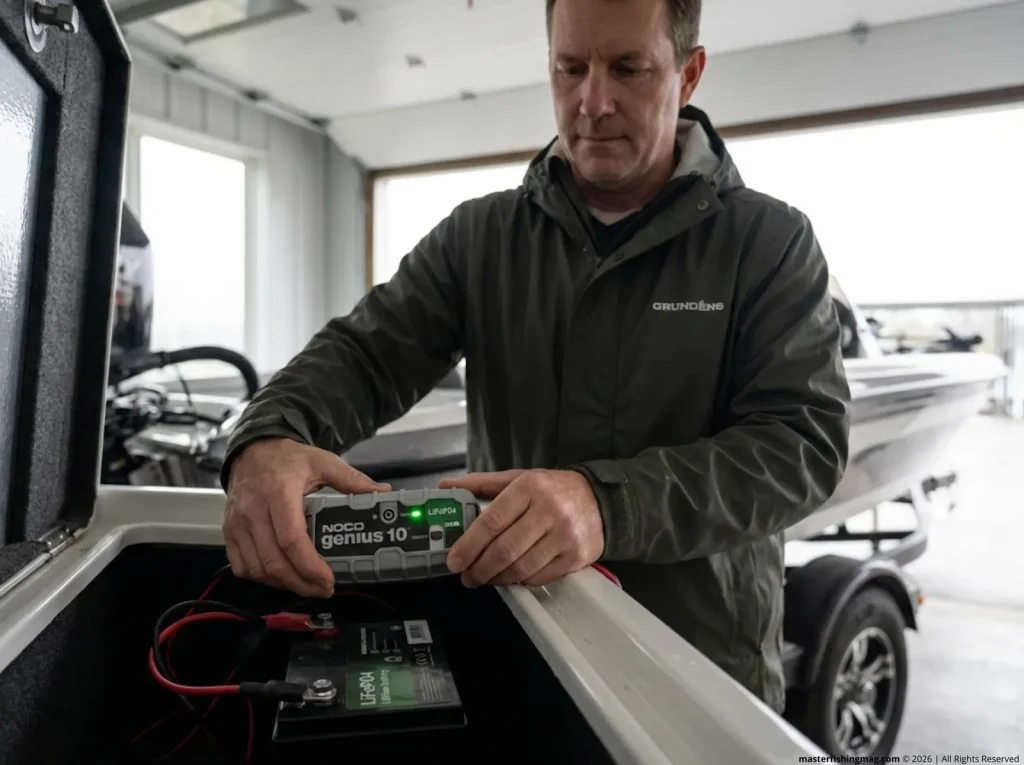
Using a standard charger, the battery never reaches proper saturation voltage, leaving it chronically at around 80% full charge. You’re paying for 100Ah and getting 80Ah every trip. The fix is straightforward: a lithium-compatible onboard charger like the NOCO Genius series, or Minn Kota’s Precision Charger Lithium line, with a dedicated LiFePO4 mode.
EMI and Forward Facing Sonar Interference
Trolling motors use Pulse Width Modulation (PWM) to control speed, and those high-frequency pulses generate electrical noise. When your sonar runs on the same battery bank as the motor, that noise travels through the shared ground and causes ghosting on your LiveScope or Panoptix screen — flickering images, phantom returns, lost bottom readings.
Lithium’s sustained higher voltage can make this interference worse. The professional fix is separating your electrical system: trolling motor on its own dedicated battery bank, electronics on a separate 12V 100Ah “house” battery. If you’ve been troubleshooting fish finder sonar blackouts, this split-bank setup eliminates the most common cause.
What Cold Weather Actually Does to Lithium Batteries

Lithium Plating: The Permanent Damage No One Warns About
Northern anglers, pay attention to this one. Below 32°F (0°C), lithium ions moving through the electrolyte toward the anode can’t seat themselves into the carbon structure fast enough during charging. Instead, metallic lithium plates onto the anode surface. This damage is permanent — irreversible capacity loss and potential internal shorts that no battery management system can fix after the fact.
The key distinction: this is a charging-only risk. Discharging your lithium battery in cold temperatures is perfectly safe. You’ll lose some temporary capacity, but the cells recover fully once they warm up. The danger comes only when you plug in the charger while the battery is below freezing.
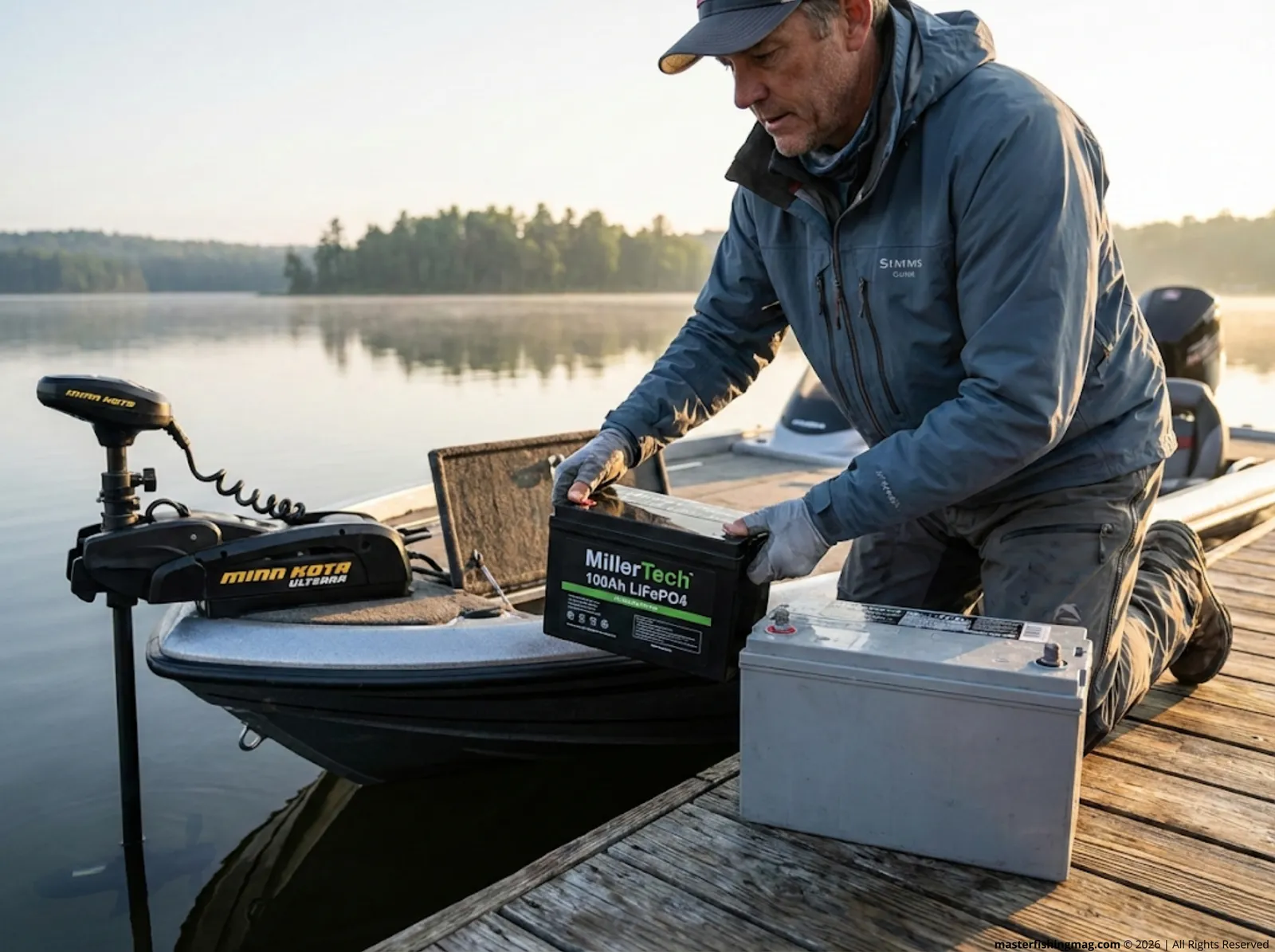
Quality lithium batteries from brands like Battle Born Batteries and MillerTech include a BMS with a built-in low-temperature cutoff that refuses to accept charge below 32°F. Budget alternatives may not have this protection, and that’s where anglers get burned.
Heated Batteries and the Cooler Trick
Premium batteries — particularly certain MillerTech and Battle Born models — include internal heating elements that activate automatically before charging in cold conditions. If your battery doesn’t have a heater, there’s a field-tested workaround that costs nothing.
The “Cooler Trick” works because lithium batteries generate their own heat during discharge. Store the battery inside an insulated cooler during sub-freezing trips, and the internal warmth keeps the cells above the danger threshold. Anderson Connectors make it easy to pull the battery at the end of the day and bring it inside for overnight charging. Anglers chasing spring walleye or late-season muskie in 25°F air temperatures have used this technique for years. There’s a reason cold-weather anglers who fish warm water discharges in winter pay close attention to their battery chemistry too — ambient temperature affects everything on the boat.
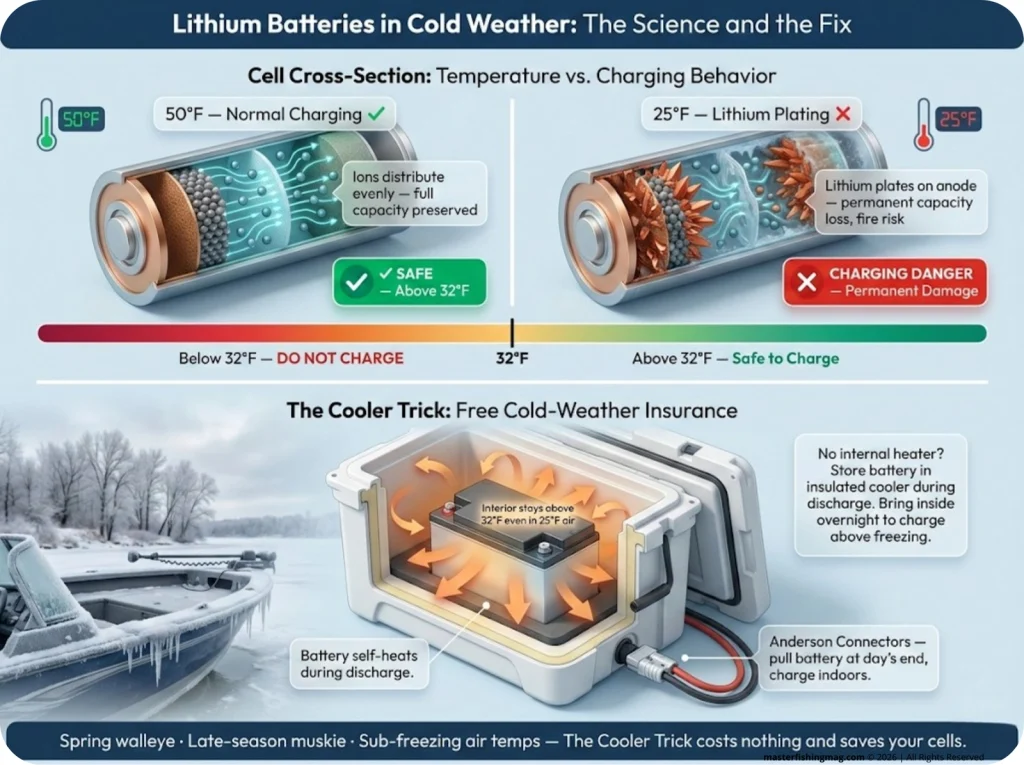
Pro tip: Spring walleye and late-season muskie anglers — if your lithium battery doesn’t have an internal heater, the Cooler Trick is the cheapest insurance against lithium plating you’ll find.
The 10-Year Money Math Most Buyers Skip
Upfront Sticker Shock vs Replacement Reality
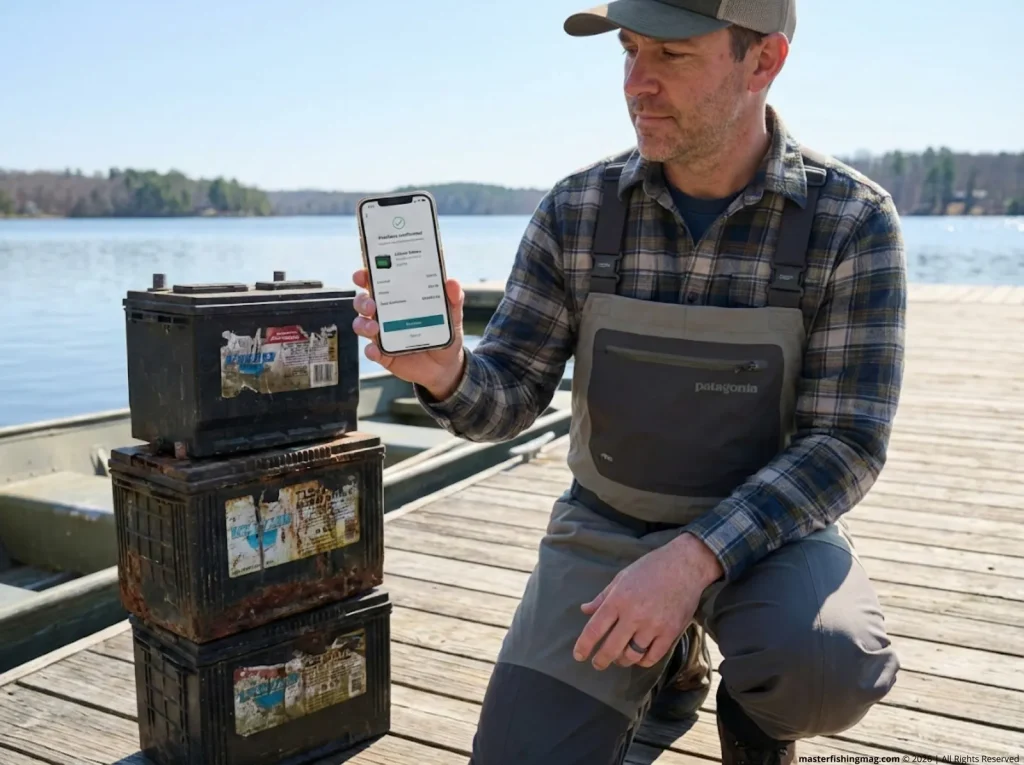
A 100Ah AGM runs $150–$250 upfront. A 100Ah LiFePO4 runs $500–$900. That upfront cost gap is real, and it stops most anglers from switching. But the comparison is misleading because it ignores cycle life.
That AGM lasts 300–500 cycles before capacity drops below usable levels. For an angler fishing 40–60 days a year, that’s replacement every 2–3 seasons. Over a decade, you’re buying four or five batteries plus the maintenance headaches. The LiFePO4 battery does 3,000–5,000 cycles and keeps going strong after 10 years.
An Enexer Technology Group analysis showed LiFePO4 demonstrates a 64% lower total cost of ownership than AGM and 75% lower than flooded lead-acid batteries over a 10-year window. That long-term cost difference makes the lithium a capital investment rather than a recurring expense. For proper installation, following ABYC marine electrical standards ensures your fusing and terminal connections protect that investment for the full lifespan.
What Zero Maintenance Actually Means
Flooded lead-acid batteries demand regular water topping, terminal cleaning, equalization charges, and careful storage at full charge to prevent sulfation. Skip a season of maintenance, and sulfate buildup hardens the plates permanently.
Lithium batteries need none of that. No water, no equalization, and a self-discharge rate of about 3% per month — which means a battery stored in October is still functional come April without touching the charger. Best storage practice for lithium: hold at 50% SOC in a cool environment. Storing at 100% stresses the chemistry and shortens lifespan over years.
Inside the BMS: What Separates a $200 Battery from an $800 One
Passive vs Active Balancing — The Hidden Quality Divide
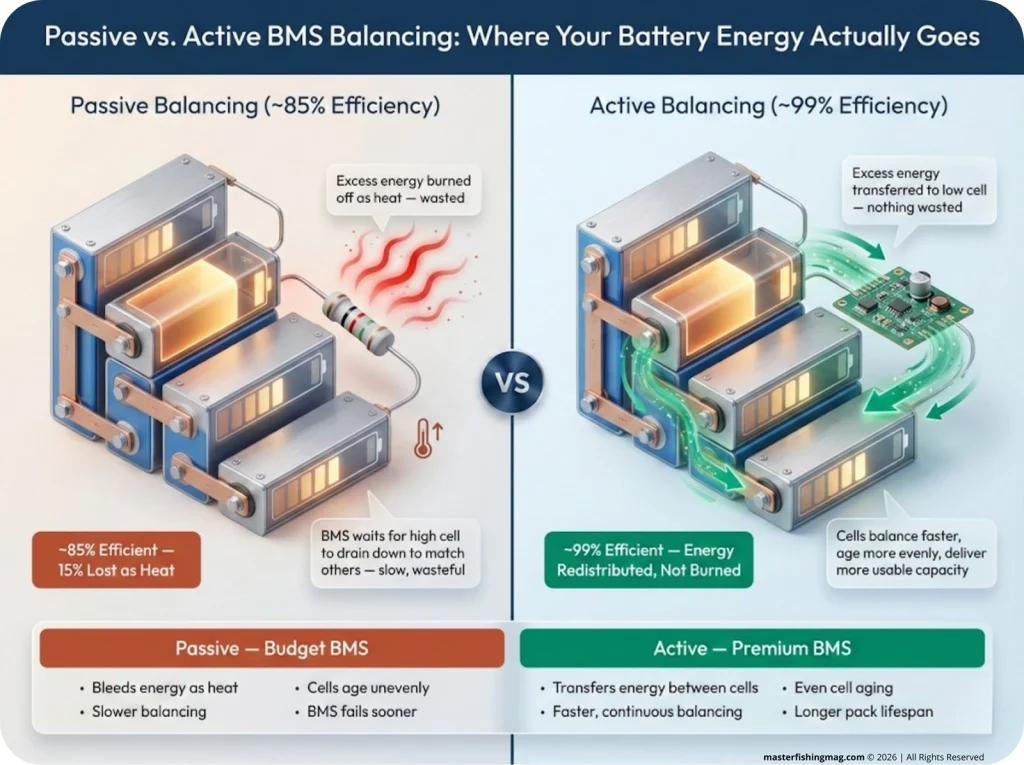
Every lithium battery contains an Internal Battery Management System (BMS) that keeps individual cells balanced during charge and discharge. How it does that balancing is the biggest quality differentiator on the market, and most buyers never think to ask about it.
Passive balancing — found in budget brands like LiTime, Redodo, and Power Queen — uses resistors to bleed excess voltage from the highest cell as heat. It works, but it wastes energy and generates internal warmth that compounds over years. Eventually, the imbalance between cells grows, the BMS trips more frequently, and your effective capacity shrinks.
Active balancing — used by MillerTech and a handful of premium manufacturers — shuttles excess energy from high cells to low cells through capacitor-based circuits. This process runs at roughly 99% efficiency. No wasted heat, no creeping imbalance, and pack life that extends toward the 15-year mark rather than declining after 5.
Pro tip: When shopping for a lithium trolling motor battery, ask the manufacturer directly whether the BMS uses passive or active balancing. If they can’t answer, it’s passive.
Bluetooth Monitoring: Why It Matters More Than You Think
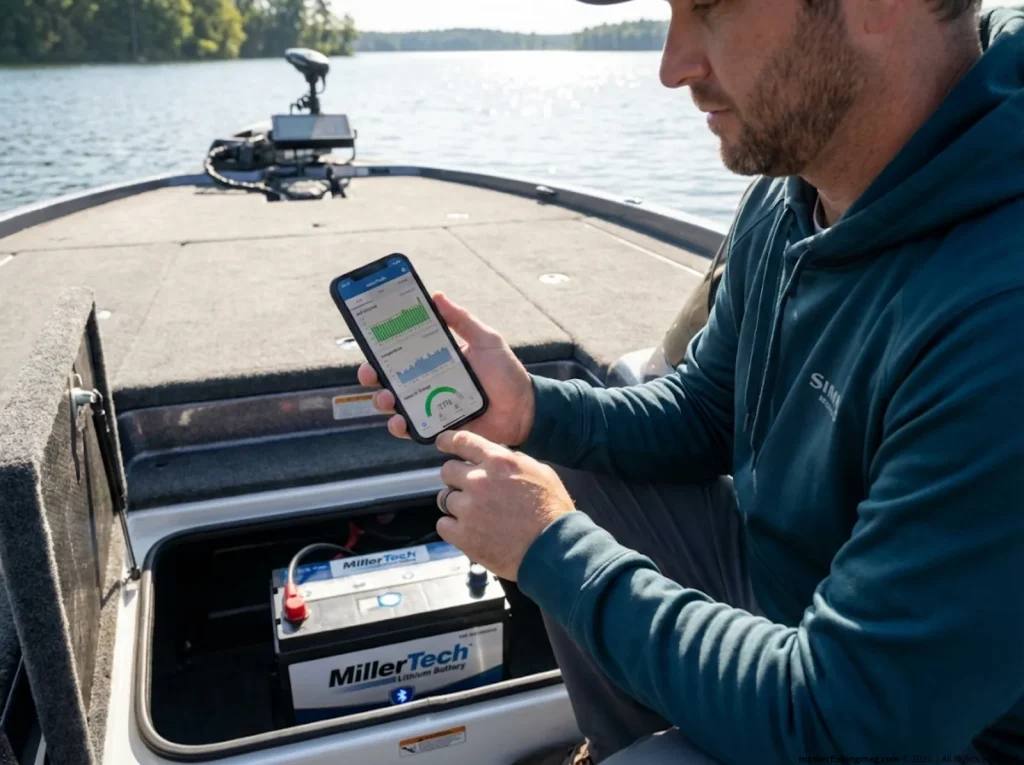
Because that flat voltage curve makes standard gauges useless, knowing your real state of charge on the water comes down to either built-in Bluetooth monitoring or an aftermarket shunt.
Batteries from Ionic and the MillerTech BT series stream real-time SOC, temperature, and individual cell balance data to your phone. Mid-tournament, that’s the difference between knowing you have 4 hours of Spot-Lock left or guessing your way into a dead battery at the worst possible moment. The alternative is installing a Victron Energy SmartShunt ($100–$150) on any lithium battery that doesn’t have Bluetooth built in. The same attention to detail that matters when you’re reading water temperature at depth vs the surface applies to reading your battery — surface-level gauges lie.
Repairable Cases vs Glued Shut
MillerTech builds their batteries with screwed cases. If a cell or BMS board fails outside warranty, a technician can open it up, replace the component, and put it back in service. Most competitors use glued or welded enclosures. When the BMS fails after warranty — and on budget units with passive balancing, it eventually will — the entire battery goes to recycling.
For a $700+ investment expected to last a decade, the ability to repair rather than replace is worth asking about.
Conclusion
Lithium wins the trolling motor battery comparison on every metric that moves the needle on the water: weight, trolling motor runtime, voltage stability, and long-term cost. The math is not close on any of them.
But the “But” in the title is real. Brushed motor compatibility (the 85% rule), compatible charger requirements, cold-weather charging limits, and EMI interference with forward-facing sonar are traps that can damage equipment or waste money if you ignore them. Not all lithium is equal, either. Active balancing, Bluetooth monitoring, and a repairable case separate a battery that lasts 5 years from one that lasts 15.
Before you buy, check two things: whether your trolling motor is brushed or brushless, and whether your charger has a LiFePO4 mode. Those two answers determine whether your lithium upgrade delivers a decade of full-thrust fishing or becomes an expensive lesson in reading the fine print.
FAQ
Can you use a lithium battery in any trolling motor?
Yes, all trolling motors can run on LiFePO4 power. However, brushed motors like the Minn Kota Endura or older Terrova models should be limited to 85% throttle to prevent overheating from the sustained higher voltage. Brushless motors — including the Minn Kota Quest and Garmin Kraken or Force — handle lithium without any throttle restrictions.
How long does a lithium trolling motor battery last on a full charge?
A 100Ah LiFePO4 battery delivers roughly 100 usable amp-hours, which is double the usable capacity of a same-rated AGM. On a 55 lb-thrust motor at mixed speeds, expect 6–10 hours of trolling motor runtime depending on current conditions, wind, and Spot-Lock usage.
Do lithium trolling motor batteries need a special charger?
Yes. Lead-acid chargers use a float stage that can damage lithium-ion batteries over time. You need a charger with a dedicated LiFePO4 profile — 14.4V to 14.6V cutoff, no float stage. The NOCO Genius series and Minn Kota Precision Charger Lithium (PCL) models have this mode built in.
Is it safe to charge lithium batteries in cold weather?
Discharging lithium in cold weather is safe — you will lose some temporary capacity but cause no permanent damage. Charging below 32°F (0°C) can cause lithium plating, which permanently degrades the cells. Look for batteries with a built-in low-temperature cutoff or internal heater to prevent this.
Are lithium trolling motor batteries worth the higher price?
Over 10 years, lithium costs 64–75% less than lead-acid when you factor in replacements and battery maintenance. A single LiFePO4 battery replaces 3–4 lead-acid batteries while saving 45–55 lbs of weight. For anglers fishing 30+ days per year, the payback period is typically 3–4 seasons.
Risk Disclaimer: Fishing, boating, and all related outdoor activities involve inherent risks that
can lead to injury. The information provided on Master Fishing Mag is for educational and informational purposes
only. While we strive for accuracy, the information, techniques, and advice on gear and safety are not a substitute
for your own best judgment, local knowledge, and adherence to official regulations. Fishing regulations, including
seasons, size limits, and species restrictions, change frequently and vary by location. Always consult the latest
official regulations from your local fish and wildlife agency before heading out. Proper handling of hooks, knives,
and other sharp equipment is essential for safety. Furthermore, be aware of local fish consumption advisories. By
using this website, you agree that you are solely responsible for your own safety and for complying with all
applicable laws. Any reliance you place on our content is strictly at your own risk. Master Fishing Mag and its
authors will not be held liable for any injury, damage, or loss sustained in connection with the use of the
information herein.
Affiliate Disclosure: We are a participant in the Amazon Services LLC Associates Program, an
affiliate advertising program designed to provide a means for us to earn advertising fees by advertising and linking
to Amazon.com. As an Amazon Associate, we earn from qualifying purchases. We also participate in other affiliate
programs and may receive a commission on products purchased through our links, at no extra cost to you. Additional
terms are found in the terms of service.