
In this article
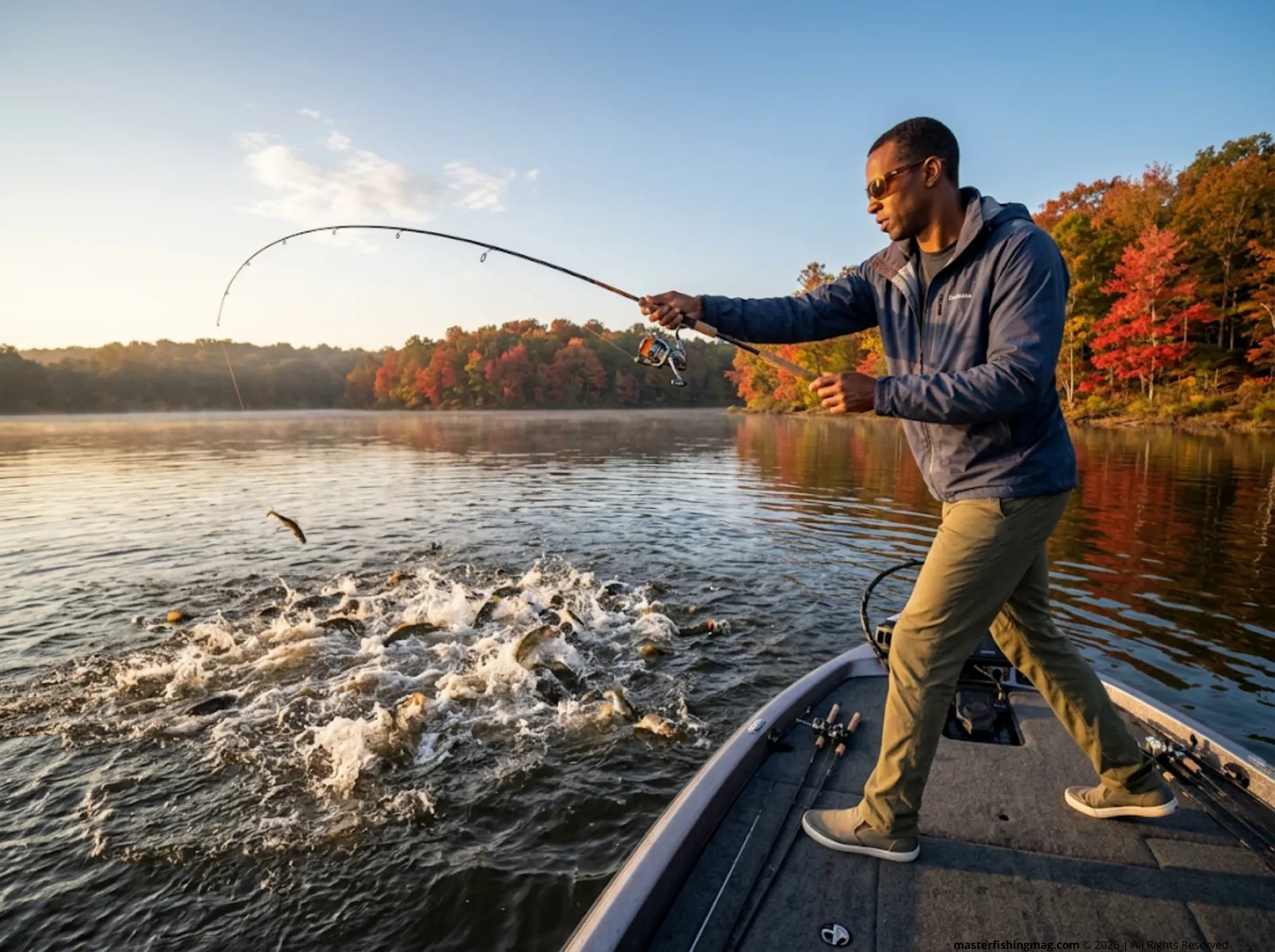
The first sign was the grebes. Twenty of them, chattering in tight clusters fifty yards off a secondary point, skinny necks popping up every few seconds with threadfin shad crosswise in their beaks. Then the surface beneath them detonated — largemouth bass hammering the bait ball from below while the birds hammered it from above. Both predators had read the same signal: the fall baitfish migration had pushed shad off the main lake and funneled them into the creek arms, and every living thing that eats them knew exactly where to be.
After fifteen years of chasing this pattern across a dozen reservoirs, I can tell you the fall shad run is the most predictable window in bass fishing — if you understand what actually triggers it. Most anglers watch the thermometer and wait. The fish don’t wait. They respond to a biological clock that starts ticking weeks before the first cold front.
This guide maps the triggers — from photoperiod and lake turnover to water temperature thresholds and barometric pressure shifts — and walks you through the four-stage “Migration Highway” from the main lake to the creek backs so you can position yourself ahead of the shad, not behind them.
⚡ Quick Answer: Shad begin moving toward creek arms when surface water temperatures drop below 70°F, typically in mid-September. But the real trigger isn’t just temperature — shortening daylight activates the fish’s pineal gland, which primes the migration weeks before the first cold front. Bass follow the bait through four stages: main lake points (75–70°F), creek mouths (70–65°F), secondary points and cove backs (65–55°F), and deep wintering holes (below 50°F). Track the temperature, watch for diving birds, and stay one stage ahead of the shad.
The Biological Trigger Most Anglers Miss
Why Daylight Matters More Than Water Temperature
Here’s what nobody talks about at the boat ramp: the fall migration doesn’t start with a cold front. It starts with shorter days.
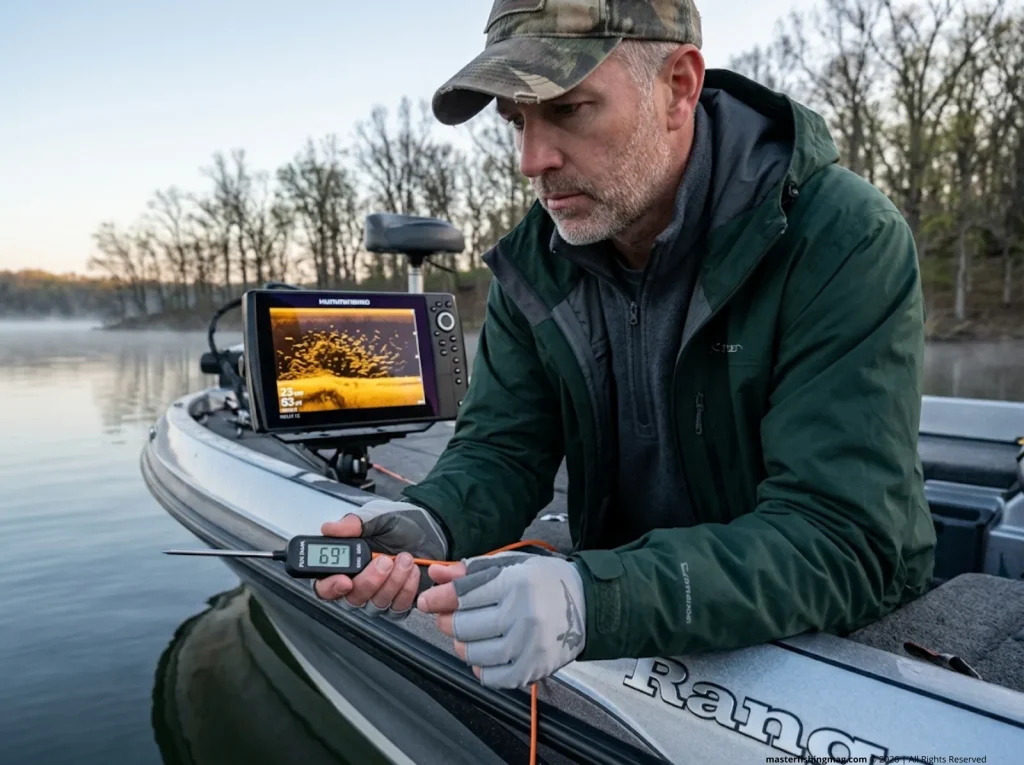
Fish have a pineal organ — a light-sensitive gland near the top of the brain that works like an internal calendar. As daylight shrinks after the autumnal equinox, this gland ramps up melatonin production during the longer nights. That hormonal shift tells the fish’s pituitary to begin preparing for seasonal movement. The shad’s biological clock fires before the water even cools. Research on how the fish pineal gland drives seasonal rhythms confirms that this light-driven melatonin cycle is the primary timer for seasonal behavior in freshwater fish — not temperature alone.
This is why you’ll sometimes see threadfin shad schooling tighter on main lake points in late September while the surface is still reading 72°F. Their internal timer has already started the countdown. If you wait for the thermometer to confirm the migration, you’re already behind the fish.
Pro tip: If shad are balling up on main lake points but the water hasn’t dropped below 70°F yet, the photoperiod trigger has already fired. Start positioning on the second and third points inside creek arms — the bait will be there within a week.
Why Threadfin Shad Are More Vulnerable Than Gizzard Shad
Not all shad migrate with the same urgency. Threadfin shad are native to warmer Gulf Coast drainages and cannot survive water below 41°F. For them, the fall move isn’t optional — it’s a survival run toward deeper thermal refuge. Miss the window, and mass mortality events follow. The USGS Nonindigenous Aquatic Species database documents multiple cases of threadfin populations wiped out by late-season cold snaps in northern reservoirs where the species was introduced.
Gizzard shad are bigger, hardier, and more cold-tolerant. They migrate less aggressively and tend to settle into deeper creek channels earlier. Bass know the difference. During the mid-fall binge feeding, largemouth preferentially target gizzard shad because the larger prey delivers more calories per chase — an energy calculation that matters when winter is closing in.
What does this mean for your tackle box? Match the threadfin profile early in the migration with 3–3.5-inch swimbaits in natural shad colors. As the season progresses and bass shift to gizzard shad, upsize to 4.5–5-inch crankbaits. The lure size evolution should mirror the bait the bass are actually eating.
Reading the Biological Clock Without Electronics
You don’t need a $5,000 sonar rig to know the migration has started. The birds will tell you first. When grebes and gulls appear on main lake points before surface temps have dropped, they’re tracking the same shad movement you should be.
The first bait balls on sonar near channel swings confirm what the birds already showed you. And here’s a pattern most anglers miss entirely: shad move vertically at night, rising higher in the water column as light fades. This night migration pattern explains why bass shift to shallow pinch points during low-light periods. The shad are high and vulnerable, and the bass know it.
If you’re serious about understanding why surface temps lie about what’s happening at depth, you need to think beyond the gauge on your console. The real story is written in day length and bird behavior.
Lake Turnover and the Oxygen Squeeze
What Happens When the Layers Mix
Every reservoir angler dreads the phrase “the lake turned over.” Here’s what it actually means.
During summer, deep lakes form three distinct layers. The warm, oxygen-rich surface layer — the epilimnion — sits above the thermocline, where temperature drops fast. Below that, the hypolimnion is cold, dense, and often nearly devoid of oxygen. Bass spend the summer cruising the thermocline like a highway, holding at the depth where temperature and oxygen levels are both comfortable.
When fall air temperatures cool the surface enough, that warm upper layer becomes denser and sinks. Wind accelerates the mixing. Eventually, the entire water column reaches a uniform temperature — and the thermocline that bass used as a reference all summer vanishes completely.
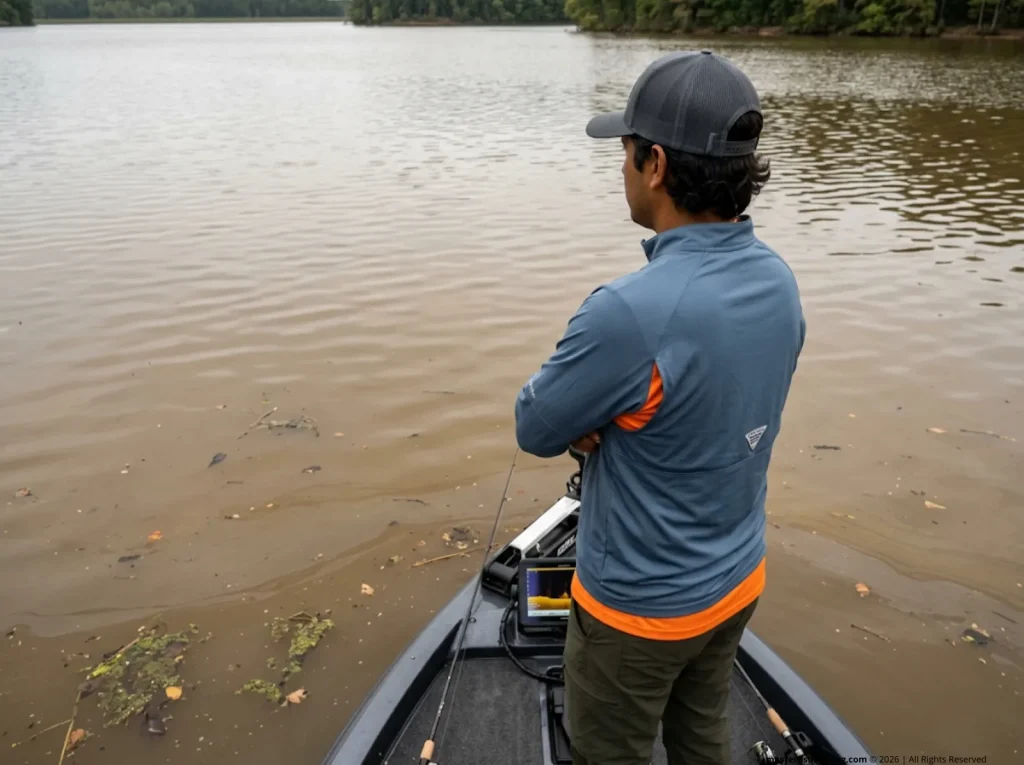
You’ll know turnover is happening when the water turns a murky coffee-brown color, you catch a hydrogen sulfide smell (rotten eggs), or you see floating debris and an oily film on the surface. Those are bottom-layer gases and sediment reaching the surface for the first time since spring.
For a deeper look at the physics driving this process, we covered it in detail in our full breakdown of lake turnover physics.
The Oxygen Squeeze Window
The mixing event creates what I call the oxygen squeeze. When that anoxic bottom water blends with the oxygenated surface, dissolved oxygen levels can temporarily crash across the entire water column. Fish and bait both retreat to the few spots still getting fresh oxygen — feeder creeks with current, bridge funnels, and wind-driven banks.
This window is the worst fishing of the fall — usually three to seven days of lifeless water where nothing seems to bite. Most anglers go home. The ones who stay fish the mouths of feeder creeks where current pushes fresh, oxygenated water into the system.
Pro tip: During active turnover, abandon the main lake entirely. Focus on feeder creeks and tributary inflows — they’re getting fresh oxygenated water while the main body is choking. Even a small trickle of moving water can concentrate every bass in a half-mile radius.
What Turnover Restores
The misery doesn’t last. Post-turnover mixing redistributes phosphorus and nutrients that have been locked in the hypolimnion since spring. When those nutrients reach the sunlit surface layer, they fuel a late-season plankton bloom — and plankton is what shad eat. Once the bloom peaks in the creek arms, the shad follow the food. And the bass follow the shad.
The five to ten days after turnover completes often produce the most explosive fall fishing of the year. If you suffered through the stagnant water, the payoff is coming.
The Migration Highway — Four Stages From Main Lake to Creek Back
Stage I — The Main Lake Gathering (75°F to 70°F)
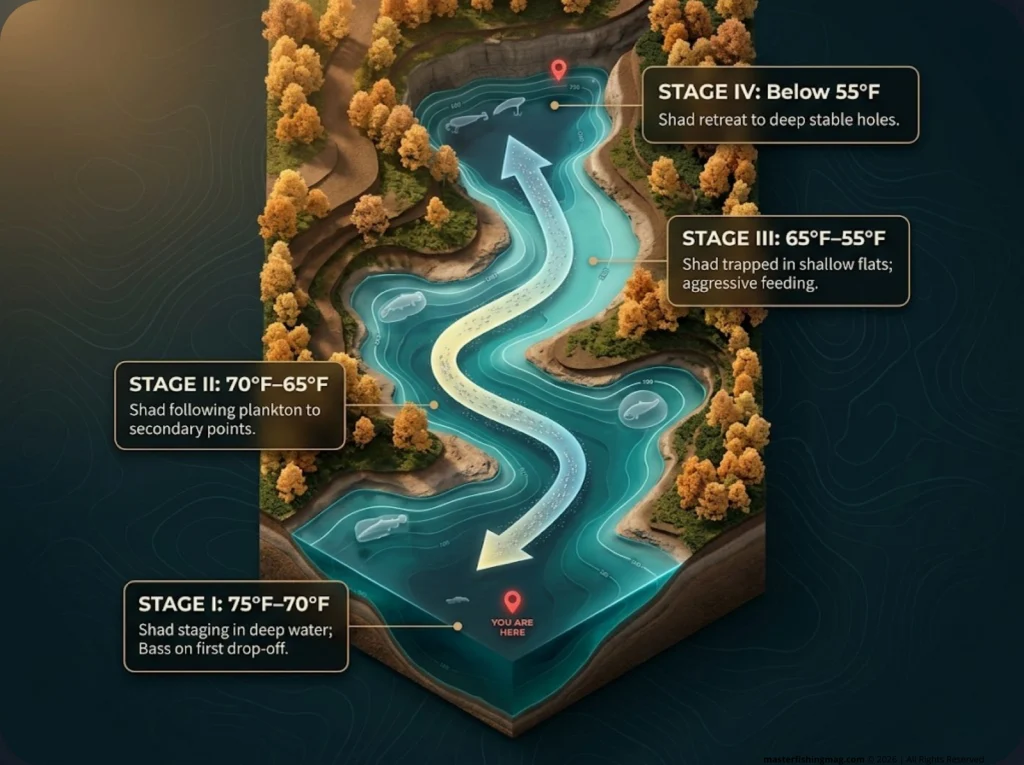
Early fall — typically September — is when shad begin schooling in massive bait balls near main lake points and river channel swings. Think of these as the on-ramps to the migration highway. The bait isn’t in the creeks yet; it’s staging at the intersection of deep and shallow water.
Bass at this stage hold on the first major depth break or point leading into large creek arms. They’re not committed to the creeks — they’re waiting for the bait to make the move. Fish fast-moving topwater lures, swim jigs, and aggressive spinnerbaits on these main lake points. If you’re marking bait on your sonar at a channel swing, you’re in the right zip code.
Stage II — The Tributary Incursion (70°F to 65°F)
When surface temps drop into the upper 60s, the bulk of the shad population shifts from open water into major creek arms and secondary coves. They’re chasing plankton, which blooms denser in nutrient-rich tributary inflows.
The key locations during this stage are creek arms with gradual depth changes (which let bait move vertically as conditions shift), channel swings where the old creek bed comes close to a bank (natural funnels), and secondary points that act as rest stops where predators can trap schools of shad against the shoreline.
Switch to squarebill crankbaits, Chatterbaits, and 3.5–4-inch swimbaits in natural shad colors. Fish the second or third point inside the creek, not the first. The first point is where the weekend crowd stops. The shad are already past it.
Stage III — The Creek Back Binge (65°F to 55°F)
This is the peak — October into early November. Shad push to the absolute furthest reaches of creeks, sometimes into water as shallow as one to three feet. They’re seeking the warmest remaining pockets and highest nutrient concentrations. Bass follow them into these shallow flats, and the result is the most aggressive topwater blowup feeding of the year.
MLF pro Keith Poche puts it simply: bass want shad in tight spaces — small, narrow creeks or pinch points where the forage can’t escape. When you find a creek back full of bait in two feet of water with bass blowing up on the surface, you’ve found the center of the fall shad migration.
Throw lipless crankbaits burned fast through the shallows, high-vibration spinnerbaits, or aggressive topwaters like the Berkley Choppo or a Pop-R. Match the hatch — match the energy of the fish. This isn’t the time for finesse.
Stage IV — The Winter Retreat (Below 55°F)
Once water drops below 55°F, the whole system reverses. Shad and bass pull back from the shallow creek backs toward deeper, more stable water in the main lake or deep creek channels. Threadfin shad seek the deepest available refuge to escape the lethal cold of the shallows.
Slow everything down. Jerkbaits with 10–20-second pauses, heavy football head jigs, and blade baits are the tools for this late fall fishing transition. Below 50°F, finesse rules: Damiki rigs, drop shots, jigging spoons. If you’re still throwing a buzzbait at 52°F, you’ve missed the shift.
For specifics on positioning during these depth changes, check out the depth playbook for fall bass transitions.
Reading the Birds — Biological Sonar Without Electronics
Gulls and Terns — The Zero-Hour Alert
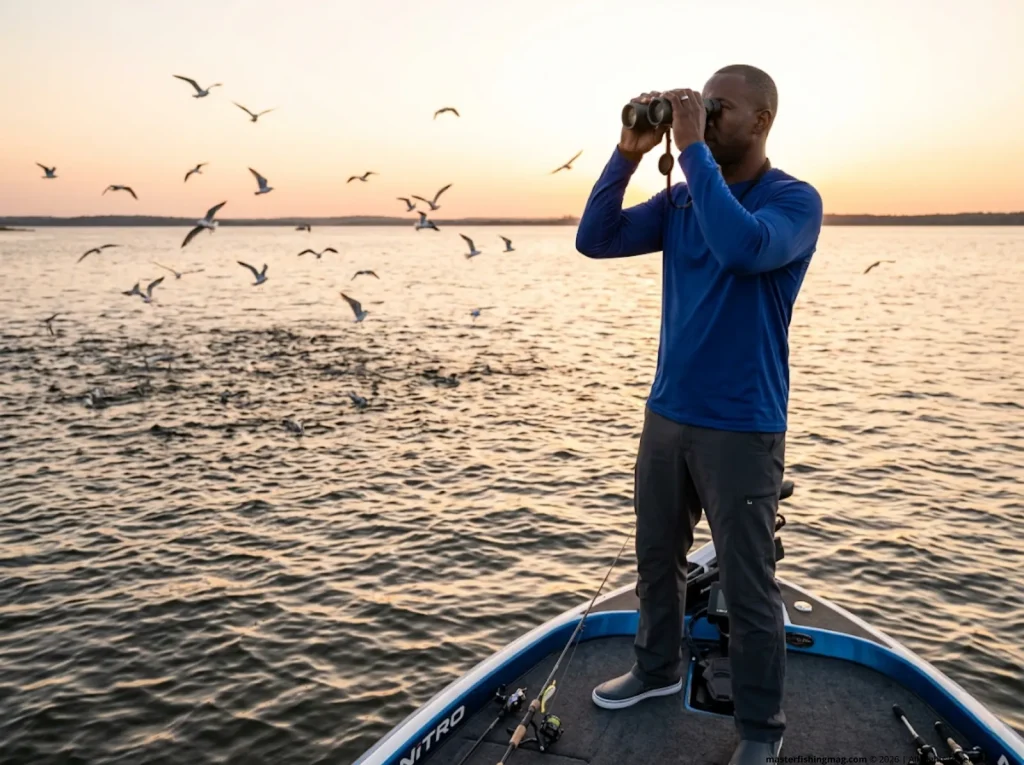
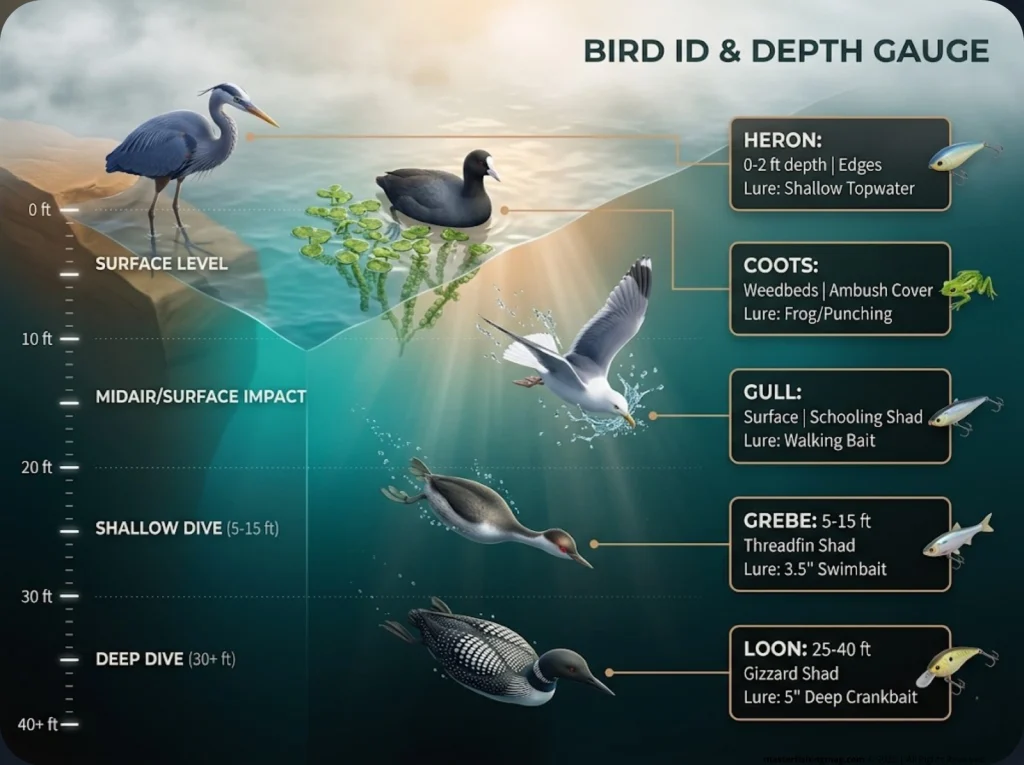
When gulls are hovering over a single spot and actively plunge-diving, predators have pushed a school of shad to the surface. This is a zero-hour indicator — the feeding frenzy is happening right now, not five minutes from now. Cut the engine fifty yards out and cast into the edges of the activity. Don’t motor through the school.
Target bait depth: zero to five feet. The fish are on top, and anything from a walking bait to a lipless crankbait will get crushed.
Grebes vs. Loons — The Depth Decoder
This is the detail that separates experienced fall fishing anglers from everyone else. Grebes — recognizable by their skinny necks and red eyes — are surface-oriented divers with lobed toes. When they’re noisy and diving in groups, they’re targeting threadfin shad in the upper five to fifteen feet. Throw smaller baits and fish near the surface.
Loons are different. Larger, denser, with webbed feet built for deep pursuit — they’ve been recorded diving past 250 feet, though they typically hunt around 33 feet. Loons signal larger forage — gizzard shad — and, consequently, larger bass. When loons are working an area, upsize your bait to 4.5–5-inch swimbaits and fish deeper with jigs or deep-diving crankbaits.
The birds aren’t just decoration. They’re telling you the bait depth and size — two pieces of data you’d otherwise need a $3,000 graph to confirm.
Herons and Coots — The Shallow Edge Clues
Blue herons are wading stalkers. When you see one parked on a windy point or near a bridge in October, it’s telling you that wind direction has pushed bait and predators into that shallow zone. Target depth: zero to two feet. The heron knows better than your electronics.
Coots are herbivores — they won’t catch your bait. But they cluster over submerged hydrilla and other vegetation. Shad use that grass for cover, and bass use it as an ambush point. A large raft of coots marks the most productive weed beds in the reservoir.
Pro tip: A heron standing on a windward point in October is a neon sign. The wind pushed plankton to that bank, the shad followed the plankton, and the heron followed the shad. So should you.
Weather and the Feeding Windows
Frontal Windows — Before, During, and After the Storm
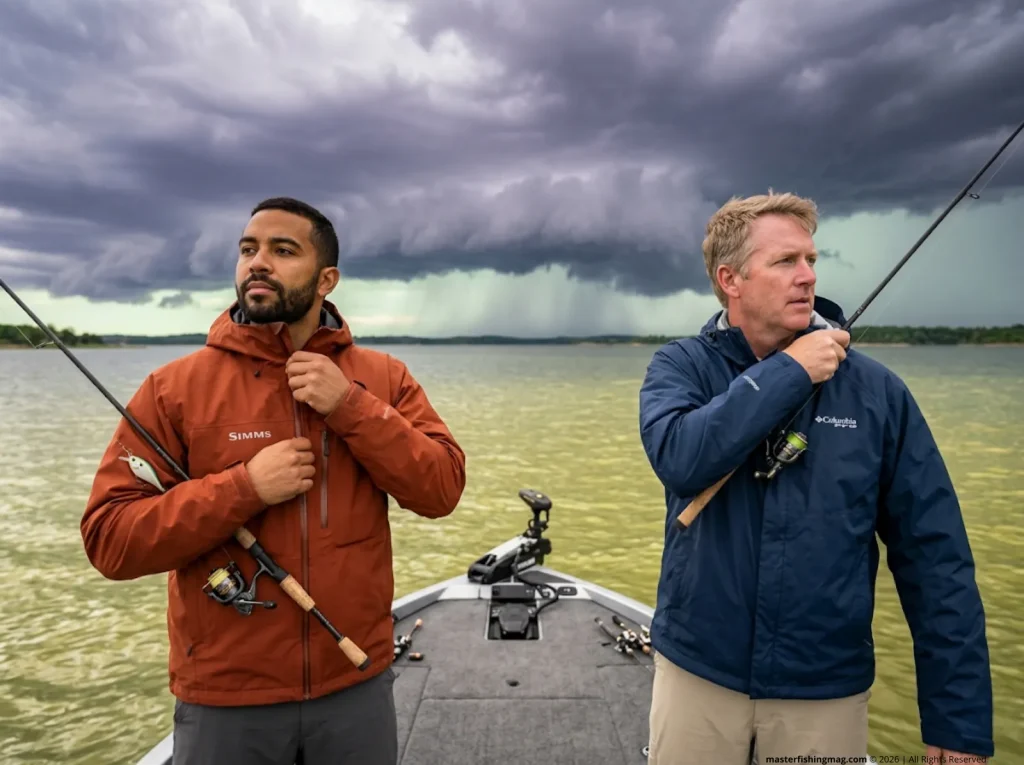
Fish sense barometric pressure changes through the swim bladder — when pressure drops before a front, the gas inside the bladder expands slightly, creating internal discomfort that often pushes fish deeper. But here’s what matters for your trip planning: the 24 hours before a cold front arrives — when the barometer is falling fast — is the most productive angling window of the fall.
During rapidly falling pressure (29.60 or lower), fish feed aggressively. Throw fast-moving baits: buzzbaits, spinnerbaits, lipless crankbaits. Once the front passes and those post-front “bluebird skies” roll in with stable high pressure (30.5 or higher), expect 24–48 hours of slow fishing while everything adjusts. Bass hold deeper and tighter to cover. Switch to finesse.
For the full breakdown, see our complete guide to fishing barometric pressure.
Wind as the Master Concentrator
In fall, wind is your best friend. It physically pushes plankton against windward banks, and the shad follow the food. Kevin VanDam has said it bluntly: the windiest, nastiest days often produce the best fishing because wind positions everything predictably.
Wind also aerates the water and breaks up surface light, making bass less cautious. On windy days, fish the bank the wind is hitting. If that wind is pushing into a secondary point at the creek mouth, that’s your spot.
Cold Rain Inflows and Micro-Migrations
A cold autumn rain can trigger what I call a micro-migration — a sudden, localized shift where cold rain inflow pouring into the back of a creek pushes shad out toward the warmer main creek channel. This creates a temporary pinch point near the feeder mouth where bass stack up for an easy meal.
Most anglers never think about rain-driven inflows as a pattern within the pattern. But if you check the weather, see overnight rain in the forecast, and hit that feeder mouth at first light — you’ll have the creek to yourself and a concentration of bass that wasn’t there yesterday.
The 5-Degree Lure Ladder — Matching Tackle to the Thermometer
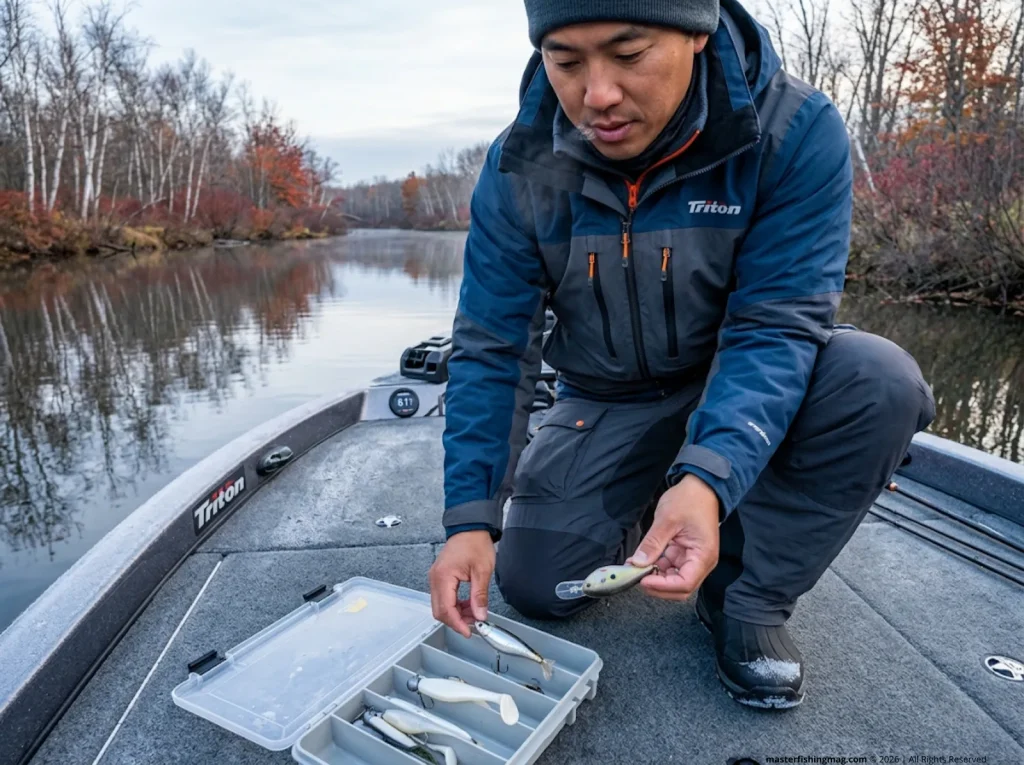
75°F to 65°F — Power and Speed
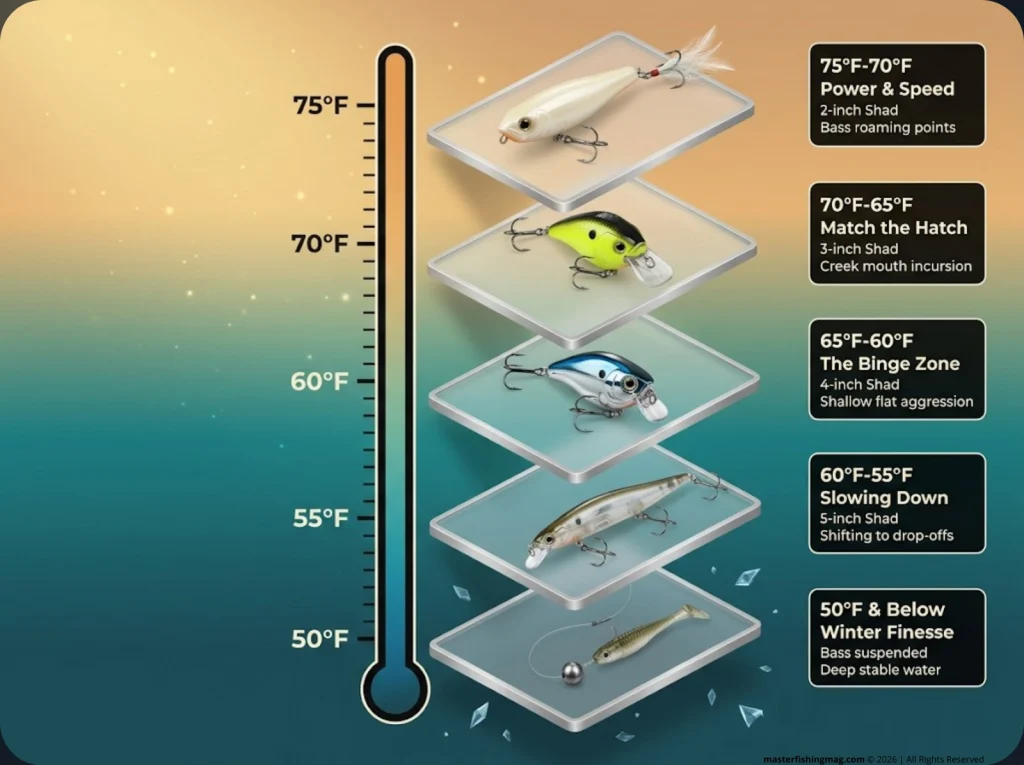
Bass metabolism is still high. At 75–70°F, throw fast: walking topwaters, buzzbaits, swim jigs, aggressive spinnerbaits. Bass are actively roaming main lake points and chasing bait in open water.
At 70–65°F, the shad have entered the creek mouths. Switch to squarebill crankbaits, Chatterbaits, and 3.5–4-inch swimbaits. This is the “match the hatch” window — shad are two to three inches at this stage, so size your lures accordingly. Strike King and FishLab both produce fall tackle swimbaits that match this shad profile well.
65°F to 55°F — The Binge Zone
The 65–60°F range is the sweet spot — the 60°F explosion in feeding activity. Lipless crankbaits burned and ripped through shallows, high-vibration spinnerbaits, topwaters like the Berkley Choppo. Bass are pushing bait into the backs of coves and shallow flats. Everything is loud and fast.
At 60–55°F, it starts to slow. Threadfin shad stress as temperatures approach the 50s, and bass begin shifting from the shallow backs toward the first major drop-offs. Switch to mid-depth crankbaits diving six to ten feet, slow-rolled spinnerbaits, and vibrating jigs. The bait has grown through the fall — now 3.5–5 inches — so upsize accordingly.
Pro tip: When the lipless crankbait bite fades in the low 60s, don’t leave the creek. Switch to a jerkbait with long pauses. The bass are still there — they’ve just downshifted one gear. Knowing how water temperature controls fish metabolism and lure cadence is the difference between adjusting and going home fishless.
Below 55°F — Finesse and Patience
Bass hold tight to vertical cover at this range — bluff walls, bridge pilings, standing timber. They won’t chase far. Jerkbaits with 10–20-second pauses, heavy football head jigs, and blade baits are the standard.
Below 50°F, winter has arrived. Fish sit in the deepest, most stable water available. Finesse rigs — Damiki, drop shot — jigging spoons, and marabou jigs are all you need. Every movement should be slow and deliberate.
Sustainable Fishing During the Fall Feed
Why Fall Bass Are More Resilient (But Still Vulnerable)
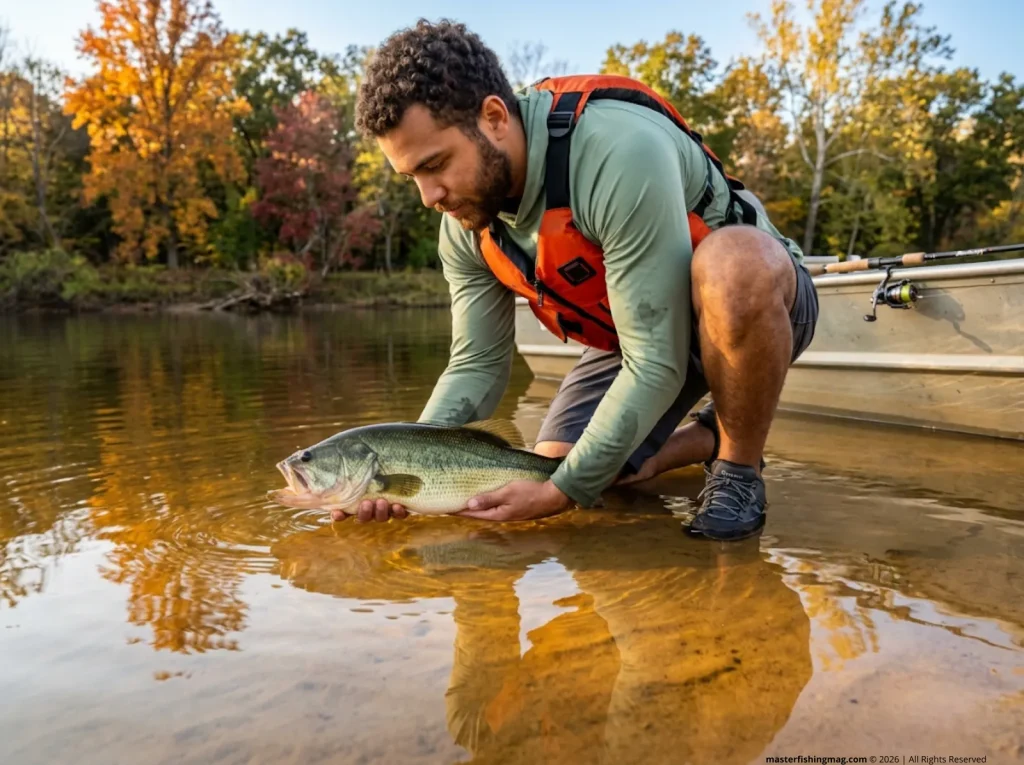
The good news: cool water makes catch-and-release far safer than summer. Post-release stress in fall and spring ran below 12% in Amistad Reservoir studies, compared to 56–89% during summer trials. Well-fed fall bass recover faster because their cortisol levels return to baseline more quickly in cooler water.
The bad news: fish that are gut-hooked in the throat or gills face much higher risk — up to 48% higher. In those situations, cutting the line and leaving the hook in place gives the fish a better 72-hour survival window than forced removal. And bass that are handled repeatedly during tournaments may struggle to build the fat reserves they need for winter dormancy and spring spawning. This is a high-stress period for the fishery, even when individual fish seem healthy at the boat.
Field Protocols for the Fall Binge
Keep fish in the water as much as possible. Wet your hands before handling to protect the slime coat. If you’re running a livewell, maintain dissolved oxygen above 5 mg/L to prevent metabolic acidosis — especially when confining multiple fish.
For photos, use the hold-your-breath rule: if you can’t hold your breath long enough to frame the shot, the fish can’t either. Support every fish horizontally with both hands. Never hang a largemouth vertically by the jaw — that weight wrenches the spine and jaw joint.
If you’re catching twenty-plus bass during a creek back session, you’re in a zone fish are depending on to build winter weight. Give back what the water gives you. For more on proper sustainable handling, see science-based catch-and-release techniques.
Conclusion
Three systems drive the fall baitfish migration, and understanding all three puts you ahead of every angler still waiting for the thermometer to drop.
Track the photoperiod, not just the temperature. When shad school on main lake points before the water cools, the pineal gland has already fired the starting gun. Position yourself one stage ahead of the bait.
Read the birds, then confirm with the graph. A raft of grebes tells you where the threadfin are in the top fifteen feet. A loon says the gizzard shad are deeper. Both are more reliable than blind sonar reading.
Adjust the lure every five degrees. The fall isn’t a single pattern — it’s a cascade of five-degree shifts that demand a different presentation each time. Match the lure selection to the shad size at each stage, and you’ll stay connected from the first buzzbait explosion in September to the last jerkbait pause in November.
Clip a thermometer to your boat this fall and log the temperature every trip alongside what you caught and where. After one season of data, you’ll own a migration tracker specific to your lake — and that’s worth more than any guide can tell you.
FAQ
What temperature do shad move into creeks?
Shad typically begin moving from the main lake into creek arms when surface water temperatures drop into the mid-60s (65–68°F). The migration is primed weeks earlier by shortening daylight, so shad may begin staging on main lake points as early as 72°F in late September.
How do you find baitfish on a fish finder?
Shad appear as dense clusters — bait balls — on sonar, usually suspended near channel swings, secondary points, or creek mouths between five and twenty-five feet. A tight, compact ball means predators are nearby. Scattered dots mean the school is relaxed.
Does wind affect baitfish migration?
Yes. Wind pushes plankton against windward banks, and shad follow the food. On windy days, the bank the wind is hitting will almost always hold more bait — and more bass — than the sheltered side.
What is the best lure for fall shad migration?
It depends on the temperature. At 70–65°F, squarebill crankbaits and 3.5-inch swimbaits work. From 65–60°F, lipless crankbaits and high-vibration spinnerbaits dominate. Below 60°F, switch to jerkbaits with long pauses. Match lure size to the growing shad — they start at two inches in September and can reach five inches by late October.
How long does the fall run last?
The most active phase — from creek mouth to creek back — typically lasts four to six weeks, from mid-September through late October. The full transition from summer pattern to winter pattern spans roughly eight to ten weeks, depending on latitude and how fast temperatures drop.
Risk Disclaimer: Fishing, boating, and all related outdoor activities involve inherent risks that
can lead to injury. The information provided on Master Fishing Mag is for educational and informational purposes
only. While we strive for accuracy, the information, techniques, and advice on gear and safety are not a substitute
for your own best judgment, local knowledge, and adherence to official regulations. Fishing regulations, including
seasons, size limits, and species restrictions, change frequently and vary by location. Always consult the latest
official regulations from your local fish and wildlife agency before heading out. Proper handling of hooks, knives,
and other sharp equipment is essential for safety. Furthermore, be aware of local fish consumption advisories. By
using this website, you agree that you are solely responsible for your own safety and for complying with all
applicable laws. Any reliance you place on our content is strictly at your own risk. Master Fishing Mag and its
authors will not be held liable for any injury, damage, or loss sustained in connection with the use of the
information herein.
Affiliate Disclosure: We are a participant in the Amazon Services LLC Associates Program, an
affiliate advertising program designed to provide a means for us to earn advertising fees by advertising and linking
to Amazon.com. As an Amazon Associate, we earn from qualifying purchases. We also participate in other affiliate
programs and may receive a commission on products purchased through our links, at no extra cost to you. Additional
terms are found in the terms of service.